Ⅰ. Introduction
Oligodontia is defined as a condition in which a tooth germ developmental disorder leads to defects in at least 6 permanent teeth, excluding the 3rd molar
teeth1). Genetic and/or environmental factors account for the largest proportion of tooth germ developmen- tal disorders2). The condition is characterized as syn- dromic or non-syndromic depending on whether it is accompanied by systemic developmental disorders.
Syndromes accompanying defects of the teeth include ectodermal dysplasia syndrome, cleft lip and palate, Van de Woude syndrome, and Down syndrome3). Numerous studies have indicated that patients with severe oligodontia might develop psychosocial prob-
◆ 증 례
부분 무치증을 동반한 지적장애 환자의 전치부 심미수복 : 증례보고
배영은∙김지연∙정태성*
부산대학교 치의학전문대학원 소아치과학교실
ANTERIOR ESTHETIC RESIN RESTORATION OF INTELLECTUALLY DISABLED CHILD WITH OLIGODONTIA : A CASE REPORT
Youngeun Bae, Jiyeon Kim, Taesung Jeong*
Department of Pediatric Dentistry, School of Dentistry, Pusan National University, Yangsan, Korea
Intellectual disability is accompanied by a high incidence of congenitally absent teeth and supernumerary teeth, and is observed more frequently than are disorders of location and order during delayed eruption, when accompanied by other symptoms. Furthermore, it is associated with a higher occurrence of dental anomalies such as conical teeth, microdontia, and amelogenesis imperfecta. As it is difficult to obtain adequate cooperation from patients with intellectual disabilities, physical restraint and conscious sedation using medication and general anesthesia can be considered. Reshaping of conical teeth with resin composite may be helpful to rehabilitate patients with oligodontia and a conical tooth shape. Diagnostic wax-up and a silicone matrix formed the basis for the successful reconstruction of the anterior teeth. This case describes the treatment of a patient with intellectual disability who had oligodontia and conical-shaped incisors.
Under general anesthesia, the patient was treated using direct composite resin restoration. [J Korean Dis Oral Health Vol.12, No.2: 66-71, December 2016]
Key words :Intellectually disability, Oligodontia, Conical teeth, General anesthesia, Esthetic restoration Abstract
*Corresponding author : Taesung Jeong
49, Busandaehak-ro, Mulgeum-eup, Yangsan, 626-870, Korea Department of Pediatric Dentistry, School of Dentistry, Pusan National University
Tel: +82-55-360-5170, Fax: +82-55-360-5174 E-mail: [email protected]
lems related to their appearance4-6).
Intellectual disability is a condition in which the development of an individual’s intellect has been de- layed or halted such that the person’s learning and social adaptation abilities are below normal7). While the level of intellectual disability is determined by the intelligence quotient (IQ), it does not necessarily coincide with a person’s ability for understanding or communication, and it is up to a dentist to determine whether a person is mentally capable of undergoing dental treatment8). Patients with intellectual disabili- ty have irregular eating habits and problems with oral hygiene, which frequently cause dental caries, gingivitis, and periodontitis, and occasionally even alveolar bone loss in severe cases. Malocclusion is al- so observed, resulting from bad oral habits such as teeth grinding, tongue-thrusting, and clenching9). While dental disease is not directly related to intel- lectual disability, congenitally absent teeth, supernu- merary teeth, delayed eruption of teeth, and abnor- malities of eruption order and location are often ob- served among patients when accompanied by other syndromes. In addition, morphologic abnormalities such as conical teeth, microdontia, and abnormalities of amelogenesis are often observed10).
As patients with intellectual disability cannot suit- ably cooperate with treatment, physical methods, conscious sedation, or general anesthesia can be con- sidered11). General anesthesia is effective in taking care of the patient during a procedure, providing safe environments for them so that they can be treated.
For this case, a patient with severe intellectual dis-
ability accompanying oligodontia and conical teeth was treated using direct composite resin restoration under general anesthesia. As it is rare to perform es- thetic restoration for patients with severe intellectual disabilities, this paper aims to discuss steps to decid- ing to perform the procedure, and its treatment re- sults.
Ⅱ. Case
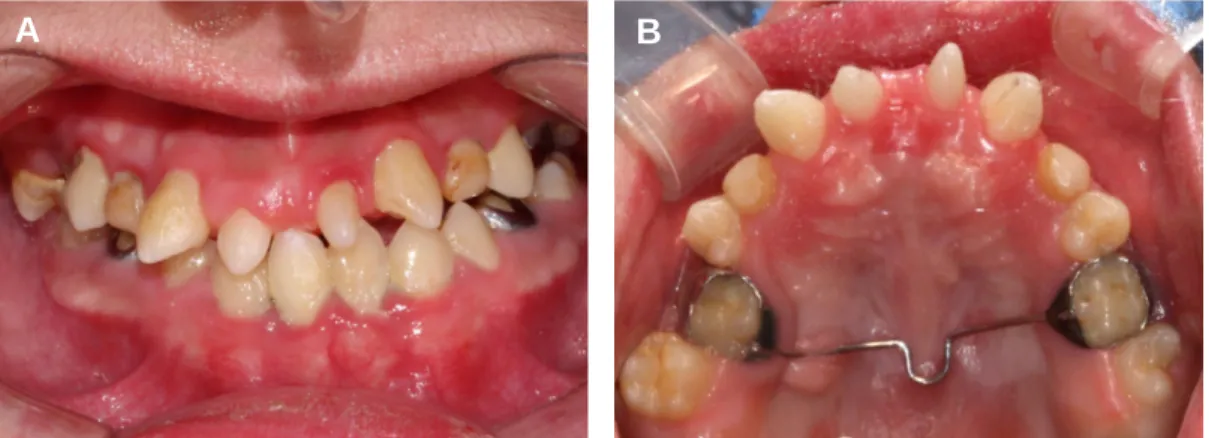
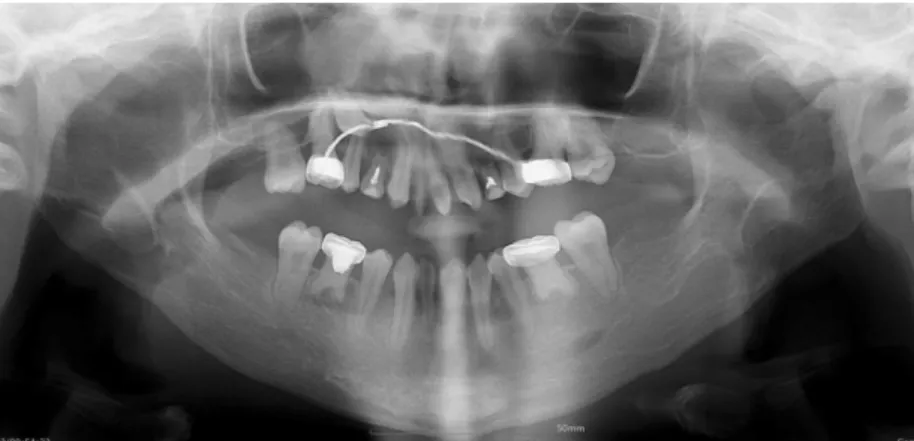
The patient was an 18-year-old male patient (height 157 cm, weight 41 kg) who was diagnosed with severe intellectual disability at the age of 4 years. He received treatment for caries under general anesthesia at the department of pediatric dentistry of Pusan National University in Sept 2005. His mother subsequently wanted to improve the shape of the pa- tient’s anterior maxillary teeth. Intraoral findings in- cluded that a large number of permanent teeth were missing, deciduous teeth were retained and mandibular overclosure with excessive vertical over- lap. In addition, teeth presumed to be upper central incisors were conical in shape (Fig. 1). Radiographic examination revealed that the following teeth were missing: mandibular central incisors (31 and 41), maxillary lateral incisors (12 and 22), maxillary left canine (23), maxillary and mandibular second pre- molars (15, 25, 35 and 45) and maxillary and mandibular second molars (17, 27, 37 and 47). And maxillary right canine (13) was impacted.
Furthermore, #53, 55, 63, 65, 75, 85 were prolonged retained (Fig. 2).
A
Fig. 1. Pre-operative intraoral view demonstrating conical tooth shape.
B
Although we could not determine whether the pa- tient wanted the treatment, as it was difficult to communicate with him, his guardian showed a strong desire for the treatment. Thus we decided to consider it, and subsequently obtained a diagnostic casts. The cast revealed conical maxillary incisal protrusion and deep overbite, enough to reach into the anterior mandibular region. Considering that the patient had a severe intellectual disability, required general anes- thesia, was unable to cooperate for the procedure, and had problems with oral care and financial diffi- culties, we decided to perform composite resin restoration. The shapes of the teeth were produced using a waxed-up plaster cast, which was shown to the guardian. The guardian was informed of the spacing between the incisors and flaring in the ante- rior region, as well as the life span of resin restora- tion and possible discoloration and staining of teeth that may occur. The procedure was determined under the agreement of the guardian.
The patient was hospitalized and the procedure was performed under general anesthesia because of the inability to control his behavior. A blood test, urine test, biochemical test, endocrine function test, electrocardiography, and chest radiograph were con- ducted to see if the patient could safely undergo a general anesthetic, and all test results were normal.
To shorten treatment time and perform a more es- thetic restoration, alginate impressions were taken at the department of pediatric dentistry 2 weeks before the procedure. Thereafter, wax-up was conducted to
form a crown in the anterior area and Aquasil Soft Putty� (Dentsply DeTrey GmbH, Konstanz, Germany) was used to make a silicone matrix. The silicone matrix was produced in such a way that it accurately reproduced the palate and incisal edge.
Pumice was used to cleanse the four upper teeth that would be restored under general anesthesia.
After the dental cleansing, occlusal evaluation was conducted and the color of the restorative material was determined. The tip of canine was removed a lit- tle bit to match them with the crown length of in- cisors. Diamond bur was used to aspirate the surface of the teeth where adhesive would be applied. We used 37% phosphoric acid to etching the enamel.
After washing the acid off and drying the surface, the adhesive was applied and allowed to polymerization.
Pre-manufactured silicone matrix was placed on the upper anterior palate, and composite resin was used to form the enamel of the palate and incisal edge.
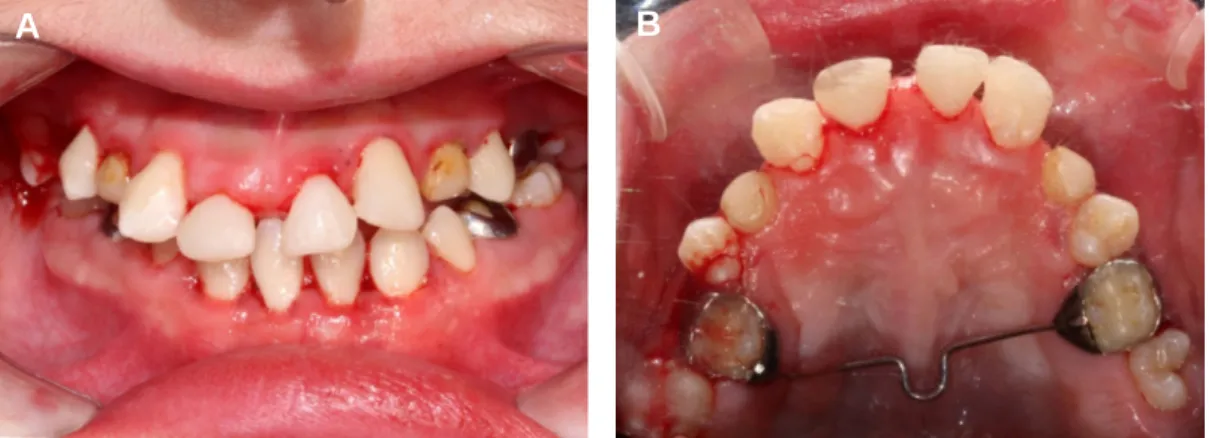
The matrix was removed and allowed to undergo ad- ditional polymerization on the palate. An anatomical layering technique was used to restore a dentinal layer. A celluloid strip and matrix were used to form the proximate surface, and enamel resin was used to restore the surface. Occlusion was then evaluated, and further polymerization, finishing and polishing were conducted. Sealant was conducted for the upper first molar teeth on the sides, and scaling and dental cleansing using pumice were performed before finish- ing the treatment (Fig. 3).
Fig. 2. Panoramic view. Congenital missing teeth (#12, 15, 17, 22, 23, 25, 27, 31, 35, 37, 41, 45, 47), ectopic impacted teeth (#13), retained primary teeth (#53, 55, 63, 65, 75, 85).
Ⅲ. Discussion
While patients with severe intellectual disability of- ten suffer from severe dental diseases, in many cases their conditions are left unaddressed owing to treat- ment inaccessibility, causing significant pain not just to themselves but to their family members as well. It is well known that dental treatment under general anesthesia, in pediatric patients who cannot cooper- ate with the treatment owing to intellectual disabili- ty, significantly improves the quality of life of both the patients and their family members12). Limeres13) et al. noted that among 564 patients with disability, 42% underwent dental treatment under general anesthesia, of which 32% had intellectual disability.
Dental treatment under general anesthesia ensures that the procedure is performed under proper lighting and that treatment areas are appropriately isolated.
Furthermore, it does not require cooperation from the patient, creating a relaxed environment for both practitioners and the patient, and thereby allowing effective treatment14). Thus, as was demonstrated in this case, dental treatment under general anesthesia can be regarded as the best treatment option for pa- tients with severe intellectual disability.
While Salles15)et al. stated that most patients with severe intellectual disability require a tooth extrac- tion or tooth filling treatment, we should not overlook that they also require esthetic improvement as well as functional restoration of oral health. Shim16) et al.
reported that 45.6% of patients with disability re-
quire esthetic dental treatment much like healthy in- dividuals. Thus, we should recognize that even pa- tients with severe disability, who are rarely engaged in social activities, and their family members, have high expectations of esthetic functional restoration.
For esthetic restoration, it is necessary to have a conversation with a patient or family members to re- flect their needs. For this reason, a dental cast is made before starting the treatment, to visualize ex- pected treatment results and perform a procedure with the informed consent of the patient or his/her family members. As patients with severe intellectual disability have difficulties in expressing themselves and communicating with others, it is important to communicate with a patient’s family members or a guardian to understand what is needed. As was shown in this case, it is important to show them a wax-up model where tooth-fillings are completed, to discuss and determine proper treatment methods based on sufficient conversation between the surgeon and guardian.
Dental rehabilitation can be achieved by various treatment methods such as direct composite resin restoration, prosthetic treatment using an all-ceramic crown or metal ceramic crowns and orthodontic treat- ment. Practitioners should determine the proper therapeutic method taking into consideration the length of treatment, cost, and a patient’s ability to take care of his/her oral health. Fortunately, follow- ing the development of adhesive tooth-filling materi- als, direct tooth-filling using composite resin is able
A
Fig. 3. Post-operative intraoral view.
B
to preserve tooth structure, whilst being reversible and able to address major complaints with only one treatment17). In addition, compared to the time and costs required, tooth-filling using composite resin can provide patients with a high level of satisfaction18). It should be considered, however, that this treatment method carries the risk of fracture and discoloration of teeth, and lasts for approximately 5 to 10 years.
Using an index matrix, which serves as a guide for anterior resin restoration, is recommended. The sili- cone-index technique fixes charging areas of compos- ite resin, helping a practitioner to create a proper contour while reducing treatment length19). This tech- nique can be used when filling cracked/injured teeth or performing a plastic operation for a microdontia.
Kim20) et al. reported that excessive resin restora- tion of embrasure for esthetic purpose might increase the risk of periodontal diseases, and that a practi- tioner should form the junction of a dental root and crown of a tooth whilst considering balance between the tooth and the gingiva, to prevent periodontal complications. As was demonstrated in the case, completely closing the space might cause periodontal complications when the space to be filled by compos- ite resin is large, and it is thus recommended to par- tially close the space instead.
Schalk21) et al. reported that when patients with partial oligodontia without any syndrome were com- pared to healthy people, the patients showed symp- toms such as plica mentalis, increased interocclusal distance and an abnormal relationship between the upper and lower jaws. They also had drier skin as compared with healthy individuals. Therefore, when teeth which are rarely missing are noted to be ab- sent, or when a large number of teeth are missing, it should be carefully observed whether a patient has an ectodermal hypoplasia. For the patient in this case, even though the guardian reported no syn- drome, it is believed that genetic testing and derma- tological tests should be conducted to ascertain whether he is suffering from a form of ectodermal hy- poplasia, as the loss of many teeth, morphologic ab- normality of teeth and presence of conical teeth were detected.
Ⅳ. Summary
Our patient with severe intellectual disability ac- companied by oligodontia and conical teeth had his anterior teeth restored with composite resin to im- prove his appearance under general anesthesia.
Direct composite resin restoration is a simple, re- versible, and economical treatment method that re- quires a small number of hospital visits and has a short procedure time. A clinical protocol using a diag- nostic wax-up and silicone matrix as a means of as- sistance helps achieve esthetic and functional treat- ment goals.
REFERENCES
1. Silverman N ,Ackerman J : Oligodontia: a study of its prevalence and variation in 4032 children.
ASDC J Dent Child, 46:470-477, 1978.
2. Schalk-Van Der Weide Y, Steen W ,Bosman F : Distribution of missing teeth and tooth morpholo- gy in patients with oligodontia. ASDC J Dent Child, 59:133-140, 1991.
3. Larmour CJ, Mossey PA, Thind BS, et al. : Hypodontia-a retrospective review of prevalence and etiology. Part I. Quintessence Int, 36:263- 270, 2005.
4. Erridge P : Restoration of the teeth in a case of oligodontia. J Dent, 8:132-134, 1980.
5. He X, Shu W, Kang Y, et al. : Esthetic and func- tional rehabilitation of a patient with nonsyn- dromic oligodontia: a case report from China. J Esthet Restor Dent, 19:137-142, 2007.
6. Worsaae N, Jensen B, Holm B, Holsko J : Treatment of severe hypodontia-oligodontia-an interdisciplinary concept. Int J Oral Maxillofac Surg, 36:473-480, 2007.
7. Katz G, Lazcano-Ponce E : Intellectual disability:
definition, etiological factors, classification, diag- nosis, treatment and prognosis. Salud Publica Mex, 50:132-141, 2008.
8. Wright RH, Cummings NA : Destructive Trends in Mental Health: The well intentioned path to harm. Routledge, New York, 2013.
9. Nowak AJ : Dentistry for the handicapped pa- tient. CV Mosby, 1976.
10. KAPD : Textbook of pediatric dentistry Yenang INC., Korea, 592-621, 2014.
11. Hulland S, Sigal MJ : Hospital-based dental care for persons with disabilities: a study of patient selection criteria. Spec Care Dentist, 20:131- 138, 2000.
12. Baens-Ferrer C, Roseman MM, Dumas HM, Haley SM : Parental perceptions of oral health- related quality of life for children with special needs: impact of oral rehabilitation under general anesthesia. Paediatr Dent, 27:137-142, 2005.
13. Limeres PJ, Va′zquez GE, Medina HJ, et al. : Pre-assessment of severely handicapped patients suitable of dental treatment under general anes- thesia. Med Oral, 8:353-360, 2002.
14. Weddell JA, Jones JE : Hospital dental services for children and the use of general anesthesia. in Dentistry for the child and adolescent. CV Mosby Co, Philadelphia, 314-332, 2004.
15. Salles PS, Tannure PN, Oliveira R, et al. : Dental needs and management of children with special health care needs according to type of dis-
ability. J Dent Child, 79:165-169, 2012.
16. Shim SH, Kim SG, Choi B : The dentists' per- ceptions and current prosthodontic treatment status for the disabled in Korea. J Kor Aca Prosthet, 47:286-294, 2009.
17. Prati C : In vitro and in vivo adhesion in opera- tive dentistry: a review and evaluation. Pract Periodontics Aesthet Dent, 10:319-327, 1998.
18. Heymann HO, Hershey HG : Use of composite resin for restorative and orthodontic correction of anterior interdental spacing. J Prosthet Dent, 53:766-771, 1985.
19. Fahl Jr N : Achieving ultimate anterior esthetics with a new microhybrid composite. Compend Contin Educ Dent Suppl, 26:4-13, 2000.
20. Kim YH, Cho YB : Diastema closure with direct composite: architectural gingival contouring. J Korean Acad Conser Dent, 36:515-520, 2011.
21. Schalk-van der Weide Y, Beemer FA, Faber JA, Bosman F : Symptomatology of patients with oligodontia. J Oral Rehabil, 21:247-61, 1994.