A yellow pigment-producing bacterium, NP2-R2 was isolated from morning glory flower for finding carotenoid-producing bacteria. Strain NP2-R2 showed the highest sequence similarity in 16S rRNA sequence with Sphingomonas sanguinis (99.86%).
The genome size of strain NP2-R2 is 4,372,860 bp with a G + C content of 66.06%. The genome includes 3,920 protein- coding genes, 65 tRNA genes and 12 rRNA genes. Strain NP2-R2 harbors three genes of crtB, crtI, and crtY associated with carotenoid biosynthesis. This genome sequence will provide useful information for comparative genome research and metabolic engineering of carotenoid synthesis.
Keywords: Sphingomonas sanguinis, carotenoid, genome sequence
The genus Sphingomonas was classified into the family Sphingomonadaceae, the order Sphingomonadales and the class Alphaproteobacteria. Members of the genus Sphingomonas are Gram-negative, strictly aerobic and rod-shaped bacteria
(Yabuuchi et al., 1990). The genus Sphingomonas is widely distributed in soil, phyllosphere and rhizosphere of plant, air, water, desert, and more (Shi et al., 2001; An et al., 2011; Kim et al., 2014; Liu et al., 2015; Zhu et al., 2015; Lee et al., 2016;
Cha et al., 2019). Some of the members within the order Sphingomonadales produce carotenoid pigments (Siddaramappa et al., 2018).
Strain NP2-R2 was isolated from morning glory flower in Jangseong, Republic of Korea. The flower sample was serially diluted with 0.85% (w/v) NaCl and appropriate 10-fold dilutions were plated on R2A agar (Difco). The plates were incubated at 28°C for 5 days. Strain NP2-R2 was one of the isolates that appeared on the R2A medium which could be distinguished in terms of yellow color colony. 16S rRNA sequence (1,475 bp) was extracted from the whole-genome sequences. The sequence similarity values were calculated between NP2-R2 and the closely related species using EzBioCloud blast (http://www.
ezbiocloud.net/identify) (Yoon et al., 2017). The phylogenetic trees based on the 16S rRNA gene sequence alignment were reconstructed by the neighbor-joining (Saitou and Nei, 1987)
Korean Journal of Microbiology (2021) Vol. 57, No. 3, pp. 238-241 pISSN 0440-2413
DOI https://doi.org/10.7845/kjm.2021.1054 eISSN 2383-9902
Copyright ⓒ 2021, The Microbiological Society of Korea
Complete genome sequence of Sphingomonas sanguinis NP2-R2, a carotenoid producing bacterium, isolated from morning glory
Jeong-Seon Kim
1, Kyeong Rok Choi
2, Hyunmin Eun
2, Jun Heo
3, Soon-Wo Kwon
1, Young-Joon Ko
1, and Soo-Jin Kim
1*
1
Agricultural Microbiology Division, National Institute of Agricultural Sciences, Rural Development Administration, Wanju 55365, Republic of Korea
2
Metabolic and Biomolecular Engineering National Research Laboratory, Korea Advanced Institute of Science and Technology (KAIST), Daejeon 34141, Republic of Korea
3
Hazard Substances Analysis Division, Gwangju Regional Office of Food and Drug Safety, Ministry of Food and Drug Safety, Gwangju 61012, Republic of Korea
나팔꽃에서 분리한 카로티노이드 생산 Sphingomonas sanguinis NP2-R2 균주의 유전체 서열 분석
김정선
1・ 최경록
2・ 은현민
2・ 허준
3・ 권순우
1・ 고영준
1・ 김수진
1*
1
국립농업과학원 농업미생물과,
2한국과학기술원 생명화학공학과,
3식품의약품안전처 광주지방식품의약품안전청 유해물질분석과
(Received July 20, 2021; Revised September 17, 2021; Accepted September 23, 2021)
*For correspondence. E-mail: [email protected];
Tel.: +82-63-238-3031; Fax: +82-63-238-3834
Complete genome of S. sanguinis NP2-R2 ∙
239
Korean Journal of Microbiology, Vol. 57, No. 3 algorithms using the software package MEGA (version 7)
(Kumar et al., 2016). The tree topology was evaluated by bootstrapping with 1,500 replicates. NP2-R2 showed the highest sequence similarities in 16S rRNA sequences with Sphingomonas sanguinis NBRC 13937
T(99.86%), S. pseudosanguinis G1-2
T(99.35%), S. yabuuchiae GTC 868
T(99.08%), and S. parapaucimobilis NBRC 15100
T(99.01%). Phylogenetic analysis using the neighbor-joining method based on the 16S rRNA sequences showed that strain NP2-R2 was clustered with S. sanguinis NBRC 13937
T, S. pseudosanguinis G1-2
T, S. yabuuchiae GTC 868
T, S. parapaucimobilis NBRC 15100
T, and S. roseiflava NMK341
T(Fig. 1).
To identify genes related to carotenoid production, we conducted whole-genome sequencing. The genome of NP2-R2 was sequenced using PacBio RS II sequencer (Pacific Biosciences) and Illumina HiSeq platform data (Illumina) at Macrogen Inc. The genome annotation was conducted using the NCBI prokaryotic genome annotation pipeline (Tatusova et al., 2016).
As a result, two contigs were assembled as one circular
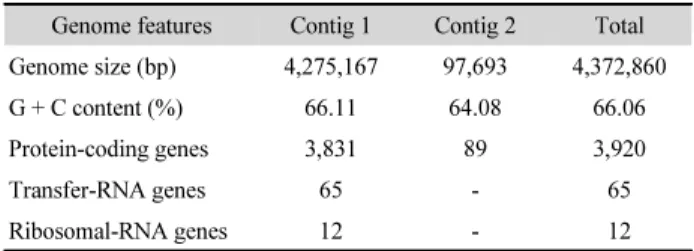
chromosome and one plasmid. The genome size of NP2-R2 is 4,372,860 bp. 3,920 protein-coding genes (CDS) were annotated, and 65 and 12 genes were annotated as tRNA and rRNA, respectively (Table 1). The DNA G + C content was 66.06% in two contigs. One circularized contig with 4,275,167 bp is the chromosome, and the other small contig with 97,693 bp may be a plasmid.
Based on the functional categories specified using EggNOG database, 3734 genes were annotated with transport and meta- bolism of amino acid (216), inorganic ion (201), lipid (97), carbohydrate (197), coenzyme (102), and nucleotide (56),
Fig. 1. Neighbor-joining phylogenetic tree based on 16S rRNA gene sequences of strains NP2-R2. Bootstrap percentages (based on 1,500 replicates) > 70%
are shown at branching points. Bar, 0.02 accumulated changes per nucleotide.
Table 1. General genomic features of the strain NP2-R2
Genome features Contig 1 Contig 2 Total Genome size (bp) 4,275,167 97,693 4,372,860
G + C content (%) 66.11 64.08 66.06
Protein-coding genes 3,831 89 3,920
Transfer-RNA genes 65 - 65
Ribosomal-RNA genes 12 - 12
240
∙ Kim et al.미생물학회지 제57권 제3호
biosynthesis, transport and catabolism of secondary metabolites (43), energy production and conversion (174), etc. The biosynthesis of isopentenyl pyrophosphate (IPP) and dimethylallyl diphosphate (DMAPP) which are carotenoid precursors occurs via two different pathways, methylerythritol 4-phosphate (MEP) pathway and mevalonate (MVA) pathway (Cheng et al., 2020; Ram et al., 2020). In the case of the strain NP2-R2, the genes involved in the MEP pathway were found, such as 1-deoxy-D-xylulose 5-phosphate synthase (dxs), 1-deoxy-D-xylulose 5-phosphate reductoisomerase (dxr). The MEP pathway is typically found in most bacteria and plant plastids while the MVA pathway is mostly present in plants and archaea (Cheng et al., 2020). The genome contains carotenoid biosynthesis genes coding for proteins, 15-cis-phytoene synthase (crtB, NP2-R2_1_02095), phytoene desaturase (crtI, NP2-R2_1_02087) and lycopene- beta-cyclase (crtY, NP2-R2_1_02086) (Table 2). This complete genome sequence data can be useful for comparative genome research, metabolic engineering of carotenoid biosynthesis and exploring the metabolism of Sphingomonas species.
Nucleotide sequence accession numbers
The complete genome sequence of S. sanguinis NP2-R2 has been deposited at NCBI under the GenBank accession no.
CP079203 and CP079204. The strain has been deposited in the Korean Agricultural Culture Collection (KACC) under the accession number KACC 81176BP.
적 요
카로티노이드 생산 균주를 탐색하기 위하여 나팔꽃에서 분 리한 노란색 색소를 생산하는 NP2-R2 균주를 선발하였다.
16S rRNA 염기서열 분석 결과, NP2-R2 균주는 Sphingomonas sanguinis에 가장 높은 유사도(99.86%)를 나타내었다. NP2-R2 균주의 총 염기서열은 4,372,860 bp이고 G + C content가 66.06%이었다. 유전체에서 단백질 유전자 3,920개, tRNA 유
전자 65개, rRNA 유전자 12개를 확인하였다. 또한 카로티노 이드 생합성과 관련된 유전자 crtB, crtI, crtY를 포함하고 있는 것을 확인하였다. 본 유전체 염기서열은 비교유전체 연구와 카로티노이드 생합성의 대사공학을 위한 유용한 정보를 제공 할 것이다.
Acknowledgments
This study was carried out with the support (Project No.
PJ01550601) of National Institute of Agricultural Sciences, Rural Development Administration, Republic of Korea.
Conflict of Interest
The authors have no conflict of interest to report.
References
An H, Xu M, Dai J, Wang Y, Cai F, Qi H, Peng F, and Fang C. 2011.
Sphingomonas xinjiangensis sp. nov., isolated from desert sand.
Int. J. Syst. Evol. Microbiol. 61, 1865–1869.
Cha I, Kang H, Kim H, and Joh K. 2019. Sphingomonas ginkgonis sp.
nov., isolated from phyllosphere of Ginkgo biloba. Int. J. Syst.
Evol. Microbiol. 69, 3224–3229.
Cheng L, Swofford CA, and Sinskey AJ. 2020. Modular engineering for microbial production of carotenoids. Metab. Eng. Commun.
10, e00118.
Kim SJ, Moon JY, Lim JM, Ahn JH, Weon HY, Ahn TY, and Kwon SW. 2014. Sphingomonas aerophila sp. nov. and Sphingomonas naasensis sp. nov., isolated from air and soil, respectively. Int. J.
Syst. Evol. Microbiol. 64, 926–932.
Kumar S, Stecher G, and Tamura K. 2016. MEGA7: molecular evolutionary genetics analysis version 7.0 for bigger datasets.
Mol. Biol. Evol. 33, 1870–1874.
Lee JH, Kim DI, Kang JW, and Seong CN. 2016. Sphingomonas lutea sp. nov., isolated from freshwater of an artificial reservoir. Int. J.
Syst. Evol. Microbiol. 66, 5493–5499.
Table 2. Carotenoid biosynthesis genes of the strain NP2-R2
Gene EC number Product Length (bp) Length (a.a.)
crtB 2.5.1.32 15-cis-phytoene synthase 951 316
crtI 1.3.99.31 Phytoene desaturase (lycopene-forming) 1,476 491
crtY 5.5.1.19 Lycopene beta-cyclase 1,173 390
Complete genome of S. sanguinis NP2-R2 ∙
241
Korean Journal of Microbiology, Vol. 57, No. 3
Liu Q, Liu HC, Zhang JL, Zhou YG, and Xin YH. 2015. Sphingomonaspsychrolutea sp. nov., a psychrotolerant bacterium isolated from glacier ice. Int. J. Syst. Evol. Microbiol. 65, 2955–2959.
Ram S, Mitra M, Shah F, Tirkey SR, and Mishra S. 2020. Bacteria as an alternate biofactory for carotenoid production: a review of its applications, opportunities and challenges. J. Funct. Foods 67, 103867.
Saitou N and Nei M. 1987. The neighbor-joining method: a new method for reconstructing phylogenetic trees. Mol. Biol. Evol. 4, 406–425.
Shi T, Fredrickson JK, and Balkwill DL. 2001. Biodegradation of polycyclic aromatic hydrocarbons by Sphingomonas strains isolated from the terrestrial subsurface. J. Ind. Microbiol.
Biotechnol. 26, 283–289.
Siddaramappa S, Viswanathan V, Thiyagarajan S, and Narjala A.
2018. Genomewide characterization of the genetic diversity of carotenogenesis in bacteria of the order Sphingomonadales.
Microb. Genom. 4, e000172.
Tatusova T, DiCuccio M, Badretdin A, Chetvernin V, Nawrocki EP, Zaslavsky L, Lomsadze A, Pruitt KD, Borodovsky M, and Ostell J. 2016. NCBI prokaryotic genome annotation pipeline. Nucleic Acids Res. 44, 6614–6624.
Yabuuchi E, Yano I, Oyaizu H, Hashimoto Y, Ezaki T, and Yamamoto H. 1990. Proposals of Sphingomonas paucimobilis gen. nov.
and comb. nov., Sphingomonas parapaucimobilis sp. no v., Sphingomonas yanoikuyae sp. nov., Sphingomonas adhaesiva sp.
nov., Sphingomonas capsulate comb. nov., and two genospecies of the genus Sphingomonas. Microbiol. Immunol. 34, 99–119.
Yoon SH, Ha SM, Kwon S, Lim J, Kim Y, Seo H, and Chun J. 2017.
Introducing EzBioCloud: a taxonomically united database of 16S rRNA gene sequences and whole-genome assemblies. Int. J.
Syst. Evol. Microbiol. 67, 1613–1617.
Zhu L, Si M, Li C, Xin K, Chen C, Shi X, Huang R, Zhao L, Shen X, and Zhang L. 2015. Sphingomonas gei sp. nov., isolated from roots of Geum aleppicum. Int. J. Syst. Evol. Microbiol .65, 1160–
1166.