INTRODUCTION
The coronavirus disease 2019 (COVID-19) spread rapidly around the world, causing the World Health Organization to declare a global pandemic on March 11, 2020. As of April 30, 2020, COVID-19 was confirmed in over 100 coun- tries, causing more than 3,000,000 confirmed cases and 223,193 deaths globally [1]. Although the case fatality rate
is low in the general population, it is higher among patients with advanced age or underlying comorbidities [2]. In the absence of a vaccine or effective treatment, questions arise on the risk of COVID-19 to patients with end-stage organ disease that are awaiting transplant surgery [3,4].
Organ transplantation saves thousands of lives; howev- er, transplant recipients, because of immunosuppression and underlying medical conditions, might be at higher risk
The feasibility of organ transplantation during the COVID-19 outbreak: experiences from South Korea
Juhan Lee, Eun Jin Kim, Kyong Ihn, Jae Geun Lee, Dong Jin Joo, Myoung Soo Kim, Soon Il Kim, Yu Seun Kim, Kyu Ha Huh
Department of Surgery, Yonsei University College of Medicine, Seoul, Korea
Background: The coronavirus disease 2019 (COVID-19) has forced healthcare systems to reduce transplant activities in order to preserve resources and minimize the risk of nosocomial transmission. Although transplantation societies around the world have pro- posed interim recommendations, little is known about the safety of transplant surgery under pandemic conditions and how transplant medicine should move forward after the peak of the pandemic.
Methods: We describe our experiences regarding the continuation of living and deceased donor transplantation under infection control measures during the COVID-19 outbreak in South Korea. We reviewed consecutive liver and kidney transplantations at Severance Hospital and analyzed national transplantation activities in South Korea.
Results: Transplantation activities with living and deceased donors remained stable during the COVID-19 outbreak compared to the same period in 2019. We performed 94 transplantations (58 kidney, 35 liver, and 1 simultaneous liver-kidney) during the COVID-19 outbreak. Twenty-five patients underwent desensitization therapy prior to transplant (nine ABO-incompatible kidney, eight human leukocyte antigen-incompatible kidney, and eight ABO-incompatible liver). No transplant recipients in our center con- tracted COVID-19. In South Korea, national transplant activities with living and deceased donors remained stable in 2020 compared to 2019.
Conclusions: Organ transplantation during pandemics appears to be feasible with appro- priate infection prevention measures.
Keywords: COVID-19; Organ transplantation; Immunosuppression; Safety
Received October 8, 2020 Revised November 9, 2020 Accepted November 9, 2020 Corresponding author: Kyu Ha Huh Department of Surgery, Yonsei University College of Medicine, 50-1 Yonsei-ro, Seodaemun-gu, Seoul 03722, Korea Tel: +82-2-2228-2138
Fax: +82-2-313-8289 E-mail: [email protected]
© The Korean Society for Transplantation This is an Open Access article distributed under the terms of the Creative Commons Attribution Non-Commercial License (http://creativecommons.org/licenses/
by-nc/4.0/) which permits unrestricted non-commercial use, distribution, and reproduction in any medium, provided the original work is properly cited.
pISSN 2671-8790
eISSN 2671-8804
of contracting COVID-19 and developing severe illness [5].
As the pandemic worsens around the world, procurements of organs from deceased donors have decreased, and transplantations from living donors have been postponed to preserve medical resources for COVID-19 and to avoid nosocomial transmission [6,7].
During the COVID-19 pandemic, decision-making about whether to proceed with organ transplantation is challeng- ing. Although transplantation societies have proposed interim recommendations, little is known about the safety and feasibility of organ transplantation under enhanced infection prevention measures during the COVID-19 out- break [5]. We report on the measures we have taken to reduce the transmission of COVID-19 and our experiences with living donor and deceased donor transplants in the initial phase of the COVID-19 pandemic in South Korea.
METHODS
All study procedures were conducted in accordance with the Declaration of Helsinki and were approved by the In- stitutional Review Board of Severance Hospital (IRB No.
2020-0500-001). Requirement for informed consent was waived by the Institutional Review Board because of the study’s retrospective design. All living donations were voluntary, and all donors underwent evaluation by trans- plant surgeons, hepatologists, nephrologists, and clinical
psychologists. All deceased donors were brain dead. No donor organs were obtained from executed prisoners or other institutionalized persons.
Data Collection
In this retrospective study, we reviewed consecutive liver transplantations and kidney transplantations performed at the Severance Hospital Transplant Center from January 20, 2020 to April 30, 2020. We also analyzed transplantations performed at our hospital during the same period in 2019 (January 20 to April 30). Severance Hospital is a 2,400- bed, university-affiliated tertiary care hospital in Seoul, located about 240 km (150 miles) from the epicenter of the COVID-19 pandemic in South Korea (Daegu and North Gyeongsang province). The Severance Hospital Transplant Center, one of the largest Korean centers for organ trans- plantation, performs approximately 180 kidney transplants and 120 liver transplants annually. We reviewed electronic medical records, laboratory findings, and radiological ex- aminations of all recipients and donors. We also analyzed data from the Korean Network for Organ Sharing (KONOS) database, which contains national data on organ dona- tions and transplantations [8,9].
Infection Prevention Measures
We established a makeshift dedicated triage for patients with fever or respiratory symptoms to prevent COVID-19 exposure to patients and healthcare providers. All patients and visitors to the hospital were screened using a standard questionnaire and thermal imaging cameras. We adopted universal face masking policy for healthcare workers in all clinical settings. In addition, healthcare workers who come into direct or indirect contact with patients with confirmed COVID-19 underwent testing for the disease subsequently.
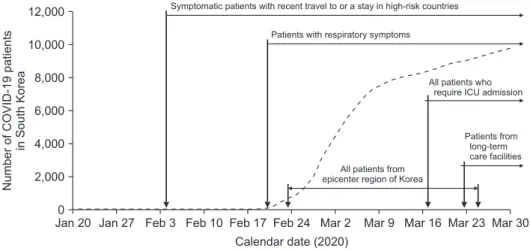
Preoperative patients were screened for COVID-19 using real time reverse transcription polymerase chain re- action (RT-PCR) of nasopharyngeal swabs in accordance with institutional guidelines. As the situation changed, testing criteria for COVID-19 in preoperative patients were modified accordingly (Fig. 1). Initially, we adopted preoper- ative COVID-19 testing for patients with respiratory symp- toms (February 4; 16 confirmed cases in South Korea), fol- lowed by testing of patients who had recently traveled to or stayed in high risk countries (February 6; 23 confirmed cases in South Korea), patients from the South Korean epicenter region of Daegu and North Gyeongsang prov- ince (February 24; 763 confirmed cases in South Korea), and immunocompromised patients (February 27; 1,595 HIGHLIGHTS
• We describe our experiences regarding the continuation of living and deceased donor transplantation during the initial phase of the coronavirus disease 2019 (COVID-19) outbreak.
• We also analyzed national transplant activities using Korean Network for Organ Sharing (KONOS) database.
• Transplantation activities with living and deceased donors remained stable during the COVID-19 outbreak and no transplant recipients in our center contracted COVID-19.
• Our early experiences suggest that organ transplanta-
tion is feasible during the COVID-19 pandemic under ap-
propriate infection prevention measures and extensive
testing.
confirmed cases in South Korea). Currently, all donors and recipients are screened for COVID-19 regardless of symp- toms in accordance with the Korean Society for Transplan- tation recommendation (released on March 13, 2020) [10].
In addition, surgeries for patients from the epicenter region were scheduled after all other surgeries were per- formed in a negative pressure operating theater. After sur- gery, patients from the epicenter recovered from anesthe- sia in the operating theater instead of the postanesthesia care unit and were then sent directly back to the ward to minimize contact with other patients.
Immunosuppressive Regimen
Immunosuppression was performed as described previ- ously [11]. Most patients that received living donor trans- plants received induction therapy with basiliximab (20 mg on days 0 and 4 posttransplant). We used anti-thymocyte globulin (ATG) for induction in human leukocyte antigen (HLA)-incompatible kidney transplantation and deceased donor kidney transplantation (1.5 mg/kg per day for 4 days). The maintenance regimen consisted of tacrolimus, corticosteroid, and mycophenolate mofetil (MMF). Initial tacrolimus was administered orally at 0.1 mg/kg twice dai- ly. The dose of tacrolimus was adjusted to maintain serum levels at 5–10 ng/mL during the first postoperative month and at 5–7 ng/mL thereafter. MMF was started at 1.0–1.5 g/day and subsequently adjusted to minimize adverse events such as leukopenia or gastrointestinal trouble.
All ABO-incompatible transplantations and HLA-incom- patible kidney transplantations were performed according to the desensitization protocol, as previously described [11,12]. Rituximab was administered within 2 weeks before transplantation. Plasmapheresis was performed until the
target antibody titer was achieved (immunoglobulin G titer
≤1:32 in ABO-incompatible transplantation, conversion of a positive crossmatch to negative).
Prophylaxis Protocol
All patients received trimethoprim-sulfamethoxazole as Pneumocystis jirovecii pneumonia prophylaxis for a mini- mum of 3 months. Fungal prophylaxis consisted of 4 mL oral nystatin administered four times daily for 12 months.
Prophylactic ganciclovir or valganciclovir for cytomega- lovirus (CMV) prophylaxis was used in high risk patients (donor seropositive, recipient seronegative, or use of ATG induction). A preemptive approach for prevention of CMV infection was used in other patients.
Statistical Analysis
Demographic information was summarized using frequen- cy counts (percentage) or medians (interquartile range), depending on the data type. The chi-square test with Fish- er’s exact test was used to compare categorical variables.
The Kruskal-Wallis test was used to compare continuous variables. The analysis was performed using IBM SPSS ver. 25.0 (IBM Corp., Armonk, NY, USA). The P-values <0.05 were considered significant.
RESULTS Organ Transplant Activities
During the COVID-19 outbreak, transplant activities remained stable compared to the same period in the previous year. In 2020 at Severance Hospital, 94 organ
Jan 20 Jan 27 Feb 3 Feb 10 Feb 17 Feb 24 Mar 2 Mar 9 Mar 16 Mar 23 12,000
10,000 8,000 6,000 4,000 2,000
Mar 30 NumberofCOVID-19patients inSouthKorea
Calendar date (2020) 0
Symptomatic patients with recent travel to or a stay in high-risk countries
Patients with respiratory symptoms
All patients who require ICU admission
Patients from long-term care facilities All patients from
epicenter region of Korea
Fig. 1. Preoperative coronavirus disease
2019 (COVID-19) testing criteria during the
outbreak. ICU, intensive care unit.
transplantations were performed (58 kidney, 35 liver, and 1 simultaneous liver-kidney) compared to 84 in 2019 (48 kidney, and 36 liver). The proportion of living-donor trans- plantations was not significantly different between the 2 years.
Baseline Characteristics
The baseline characteristics of the liver transplant recip- ients are shown in Table 1. There were no significant dif- ferences between the COVID-19 period and the same time period in the previous year in terms of patient age, sex, and model for end-stage liver score. In both periods, alcoholic liver disease and hepatitis B were the two most common etiologies. A total of 22 patients had hepatocellular car- cinoma at the time of liver transplant, and 19 underwent pretransplant locoregional treatment. The proportion of ABO-incompatible liver transplants was not significantly different between two periods (22.2% in 2020 vs. 16.7% in 2019).
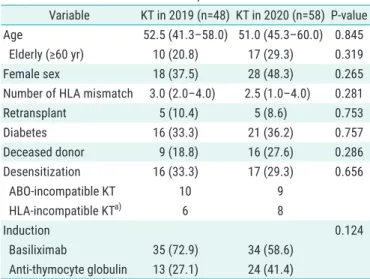
A total of 58 patients underwent kidney transplantation during the COVID-19 outbreak. The median age of those patients was 51 years, and 48.3% were female. Forty-two (72.4%) of the patients that received kidney transplants during the COVID-19 outbreak had living donors, and 17 (29.3%) underwent desensitization treatment prior to
transplantation (9 ABO-incompatible and 8 HLA-incom- patible). The baseline characteristics of the kidney trans- plant patients are summarized in Table 2. There were no significant differences between the COVID-19 period and the same time period in the previous year in terms of age, sex, and diabetes. The use of ATG induction was more common in 2020 than in 2019, but the difference was not statistically significant (41.4% in 2020 vs. 27.1% in 2019, P=0.124).
COVID-19 Test
As of April 30, more than 620,000 individuals were tested for COVID-19 in South Korea (population of 51 million).
A total of 7,550 patients underwent COVID-19 testing by real-time RT-PCR according to institutional guidelines at Severance Hospital. Among the patients undergoing transplantation, 50 recipients and 46 donors underwent COVID-19 testing prior to transplantation. During the study period, 909 healthcare workers were tested, and all were negative for COVID-19.
Postoperative Courses
The postoperative courses are summarized in Table 3. No incidence of COVID-19 infection occurred during the study period. All liver transplant recipients received care in the intensive care unit (ICU) after transplantation. The median length of stay in the ICU and duration of ventilator care
Table 1. Baseline characteristics of LT patientsVariable LT in 2019 (n=36) LT in 2020 (n=36
a)) P-value
Age 53.0 (38.8–61.8) 54.5 (45.3–62.8) 0.813
Elderly (≥60 yr) 12 (33.3) 11 (30.6) 0.800
Female sex 14 (38.9) 12 (33.3) 0.624
Original disease 0.439
Hepatitis B virus 12 (33.3) 14 (38.9)
Hepatitis C virus 0 3 (8.3)
Alcoholic liver disease 12 (33.3) 10 (27.8)
Biliary disease 5 (13.9) 2 (5.6)
Others 7 (19.4) 7 (19.4)
Hepatocellular carcinoma 10 (27.8) 12 (33.3) 0.609 Pretransplant loco-
regional treatment
9/10 (90.0) 10/12 (83.3)
MELD score 14.0 (10.8–28.3) 18.0 (11.8–32.3) 0.988
Diabetes 13 (33.3) 13 (33.3) >0.999
Deceased donor 7 (19.4) 10 (27.8) 0.405
ABO-incompatible LT 6 (16.7) 8 (22.2) 0.551
Values are presented as median (interquartile range) or number (%).
LT, liver transplantation; MELD, model for end-stage liver disease.
a)
One simultaneous liver-kidney transplant case was classified to LT.
Table 2. Baseline characteristics of KT patients
Variable KT in 2019 (n=48) KT in 2020 (n=58) P-value
Age 52.5 (41.3–58.0) 51.0 (45.3–60.0) 0.845
Elderly (≥60 yr) 10 (20.8) 17 (29.3) 0.319
Female sex 18 (37.5) 28 (48.3) 0.265
Number of HLA mismatch 3.0 (2.0–4.0) 2.5 (1.0–4.0) 0.281
Retransplant 5 (10.4) 5 (8.6) 0.753
Diabetes 16 (33.3) 21 (36.2) 0.757
Deceased donor 9 (18.8) 16 (27.6) 0.286
Desensitization 16 (33.3) 17 (29.3) 0.656
ABO-incompatible KT 10 9
HLA-incompatible KT
a)6 8
Induction 0.124
Basiliximab 35 (72.9) 34 (58.6)
Anti-thymocyte globulin 13 (27.1) 24 (41.4) Values are presented as median (interquartile range) or number (%).
KT, kidney transplantation; HLA, human leukocyte antigen.
a)
Five patient underwent both HLA- and ABO-incompatible kidney trans-
plant was classified to HLA-incompatible kidney transplant.
after liver transplantation were not significantly different between the COVID-19 period and the same time period in the previous year. In addition, the proportion of patients who received postoperative continuous renal replacement therapy was similar between the two time periods. Post- operative courses in kidney transplant recipients were not significantly different between the two time periods.
Organ Donation and Transplant Activities in Korea
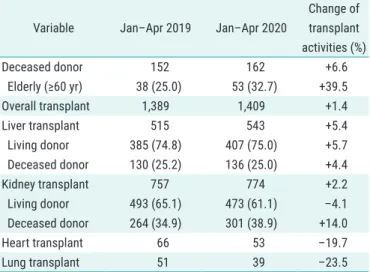
We compared the organ donation and transplant activities from January 2020 to April 2020 with those during the same time period in the previous year (Table 4). According to the KONOS database, a total of 162 deceased donors were used in 2020 compared to 152 in 2019 [8]. Transplant activities were stable between the two time periods for both living donor and deceased donor transplantations [9].
In 2020, 1,409 organ transplantations were performed (543 liver, 774 kidney, 53 heart, and 39 lung) compared to 1,389 in 2019 (515 liver, 757 kidney, 66 heart, and 51 lung). The proportion of living donor transplantations was not signifi- cantly different between the two time periods.
DISCUSSION
Since the first imported case of COVID-19 was docu- mented on January 20, 2020, South Korea has carried out extensive virus testing and contact tracing [13-15]. In co- operation with efforts at the national level, our institution put stringent measures into place to prevent COVID-19 transmission. As the situation continues to change rapidly, infection control measures for patients undergoing organ transplantation have been modified accordingly. Thanks to those efforts, we were able to maintain both living donor
transplantation and deceased donor transplantation for our patients. To date, we have not had any instances of COVID-19 infection among our patients.
As the outbreak grew to a pandemic, many healthcare providers raised the concern that organ transplant recip- ients might be at higher risk of developing severe illness caused by COVID-19 [5]. In prior outbreaks of respiratory viruses, organ transplant recipients demonstrated greater susceptibility to infection, greater disease severity, and prolonged shedding of virus compared with the general population [16,17]. However, there are limited data on COVID-19 in organ transplant recipients [18]. Although organ transplant recipients might be more susceptible to COVID-19 infection, it is uncertain whether immunosup- pression alters the clinical features and disease severity of COVID-19. According to data collected so far, the clinical features of COVID-19 among transplant recipients are as heterogeneous as they are in the general population [19].
Furthermore, there are some preliminary reports that the reduced immune response due to immunosuppression might have a protective effect against severe COVID-19 symptoms [20,21].
Another concern for organ transplantation during the COVID-19 crisis is a lack of medical resources [22]. Health- care providers are under increasing pressure to provide care only in the most urgent cases in order to preserve re- sources for the COVID-19 response [23]. A lack of ICU beds and ventilators might not only affect care for transplant recipients but also organ procurements from deceased do- nors [6]. In the face of unprecedented challenges posed by
Table 3. Postoperative courses after transplantationVariable 2019 2020 P-value
Liver transplant (n=36) (n=36)
Length of ICU stay after transplant 3 (2–7) 3 (2–4) 0.948 Length of ventilator care 2 (1–5) 1 (1–3) 0.227 Continuous renal replacement therapy 8 (22.2) 10 (27.8) 0.586
Kidney transplant (n=48) (n=58)
ICU care after transplant 2 (4.2) 1 (1.7) 0.589 Delayed graft function 3 (6.3) 7 (12.1) 0.343 Values are presented as median (interquartile range) or number (%).
ICU, intensive care unit.
Table 4. Overall organ transplant activities in South Korea