1. Introduction
South Korea (hereinafter Korea) faces a surge of 2019 cor-onavirus disease (COVID-19) outbreak where the number of new coronavirus cases increased exponentially peaking on February 29, 2020, with a record of 909 new infections [1]. Despite its continued appearance of small confirmed cases recently, Korea was able to successfully flatten the COVID-19 curve in just 20 days [2]. It is pandemic man-agement health policies that were rather different from the international recommendations, namely containment first then mitigation [3, 4]. What is interesting is that Korea did not prioritize policy measures in either contain-ment or mitigation strategy or choose one strategy from
mitigation and containment. All measures and strategies were integrated and implemented under strong and coor-dinated government leadership.
Based on international practices of containment and mitigation strategies and their measures, this article describes policies, actors, and processes of the Korean pandemic management along with its enabling digital technologies (DTs). For this objective, it then attempts to address the following questions. First, how does Korea embrace various responding measures listed in contain-ment strategy while minimizing opportunity cost coming from prioritization of these measures? Second, how does Korea successfully implement both containment and miti-gation strategies simultaneously?
This article first explains methods and theoretical back-ground followed by the Korean comprehensive policy measures using DTs and other innovative policies between March 2020 – June 2020. Then, it will delve into how DTs play a role in containing and mitigating COVID-19 by ena-bling, facilitating, and integrating all relevant measures and strategies. Lastly, this article offers recommendations for other countries.
* Moon Soul Graduate School of Future Strategy, Korea Advanced Institute of Science and Technology (KAIST), Yousung, Daejeon, KR
† Development Finance Division, Korea Ministry of Economy and
Finance, Government Complex, Sejong, KR
‡ Division of International Studies, Hanyang University, Sageun,
Seongdong, Seoul, KR
Corresponding author: Yongseok Seo, PhD ([email protected])
EXPERT CONSENSUS DOCUMENT, RECOMMENDATION, AND WHITE PAPER
Searching for Digital Technologies in Containment and
Mitigation Strategies: Experience from South Korea
COVID-19
Kyungmoo Heo
*, Daejoong Lee
†, Yongseok Seo
*, and Hyeseung Choi
‡Background: Korea has achieved health policy objectives in pandemic management so far, namely minimiz-ing mortality, flattenminimiz-ing the epidemic curve, and limitminimiz-ing the socio-economic burden of its measures. The key to the Korean government’s success in combating COVID-19 lies with the latest digital technologies (DTs). The prompt and effective application of DTs facilitates both containment as well as mitigation strategies and their sub-policy measures.
Methods: This article uses an experiential analysis based on an exploratory case study – analysis on field applications of the government’s interventions. Information is collected by qualitative methods such as literature analysis, meeting materials, and a review of various government reports (including internal ones) along with academic and professional experiences of the authors.
Findings: The article presents the unique Korean health policy approaches in the COVID-19 crisis. First, DTs allow the Korean government to embrace various policy measures together listed in containment strat-egy, namely altering and warning, epidemiological investigation, quarantine of contacts, case-finding, social distancing, and mask-wearing. Second, DTs allow Korea to integrate containment and mitigation strategies simultaneously. Along with the above measures in containment, healthcare service, medical treatment, and prophylaxis (presymptomatic testing) within mitigation are utilized to prevent a COVID-19 spread.
Conclusions: Korea develops DTs in an integrated manner in the early pandemic stage under strong and coordinated government leadership. Above all, the DTs’ functions in each pandemic developmental stage are continuously upgraded. Instead of prioritizing policy measures or strategies, therefore, Korea can implement diverse policies simultaneously by integrating DTs effectively. During the COVID-19 outbreak, DTs work as the enablers to connect these two strategies and their measures in Korea.
Recommendations: DTs should be at the center of the disaster management paradigm, especially during a pandemic. DTs are facilitators and integrators of containing and mitigating strategies and their policy measures.
2. Methods and Theoretical Background
In a pandemic outbreak situation, policy objectives of a government are namely to minimize mortality, to flatten the epidemic curve, and to limit the socio-economic bur-den of its measures [5–7]. A government utilizes a range of policy measures to achieve these objectives. Both con-tainment (delaying) and mitigation strategies are mostly introduced as the government’s policy interventions. The World Health Organization defines containment as a means to prevent or delay the spread of infection while mitigation as a means to reduce the impact of the pan-demic [3]. The details of both containment and mitigation strategies are depicted in Figure 1 [3, 8].
Various pieces of literature and reports in epidemiol-ogy, infectious diseases, and public health policy have researched about containment and mitigation strategies in terms of their applicable conditions [9, 10], effective-ness [4], and sequences [11]. These papers also suggest a government prioritize measures or select a certain one listed in mitigation and/or containment strategies based on the phase and severity of a pandemic (refer to
Figure 1 for the phase of pandemic and relevant strate-gies) [3]. Because of limited resources and time, putting all measures or strategies into certain plays assumes to be challenging [12]. Furthermore, focusing heavily on one measure may jeopardize other efforts of a govern-ment [5]. For example, continued border control may cause the tourism industry to face its downturn. As seen on Figure 2 [1, 13, 14], however, Korea is recognized as achieving major policy objectives in pandemic manage-ment by applying all these strategies and measures simul-taneously as of June 12, 2020.
This article uses an experiential and rather reflective analysis [15–17] based on an exploratory case study [18, 19] – qualitative analysis on field applications of the government’s interventions, namely the DT-based policy measures of Korea. We are taking into account the research questions of this article – ‘why’ and ‘how,’ it is critical to provide detailed but underlying information and mean-ingful implications. Therefore, this analysis supports understanding the in-depth context in applying them and making policy practitioners for timely decisions within the
Figure 1: Phases of Pandemic with Measures in Containment and Mitigation. * Reference: [4, p.11 & p.24; 8].
Figure 2: Achievement Level of Korea in COVID-19 Policy Objectives. * Reference: [1]; * Reference: [13]; * Reference: [14].
uncertainty of the global pandemic. For scholars, a result of this analysis can be a trigger point to interact between interested actors and implicate multiple interpretations with respect to meaning, relevance, and importance, as a potential to shape future research.
This article delivers unique but practical implica-tions for both health policy practitioners and scholars with the Korean lessons learned written in two English written policy reports. These reports, published from the Government of Korea, namely Tackling COVID-19 Health, Quarantine and Economic Measures: Korean Experience [20] and Flattening the Curve on COVID-19: How Korea Responded to a Pandemic Using Information and Communication Technologies [21] are the foundation of this article. They have received wider recognition from foreign countries and international communities such as the World Bank and the United Nations. So far, the total four reports have been published, and the 5th one is about
to be published at the end of August 2020. Our attempt is to bring these rather intuitive governmental reports into the academic realm. In addition, to enrich the contents, additional information is collected by qualitative methods such as literature analysis, meeting materials, and a review of various government reports (including internal ones) along with academic and professional experiences of the authors.
3. Result
3.1. Policy Measures for Containment Strategy
3.1.1. Timely Delivery of Public Information
Cellular Broadcasting Service (CBS). CBS enables the
Korean government to transmit emergency alert text mes-sages on the COVID-19 outbreak. Instead of sending a message to each individual, CBS allows the government to broadcast an emergency situation from the mobile tele-com base stations. Because of this broadcasting approach, CBS can warn individuals and send short emergency alerts and guidelines for the public when they enter into a dis-aster area. National Disdis-aster and Safety Status Control Center of the Ministry of the Interior and Safety (MOIS) is in charge of the system [21], but provincial and municipal governments can also send alert messages to their local residents without approval from the MOIS. With support from the mobile telecom carriers, CBS sends messages without a delivery bottleneck when an emergency occurs. It is because CBS has its own channel for texting messages and does not use the general SMS text messaging system. Moreover, the government made an agreement with the three largest mobile carriers in August 2019 about sharing their own designated frequency channel for an emergency alert and a phone call.
Artificial-Intelligence (AI)-based Chatbot in Municipal Authorities. The Sungnam municipal government
pro-vides the AI-based care call service to those under active monitoring [21]. The AI chatbot calls twice a day to check whether they have a fever or any respiratory symptom and automatically send the check-up results to the pub-lic health clinic via email. The service also includes the provision of AI speakers at a patient’s home in order to offer two-way communication on COVID-19 situation
[22]. It answers questions of individuals and automati-cally informs the latest COVID-19 developments such as the number of the confirmed cases and deaths, preven-tion guidelines, and informapreven-tion on mask-availability in neighboring areas.
3.1.2. Government Transition to Smart Life
Smart Working. The Korean government launched a
web-site to provide the private companies’ software solutions of remote working to private and public organizations. The website includes information on solution providers such as contact numbers and featured functions as well as the price of their products [21]. After a joint survey with the Korea Software Industry Association, the govern-ment identifies the demand for solutions and classifies more than 140 solutions by the business sector [21]. To remove the burden of applying the government remote working scheme within a short period of time, the gov-ernment also offers free solutions and related infrastruc-tural and technical supports. Moreover, the government takes the initiative and an exemplary role in remote working. For example, municipalities adopt real-time virtual meetings along with flexible working hours to minimize contacts. 30% of all central government offic-ers enter into the mandatory smart working scheme [22]. To maintain the required level of security in the govern-ment affairs, the governgovern-ment establishes Global Virtual Private Network (the government’s intranet that enables access outside their offices) and sets up G-Drive (the gov-ernment’s cloud storage system) [22].
Remote Education. As of April 20, 2020, all Korean
stu-dents start mandatory online public education [21]. It is the outcome of the government’s prompt action in set-ting responding policies and DT infrastructures. First, to support students with limited digital access in the vulner-able class, the government lends smart devices such as computers and smart tablets that donated from the pri-vate sector. Second, the government exempts smartphone data and subscription charges when students access the Korea Educational Broadcasting System website. Third, for higher education such as universities and colleges, the gov-ernment creates online simulation software and platform where students can experience hands-on learning content for 23 high-demand classes (e.g., quantum chemistry).
3.1.3. Development of Public Mobile Applications
Self-Diagnosis Mobile Application. The Korean government
develops the mobile diagnosis application to monitor any possible COVID-19 symptoms of inbound passengers and to provide them with prompt medical advice. The applica-tion can be downloaded easily at the airport/harbor immi-grations. A passenger is required to install it when sub-mitting his/her information at the immigrations [20]. All inbound passengers must report their health conditions through the diagnosis application once a day during their 14 days of mandatory self-quarantine [21, 22]. Submitted data is collected by the central diagnosis system under strong privacy protection. When any suspicious symptom appears, passengers are encouraged to seek medical advice first through call centers operated by the Korea Centers
for Disease Control and Prevention (KCDC), or at COVID-19 screening centers [1]. Symptoms are crossed checked with their immigration data (e.g., nationality and a coun-try visited) and daily health information collected through the application before being sent to public health clin-ics. Information on those with symptoms for more than two days is transferred to local governments. Then, cor-responding public health clinics provide medical advice, testing, and instructions on how to be treated. Figure 3 describes the process of self-diagnosis and the roles of rel-evant public administrations and local governments.
Self-Quarantine Safety Mobile Application. The Korean
government develops the quarantine application to effec-tively monitor those under self-quarantine. This applica-tion has three key funcapplica-tions: submitting a self-diagnosis to their assigned government officers, a GPS-based location tracking to prevent possible violations of self-quarantine orders, and providing necessary self-quarantine guide-lines [20]. Those under self-quarantine use the application twice a day to monitor four symptoms: fever, cough, sore throat, and respiratory difficulties [21]. Once submitted, the self-diagnostic data are automatically transferred to an assigned case-officer. A case-officer is notified when indi-viduals leave their self-quarantine area, and an abnormal result of a self-diagnosis is detected. Two types of quaran-tine applications are developed: one for the users under self-quarantine and the other for government case-offic-ers. Figure 4 shows visual images of two applications.
3.1.4. Data-based Government’s Epidemiological Investigation Smart Quarantine Information System (SQIS). Tracing
inbounded passengers and their potential contacts is an important part of an epidemiological investigation, especially when an infection risk from a certain COVID-19-rampant country is high. The Korean government introduces SQIS which utilizes the overseas roaming data information to identify inbound passengers from
high-risk regions and to monitor them during the latent period of the infection [20]. SQIS is managed by epidemiological investigative teams organized promptly by the director of KCDC, mayors, and governors based on the Infectious Disease Control and Prevention Act [20]. To increase the accuracy of contact tracing, SQIS integrates information from the National Police Agency, mobile carriers, and credit card companies.
Epidemiological Investigation Support System (EISS).
When daily confirmed cases reach a peak, epidemio-logical investigators underwent a heavy workload. The Ministry of Land, Infrastructure, and Transport and KCDC together develop a computer-aided system, namely EISS, to analyze a large amount of data. EISS supports epide-miological investigators in quickly identifying the trans-mission routes and places that the confirmed cases visited [20]. First, EISS simultaneously collects various types of real-time data such as individual GPS information from a mobile phone and credit-card transaction history. EISS col-lects data within 10 minutes and promptly conducts a spa-tial-temporal analysis. Second, public health officials use data in EISS when they cross-check the epidemiological interview responses of the patients. Third, the EISS’s big data analysis allows officials to have real-time data feeds on confirmed cases, including their whereabouts and the time spent on each location. Based on these multiple data points, the system can detect cluster infection and iden-tify the source of transmission.
3.2. Measures for both Mitigation and Containment Strategies
3.2.1. Remote Public Healthcare with Telemedicine Service
The Korean government temporarily permits doctors to engage in telemedicine. This measure has two purposes [20]. The first purpose is to avoid group contagion in virus vulnerable facilities such as medical institutions and nursing homes. The second is to prevent further spread
Figure 3: Process of Self-Diagnosis. * Reference: [22].
of infection to other provinces. For example, in Daegu City, where the largest confirmed cases are detected, local hospitals link their network with their well-known but far-away mother hospitals by synchronizing electronic hospital information systems in real-time [21]. Medical questionnaires filled out by patients and X-ray scans are uploaded on the integrated system. Radiologists from mother hospitals which is hundreds of kilometers away from Daegu city, analyze uploaded medical scans, and record a diagnosis into the database. If necessary, local hospitals conduct patients’ medical examinations and treatments through video conferences with mother hos-pitals. When symptoms of confirmed patients are aggra-vated, local hospitals transfer them to designated COVID-19 treatment hospitals.
For mild and presymptomatic patients, hospital nurses use video calls in smartphones to check their daily con-ditions and further development of symptoms [20]. If patients show symptoms unrelated to COVID-19, nurses guide them to visit the government-designated National Security Hospitals that separate treatment processes of respiratory from non-respiratory patients to prevent in-hospital infection of COVID-19 to other patients. This separation process comes from the lessons learned from the Middle East Respiratory Syndrome outbreak in 2015 [23]. At that time, unseparated and unselected in-hospital contacts of confirmed and presymptomatic patients with normal patients triggered a surge of in-hospital infections in few largest hospitals in Korea.
3.2.2. Information Sharing with Open Public Data
Government-Corporation-Researchers Network. The Korean
government establishes a network composed of relevant stakeholders to fight against COVID-19. While protecting personal information, the government shares different levels of medical and epidemiological data with research-ers for immediate R&D purposes [21]. For example, KCDC shares data of confirmed cases with the network for pre-dictive research. By partnering with the largest mobile carrier in Korea, the government also provides research-ers with data on the levels of foot traffic and international roaming for free. Such support is useful for forecasting the macroscopic spread of COVID-19 and evaluating the effectiveness of policy responses.
Mobile Applications by Partnership between Government and Private Sectors. Based on information released by
KCDC, various COVID-19 related mobile applications are introduced to the public [21]. First, startups develop tel-emedicine service applications. These applications offer patients access to diagnosis, remote treatment, and pre-scriptions for suspected coronavirus symptoms. When application users are suspected of being infected with COVID-19, the applications automatically connect users to the government emergency hotline. In detail, the appli-cations help patients to fill in medical questionnaires provided by COVID-19 screening hospitals prior to their hospital visits. Therefore, the applications contribute to minimizing the actual time patients spend at the hospi-tals, ultimately reducing the risk of in-hospital contagion. Figure 4: Self-Quarantine Safety Applications.
There are applications that are widely used by the pub-lic. For example, there are applications that inform the public of the travel routes of confirmed patients [21]. Some applications calculate a mix of risk factors in sur-rounding areas when users enter their commuting routes. If users record their own routes, applications compare users’ paths with those previously taken by confirmed cases or new patients diagnosed with COVID-19. If users were at the same place as a confirmed patient at a similar time, applications suggest users conduct a presympto-matic test by providing information on when and where testing is available. In addition, there are applications that depict the number of public-procured face masks avail-able at a given location in real-time. The availability sta-tus of public masks is illustrated in different colors: green (more than 100), yellow (between 30 and 99), red (below 30), and grey (none available) [21]. Information on mask sellers is automatically updated in accordance with data publicly released by the National Information Society Agency [21].
3.2.3. Innovation by Government’s Fast Approval and Immediate Funding
Agile Governmental Actions on COVID-19 Diagnostic Kit.
The government’s agile responses toward emergency approvals and immediate R&D fundings enable Korea to conduct COVID-19 tests as fast and many as possible. On February 4, only three weeks after the release of the COVID-19 genetic sequence, the government granted emergency use authorization for test kits [20]. The govern-ment continues to increase the number of public testing institutions and private test kit manufacturers. As of April 15, 2020, five diagnostic reagent companies have obtained emergency use approval in producing RT-PCR reagents, which are the chemical substance used in COVID-19 test-ing [20]. Moreover, the government’s continued fundtest-ing on infectious disease R&D enables Korea to play a major role in eliminating uncertainties in the early stages of the virus spread. Three out of the above five test kit-manu-facturing companies have received government funding [21] since the outreak of the Middle East Respiratory Syn-drome outbreak in 2015. Their R&D capabilities in DTs, AI,
and high-performance computing capacity contribute to swift product development and raise the daily testing kit production.
AI Installation for Chest Radiography Detection. Amid
the rapid spreads of COVID-19, it is important for the Korean government to quickly screen patients and selec-tively accommodate patients with severe symptoms. The experimental AI-based treatment is then introduced and applied to the field of battle against COVID-19 to comple-ment a lack of healthcare workers and a shortage of hos-pital beds. For example, some local governments install AI devices for chest radiography detection at public health centers and local hospitals to relieve the burden of health-care workers and to improve the efficiency of diagnosis [21]. AI quickly learns, detects, and analyzes a large-scale chest X-ray photographic data. AI reads X-ray imaging of a patient’s lung condition and detects abnormal find-ings such as pneumonia – a major symptom of COVID-19 patients. AI then identifies those requiring intensive care with high accuracy in just a few seconds. The Korean gov-ernment supports these innovative AI-based testing. For example, the government announced fast-track approval and funding support for AI R&D companies responding to COVID-19 on March 12, 2020 [21]. The high-performance computing and infrastructure offers preferentially to busi-nesses that develop AI algorithms related to COVID-19.
Innovative Walk-through Testing Center (K-Walk-Thru).
K-Walk-Thru is a test booth system adopted by Korea to quickly collect samples with minimal contact [20]. Despite its temporal operation, testing data are uploaded to the central system, and testing results are automatically shared with individuals tested. These innovative actions help minimize the risk of cross infections at the testing centers while maximizing daily testing capacity amid fast rates of new confirmed cases. The quick and safe K-Walk-Thru testing stations are available in two different types: negative pressure type and positive pressure type. They both consist of a single booth that separates healthcare professionals from individuals who are being tested. The only difference is in terms of who is inside the booth and how much time it takes for each sampling. The detailed explanation of K-Walk-Thru testing stations is in Figure 5.
Figure 5: Two Types of Korea Walk-Through Testing Centers. * Reference: [20].
4. Discussion
Digital Technologies: Enabler, Facilitator, and Integrator
In the fight against the COVID-19 pandemic outbreak, the DT-based policy measures and strategies succeed Korea. The traditional concerns of both limited resources and uncertainties of a pandemic development in implement-ing measures for containment and mitigation together are offset by DTs. Korea does not prioritize measures or strategies, so to avoid the opportunity cost of choosing one instead of the other. It has shown that with the sup-port of DTs, measures and strategies can be implemented simultaneously and successfully.
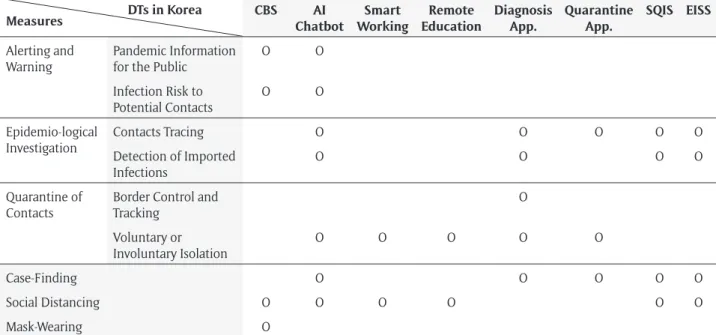
DTs embrace various government measures listed in a containment strategy. Korea introduces DTs in the early pandemic stage. By continuously upgrading the DTs’ functions in each pandemic developmental stage, Korea can implement these diverse measures simultaneously. Table 1 summarizes each DT-based measure in the miti-gation strategy. First, CBS and AI Chatbots enable two-way communications between the government and the public. By sharing facts on the pandemic through CBS and AI Chatbot, the government informs practical guide-lines on social distancing and wearing masks. Second, smart working and remote education systems support the implementation of strict social distancing measures and indirectly facilitate self-isolation. Third, the early installation of self-diagnosis mobile applications at the border control allows multiple measures at the same time – tracking inbound passengers, monitoring their potential infections, and encouraging self-isolation. Quarantine application is similar to self-diagnosis appli-cations, but it focuses more on detecting infections and ultimately finding possible confirmed cases. Fourth, SQIS and EISS in epidemiological investigations support the
public administration to trace contacts, find confirmed cases, and detect imported infections.
DTs integrate containment and mitigation strategies effectively. Korea implants both strategies in the early design stage of DTs. During the COVID-19 outbreak, DTs work as the enablers to connect these two strate-gies. Table 2 summarizes each DT-based measures in both containment and mitigation strategies. First, by applying remote public healthcare with telemedicine service at the early stage of the pandemic outbreak, the government contains diseases and relieves mild symp-toms. These remote services screen the actual COVID-19 symptoms and provide prophylaxis for asymptomatic patient such as prescription of antibiotics and antiviral medicines at home. Consequently, it can prevent possible in-hospital infections. Second, a triangular cooperation network formed by the government, corporations, and researchers enables treatments that prevent something from happening, namely prophylaxis. The network sug-gests presymptomatic testing on individuals in a certain region and develops better healthcare solutions. These achievements are based on studies on the effectiveness of wearing-face masks, social distancing, and epidemiologi-cal forecasting. Moreover, mobile applications developed by the effective and prompt public-private partnership connect other containment measures with presympto-matic testings. Third, the government’s fast approval and immediate funding to COVID-19 diagnostic kit, instal-lation of AI for chest radiography detection, and a new type of testing center help innovation of mitigation and containment strategies. These government’s actions fas-ten and widen the application of presymptomatic testing and indirectly support medical personnel to focus on the treatment by relieving them from the heavy workload of X-ray encryption.
Table 1: Digital Technologies for Containment Strategy.
Measures DTs in Korea CBS ChatbotAI WorkingSmart EducationRemote Diagnosis App. Quarantine App. SQIS EISS
Alerting and
Warning Pandemic Information for the Public O O
Infection Risk to
Potential Contacts O O
Epidemio-logical
Investigation Contacts Tracing O O O O O
Detection of Imported
Infections O O O O
Quarantine of
Contacts Border Control and Tracking O
Voluntary or
Involuntary Isolation O O O O O
Case-Finding O O O O O
Social Distancing O O O O O O
Mask-Wearing O
* Abbreviation: AI, Artificial intelligence; App.: Application; CBS, Cellular Broadcasting Service; DT, Digital technology; EISS, Epidemiological Investigation Support System; SQIS, Smart Quarantine Information System.
5. Conclusion
Disaster Management Paradigm with New Thought This article presents the actual responses of the Korean government against COVID-19 using the latest DTs. It also discusses how Korea smartly fights against an invisible micro-pathogen. Korea has made a success in containing and mitigating COVID-19 so far. The traditional method of applying specific measures or strategies depending on the phase and development of the epidemic is not applied in Korea. Korea rather embraces measures for containment strategy and integrates containment and mitigation strat-egies effectively under DTs.
Based on the Korean experience, this article recom-mends changing the disaster management paradigm, especially in a pandemic crisis, by placing DTs at the center. Along with other critical government’s actions
and individual behaviors during epidemic and pandemic, DTs should be considered as a prerequisite element. DT can connect the government’s policies with individual behaviors, allowing individuals to understand the gov-ernment’s intentions and a government to help individu-als. As seen on the above, DTs can effectively integrate both containment and mitigation strategies. DTs are no longer in the peripheral position of disaster manage-ment. They have become the enablers, facilitators, and integrators of containment and mitigation measures and strategies. This conceptual framework is depicted in Figure 6.
We hope the experience of Korea provides a valuable solution to help other countries and communities in com-batting COVID-19. The identical application of Korea DTs to another context, especially countries that have different Figure 6: Digital Technology-Centered Epidemic and Pandemic Paradigm.
Table 2: Digital Technologies for both Containment and Mitigation Strategies. DTs in Korea Measures Remote Public Healthcare with Telemedicine Service Government- Corporation-Researchers Network Mobile Application by Public-Private Partnership COVID-19 Diagnostic Kit AI for Chest Radiography Detection K-Walk-Thru Testing Centers Containment Strategy
Alerting and Warning O
Epidemio-logical Investigation O O O O O O Quarantine of Contacts O O Case-Finding O O O O Social Distancing O O O O O Mask-Wearing O O Mitigation Strategy Healthcare and Medical Treatment O O O Drug Repurposing and Vaccines Prophylaxis (Pre-symptomatic Testing) O O O O O O
levels of DT capacities and capabilities, may not be pos-sible. Moreover, there might be many other factors that contribute to the successful utilization of DTs in the con-text of Korea. However, what this Korean case emphasizes is the role of DTs and the responsibility of a government to effectively use DTs in pandemic management. Therefore, in general, to implement DTs in pandemic situations, the following three factors are in need to be considered. Governments need to have strong initiations in R&D, maximize DTs for public communication channels and network, and facilitate public-private partnerships as well as strong stakeholder networks to advance DTs and their field applications.
List of Abbreviations AI: Artificial-Intelligence
CBS: Cellular Broadcasting Service COVID-19: Coronavirus Disease DTs: Digital Technologies
EISS: Epidemiological Investigation Support System KCDC: Korea Centers for Disease Control and Prevention MOIS: Ministry of the Interior and Safety
SQIS: Smart Quarantine Information System Funding Information
This research did not receive any specific grant from fund-ing agencies in the public, commercial, or not-for-profit sectors.
Competing Interests
The authors have no competing interests to declare. Author Contribution
All authors verify that each author had access to the data and a role in writing the manuscript.
Publisher’s Note
This paper underwent peer review using the Cross-Pub-lisher COVID-19 Rapid Review Initiative.
References
1. Korea Central Disease Control Headquarters. Coronavirus Disease-19, Republic of Korea. Minis-try of Health and Welfare. Cases in Korea Web site. http://ncov.mohw.go.kr/en/. Accessed June 12, 2020.
2. Majeed A, Seo Y. Can the UK emulate the South Korean approach to COVID-19? BMJ. 2020; 369: 2084. DOI: https://doi.org/10.1136/bmj.m2084 3. World Health Organisation. Pandemic influenza
preparedness and response: A WHO guidance docu-ment. In: Programme WGI, ed. Switzerland: World Health Organisation; 2009.
4. Nicoll A, Coulombier D. Europe’s initial experi-ence with pandemic (H1N1) 2009 – mitigation and delaying policies and practices. Euro Surveill. 2009; 14(29): 1–6. DOI: https://doi.org/10.2807/ ese.14.29.19279-en
5. Hollingsworth D, Klinkenberg D. Mitigation strategies for pandemic influenza A: Balancing
conflicting policy objectives. PLoS Comput Biol. 2011; 7(2): 1001076–1001076. DOI: https://doi. org/10.1371/journal.pcbi.1001076
6. Mounier Jack S, Jas R. Progress and shortcomings in European national strategic plans for pandemic influenza. Bulletin of the World Health
Organiza-tion. 2007; 85(12): 923–929. DOI: https://doi.
org/10.2471/BLT.06.039834
7. Anderson R, Heesterbeek H. How will coun-try-based mitigation measures influence the course of the COVID-19 epidemic? The Lancet. 2020; 395(10228): 931–934. DOI: https://doi. org/10.1016/S0140-6736(20)30567-5
8. World Health Organisation. WHO global influ-enza preparedness plan. In: Disease DoC, ed. Switzerland: World Health Organisation; 2005. 9. Ferguson NM, Cummings D. Strategies for
miti-gating an influenza pandemic. Nature. 2006; 442(7101): 448–452. DOI: https://doi.org/10.1038/ nature04795
10. Ferguson N, Cummings D, Cauchemez S, et al. Strategies for containing an emerging influ-enza pandemic in Southeast Asia. Nature. 2005; 437(7056): 209–214. DOI: https://doi.org/10.1038/ nature04017
11. Markel H, Stern A. Nonpharmaceutical Influenza Mitigation Strategies, US Communities, 1918–1920 Pandemic. Emerging Infectious Diseases. 2006; 12(12): 1961–1964. DOI: https://doi.org/10.3201/ eid1212.060506
12. Anderson R, Fraser C, Ghani A, et al. Epidemiol-ogy, transmission dynamics and control of SARS: the 2002–2013. Philosophical Transactions of the
Royal Society of London Series B: Biological Sciences.
2004; 359(1447): 1091–1105. DOI: https://doi. org/10.1098/rstb.2004.1490
13. COVID-19 Coronavirus Pandemic. Dadax Limited. 2020. https://www.worldometers.info/coronavirus/ worldwide-graphs/. Accessed April 23, 2020. DOI: https://doi.org/10.4324/9781003095590-3
14. International Monetary Fund. World Economic
Outlook. Washington, DC: International Monetary
Fund; 2020.
15. Cabinet Office and Strategic Policy Making Team. Professional policy making for the twenty first
century. London: Cabinet Office; 2009.
16. Heinrich C. Evidence-Based Policy and Performance Management: Challenges and Prospects in Two Parallel Movements. The American Review of Public
Administration. 2007; 37(3): 255–277. DOI: https://
doi.org/10.1177/0275074007301957
17. Jennings EJ, Hall J. Evidence-Based Practice and the Use of Information in State Agency Decision Making. Journal of Public Administration Research
and Theory. 2011; 22(2): 245–266. DOI: https://doi.
org/10.1093/jopart/mur040
18. Herriott RE, Firestone WA. Multisite Qualitative Policy Research: Optimizing Description and General-izability. Educational Researcher. 1983; 12(2): 14–19. DOI: https://doi.org/10.3102/0013189X012002014
19. Yin RK. Case study research and applications: design and methods. 6th ed. Singapore: Sage publications; 2017.
20. The Government of the Republic of Korea.
Tack-ling COVID-19 Health, Quarantine and Economic Measures: Korean Experience. Sejong: Ministry of
Economy and Finance; Mar 31, 2020.
21. The Government of the Republic of Korea. Flattening the curve on COVID-19: How Korea
responded to a pandemic using ICT. Sejong: Ministry
of Economy and Finance; 2020.
22. Korea Centers for Disease Control and Preven-tion. Coronavirus Disease 2019: Response Guidelines
(for Local Governments). Sejong: Korea Ministry of
Health and Welfare; 2020.
23. Park S, Kim Y-M, Yi S, et al. Coronavirus Disease Outbreak in Call Center, South Korea. Emerging
infectious diseases. 2020; 26(8).
How to cite this article: Heo K, Lee D, Seo Y, Choi H. Searching for Digital Technologies in Containment and Mitigation Strategies:
Experience from South Korea COVID-19. Annals of Global Health. 2020; 86(1): 109, 1–10. DOI: https://doi.org/10.5334/aogh.2993
Published: 31 August 2020
Copyright: © 2020 The Author(s). This is an open-access article distributed under the terms of the Creative Commons Attribution
4.0 International License (CC-BY 4.0), which permits unrestricted use, distribution, and reproduction in any medium, provided the original author and source are credited. See http://creativecommons.org/licenses/by/4.0/.
![Figure 1: Phases of Pandemic with Measures in Containment and Mitigation. * Reference: [4, p.11 & p.24; 8].](https://thumb-ap.123doks.com/thumbv2/123dokinfo/5092751.77212/2.892.79.819.907.1126/figure-phases-pandemic-measures-containment-mitigation-reference-amp.webp)
![Figure 3: Process of Self-Diagnosis. * Reference: [22].](https://thumb-ap.123doks.com/thumbv2/123dokinfo/5092751.77212/4.892.83.799.789.1125/figure-process-of-self-diagnosis-reference.webp)
![Figure 5: Two Types of Korea Walk-Through Testing Centers. * Reference: [20].](https://thumb-ap.123doks.com/thumbv2/123dokinfo/5092751.77212/6.892.174.710.871.1126/figure-types-korea-walk-testing-centers-reference.webp)