- 461 - Introduction
1)
Obesity is a disorder wherein excessive body fat accumulates owing to an imbalance in energy expenditure and intake and has become a serious global health concern
*Corresponding author. E-mail:[email protected] Phone:82-55-751-3272, Fax:82-55-751-3279
Received 22 June 2018; Revised 20 July 2018; Accepted 21 July 2018.
Copyright ⓒ The Korean Society of Food Preservation. All rights reserved.
because it is a risk factor or various severe metabolic comorbidities, including diabetes, cardiovascular injury, hyperlipemia and cancer (1,2). Currently, certain anti-obesity drugs are commercially available, including orlistat and sibutramine. Owing to dissatisfaction with the high costs and potentially hazardous side effects, natural products that can regulate adipogenesis have currently received increasing attention and are an excellent alternative strategy to treat obesity (3,4).
The use of soybean as food products has a long history in Asian countries, and soybeans have a large amount of
Enhanced digestive enzyme activity and anti-adipogenic of fermented soy-powder milk with probiotic Lactobacillus plantarum P1201 through
an increase in conjugated linoleic acid and isoflavone aglycone content
Chung Eun Hwang1, Dong Hoon Lee2, Baolo Kim1, Ok Soo Joo1, Su Cheol Kim1, Jin Hwan Lee3, Su Young Hong4, A Ra Choi1, Kye Man Cho1*
1
Department of Food Science, Gyeongnam National University of Science and Technology, Jinju 52725, Korea
2
Department of Anatomy and Convergence Medical Science, Institute of Health Sciences, School of Medicine, Gyeongsang National University, Jinju 52727, Korea
3
Division of Research Development and Education, National Institute of Chemical Safety, Ministry of Environment, Daejeon 34111, Korea
4
Food Science Research Institute, Kolmar BNH Inc., Sejong 30003, Korea
Abstract
This study aimed to produce fermented soy-powder milk (FSPM) with Lactobacillus plantarum P1201 and to evaluate its anti-obesity activity. Isoflavone and conjugated linoleic acid (CLA) of unfermented soy-powder milk (UFSPM) and FSPM and were analyzed via high-pressure liquid chromatography (HPLC) and gas chromatography (GC).
Their inhibitory activities against α-glucosidase, α-amylase, and pancreatic lipase were assayed. Their anti-obesity activities were evaluated on the basis of their inhibitory effects on adipocyte differentiation in 3T3-L1 cells, and the expression of mRNAs associated with adipogenesis and lipid metabolism were analyzed via real time-polymerase chain reaction (RT-PCR) and quantitative PCR (qPCR). FSPM with L. plantarum P1201 increased the isoflavone aglycones (daidzein, glycitein, and genistein) content and produced CLA in soy-powder milk (SPM), both of which possessed bio-activity. Both UFSPM and FSPM showed dose-dependent inhibitory activity for α-glucosidase, α -amylase, and pancreatic lipase. FSPM, but not UFSPM, suppressed adipogenesis in 3T3-L1 cells and reduced their triglyceride content by 23.1% after treatment with 1,000 μg/mL of FSPM, compared with the control group. The anti-obesity effect of FSPM can be attributed to CLA and isoflavone aglycones, which targeted CCAAT/enhancer binding protein α (C/EBP-α) and down-regulated lipoprotein lipase (LPL), adiponectin, adipocyte fatty acid-binding protein (aP2), fatty acid synthase (FAS), and acetyl CoA carboxylase (ACC) mRNA. Furthermore, FSPM enhanced the inhibitory activity of glucosidase and pancreatic enzymes and anti-obesity activity. Further studies are required to investigate whether the anti-obesity effect of FSPM persists in an in vivo mouse model of diet-induced obesity.
Key words:fermented soy-powder milk, Lactobacillus plantarum P1201, anti-adipogenesis, isoflavone aglycones
bioactive compounds and biological activities in addition to their high nutritional value, including estrogenic, antioxidant, anti-osteoporotic, anticarcinogenic, anti-diabetic, and anti- obesity effects (2,5-7). Soymilk is the watery extract of soybeans (8). Fermentation with lactic acid bacteria (LAB) can enhanced not only the physicochemical and sensory properties of soymilk but also the biological anti-obesity effects (9,10). Moreover, isoflavonoids in soymilk are converted from glycosides into the corresponding aglycones after fermentation (11), which display markedly higher absorption efficiency and bioavailability in preventing chronic disease than their glucosides (5).
Fermentation with bacteria of genus Lactobacillus yields conjugated linoleic acid (CLA) from linoleic acid under specific growth conditions (12). CLA has received increasing attention in recent years owing to its potential health effects, including antitumor, anti-atherogenic, antidiabetic, immunomodulatory, osteosynthetic and anti-obesity effects (13). Soybean oil from commodity soybeans contains 54%
linoleic acid (14). Soybeans have the potential to produce CLA-rich foods via LAB fermentation.
We previously reported that the antioxidant activity of soymilk was improved upon fermentation with L. plantarum P1201 under optimal conditions and that the fermented soy-powder milk (FSPM) contained high levels of isoflavone aglycones. Moreover, fermentation with L. plantarum can produce CLA, another bio-active substance, in soymilk (6,15-17). In the present study, we aimed to determine isoflavone and CLA content, estimated the inhibitory activity of α-glucosidase, α-amylase, and pancreatic lipase and, the inhibitory effects on adipogenesis in a 3T3-L1 cells for FSPM and unfermented soy-powder milk (UFSPM). We further determined the effects of FSPM and USFPM on the expression of mRNA associated with adipogenesis and lipid metabolism in 3T3-L1 cells to elucidate the underlying inhibitory mechanism.
Methods and materials
Materials and reagents
The middle soybean cultivar Daewonwas obtained from the National Institute of Crop Science (NICS) of the Rural Development Administration (RDA) in Miryang, Korea, in 2013. Safflower seeds were obtained from the Agricultural Processing Office at Hamyang of Gyeongsangnamdo province. Supercritical carbon dioxide fluid (N-TECH,
Incheon, Korea) extraction is an important separation technique in food and nutraceutical applications owing to its non-toxic nature (17) and was used to extract safflower seed oil 75 kgf/cm2and 25±5℃ for 36±12 h. The potential probiotic L. plantarumP1201 was isolated from fermented beverage plant extracts and cultured in an MRS broth/agar (MRSB/MRSA, Difico, Becton Dickinson Co., Sparks, MD, USA) (15). Standard isoflavone aglycone and β-glucosides (daidzein, glycitein, genistein, daidzin, glycitin, and genistin) were purchased from Sigma-Aldrich Co. (St. Louis, MO, USA) and Indofine (Hillsborough, NJ, USA), respectively.
Standard CLA, penicillin, and streptomycin were purchased from Sigma-Aldrich Co., Dulbecco’s modified Eagle’s medium (DMEM) and fetal bovine serum (FBS) were purchased from Invitrogen Co. (Grand Island, NY, USA).
High-performance liquid chromagraphy (HPLC)-grade H2O, methanol, and acetonitrile were purchased from Fisher Scientific (Fairlawn, NJ, USA). All other reagents are of analytical grade, unless specified otherwise.
Production of FSPM
Soybeans were washed in tap water for 12 h and drained.
Washed soybeans (120 g) were immersed in boiling distilled water for 30 min. The boiled soybeans were dried in a dry oven (HD07026-5003, Hyundae Household Appliances Co., Ltd., Seoul, Korea) at 55℃ for 2-3 days and then pulverized using an ultra-precision grinder into soybean powder. Ten grams of soybean powder was mixed with 100 mL of 2%
sucrose in a 250 mL flask. The mixture was sterilized in an autoclave at 121℃ for 15 min. After cooling, the mixture was hydrolyzed with 10 U of cellulase, protease, and esterase at 37℃ for 24 h. Safflower seed oil, at a final concentration of 1.0%, was then added. The pre-cultureL. plantarumP1201 was inoculated at a density of 2.0×10⁷CFU/mL. Fermentation was carried out at 35±1℃ for 48 h (17). UFSPM and FSPM were extracted and stored at -70℃ until analysis.
Determination of pH, acidity, viable cell number, and β-glucosidase activity
The pH, acidity and viable cell numbers were determined in accordance with the method of Hwang et al. (15). pH was measured using a pH meter (MP 200, Schwerzenbach, UK). The acidity was determined upon titration with a 0.01 N NaOH solution and was expressed in terms of lactic acid (%). To determine the number of viable cells, 1 mL of the samples was mixed with 9 mL of sterilized distilled water at room temperature (25℃), and the mixture was spread on
MRS agar plates. The plate was incubated at 30℃ for 48 h, and the colonies were enumerated. β-Glucosidase activity was evaluated by measuring the hydrolysis ratio of p-nitrophenyl β-D-glucopyranoside (pNPG) in accordance with the method of Hati et al. (8) with some modifications.
CLA and isolfavone analysis
The amount of CLA was determined in accordance with the method of Kim et al. (16). Total lipids were extracted using CHCl3. Soybean lipids were mixed with 0.5 N NaOH in methanol. After mixtures were heated at 100℃ for 5 min and cooled to room temperature (25℃), 14% borontrifluoride in methanol (BF3/MeOH) was added and the mixture washed at 100℃ for 30 min for fatty acid methylation. After cooling to room temperature, fatty acid methyl esters were extracted with isooctane and analyzed via gas chromatography (GC) with an SP-2560 capillary column (100 m×0.25 mm i.d., 0.20 μm film thickness; Sigma-Aldrich Co.).
We quantified isoflavones in the UFSPM and FSPM in accordance with the method of Hwang et al. (18). Briefly, the sample (1 g) was extracted with 10 mL of 50% methanol for 12 h at room temperature. The extracts were filtered through a 0.45 μm membrane filter and analyzed via an HPLC system equipped with a LiChrospher 100 RP C18 (4.6×150 mm, 5 μm, Merck KGaA, Darmstadt, Germany). In total 20 μL samples were injected and gradient elution was performed using a two-solvents mixture: 0.1% glacial acetic acid solution (solvent A) and 100% acetonitrile (solvent B). Isoflavones were eluted in accordance with the following program: 0-20 min, 10% solvent B; 30 min, 20% solvent B; 40 min, 25%
solvent B; 50 min, 35% solvent B. The flow rate, oven temperature, and detection wavelength were 1 mL/min, 30℃, and 254 nm, respectively.
Digestive enzyme inhibition assay
α-Glucosidase inhibitory activity was determined in accordance with previously described method (17). In total, 50 μL of sample solution, 50 μL of α-glucosidase (0.5 U/mL), and 50 μL of sodium phosphate buffer (200 mM, pH 6.8) were mixed and incubated at 37℃ for 10 min. Thereafter, 100 μL of a 5 mM p-nitrophenyl-α-D-glucopyranoside solution was added to the mixture and was allowed to react for 10 min at 37℃. The the reaction was then terminated via addition of 0.75 mL of 100 mM Na2CO3, and the absorbance of the reaction mixture was measured spectrophotomertically at 420 nm.
α-Amlyase inhibitory activity was assessed in accordance
with a previously described method (17). In total, 40 μL of sample solution, 50 μL of α-amylase (0.5 U/mL) and 150 μL of sodium phosphate buffer (200 mM, pH 6.8) were mixed and incubated at 37℃ for 10 min. Thereafter, 250 μL of 1% starch solution in sodium phosphate buffer (pH 6.8) was added to the mixture. The mixture was then allowed to react at 37℃ for 10 min. After having terminated the reaction, 250 μL of a 40 mM 3,5-dinitrosalicylic acid (DNS) solution containing 30% sodium potassium tartrate in 0.5 M NaOH was added, and the mixture was heated for 10 min at 100℃
for color formation. Thereafter, the solution was cooled immediately on ice, and the absorbance was measured spectrophotometrically at 540 nm.
The pancreatic lipase inhibitory assay was performed in accordance with the method of Lee et al. (17). In total, 50 μL of sample solution, 50 μL of lipase (1.0 U/mL) and 50 μL of sodium phosphate buffer (200 mM, pH 6.8) were mixed and incubated at 37℃ for 10 min. Thereafter, 100 μL p-NPB (5 mM) in sodium phosphate buffer (pH 6.8) was added.
The mixture was incubated at 37℃ for 10 min. Thereafter, the reaction was terminated via addition of 0.75 mL of 100 mM Na2CO3, and the absorbance was measured spectrophotometrically at 420 nm. A control representing 100% of the enzymatic activity was used similarly; however, conducted the sample solution was replaced with distilled water. Inhibitory activity was calculated as follows:
Inhibitory activity (%)=absorbance of the control-absorbance of the sampleabsorbance of the control ×100
Cell culture and differentiation and Oil Red O staining
3T3-L1 cells were purchased from the American Type Culture Collection (Manassas, VA, USA). The subcultured cells were seeded into a 60-mm well plate (5×10⁵cells/plate) and cultured in DMEM supplemented with 10% FBS and 1% penicillin-streptomycin at 37℃ in a humidified atmosphere at 5% CO2. Upon reaching confluency, the cells were differentiated with a 3T3-L1 differentiation kit (BioVisionInc., Milpitas, CA, USA) containing 1.5 μg/mL in sulin, 1 μM dexamethasone (DEX), 500 μM 3-isobutyl- 1-methylxanthine (IBMX), and 1 μM rosiglitazone. After day 3, the differentiation medium was replaced with 10%
FBS/DMEM containing 1.5 μg/mL insulin. The medium was replenished every 2 days until 6 day. Samples with different concentrations were administered at the initiation of differentiation and with every medium change for 9 days.
After differentiation ended, cells were washed twice with phosphate-buffered saline (PBS) and fixed with 10% formalin for 60 min at room temperature. The fixed cells were then washed thrice with distilled water (DW) and incubated for 5 min in 60% isopropanol. Isopropanol was eliminated, and the cells were stained with a 0.18% Oil Red O solution in 60% isopropanol for 20 min at room temperature. The Oil Red O solution was eliminated, and the cell culture plate was washed with DW until the excess stain was eliminated.
Lipid droplets were stained red. Cell morphology was assessed using an Olympus BX51 microscope (Olympus, Seoul, Korea) with imaging software.
Determination of triglyceride content
The triglyceride content in adipocytes was determined using a triglyceride colorimetric assay kit (Cayman Chemicals, Ann Arbor, MI, USA). The treated cells were washed thrice with PBS, and the pellet was resuspended in 200 μL of cold standard diluent. The suspension was sonicated for 20 one-second bursts and centrifuged at 12,000 rpm for 15 min. Triglyceride content was determined in the supernatant.
Quantitative reverse transcription polymerase chain reaction (qRT-PCR) analysis
Total RNA was isolated from treated cells, using TRIzol reagent (Invitrogen, Carlsbad, CA, USA), and the RNA concentration and purity were measured using the microplate reader (Infinite M200, Tecan, Salzburg, Austria). cDNA was synthesized using the M-MLV reverse transcriptase kit (Enzynomics, Daejeon, Korea) in accordance with the manufacturer's instructions. The reactions were initiated at 4℃ and held for 5 min. Thereafter, the reactions were subsequently carried out at 37℃ for 60 min and 95℃ for 5 min. Finally, they were held at 4℃ for 10 min.
Table 1. Sequences of primers for reverse transcription polymerase chain reaction-based amplication of genes involved in lipid metabolism
Gene symbol Primer sequence (RT-PCR) Primer sequence (qPCR)
Forward (5ʹ→3ʹ) Reverse (5ʹ→3ʹ) Forward (5ʹ→3ʹ) Reverse (5ʹ→3ʹ) LPL TCCAAGGAAGCCTTTGAGAA TATTTGTGGAAACCTCGGGC TCCAAGGAAGCCTTTGAGAA CCATCCTCAGTCCCAGAAAA C/EBP-α TGGACAAGAACAGCAACGAG TCCTCTGGGTCTCCAGCC TGGACAAGAACAGCAACGAG TCACTGGTCAACTCCAGCAC Adiponectin AAGGACAAGGCCGTTCTCT TATGGGTAGTTGCAGTCAGTTGG AAGGACAAGGCCGTTCTCT TCCAGATGGAGGAGCACAGA aP2 TGGGAACCTGGAAGCTTGTC GTGGTCGACTTTCCATCCCA TGGGAACCTGGAAGCTTGTC GCTGATGATCATGTTGGGCTTG FAS CCCTTGATGAAGAGGGATC CCGTCAATGCAGTGGTCTA CCCTTGATGAAGAGGGATC ACTCCACAGGTGGGAACAAG ACC GGACCACTGCATGGAATGTTAA CCAGGCTACCATGCCAATCT GGACCACTGCATGGAATGTTAA TGAGTGACTGCCGAAACATCTC β-Actin CACCCCAGCCATGTACGT TCCAGGGAGGAAGAGGATGC CACCCCAGCCATGTACGT GTCCAGACGCAGGATGGC
Lipoprotein lipase (LPL), relative CCAAT enhancer-binding proteins α (C/EBP α), adiponectin, adipocyte fatty acid binding protein (aP2), fatty acid synthase (FAS) and acetyl CoA carboxylase (ACC) mRNA levels were analyzed in adipocytes via RT-PCR, using the Maxime RT-PCR PreMix Kit (Intron Biotechnology, Seoul, Korea) and by qPCR using the TOPrealTM qPCR2×PreMix PCR kit (Enzynomics, Daejeon, Korea) with a 7500 Real-Time PCR System (Applied, Biosystems), with β-actin mRNA used as an internal control (Table 1). Cycling conditions for qPCR analysis were as follows: denaturation at 95℃ for 5 min, followed by 45 cycles of denaturation at 95℃ for 30 sec, annealing at 60℃ for 30 sec (C/EBP-α at 65℃), and extension at 72℃ for 30 sec. mRNA expression levels of all samples were normalized to that of β-actin, and the results are expressed as the fold change of the threshold cycle (Ct) value relative to controls, determined using the 2-△△Ctmethod. For RT-PCR, the amplified products were analyzed via electrophoresis on a 1.5% agarose gel followed by staining with ethidium bromide.
Statistical analyses
Data are expressed as the means±standard deviation (SD) values. An analysis of variance (ANOVA), followed by Tukey’s HSD test, was carried out multiple-group comparisons.
JMP 10 package (SAS Institute, Carry, NC, USA) was used for statistical analysis, and a p-value <0.05 and a power value of the tests were considered statistically significant.
Results and discussion
Physicochemical properties of UFSPM and FSPM
In the case of FSPM, a reduction in pH, an increase in
the acidity, and an increase in viable cell numbers were observed, compared with those in the case of UFSPM (Table 2). The reduction in pH and the increase in acidity are attributed to the production of lactic acid during fermentation (19). FSPM had appropriate acidity, within the pH range of commercial yogurts (pH 3.9-4.2) (20). Importantly, FSPM exhibited higher levels of β-glucosidase activity than UFSPM, accompanied by a high content of isoflavone aglycones (21).
Table 2. Comparison of pH, acidity, viable cell numbers, and β -glucosidase activity between unfermented and fermented soy-powder milk
Contents Samples1)
UFSPM FSPM
pH 6.01±0.302)a3) 4.17±0.21b Acidity (%, as lactic acid) 0.43±0.03b 1.12±0.06a Viable cell numbers (log CFU/mL) 9.21±0.46a 10.49±0.52a
β-Glucosidase activity (unit/mL) 0.03±0.00b 1.64±0.05a
1)UFSPM, unfermented soy-powder milk; FSPM, fermented soy-powder milk.
2)All values are presented as the mean±SD of determinations in three independent experiments.
3)Different letters within the row are significantly different at p<0.05 by Duncan`s multiple range test.
CLA and isoflavone contents in UFSPM and FSPM
The total CLA content in FSPM was 1.28 mg/g, among which the cis-9, trans-10 isomer accounted for 90.62%;
however, the CLA content in the UFSPM was too low to be detected (Table 3).
Microbial fermentation can yield CLA. Van Nieuwenhove et al. (22) reported that the conversion ratio from linoleic acid to CLA by LAB was approximately 17% and 36% in MRS broth and buffalo milk, respectively. Hennessy et al.
(23) reported that free linoleic acid was bioconverted to the predominantcis-9,trans-11 CLA isomers by theBifidobacterium Table 3. Comparison of conjugated linoleic acid content in unfermented and fermented soy-powder milk
Conjugated linoleic acid (CLA) contents (mg/g) Samples1)
UFSPM FSPM
cis-9,trans-11 CLA ND2) 1.16±0.083)a4) trans-10,cis-12 CLA ND 0.12±0.01b
Total CLA ND 1.28±0.11a
1)UFSPM, unfermented soy-powder milk; FSPM, fermented soy-powder milk.
2)ND, not detected.
3)All values are presented as the means±SD of determinations in three independent experiments.
4)Different letters within the row are significantly different at p<0.05 by Duncan`s multiple range test.
breve and B. longum strains, concurrent with the present results.
As shown in Table 4, the glycoside isoflavone content decreased, while that aglycone isoflavone increased in FSPM compared with UFSPM. β-glycosidase and/or the lactic acid generated during fermentation is involved in the catalysis of β-glycosides into aglycone isoflavone (21,24). These enzymes catalyze the hydrolysis of isoflavone β-glycoside bonds by various LAB. This phenomenon confirms that isoflavone derivatives and their content may be associated with the hydrolases including β-glycosidase effects during soybean fermentation (17). Recent studies have reported an increase in isoflavone aglycones content from isoflavone glucosides by β-glycosidase enzyme in soybeans and soy products. In addition, lactic acid fermentation converts glycoside, malonyl and acetyl glycoside to aglycone (25). Hwang et al. (15) and Lee et al. (17) reported that the daidzein and genistein content increased, while that of daidzin and genistin decreased during fermentation, concurrent with the present results. Aglycone isoflavone has a higher bioavailability than its corresponding glycoside isoflavone (5). Thus, FSPM would be expected to display greater bioactivity than UFPSM.
Table 4. Comparison of isoflavone glycoside and isoflavone contents in unfermented and fermented soy-powder milk
Isoflavone contents (μg/g) Samples1)
UFSPM FSPM
Glycosides
Daidzin 264.68±15.882)a3) 54.34±3.26b Glycitin 165.96±9.96a 26.66±1.60b Genistin 371.77±22.31a 12.10±0.73b Total 802.41±48.14a 93.11±5.59b Aglycones
Daidzein 17.69±1.06b 164.86±9.89a Glycitein 10.63±0.64b 40.10±2.41a Genistein 15.12±0.91b 164.09±9.85a Total 43.44±4.37b 369.08±20.37a Total isoflavones 845.85±53.97a 546.79±27.22b
1)UFSPM, unfermented soy-powder milk; FSPM, fermented soy-powder milk.
2)All values are presented as the means±SD of determinations in three independent experiments.
3)Different superscripts within the row are significantly different at p<0.05 by Duncan`s multiple range test.
Digestive enzyme inhibitory activities in UFSPM and FSPM
As shown in Fig. 1, both UFSPM and FSPM inhibited the activities of α-glucosidase, α-amylase, and pancreatic
lipase in a dose-dependent manner, owing to isoflavone and phenolic compounds (26-28). FSPM displayed greater inhibition of these enzymes than UFSPM, especially for pancreatic lipase, when treated at the same concentration.
α-Glucosidase and α-amylase generate glucose from dietary sources, and the inhibition of both enzymes is considered therapeutic strategy for type-2 diabetes by controlling postprandial hyperglycemia (29). Pancreatic lipase is an important enzyme for digesting dietary triglycerides, and the inhibition of pancreatic lipase can reduce energy intake and prevent obesity (30). Therefore, the inhibition of α -glucosidase, α-amylase and pancreatic lipase by FSPM is considered beneficial to prevent metabolic diseases.
Fig. 1. Comparison of α-glucosidase (A), α-amylase (B), and pancreatic lipase inhibitory activity (C) on treatment with unfermented and fermented soy-powder milk.
UFSPM, unfermented soy-powder milk; FSPM, fermented soy-powder milk.
Different letters within the bar are significantly different at p<0.05 by Duncan`s multiple range test.
Effect of lipid accumulation in 3T3-L1 adipocytes in UFSPM and FSPM
Obesity result from numerous changes in adipocytes through a complex interplay between proliferation and differentiation of pre-adipocytes (31). The inhibition of adipocyte differentiation is a key strategy in preventing obesity. In the presence of a hormonal cocktail comprising IBMX, DEX, rosiglitazone, and insulin, 3T3-L1 preadipocytes reportedly differentiated into adipocyte-like cells and accumulate triacylglycerol-rich lipid droplets (32). To decide the test concentration, the effect of UFSPM and FSPM on the proliferation of 3T3-L1 pre-adipocytes were determined.
No toxicity was observed in the concentration range of 100-1,000 μg/mL (data not shown). In the selected concentration range, the effects of UFSPM and FSPM on lipid accumulation in 3T3-L1 cells were investigated. 3T3-L1 cells were differentiated into adipocytes during 9 days in DMEM in the presence or absence of UFSPM and FSPM;
thereafter, intracellular lipid content was evaluated via Oil Red O staining. The number of lipid droplets in the FSPM-treated group decreased compared with that of untreated group and UFSPM-treated group (Fig. 2). Moreover, analysis of intracellular triglyceride levels revealed that FSPM caused a dose-dependent reduction in the intracellular accumulation of triglycerides compared to the untreated group. The TG levels decreased by 23.1% at a concentration of 1,000 μg/mL, whereas the UFSPM-treated group did not show a reduction but rather a significant increase in the intracellular accumulation of TG (Fig. 3). These results indicate that FSPM repressed the accumulation of intracellular lipids in adipocytes.
The aglycone isoflavone genistein can efficiently inhibit adipocyte differentiation and has potential anti-obesity effects on 3T3-L1 cells (1). The trans-10, cis-12 isomer of CLA can inhibit preadipocyte differentiation and reduce body fat gain in mice (33). Zhai et al. (34) investigated the effects oftrans-10,cis-12 andcis-9,trans-11 isomers of CLA onlipid metabolism in 3T3-L1 cells and reported that thetrans-10, cis-12 isomer stimulated adipocyte energy expenditure, apoptosis, and fatty acid oxidation and exhibited a greater effect on lipid metabolism than the cis-9,trans-11 isomer.
We attributed the anti-obesity effect of FSPM to aglycone isoflavones and the trans-10, cis-12 isomer of CLA.
Effects of UFSPM and FSPM on the expression of genes associated with adipocyte differentiation To understand the molecular mechanisms underlying the
Fig. 2. Lipid droplet accumulation in differentiated 3T3-L1 cells after treatment with unfermented and fermented soy-powder milk.
A, UFSTM-treated group; B, FSPM-treated group.
DM, differentiation medium.
Fig. 3. Triglyceride content in differentiated 3T3-L1 cells after treatment with unfermented and fermented soy-powder milk.
DM, differentiation medium.
Different letters within the bar are significantly different at p<0.05 by Duncan`s multiple range test.
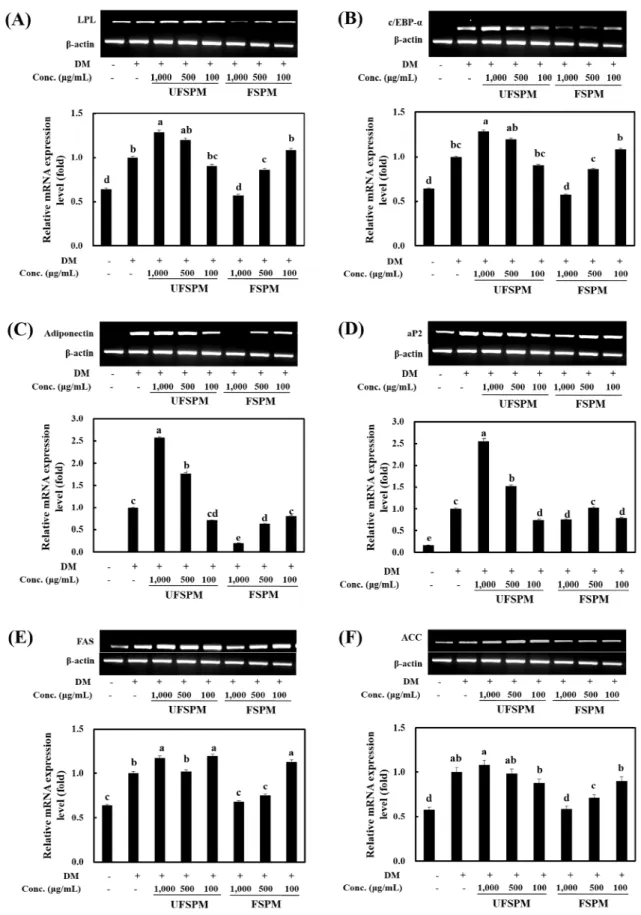
suppression of adipocyte differentiation by FSPM, the expression levels of genes involved in adipogenesis and lipid metabolism were assessed. The mRNA levels of LPL, C/EBP- α, adiponectin, aP2, FAS and ACC in the FSPM-treated (1,000 μg/mL) cells decreased to 43, 39, 81, 25, 32, and 41% of the untreated group, respectively (Fig. 4).
C/EBP-α, one of three isoforms of C/EBPs, is critical activator of adipogenesis and plays an important role in terminal differentiation by maintaining the differentiated status of adipocytes (1). In the present study, C/EBP-α was down-regulated by FSPM. Moreover, target genes regulated by transcription factors, such as LPL, adiponectin, aP2, FAS, and ACC, were also down-regulated. The reduction in LPL mRNA expression reduces intracellular lipid accumulation during differentiation of 3T3-L1 preadipocytes (35). Adipocyte
fatty acid-binding protein (aP2) is considered a potential pharmacotherapeutic target because its absence protects against both dietary and genetic obesity (6). FAS is up-regulated in adipose tissue, and inhibition of FAS can inhibit preadipocyte differentiation and suppress food intake, thereby resulting in weight loss in mice (6,36). The lipogenic enzyme ACC yields malonyl-CoA, a substrate of fatty acid synthase, and inhibition of ACC prevents the differentiation of 3T3-L1 cells (37). Adiponectin is the adipocytokine secreted by fully differentiated adipocytes, and its synthesis levels correlate with adipocyte development (35). Down- regulation of adiponectin decreases the adipocyte number.
These results indicate that FSPM decreased lipid accumulation in 3T3-L1 adipocytes by suppressing the mRNA expression of genes related associated with adipogenesis and lipid metabolism.
Conclusion
FSPM showed greater inhibitory effects for α-glucosidase, α-amylase, and pancreatic-lipase than UFSPM. Moreover, FSPM inhibited the differentiation of 3T3-L1 cells and decreased lipid accumulation and the triglyceride content in 3T3-L1 cells by suppressing the mRNA expression of genes associated with adipogenesis and lipid metabolism, such as LPL, C/EBP-α, adiponectin, aP2, FAS, and ACC; however, UFSPM did not yield such effects. However, obesity is a complex, chronic metabolic disease. Nonetheless, the results of a 3T3-L1 cell in vitro test were not adequate to prove the anti-obesity effect of FSPM and to understand the
Fig. 4. Effect of unfermented and fermented soy-powder milk on mRNA expression of LPL (A), C/EBP-α (B), adiponectin (C), aP2 (D), FAS (E), and ACC (F).
DM, differentiation medium.
Different letters within the bar are significantly different at p<0.05 by Duncan`s multiple range test.
anti-obesity mechanism of FSPM. Further studies are required to investigate whether the anti-obesity effect of FSPM persists in an in vivo mouse model of diet-induced obesity.
Acknowledgment
This study was financial supported by the Cooperative Research Program for Agriculture Science & Technology Development (grant number PJ01133903), Rural Development Administration (RDA) and the Basic Science Research Program through the National Research Foundation of Korea (NRF) funded by the Ministry of Education, Science and Technology (grant number 2016R1D1A1B01009898), Republic of Korea.
References
1. Hwang JW, Do HJ, Kim OY, Chung JH, Lee JY, Park YS, Hwang KY, Seong SI, Shin MJ (2015) Fermented soybean extract suppresses differentiation of 3T3-L1 preadipocytes and facilitates its glucose utilization. J Funct Foods, 15, 516-524
2. Tan HY, Tse IMY, Li ETS, Wang M (2015) Inhibitory effects of oxyresveratrol and cyanomaclurin on adipogenesis of 3T3-L1 cells. J Funct Foods, 15, 207-216 3. Yun JW (2010) Possible anti-obesity therapeutics from
nature: A review. Phytochem, 71, 1625-1641
4. Kim HK, Kim JN, Han SN, Nam JH, Na HN, Ha TJ (2012) Black soybean anthocyanins inhibit adipoyte differentiation in 3T3-L1 cells. Nutr Res, 32, 770-777 5. Izumi T, Piskula MK, Osawa S, Obata A, Tobe K, Saito M, Kataoka S, Kubota Y, Kikuchi M (2000) Soy isoflavone aglycones are absorbed faster and in higher amounts than their glucosides in humans. J Nutr, 130, 1695-1609
6. Xie C, Hwang CE, Oh CK, Yoon NA, Ryu JH, Jeong JY, Roh GS, Kim HJ, Cho GJ, Choi WS, Kang SS, Cho KM, Lee DH (2017) Fermented soy-powder milk with Lactobacillus plantarumP1201 protects against high-fat diet-induced obesity. Int J Food Sci Technol, 52, 1614-1622
7. Hwang CE, Haque MA, Lee JH, Joo OS, Kim SC, Lee HY, Um BS, Park KS, Cho KM (2018) Comparison of γ-aminobutyric acid and isoflavone aglycone contents to radical scavenging activities of high-protein soybean
sprouting by lactic acid fermentation withLactobacillus brevis. Korean J Food Preserv, 25, 7-18
8. Hati S, Vij S, Singh BP, Mandal S (2015) β-Glucosidase activity and bioconversion of isoflavones during fermentation of soymilk. J Sci Food Agric, 95, 216-220 9. Lee BH, Lo YH, Pan TM (2013) Anti-obesity activity of Lactobacillus fermented soy milk products. J Funct Foods, 5, 905-913
10. Cheng MC, Tsai TY, Pan TM (2015) Anti-obesity activity of the water extract of Lactobacillus paracasei subsp.
paracasei NTU 101 fermented soy milk products. Food Funct, 6, 3522-3530
11. Lim KH, Han JH, Lee JY, Park YS, Cho YS, Kang KD, Yuk WJ, Hwang KY, Seong SI, Kim B, Kwon JK, Kang CW, Kim JH (2012) Assessment of antidiabetogenic potential of fermented soybean extracts in streptozotocin- induced diabetic rat. Food Chem Toxicol, 50, 3941-3948 12. Hosseini ES, Kermanshahi RK, Hosseinkhani S, Shojaosadati SA, Nazari M (2015) Conjugated linoleic acid production from various substrates by probiotic Lactobacillus plantarum. Ann Microbiol, 65, 27-32 13. Andrade JC, Ascencao K, Gullon P, Henriques S, Pinto
J, Rocha-Santos TA, Freitas AC, Gomes AM (2012) Production of conjugated linoleic acid by food-grade bacteria: A review. Int J Dairy Technol, 65, 467-481 14. Pham AT, Shannon JG, Bilyeu KD (2012) Combinations of mutant FAD2 and FAD3 genes to produce high oleic acid and low linolenic acid soybean oil. Theor Appl Genet, 125, 503-515
15. Hwang CE, An MJ, Lee HY, Lee BW, Kim HT, Ko JM, Baek IY, Seo WT, Cho KM (2014) Potential probiotic Lactobacillus plantarum P1201 to produce soy-yogurt with enhanced antioxidant activity. Korean J Food Sci Technol, 46, 556-565
16. Kim B, Lee BW, Hwang CE, Lee YY, Lee C, Kim BJ, Park JY, Sim EY, Haque MA, Lee DH, Lee JH, Ahn MJ, Lee HY, Ko JM, Kim HT, Cho KM (2015) Screening of conjugated linoleic acid (CLA) producingLactobacillus plantarumand production of CLA on soy-powder milk by these stains. Korean J Microbiol, 51, 231-240 17. Lee JH, Kim B, Hwang CE, Haque MA, Kim SC, Lee
CS, Kang SS, Cho KM, Lee DH (2018) Changes in conjugated linoleic acid and isoflavone contents from fermented soymilks using Lactobacillus plantarumP2101 and screening for their digestive enzyme inhibition and antioxidant properties. J Funct Foods, 43, 17-28 18. Hwang CE, Lee DH, Joo OS, Lee HY, Kim SC, Park
KS, Um BS, Cho KM (2017) Comparison of physiochemical property, phytochemical contents, and biological activity of soy sauce added with bitter melon powder. Korean J Food Preserv, 24, 1138-1148 19. Sharma V, Mishra HN (2014) Unstructured kinetic
modeling of growth and lactic acid production by Lactobacillus plantarumNCDC 414 during fermentation of vegetable juices. LWT-Food Sci Technol, 59, 1123-1128
20. Mani-Lopez E, Palou E, Lopez-Malo A (2014) Probiotic viability and storage stability of yogurts and fermented milks prepared with several mixtures of lactic acid bacteria. J Dairy Sci, 97, 2578-2590
21. Marazza JA, Garro MS, de Giori GS (2009) Aglycone production byLactobacillus rhamnosusCRL981 during soymilk fermentation. Food Microbiol, 26, 333-339 22. Van Nieuwenhove CP, Oliszewski R, Gonzalez SN, Perez
Chaia AB (2007) Conjugated linoleic acid conversion by dairy bacteria cultured in MRS broth and buffalo milk.
Lett Appl Microbiol, 44, 467-474
23. Hennessy AA, Ross RP, Devery R, Stanton C (2009) Optimization of a reconstitute skim milk based medium for enhanced CLA production byBifidobacteria. J Appl Microbiol, 106, 1315-1327
24. Rekha CR, Vijayalakshmi G (2010) Bioconversion of isoflavone glycosides to aglycones, mineral bioavailability and vitamin B complex in fermented soymilk by probiotic bacteria and yeast. J Appl Microbiol, 109, 1198-1208 25. Yeom SJ, Kim BN, Kim YS, Oh DK (2012) Hydrolysis of isoflavone glycosides by a thermostable β-glucosidase from Pyrococcus furiosus. J Agric Food Chem, 60, 1535-1541
26. Liu R, Xu B (2015) Inhibitory effects of phenolics and saponins from commonly consumed food legumes in China against digestive enzymes pancreatic lipase and α-glycosidase. Int J Food Prop, 18, 2246-2255 27. Lee DS, Lee S (2001) Genistein, a soy isoflavone, is
a potent α-glucosidase inhibitor. FEBS lett, 501, 84-86 28. de Sales PM, de Souza PM, Simeoni LA, Magalhaes PO, Damaris S (2012) α-Amylase inhibitors: A review
of raw material and isolated compounds from plant source. J Pharm Pharm Sci, 15, 141-183
29. Striegel L, Kang B, Pilkenton SJ, Rychlik M, Apostolidis E (2015) Effect of black tea and black tea pomace polyphenols on α-glucosidase and α-amylase inhibition, relevant to type 2 diabetes prevention. Front Nutr, 2, 1-6 30. Sosnowska D, Podsedek A, Redzynia M, Zyzelewicz D (2015) Effects of fruit extracts on pancreatic lipase activity in lipid emulsion. Plant Foods Hum Nutr, 70, 344-350
31. Lasa A, Churruca I, Eseberri I, Andres-Lacueva C, Portillo MP (2012) Delipidating effect of resveratrol metabolites in 3T3‐L1 adipocytes. Mol Nutr Food Res, 56, 1559-1568
32. Xiao L, Zhang J, Li H, Liu J, He L, Zhang J, Zhai Y (2010) Inhibition of adipocyte differentiation and adipogenesis by the traditional Chinese herb Sibiraea angustata. Exp Biol Med, 235, 1442-1449
33. Kang K, Liu W, Albright KJ, Park Y, Pariza MW (2003) trans-10,cis-12 CLA inhibits differentiation of 3T3-L1 adipocytes and decreases PPARγ expression. Biochem Biophys Res Commun, 303, 795-799
34. Zhai J, Liu Z, Li J, Chen J, Jiang L, Wang D, Yuan J, Shen JG, Yang DP, Chen JQ (2010) Different mechanisms of cis-9,trans-11- and trans-10,cis-12- conjugated linoleic acid affecting lipid metabolism in 3T3-L1 cells. J Nutr Biochem, 21, 1099-1105 35. Kowalska K, Olejnik A, Rychlik J, Grajek W (2015)
Cranberries (Oxycoccus quadripetalus) inhibit lipid metabolism and modulate leptin and adiponectin secretion in 3T3-L1 adipocytes. Food Chem, 185, 383-388
36. Schmid B, Rippmann JF, Tadayyon M, Hamilton BS (2005) Inhibition of fatty acid synthase prevents preadipocyte differentiation. Biochem Biophys Res Commun, 328, 1073-1082
37. Lee CM, Yoon MS, Kim YC (2015) Effects ofPueraria lobata root ethanol extract on adipogenesis and lipogenesis during 3T3-L1 differentiation into adipocytes.
Toxicol Res, 2, 191-201