REVIEW ARTICLE
Helicobacter pylori 의 새로운 제균 치료법
강봉구, 박성민, 김병욱
가톨릭대학교 의과대학 내과학교실
New Therapeutic Strategies against Helicobacter pylori
Bong-Ku Kang, Sung Min Park and Byung Wook Kim
Department of Internal Medicine, College of Medicine, The Catholic University of Korea, Seoul, Korea
The standard therapy for Helicobacter pylori infection in Korea is a triple-drug regimen consisting of a proton pump inhibitor with two antibiotics such as clarithromycin, amoxicillin, and metronidazole. However, as the eradication rate of this regimen has declined over the past decade, this prompted the formulation of new therapeutic regimens. New therapeutic strategies against H. pylori infection that had been tried all over the world include sequential therapy, concomitant therapy, and tailored therapy This article will review the basic concepts and the results of previous clinical trials on the aforementioned new therapeutic regiments. (Korean J Gastroenterol 2014;63:146-150)
Key Words: Helicobacter pylori; Eradication
CC This is an open access article distributed under the terms of the Creative Commons Attribution Non-Commercial License (http://creativecommons.org/licenses/
by-nc/3.0) which permits unrestricted non-commercial use, distribution, and reproduction in any medium, provided the original work is properly cited.
교신저자: 김병욱, 403-720, 인천시 부평구 동수로 56, 가톨릭대학교 인천성모병원 소화기내과
Correspondence to: Byung Wook Kim, Division of Gastroenterology, Department of Internal Medicine, Incheon St. Mary’s Hospital, The Catholic University of Korea, 56 Dongsu-ro, Bupyeong-gu, Incheon 403-720, Korea. Tel: +82-32-280-5052, Fax: +82-32-280-5987, E-mail: [email protected]
Financial support: None. Conflict of interest: None.
서 론
Helicobacter pylori는 1984년 Marshall과 Warren1에 의 해 처음 발견되었고, 위염, 소화성궤양, 위점막연관림프종 (marginal zone B cell lymphoma of mucosa-associated lymphoid tissue type), 위선암 등을 유발하는 것으로 알려져 있다.2,3 H. pylori 제균 치료는 소화성궤양의 재발률을 낮추고 위점막연관림프종의 관해를 유도하며, 조기 위암의 내시경 치 료 후 이시성 재발률을 낮출 수 있다.4-8 우리나라에서는 대한 헬리코박터ㆍ상부위장관학회에서 1998년 처음으로 진단 및 치료 가이드라인을 제정한 후 2009년 두 번째 가이드라인, 2013년에 세 번째 가이드라인이 발표되었다.9-11 현재 가이드 라인에 따르면 양성자펌프억제제(proton pump inhibitor) 표 준용량, 아목시실린(amoxicillin) 1.0 g, 클라리스로마이신 (clarithromycin) 500 mg을 1일 2회 1-2주간 투여하는 삼제 요법을 표준 1차 요법으로 권고하고 있다. 그러나 전세계적으 로 클라리스로마이신에 대한 내성균 발현의 증가로 H. pylori
제균율이 점차 낮아지고 있고,12 국내의 보고에서도 H. pylori 제균율은 낮아지고 있다.13-15 이로 인해 제균율이 더 높은 새 로운 1차 요법의 필요성이 대두되고 있는데, 본 논고에서는 기존의 1차 요법을 대체할 수 있는 새로운 치료법들 중 순차 적 제균 요법(sequential therapy), 동시 제균 요법(concomi- tant therapy), 맞춤형 치료(tailored therapy) 등에 대하여 알 아보고자 한다.
본 론
1. 순차적 제균 요법
순차적 제균 요법은 2000년 Zullo 등16에 의해 처음 소개된 치료법으로 양성자펌프억제제와 아목시실린을 첫 5일간 투여 한 후 다음 5일간 양성자펌프억제제와 클라리스로마이신, 니 트로이미다졸(메트로니다졸 또는 티니다졸)을 투여하는 방법 이다.
표준 삼제 요법의 효과에 영향을 미치는 인자들로는 세균
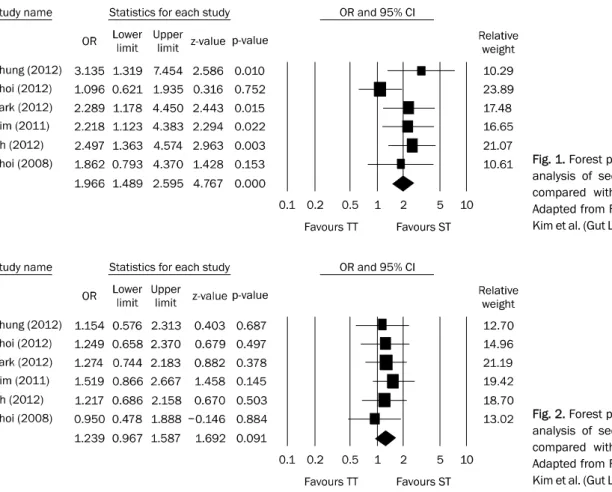
Fig. 1. Forest plot of the per-protocol analysis of sequential therapy (ST) compared with triple therapy (TT).
Adapted from Fig. 3 of the article by Kim et al. (Gut Liver 2013;7:546-551).
Fig. 2. Forest plot of the per-protocol analysis of sequential therapy (ST) compared with triple therapy (TT).
Adapted from Fig. 4 of the article by Kim et al. (Gut Liver 2013;7:546-551).
적 요인으로 항생제 내성, 위강 내 H. pylori 밀도, Cag A 등이 있고, 숙주요인으로는 기저질환, 흡연, 순응도 등이 있 다.17 이 중 클라리스로마이신에 대한 내성과 치료에 대한 순 응도 두 가지 요인만이 치료 결과와 중요한 연관이 있다.18 이러한 요인을 고려할 때, 순차적 제균 요법이 표준 삼제 요법 보다 더 높은 제균율을 보이는 이유는 다음과 같다. 첫째, 클 라리스로마이신 포함 표준 삼제 요법은 위강 내 세균 밀도가 낮을수록 높은 제균율을 획득하는 것으로 알려져 있다.19-21 따 라서 순차적 제균 요법은 처음 5일간 투여되는 아목시실린을 병합한 이제 요법을 통해 위강 내 세균 밀도를 낮추고, 이는 이후에 투여되는 클라리스로마이신, 니트로이미다졸의 효과 를 증가시킨다. 둘째, H. pylori는 항생제를 세균 밖으로 빠르 게 이동시켜 항생제가 리보솜(ribosome)과 결합하는 것을 방 해하는 유출채널(efflux channel)을 만들 수 있다.22-24 초기 이 제 요법의 아목시실린은 세균의 세포벽에 손상을 입혀 유출채 널의 생성을 억제하고 이를 통해 이후에 투여되는 클라리스로 마이신의 효과를 향상시킨다.25,26
국내에서 시행된 한 메타분석에서 치료의향분석(intent to treat, ITT)상 순차적 제균 요법의 제균율은 79.4%로 표준 삼 제 요법의 68.2%보다 높았다. 또한 프로토콜에 따른 분석 (per-protocol, PP)에서도 순차적 제균 요법의 제균율이 86.4%
로 표준 삼제 요법의 78.9%보다 높았다(Figs. 1, 2).27 그러나 메타분석에 포함된 6개의 연구 중 5개는 단일기관연구였고, 치료 가이드라인에서 요구하는 ITT 분석에서 80%, PP 분석 에서 90% 이상을 만족시키지 않고 있어, 전국적인 전향적 다 기관 연구가 필요하다.
국내에서 H. pylori 균주의 클라리스로마이신 저항성은 1994년 2.8%에서 2003년 13.8%로 증가하였다는 보고와28 2003-2005년 16.7%에서 2007-2009년 38.5%로 급격하게 증 가하였다는 보고가 있어,29 클라리스로마이신의 저항성이 크 게 증가하고 있는 것으로 생각된다. 이러한 점을 고려할 때, 국내에서는 H. pylori에 대한 1차 제균 방법으로 순차적 제균 요법이 표준 삼제 요법을 대체할 수 있는 좋은 치료법으로 생각된다. 그러나 순차적 제균 요법의 단점은 치료 중간에 복 용하는 약제가 바뀌기 때문에 약제에 대한 순응도가 떨어질 수 있고 제균 실패 시에 2차 제균 요법이 확립되어 있지 않다 는 점이다.
2. 동시 제균 요법
동시 제균 요법은 1998년 독일과 일본의 연구에서 처음으 로 소개된 치료법으로,30,31 양성자펌프억제제와 3가지의 항생 제(아목시실린, 클라리스로마이신, 니트로이미다졸)를 동시에
투여하는 치료법이다. 이 요법은 5일간의 짧은 치료기간에도 불구하고 좋은 제균율을 보였다.
국내의 동시 제균 요법과 표준 삼제 요법을 비교한 단일기 관연구에서 5일간의 동시 제균 요법은 ITT 분석에서 80.7%, PP 분석에서 91.4%의 제균율을 보였고 7일간의 표준 삼제 요법은 ITT 분석에서 72.6%, PP 분석에서 85.2%의 제균율을 보여, 동시 제균 요법의 제균율이 표준 삼제 요법보다 다소 높았으나 통계적으로 유의한 차이는 없었다. 부작용은 동시 제균 요법이 35.6%로 표준 삼제 요법의 25.2%보다 더 높았으 나 통계적으로 유의한 차이는 없었다.32 그러나 동시 제균 요 법과 표준 삼제 요법을 비교한 국외의 메타분석에서 동시 제 균 요법의 제균율은 ITT 분석에서 90.8%로 표준 삼제 요법의 79%보다 높았고, PP 분석에서도 동시 제균 요법의 제균율은 93.4%로 표준 삼제 요법의 82.8%보다 통계적으로 의미 있게 높았다.33
동시 제균 요법에 관하여 총 인원 1,723명을 대상으로 하는 15개의 연구에 대한 메타 분석에서 ITT 분석상 제균율은 90%였으며 7-10일간 치료한 군이 3-5일간 치료한 군보다 더 좋은 결과를 보였다.34 이렇게 치료기간이 길수록 H. pylori 제균율이 증가하는 이유에 대해 이 논문에서는 메트로니다졸 에 대한 내성을 극복할 수 있기 때문으로 설명하였으며 향후 메트로니다졸 고용량을 포함하는 동시 제균 요법에 대한 연구 가 필요하다고 언급하였다.
동시 제균 요법은 순차적 제균 요법에 비해 복용법이 간편 하여 현재 순차적 제균 요법의 대안 요법으로 고려할 수 있다.
그러나 순차적 제균 요법과 마찬가지로 제균 실패 시에 2차 제균 요법이 확립되어 있지 않다. 두 요법을 14일간 투여하는 방법을 비교한 국내의 한 연구에서 두 군 간의 H. pylori 제균 율, 약제에 대한 순응도 및 부작용 등은 통계적으로 유의한 차이가 없었고,35 두 요법의 10일간의 치료를 비교한 국외의 여러 연구에서도 국내에서와 동일하게 H. pylori 제균율, 약제 에 대한 순응도 및 부작용은 통계적으로 유의한 차이가 없었
다.36-38 향후 두 요법 중 어느 방법의 제균율이 더 높은지에
대해 추가적인 연구가 필요하겠다.
3. 맞춤형 치료
맞춤형 치료는 H. pylori 제균 치료 전에 클라리스로마이신 에 대한 내성을 미리 확인하여 그 결과에 따라 치료 약제를 다르게 하는 방법이다. 또한 양성자펌프억제제의 대사 정도에 따라 그 종류를 선택하는 방법도 일종의 맞춤형 치료이다. 그 러나 H. pylori의 균 배양이 어렵고 오랜 시간이 소요되며, 내성을 판단하는 기준도 각 검사법에 따라 다양하기 때문에 현재까지는 주로 경험적 항생제 치료에 의존할 수 밖에 없었다.
최근에는 중합효소연쇄반응을 이용하여 23s rRNA 유전자
의 점 돌연변이(point mutation)를 확인하여 H. pylori의 클 라리스로마이신에 대한 내성을 빠르고 간단하게 알아낼 수 있 는 검사법이 상품화되어 일부 진료현장에서 사용되고 있다.39 비용은 신속요소분해효소검사와 비슷하고 우리나라에서 보험 적용도 받을 수 있으며, 검사 소요시간도 일주일 이내이므로 일차의료기관에서도 수탁검사를 통해 사용할 수 있다. 이 검 사 결과를 바탕으로 클라리스로마이신 내성인 경우는 니트로 이미다졸을 포함한 삼제 요법 치료 혹은 비스무스(bismuth) 를 포함하는 사제 요법을 1차 치료로 고려할 수 있고, 클라리 스로마이신에 내성이 없는 경우는 기존의 표준 삼제 요법을 사용하면 된다.
국내에서 1,232명을 대상으로 한 다기관연구에서 맞춤형 치료의 제균율은 ITT 분석에서 80.7%, PP 분석에서 91.2%로 클라리스로마이신에 대한 내성 확인 없이 표준 삼제 요법을 사용한 대조군의 69.5%와 75.9%에 비해 통계적으로 유의하 게 더 높았다. 프로톤펌프억제제, 아목시실린, 메트로니다졸 을 사용한 대조군의 ITT 분석 79.1%, PP 분석 71.1%와 비교 하여도 맞춤형 치료의 제균율은 통계적으로 유의하게 높았 다.40 따라서 클라리스로마이신의 저항성이 20%가 넘는 국내 에서 맞춤형 치료는 새로운 표준 1차 제균 요법으로 고려할 수 있다.
결 론
국내에서 H. pylori에 대한 표준 삼제 요법의 제균율은 점 차 감소하고 있어, 표준 삼제 요법을 더 이상 1차 치료법으로 권고해야 할지 논의가 필요한 시점이다. 현재 국내외 여러 보 고들에 의하면 순차적 제균 요법 또는 동시 제균 요법이 표준 삼제 요법을 대신할 수 있을 것으로 기대되지만 클라리스로마 이신과 니트로이미다졸을 동시에 1차에 투여하고도 실패할 경우 두 약제 모두에 내성이 생길 수 있다는 점과 그 이후에 사용할 2차 요법이 확립되어 있지 않다는 문제점이 남아 있 다. 이 때문에 2013년 개정된 대한헬리코박터 · 상부위장관학 회의 치료 가이드라인에서도 순차 제균 요법과 동시 제균 요 법은 2차 치료로서 권고하고 있다. 클라리스로마이신의 저항 성이 계속해서 증가하고 있는 우리나라의 현실을 고려할 때, 맞춤형 치료도 그 대안이 될 수 있으나 더 많은 환자들을 대상 으로 하는 전향적 연구가 지속되어야 하겠다.
REFERENCES
1. Marshall BJ, Warren JR. Unidentified curved bacilli in the stom- ach of patients with gastritis and peptic ulceration. Lancet 1984;1:1311-1315.
2. Suerbaum S, Michetti P. Helicobacter pylori infection. N Engl J
Med 2002;347:1175-1186.
3. Blaser MJ. Helicobacter pylori and gastric diseases. BMJ 1998;316:1507-1510.
4. Leodolter A, Kulig M, Brasch H, Meyer-Sabellek W, Willich SN, Malfertheiner P. A meta-analysis comparing eradication, heal- ing and relapse rates in patients with Helicobacter pylo- ri-associated gastric or duodenal ulcer. Aliment Pharmacol Ther 2001;15:1949-1958.
5. Wotherspoon AC, Doglioni C, Diss TC, et al. Regression of primary low-grade B-cell gastric lymphoma of mucosa-associated lym- phoid tissue type after eradication of Helicobacter pylori. Lancet 1993;342:575-577.
6. Hong SS, Jung HY, Choi KD, et al. A prospective analysis of low-grade gastric malt lymphoma after Helicobacter pylori eradication. Helicobacter 2006;11:569-573.
7. Uemura N, Mukai T, Okamoto S, et al. Effect of Helicobacter pylori eradication on subsequent development of cancer after endo- scopic resection of early gastric cancer. Cancer Epidemiol Biomarkers Prev 1997;6:639-642.
8. Fukase K, Kato M, Kikuchi S, et al; Japan Gast Study Group.
Effect of eradication of Helicobacter pylori on incidence of meta- chronous gastric carcinoma after endoscopic resection of early gastric cancer: an open-label, randomised controlled trial.
Lancet 2008;372:392-397.
9. Korean H. pylori Study Group. Diagnosis and treatment of Helicobacter pylori infection in Korea. Korean J Gastroenterol 1998;32:275-289.
10. Kim N, Kim JJ, Choe YH, Kim HS, Kim JI, Chung IS; Korean College of Helicobacter and Upper Gastrointestinal Research; Korean Association of Gastroenterology. Diagnosis and treatment guidelines for Helicobacter pylori infection in Korea. Korean J Gastroenterol 2009;54:269-278.
11. Kim SG, Jung HK, Lee HL, et al; Korean College of Helicobacter and Upper Gastrointestinal Research. Guidelines for the diag- nosis and treatment of Helicobacter pylori infection in Korea, 2013 revised edition. Korean J Gastroenterol 2013;62:3-26.
12. Graham DY, Fischbach L. Helicobacter pylori treatment in the era of increasing antibiotic resistance. Gut 2010;59:1143-1153.
13. Chung JW, Lee GH, Han JH, et al. The trends of one-week first-line and second-line eradication therapy for Helicobacter pylori in- fection in Korea. Hepatogastroenterology 2011;58:246-250.
14. Chung WC, Lee KM, Paik CN, et al. Inter-departmental differ- ences in the eradication therapy for Helicobacter pylori in- fection: a single center study. Korean J Gastroenterol 2009;53:
221-227.
15. Choi YS, Cheon JH, Lee JY, et al. The trend of eradication rates of first-line triple therapy for Helicobacter pylori infection: single center experience for recent eight years. Korean J Gastroenterol 2006;48:156-161.
16. Zullo A, Rinaldi V, Winn S, et al. A new highly effective short-term therapy schedule for Helicobacter pylori eradication. Aliment Pharmacol Ther 2000;14:715-718.
17. Zullo A, De Francesco V, Hassan C, Morini S, Vaira D. The sequen- tial therapy regimen for Helicobacter pylori eradication: a pooled-data analysis. Gut 2007;56:1353-1357.
18. Mégraud F. H pylori antibiotic resistance: prevalence, im-
portance, and advances in testing. Gut 2004;53:1374-1384.
19. Perri F, Clemente R, Festa V, et al. Relationship between the re- sults of pre-treatment urea breath test and efficacy of erad- ication of Helicobacter pylori infection. Ital J Gastroenterol Hepatol 1998;30:146-150.
20. Maconi G, Parente F, Russo A, Vago L, Imbesi V, Bianchi Porro G.
Do some patients with Helicobacter pylori infection benefit from an extension to 2 weeks of a proton pump inhibitor-based triple eradication therapy? Am J Gastroenterol 2001;96:359-366.
21. Lai YC, Yang JC, Huang SH. Pre-treatment urea breath test re- sults predict the efficacy of Helicobacter pylori eradication ther- apy in patients with active duodenal ulcers. World J Gastroenterol 2004;10:991-994.
22. Paulsen IT, Brown MH, Skurray RA. Proton-dependent multidrug efflux systems. Microbiol Rev 1996;60:575-608.
23. Webber MA, Piddock LJ. The importance of efflux pumps in bac- terial antibiotic resistance. J Antimicrob Chemother 2003;51:
9-11.
24. Roberts MC. Resistance to macrolide, lincosamide, streptogra- min, ketolide, and oxazolidinone antibiotics. Mol Biotechnol 2004;28:47-62.
25. Murakami K, Fujioka T, Okimoto T, Sato R, Kodama M, Nasu M.
Drug combinations with amoxycillin reduce selection of clari- thromycin resistance during Helicobacter pylori eradication therapy. Int J Antimicrob Agents 2002;19:67-70.
26. De Francesco V, Margiotta M, Zullo A, et al. Clarithromycin-re- sistant genotypes and eradication of Helicobacter pylori. Ann Intern Med 2006;144:94-100.
27. Kim JS, Kim BW, Ham JH, et al. Sequential therapy for Helicobacter pylori infection in Korea: systematic review and meta-analysis. Gut Liver 2013;7:546-551.
28. Kim JM, Kim JS, Jung HC, Kim N, Kim YJ, Song IS. Distribution of antibiotic MICs for Helicobacter pylori strains over a 16-year period in patients from Seoul, South Korea. Antimicrob Agents Chemother 2004;48:4843-4847.
29. Hwang TJ, Kim N, Kim HB, et al. Change in antibiotic resistance of Helicobacter pylori strains and the effect of A2143G point mu- tation of 23S rRNA on the eradication of H. pylori in a single cen- ter of Korea. J Clin Gastroenterol 2010;44:536-543.
30. Okada M, Oki K, Shirotani T, et al. A new quadruple therapy for the eradication of Helicobacter pylori. Effect of pretreatment with omeprazole on the cure rate. J Gastroenterol 1998;33:
640-645.
31. Treiber G, Ammon S, Schneider E, Klotz U. Amoxicillin/metroni- dazole/omeprazole/clarithromycin: a new, short quadruple therapy for Helicobacter pylori eradication. Helicobacter 1998;3:54-58.
32. Kim SY, Lee SW, Hyun JJ, et al. Comparative study of Helicobacter pylori eradication rates with 5-day quadruple "concomitant"
therapy and 7-day standard triple therapy. J Clin Gastroenterol 2013;47:21-24.
33. Essa AS, Kramer JR, Graham DY, Treiber G. Meta-analysis:
four-drug, three-antibiotic, non-bismuth-containing "concomitant therapy" versus triple therapy for Helicobacter pylori eradication.
Helicobacter 2009;14:109-118.
34. Gisbert JP, Calvet X. Review article: non-bismuth quadruple
(concomitant) therapy for eradication of Helicobater pylori.
Aliment Pharmacol Ther 2011;34:604-617.
35. Lim JH, Lee DH, Choi C, et al. Clinical outcomes of two-week se- quential and concomitant therapies for Helicobacter pylori erad- ication: a randomized pilot study. Helicobacter 2013;18:180-186.
36. McNicholl AG, Marin AC, Molina-Infante J, et al; Participant Centres. Randomised clinical trial comparing sequential and concomitant therapies for Helicobacter pylori eradication in rou- tine clinical practice. Gut 2014;63:244-249.
37. Huang YK, Wu MC, Wang SS, et al. Lansoprazole-based sequen- tial and concomitant therapy for the first-line Helicobacter pylori eradication. J Dig Dis 2012;13:232-238.
38. Wu DC, Hsu PI, Wu JY, et al. Sequential and concomitant therapy with four drugs is equally effective for eradication of H pylori infection. Clin Gastroenterol Hepatol 2010;8:36-41.
39. Woo HY, Park DI, Park H, et al. Dual-priming oligonucleotide-based multiplex PCR for the detection of Helicobacter pylori and deter- mination of clarithromycin resistance with gastric biopsy specimens. Helicobacter 2009;14:22-28.
40. Lee HJ, Kim JI, Cheung DY, et al. Eradication of Helicobacter pylo- ri according to 23S ribosomal RNA point mutations associated with clarithromycin resistance. J Infect Dis 2013;208:1123- 1130.