Received:November 23, 2017, Revised:February 2, 2018, Accepted:February 20, 2018 Corresponding to:Sang-Cheol Bae http://orcid.org/0000-0003-4658-1093
Department of Rheumatology, Hanyang University Hospital for Rheumatic Diseases, 222 Wangsimni-ro, Seongdong-gu, Seoul 04763, Korea. E-mail:[email protected]
Copyright ⓒ 2018 by The Korean College of Rheumatology. All rights reserved.
This is a Open Access article, which permits unrestricted non-commerical use, distribution, and reproduction in any medium, provided the original work is properly cited.
Productivity Loss of Rheumatoid Arthritis Patients according to the Their Stages of the Disease Activity Score
Sang-Cheol Bae1, Jin-Hye Cha2, Jung-Yoon Choe3, Sung Jae Choi4, Soo-Kyung Cho1, Won-Tae Chung5, Chung-Il Joung6, Young-Ok Jung7, Young Mo Kang8, Dong-Wook Kim9, Jinseok Kim10, Young-Joo Kim2,
Choong-Ki Lee11, Hye-Soon Lee12, Jisoo Lee13, Sang-Heon Lee14, Sang-Hoon Lee15, Shin-Seok Lee16, Yeon-Ah Lee17, Seong-Su Nah18, Seung Cheol Shim19, Gwan-Gyu Song20, Chang-Hee Suh21, Soyoung Won1, Wan-Hee Yoo22, Bo Young Yoon23
1Department of Rheumatology, Hanyang University Hospital for Rheumatic Diseases, 2Outcomes Research/Real World Data Team, Corporate Affairs and Health & Value Division, Pfizer Pharmaceuticals Korea Limited, Seoul, 3Division of Rheumatology, Department of Internal Medicine, Catholic University of Daegu School of Medicine, Daegu, 4Division of Rheumatology, Korea University Ansan Hospital, Ansan,
5Department of Rheumatology, Dong-A University Hospital, Busan, 6Department of Rheumatology, Konyang University Hospital, Daejeon,
7Department of Rheumatology, Hallym University Kangnam Sacred Heart Hospital, Seoul, 8Department of Rheumatology, Kyungpook National University Hospital, Daegu, 9Department of Rheumatology, Inje University Busan Paik Hospital, Busan, 10Department of Rheumatology, Jeju National University School of Medicine, Jeju, 11Department of Infectious Diseases and Rheumatology, Yeongnam University Hospital, Daegu,
12Department of Rheumatology, Hangyang University Guri Hospital, Guri, 13Division of Rheumatology, Ewha Womans University Mokdong Hospital, 14Department of Rheumatology, Konkuk University Medical Center, 15Department of Rheumatology, Kyung Hee University Hospital at Gangdong, Seoul, 16Division of Rheumatology, Chonnam National University Medical School and Hospital, Gwangju, 17Division of
Rheumatology, Department of Internal Medicine, Kyung Hee University Hospital, Seoul, 18Department of Rheumatology, Soonchunhyang University Cheonan Hospital, Cheonan, 19Department of Rheumatology, Chungnam National University Hospital, Daejeon, 20Division of Rheumatology, Korea University Guro Hospital, Seoul, 21Department of Rheumatology, Ajou University School of Medicine, Suwon,
22Department of Rheumatology, Chonbuk National University Hospital, Jeonju, 23Division of Rheumatology, Department of Internal Medicine, Inje University Ilsan Paik Hospital, Goyang, Korea
Objective. Productivity loss was compared by 3-stage of disease activity and associations between higher disease activity and high productivity loss were identified. Methods. Data were extracted from Rheumatoid Arthritis (RA) Patient-reported Outcomes Research, which enrolled 2,000 RA patients (>20-year) on disease-modifying-antirheumatic-drugs (DMARDs) (≥
6-month) from December 2012 to June 2013. This included 1,457 RA patients with the disease activity score (DAS-28-ESR) in their medical charts. Productivity loss in time and indirect cost was estimated using The World Health Organization Health and Work Performance Questionnaire (HPQ). Baseline characteristics and productivity loss outcomes were compared according to DAS-28-ESR groups. Results. 84.4% were females, 54.2% had low DAS-28-ESR (<3.2), and 38.2% and 7.6% had moderate (3.2∼5.1) and high DAS-28-ESR (>5.1). Patients with moderate to high DAS-28-ESR had higher lost productivity time (LPT) and monthly costs of LPT than those with low DAS-28-ESR (time in hours: 110.0±58.4 vs. 132.4±57.2 vs. 71.5±52.0, p<0.0001;
monthly costs of LPT in 1,000 Korean won: 1,097±607 vs. 1,302±554 vs. 741±531, p<0.0001). Multiple regression analyses revealed significant associations with high LPT in high (adjusted odds ratio [OR]=3.87, 95% confidence interval [CI]: 2.18∼
6.87) and moderate DAS-28-ESR (adjusted OR=1.88, 95% CI: 1.41∼2.52) compared to low DAS-28-ESR. In addition, positive associations with high monthly costs of LPT were observed in high (adjusted OR=3.45, 95% CI: 1.98∼5.99) and moderate DAS-28-ESR (adjusted OR=1.93, 95% CI: 1.43∼2.54) compared to low DAS-28-ESR. Conclusion. Timely therapeutic strat- egies should be taken into consideration given that the RA patients with moderate to high DAS-28-ESR showed strong associa- tions with high productivity loss for effective management of RA. (J Rheum Dis 2018;25:122-130)
Key Words. Rheumatoid arthritis, Productivity loss, Disease activity score, Patient reported outcome measures
INTRODUCTION
Rheumatoid arthritis (RA) is a chronic inflammatory disease associated with progressive joint destruction within the first two years of disease onset [1]. Thus, prompt disease control is critical to prevent the further progression of disease severity and reduce the burden of illness [2]. Disease activity score-28-erythrocyte sed- imentation rate (DAS-28-ESR) is widely used to measure disease activity in RA patients [3]. DAS-28-ESR is used as a tool to guide treatment decision recommended by American College of Rheumatology (ACR), since it has been proved to be the most accurate tool when discrim- inating low from high disease activity [4-6]. Therefore, systemic monitoring of DAS-28-ESR could bring an influ- ential impact on improving health outcomes of patients [7]. One interventional study with RA patients showed clinical improvements in the group treated with DAS-28-ESR-driven therapy compared to a group treated with usual care in mean health assessment questionnaire (HAQ) and DAS-28-ESR scale after two years of ob- servation [7].
Numerous studies have covered that RA patients suffer from a considerable socio-economic burden as well as worse health-related quality of life (HRQoL) and func- tional disability than general population [8-11]. Recent findings have identified that one of the strongest determi- nants of lower patient reported outcomes (PROs) in Korean RA patients was higher disease activity [12]. In order to minimize the socio-economic burden of disease, it is important to determine the association between DAS-28-ESR and productivity loss.
Reducing productivity loss along with functional dis- ability is also considered important in an effort to im- prove PROs in RA patients [13]. In fact, RA patents’ total costs of illness were dominated by the indirect cost com- ing from productivity loss [14-16]. Since impaired phys- ical function, which is mostly dependent on the level of disease severity, is the main cause of decreased work ca- pacity in RA patients, we expect to observe relatively higher productivity loss in moderate to high DAS-28-ESR groups compared to low DAS-28-ESR group [17-19].
Although a number of literatures have reviewed pro- ductivity loss in RA, there is a lack of studies specifically observing productivity loss by disease activity of RA pa- tients [19-21]. Therefore, this analysis was triggered to compare productivity loss by 3-stage of disease activity (low, moderate, high) and identify associations between
higher disease activity and high productivity loss using the data from the Rheumatoid Arthritis Patient-reported Outcomes Research [22].
MATERIALS AND METHODS
Patients (study population)
The Rheumatoid Arthritis Patient-reported Outcomes Research population included 2,000 RA patients re- cruited from rheumatology department of 22 tertiary hos- pitals during December 2012 and June 2013 in Korea [22]. For this specific analysis, we included patients re- corded DAS-28-ESR in their medical chart, and the most recent records from baseline were extracted for the analysis. 543 patients whose records of DAS-28-ESR were not retrievable from the medical chart were excluded. Eligibility criteria at baseline were patients old- er than 20 years who and were diagnosed with RA, and have been treated with disease-modifying antirheumatic drugs (DMARDs) for at least past 6 months. Anyone in severe acute or chronic clinical/mental condition other than RA, that may affect quality of life of a patient, was ex- cluded from the study by physician’s discretion during the recruitment period. This study was approved by Institutional Review Board (IRB) of all participating hospi- tals (IRB no. 2012-09-027). All procedures in this study have therefore been performed in accordance with the ethical standards of the institutional and/or national re- search committee and with the 1964 Declaration of Helsinki and its later amendments or comparable ethical standards. All participants provided their informed con- sent prior to their enrollment in the study [22].
Data collection
Data on socio-demographic and clinical characteristics including gender, age, date of RA diagnosis, the most re- cent Disease Activity Score (DAS-28-C-reactive protein [CRP]/ESR), rheumatoid factor serology, anti-cyclic cit- rullinated peptide (anti-CCP) antibody, treatment pat- terns, and Charlson comorbidity index (CCI) were ob- tained from the medical record [22]. The DAS-28-ESR is an index consisting of a 28 tender joint count (range: 0∼
28), a 28 swollen joint count (range: 0∼28), ESR and an optional general health assessment on a visual analogue scale (range: 0∼100) [23]. Its continuous scale ranges from 0 to 9.4 and the stage of disease activity categorizes into low (DAS-28-ESR: <3.2), moderate (DAS-28-ESR:
3.2∼5.1), and high (DAS-28-ESR: >5.1) [23]. Also, func-
Table 1. Patient characteristics by disease activity score (DAS-28-ESR)
Variable Total
(n=1,457)
DAS-28-ESR <3.2 (n=790, 54.2%)
DAS-28-ESR 3.2∼5.1 (n=557, 38.2%)
DAS-28-ESR >5.1
(n=110, 7.6%) p-value*
Gender 0.0003
Male 227 (15.6) 151 (19.1) 62 (11.1) 14 (12.7)
Female 1,230 (84.4) 639 (80.9) 495 (88.9) 96 (87.3)
Age (yr) 0.0092
N 1,457 790 557 110
Mean±SD 55.7±11.9 54.8±11.7† 56.7±11.9† 56.7±12.5
Median 55.0 55.0 57.0 57.0
Min, max 20, 87 20, 87 25, 86 20, 80
Duration of disease (yr) 0.0003
N 1,358 746 516 96
Mean±SD 8.4±7.1 7.8±6.8† 9.2±7.5† 9.9±7.5†
Median 6.4 5.5 7.5 8.3
Min, max 0, 44 0.0, 44.4 0.3, 44.5 0.0, 30.7
RF positivity 0.0479
Positive 1,124 (77.1) 591 (74.8) 440 (79.0) 93 (84.6)
Negative 307 (21.1) 187 (23.7) 104 (18.7) 16 (14.6)
Unknown 26 (1.8) 12 (1.5) 13 (2.3) 1 (0.9)
Anti-CCP positivity 0.0636
Positive 1,016 (69.7) 545 (69.0) 393 (70.6) 78 (70.9)
Negative 209 (14.3) 129 (16.3) 71 (12.7) 9 (8.2)
Unknown 232 (15.9) 116 (14.7) 93 (16.7) 23 (20.9)
CCI 0.3671
1∼2 1,311 (90.0) 720 (91.1) 493 (88.5) 98 (89.1)
3∼4 126 (8.6) 62 (7.9) 55 (9.9) 9 (8.2)
≥5 20 (1.4) 8 (1.0) 9 (1.6) 3 (2.7)
Current steroid use <0.0001
Yes 1,042 (71.5) 516 (65.3) 434 (77.9) 92 (83.6)
No 415 (28.5) 274 (34.7) 123 (22.1) 18 (16.4)
Current NSAID use 0.0211
Yes 1,099 (75.4) 578 (73.2) 428 (76.8) 93 (84.6)
No 358 (24.6) 212 (26.8) 129 (23.2) 17 (15.5)
KHAQ score <0.0001
Mean±SD 0.7±0.7 0.4±0.5† 0.9±0.7† 1.3±0.8†
Median 0.5 0.3 0.9 1.1
Min, max 0, 3 0, 3 0, 3 0, 3
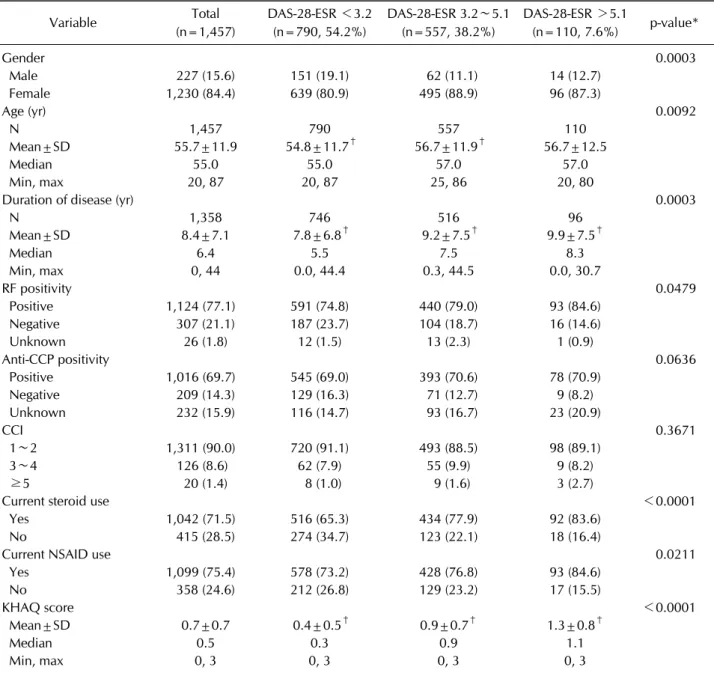
Values are presented number (%) otherwise indicated. DAS-28-ESR: disease activity score-28-erythrocyte sedimentation rate, SD:
standard deviation, RF: rheumatoid factor, CCP: cyclic citrullinated peptide, CCI: Charlson comorbidity index, Connective tissue disease was considered for all rheumatoid arthritis patients, NSAID: nonsteroidal anti-inflammatory drug, HAQ: health assessment questionnaire. *p-value by chi-square test or analysis of variance. †A post hoc analysis showed the significant difference between groups at p-value <0.05.
tional disability was measured using the Korean Health Assessment Questionnaire (KHAQ) through patients self-report. All data on the outcome variables were ob- tained from the self-reported questionnaires. Productivity loss was also estimated using Health and Work perform- ance Questionnaire (HPQ) in terms of time and indirect cost on monthly basis [24]. Calculation of lost pro- ductivity time (LPT) and the monthly cost of LPT due to
absenteeism and presenteeism were performed as fol- lows [24-29]. Monthly cost of LPT was calculated using the hourly wage (Korean won [KRW]/hour) based on average wage of Korean workers by their age, gender, and occupation [25].
LPT=[absenteeism+presenteeism]
- Absenteeism={[entire work days missed due to RA over past four weeks]×8(hours)/day}+{[partial days
Figure 1. Lost productivity time in hours by DAS-28-ESR in the past one month. DAS-28-ESR: disease activity score-28-ery- throcyte sedimentation rate. *p-value by analysis of variance.
Figure 2. Productivity loss in indirect cost by DAS-28-ESR per month. DAS-28-ESR: disease activity score-28-erythrocyte se- dimentation rate. *p-value by analysis of variance.
missed due to RA over past four weeks]×4(hours)/day}
- Presenteeism=[actual days worked if not sick due to RA over past four weeks]×{[10-overall job perform- ance]/10}
Monthly cost of LPT=LPT×hourly wage (KRW/hour) Statistical analysis
Analysis of variance (ANOVA) or chi-square test was performed to observe the distribution and mean variance of each characteristic among different stages of DAS- 28-ESR groups. Mean absenteeism and presenteeism and their sub-item means were estimated with their standard deviation within each DAS-28-ESR groups. LPT in hours and monthly cost of LPT in 1,000 KRW were calculated by low, moderate and high DAS-28-ESR groups and were compared using ANOVA. To evaluate the association be- tween high lost productivity time (≥100 hours) and dis- ease activity stage, we used multiple logistic regression analysis. Likewise, association between high monthly cost of LPT (≥1,000,000 KRW) and disease activity stage was measured using multiple logistic regression analysis.
In the multiple logistic regression analyses, variables that were found to be significant from simple logistic analyses and also determined clinically meaningful were included.
All analyses were performed using SAS version 9.3 (SAS Institute, Cary, NC, USA).
RESULTS
Characteristics of the RA patients by DAS-28-ESR groups
Table 1 describes the characteristics of RA patients with DAS-28-ESR measurements (n=1,457) by low (DAS- 28-ESR: <3.2), moderate (DAS-28-ESR: 3.2∼5.1), high (DAS-28-ESR: >5.1) DAS-28-ESR groups including so- cio-demographic factors and clinical factors overall. Among those 1,457 patients with DAS-28-ESR recorded, each group had 80.9% , 88.9%, 87.3% females in low, moderate, high DAS-28-ESR groups, respectively (p=0.0003).
Mean age was 54.8±11.7, 56.7±11.9, 56.7±12.5 in low, moderate, high DAS-28-ESR groups, respectively (p=0.0092). Mean duration of illness was approximately 8 years for patients having low DAS-28-ESR, while it was approximately 9 and 10 years for patients having moder- ate to high DAS-28-ESR, respectively (p=0.0003).
Patients with positive rheumatoid factor (RF) were 74.8%, 79.0%, 84.6% (p=0.0479) and with positive anti-CCP anti- body were 69.0%, 70.6%, 70.9% in each group. Steroid and nonsteroidal anti-inflammatory drugs (NSAIDs) use were 65.3%, 77.9%, 83.6% and 73.2%, 76.8%, 84.6% in each group, respectively. For functional disability, KHAQ scores differed by levels of DAS-28-ESR, and patients with high DAS-28-ESR showed highest scores indicating the most impairment comparing to patients with low and moderate DAS-28-ESR groups.
Table 2. Productivity loss in rheumatoid arthritis over past four weeks
Variable Total
(n=1,457)
DAS-28-ESR <3.2 (n=790, 54.2%)
DAS-28-ESR 3.2∼5.1 (n=557, 38.2%)
DAS-28-ESR >5.1
(n=110, 7.6%) p-value*
Absenteeism
Actual days worked if not sick due to RA (d) 0.4202
Mean±SD 26.0±3.8 25.9±3.7 26.1±3.8 25.7±4.7
Median 28.0 28.0 28.0 28.0
Min, max 5, 28 8, 28 5, 28 8, 28
Entire work days missed due to RA (d) <0.0001
Mean±SD 1.7±5.0 0.7±3.2† 2.5±5.9† 4.3±7.7†
Median 0.0 0.0 0.0 0.0
Min, max 0, 28 0, 28 0, 28 0, 28
Partial days missed due to RA (d) <0.0001
Mean±SD 3.0±6.5 1.7±4.8† 4.3±7.4† 6.4±8.7†
Median 0.0 0.0 0.0 1.8
Min, max 0, 28 0, 28 0, 28 0, 28
Lost productivity time in hours <0.0001
Mean±SD 90.9±59.0 71.5±52.0† 110.0±58.4† 132.4±57.2†
Median 85.6 67.0 112.0 128.0
Min, max 0, 224 0, 224 0, 224 0, 224
Presenteeism
Performance of most workers in a similar job‡ 0.0629
Mean±SD 7.8±1.9 7.9±1.8 7.7±1.9 7.5±2.0
Median 8.0 8.0 8.0 8.0
Min, max 0, 10 0, 10 0, 10 0, 10
Overall performance‡ <0.0001
Mean±SD 6.1±2.4 6.9±2.1† 5.4±2.3† 4.4±2.4†
Median 5.0 7.0 5.0 5.0
Min, max 0, 10 0, 10 0, 10 0, 10
Overall performance compared to others§ <0.0001
Mean±SD 4.7±1.6 4.3±1.5† 5.1±1.5† 5.6±1.5†
Median 4.0 4.0 5.0 6.0
Min, max 1, 7 1, 7 1, 7 2, 7
Monthly cost of lost productivity time (1,000 Korean won) <0.0001
Mean±SD 920±597 741±531† 1,097±607† 1,302±554†
Median 858 673 994 1,369
Min, max 0, 3,626 0, 3,626 0, 3,506 0, 2,671
DAS-28-ESR: disease activity score-28-erythrocyte sedimentation rate, RA: rheumatoid arthritis, SD: standard deviation. *p-value by analysis of variance. †A post hoc analysis showed the significant difference between groups at p<0.05. ‡Rating on a scale from 0 to 10 (worst to top performance). §Rating on a scale from 1 to 7 (a lot better to a lot worse).
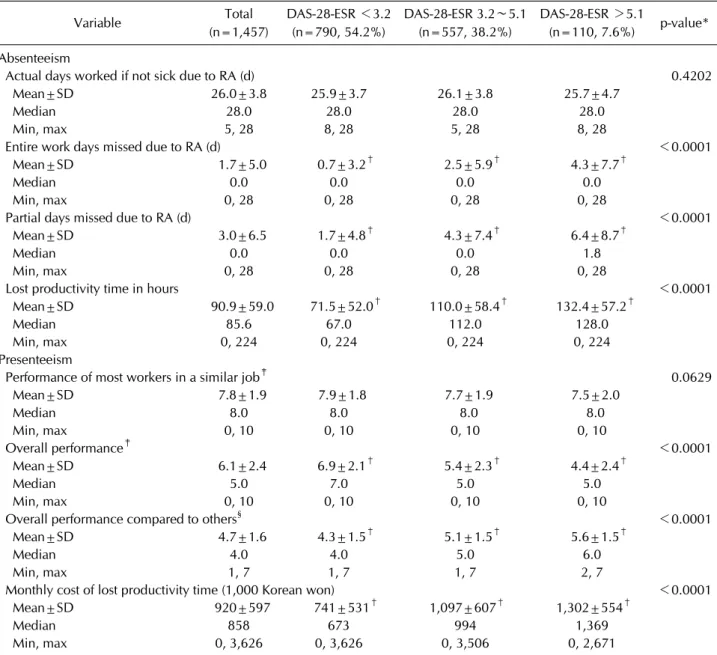
Of all 1,457 patients, mean LPT was 90.9 hours during the past one month, and monthly cost of LPT was 920,000 KRW (Table 2, Figures 1 and 2). When moderate to high DAS-28-ESR groups were compared to low DAS-28-ESR group, longer missed work days were observed in moder- ate to high DAS-28-ESR groups (p<0.0001). Overall work performance also got worse as DAS-28-ESR stage of RA patients became more severe (p<0.0001) (Table 2).
Compared to patients with low DAS-28-ESR, those with moderate to high DAS-28-ESR had increasingly higher LPT and monthly costs of LPT (time in hours: 110.0±58.4,
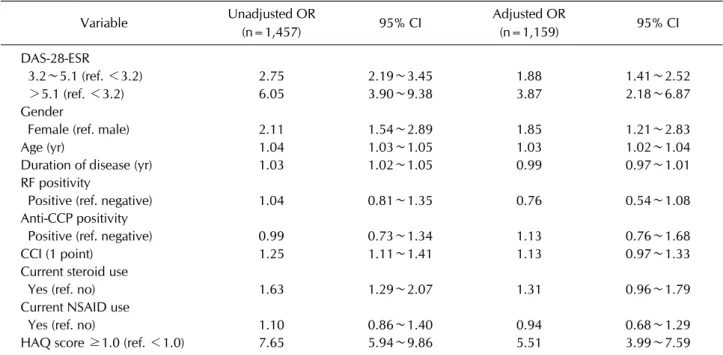
132.4±57.2 vs. 71.5±52.0, p<0.0001; monthly costs of LPT in 1,000 KRW: 1,097±607, 1,302±554 vs. 741±531, p<0.0001) (Table 2). In multiple regression analyses, significant positive associations with high LPT (≥100 hours) were shown in high (adjusted odds ratio [OR]=3.87, 95% confidence interval [CI]: 2.18∼6.87) and moderate DAS-28-ESR (adjusted OR=1.88, 95% CI: 1.41∼2.52) compared to low DAS-28-ESR. Female compared to male (adjusted OR=1.85, 95% CI: 1.21∼2.83), age per 1 year (adjusted OR=1.03, 95% CI: 1.02∼1.04), and KHAQ ≥ 1.0 compared to KHAQ <1.0 (adjusted OR=5.51, 95%
Table 3. Univariate and multivariate analysis of factors associated with high lost productivity time (≥100 hours)
Variable Unadjusted OR
(n=1,457) 95% CI Adjusted OR
(n=1,159) 95% CI
DAS-28-ESR
3.2∼5.1 (ref. <3.2) 2.75 2.19∼3.45 1.88 1.41∼2.52
>5.1 (ref. <3.2) 6.05 3.90∼9.38 3.87 2.18∼6.87
Gender
Female (ref. male) 2.11 1.54∼2.89 1.85 1.21∼2.83
Age (yr) 1.04 1.03∼1.05 1.03 1.02∼1.04
Duration of disease (yr) 1.03 1.02∼1.05 0.99 0.97∼1.01
RF positivity
Positive (ref. negative) 1.04 0.81∼1.35 0.76 0.54∼1.08
Anti-CCP positivity
Positive (ref. negative) 0.99 0.73∼1.34 1.13 0.76∼1.68
CCI (1 point) 1.25 1.11∼1.41 1.13 0.97∼1.33
Current steroid use
Yes (ref. no) 1.63 1.29∼2.07 1.31 0.96∼1.79
Current NSAID use
Yes (ref. no) 1.10 0.86∼1.40 0.94 0.68∼1.29
HAQ score ≥1.0 (ref. <1.0) 7.65 5.94∼9.86 5.51 3.99∼7.59
OR: odds ratio, CI: confidence interval, DAS-28-ESR: disease activity score-28-erythrocyte sedimentation rate, RF: rheumatoid factor, CCP: cyclic citrullinated peptide, CCI: Charlson comorbidity index, Connective tissue disease was considered for all rheumatoid arthritis patients, NSAID: nonsteroidal anti-inflammatory drug, HAQ: health assessment questionnaire.
Table 4. Univariate and multivariate analysis of factors associated with high monthly cost of lost productivity time (≥1,000,000 Korean won)
Variable Unadjusted OR
(n=1,457) 95% CI Adjusted OR
(n=1,159) 95% CI
DAS-28-ESR
3.2∼5.1 (ref. <3.2) 2.48 1.98∼3.11 1.93 1.43∼2.54
>5.1 (ref. <3.2) 5.42 3.52∼8.32 3.45 1.98∼5.99
Gender
Female (ref. male) 0.97 0.73∼1.30 0.52 0.36∼0.76
Age (yr) 1.01 1.01∼1.02 0.99 0.98∼1.01
Duration of disease (yr) 1.02 1.00∼1.03 0.99 0.97∼1.01
RF positivity
Positive (ref. negative) 0.88 0.68∼1.13 0.66 0.47∼0.92
Anti-CCP positivity
Positive (ref. negative) 0.85 0.63∼1.16 1.02 0.70∼1.50
CCI (1 point) 1.16 1.03∼1.30 1.10 0.94∼1.28
Current steroid use
Yes (ref. no) 1.63 1.28∼2.08 1.18 0.87∼1.61
Current NSAID use
Yes (ref. no) 1.16 0.90∼1.48 0.92 0.67∼1.25
HAQ score ≥1.0 (ref. <1.0) 5.65 4.43∼7.21 6.07 4.39∼8.40
OR: odds ratio, CI: confidence interval, DAS-28-ESR: disease activity score-28-erythrocyte sedimentation rate, RF: rheumatoid factor, CCP: cyclic citrullinated peptide, CCI: Charlson comorbidity index, Connective tissue disease was considered for all rheumatoid arthritis patients, NSAID: nonsteroidal anti-inflammatory drug, HAQ: health assessment questionnaire.
CI: 3.99∼7.59) were also positively associated with high LPT (Table 3).
Also, significant positive associations with high month- ly cost of LPT (≥1,000,000 KRW) were shown in high DAS-28-ESR (adjusted OR=3.45, 95% CI: 1.98∼5.99) and moderate DAS-28-ESR groups (adjusted OR=1.93, 95% CI: 1.43∼2.54) compared to low DAS-28-ESR group.
Also, female compared to male (adjusted OR=0.52, 95%
CI: 0.36∼0.76), RF positivity compared to RF negativity (adjusted OR=0.66, 95% CI: 0.47∼0.92), and KHAQ
≥1.0 compared to KHAQ <1.0 (adjusted OR=6.07, 95% CI: 4.39∼8.40) showed positive association with high monthly costs of LPT (Table 4).
DISCUSSION
This is a unique large-scale multicenter, cross-sectional, observational research representing a large number of RA patients in Korea. Previously, characteristics of entire pa- tients in this research has been determined as average age of fifties, mostly females, having over eight years of dis- ease duration, and more than half had low stage of disease activities [22]. In this particular analysis, we investigated Korean RA patient characteristics and their productivity loss outcomes by different stage of DAS-28-ESR groups among those with DAS-28-ESR measurement. With an ultimate goal of improving patient’s HRQoL and func- tional disability for treatment of RA, treatment guidelines recommend an adequate treatment of patients by differ- ent stage of DAS-28-ESR considering factors associated with those poor outcome measures [4]. Since DAS-28- ESR is one of the most influential factors associated with HRQoL and functional disability, we now compared pro- ductivity loss, which is directly and indirectly related to quality of life of RA patients, by DAS-28-ESR stage.
Although a majority of studies on productivity loss in RA observed its association with functional disability as a primary predictor [30-32], this analysis was focused on the relationship of productivity loss with disease activity which can be an objective approach to the evaluation of disease prognosis. Through this study, we were specifi- cally able to determine the strength of association bet- ween two measures of productivity loss and DAS-28-ESR stages for the past 1-month adjusting for all other determinants. The results of productivity loss measures were consistent both in LPT and monthly costs of LPT, and the associations were shown to be stronger as DAS-28-ESR stage increases although some adjusted fac-
tors were found to be marginally significant when month- ly costs of LPT were measured as productivity loss outcome. The interpretation of these results may be lim- ited to transient associations between higher DAS28 and impaired LPT in time and indirect cost since the data used in this analysis was achieved from relatively short obser- vation. However, a prospective study targeting patients with axial Spondyloarthritis found that the prominent impacts of decreasing disease activity on remarkable im- provement in work productivity for the 1-year study dura- tion [33]. Similarly, previous studies including rheuma- toid arthritis showed that higher disease activity was a predictive factor that yields compromised productivity in both time and indirect cost [34-36].
There have been many approaches to study disease-in- duced costs as health outcomes, and costs have been cal- culated in various ways including the expected cost esti- mation using economic models and standard cost estima- tion performed by a panel of clinicians [14,37]. In spite of the fact these approaches would bring more accurate and reliable results than that from the study proposed herein, this analysis should come to attention the way in which it adds values since it utilizes the clinical observational data from the real world practice and patient surveys on the LPT measuring both the socio-economic burden and the health-related disease burden at the same time.
Nevertheless, this study has several limitations. Firstly, we cannot infer temporality in this cross-sectional study although we determined the strength of association be- tween productivity loss outcomes and DAS-28-ESR.
Second, there may be possible respondent bias when pa- tients administered questionnaire used for the measure- ment of the productivity loss. Even though this study is valuable for presenting the data of a representable pop- ulation of Korean RA patients, the results could not be generalized to other populations with different social and economic characteristics. Third, this study may selectively include healthy patients with minimal impairment in their clinical conditions who were sufficiently able to complete patients’ self-administered questionnaires.
Lastly, the fact that no specific socio-economic data such as education and actual income status did not include in the analysis should be taken into consideration while in- terpreting study results.
In conclusion, patients with moderate to high DAS-28- ESR had more productivity loss in time and monthly cost of lost productivity time than patients with low DAS- 28-ESR, and stronger association was found to be present
between higher disease activity and high LPT as well as high monthly cost of LPT. Although all patients were be- ing treated with either biologic DMARDs or conventional DMARDs, burden of patients still remained high among RA patients and these results could be easily discri- minated when outcomes were observed by different stages of DAS-28-ESR as in this study. Based on the re- sults obtained from this analysis of Korean RA patients, treatment should be considered in a timely manner after the onset of disease to control the disease activity which may lead to higher socio-economic burden and physical impairment based on higher productivity loss in time and indirect cost. Therefore, focused treatments on patients with moderate to high DAS-28-ESR could not only en- hance suppression of further progression, but also be positively associated with low burden of illness.
ACKNOWLEDGMENTS
This was sponsored by Pfizer Pharmaceuticals Korea Limited.
CONFLICT OF INTEREST
No potential conflict of interest relevant to this article was reported.
REFERENCES
1. Filipovic I, Walker D, Forster F, Curry AS. Quantifying the economic burden of productivity loss in rheumatoid arthritis. Rheumatology (Oxford) 2011;50:1083-90.
2. Pisetsky DS, St Clair EW. Progress in the treatment of rheu- matoid arthritis. JAMA 2001;286:2787-90.
3. Bardwell WA, Nicassio PM, Weisman MH, Gevirtz R, Bazzo D. Rheumatoid arthritis severity scale: a brief, physi- cian-completed scale not confounded by patient self-report of psychological functioning. Rheumatology (Oxford) 2002;41:38-45.
4. Fransen J, van Riel PL. The disease activity score and the EULAR response criteria. Rheum Dis Clin North Am 2009;35:745-57.
5. van der Heijde DM, van't Hof MA, van Riel PL, van Leeuwen MA, van Rijswijk MH, van de Putte LB. Validity of single variables and composite indices for measuring disease activ- ity in rheumatoid arthritis. Ann Rheum Dis 1992;51:
177-81.
6. Singh JA, Furst DE, Bharat A, Curtis JR, Kavanaugh AF, Kremer JM, et al. 2012 update of the 2008 American College of Rheumatology recommendations for the use of dis- ease-modifying antirheumatic drugs and biologic agents in the treatment of rheumatoid arthritis. Arthritis Care Res (Hoboken) 2012;64:625-39.
7. Goekoop-Ruiterman YP, de Vries-Bouwstra JK, Kerstens PJ, Nielen MM, Vos K, van Schaardenburg D, et al.
DAS-driven therapy versus routine care in patients with re- cent-onset active rheumatoid arthritis. Ann Rheum Dis 2010;69:65-9.
8. Linde L, Sørensen J, Ostergaard M, Hørslev-Petersen K, Hetland ML. Health-related quality of life: validity, reli- ability, and responsiveness of SF-36, 15D, EQ-5D [corrected]
RAQoL, and HAQ in patients with rheumatoid arthritis. J Rheumatol 2008;35:1528-37.
9. Rupp I, Boshuizen HC, Dinant HJ, Jacobi CE, van den Bos GA. Disability and health-related quality of life among pa- tients with rheumatoid arthritis: association with radio- graphic joint damage, disease activity, pain, and depressive symptoms. Scand J Rheumatol 2006;35:175-81.
10. Bansback N, Zhang W, Walsh D, Kiely P, Williams R, Guh D, et al. Factors associated with absenteeism, presenteeism and activity impairment in patients in the first years of RA.
Rheumatology (Oxford) 2012;51:375-84.
11. Geuskens GA, Burdorf A, Hazes JM. Consequences of rheu- matoid arthritis for performance of social roles--a literature review. J Rheumatol 2007;34:1248-60.
12. Cho SK, Kim D, Jun JB, Bae SC, Sung YK. Factors influenc- ing quality of life (QOL) for Korean patients with rheuma- toid arthritis (RA). Rheumatol Int 2013;33:93-102.
13. Corbacho MI, Dapueto JJ. Assessing the functional status and quality of life of patients with rheumatoid arthritis. Rev Bras Reumatol 2010;50:31-43.
14. Kobelt G, Lindgren P, Lindroth Y, Jacobson L, Eberhardt K.
Modelling the effect of function and disease activity on costs and quality of life in rheumatoid arthritis. Rheumatology (Oxford) 2005;44:1169-75.
15. McIntosh E. The cost of rheumatoid arthritis. Br J Rheumatol 1996;35:781-90.
16. Kobelt G, Eberhardt K, Jönsson L, Jönsson B. Economic con- sequences of the progression of rheumatoid arthritis in Sweden. Arthritis Rheum 1999;42:347-56.
17. Walker N, Michaud K, Wolfe F. Work limitations among working persons with rheumatoid arthritis: results, reli- ability, and validity of the work limitations questionnaire in 836 patients. J Rheumatol 2005;32:1006-12.
18. Young A, Dixey J, Kulinskaya E, Cox N, Davies P, Devlin J, et al. Which patients stop working because of rheumatoid arthritis? Results of five years' follow up in 732 patients from the Early RA Study (ERAS). Ann Rheum Dis 2002;
61:335-40.
19. Doeglas D, Suurmeijer T, Krol B, Sanderman R, van Leeuwen M, van Rijswijk M. Work disability in early rheu- matoid arthritis. Ann Rheum Dis 1995;54:455-60.
20. Boonen A, Severens JL. The burden of illness of rheumatoid arthritis. Clin Rheumatol 2011;30 Suppl 1:S3-8.
21. van Vilsteren M, Boot CR, Knol DL, van Schaardenburg D, Voskuyl AE, Steenbeek R, et al. Productivity at work and quality of life in patients with rheumatoid arthritis. BMC Musculoskelet Disord 2015;16:107.
22. Bae SC, Cho SK, Won S, Lee HS, Lee SH, Kang YM, et al.
Factors associated with quality of life and functional dis- ability among rheumatoid arthritis patients treated with disease-modifying anti-rheumatic drugs for at least 6 months. Int J Rheum Dis 2016. DOI: 10.1111/1756- 185X.12915.
23. Prevoo ML, van 't Hof MA, Kuper HH, van Leeuwen MA, van de Putte LB, van Riel PL. Modified disease activity scores that include twenty-eight-joint counts. Development and validation in a prospective longitudinal study of patients with rheumatoid arthritis. Arthritis Rheum 1995;38:44-8.
24. Woo JM, Kim W, Hwang TY, Frick KD, Choi BH, Seo YJ, et al. Impact of depression on work productivity and its im- provement after outpatient treatment with antidepressants.
Value Health 2011;14:475-82.
25. Occupational category, educational background, age class, gender, wage & working conditions [Internet]. Daejeon:
Korean Statistical Information Service, 2016 [cited 2017 Feb]. Available from: http://kosis.kr/statHtml/statHtml.
do?orgId=118&tblId=DT_PAYN002&conn_path=I2.
26. Zhang W, Gignac MA, Beaton D, Tang K, Anis AH;
Canadian Arthritis Network Work Productivity Group.
Productivity loss due to presenteeism among patients with arthritis: estimates from 4 instruments. J Rheumatol 2010;
37:1805-14.
27. Kessler RC, Barber C, Beck A, Berglund P, Cleary PD, McKenas D, et al. The world health organization health and work performance questionnaire (HPQ). J Occup Environ Med 2003;45:156-74.
28. Kessler RC, Ames M, Hymel PA, Loeppke R, McKenas DK, Richling DE, et al. Using the world health organization health and work performance questionnaire (HPQ) to eval- uate the indirect workplace costs of illness. J Occup Environ Med 2004;46(6 Suppl):S23-37.
29. World health organization health and work performance questionnaire HPQ short form (absenteeism and presentee- ism questions and scoring rules) [Internet]. Boston (MA):
Harvard Medical School [cited 2009 Aug]. Available from:
www.hcp.med.harvard.edu/hpq/info.php.
30. Sruamsiri R, Mahlich J, Tanaka E, Yamanaka H. Productivi-
ty loss of Japanese patients with rheumatoid arthritis - A cross-sectional survey. Mod Rheumatol 2017:1-8.
31. Klimeš J, Vocelka M, Šedová L, Doležal T, Mlčoch T, Petříko- vá A, et al. Medical and productivity costs of rheumatoid ar- thritis in the Czech Republic: cost-of-illness study based on disease severity. Value in Health Regional Issues 2014;4:
75-81.
32. Nguyen XT, Ohinmaa A, Barnabe C, Homik J, Barr SG, Martin L, et al. Self-reported productivity losses of people with rheumatoid Arthritis in Alberta, Canada. The Open Pharmacoeconomics & Health Economics Journal 2013;5:
11-4.
33. van Lunteren M, Ez-Zaitouni Z, Fongen C, Landewé R, Ramonda R, van der Heijde D, et al. Disease activity de- crease is associated with improvement in work productivity over 1 year in early axial spondyloarthritis (SPondyloArthritis Caught Early cohort). Rheumatology (Oxford) 2017;56:
2222-8.
34. Chaparro Del Moral R, Rillo OL, Casalla L, Morón CB, Citera G, Cocco JA, et al. Work productivity in rheumatoid arthritis: relationship with clinical and radiological features.
Arthritis 2012;2012:137635.
35. Lillegraven S, Sundlisæter NP, Aga AB, Olsen IC, Uhlig T, Kvien TK, et al. Work productivity in newly diagnosed, un- treated rheumatoid arthritis patients. Paper presented at:
2015 ACR/ARHP Annual Meeting; 2015 Nov 6-11; San Francisco (CA), USA. Abstract no. 2166.
36. Kawalec P, Malinowski KP, Pilc A. Disease activity, quality of life and indirect costs of psoriatic arthritis in Poland.
Rheumatol Int 2016;36:1223-30.
37. Saraux A, Gossec L, Goupille P, Bregman B, Boccard E, Dupont D, et al. Cost-effectiveness modelling of biological treatment sequences in moderate to severe rheumatoid ar- thritis in France. Rheumatology (Oxford) 2010;49:733-40.