INTRODUCTION
The Geriatric Depression Scale (GDS) is a widely used clin- ical and research depression screening tool since it was first developed over 30 years ago.1 This is the first specifically de- signed depression screening scale for elderly persons, as so- matic and sexual complaints that are present on other depres- sion scales have been removed. However, because the original
GDS (GDS30) is relatively time-consuming, a shortened 15- item version (GDS15), which was extracted from the GDS30, has been developed.2 Sensitivity and specificity of the GDS15 has been assessed in a general elderly population,2 geriatric in- patients,3 primary care outpatients,4,5 and elderly patients6 and shows good discriminant validity, content validity, concurrent validity and internal consistency and reliability.
The GDS is a reliable screening tool for detecting depressive symptoms in elderly persons and patients with mild cognitive impairment. However, the usefulness of the GDS for patients with dementia, such as Alzheimer’s disease (AD), is question- able.7,8 Thus, exploring the structure and clinical characteris- tics of the GDS15 items would be helpful to determine the util-
The Relationship between Geriatric Depression Scale Structure and Cognitive-Behavioral Aspects
in Patients with Alzheimer’s Disease
Yong Tae Kwak,1 Sook Hyung Song,2 YoungSoon Yang3
1Department of Neurology, Hyoja Geriatric Hospital, Yongin, Korea
2Department of Psychiatry, Yong-in Mental Hospital, Yongin, Korea
3Department of Neurology, VHS Medical Center, Seoul, Korea
Background and Purpose Although the 15-item Geriatric Depression Scale (GDS15) is a widely used depression screening questionnaire, the implications of the GDS15 in patients with Alzheimer’s disease (AD) are questionable. We designed this study to explore the GDS15 factor structure and the relationships between these factors and cognitive-behavioral aspects.
Methods The GDS15, cognitive function tests, and the Korean-Neuropsychiatry Inventory were administered to 310 patients with probable AD, who were not medicated before visiting the hospital. Three factors were identified by principal components analysis. A bivariate correla- tion analysis was conducted to determine the relationships between factors and neurocognitive and behavior symptoms.
Results Factor 2 was correlated with the Korean Boston Naming Test, calculating ability, the go-no-go test, the Controlled Oral Word Asso- ciation Test (COWAT), the Color Word Stroop Test (CWST; words and color), aggression, depression, and apathy. Factor 3 was correlated with calculating ability, the Seoul Verbal Learning Test, immediate recall, copy, and delayed recall on the Rey-Osterieth Complex Figure Test, con- trasting on the COWAT, and words and delusion on the CWST. We identified three factors and revealed that the GDS15 may be comprised of a heterogeneous scale.
Conclusions These results suggest that the GDS15 may be comprised of a heterogeneous scale and suggest multi-dimensional properties of the GDS15 in patients with AD.
Key Words 15-item Geriatric Depression Scale, Alzheimer’s disease, Neuropsychiatry Inventory, factor analysis, cognitive function.
Received: December 15, 2014 Revised: February 27, 2015 Accepted: February 27, 2015
Correspondence: Yong Tae Kwak, MD, Department of Neurology, Hyoja Geriatric Hospital, 1-30 Jungbu-daero 874beon-gil, Giheung-gu, Yongin 446-512, Korea Tel: +82-31-288-0602, Fax: +82-31-288-0539, E-mail: [email protected]
cc This is an Open Access article distributed under the terms of the Cre- ative Commons Attribution Non-Commercial License (http://creative- commons.org/licenses/by-nc/3.0) which permits unrestricted non-com- mercial use, distribution, and reproduction in any medium, provided the ori- ginal work is properly cited.
DND
ORIGINAL ARTICLE
Print ISSN 1738-1495 / On-line ISSN 2384-0757
Dement Neurocogn Disord 2015;14(1):24-30 / http://dx.doi.org/10.12779/dnd.2015.14.1.24
DND
ity of the GDS15 in patients with AD.
One approach to better understand the GDS15 and depres- sive symptomatology of patients with AD is to evaluate wheth- er specific GDS15 items are associated with patients with AD.
Rather than recognizing individual items separately, a num- ber of associated items (factors) are identified and compared with these factors. This approach can provide insight into how the GDS15 items can be subgrouped (factors) and whether the GDS can be used as a uni-dimensional (i.e., a total score mea- suring depression)9 or multi-dimensional scale (i.e., grouping different subscales together into one total score).10,11 If the in- dividual items of the GDS are heterogeneous in patients with AD, then they might be grouped similarly; thus, allowing de- lineation of more homogenous sub-groups and provide insight into depression in patients with AD. A factor analysis is the most widely used statistical method to extract correlated subsets of the GDS items, and a few factor analyses of the GDS309-12 and GDS1513-17 have been published.
The cognitive implications of depression in patients with AD have been studied extensively with inconsistent results. Previ- ous studies provide evidence for a negative impact of depres- sion on domains, including general cognition,18 full scale IQ,19 measures of dementia severity, working memory, processing speed,20 attention, motor functioning, and visuospatial percep- tion and construction.21 Other investigators have found no cog- nitive differences between patients with AD with and without depressive symptoms.22,23
One of the confounding factors in this inconsistency is a psy- choactive medication effect, particularly that of antidepres- sants. Depression is clearly influenced by antidepressants, but it can also be influenced by other psychoactive medications.
Due to the long-standing Korean Confucian tradition of car- ing for patients with dementia by family members, a consid- erable portion of patients with mild to severe AD visit demen- tia clinics with no medication history. Therefore, we are able to recruit for drug-naïve patients with probable AD, which would overcome the psychoactive medication effects.
The aims of this study were to examine the factor structure of the GDS15 in patients with probable AD. A second aim was to identify the relationships between these factors and neuro- psychological and behavioral aspects. Finally, we determined the structure and clinical meaning of the GDS15.
METHODS
Participants
The initial 1324 patients with dementia were prospectively enrolled and screened from March 2003 to July 2013 at the Hyoja Geriatric Hospital. Among the 1324 patients, the study subjects
included 310 patients with probable AD, who were not med- icated before visiting the hospital. All study subjects met the National Institute of Neurological and Communicative Disor- ders and Stroke-Alzheimer’s Disease and Related Disorders Association criteria for probable AD.24 Patients who were tak- ing psychoactive drugs, including antidepressants, antipsy- chotics, anticonvulsants, benzodiazepines, or cholinesterase inhibitors were excluded from this study.
All study subjects underwent a complete medical history, physical and neurological evaluations, comprehensive neuro- psychological testing, routine laboratory tests, and brain mag- netic resonance imaging or a computed tomography scan.
Procedures
A structured interview and neuropsychological examina- tion were performed with each subject. The Korean version of the Mini-Mental State Examination (K-MMSE)25 and the Clin- ical Dementia Rating Scale (CDR)26 were used to assess cogni- tive function. The Barthel index27 was used to assess activities of daily living (ADL).
Cognitive functions of all study subjects were evaluated with the Seoul Neuropsychological Screening Battery,28 which in- cludes standardized and validated tests of diverse cognitive do- mains. Among them, the forward digit span, the Korean ver- sion of the Boston Naming Test, calculation, the Seoul Verbal Learning Test (SVLT) (three immediate recall trials of 12 items and 20-min delayed recall trial for the 12 items), the Rey-Os- terrieth Complex Figure Test (RCFT) (copying, immediate, and 20-min delayed recall and recognition), the Controlled Oral Word Association Test (COWAT), which is test of semantic flu- ency and letter-phonemic fluency and contrasting program test, the go-no-go test, and the Color Word Stroop Test (CWST) were adopted for this study.
The GDS15 was administered by a trained neuropsycholo- gist. A cutoff screening criterion of the Korean version of GDS15 for depression is 8 or more endorsed items.5 This would mean that a participant answered yes in the case of the 10 negative items and no in the case of the five positive items.
The Korean version of the Neuropsychiatry Inventory (K- NPI)29 was administered to assess the behavioral aspects of de- mentia. This scale addresses 12 specific behavioral and psy- chological symptoms and provides a numeric score for each domain that is the product of the frequency by severity sub- scores. The total K-NPI score was calculated by adding the 12 composite scores. Diagnosing depression based on the Neuro- psychiatry Inventory (NPI) depression domain was classified as the NPI-D (>1 on the depression subscale).
After a complete description of the study was given to the pa- tients and their caregivers, written informed consent was ob-
Yong Tae Kwak et al.
GDS Structure and Cognitive-Behavioral Aspects in AD
tained from all patients or caregivers.
Statistical analysis
The study subject demographic data are described, and an estimate of internal consistency of the GDS15 as a function of dementia severity was made. A principal components analy- sis (PCA) was carried on the GDS15. Before the PCA analysis, two complementary methods, the Kaiser-Meyer-Olkin Mea- sure of Sampling Adequacy and Bartlett’s test of sphericity, were used to assess the appropriateness of a factor analysis. The ob- jective of this preliminary phase was to assess whether items were reciprocally related to develop a factor model. Factors were extracted by using PCA with Spearman’s correlation matrices, and varimax rotation was used for orthogonal rotation to achi- eve a simple structure. The rotation phase allows for the iden- tification of factors summarizing sets of closely related variables and is more easily interpreted than those obtained in the ex- traction phase. Factors were selected if their eigenvalue was 1, and an item was included if its factor loading was 0.30. Fac- tors were extracted initially by PCA for mathematical and em- pirical determination of the factors. Spearman’s correlation analysis was conducted between the GDS15 items and cogni- tive functions, ADL, and behavioral symptoms to identify the characteristics of these GDS15 subgroups. Statistical analyses were performed with the SPSS ver. 18.0 (SPSS Inc., Chicago, IL, USA). A p-value <0.05 was considered significant.
RESULTS
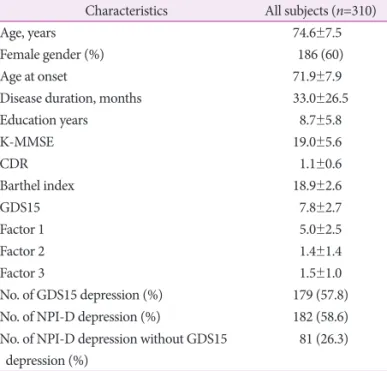
Demographic characteristics of the study subjects The study included 124 men (40.0%) and 186 women (60.0%) with a mean age of 74.6±7.5 years. The mean K-MMSE and CDR scores were 19.0±5.6 and 1.1±0.6 respectively, indicat- ing that subjects with mild to moderate AD were mainly re- cruited (Table 1). More than half of the subjects had depression, according to self-rated criteria (GDS15) and caregiver-rated criteria (NPI-D), and 26.3% of the subjects had depression based on the GDS15 without evidence of depression on the NPI-D (Table 1).
Reliability of the GDS15 by dementia severity and test-retest
Internal reliability was measured using Cronbach’s alpha and is presented in Table 2 according to dementia severity. The internal consistency of the GDS15 was excellent across all three groups and did not decline with dementia severity (Table 2).
Test-retest reliability was evaluated with a 1 week interval using patients with AD not included in this study. Reliability was evaluated with the intraclass coefficient, and good reliabil-
ity was demonstrated (Table 3).
Prevalence of the GDS15 items
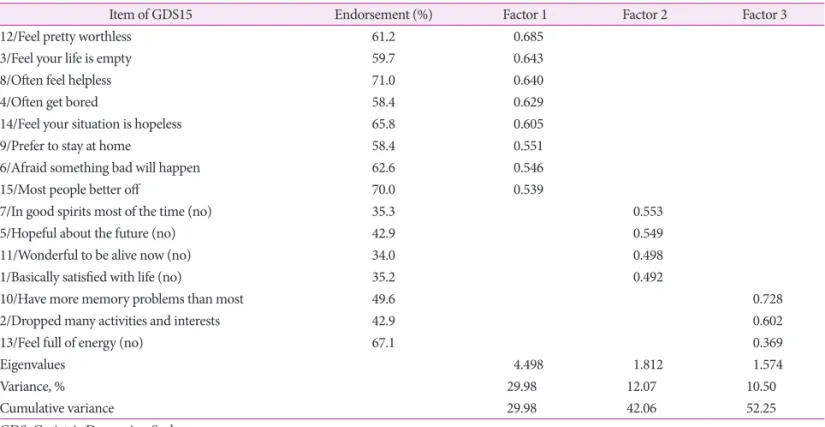
The prevalence of individual GDS15 items is summarized in Table 4. Item 8, “often feel helpless” was the most frequently endorsed item and item 11, “wonderful to be alive now (no)”
was the least frequently endorsed item.
PCA of the GDS15 items
The PCA results and the factor loadings are shown in Table 4. All 15 items reached the factor loading criterion of ≥0.30, and three subgroups were identified using the 15 items. These three subgroups explained 52.25% of the total data variance.
The first subgroup, factor 1 (resembling what was previous- ly called “dysphoria”12,13,20) (29.98% of total variance) included Table 1. Demographic and clinical features of the study subjects
Characteristics All subjects (n=310)
Age, years 74.6±7.5
Female gender (%) 186 (60)
Age at onset 71.9±7.9
Disease duration, months 33.0±26.5
Education years 8.7±5.8
K-MMSE 19.0±5.6
CDR 1.1±0.6
Barthel index 18.9±2.6
GDS15 7.8±2.7
Factor 1 5.0±2.5
Factor 2 1.4±1.4
Factor 3 1.5±1.0
No. of GDS15 depression (%) 179 (57.8)
No. of NPI-D depression (%) 182 (58.6)
No. of NPI-D depression without GDS15 depression (%)
81 (26.3) CDR: Clinical Dementia Rating Scale, GDS: Geriatric Depression Scale, K-MMSE: Korean Mini-Mental State Examination, NPI-D: Neuropsy- chiatry Inventory depression subscale.
Table 2. Internal consistency estimated by severity of dementia CDR (number) Cronbach’s alpha (n=310)
0.5 (75) 0.805
1 (167) 0.855
2 (68) 0.832
CDR: Clinical Dementia Rating Scale.
Table 3. GDS values after the test and re-test trials and reliability tests*
1st test 2nd test Mean 1st–2nd SD
GDS15 (n=30) 8.02 7.43 0.62 1.80
Intraclass correlation coefficient=0.870.
*Pearson’s correlation=0.875 (p<0.001) between the first and second test.
GDS: Geriatric Depression Scale, SD: standard deviation.
DND
eight items: “feel pretty worthless”, “feel your life is empty”, “of- ten feel helpless”, “often get bored”, “feel your situation is hope- less”, “prefer to stay at home”, “afraid something bad will hap- pen”, and “most people better off”. The second subgroup, factor 2 (resembling what was previously called “life satisfaction or apathy”12,13,20) (12.07% of total variance) was comprised of four items: “in good spirits most of the time (no)”, “hopeful about the future (no)”, “wonderful to be alive now (no)”, and “basi- cally satisfied with life (no)”. The third subgroup, factor 3 (re- sembling what was previously called “cognitive impairment”13,20) (10.50% of total variance) included three items: “have more memory problems than most”, “dropped many activities and interests”, and “feel full of energy (no)”.
Correlation between GDS15 factors and general cognitive and ADL function
The correlation between the GDS15 factors and general cognitive and ADL functions are summarized in Table 5. In contrast to factors 1 and 3, factor 2 was not significantly corre- lated with GDS15. The Barthel index was significantly corre- lated with factor 1 and negatively correlated with factor 2. The MMSE was significantly correlated with factors 2 and 3.
Correlation between GDS15 factors and specific cognitive functions
Factor 2 was significantly correlated with the Korean Boston Naming Test (K-BNT), calculation, go-no-go, the COWAT (se-
mantic and phonemic), and the CWST (word and color). Fac- tor 3 was correlated with calculation, the SVLT (immediate re- call), RCFT (copy delay recall, and contrasting), the COWAT (semantic and phonemic), and the CWST (word). Factor 1 was not correlated with any of the tested neurocognitive functions (Table 6).
Correlation between GDS15 factors and NPI subdomains
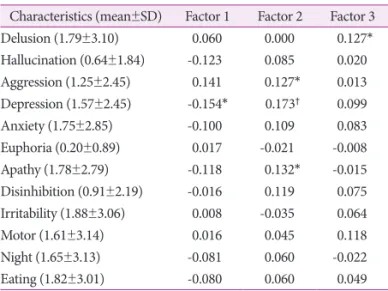
Factor 2 was significantly correlated with aggression, de- pression, and apathy. Factor 3 was correlated with delusion.
Factor 1 was correlated with the depression subdomains in the K-NPI (Table 7).
Table 4. Three factor structure of the GDS15 in the study subjects
Item of GDS15 Endorsement (%) Factor 1 Factor 2 Factor 3
12/Feel pretty worthless 61.2 0.685
3/Feel your life is empty 59.7 0.643
8/Often feel helpless 71.0 0.640
4/Often get bored 58.4 0.629
14/Feel your situation is hopeless 65.8 0.605
9/Prefer to stay at home 58.4 0.551
6/Afraid something bad will happen 62.6 0.546
15/Most people better off 70.0 0.539
7/In good spirits most of the time (no) 35.3 0.553
5/Hopeful about the future (no) 42.9 0.549
11/Wonderful to be alive now (no) 34.0 0.498
1/Basically satisfied with life (no) 35.2 0.492
10/Have more memory problems than most 49.6 0.728
2/Dropped many activities and interests 42.9 0.602
13/Feel full of energy (no) 67.1 0.369
Eigenvalues 4.498 1.812 1.574
Variance, % 29.98 12.07 10.50
Cumulative variance 29.98 42.06 52.25
GDS: Geriatric Depression Scale.
Table 5. Correlation between GDS15, GDS factors, and general cognitive function on the Barthel index
GDS15 Factor 1 Factor 2 Factor 3 GDS15
Factor 1 0.826†
Factor 2 0.020 -0.402†
Factor 3 0.519† 0.184† -0.21
K-MMSE 0.005 0.133 -0.177† -0.170†
CDR -0.019 -0.107 0.097 0.130*
Barthel 0.158† 0.254† -0.160* -0.063
*p-value<0.05, †p-value<0.01.
CDR: Clinical Dementia Rating Scale, GDS: Geriatric Depression Scale, K-MMSE: Korean Mini-Mental State Examination.
Yong Tae Kwak et al.
GDS Structure and Cognitive-Behavioral Aspects in AD
DISCUSSION
Depression in patients with AD has different clinical features than those occurring in younger non-demented patients. Due to these differences, depression in patients with AD has been considered an atypical syndrome of depression.11 How cogni- tive dysfunction is associated with depression is unclear in pa- tients with AD, and there is no consensus. Due to this lack of consistent relationships between cognitive abnormalities and depression,30 depression is usually regarded as an epiphenom- enon of AD and not secondary to cognitive impairment.31 De- pression has also been associated with greater impairment in ADL, behavioral disturbances, such as aggression and wander- ing,32 and psychoses, such as delusions and hallucinations.33
The GDS is a widely used clinical and research instrument, but its clinical utility in patients with dementia is questionable.
Items related to cognitive aspects in the GDS, which is a useful depression index in younger patients, usually accompany pa- tients with AD. These cognitive impairment items can influ- ence overall GDS scores according to dementia severity.
Several studies have reported the factor structure of the GDS and have extracted similar components. First, there is a con- sistent dysphoria or similar mood component.11,13 There is also frequently a component that suggests symptoms of apathy or symptoms related to apathy (e.g., diminished motivation or social withdrawal).13,16 Several studies have also reported com- ponents related to cognitive impairment and anxiety.10,11 How- ever, the subjects of these studies were samples of cognitively intact or heterogeneously impaired subjects, whereas study
subjects were homogenous with probable AD. Thus, these studies may not be appropriately applied to patients with prob- able AD.
We presented a three-factor PCA model that shows good overall fit using the GDS15. The reliability analyses support in- ternal consistency of the GDS15 in patients with different se- verity levels of dementia, including those with severe cognitive impairment.
As in previous studies, the results of our factor analysis yield- ed three factors reflecting dysphoria,11,14 life satisfaction,13,16 and cognitive impairment.11 Factor 1 consisted of eight items that describe worthlessness, emptiness, helplessness, boredom, and hopelessness, as well as getting bored and fear that something bad is going to happen. All of these questions are positively stat- ed items. Factor 2 consisted of four items considering lack of good spirits, not hopeful about the future, not wonderful to be alive, and a lack satisfaction with life. All of these items are com- prised of negatively stated beliefs. Factor 3 was comprised of three items that describe memory problems, decreased activ- ities, and lack of energy. A mix of positively and negatively stat- ed items occurred in factor 3.
An analysis of item frequencies revealed that “helpless” was most the frequently endorsed item and that “wonderful to be alive now” was the least frequently endorsed item. In a previ- ous factor analysis study on the GDS15,13 three dimensions were reported, such as general depressive affect (resembling our fac- tor 1), life satisfaction (resembling our factor 2), and withdrawal (resembling our factor 3). In our study, the item “do you feel you have more problems with memory than most?” did not load highly on the cognitive impairment construct, but this item loaded highly on factor 3. The item “prefer to stay at home” is included in withdrawal symptoms, but this was included in Table 7. Correlation between GDS factors and the K-NPI subdomain
Characteristics (mean±SD) Factor 1 Factor 2 Factor 3
Delusion (1.79±3.10) 0.060 0.000 0.127*
Hallucination (0.64±1.84) -0.123 0.085 0.020
Aggression (1.25±2.45) 0.141 0.127* 0.013
Depression (1.57±2.45) -0.154* 0.173† 0.099
Anxiety (1.75±2.85) -0.100 0.109 0.083
Euphoria (0.20±0.89) 0.017 -0.021 -0.008
Apathy (1.78±2.79) -0.118 0.132* -0.015
Disinhibition (0.91±2.19) -0.016 0.119 0.075 Irritability (1.88±3.06) 0.008 -0.035 0.064
Motor (1.61±3.14) 0.016 0.045 0.118
Night (1.65±3.13) -0.081 0.060 -0.022
Eating (1.82±3.01) -0.080 0.060 0.049
*p-value<0.05, †p-value<0.01.
GDS: Geriatric Depression Scale, K-NPI: Korean-Neuropsychiatry In- ventory, SD: standard deviation.
Table 6. Correlation between GDS factors and specific cognitive function
Neuropsychological test (mean±SD) Factor 1 Factor 2 Factor 3 Forward digit span (4.7±1.5) 0.104 -0.083 -0.112
K-BNT (27.6±11.7) 0.006 -0.133* -0.024
Calculation (8.1±3.9) 0.132 -0.193† -0.197† SVLT immediate recall (11.0±4.9) 0.076 -0.112 -0.137*
SVLT delay recall (1.2±1.8) 0.041 0.021 0.024
RCFT copy (20.2±11.1) 0.126 -0.127 -0.273†
RCFT delay recall (3.0±4.2) -0.038 -0.003 -0.144*
Contrasting (15.5±7.3) -0.010 -0.106 -0.201*
Go-no-go (12.0±7.5) 0.038 -0.111* -0.075
COWAT semantic (16.7±7.9) 0.054 -0.125* -0.166† COWAT phonemic (13.0±8.3) 0.015 -0.186* -0.275† CWST word correct (95.7±22.8) 0.163 -0.208† -0.310† CWST color correct (43.7±22.5) 0.049 -0.166* -0.046
*p-value<0.05, †p-value<0.01.
COWAT: Controlled Oral Word Association Test, CWST: Color Word Stroop Test, GDS: Geriatric Depression Scale, K-BNT: Korean version of the Boston Naming Test, RCFT: Rey-Osterrieth Complex Figure Test, SD: standard deviation, SVLT: Seoul Verbal Learning Test.
DND
factor 1 in our study. The item “dropped activity and interest”
is included in withdrawal or apathy symptoms,11,17 but this item was a component of factor 3 in our study.
Another AD study that used the GDS30 reported four fac- tors. All items included in factor 2 of our study belong to the apathy factor. Most items in factor 1 of our study were consis- tent with dysphoric factors, except items 3 (apathy factor) and 9 (social withdrawal factor). Only the memory problem items in factor 3 of our study were consistent with cognitive impair- ment factors. The item “dropped activity” (factor 3 in our study) is included as an apathy factor and the item “prefer to stay home”
(cognitive impairment item in our study) is included as a so- cial withdrawal factor.18 These discrepancies may be due to dif- ferences in study subject characteristics, e.g., community study or hospital study, and non-demented or patients with AD.
The correlations between these factors and cognitive func- tions, ADL, and the neuropsychiatric symptom domains were analyzed to identify the clinical characteristics of these factors.
Interestingly, factor 1 was not correlated with any other gener- al, specific cognitive function and was only correlated with the depression subdomain of the K-NPI. However, this factor was correlated with the Barthel index, which was rather puzzling.
Considering that this factor was not correlated with a cogni- tion index (K-MMSE or CDR), factor 1 may have mild demen- tia severity. This hypothesis should be explored.
Factor 2 was significantly correlated with the K-MMSE, the Barthel index, the K-BNT, calculation, go-no-go test, the COW- AT (semantic and phonemic), the CWST (word and color), and the aggression, depression, and apathy tests. Factor 3 was cor- related with the K-MMSE, the CDR, calculation, the SVLT (im- mediate recall), the RCFT (copy, delay recall, and contrasting), the COWAT (semantic and phonemic), the CWST (word), and delusions. These findings suggest that factors 2 and 3 are more or less related to diverse cognitive functions and behavioral symp- toms, whereas factor 1 was not associated with any cognitive aspects. Thus, our results may favor the cognitive bias hypoth- esis of depression.
The depression subdomain of the K-NPI was correlated with factors 1 and 2. Apathy in the K-NPI was only correlated with factor 2. These findings suggest that depression, as measured by the K-NPI, usually reflects life satisfaction (or apathy?) and cognitive aspects, but not subjective-rated dysphoric aspects.
This discrepancy between the GDS15 and the K-NPI was sug- gested previously.34
Another possibility that cannot be overlooked relates to the valence of the factor 2 items, which can be related to the con- struct of the items or that the structure of the questionnaire in- fluenced the results, considering that the items for this factor were all negatively associated. For example, “do you feel happy
most of the time?” and the negatively stated item “don’t you feel happy most of the time?” may affect the underlying factor structure of the items. Patients should hold their responses to a go stimulus but respond to a no-go stimulus, if they are re- sponding appropriately. This response inhibition is a condition sine qua non for human executive function, and diverse cogni- tive functions, including response inhibition, should be mobi- lized.35 The go-no-go test can assess these functions. Thus, the correlations between factor 2 and the negatively stated items may be associated with the structure of this questionnaire.
Our results show that some questionnaire items are more likely to be associated with general and specific cognitive func- tions. As a result, these items can be non-affective factors, even though they are found in depression scales, such as the GDS.
However, we should be cautious when interpreting the clini- cal implications of these factors, particularly between factors 2 and 3. Further studies are needed to elucidate the somewhat different neuropsychological impairment profiles suggested for involvement of different neural substrates.
In contrast to previous studies that only determined the GDS structure, we revealed not only the structure, but the cogni- tive-behavioral characteristics of these factors. By associating the factors with other cognitive and behavioral aspects, we gained insight in to GDS structure for patients with AD. How- ever, whether depression influenced cognitive function or vice versa remains uncertain because of the study design and sta- tistical methods.
Our study had several limitations. First, sample size was rel- atively small. Second, we included mainly patients with mild AD; thus, this study was biased for mild cases (mean CDR score, 1.1). Third, the statistical methods (correlation) and study design (retrospective study) cannot be used to determine cause-effect relationships and only suggest correlations among factors. Thus, we cannot define the flow relationship among these variables. Fourth, correlation testing is used to confirm the relationship between two variables. Although the result is significant with a p-value <0.05, the correlation coefficients of some variables that measure the strength and direction of the relationship between two variables was low in our study. Thus, although these variables were related, the strength (not the re- lationship itself) may have been low. The statistical results should be considered cautiously. Finally, this was a hospital-based study and may not represent the actual community.
In summary, our results show that the GDS15 was comprised of three different structures, and these factors were related to cognitive and behavioral symptoms. These findings suggest multi-dimensional characteristics of the GDS in patients with AD. Therefore, a screening tool for depression should be ap- plied cautiously.
Yong Tae Kwak et al.
GDS Structure and Cognitive-Behavioral Aspects in AD
Conflicts of Interest
The authors have no financial conflicts of interest.
REFERENCES
1. Yesavage JA, Brink TL, Rose TL, Lum O, Huang V, Adey M, et al.
Development and validation of a geriatric depression screening scale:
a preliminary report. J Psychiatr Res 1982-1983;17:37-49.
2. Sheikh JI, Yesavage JA. Geriatric Depression Scale (GDS) recent evi- dence and development of a shorter version. Clinical Gerontologist 1986;
1:165-173.
3. Shah AK, Phongsathorn V, Bielawska C, Katona C. Screening for de- pression among geriatric inpatients with short versions of the Geriat- ric Depression Scale. Int J Geriatr Psychiatry 1996;11:915-918.
4. D’Ath P, Katona P, Mullan E, Evans S, Katona C. Screening, detection and management of depression in elderly primary care attenders. I: The acceptability and performance of the 15 item Geriatric Depression Scale (GDS15) and the development of short versions. Fam Pract 1994;11:
260-266.
5. Bae JN, Cho MJ. Development of the Korean version of the Geriatric Depression Scale and its short form among elderly psychiatric patients.
J Psychosom Res 2004;57:297-305.
6. Pomeroy IM, Clark CR, Philp I. The effectiveness of very short scales for depression screening in elderly medical patients. Int J Geriatr Psy- chiatry 2001;16:321-326.
7. Montorio I, Izal M. The Geriatric Depression Scale: a review of its de- velopment and utility. Int Psychogeriatr 1996;8:103-112.
8. Debruyne H, Van Buggenhout M, Le Bastard N, Aries M, Audenaert K, De Deyn PP, et al. Is the geriatric depression scale a reliable screen- ing tool for depressive symptoms in elderly patients with cognitive im- pairment? Int J Geriatr Psychiatry 2009;24:556-562.
9. Parmelee PA, Lawton MP, Katz IR. Psychometric properties of the Ge- riatric Depression Scale among the institutionalized aged. Psychol As- sess 1989;1:331-338.
10. Adams KB, Matto HC, Sanders S. Confirmatory factor analysis of the geriatric depression scale. Gerontologist 2004;44:818-826.
11. Adams KB. Depressive symptoms, depletion, or developmental change?
Withdrawal, apathy, and lack of vigor in the Geriatric Depression Scale.
Gerontologist 2001;41:768-777.
12. Sheikh JI, Yesavage JA, Brooks JO 3rd, Friedman L, Gratzinger P, Hill RD, et al. Proposed factor structure of the Geriatric Depression Scale.
Int Psychogeriatr 1991;3:23-28.
13. Mitchell J, Mathews HF, Yesavage JA. A multidimensional examina- tion of depression among the elderly. Research on Aging 1993;15:198- 14. Friedman B, Heisel MJ, Delavan RL. Psychometric properties of the 219.
15-item geriatric depression scale in functionally impaired, cognitive- ly intact, community-dwelling elderly primary care patients. J Am Geri- atr Soc 2005;53:1570-1576.
15. Incalzi RA, Cesari M, Pedone C, Carbonin PU. Construct validity of the 15-item geriatric depression scale in older medical inpatients. J Geri- atr Psychiatry Neurol 2003;16:23-28.
16. Brown PJ, Woods CM, Storandt M. Model stability of the 15-item Ge- riatric Depression Scale across cognitive impairment and severe de- pression. Psychol Aging 2007;22:372-379.
17. Havins WN, Massman PJ, Doody R. Factor structure of the Geriatric Depression Scale and relationships with cognition and function in Al- zheimer’s disease. Dement Geriatr Cogn Disord 2012;34:360-372.
18. Rovner BW, Broadhead J, Spencer M, Carson K, Folstein MF. Depres- sion and Alzheimer’s disease. Am J Psychiatry 1989;146:350-353.
19. Breen AR, Larson EB, Reifler BV, Vitaliano PP, Lawrence GL. Cogni- tive performance and functional competence in coexisting dementia and depression. J Am Geriatr Soc 1984;32:132-137.
20. Rubin EH, Kinscherf DA, Grant EA, Storandt M. The influence of ma- jor depression on clinical and psychometric assessment of senile de- mentia of the Alzheimer type. Am J Psychiatry 1991;148:1164-1171.
21. Wefel JS, Hoyt BD, Massma PJ. Neuropsychological functioning in de- pressed versus nondepressed participants with Alzheimer’s disease.
Clin Neuropsychol 1999;13:249-257.
22. Fahlander K, Berger AK, Bäckman L, Wahlin A. Depression does not aggravate the episodic memory deficits associated with Alzheimer’s disease. Neuropsychology 1999;13:532-538.
23. Lopez OL, Boller F, Becker JT, Miller M, Reynolds CF 3rd. Alzheim- er’s disease and depression: neuropsychological impairment and pro- gression of the illness. Am J Psychiatry 1990;147:855-860.
24. McKhann G, Drachman D, Folstein M, Katzman R, Price D, Stadlan EM. Clinical diagnosis of Alzheimer’s disease: report of the NINCDS- ADRDA Work Group under the auspices of Department of Health and Human Services Task Force on Alzheimer’s Disease. Neurology 1984;34:
939-944.
25. Kang Y, Na DL, Hahn S. A validity study on the Korean Mini-Mental State Examination (K-MMSE) in dementia patients. J Korean Neurol Assoc 1997;15:300-308.
26. Hughes CP, Berg L, Danziger WL, Coben LA, Martin RL. A new clin- ical scale for the staging of dementia. Br J Psychiatry 1982;140:566-572.
27. Mahoney FI, Barthel DW. Functional evaluation: the barthel index. Md State Med J 1965;14:61-65.
28. Kang Y, Na D. Seoul Neuropsychological Screening Battery (SNSB).
Incheon: Human Brain Research & Consulting, 2003.
29. Choi SH, Na DL, Kwon HM, Yoon SJ, Jeong JH, Ha CK. The Korean version of the neuropsychiatric inventory: a scoring tool for neuropsy- chiatric disturbance in dementia patients. J Korean Med Sci 2000;15:
609-615.
30. Lyketsos CG, Steinberg M, Tschanz JT, Norton MC, Steffens DC, Bre- itner JC. Mental and behavioral disturbances in dementia: findings from the Cache County Study on Memory in Aging. Am J Psychiatry 2000;157:708-714.
31. Payne JL, Lyketsos CG, Steele C, Baker L, Galik E, Kopunek S, et al.
Relationship of cognitive and functional impairment to depressive fea- tures in Alzheimer’s disease and other dementias. J Neuropsychiatry Clin Neurosci 1998;10:440-447.
32. Schneider LS, Tariot PN, Lyketsos CG, Dagerman KS, Davis KL, Da- vis S, et al. National Institute of Mental Health Clinical Antipsychotic Trials of Intervention Effectiveness (CATIE): Alzheimer disease trial methodology. Am J Geriatr Psychiatry 2001;9:346-360.
33. Zubenko GS, Zubenko WN, McPherson S, Spoor E, Marin DB, Far- low MR, et al. A collaborative study of the emergence and clinical fea- tures of the major depressive syndrome of Alzheimer’s disease. Am J Psychiatry 2003;160:857-866.
34. Kwak YT, Yang Y, Pyo SJ, Koo MS. Clinical characteristics according to depression screening tools in patients with Alzheimer’s disease: view from self, caregiver-reported and drug-intervention pattern. Geriatr Gerontol Int 2014;14:660-666.
35. Aron AR, Fletcher PC, Bullmore ET, Sahakian BJ, Robbins TW. Stop- signal inhibition disrupted by damage to right inferior frontal gyrus in humans. Nat Neurosci 2003;6:115-116.