New Physics: Sae Mulli,
Vol. 67, No. 4, April 2017, pp. 451∼455 http://dx.doi.org/10.3938/NPSM.67.451
Investigation of the Electrochemical Responses of Graphite Oxide-Carbon Nanotube Composite Films to Biomolecules
Hien Thi Ngoc Le · Hae Kyung Jeong
∗Department of Physics, Institute of Basic Science, Daegu University, Gyeongsan 38453, Korea (Received 20 November 2016 : revised 29 January 2017 : accepted 2 February 2017)
Graphite-oxide and carbon-nanotube (GO CNT) composite films are synthesized by using a sim- ple chemical method and characterized for biosensor applications. Two kinds of graphite oxide were used. One is typical graphite oxide (GO), and the other is thermally-reduced graphite oxide (TRGO). The electrochemical properties of the two composite films (GO CNT and TRGO CNT) was investigated when three kinds of biomolecules (dopamine, thioridazine, and ascorbic acid) are applied. Compared to the GO CNT composite film, the TRGO CNT composite film is found to show a significantly high electrochemical response to the all the molecules due to its higher surface area and lower impedance.
PACS numbers: 88.05.uf, 88.30.rh, 87.15.M-
Keywords: Graphite oxide, Carbon nanotube, Biomolecule recognition
I. INTRODUCTION
Graphite oxide (GO) has a layered structure simi- lar to graphite, but the layers of GO is heavily deco- rated by oxygen-containing groups, such as epoxy, hy- droxyl, and carboxyl functional groups [1], introducing hydrophilic property, contrast to the hydrophobic prop- erty of graphite. As a result, the oxidized layers of GO are likely to be exfoliated in water under moderate ultra- sonication [2] so that GO could be a composite platform easily. The most attractive property of GO is that it can be (partly) reduced to graphene-like sheets by removing some of the oxygen-containing groups with the recovery of a conjugated structure [2]. GO can be reduced in sev- eral methods: chemical [3], thermal [4], microwave [5], photonic [6] methods. There are advantages and disad- vantages of each method. The thermal reduction method, which has chemical-free and no explosion risk compared to the others, is applied here to reduce GO. Thermally reduced GO (TRGO) could be a good electrode of the electrochemical devices for the biomolecules recognition
∗E-mail:[email protected]
because of high surface area, good electric conductivity, and hydrophilic property.
Carbon nanotube (CNT) could be also a good elec- trode of the electrochemical devices due to its excellent electric conductivity and high aspect ratio, resulting in a good network or matrix for easy attachment of ions, enzymes, and biomolecules [7]. CNT has been shown good carrier properties by serving as a transporter of biomolecules to the target site of a diverse array of com- pounds, including drugs [8], vaccines [9], small peptides [10], proteins [11], nucleic acids [12], vitamins and sugars [13]. Basically, the molecules are attached on either the inner or outer tube wall surfaces, which are the so-called filling or wrapping modes of binding, respectively [14].
In the paper, two kinds of GO CNT composite films are synthesized. One is GO CNT film from GO and CNT and the other is TRGO CNT film made from the thermally reduced GO (TRGO) and CNT. Their elec- trochemical properties for the biomolecules recognition with three kinds of biomolecules, such as dopamine, thioridazine, and ascorbic acid, are investigated. The TRGO CNT film exhibits much better electrochemical performance in the biomolecules recognition response compared to that of the GO CNT film and the detail results are discussed.
This is an Open Access article distributed under the terms of the Creative Commons Attribution Non-Commercial License (http://creativecommons.org/licenses/by-nc/3.0) which permits unrestricted non-commercial use, distribution, and reproduction in any medium, provided the original work is properly cited.
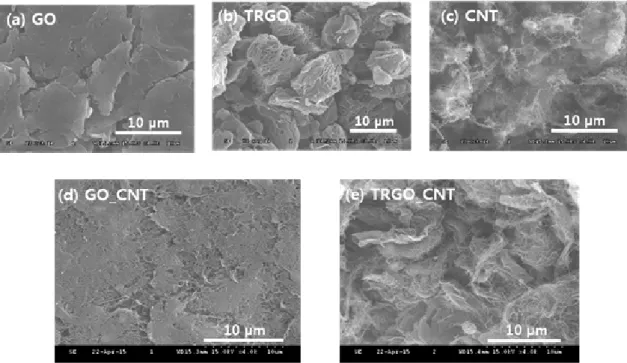
Fig. 1. SEM images of (a) GO, (b) TRGO, (c) CNT, (d) GOCNT, and (e) TRGOCNT.
II. EXPERIMENTAL
Graphite (Alfa Aesar), CNT (20 µm of length, 10 nm of diameter, Hanwha Nanotech), and the biomolecules (dopamine, thioridazine, and ascorbic acid, Sigma Aldrich) were purchased and used without any pre- treatment. GO was synthesized by the modified Brodie method as described in elsewhere [15]. TRGO was syn- thesized as follows: GO was heated at 280◦C for 30 min in Ar environment with the ramping rate of 9◦C/min and it was cool down to room temperature for overnight [15].
The GO CNT composite film was synthesized by mix- ing of GO (10 mg) and CNT (20 mg) in deionized (DI) water of 20 mL. Then the mixture was sonicated for 180 min at room temperature followed by the vacuum fil- tration with a cellulose paper to form a free-standing film. The film was then dried at 60◦C in a vacuum oven for overnight and used for the characterization.
The TRGO CNT composite film was also synthesized through the same procedure except that TRGO (10 mg) was used instead of GO. The other processes were exactly the same as the GO CNT film.
Scanning electron microscopy (SEM, Ltd., S-4300, JEOL, Japan) and energy dispersive X-ray spectroscopy
(EDS, HORIBA system, Hitachi) were performed to in- vestigate the surface morphology and the elemental com- position of the films. Electrochemical properties were investigated by cyclic voltammetry (CV), electrochemi- cal impedance spectroscopy (EIS), and differential pulse voltammetry (DPV) using EC-Lab (Bio-Logic, sp-150, France) in a three-electrode cell. An Ag/AgCl electrode was used as the reference electrode, and a platinum wire was employed as the counter electrode. The working elec- trode was prepared as follows. Each sample of 0.5 mg was dispersed well in isopropanol of 1 mL, and then the mix- ture of 10 g was dropped onto the glassy carbon electrode (GCE) and dried completely. CV was performed at the scan rate of 50 mV/s, DPV was measured at the pulse amplitude of 2.5 mV and pulse width of 100 ms, and the frequency from 100 mHz to 100 kHz was applied for the EIS measurement.
III. RESULTS AND DISCUSSION
SEM images of GO, TRGO, CNT, GO CNT, and TRGO CNT are shown in Fig. 1 GO has the smooth and two-dimensional surfaces, while TRGO show the ex- panded layers of the crumpled sheets due to the thermal effect, introducing the emergence of the oxygen func- tional groups existed in GO. CNT displays a tangled long
Investigation of the Electrochemical Responses of Graphite Oxide-Carbon · · · – Hien Thi Ngocr Le · Hae Kyung Jeong 453
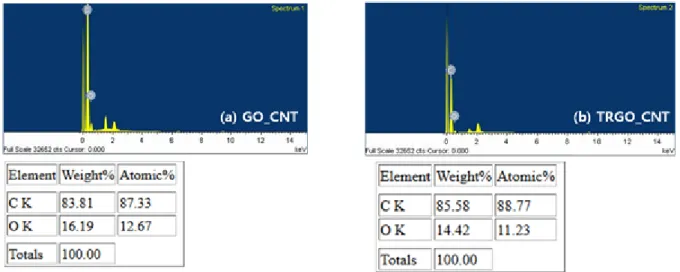
Fig. 2. (Color online) EDS results of the (a) GO CNT and (b) TRGO CNT composite films.
Fig. 3. (Color online) Cyclic voltammetry (CV) results of GO CNT and TRGO CNT with CNT at two different window potentials without biomolecules: (a) -0.2 V ∼ 0.5 V and (b) 0.4 V ∼ 0.8 V.
and thin one dimensional structure. The final GO CNT and TRGO CNT composite films exhibit significant dif- ferent morphologies. GO CNT has relatively flat surface in two-dimension, but TRGO CNT has irregular surfaces in three-dimensional structure. Hence, the TRGO CNT film is expected to have larger surface area than that of the GO CNT film, providing a positive effect on the elec- trochemical performance. Fig. 2 shows the corresponding EDS results of the composite films. The oxygen atomic percentages of GO CNT and TRGO CNT are 13 and 11 at%, respectively, indicating that the reduction of the oxygen functional groups occurred in TRGO CNT, at- tribute to TRGO.
Fig. 3 shows CV results of CNT, GO CNT and TRGO CNT in 0.1 M phosphate buffer solution (PBS)
[H2PO4]−/[HPO4]2− (pH = 7.5) at two different po- tential window. No faradaic interaction without the biomolecules was observed, and the rectangular shape, the characteristic of the electric double layer capacitor (EDLC), of CV proved that TRGO CNT could be a good electrode for the biomolecule recognition measurement.
TRGO CNT shows the higher current in CV compared to that of GO CNT because of TRGO. TRGO might improve the electrochemical conductivity, and the high conductivity is strongly correlated with the electrochem- ical performance for the biomolecule recognition.
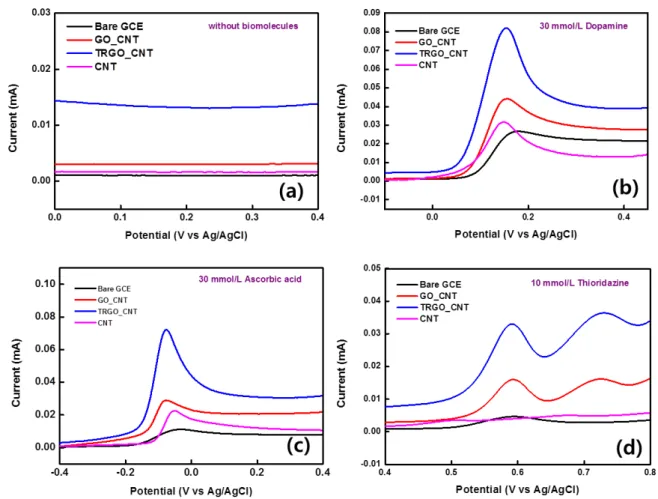
The differential pulse voltammetry (DPV) results of the GCE, CNT, GO CNT, and TRGO CNT electrodes without biomolecules are shown in Fig. 4(a), and no ox- idation peaks from three samples are found. By adding the dopamine of 30 mmol/L into the PBS solution three
Fig. 4. (Color online) Differential pulse voltammetry (DPV) results of GCE, CNT, GO CNT, and TRGO CNT (a) without biomolecules and with (b) dopamine, (c) ascorbic acid, and (d) thioridazine molecules.
Fig. 5. (Color online) Electrochemical impedance spectra (EIS) of GO CNT and TRGO CNT in (a) the linear and (b) log scale of the frequency.
samples display one oxidation peak at 0.15 V, as shown in Fig. 4(b). The peak is corresponding to the oxida- tion reaction of dopamine to dopamine-o-quinone, as de- scribed in elsewhere [16]. TRGO CNT current was the highest to the dopamine. For the ascorbic acid, as shown
in Fig. 4(c), the oxidation peak at – 0.06 V was found due to the oxidation of hydroxyl groups of the furan ring to carbonyl groups [17]. TRGO CNT response current is also the highest in the ascorbic acid measurement. Two oxidation peaks at 0.59 and 0.73 V were observed with
Investigation of the Electrochemical Responses of Graphite Oxide-Carbon · · · – Hien Thi Ngocr Le · Hae Kyung Jeong 455
the thioridazine molecule of 10 mmol/L in Fig. 4(d), and the peaks correspond to the first and second step of the oxidation of thioridazine, as proposed in elsewhere [18].
Again TRGO CNT shows the highest response to the molecule, confirming that TRGO CNT is much better electrode compared to GO CNT in the point of the elec- trochemical performance with the biomolecules.
The reason for the high electrochemical performance of TRGO CNT could be found in the impedance re- sults. The electrochemical impedance spectra are shown in Fig. 5. The impedance of TRGO CNT composite is much lower than that of GO CNT in the all frequency region, as shown in Fig. 5(a). In order to compare the impedance in the low frequency regime clearly Fig. 5(b) displays it in the log scale of both x and y axis, con- firming that the impedance of TRGO CNT is two or- der lower than that of GO CNT. This is the reason why TRGO CNT has better electrochemical performance to the biomolecules compared to GO CNT. It is, therefore, concluded that the free-standing film made from TRGO and CNT could provide better electrode, contrast to the GO CNT film, for the electrochemical biomolecule recog- nition.
IV. CONCLUSIONS
The free-standing GO CNT and TRGO CNT com- posite films are synthesized by a simple chemical method and their electrochemical performance for the biomolecules (dopamine, thioridazine, and ascorbic acid) recognition was characterized. TRGO CNT shows higher surface area based on the three-dimensional structure and lower electrochemical impedance compared to those of the GO CNT film, resulting in higher electrochemical response current to the all biomolecules, without unnec- essary faradaic reactions. The TRGO CNT film, there- fore, could be applied for biosensors electrodes.
REFERENCES
[1] H. K. Jeong, Y. P. Lee, R. J. W. E. Lahaye, M. H.
Park and K. H. An et al., J. Am. Chem. Soc. 130, 1362 (2008).
[2] S. F. Pei and H. M. Cheng, Carbon 50, 3210 (2012).
[3] N. A. Kotov, I. D´ek´any and J. H. Fendler, Adv.
Mater. 8, 637 (1996).
[4] Z. S. Wu, W. Ren, L. Gao, B. Liu and C. Jiang et al., Carbon 47, 493 (2009).
[5] Y. Zhu, S. Murali, M. D. Stoller, A. Velamakanni and R. D. Piner et al., Carbon 48, 2118 (2010).
[6] L. J. Cote, R. Cruz-Silva and J. Huang, J. Am.
Chem. Soc. 131, 11027 (2009).
[7] C. H. Lu, H. H. Yang, C. L. Zhu, X. Chen and G.
N. Chen, Angew. Chem. Int. Ed. 48, 4785 (2009).
[8] A. Bianco, K. Kostarelos and M. Prato, Curr. Opin.
Chem. Biol. 9, 674 (2005).
[9] A. Bianco and M. Prato, Adv. Mater. 15, 1765 (2003).
[10] D. Pantarotto, C. D. Partidos, R. Graff, J. Hoebeke and J.-P. Briand et al., J. Am. Chem. Soc. 125, 6160 (2003).
[11] D. Pantarotto, J.-P. Briand, M. Prato and A. Bri- anco, Chem. Commun. 1, 16 (2004).
[12] H. Gao, Y. Kong, D. Cui and C. S. Ozkan, Nano Lett. 3, 471 (2003).
[13] Y. H. Xie and A. K. Soh, Mater. Lett. 59, 971 (2005).
[14] U. Arsawang, O. Saengsawang, T. Rungrotmongkol, P. Sornmee and K. Wittayanarakul et al., J. Molec- ular Graphics and Modelling 29, 591 (2011).
[15] M. Jin, H. K. Jeong, T. H. Kim, K. P. So and Y. Cui et al., J. Phys. D: Appl. Phys. 43, 275402 (2010).
[16] R. M. Wightman, L. J. May and A. C. Michael, Anal. Chem. 60, 769 (1988).
[17] Vitamin C in Fruit Juices, Available from http://
dwb5.unl.edu/CHEM/SmallScale/SmallScale-054.
html (accessed Nov. 15, 2015).
[18] M. H. Mashhadizadeh and E. Afshar, Electroanal- ysis 24, 2193 (2012).