19 Korean Chem. Eng. Res., 55(1), 19-26 (2017)
https://doi.org/10.9713/kcer.2017.55.1.19 PISSN 0304-128X, EISSN 2233-9558
Synthesis of Complex Compounds Ni(II)-Chlorophyll as Dye Sensitizer in Dye Sensitizer Solar Cell (DSSC)
Handoko Darmokoesoemo†, Arista Rahma Fidyayanti, Harsasi Setyawati and Heri Septya Kusuma† Department of Chemistry, Faculty of Science and Technology, Airlangga University, 60115, Indonesia (Received 9 September 2016; Received in revised form 28 September 2016; accepted 7 October 2016)
Abstract − Increasing global energy demand has resulted in an energy crisis. The dye sensitizer solar cell (DSSC) is an alternative source because of its ability to convert the sun’s energy into electrical energy. Our aim was to determine the effect of synthesized Ni(II)-Chlorophyll for enhancing the efficiency of solar cells based DSSC. Complex compound Ni(II)- Chlorophyll was successfully synthesized as a dye sensitizer of Ni(NO3)2.6H2O and chlorophyll ligand with saponification method. Characterization results with spectrophotometer UV-Vis showed that the complex compounds of Ni(II)-Chlorophyll have a maximum wavelength of 295.00 nm, 451.00 and 665.00 nm. The bond between the ligand and metal appears in the vibration Ni-O at wave number 455.2 cm-1. Complex compoun Ni(II)-Chlorophyll has a magnetic moment 7.10 Bohr Magneton (BM). The performance of complex compound Ni(II)-Chlorophyll as a dye sensitizer shows the value of short-circuit current (Jsc) at 3.00 mA/cm2, open circuit voltage (Voc) at 0.15 V and the efficiency (η) 0.20%.
Key words: Ni(II)-Chlorophyll, Dye sensitizer, DSSC, Efficiency
1. Introduction
The energy crisis has become a major problem for every country in the world, especially for fossil fuel sources [1]. Global energy demand is increasing, but the fossil fuels amount decreases every time, this make researchers more active in studying and finding new alterna- tive energy sources [2]. Some alternative energy has developed as a solution to the depletion of fossil fuel supply, such the development of hydropower, wind power, solar power, nuclear power and bio- mass energy [3]. One of the few solutions offered is the development of solar cell technology because solar energy is one of the abundant energy, especially in tropical countries like Indonesia [1].
Dye sensitizer solar cell (DSSC) is one of the most promising alternative energy sources, because it has a high efficiency in con- verting sunlight, the production process is simple, low-cost produc- tion is needed as well as nontoxicity [4]. DSSC consists of a layer of dye, a conductive glass, the working electrode, electrolyte and refer- ence electrode [5]. Dye layer is the main component of the DSSC that serves to absorb sunlight so that the process of converting sun- light into electricity energy goes well [1].
In this study, the dye was synthesized from the complex compound Ni(II)-Chlorophyll, where the complex compound was derived from Ni2+ metals and chlorophyll as ligands with saponification method.
Therefore, our objective was to determine the effect of synthesized Ni(II)-Chlorophyll for enhancing the efficiency of solar cells based DSSC.
2. Experimental
2-1. Tools and materials
The tools used in this study included glassware, which is com- monly used in laboratories, glass plates (2.5 cm × 2.5 cm × 0.01 cm), light meter, multimeter, potentiometer 100 KΩ, the scales of analy- sis METLER AE 200, graphite pencil, hotplate, stirrer, thermome- ter, pipette, furnace, stir bar, and oven. The characterization tools which used in this study were a Shimadzu spectrophotometer UV- Vis 1800, Shimadzu FTIR spectrophotometer, MSB Sherwood Sci- entific, Conductometer Eutech CON 510 and XRD Instrument X'Pert PRO.
The chemicals used were chlorophyll powder CMP, titanium dioxide Degussa P 25, sodium hydroxide (NaOH, 99%), methanol (CH3OH, 99%), ethanol (C2H5OH, 99%), hydrochloric acid (HCl, 37%), nickel nitrate (Ni(NO3).6H2O), aquabidest, electrolyte solu- tion of I2 in KI. All the ingredients in the above were pro-quality analysis (p.a) unless otherwise stated.
2-2. Making the Chlorophyll solution
This experiment using CMP brands as the chlorophyll powder.
One gram of chlorophyll was dissolved in 10 ml aquabidest in 10 ml flask. Furthermore, the solution was homogenized in the flask.
2-3. Chlorophyll saponification reaction
The saponification reaction involved dissolving 2 g of NaOH in 50 mL aquabidest, then adding 2 mL solution of NaOH in ethanol to form ethanol-NaOH with a total volume of 10 mL. Subsequently, 5 mL of chlorophyll was added to the solution and homogenized for 2 hours in a water bath at a constant temperature. The top layer was taken
†To whom correspondence should be addressed.
E-mail: [email protected], [email protected] This is an Open-Access article distributed under the terms of the Creative Com- mons Attribution Non-Commercial License (http://creativecommons.org/licenses/by- nc/3.0) which permits unrestricted non-commercial use, distribution, and reproduc- tion in any medium, provided the original work is properly cited.
pH 2-3. Then adding 5 ml of Ni(NO3)2.6H2O 10% which was homoge- nized and heated at 60~70oC for 1 hour, the precipitate oven at a temperature of ± 80oC for 24 hours [6].
2-6. Preparation Dye Sensitizer Solar Cell (DSSC) 2-6-1. Coating TiO2 film on glass plates by doctor blade method The 0.1 g of TiO2 Degussa P 25 compound was suspended in 100 mL of methanol 98% [7]. Suspension of TiO2 was coated on a glass plate 2.5 cm × 2.5 cm × 0,01 cm using the rod by sliding it on the sur- face of the glass to flatten the TiO2 suspension that had dripped until it reached a certain thickness. TiO2 coated glass was cooled at room temperature for 45 minutes and then heated at 450oC for 30 min- utes, then cooled to 70oC [8].
2-6-2. Making of electrolytes
The electrolyte solution was made by comparison of alkali iodide salt concentration of 0.5 M and 0.05 M I2. The 0.4980 g KI was dis- solved in 6 mL acetonitrile in a glass beaker. In another beaker was put as much as 0.0760 g I2 and 6 mL asetonitrile, then stirred until homogeneous. The solution in the second beaker was mixed and stirred [9].
2-6-3. Making of working electrode for DSSC
Glass plate that had been coated TiO2 suspension was immersed in a complex compound Ni(II) -chlorophyll on a petri dish for 24 hours.
For use in the long term, after coating, glass plates were stored in dark glass bottles, and an effort was made to avoid from scratches so as not to damage the layer of TiO2 [8].
2-6-4. Making of reference electrode for DSSC
The glass plate which was ready to use was coated with a graphite pencil at the surface, which was created as a pencil tip chisel eye so that the coating on the glass plate spread well. Then, the glass plate was heated at 450oC for 30 minutes [8].
2-6-5. DSSC assembly
The working electrode that had been made was placed on the table
rent and voltage was measured for 14 days [10].
2-6-7. Current and voltage characterization of DSSC using a potentiometer
Current and voltage I-V can be characterized by making a series circuit by connecting the multimeter, DSSC cells, and potentiome- ters, which are minimized and maximized.
3. Results and Discussion
3-1. Characterization of Compound Complex Ni(II)-Chlorophyll Synthesized complex compounds were characterized to deter- mine their characteristics. The characterization used UV-Vis spectro- photometer, FTIR spectrophotometer, MSB and conductometer.
3-1-1. Characterization of compound complex Ni(II)-Chlorophyll using UV-VIS spectrophotometer
Characterization by UV-Vis spectrophotometer was conducted to determine the maximum absorption wavelength in the wavelength range 200~800 nm. The characterization results with UV-Vis spec- trophotometer are shown in Table 1.
Table 1 shows that the maximum wavelength of complex com- pounds Ni(II)- chlorophyll and chlorophyll has a different maximum wavelength. The maximum wavelength of chlorophyll is 404.00 nm and 630.00 nm, while the maximum wavelength of complex com- pound Ni(II)-chlorophyll is 295.00 nm, 451.50 nm and 665.00 nm.
From the different wavelengths we can see that complex compound Ni(II)-chlorophyll was successfully synthesized. Complex compound Ni(II)-chlorophyll wavelength appears in the UV and visible at 295.00 nm and 736.00. The wavelengths appear in the UV due to the phe- nomenon of charge transfer in the form metal to ligand charge trans- fer (MLCT), which phenomenon occurs because the metal Ni(II) has
Table 1. Results of characterization of complex compounds of Ni(II)- Chlorophyll, chlorophyll and Ni(NO3)·6H2O
Compound Maximum Wavelength (nm)
Ni(II)-chlorophyll 295.00 - 451.50 665.00
Chlorophyll - 404.00 - 630.00
lower oxidation states [15]. Meanwhile, the wavelength appearing on visible areas is caused by the transition d-d in the complex com- pound. This transition is changing the distribution of metal-ligand charge, because the electron density shifts from orbital with high metal character to a high ligand orbitals, and these phenomena belong to MLCT [25]. The solvent of this complex compound Ni(II)-Chloro- phyll is DMSO (Dimethyl Sufoxide), which has a high polarity so it causes a bathochromic shift in the visible region. MLCT complex compounds are good to be applied as a dye sensitizer because they can absorb more sunlight that can be converted into electrical energy [24].
3-1-2. Characterization of compound complex Ni(II)-Chlorophyll with fourier transform infrared (FTIR) spectrophotometer
The results of the synthesis of complex compound of Ni(II)-Chlo- rophyll are characterized by a Fourier transform infrared (FTIR) spectrophotometer to determine the functional groups and the bond between the metal ligands. The differences in the results of the FTIR spectra of chlorophyll ligand with complex compound Ni(II)-Chlo- rophyll indicate that the complex compound has been synthesized successfully. The characterization results of chlorophyll ligand and complex compound Ni (II)-Chlorophyll can be seen in Fig. 1; the information of FTIR spectrum of ligands and complex compound can be seen in Table 2.
Based on the FTIR spectra and descriptions of the table, there is a bond between the metal Ni(II) with ligands chlorophyll that can be
seen from the formation of Ni-O bond, so it can be concluded that the complex compound of Ni (II)-chlorophyll has been successfully syn- thesized. Prediction of bonding between the metal Ni (II) with ligands chlorophyll can be seen in Fig. 2.
3-1-3. Complex compound Ni(II)-Chlorophyll characteriztion using magnetic susceptibility balance (MSB)
This complex compound Ni(II)-Chlorophyll was characterized using magnetic succeptibility balance (MSB) to measure the magnetic moment so we could categorize its magnetic characteristics.
According to Table 3 we can seen the difference in value of the magnetic moment in Ni(NO3)2 .6H2O, chlorophyll ligands and com- plex compounds Ni(II)-Chlorophyll, indicating that the complex Fig. 1. The FTIR spectra of chlorophyll ligands and complex compounds
Ni(II)-Chlorophyll.
Table 2. Data Translation The FTIR spectrum of ligands and complex compounds
Bonds Ligand wavenumber (cm-1) Complex compound wavenumber (cm-1) Theoretical wavenumber (cm-1) References
Ni-O 455.2 430~480 Adekunle et al., 2014
Mg-N 300.9 308.61 242~310 Mojumdar et al., 1998
OH 3394.72 3402 3362~3421 Ahmed et al., 2014
CO 2167.99 2167.99 2150~2200 Chakarova et al., 2011
CH 1381 1381 1350~1400 Bodirlau et al., 2007
C=C Aromatic 1635 1620 1619~1640 Ahmed et al., 2014
Fig. 2. Prediction of bonding between the metal Ni (II) with ligands chlorophyll.
Table 3. Results of the magnetic moment of Ni(NO3)2·6H2O, chlorophyll ligand and Ni(II)-Chlorophyll
Compound Magnetic Moment (BM)
Ni(NO3)2·6H20 2.32
Ligand Chlorophyll 0.81
Ni(II)-Chlorophyll 7.10
Chlorophyll ligands are weak ligands and not strong enough to push the electrons in the metal d orbitals Ni (II) to pair [11]. In this experi- ment, chlorophyll ligands donated five pairs of free electron pairs at the metal Ni(II) on orbital s, p and d to form hybridization sp3d2 which is the octahedral shaped structure [10]. Prediction of mag- netic properties of complex Ni(II)-Chlorophyll by valence bond the- ory is contained in Fig. 3.
According to Table 3, complex compound Ni(II)-Chlorophyll has a value of 7.10 BM, which indicates there are seven unpaired elec- trons, but as shown in Fig. 3.4, there are only two unpaired electrons in this case because the chlorophyll ligands bound Ni metal contrib- uting to donating magnetic properties, resulting in a complex com- pound magnetization value also increasing.
3-1-4. Electrical conductivity characterization of complex compound Ni (II)-chlorophyll by conductometer
Electrical conductivity of complex compounds with conductome- ter was characterized to determine whether the complex compounds synthesized a molecular or ionic complex compound. The synthesis of complex compound of Ni(II)-Chlorophyll electrical conductivity was measured by comparing the value of the conductance of a solu- tion of complex compounds of Ni(II)-Chlorophyll with solvent, where the solvent of complex compounds of Ni(II)-Chlorophyll is DMSO
it can be concluded that the complex compound of Ni(II)-Chloro- phyll is an ionic complex compound. The advantage of an ionic compound is that it has a boiling point and a high melting point; in addition, ionic compounds easily decompose into ions, making it easier to conduct electricity.
3-2. Applications of Complex Compound Ni(II)-Chlorophyll as a dye sensitizer in DSSC
3-2-1. Characterization of compound complex bond Ni(II)-Chlo- rophyll and TiO2 with FTIR spectrophotometer
This characterization proves the existence of chemical bonds formed between TiO2 with Ni(II)-Chlorophyll. Ligand functional groups must have a lone pair of electrons that can bind with TiO2 [13].
From the above spectra, at a wavenumber of 671.23 cm-1 bonds are formed Ti-O, indicating that the complex compound Ni(II)-Chlo- rophyll is bound to Ti. The wavenumber range is in accordance with the literature where Ti bonds with group O ligands will appear in the wavenumber range of 450~1000 cm-1 [18]. Prediction of chemical
Fig. 4. Spectra of ligand chlorophyll, complex compounds Ni(II)- Chlorophyll and TiO2 with Ni(II)-Chlorophyll.
Fig. 5. Prediction of chemical bonds between TiO2 with Ni(II)-Chloro- phyll.
bonds between TiO2 with complex compounds of Ni(II)-Chloro- phyll is shown in Fig. 5.
3-2-2. Making of electrolytes
The electrolyte solution was prepared by dissolving 0.4980 g of KI in 6 mL acetonitrile and 0.0760 g of I2 in 6 mL acetonitrile. After dissolving completely, the solution was mixed and homogenized; the
solution obtained a blood red color. For time use, the electrolytic solution was stored in a brown glass bottle.
3-2-3. DSSC assembly
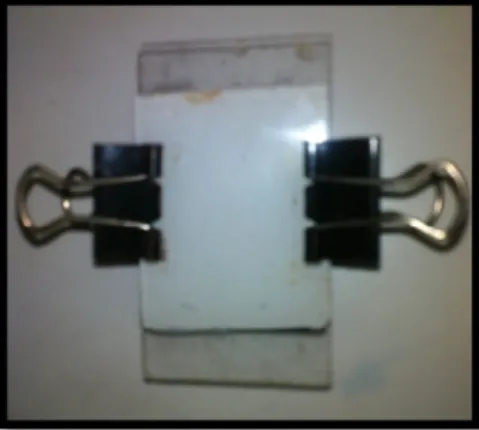
DSSC was assembled by working electrode and a reference elec- trode mounted facing each other, is a side with the one containing dye dealing with the side containing carbon. Furthermore, between the two electrodes was spilled two drops of electrolyte solution. DSSC circuit was then clamped with clamp clips and then its efficiency was measured with a multimeter.
3-2-4. Current measurement of DSSC
In this study, the current measurement was done consistently for 14 days at around 10:00 to 13:00 pm on June 7 to 20, 2016. These measurements were performed by using the working electrode TiO2, TiO2-chlorophyll, TiO2 with Ni(II)-Chlorophyll, TiO2 with a mix- ture of chlorophyll and Ni(NO3)2·6H2O. These measurements were performed on each DSSC cell in order to know the current generated during 14 days. In addition, a comparison was made of the current generated in the TiO2 with Ni(II)-Chlorophyll and TiO2 with a mix-
Table 5. Flow of the working electrode TiO2, TiO2-chlorophyll, TiO2 with Ni(II)-Chlorophyll and TiO2 with a mixture of chlorophyll and Ni(NO3)2·6H2O
Days Current Isc (mA)
TiO2 TiO2-Chlorophyll TiO2 with Ni(II)-Chlorophyll TiO2 mix with Chlorophyll and Ni(NO3)2.6H2O Lux
1 17.70 19.20 20.60 15.80 750.90
2 19.20 20.50 21.20 15.50 756.30
3 17.10 19.70 20.53 15.70 756.25
4 17.60 20.30 21.30 16.20 757.95
5 18.90 19.80 22.00 17.10 736.85
6 17.20 18.90 21.60 14.30 758.20
7 17.90 19.70 20.50 16.30 759.35
8 17.60 19.40 19.80 15.70 756.35
9 17.30 19.00 18.90 16.60 742.45
10 17.60 17.30 18.30 15.60 731.05
11 17.20 18.00 18.50 15.50 722.30
12 16.80 17.00 17.80 14.40 719.65
13 16.10 17.70 17.40 14.20 702.45
14 15.70 15.50 17.10 13.80 698.30
Fig. 6. The series of DSSC.
Fig. 7. Current measurement each day.
sity of sunlight affected the output current, the greater the intensity of sunlight the output current was getting bigger too, and if the sun intensity decreased smaller, then the output generated current also decreased [2].
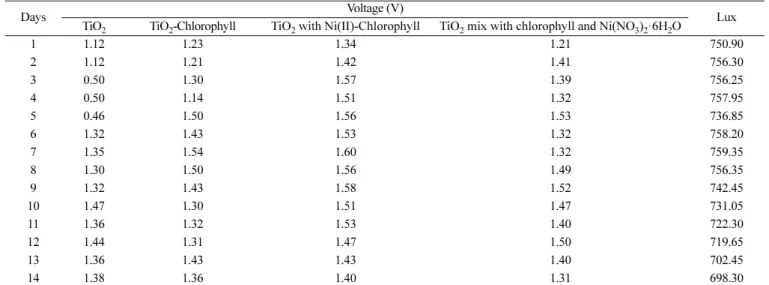
3-2-5. Voltage measurements of DSSC
In this study, the voltage was measured for 14 days at 10:00 to 13:00
2
erated by TiO2 + Ni(II)-Chlorophyll produced the highest scores because the electrons captured by TiO2 contained more complex compounds than the others [14].
3-2-6-. I-V curve measurement
I-V curve measurements were performed to determine the effi- ciency of DSSC cells in converting sunlight into electrical energy.
Table 6. Voltage of the working electrode TiO2, TiO2-chlorophyll, TiO2 with Ni(II)-Chlorophyll and TiO2 with a mixture of chlorophyll and Ni(NO3)2·6H2O
Days Voltage (V)
TiO2 TiO2-Chlorophyll TiO2 with Ni(II)-Chlorophyll TiO2 mix with chlorophyll and Ni(NO3)2·6H2O Lux
1 1.12 1.23 1.34 1.21 750.90
2 1.12 1.21 1.42 1.41 756.30
3 0.50 1.30 1.57 1.39 756.25
4 0.50 1.14 1.51 1.32 757.95
5 0.46 1.50 1.56 1.53 736.85
6 1.32 1.43 1.53 1.32 758.20
7 1.35 1.54 1.60 1.32 759.35
8 1.30 1.50 1.56 1.49 756.35
9 1.32 1.43 1.58 1.52 742.45
10 1.47 1.30 1.51 1.47 731.05
11 1.36 1.32 1.53 1.40 722.30
12 1.44 1.31 1.47 1.50 719.65
13 1.36 1.43 1.43 1.40 702.45
14 1.38 1.36 1.40 1.31 698.30
Fig. 8. Graph Voltage Measurement of DSSC.
DSSC cell will generate power when it is loaded at the same time.
The load given in this study is a potentiometer which has a resistiv- ity of 100 KΩ. The results of the current I-V measurements are shown in Table 7.
In this study we measured the I-V curve to the compound complex Ni(II)-Chlorophyll, TiO2, ligand chlorophyll and mixing Ni(NO3)2·6H2O with chlorophyll in order to get the efficiency of each of these com- pounds.
In Figs. 9, 10, 11 and 12 are the obtained values of short circuit current (Isc) of 12.00 mA; 5.00 mA; 13.00 mA and 6.00 mA. We also obtained the value of current open circuit (Voc) of 0.15 V; 0.19 V;
0.09 V and 0.07 V. Impp and Vmpp values were obtained by multiply- ing the current and voltage of each point in order to obtain the greatest
extent. From the data obtained then can be determined the efficiency of complex compounds Ni(II)-Chlorophyll, TiO2, ligand chlorophyll and mixing Ni(NO3)2·6H2O with chlorophyll, respectively, by 1.81%;
0.55%; 1.14% and 0.04%.
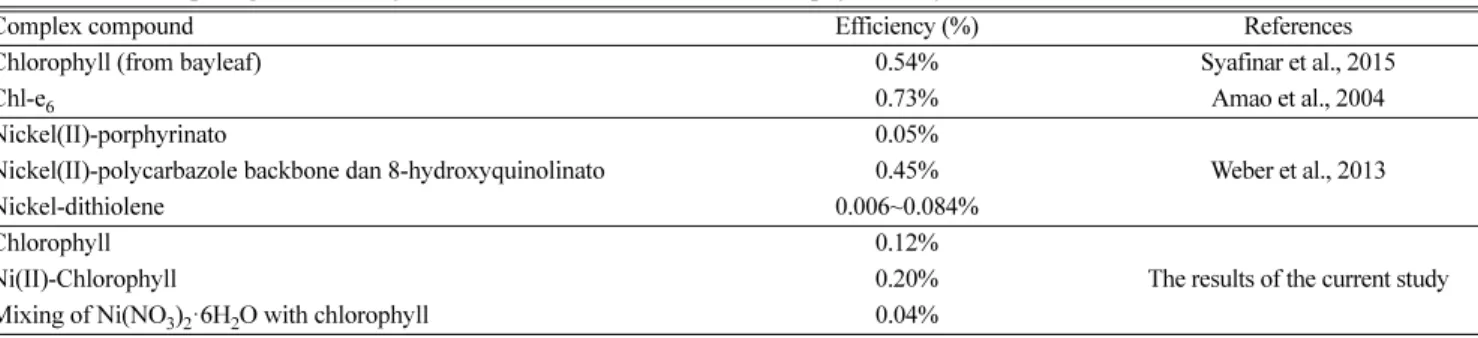
Complex compound Ni(II)-Chlorophyll has the greatest efficiency values when compared with previous studies that use the metal Ni (II). The efficiency of complex compound Ni(II)-Chlorophyll is also greater than the efficiency of chlorophyll conducted in this study;
this is due to the complex compound Ni(II)-Chlorophyll MLCT phe- nomenon that occurred ,so it can absorb more. Thus the sunlight was converted into larger, and the resulting efficiency was greater too if compared with chlorophyll [24]. In addition, the use of chlorophyll ligands, which also have an ability to convert sunlight, become one of the factors that efficiency of the complex compound Ni(II)-Chlo- rophyll becomes larger too.
Table 7. Data from current measurement voltage (I-V)
Compound Jsc (mA/cm2) Voc (V) FF η (%)
Ni(II)-Chlorophyll 3.00 0.15 0.23 0.20
TiO2 1.25 0.19 0.13 0.06
Chlorophyll 3.25 0.09 0.22 0.12
Mixing Ni(NO3)2·6H2O with chlorophyll 1.50 0.07 0.21 0.04
Fig. 9. I-V curve compounds Complex Ni(II)-Chlorophyll.
Fig. 10. I-V curve TiO2.
Table 8. Table comparing the efficiency of DSSC some metals Ni2+ and chlorophyll as a dye sensitizer
Complex compound Efficiency (%) References
Chlorophyll (from bayleaf) 0.54% Syafinar et al., 2015
Chl-e6 0.73% Amao et al., 2004
Nickel(II)-porphyrinato 0.05%
Weber et al., 2013 Nickel(II)-polycarbazole backbone dan 8-hydroxyquinolinato 0.45%
Nickel-dithiolene 0.006~0.084%
Chlorophyll 0.12%
The results of the current study
Ni(II)-Chlorophyll 0.20%
Mixing of Ni(NO3)2·6H2O with chlorophyll 0.04%
Fig. 11. I-V curve Chlorophyll.
Fig. 12. I-V curve of Ni(II) + Chlorophyll.
short-circuit current (Jsc) at 3.00 mA/cm2, an open circuit voltage (Voc) at 0.15 V and has an efficiency (η) of 0.20%.
References
1. Adekunle, A. S., Oyekunle, J. A., Oluwafemi, O. S., Joshua, A.
O., Makinde, W. O., Ogunfowokan, A. O., Eleruja, M. A. and Ebenso, E. E., J. Electrochem., 9, 3008(2014).
2. Afifudin, F. and Farid, S. H., Journal Neutrino, 4, 1(2012).
3. Ahmed, J. K., Amer, Z. J. A. and Al-Bahate, M. J. M., Int. J.
Mater. Sci. Appl., 4, 21(2015).
4. Amao, Y. and Komori, T., Biosensor Bioelectro, 19, 843(2004).
5. Armas, S. D., Miguel, M. A. S., Ovied, J. and Sanz, J. F., Comput.
Theori. Chem., 975, 99 (2011).
6. Bodirlau, R. and Teaca, C. A., “Fourier Transform Infrared Spec- troscopy and Thermal Analysis of Lignocellulose Fillers Treated with Organic Anhydrides,” Rom. J. Phys., 54, 93(2007).
7. Chakarova, K. and Hadjiivanov, K., Chem. Commun., 47, 1878 (2011).
8. Fuadi, F. Z., Photocatalytic degradation of pentaclorophenol with TiO2 immobilized on a glass column (in Bahasa Indonesia), Thesis (2007).
9. Han, J., Wang, Y., Ma, J., Wu, Y., Hu, Y., Ni, L. and Li, Y., J.
Sep. Pur. Tech., 115, 51(2013).
10. Kadish, K. M., Smith, K. M. and Guilard, R., The Porphyrin Handbook, Volume 3 Inorganic, Organometallic and Coordina-
16. Mojumdar, S. C., Melnik, M. and Jona, E., Chem. Pap. Slovak Acad. Sci., 53, 309(1999).
17. Mozaffari, S. A., Ranjbar, M., Kouhestanian, E., Amoli, H. S.
and Armanmehr, M. H., Mater. Sci. Semicond. Process., 40, 285 (2015).
18. Murugakoothan, P., Ananth, S., Vivek, P. and Arumanayagam, T., J. Nano Electron. Phys., 6, 01003-1(2014).
19. Pancaningtyas, L. and Akhlus, S., The Role of Electrolytes in Dye Sensitized Solar Cell (DSSC) Performance (in Bahasa Indo- nesia), Thesis (2013).
20. Qadir, M. B., Sun, K. C., Sahito, I. A., Arbab, A. A., Choi, B. J., Yi, S. C. and Jeong, S. H., Sol. Energy Mater. Sol. Cells, 140, 141(2015).
21. Susanti, D., Nafi, M., Purwaningsih, H., Fajarin, R. and Kusuma, G.
E., Procedia Chem., 9, 3(2014).
22. Syafinar, R., Gomesh, N., Irwanto, M., Fareq, M. and Irwan, Y.
M., Energy Procedia, 79, 799(2015).
23. Ye, M., Wen, X., Wang, M., Iocozzia, J., Zhang, N. and Lin, Z., Mater. Today, 18, 155(2015).
24. Yin, J.-F., Velayudham, M., Bhattacharya, D., Lin, H.-C. and Lu, K.-L., Coord. Chem. Rev., 256, 3008(2012).
25. Yuniyanto, M., Study the Performance of the Cathode Metal ion Zn (II) and Cr (III) Without Plasticizers from Minopropyltrimetoxysilan and Octyltrietoxysilan with Kromoionofor 4-(2-Piridilazo) Resor- cinol (in Bahasa Indonesia), Thesis (2006).
26. Zamrani, R. A. and Prajitno, G., Jurnal Sains dan Seni Pomits, 1, 1(2013).