652 https://doi.org/10.9713/kcer.2017.55.5.652
PISSN 0304-128X, EISSN 2233-9558
Optimization of Extended UNIQUAC Parameter for Activity Coefficients of Ions of an Electrolyte System using Genetic Algorithms
Seyed Hossein Hashemi†, Seyed Ali Mousavi Dehghani*, Abdolhamid Khodadadi**, Mahmood Dinmohammad*, Seyed Mohsen Hosseini*** and Seyed Abdolrasoul Hashemi****
Graduate Msc Chemical Engineering, University of Mohaghegh Ardabili, Ardabil, Iran
*Institute of production and recovery, RIPI, NIOC, Iran
**Graduated Bsc Chemical Engineering,Persian Gulf University , Bushehr, Iran
***Graduate Msc Chemical Engineering, Sahand University,tabriz, Iran
****Graduate Msc computer Engineering, Software trends, Yasooj Islamic Azad University (Received 13 January 2017; Received in revised form 29 May 2017; accepted 7 June 2017)
Abstract − In the present research, in order to predict activity coefficient of inorganic ions in electrolyte solution of a petroleum system, we studied 13 components in the electrolyte solution, including H2O, CO2 (aq), H+, Na+, Ba2+, Ca2+, Sr2+, Mg2+, SO4, CO3, OH-, Cl-, and HCO3. To predict the activity coefficient of the components of the petroleum sys- tem (a solid/liquid equilibrium system), activity coefficient model of Extended UNIQUAC was studied, along with its adjustable parameters optimized based on a genetic algorithm. The total calculated error associated with optimizing the adjustable parameters of Extended UNIQUAC model considering the 13 components under study at three temperature levels (298.15, 323.15, and 373.15 K) using the genetic algorithm is found to be 0.07.
Key words: Mineral ions, Optimization, Genetic Algorithms, Extended UNIQUAC Model
1. Introduction
Optimization is the process of maximizing the desirable effi- ciency. Optimization techniques implement this process by under- taking some modifications on an initial assumption. To increase the efficiency, optimization algorithms should apply operators on initial points to produce new points within the search space for objective function (to gradually move toward the optimal locations within this space). In most of these search techniques (gradient method), the algorithm proceeds from one point to another; in most cases, this point-by-point approach ends up with optimization errors as they converge to a local maxima. This drawback in optimization of non- linear models leads to complex issues in the process of problem solv- ing. To overcome this drawback [1-3] powerful algorithms such as genetic algorithms (GA) are proposed. Electrolyte solutions are listed among the most important aqueous systems in chemical indus- tries, such as petroleum systems, due to the electrostatic and short- range forces established between ions and solvent. Either high or low concentration can lead to a non-ideal behavior in the electrolyte sys- tems. In this regards it is necessary to investigate all inter-particle forces. Due to the dependence of saturation index of mineral sedi- ment formation in chemical systems, such as oil, on the mineral ions of aqueous solutions, the importance of their activity factors increases;
thus it is being used in modeling thermodynamic prediction of min-
eral sediment formation during industrial processes. In studies pre- dicting mineral sediments in electrolytic aqueous solutions, two terms of thermodynamic equilibrium constant and activity factor of water-soluble mineral components are considered. Mineral sedi- ments are one of the main problems of oil facilities, and the forma- tion of these deposits is one of the fundamental challenges the water feeding systems confront. Depending on the conditions (changes in water pressure and temperature alone or in combining two incompat- ible water) during an operation when these mineral ions are dissolved in the system (in a state of saturation), these deposits can cause major problems by reducing the inner diameter of extraction pipe, increas- ing repair and maintenance costs and causing overall decline in the exploitation of oil of underground reservoirs. Therefore, considering the importance of mineral sediment formation based on the nature and activity of mineral ions in water systems of industrial operations such as oil, in this research in order to predict activity factor of min- eral ions in oil systems, 13 components of electrolytic solutions have been studied: H2O, CO2 (aq, H+, Na+, Ba2+, Ca2+, Sr2+, Mg2+, SO4, CO3, OH−, Cl− and HCO3. Considering the satisfying efficiency of the activity coefficient model of Extended UNIQUAC with its adjust- able parameters optimized using genetic algorithms, we used this method to investigate the activity coefficient of the ions in this study.
2. Theoretical Section 2-1. Extended UNIQUAC Model
Thomsen and Rasmussen (1999)[4] exercised Extended UNI- QUAC model to study the electrolytic systems. Satisfying results were
†To whom correspondence should be addressed.
E-mail: [email protected]
This is an Open-Access article distributed under the terms of the Creative Com- mons Attribution Non-Commercial License (http://creativecommons.org/licenses/by- nc/3.0) which permits unrestricted non-commercial use, distribution, and reproduc- tion in any medium, provided the original work is properly cited.
acquired for the solid-liquid, liquid-liquid and liquid-vapor equilib- rium systems. The model is a combination of local composition model (UNIQUAC) and Debye-Hückel term. UNIQUAC model was suggested by Abrams and Prausnitz [5] to describe the Gibb's addi- tional energy of the mixture, and includes two parts: one part of the compound is related to the entropy of the system and is determined according to the size and shape of molecule, the remaining part con- siders the intermolecular forces involved in mixing enthalpy and depends on molecular forces.
UNIQUAC equation has adjustable parameters and is expressed as follows for the equilibrium of liquid-solid systems (multi-part) [4-6]:
GE= GEcombinatorial+ GEResidual+ GEDebye-HucKel (1)
(2)
In the upper equation, GE is Gibbs free energy, z is coordination number with a value of 10; xi is mole fraction; ϕi is mole fraction;
φi is volume fraction and θi is the surface area fraction of ions in the liquid-solid or liquid-vapor equilibrium system which is expressed as:
(3)
(4)
where ri and qi are the volume and surface area parameters for each ion. Also, for the residual term, the following equation holds:
(5)
(6) where uii is the interaction energy between similar ions in an equi- librium system of solid-liquid and vapor-liquid. uij is the interaction energy between different ions in an equilibrium system. The interac- tion energy is a function of temperature and is defined as:
(7) where uij0 and uijt are two adjustable parameters for interaction energy between the ions in the equilibrium system.
The Debye-Hückel contribution (to the Gibb's excess energy) of the extended UNIQUAC model is given by the expression:
(8)
where Mw is the molar mass of water, xw is the mole fraction of water, A is a Debye-Hückel parameter, b is a constant value equal to 1.5 ( )0.5, and I is the ionic strength.
(9)
In Eq. 9, zi is the charge and mi is the molality (mol (kg H2O)-1) of ion i. Considering the relationship between excess Gibbs free energy and basic equations of thermodynamics, by differentiation of Equa- tion 1 with respect to the mole fraction of different species, the activ- ity coefficient for each ion is derived:
(10)
lnγi= lnγiResidual+ lnγicombinatorial+ ln γiDebye-Hückel (11) To normalize Equation 11 for electrolyte system, considering water existence (as a solvent) and its ions of solute, we have:
(12) (13)
In Eq. 13, for yi∞ (act ivity coefficient of ion at infinite dilution), we have:
(14) And finally, we have:
(15)
2-2. Genetic Algorithms
First introduced by John Holland, the genetic algorithm is indeed a special case of evolutionary algorithm. It only requires some infor- mation about the quality of generated solutions using each set of variables, whereas some other optimization techniques require detailed informa- tion and recognition of the problem structure and variables [7,8].
As a numerical optimization technique, genetic algorithms consid- ers a set of points within the solution space and searches different points across this space at each iteration. This algorithm works with- out any limitation regarding the function to be optimized (e.g., differ- entiability) and, in the process of searching for a solution, it only requires the evaluation of the objective function at different points.
According to these features genetic algorithms can be considered as a reliable technique in case of different linear and non-linear problems.
In each iteration, each string in the set of available strings will be decoded and its value is evaluated using the objective function.
Based on the evaluated values, a fitness value is assigned to each string. This fitness value determines the probability for each string to be selected among the population of the strings.According to the selection probabilities, a set of strings is selected. By applying genetic operators on the selected strings, new strings are selected to replace some of the strings from the initial population; this is done to keep Gcombinatorial
E
---RT xi ∅i
xi ---
⎝ ⎠⎛ ⎞ Z
---2
∑
qixi ∅θii
---
⎝ ⎠⎛ ⎞ ln –
∑
ln=
∅i
xiri
l lxrl
∑
---=
θi
xiri
l lxrl
∑
---=
GResidualE
---RT =–
∑
i iqxiln(∑
k kθϕki) ϕij exp uij–uii---RT
⎝– ⎠
⎛ ⎞
=
uij=uij0+uijt(T 298.15– )
GDebye HucKelE –
---RT xwMw4A b3
--- 1 bI
12 ---
⎝ + ⎠
⎛ ⎞
ln bI
12 ---
– b2I ---2 + –
=
Kg mol---
I=0.5
∑
miZi2γi
ln ∂ nGE
---RT
⎝ ⎠
⎛ ⎞
∂ni
---
=
γi→1 as xi→0 γi
* γi
γi
---∞
=
γi∞ limx
i→0γi
=
γi*
ln ∅i
xi ---
⎝ ⎠⎛ ⎞
ln 1 ∅i
xi ---
⎝ ⎠⎛ ⎞
– z
2--- qi ∅i
θi
---
⎝ ⎠⎛ ⎞
ln 1 ∅i
θi
--- –
⋅ + ri
rw
⎝ ⎠---- ln⎛ ⎞
– 1 ri
rw –----
+ + +
=
z
2--- qi ri⋅qw rwqi ---
⎝ ⎠
⎛ ⎞
ln 1 ri⋅qw rwqi --- –
⋅ + qi 1 θkϕlk
∑
k⎝ ⎠
⎛ ⎞ θkϕlk
Σθlϕlk
---
∑
k– ln
–
+ +
qi[1–ln(ϕwi)–ϕiw] Zi 2 AI1/2
1 bI+ 1/2 --- –
–
Korean Chem. Eng. Res., Vol. 55, No. 5, October, 2017
the number of strings constant at different iterations. In genetic algo- rithms, not only genetic operators search for new points in the solu- tion space at each iteration, but also the selection process searchs the regions within the solution space where the statistical average of the objective function considered by the user is higher in value [8,9]. In genetic algorithms, using strings of either constant or variable lengths, a set of design variables is coded, with each string representing a solution point in computational search space.
These algorithms begin with producing a generation where a so- called “initial population” is generated either selectively or randomly.
The existing population is selected according to the fitness of each individual in the population for the next generation. Thereafter, genetic operators, such as selection, crossover or mutation, are applied and finally a new population is established. Consequently, new genera- tions replace older ones and the cycles continue until a solution is reached [8-10]. Theh genetic algorithm does not require detailed information about the problems under study. Considering that its decisions are principally made randomly, all possible solutions are achievable theoretically. Among other strengths of genetic algorithm, one can refer to the following [8-11]:
1. It does not need to calculate derivatives of functions.
2. It can undertake the optimization process using either continu- ous or discrete variables.
3. It can undertake the optimization process using a large number of variables.
4. It is capable of obtaining several solutions at the same time.
5. It is applicable on sets of solutions.
Many researchers have made use of genetic algorithms to solve complex linear or non-linear engineering and chemical problems and issues, including Agrawal et al. [12] (in optimizing low-density polyethylene reactor), Cao et al. [13] (in optimizing the minimum consumption of fresh water), Elliot et al. [14] (in optimizing aviation fuel combustion), Jezowski et al. [15] (in optimizing retrofitting thermal transducer) and Masoori et al. [16] (in optimizing reaction rate in reactive systems), and the results demonstrate the efficiency of using genetic algorithms in optimization and objective function
problems. System problems and industrial and chemical process optimization are among the other usages of genetic algorithms as stated by Till et al. [17], Young et al. [18] and Lepar et al. [19].
Fig. 1 provides a flowchart of optimization and calculation of activity coefficient of ions in a petroleum system (under solid/liquid equilibrium) using genetic algorithm. According to this flowchart, we begin with calling three constant terms, R, temperature varia- tions, and initial concentration in molality. Since the activity coeffi- cient model of Extended UNIQUAC is calculated based on molar ratios, the initial concentration should be unit-converted from molality to molar ratio. In Extended UNIQUAC model, three important parame- ters comprise the main axis of the model: u with all of them being optimizable and adjustable. However, the parameter u is more important than the others due to its dependence on temperature con-
Table 1. Initial Concentration values for calculation of activity coefficient Components of
Electrolytic system
Initial concentration (molality)
Activity Coeeficient at 298.15 k
Activity Coeeficient at 323.15 k
Activity Coeeficient at 373.15 k
H2O 55.5 0.8506 0.8507 0.8554
CO2(aq) 0.00867 1.8095 1.8091 1.8088
H+ 0.00401 1.9810 1.3059 0.9719
Na+ 3.14 0.7263 0.7373 0.6649
Ba2+ 0.000112 0.1510 0.1326 0.0793
Ca2+ 0.311 0.4019 0.3199 0.1876
Sr2+ 0.0172 0.3578 0.2679 0.1312
Mg2+ 0.0981 0.6378 0.4617 0.2359
OH− 2.96E-12 0.3631 0.3471 0.2818
Cl− 4.05 0.9317 0.9327 0.8462
SO42− 0.00406 0.0233 0.0272 0.0227
CO32− 2.92E-13 0.0160 0.0138 0.0052
HCO3 0.0113 0.7098 0.7218 0.5851
Fig. 1. A flowchart for the optimization process of the activity coeefi- cient of inorganic ions using Extended UNIQUAC model based on Genetic Algorithm.
ditions. The three parameters u were used in the optimization algo- rithm and then, the activity coefficient was calculated in molar ratio, and once unit-converted to molality, it was fed into a trial and error loop.
The optimization process stops as soon the error satisfies the pre- defined error criterion and the results are printed. The computation process continues until the error criterion is met.
3. Data Used in this Study
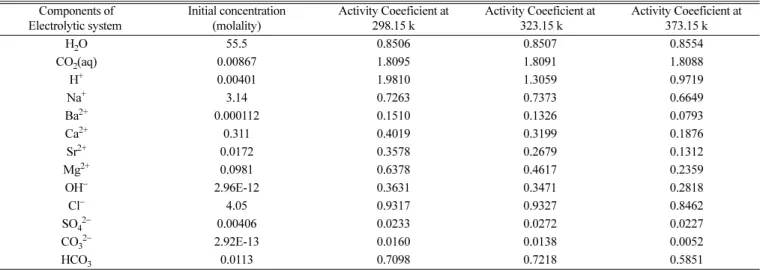
In this research, in order to investigate activity coefficient of ions in a petroleum system, the activity coefficient model of Extended UNIQUAC was studied. The adjustable parameters of this model were optimized according to the equilibrium concentration and activity coefficient (according to Pscalsim1 Software of The Research Insti- tute of Petroleum Industry of Iran) presented in Table 1.
4. Results and Discussion 4-1. Results of parameter optimization of the model
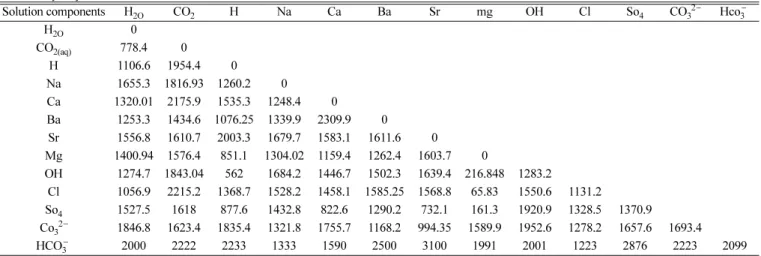
The process denoted in the flowchart in Fig. 1 was performed on the data. After running the application for the equilibrium concen- trations presented in Table 1 and temperature variations of 298.15, 323.15, and 373.15 K, the error equation ( ) rep- resents a total calculated error equal to 0.07. Fig. 2 shows the trend of GA iterations as the optimization process continued to reach a desirable total error (at three temperature levels of 298.15, 323.15, and 373.15 K). Table 2 represents optimal values of the parameters r and q. Tables 3 and 4 represent the values of uo and ut, respec- tively.
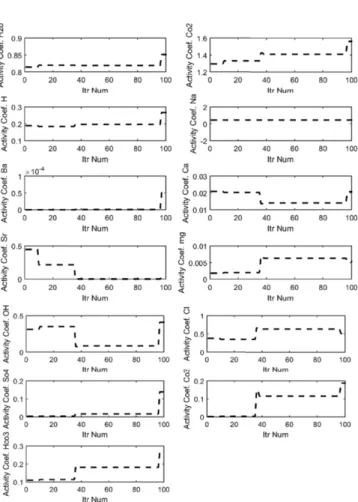
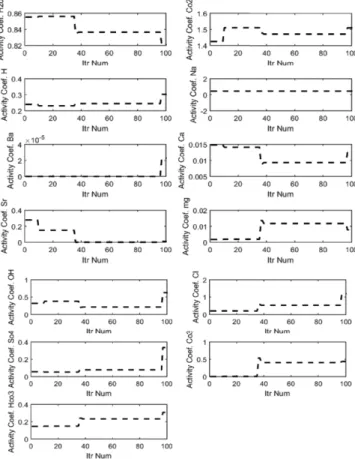
In Figs. 3~5, the trend of the GA iteration is represented for the 13 components in the electrolyte solution including water, dis- solved carbon dioxide, hydrogen, sodium, barium, calcium, strontium, magnesium hydroxide, chloride, sulfate, carbonate and bicarbonate at three different temperatures (298.15, 323.15, and 373.15 K).
gRef–gcal
( )
n 2
k 0=
∑
Table 2. Optimization of parameters r and q for UNIQUAC equation fitted to experimental data [6,20]
Electrolyte solution components r q
H2O 0.92 1.4
CO2 0.75 2.45
H 0.14 0.1E-15
Na 1.4 1.2
Ba 15.67 14.48
Ca 3.87 1.48
Sr 7.14 12.89
Mg 5.41 2.54
OH 9.4 8.88
Cl 10.39 10.2
SO4 12.79 12.44
CO3 10.83 10.77
HCO3 8.08 8.68
Fig. 2. Calculation of total error associated with the optimization of activity coefficient of ions in electrolyte solution of Extended UNIQUAC model at three temperatures of 298.15, 323.15, and 373.15 K and the pressure of 1 bar by implementing Genetic Algorithms in Matlab Software (reference activity coefficient, activity coefficient of inorganic ions in Pscalsim Software).
Table 3. uoij= uojiparameter of energy interaction between ions for aqueous electrolyte systems in UNIQUAC equation
Solution components H2O CO2 H Na Ca Ba Sr mg OH Cl So4 CO32− Hco3−
H2O 0
CO2(aq) 778.4 0
H 1106.6 1954.4 0
Na 1655.3 1816.93 1260.2 0
Ca 1320.01 2175.9 1535.3 1248.4 0
Ba 1253.3 1434.6 1076.25 1339.9 2309.9 0 Sr 1556.8 1610.7 2003.3 1679.7 1583.1 1611.6 0 Mg 1400.94 1576.4 851.1 1304.02 1159.4 1262.4 1603.7 0
OH 1274.7 1843.04 562 1684.2 1446.7 1502.3 1639.4 216.848 1283.2 Cl 1056.9 2215.2 1368.7 1528.2 1458.1 1585.25 1568.8 65.83 1550.6 1131.2
So4 1527.5 1618 877.6 1432.8 822.6 1290.2 732.1 161.3 1920.9 1328.5 1370.9 Co32− 1846.8 1623.4 1835.4 1321.8 1755.7 1168.2 994.35 1589.9 1952.6 1278.2 1657.6 1693.4
HCO3− 2000 2222 2233 1333 1590 2500 3100 1991 2001 1223 2876 2223 2099
1Pars Scale Simulator
Korean Chem. Eng. Res., Vol. 55, No. 5, October, 2017
4-2. Comparing the results of genetic algorithms with other algorithms
Fig. 6 provides a comparison between the optimization of Extended UNIQUAC model based on three algorithms: Imperialist Competi- tive Algorithm (ICA) [21], Particle Swarm Optimization Algorithm (PSO) [22-23] and Artificial Bee Colony Algorithm (ABC) [24-26].
Based on the flowchart in Fig. 1, the associated error with the optimi- zation of the parameters of the considered model in this research
using IC, PSO and ABC algorithms was found to be 0.054, 0.1045, and 0.089, respectively. Whereas, the associated error with the appli- cation of the proposed GA in the present research was 0.07, empha- sizing superior quality and accuracy of the genetic algorithms compared to the aforementioned algorithms.
4-3. Comparing the optimized theoretical model with exper- imental results
Fig. 7 compares solubility predictions of three electrolyte systems Table 4. utij = utji parameter of energy interaction between ions for aqueous electrolyte systems in UNIQUAC equation
Solution components H2O CO2 H Na Ca Ba Sr mg OH Cl So4 CO32− Hco3−
H2O 0.0001
CO2(aq) 2.01 0.002
H −5.66 −2.06 0.0012
Na 1.9 −2.83 5.001 0.00203
Ca 5.81 −6.03 4.28 −0.062 0.032
Ba 24.75 −6.2523 −6.624 1.47 2.63 0.0001
Sr 8.4 1.9343 4.34 −4.5 −2.88 6.97 0.0011
Mg 7.97 −4.711 −2.23 5.7 4.73 12.4 5.62 0.0025
OH −1.97 4.75 −4.02 −3.27 3.95 5.96 1.35 7.9 1.54
Cl −2.95 −2.04 −5.411 −1.46 9.16 0.93 −5.4 6.77 −5.2 7.3
So4 −2.64 1.34 −5.2 −2.463 −1.069 −0.54 1.25 2.44 14.98 2.44 6.7
Co32− −6.54 −6.25 0.004 2.5113 7.64 6.59 −4.5 0.03 −0.4 7.7 −6.56 −0.46
HCO3− 2 3.1 −2.3 1.3 −1.9 2.5 3.1 1.91 1 1.23 2.6 2.3 2.9
Fig. 3. Optimization of activity coefficient of components of electro- lyte solution using genetic algorithms (GA) at 298.15 K.
Fig. 4. Optimization of activity coefficient of components of electro- lyte solution using genetic algorithms (GA) at 323.15 K.
at the constant pressure of 1 bar and two different temperatures of 323 and 368 K using the theoretically optimized model in this research to experimental results. According to the results of Fig. 7, solubility of barium sulfate at 323 K increases as does the concentration of sodium chloride. This is also true for the solubility of strontium sul- fate in presence of magnesium chloride and calcium chloride at 368 K, as the increase in the concentration of magnesium chloride and cal- cium chloride leads to an increase in the concentration of strontium sulfate. Comparing the results demonstrated in Fig. 7 emphasizes that the optimized model in this research is significantly acceptable.
5. Conclusion
Considering the efficiency of the activity coefficient model of Extended UNIQUAC with optimized parameters was studied to pre- dict activity coefficient of inorganic ions in petroleum systems (under solid-liquid equilibrium). The parameters of Extended UNIQUAC model were optimized by using genetic optimization algorithm. To apply trial and error on the results, the Pscalsim Software released by Research Institute of Petroleum Industry (RIPI) was used as the compar- ison reference. The total error calculated for the 13 ions under three temperatures of 298.15, 323.15, and 373.15 K using the genetic algo- rithm was found to be 0.07, and the iteration trend of the algorithm was reported for the 13 components of the system under study at three temperatures of 298.15, 323.15, and 373.15 K. The results obtained
using the genetic algorithm demonstrate the importance and priority of exploiting the optimized Extended UNIQUAC model in case of investigating saturation index of inorganic precipitates.
Fig. 5. Optimization of activity coefficient of components of electro- lyte solution using genetic algorithms (GA) at 373.15 K.
Fig. 6. Comparison between the optimization of Extended UNI- QUAC model based on three algorithms: imperialist com- petitive (a) Particle Swarm Optimization (b) and Artificial Bee Colony (c).
Korean Chem. Eng. Res., Vol. 55, No. 5, October, 2017
References
1. Mühlenbein, H. and Schlierkamp-Voosen, D., “Predictive Models for the Breeder Genetic Algorithm,” Evolutionary Computation, 1(1), 25-49(1993).
2. Fathian, M., Amiri, B. and Maroosi, A., “Application of Honey-bee Mating Optimization Algorithm on Clustering,” Applied Mathe- matics and Computation, 190, 1502-1503(2007).
3. Fontane, D., “Multi-objective Simulation and Optimization of Reservoir Operation Using Excel.,” Proceeding of the Second Fed- eral Interagency Hydrologic Modeling Conference. Las Vegas, NV, USA(2001).
4. Thomsen, K. and Rasmussen, P., “Modeling of Vapor-liquid-Solid Equilibrium in Gas-aqueous Electrolytesystems,” Chemical Engi- neering Science, 54, 1787-1802(1999).
5. Abrams, D. and Prausnitz, J., “Statistical Thermodynamics of Liquid Mixtures: A New Expression for the Excess Gibbs Energy of Partly or Completely Miscible Systems,” AIChE J. 21(1) 116-128(1975).
6. Garcia, A., Thomsen, K. and Stenby, E., “Prediction of Mineral Scale Formation in Geothermal and Oilfield Operations Using the Extended UNIQUAC Model Part I. Sulfate Scaling Minerals,”
Geothermics, 34, 61-97(2005).
7. Voss, M. and Foley, C., “Evolutionary Algorithm for Structural Optimization,” Proceedings Genetic and Evolutionary Computa- tion Conference (GECCO 99)(1999).
8. Whitley, D., “A Genetic Algorithm Tutorial,” Statistics and com- puter, 4, 65-85(1994).
9. Krishnamoorthy, C., Venkatesh, P. and Sudarshan, R., “Object- Oriented Framework for Genetic Algorithm Engineering, with Application to Space Truss Optimization,” Journal of Computer in Civil Engineering, 16(1), 66-75(2002).
10. Mitsuo, G. and Runwei, C., Genetic algorithms and engineering design. Wiley(1997).
11. Goldberg, D., Genetic Algorithm in search, Optimization and Machine Learning, Addison-Wesley(1989).
12. Agrawal, N., Rangaiah, G., Ray, A. K. and Gupta, S. K., “Multi- objective Optimization of the Operation of an Industrial Low- density Polyethylene Tubular Reactor Using Genetic Algorithm and Its Jumping Gene Adaptations,” Industrial and Engineering Chemistry Research, 45(9), 3182-3199(2006).
13. Cao, K., Feng, X. and Ma, H., “Pinch Multi-agent Genetic Algorithm for Optimizing Water-using Networks,” Computers and Chemi- cal Engineering, 31(12), 1565-1575(2007).
14. Elliott, L., Ingham, D., Kyne, A., Mera, N., Pourkashanian, M.
and Wilson, C., “A Novel Approach to Mechanism Reduction Optimization for an Aviation Fuel/air Reaction Mechanism Using a Genetic Algorithm,” Journal of Engineering for Gas Turbines and Power, 128(2), 255-263(2006).
15. Jezowski, J., Bochenek, R. and Poplewski, G., “On Application of Stochastic Optimization Techniques to Designing Heat Exchanger- and Water Networks,” Chemical Engineering and Processing:
Process Intensification 46(11), 1160-1174(2007).
16. Masoori, M., Boozarjomehry, R. and dlobshiat, A., “Which Method is Better for the Kinetic Modeling: Decimal Encoded or Binary Genetic Algorithm?,” Chemical Engineering Journal, 130(1), 29-37 (2007).
17. Till, J., Sand, G., Urselmann, M. and Engell, S., A Hybrid Evo- lutionary Algorithm for Solving Two-stage Stochastic Integer Programs in Chemical Batch Scheduling,” Computers and Chemical Engineering, 31(5-6), 630-647(2007).
18. Young, C.-T., Zheng, Y., Yeh, C.-W. and Jang, S.-S., “Information- guided Genetic Algorithm Approach to the Solution of Minlp Problems,” Industrial and Engineering Chemistry Research, 46(5), 1527-1537(2007).
19. Lepar, Y. Y., Wang, Y,-C., Chang, C.-T., “Automatic Generation of Interlock Designs Using Genetic Algorithms,” Computers and Chemical Engineering, 101(9), 167-192(2017).
20. Garcia, A., Thomsen, K. and Stenby, E., “Prediction of Mineral Scale Formation in Geothermal and Oilfield Operations Using the Extended UNIQUAC Model Part II. Carbonate-scaling Min- erals,” Geothermics, 35, 239-284(2006).
21. Ghasemi, M., Ghavidel, S., Rahmani, S., Roosta, A., Falah, H.,
“A Novel Hybrid Algorithm of Imperialist Competitive Algorithm and Teaching Learning Algorithm for Optimal Power Flow Problem with Non-smooth Cost Functions,” Eng. Appl. Artif. Intell., 29, 54-69(2014).
22. Yonggang, C., Fengjie, Y. and Jigui, S., “A New Particle Swam Optimization Algorithm,” Journal of Jilin University, 24(2), 181- 183(2006).
23. Clerc, M. and Kennedy, J., “The Particle Swarm-explosion Stability, and Convergence in a Multidimensional Complex Space,” IEEE Transactions on Evolutionary Computation, 6(1), 58-73(2002).
24. Basturk, B. and Karaboga, D., “An Artificial Bee Colony (ABC) Algorithm for Numeric Function Optimization,” IEEE Swarm Intelligence Symposium, May 12-14, Indianapolis, IN, USA(2006).
25. Karaboga, D. and Basturk, B., “A Powerful and Efficient Algo- rithm for Numerical Function Optimization: Artificial Bee Colony (ABC) Algorithm,” Journal of Global Optimization, 39, 459-471 Fig. 7. Comparison between solubility values ((molality) predicted
by Extended UNIQUAC model and experimental data: a) BaSO4-NaCl-H2O (at pressure: 1 bar and Temperatures : 323.15 K & Experimental reference [27]). b) SrSO4-MgCl2- H2O (at pressure: 1 bar and Temperatures: 368.15 K &
Experimental reference [28]). c) SrSO4-CaCl2-H2O (at pres- sure: 1 bar and Temperatures: 368.15 K & Experimental reference [28]).
(2007).
26. Karaboga, D. and Basturk, B., “On the Performance of Artifi- cial Bee Colony (ABC) Algorithm,” Applied Soft Computing, 8, 687-697(2008).
27. Templeton, C., “Solubility of Barium Sulfate in Sodium Chloride Solutions from 25 to 958C,” J. Chem. Eng. Data, 514-516(1960).
28. Vetter, O., Vandenbroeck, I. and Nayberg, J., “SrSO4: the Basic Solubility Data,” Society of Petroleum Engineers, 271-281(1983).