Agric. Chem. Biotechnol.48(4), 193-197 (2005) Article
Antioxidant Effects of Isoflavones from the Stem Bark of
Cudrania tricuspidata
Jin Hwan Lee, Byong Won Lee, Jin Hyo Kim, Woo Duck Seo, Ki Chang Jang and Ki Hun Park*
Division of Applied Life Science (BK21 program), Institute of Agricultural & Life Sciences, Department of Agricultural Chemistry, Gyeongsang National University, Jinju 660-701, Korea
Received August 19, 2005; Accepted September 30, 2005
Isoflavones 4'-from stem bark of O-methylalpinumisoflavone (1) and 5, 7, 4'-trihydroxy-6,8-diprenylisoflavone (2) were isolatedCudrania tricuspidata (Carr.) Bureau. These compounds were the first reported from this plant. Antioxidant activities 1 and 2 were evaluated by measuring their ability to scavenge DPPH and ABTS radicals. Diprenylisoflavone 2 showed strong scavenging activity against ABTS (IC50 = 16.3
µM), three-fold higher compared to genistein, which do not possess prenylated group which indicates strong scavenging activity against ABTS radical of isoflavone 2 was due to prenyl group.
Key words: Cudrania tricuspidata, antioxidant, prenylated isoflavone, DPPH, ABTS.
Flavonoids are naturally occurring substances in plant and foods and are thought to have positive effects on human health.1,2) In particular, the antioxidant properties of flavonoids have been shown to be highly effective against several diseases involved in oxidative stress.3) Until now, various methods have been developed to determine the antioxidant activity, among which DPPH and ABTS radical systems4-8) were commonly used to measure total antioxidant activity before applied biological system.
Cudrania tricuspidata (Carr.) Bureau, which belongs to the family Morus, is well known as an important traditional herbal remedy for anti-tumor, anti-inflammation, gastritis, and live damage9) in East Asian Countries such as Korea, China, and Japan. This plant, a rich source of prenylated xanthones9-13) and flavonoids,14-17) has been investigated phytochemically and biologically. Recently, we reported cytotoxic xanthones and antibacterial flavonoids from the roots of this plant.18,19) Our continuing research on this species, we wish to report that studying to identify antioxidants from the stem bark of this plant.
In the present paper, we describe the isolation and structural elucidation of two isoflavone (
1
,2
) from dried stem bark of C.tricuspidata. In addition, radical scavenging capacities of the isolated compounds against the stable DPPH and ABTS were examined. We also described the influence of prenyl group in the ABTS radical cation system.
Materials and Methods
Plant materials.
The stem bark of C. tricuspidata (Carr.) Bureau was collected from Hyoupchun (Korea) in August, 2002, and identified by Prof. Jae-Hong Pak of Kyungpook National University (KNU). A voucher specimen (Park, K. H.110) of this raw material has been deposited at the Herbarium of KNU.
Reagents.
DPPH (1,1-diphenyl-2-picrylhydrazyl), 2,2'-azino-bis-(3-ethylbenzthia-zoline-6-sulfonic acid) (ABTS), sodium presulfate, Trolox (6-hydroxy-2,5,7,8-tetrame-thylchroman-2- carboxylic acid), and genistein were purchased from Sigma- Aldrich.
Instruments.
Melting points were measured on a Thomas Scientific Capillary Melting point Apparatus and were uncorrected.IR spectra were recorded on a Bruker IFS66 infrared Fourier transform spectrophotometer (KBr) and UV spectra were measured on a Beckman DU650 spectrophotometer. 1H-NMR and 13C-NMR at 500 and 125 MHz, respectively and 2D- NMR data were obtained on a Bruker AM 500 spectrometer in CDCl3. EIMS were obtained on a JEOLJMS-700 mass spectrometer.
Extraction and Isolation
The air-dried stem bark of C. tricuspidata (Carr.) Bureau (1.5 kg) were cut into pieces and extracted at room temperature with CHCl3 (2 L × 3) for ten days. Subsequently, the CHCl3
extract was evaporated in vacuo to give a crude extract (70 g).
The concentrated extract was chromatographed over silica gel using hexane:EtOAc and CHCl3:acetone gradient to give 15 fractions (Fr. 1-Fr. 15). The fraction seven (1.2 g) was applied to silica gel column chromatography with hexane : ether
*Corresponding author
Phone: +82-55-751-5472; Fax: +82-55-757-0178 E-mail: [email protected]
Abbreviations: DEPT, Distortionless Enhancement by Polarization Transfer; HMBC, Hetero nuclear Multiple-Bond Connectivity; COSY, Correlation Spectroscopy.
(25 : 1→1 : 1) to afford 10 subfractions. Subfraction (5-6) were subjected to silica gel chromatography (hexane : acetone
= 20 : 1→1 : 1) and purified by recrystallization (hexane : ether) to yield 4'-O-methylalpinumisoflavone
1
(25 mg). The fraction ten (2.7 g) was chromatographed over silica gel as stationary phase using hexane : acetone gradient (20 : 1) as mobile phase to afford 16 subfractions. 5,7,4'-Trihydroxy-6,8-diprenylisoflavone2
(32 mg) was purified from subfractions 7-9 by recrystallization using mixture of hexane:EtOAc as the solvent system.4'-
O-Methylalpinumisoflavone (1):
Yellow crystals; mp 135-137oC (lit.,20,21) mp 137-138oC); UV (MeOH) λmax 326, 280 nm; IR (KBr) Vmax 3572, 3320, 1650 cm−1 1H-NMR (CDCl3, 500 MHz) δ 1.47 (6H, s, H-2''-CH3), 3.84 (3H, s, H- 4-OCH3), 5.62 (1H, d, J= 10.0 Hz, H-3''), 6.33 (1H, s, H-8), 6.73 (1H, d, J= 10.0 Hz, H-4''),6.98 (2H, d, J= 10.0 Hz, H-3' and H-5'), 7.45 (2H, d, J= 10.0 Hz, H-2' and H-6'), 7.82 (1H, s, H-2), and 13.2 (1H, s, H-5-OH); 13C-NMR data (Table 1).5,7,4'-Trihydroxy-6,8-diprenylisoflavone (2):
Yellow amorphous; mp 135-137oC (lit.,22,23) mp 187-188oC); UV (MeOH) λmax 337, 270 nm; IR (KBr) Vmax 3400, 2910, 1648 cm−11H-NMR (CDCl3, 500 MHz) δ 1.76 (3H, s, H-4'''), 1.78 (3H, s, H-4''), 1.82 (3H, s, H-5'''), 1.83 (3H, s, H-5''), 3.46 (4H, m, H-1'' and H-1'''), 5.25 (2H, m, H-2'' and H-2'''), 6.40 (1H, s, H-7-OH), 6.74 (2H, d, J= 8.2 Hz, H-3' and H-5'), 7.26 (2H, d,J= 8.2 Hz, H-2' and H-6'), 7.88 (1H, s, H-2), and 13.1 (1H, s, H-5-OH); 13C-NMR data (Table 1).
Measurement of scavenging activity of DPPH radical:
Antioxidant activities of the isolated isoflavones were measured on the basis of the scavenging activity of the stable 1,1-diphenyl-2-picrylhydrazyl (DPPH) free radical following the method described by Braca et al. 24) Various concentrations of the compounds were added to a 0.15 mM in EtOH, and the mixture was shaken vigorously. Absorbance at 517 nm was determined after 30 min, and the radical scavenging effect was calculated as [Ao−Ae/Ao]×100, where Ae and Ao were absorbance of samples with and without isolated isoflavones, respectively.
Measurement of Trolox equivalent antioxidant capacity (TEAC):
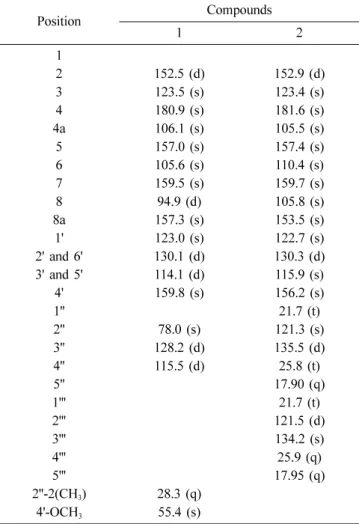
TEAC assay is based on the relative ability of antioxidants to scavenge the radical cation 2,2'-azino-bis-(3- ethylbenzthia-zoline-6-sulfonic acid) (ABTS•+). The radical cation was prepared by mixing 7 mM ABTS stock solution with 2.45 mM potassium persulfate. The reaction mixture was maintained for 4-8 h until the mixture is complete and the absorbance is stable. ABTS•+ solution was diluted with ethanol and the absorbance was read at 734 nm. For the photometric assay 0.9 mL ABTS•+ solution and 0.1 mL Fig. 1. Structures of isolated compounds 1, 2, and genistein.Table 1. 13C-NMR of compounds 1 and 2 at 125MHz (ppm, m)a
Position Compounds
1 2
12 152.5 (d) 152.9 (d)
3 123.5 (s) 123.4 (s)
4 180.9 (s) 181.6 (s)
4a 106.1 (s) 105.5 (s)
5 157.0 (s) 157.4 (s)
6 105.6 (s) 110.4 (s)
7 159.5 (s) 159.7 (s)
8 94.9 (d) 105.8 (s)
8a 157.3 (s) 153.5 (s)
1' 123.0 (s) 122.7 (s)
2' and 6' 130.1 (d) 130.3 (d)
3' and 5' 114.1 (d) 115.9 (s)
4' 159.8 (s) 156.2 (s)
1'' 21.7 (t)
2'' 78.0 (s) 121.3 (s)
3'' 128.2 (d) 135.5 (d)
4'' 115.5 (d) 25.8 (t)
5'' 17.90 (q)
1''' 21.7 (t)
2''' 121.5 (d)
3''' 134.2 (s)
4''' 25.9 (q)
5''' 17.95 (q)
2''-2(CH3) 28.3 (q)
4'-OCH3 55.4 (s)
aThe chemical shifts of compounds 1 and 2 were determined in CDCl3.
Antioxidant effects of isoflavones from Cudrania tricuspidata 195 isolated isoflavones were mixed for 45s and the absorbance
was measured immediately after 1 min at 734 nm. Antioxidant activity of the isolated isoflavones were calculated by determining the decrease in absorbance at different concentrations using the following equation: E = [Ao−Ae/Ao]×100, where Ae and Ao were absorbances of samples with and without isolated isoflavones, respectively. Antioxidant activity was expressed as TEAC values. TEAC values, which express the µM of Trolox having the antioxidant capacity corresponding to 1.0
µM of the test substance.
Results and Discussion
The dried and chopped stem bark of C. tricuspidata (1.5 kg) was extracted with CHCl3. The CHCl3 extract (70 g) was repeated chromatographed on silica gel column, two compounds were isolated. Structural identifications of two compounds were carried out by interpretation of several spectral data, and comparison with the data described in the literature.20-23) Compounds were readily identified as 4'-O-methylalpinum- isoflavone (1) and 5,7,4'-trihydroxy-6,8-diprenylisoflavone (2). These compounds were the first reported from this plant and until now, no isoflavone compound had been isolated from C. tricuspidata. Compound 1 was obtained as yellow crystals and in the EIMS, the molecular ion peak showed at m/
z 350. UV spectrum showed absorption maximum at 326 nm and IR spectrum showed strong hydroxyl and carbonyl group absorption bands at 3572 and 1650 cm−1 respectively. The 1H- NMR spectrum of 1 exhibited a singlet observed at δ 7.82 ppm was characteristic of the isoflavone skeleton. It also showed signals due to two tertiary methyl groups (δ 1.47, 6H), one methoxy group signal at δ 3.84 (3H, s), two olefinic protons at δ 5.62 (1H, d, J= 10.0 Hz, H-3'') and 6.73 (1H, d, J
= 10.0 Hz, H-4''), one aromatic proton at δ 6.33 (1H, s, H-8), hydrogen-bonded hydroxyl group at δ 13.2 (1H, s, H-5-OH), and AA'BB' type signals at δ 7.45 (2H, d, J= 10.0 Hz) and 6.98 (2H, d, J= 10.0 Hz) assignable to H-2', 6' and H-3', 5' of the B-ring, respectively. In addition, 13C-NMR and DEPT experiments indicated the presence of two methyl (δ 28.3) groups, 13 signals due to the isoflavone skeleton including two equivalent aromatic carbons of the symmetrical B-ring, one methoxyl group (δ 55.4), and two olefinic (δ 115.5 and 128.2) carbons of 2'', 2''-dimethylpyrano substituent. In particular, the set of signals at δ 28.3, 78.0, 115.5, and 128.2 in the 13C- NMR spectrum provided further support for the presence of a gem-dimethyl chromene system.25) The location of one methoxyl group and a gem-dimethylpyran moiety on ring A was determined from the HMBC spectrum (Fig. 2). From the above spectroscopic evidence, the structure of compound 1
determined as 4'-O-methylalpinumisoflavone.Compound 2 is yellow amorphous and its mass spectrum showed a major ion peak at m/z 406. UV spectrum showed absorption at 337 and 270 nm and IR spectrum exhibited bands for free hydroxyl and carbonyl at 3400 and 1648 cm−1 respectively. The 1H- NMR singlet signal at δ 7.88 ppm (H-2) and 13C-NMR signal
at 152.9 ppm were all typical of an isoflavone skeleton. In the
1H-NMR spectrum of compound 2, the downfield singlet signals at δ 13.1 (H-5-OH) showed intramolecular hydrogen bonded group, as well as it also showed a multiple at δ 3.46 (4H, m, H-1'' and H-1'''), a multiple at 5.25 (2H, m, H-2'' and H-2'''), and four singlet signals at 1.76 (3H, s, H-4'''), 1.78 (3H, s, H-4''), 1.82 (3H, s, H-5'''), and 1.83 (3H, s, H-5''), which indicated the presence of two prenyl groups. 13C-NMR spectrum also showed two intense signal at δ 115.9 (C-3' and C-5') and 130.3 (C-2' and C-6') assigned to two equivalent aromatic carbons of the symmetrical B-ring. Therefore, two prenyl groups were easily deduced from the connectivities from C-1'' to C-5'' and from C-1''' to C-5''' in 1H-1H COSY spectrum, the positioning of the substituents on the ring system was based on the results of HMBC spectrum (Fig. 2).
The HMBC correlations of C-6 with H-2'' and hydrogen- bonded hydroxyl group (δ 13.1) allowed 3,3-dimethylallyl group to site at C-6 on the A-ring obviously. Remaining 3,3- dimethylallyl group was located at C-8 on the A-ring based on the correlations of H-2''' with C-7 and C-8a in HMBC spectrum. On the basis of the above data, the structure of compound 2 was elucidated to be 5,7,4'-trihydroxy-6,8- diprenylisoflavone.
DPPH and ABTS radicals were chosen to test the antioxidant activities of the isolated isoflavone from the stem bark of C.
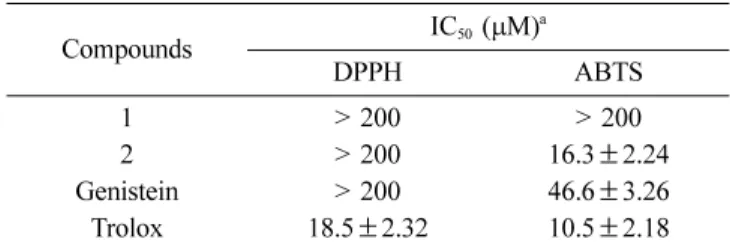
tricuspidata. For measurement of antioxidant activity, UV/Vis spectrophotometry method was used to observe DPPH and ABTS radicals. The change in absorbance produced by reduced DPPH was used to evaluate the ability of isolated isoflavones to act as free radical scavengers. Two isoflavones were not capable of reacting with DPPH, in the concentration of 200µM, only less than 10% scavenging activity. The ABTS radical cation was formed instantly after the addition of potassium persulfate to an ABTS solution. The isolated Fig. 2. Important HMBC correlations in compounds 1 and 2.
methylalpinumisoflavone
1
was not capable of reacting with ABTS, whereas prenylated isoflavone2
showed strong antioxidant activity against ABTS radicals (Table 2). In addition, the scavenging activity of the prenylated isoflavone2
against ABTS was three-fold higher compared to genistein of a structurally similar isoflavone, which do not possess the prenyl group in the A-ring.These results demonstated that prenyl group on A-ring of isoflavone contributed to a more potent antioxidant activity against ABTS radical system.
In conclusion, the two isoflavones were the first to be reported from the stem bark of C. tricuspidata. The prenyl group on isoflavone
2
showed strong antioxidant activity against ABTS radical system.Acknowledgments.
This Study was supported by technology Development Program for Agriculture and Forestry Ministry of Agriculture and Forestry, Republic of Korea.References
1. Di Carlo, G., Mascolo, N., Izzo, A. A. and Capasso, F.
(1999) Flavonoids: Old and new aspects of a class of natu- ral therapeutic drugs. Life Science65, 337-353.
2. Havsteen, B. (1983) Flavonoids, a class of natural products of high pharmacological potency. Biochemical Pharmacol- ogy32, 1141-1148.
3. Bravo, L. (1998) Polyphenols: Chemistry, dietary sources, metabolism and nutritional significance. Nutrition Reviews
59, 317-333.
4. Jayaprakasha, G. K., Rao, L. J. and Sakariah, K. K. (2004) Antioxidant activities of flavidin in different in vitro model systems. Bioorg. Med. Chem.12, 5141-5146.
5. Peng, Z. F., Strack, D., Baumert, A., Subramaniam, R., Goh, N. K., Chia, T. F., Tan, S. W. and Chia, L. S. (2003) Antioxidant flavonoids from leaves of Polygonum hydro- piper L. Phytochemistry62, 219-228.
6. Chung, Y.-C., Chen, S.-J., Hsu, C.-K., Chang C.-T. and Chou, S.-T. (2005) Studies on the antioxidative activity of Graptopetalum paraguayense E. Walther. Food Chemistry
91, 416-424.
7. Re, R., Pellegrini, N., Proteggente, A., Pannala, A., Yang, M. and Rice-Evans, C. (1999) Antioxidant activity apply-
ing an improved ABTS radical cation decolorization assay.
Free Radic. Biol. Med.26, 1231-1237.
8. Miller, N. J., Castelluccio, C., Tijburg, L. and Rice-Evans, C. (1996) The antioxidant properties of theaflavins and their gallate esters-radical scavengers or metal chelators?. FEBS Lett.392, 40-44.
9. Hano, Y., Matsumoto, Y., Sun, J.-Y. and Nomura, T. (1990) Structures of four new isoprenylated xanthones, cudraxan- thones H, I, J, and K. Planta Med.56, 478-481.
10. Nomura, T., Hano, Y. and Fujimoto, T. (1983) Three new isoprenylated xanthones, cudraxanthone A, B and C, from the root bark of Cudrania Tricuspidata (carr.) bur. Hetero- cycles20, 213-218.
11. Fujimoto, T., Hano, Y. and Nomura, T. (1984) Components of root bark of Cudrania tricuspidata 1. Structures of four new isoprenylated xanthones, cudraxanthones A, B, C and D. Planta Med.50, 218-221
12. Hano, Y., Matsumoto, Y., Sun, J. Y. and Nomura, T. (1990) Structures of three new isoprenylated xanthones, Cudraxan- thones E, F, and G. Planta Med.56, 399-402.
13. Hano, Y., Matsumoto, Y., Shinora, K., Sun, J. Y. and Nomura, T. (1991) Structures of four new isoprenylated xanthones, cudraxanthones L, M, N, and O from Cudrania tricuspidata. Planta Med.57, 172-175.
14. Fujimoto, T., Hano, Y., Nomura, T. and Uzawa, J. (1984) Components of root bark of Cudrania tricuspidata 2. Struc- tures of two new isoprenylated flavones, cudraflavones A and B. Planta Med.50, 161-163.
15. Fujimoto, T. and Nomura, T. (1984) Structures of cudrafla- vanone A and euchrestaflavanone C. Heterocycles22, 997- 1003.
16. Young, H. S., Park, H. J. and Choi, J. S. (1989) Chemical study on the stem of Cudrania tricuspidata. Arch. Pharm.
Res.12, 39-41.
17. Lee, I. K., Kim, C. J., Song, K. S., Kim, H. M., Koshino, H., Uramoto, M. and Yoo, I. D. (1996) Cytotoxic benzyl dihydroflavonols from Cudrania tricuspidata. Phytochemis- try41, 213-216.
18. Lee, B. W., Gal, S. W., Park, K.-M. and Park, K. H. (2005) Cytotoxic xanthones from Cudrania tricuspidata. J. Nat.
Prod.68, 456-458.
19. Lee, B. W., Kang, N. S. and Park, K. H. (2004) Isolation of antibacterial prenylated flavonoids from Cudrania tricuspi- data. J. Korean Soc. Appl. Biol. Chem.47, 270-273.
20. Asomaning, W. A., Amoako, C., Oppong, I. V., Phillips, W.
R., Addae-Mensah, I, Osei-Twum, E. Y., Waibel, R. and Achenbach, H. (1995) Pyrano-and dihydrofurano-isofla- vones from Milletia thonningii. Phytochemistry 39, 1215- 1218.
21. Olivares, E. M., Lwande, W., Monache, F. D. and Bettolo, G. B. M. (1982) A pyrano-isoflavone from seeds of Mille- tia thonningii. Phytochemistry21, 1763-1765.
22. Singhal, A. K., Sharma, R. P., Thyagarajan, G., Herz, W.
and Govindan, S. V. (1980) New prenylated isoflavones and a prenylated dihydroflavonol from Millettia pachycarpa. Phytochemistry19, 929-934.
Table 2. Antioxidant activities of isolated compounds 1 and 2 on DPPH and ABTS radicals
Compounds IC50 (µM)a
DPPH ABTS
1 > 200 > 200
2 > 200 16.3±2.24
Genistein > 200 46.6±3.26
Trolox 18.5±2.32 10.5±2.18
aInhibitory activity was expressed as the mean of 50% inhibitory concentration of triplicate determinations
Antioxidant effects of isoflavones from Cudrania tricuspidata 197 23. Shirataki, Y., Manaka, A., Yokoe, I. and Komatsu, M.
(1982) Two prenylflavanones from Euchresta japonica. Phytochemistry21, 2959-2963.
24. Braca, A., De Tommasi, N., Di, Bari, L., Pizza, C., Politi, M. and Morelli, I. (2001) Antioxidant principles from Bau-
hinia terapotensis. J. Nat. Prod.64, 892-895.
25. Mabry, T. J., Markham, K. R. and Thomas, M. B. (1970) The systematic identification of flavonoids. Academic Press, New York, pp. 165-166.