Introduction
The most common entrapment neuropathy, carpal tunnel syndrome (CTS), is characterized by compression of the distal median nerve within the anatomic area referred to as the carpal tunnel. It is highly related to occupations involving repeated movements and upper-
ISSN 1229-6066 https://doi.org/10.18214/jkaem.2018.20.1.14 J Korean Assoc EMG Electrodiagn Med 20(1):14-21, 2018
J Korean Assoc
Electrodiagn Med EMG
Copyright © by Korean Association of EMG Electrodiagnostic Medicine
This is an Open Ac cess article distributed under the terms of the Creative Commons Attribution Non-Commercial License (http://creativecommons.org/licenses/by-nc/4.0) which permits unrestricted non-commercial use, distribution, and reproduction in any medium, provided the original work is properly cited.
Received October 12, 2017
Revised (1st) November 27, 2017, (2nd) December 19, 2017 Accepted December 28, 2017
Corresponding Author: Chang Han Lee
Department of Rehabilitation Medicine, Gyeongsang National University Hospital, 79 Gangnam-ro, Jinju 52727, Korea
Tel: 82-55-750-8256, Fax: 82-55-750-8255, E-mail: [email protected]
경상남도 과수농민의 수근관 증후군과 동반된 척골신경병증
조홍식
1
, 천세웅2
, 이은신1
, 윤철호1
, 신희석1
, 이창한1
1경상대학교 의학전문대학원 재활의학교실, 2창원경상대학교병원 재활의학과
Involvement of Motor and Sensory Fibers of the Ulnar Nerve according to the Severity of Work-Related Carpal Tunnel Syndrome
among Orchardists
Hongsik Jo
1, Se-Woong Chun
2, Eun Shin Lee
1, Chulho Yoon
1, Heesuk Shin
1, Chang Han Lee
11
Department of Rehabilitation Medicine, Gyeongsang National University School of Medicine and Gyeongsang National University Hospital, Jinju,
2Department of Rehabilitation Medicine,
Gyeongsang National University Changwon Hospital, Changwon, Korea
Objective: To elucidate the involvement of motor and sensory fibers of the ulnar nerve in cases of work-related carpal
tunnel syndrome (CTS) among orchardists and to determine the association between the severity of work-related CTS and ulnar neuropathy (UN).Method: 1,594 hands of 797 subjects were underwent electrodiagnostic (EDX) tests for median and ulnar nerves.
Subjects were classified into three groups: non-CTS, non-UN+CTS, and UN+CTS group. The CTS group was classified into subgroups of CTS severity.
Results: Significant differences were found in the conduction parameters of median and ulnar nerves (p < 0.001)
among the three groups. Comparison of the mean values of non-CTS group and subgroups of CTS severity also showed significant differences in the conduction parameters of ulnar nerve (p < 0.05). In addition, the severity of CTS showed significant correlations with conduction parameters of the ulnar nerve (p < 0.05).Conclusion: Based on the severity of work-related CTS, we suggest that the pathological processes leading to CTS may
affect the motor and sensory fibers of the ulnar nerve.Key Words: carpal tunnel syndrome, electrodiagnostic test, orchardists, ulnar neuropathy, work-related carpal tunnel
syndromelimb strength.
1,2Most patients complain of symptoms in the fingers and hand that extend beyond the typical median nerve distribution. Involvement of the ulnar nerve territory has often been observed in CTS.
1,3Because of the close anatomical contiguity between the carpal tunnel and the Guyon’s canal, pathologic processes that cause CTS might induce indirect com- pression of ulnar nerve.
4,5A few studies have reported about the coincidence of clinically involved little finger in CTS.
1,6-8These studies have been taken in the general population.
To the best of our knowledge and based on a com- prehensive literature review, no published study has yet assessed the involvement of motor and sensory fibers of the ulnar nerve in work-related CTS. The purpose of our study is 1) to elucidate the involvement of motor and sensory fibers of the ulnar nerve in cases of CTS among orchardists who repeatedly use their wrists and hands and 2) to investigate any association between the severity of CTS and ulnar neuropathy (UN).
Materials and Methods
1) Subjects
As part of the Farmers’ Health Promotion Project, a retrospective case-control study was performed by an- alyzing electrodiagnostic (EDX) test in orchardists who visited Gyeongsang National University Hospital Center for Farmer's Safety and Health between July 2013 and September 2014. The participants had repea tedly used their wrists and hands for a long time. They had no his- tory or clinical signs suggesting systemic disease, clini- cal or electrophysiological signs suggesting pathologi- cal conditions such as polyneuropathy, radiculopathy, muscle atrophy following median and ulnar nerve sur- gery, and other neurological disease, or associated with CTS. Demographic and EDX test data for 797 subjects (378 males, 419 females) who satisfied the inclusion criteria were analyzed in the basic investigation. De- mographic data included sex, age and total work time period. Based on the EDX results, we divided the hands
of all subjects into non-CTS and CTS groups, The CTS group was divided into non-UN + CTS and UN + CTS groups, again. Patient consent was obtained from all the participants prior to the study, and the study was approved by the Institutional Review Board of our Hos- pital.
2) Electrodiagnostic test
All the subjects underwent EDX tests. A Medelec Synergy system (Oxford Instruments, Oxford, UK) was used for EDX studies with the subjects lying on a bed in a quiet and warm room, and the limb temperature maintained at 33
oC. Nerve conduction studies of median and ulnar nerves were performed as follows. Surface recording electrodes (Ag/AgCl) were placed over the motor point of the abductor digiti minimi muscle for the ulnar nerve, and over the abductor pollicis brevis muscle for the median nerve. The median nerve was stimulated at a distance of 8 cm from the active electrode, between the tendons of the flexor carpi radialis and palmaris longus muscles at the wrist and the elbow. The ulnar nerve was stimulated at the wrist at a distance of 8 cm for the abductor digiti minimi and at the elbow. The motor nerve conduction velocities (MCVs), distal motor latencies (DMLs), and compound muscle action potential (CMAP) amplitudes for median and ulnar nerves were calculated. The sensory never conduction studies were conducted by determining the sensory nerve action potential (SNAP) amplitudes and distal sensory latencies (DSLs) antidromically, using a ring electrode after wrist stimulation and registered at the third digit for the median nerve at a distance of 14 cm between the stimulator and the active electrode.
SNAP amplitudes and DSLs for the ulnar nerve were obtained at the fifth digit similarly at a distance of 14 cm between the stimulator and active electrode.
A diagnosis of CTS in the EDX tests was defined as
a median motor nerve distal latency exceeding 4.0 ms
or a median sensory nerve distal latency exceeding
3.6 ms, or by comparing the median sensory latency
to digit IV with the ulnar sensory latency to the same
digit, with the difference in distal latency exceeding
0.5 ms.
9Normal MCVs of the median nerve along the forearm were mandatory (50 m/s). The EDX criteria of ulnar neuropathy (UN) included ulnar nerve DSLs >
3.5 ms and/or DMLs > 3.6 ms and/or SNAP amplitude
< 15 mV and/or CMAP amplitude < 7.9 mV.
10,11The severity of CTS was classified as previously described
12as follows: normal (grade 0); very mild (grade 1), CTS demonstrable only with most sensitive test; mild (grade 2), sensory nerve conduction velocity slow on finger/
wrist measurement, normal terminal latency; moderate (grade 3), sensory potential preserved with motor slowing, distal motor latency to APB < 6.5 ms; severe (grade 4), absent sensory potential but preserved motor response, distal motor latency to APB < 6.5 ms; very severe (grade 5), terminal latency to APB > 6.5 ms;
extremely severe (grade 6), sensory and motor potential effectively unrecordable (surface motor potential ranging from APB < 0.2 mV amplitude).
3) Data analysis
Statistical analyses were conducted using SPSS ver- sion 21.0 (IBM, Armonk, NY, USA). Arithmetic mean values and standard deviation for different variables were measured. One way analysis of variance (ANOVA) and the Pearson chi-squared test comparing sex among three groups were done to compare demographic characteristics. The total work period was assessed with the analysis of covariance (ANCOVA) procedure.
The covariate was age. Comparison of the EDX param- eters among three groups was investigated using one- way ANOVA. The Bonferroni post hoc test was per-
formed to identify the differences between the groups.
A repeated measure of ANOVA was applied to compare differences of EDX parameters according to the Bland classification.
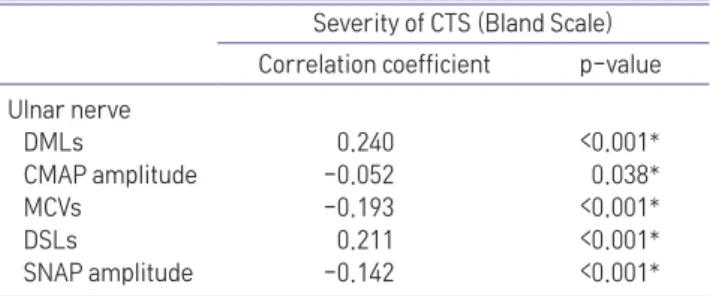
12Spearman correlation coefficients and the corresponding p-values were used to evaluate the relationships between the severity of CTS based on Bland classification and conduction parameters of the ulnar nerve in the CTS group. A p-value of 0.05 was considered statistically significant.
Results
1) General characteristics of the subjects
We studied 1,594 hands of a total of 797 subjects aged between 29 and 80 years (mean 59.6 years). 271 subjects had bilateral CTS, 55 had right-sided CTS, and 47 had left-sided CTS. Among 1,594 hands, 950 hands were diagnosed normal in EDX test. A total of 644 symptomatic hands in 373 subjects were diagnosed with CTS. In the CTS group, non-UN and UN groups were 398 and 246 hands, respectively. The general characteristics of each group are presented in Table 1. There were significant differences among the three groups in sex, age and total work period. Post-hoc testing revealed that in the UN + CTS group (p < 0.001), age and total work period were significantly higher than those in the non-CTS and non-UN + CTS groups.
In addition, after adjusting for age, ANCOVA revealed significant differences among the three groups in the total work period (p < 0.05).
Table 1. Demographic and Baseline Characteristics among Three Groups
Characteristics Non-CTS group
(n = 950)
CTS group
p-value non-UN (n = 398) UN (n = 246)
Number of hands (n)
Male/Female 462/485 128/270 200/46 <0.001*
Age (y) 58.3 ± 9.11 60.1 ± 7.88 64.9 ± 6.36
†,‡<0.001*
Total work period (y) 28.3 ± 13.95 32.2 ± 13.56 35.5 ± 14.98
†,‡0.037*
,§Values are shown as mean ± SD, or as otherwise indicated. CTS: carpal tunnel syndrome, UN: ulnar neuropathy
*p < 0.05 is significant,
†Significantly different compared with the non-CTS group,
‡Significantly different compared with CTS+non-UN group,
§