대한화상학회지 제 24 권 제 1 호
18
Journal of Korean Burn SocietyVol. 24, No. 1, 18-20, 2021
https://doi.org/10.47955/jkbs.21.0004
CASE REPORT
부인과적 시술 중 발생한 생식기 부위의 Trichloroacetic Acid 화학 화상
이종건ㆍ유성훈ㆍ김동철
분당제생병원 성형외과, 화상재건센터
Accidental Trichloroacetic Acid Burn Injuries on Genital Area during Gynecological Procedures
Chong Kun Lee, M.D., Ph.D., Sung Hoon Yu, M.D. and Dong Chul Kim, M.D., Ph.D.
Department of Plastic and Reconstructive Surgery, Advanced Burn Reconstruction Center, Bundang Jesaeng Hospital, Songnam, Korea
TCA is widely used in cosmetic treatments such as chemical peels, tattoo removal, and also in gynecological procedures for managing cervical intraepithelial neoplasia. However, storage of high concentration of TCA in a gynecology office is a poten- tial hazard, as it may accidentally cause severe chemical burns. We report a case of deep dermal TCA chemical burn on geni- tal area, which occured accidentally and resulted from misuse of high concentration (90%) of TCA coated vaginal gauze pack- ing dressing during gynecological procedures. (J Korean Burn Soc 2021;24:18-20)
Key Words: Trichloroacetic acid, Chemical burns, Genital burn
Received: 2021. 4. 16, Revised: 2021. 4. 27, Accepted: 2021. 5. 6 Corresponding author: Dong Chul Kim, Department of Plastic
and Reconstructive Surgery, Advanced Burn Reconstruction Center, Bundang Jesaeng Hospital, 20 Seohyeon-ro 180, Songnam 13590, Korea
Tel: 82-31-779-0281, Fax: 82-31-779-5032 E-mail: [email protected]
INTRODUCTION
Iatrogenic injury is an intrinsic risk of all medical procedures. The trichloroacetic acid (TCA: CCL3-COOH) is an analogue of acetic acid in which the three hydrogen atoms of the methyl group have all been replaced by chlorine atoms. The TCA can be used as topical anti- septic, keratolytic agent, chemical peels in medical field, and also treatment for Cervical Intraepithelial Neoplasia.
This paper report a case of accidental deep dermal TCA chemical burn on vagina resulted from misuse of TCA coated vaginal gauze packing dressing during gyneco- logical procedures. The aim of this case report is to sug- gest that special attention should be paid to prevent acci- dental chemical burns in the medical field, and the man- agement of burn injury on genital area.
CASE REPORT
The 63-year-old female was sustained from the chem- ical burn, deep 2
ndto 3
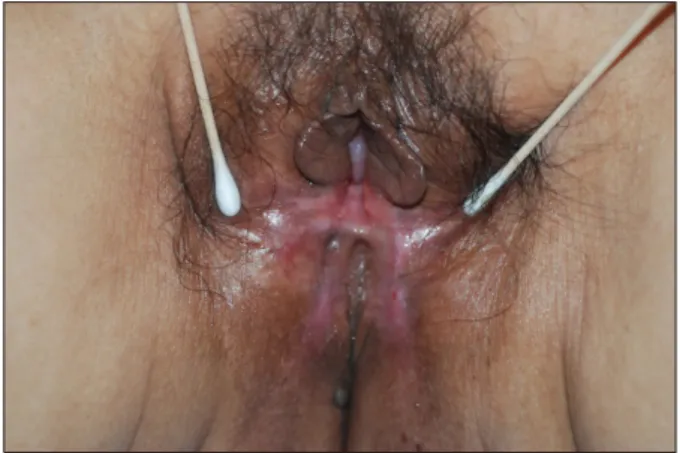
rddegree on vulva and vagina. She received a diagnostic procedure including punch biopsy for cervical intraepithelial neoplasm Grade l with features of human papilloma virus infection in gynecological office. At the end of this procedures, just after vaginal packing dressing, the patient had severe pain in her geni- tal area. 20 minutes later, the vaginal packing was com- pletely removed, and the affected genital area was copi- ously irrigated with saline. The patient had deep dermal burn on her lower vagina wall, and surrounding vulva area. By investigating the coating solution included in the packing, it was revealed as 90% TCA concentration. On the vaginal examination, white thick eschars were seen with erythema, and swelling at the lower posterior area of vaginal wall, and 10×3 cm sized lower portion of vulva. After copious saline irrigation of vagina, burn dressing with MEBO
Ⓡointment was performed (Figs. 1, 2).
From the initial treatment, the patient received office
based conservative burn dressing without Foley catheter
insertion. The patient was informed how to wash the
burned area with water 4 times a day, and apply the oint-
Chong Kun Lee, et al:Accidental Trichloroacetic Acid Burn Injuries on Genital Area
19
Fig. 1. On postburn 4 days, moderate thick eschars with
surrounding inflammation and swelling on the vagina and vulva area were seen.Fig. 2. Open burn dressing with MEBO
Ⓡ ointment application in every 6 hours was started.Fig. 3. On postoperative 6 weeks, the burn wound was well
healed and mild strictures on lower external vagina were noted.ment by herself at home. After 6 weeks conservative burn dressing, the burn wounds on vagina and vulva well healed, and mild stricture on lower external vagina was noted (Fig. 3).
DISCUSSION
TCA is widely used in cosmetic treatments such as chemical peels and tattoo removal and also in treatment for cervical intraepithelial neoplasia. Geisler et al. (2016) demonstrated that a high regression and remission rate and a high HPV clearance rate were observed 8 weeks after topical 85% trichloroacetic acid treatment for pa- tients with CIN [1].
However, numerous studies have been reported about the risk of chemical burn related TCA [2,3]. Ryu et al. not-
ed that Acetic acid (37%) was the most common cause of chemical burns treated in a single hospital study between 2000 and 2009, followed by Hydrofluoric acid (20%), Hydrochloric acid (13%), and Thinner (10%) [4].
In our case, a chemical burn injury (deep 2
ndto 3
rdde- gree) with severe pain occurred on vulva and vagina after accidentally misused vaginal packing dressing coated with 90% concentration TCA solution during the diag- nostic procedure for CIN. Given that TCA is a solution used for treatment of CIN, it is possible that the solution used for treatment and the solution used for dressing were confused. Generally, TCA has low viscosity; there- fore, special attention is required because it can easily drip down onto normal tissue, which can also become chemically coagulated. Therefore, when managing CIN, the wooden stick end of the cotton swab saturated with trichloroacetic acid is carefully applied [1]. The TCA should be handled very carefully even when used in treatment at the medical office and also with care in drug placement and administration as a high hazard medicine.
Andersen et al. (2021) reported that iatrogenic burns
are overall rare and appear to be decreasing in number
over the last six years [5], however, as the causes of oc-
currence and the depth of burns vary, the treatment ap-
proaches are varied. In the burn management, it is im-
portant to decide whether or not to perform burn
surgery. Genital burns are not frequent injuries, because
the body region is usually well protected against trau-
matic agents. In a review of the hospital charts from four
burn centers (Antwerp, Cincinnati, Cleveland and Galveston),
20
대한화상학회지 Vol. 24, No. 1, 2021it is shown that genital burns were present in 2.8∼13%
of hospital admissions [6-8]. Michielsen et al. noted that even structures that appear non‐viable do often recover.
Even in deep second‐degree burns to the genitals, this conservative approach might lead to a successful outcome (61∼90%) [6]. Although the surgical treatment is well es- tablished for the limbs, the management of genital lesions remains challenging and the genital area burns, as special area burns, should be treated at an experienced burns center. Our burn center’s principle of treatment for deep dermal burn wounds on genital area is usually con- servative dressing. In our case, the burn wounds on vagi- na and vulva were well healed by conservative dressing with MEBO
Ⓡointment. We have known empirically that MEBO
Ⓡhave advantages on pain, wounds to care for in- fection, and promoting easy separation of burn eschars.
MEBO
Ⓡis a herbal formulation patented in 1995 possess- ing b-sitosterol, baicalin, and berberine as active in- gredients in a base of beeswax and sesame oil. It offers the advantages of optimum moisture for wound healing [9]. Another feature of the effect of MEBO
Ⓡhas also been well documented, including cases of wounds associated with severe pain like that of burns [10].
As introduced in our case, the iatrogenic and accidental TCA burn is a potential hazard in a gynecology office and physicians should have to pay attention to the risk of chemical burn related TCA. The hazard of the TCA sol- ution should be emphasized, and precaution for careless preparing and misusing of this solution must be kept in mind by physician and their assistants. In the future, more effective and practical strategies for guard against accidental chemical burn based on related risk factors should be implemented.
CONFLICTS OF INETEREST
The authors have no financial disclosures or conflicts of interest to declare.
REFERENCES
1. Stephanie Geisler, Sophie Speiser, Lukas Speiser, Georg Heinze, Adam Rosenthal, Paul Speiser. Short-term efficacy of trichloroacetic acid in the treatment of cervical intraepithelial neoplasia. Obstetrics & Gynecology 2016;127:353-9.
2. Hye Sung Han, Guk Jin Jeong, Ji Yeon Hong, Beom Joon Kim.
Severe chemical burn leaving an irredeemable scar because of unskilled chemical peel at an oriental medicine clinic. Int Wound J 2019;16:1049-51.
3. Michael Sosin, Beth Lynn Sosin, Eduardo D Rodriguez.
Accidental trichloroacetic acid burn in a Gynecology office.
Obstetrics & Gynecology 2015;126:1290-3.
4. An Young Ryu, Gi Yeun Hur, Dong Lark Lee. A clinical observation of chemical burn. Journal of Korean Burn Society 2009;12:131-4.
5. Andersen E, Powell L, Marcaccini R. A 15-year review of iatrogenic burn injuries in an academic public hospital Journal of Burn Care & Research 2021;42:147.
6. Michielsen D, Van Hee R, Neetens C, Lafaire C, Peeters R.
Burns to the genitalia and the perineum. J Urol 1998;159:
418-9.
7. Peck MD, Boileau MA, Grube BJ, Heimbach DM. The manage- ment of burns to the perineum and genitals. J Burn Care Rehabil 1990;11:54-6.
8. Angel C, Shu T, French D, Orihuela E, Lukefahr J, Herndon DN. Genital and perineal burns in children: 10 years of experience at a major burn center. J Pediatr Surg 2002;37:
99-103.
9. M. Al-Meshaan, M. Abdul Hamid, T. Quider, A. Al-Sairafi, R. Dham. Role of Mebo (Moist Exposed Burn Ointment) in the treatment of fournier’s gangrene. Ann Burns Fire Disasters 2008;21:20-2.
10. Atiyeh B.S., Ioannovich J., Magliacani G., Masellis M., Costagliola M., Dham R. The efficacy of moisture-retentive ointment in the management of cutaneous wounds and ulcers: a multicenter clinical trial. Indian J Plastic Surgery 2003;36:89-98.