• 검색 결과가 없습니다.

Isolated Unilateral Absence of Pulmonary Artery Associated with Contralateral Lung Cancer

N/A
N/A
Protected

Academic year: 2021

Share "Isolated Unilateral Absence of Pulmonary Artery Associated with Contralateral Lung Cancer"

Copied!
3
0
0

로드 중.... (전체 텍스트 보기)

전체 글

(1)

ISSN: 2233-601X (Print) ISSN: 2093-6516 (Online)

− 280 −

Received: March 19, 2018, Revised: April 4, 2018, Accepted: April 11, 2018, Published online: August 5, 2018

Corresponding author: Jae-Ik Lee, Department of Thoracic and Cardiovascular Surgery, Gachon University Gil Medical Center, 21 Namdong-daero 774beon-gil, Namdong-gu, Incheon 21565, Korea

(Tel) 82-32-460-8922 (Fax) 82-32-460-3117 (E-mail) [email protected]

© The Korean Society for Thoracic and Cardiovascular Surgery. 2018. All right reserved.

This is an open access article distributed under the terms of the Creative Commons Attribution Non-Commercial License (http://creativecommons.org/

licenses/by-nc/4.0) which permits unrestricted non-commercial use, distribution, and reproduction in any medium, provided the original work is properly cited.

Isolated Unilateral Absence of Pulmonary Artery Associated with Contralateral Lung Cancer

Kun Woo Kim, M.D. 1 , Jae-Ik Lee, M.D., Ph.D. 1 , Kuk-Hui Son, M.D., Ph.D. 1 , Eun Young Kim, M.D. 2 , Kook-Yang Park, M.D., Ph.D. 1 , Chul-Hyun Park, M.D., Ph.D. 1

Departments of

1

Thoracic and Cardiovascular Surgery and

2

Radiology, Gachon University Gil Medical Center

Unilateral absence of a pulmonary artery (UAPA) is a rare congenital anomaly that may present with various symptoms, depending on the nature and severity of other cardiovascular anomalies. Furthermore, con- tralateral lung surgery in patients with UAPA is extremely rare, and clinical experience is limited. This report describes a case of surgical treatment of contralateral primary lung cancer in a patient with isolated UAPA.

A 56-year-old man was diagnosed with primary lung cancer accompanied by isolated UAPA on the con- tralateral side. He underwent meticulous cardiorespiratory function tests preoperatively. We performed a right lower lobectomy. Although in the immediate postoperative period, the patient suffered from a mild decline in his respiratory function, he recovered uneventfully. The present case shows that preoperative awareness of UAPA and meticulous perioperative management enable contralateral lung surgery to be performed safely.

Key words: 1. Unilateral absence of pulmonary artery 2. Lung neoplasms

3. Surgery

4. Perioperative care

Case report

A 56-year-old man presented with a mass shadow in the right lung field on a chest X-ray. Chest com- puted tomography (CT) revealed a mass measuring roughly 4 cm in the right lower lobe (Fig. 1A), and a 3-dimensional reconstructed CT image confirmed left unilateral absence of a pulmonary artery (UAPA) with hypertrophic bronchial arteries reflecting collat- eral circulation (Fig. 1B). After percutaneous needle biopsy, the tumor was identified as adenocarcinoma.

In room air, arterial blood gas analysis (ABGA) yield- ed results of 92.5 mm Hg for PO

2

, 34.7 mm Hg for PCO

2

, and 97.4% for oxygen saturation (SaO

2

).

Pulmonary function testing revealed a forced vital ca-

pacity (FVC) of 3.1 L (70% of predicted), a forced expiratory volume in 1 second (FEV1) of 2.2 L (64%

of predicted), and a FEV1/FVC ratio of 0.71. Echocar- diography revealed no cardiac anomaly and the right ventricular systolic pressure (RVSP) was 23.7 mm Hg. Based on the results of these tests, we planned thoracoscopic lobectomy. During the operation, im- mediately after applying single-lung ventilation, SaO

2

decreased rapidly. Because this event repeated, con- version to open thoracotomy was required, and the planned lobectomy was completed uneventfully un- der double-lung ventilation. Postoperatively, in the resting state, SaO

2

was 97%–99% with an oxygen supply of 3 L/min via a nasal prong and 88%–92%

in room air. Even during simple daily activities, he

Korean J Thorac Cardiovasc Surg 2018;51:280-282 □ CASE REPORT □

https://doi.org/10.5090/kjtcs.2018.51.4.280

(2)

UAPA Associated with Contralateral Lung Cancer

− 281 −

Fig. 1. (A) Chest CT shows a mass larger than 4 cm in the right lower lobe (arrow). (B) Three-dimen- sional reconstructed CT image shows a normal RPA and absence of the left pulmonary artery, as well as compensatory hypertrophy of the collateral systemic arteries (arrows). Lung cancer is noted in the right lower lobe (asterisk). CT, computed tomography; RPA, right pulmonary artery.

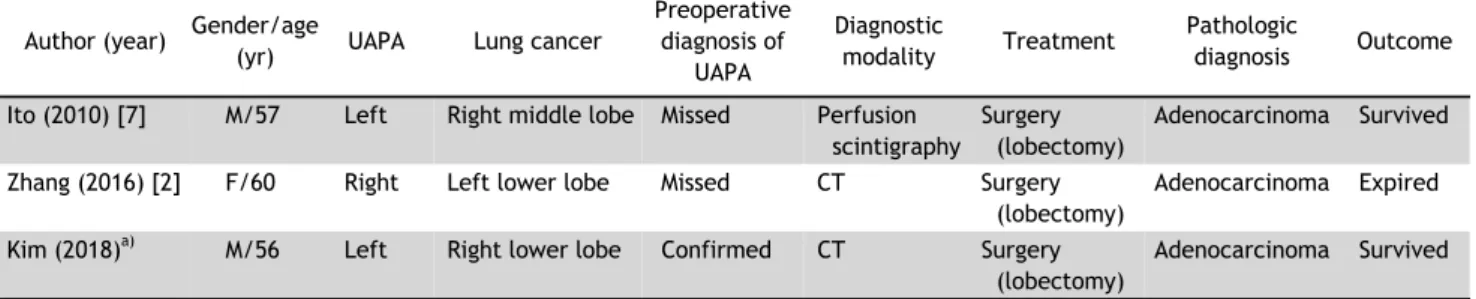
Table 1. Reports of unilateral absence of a pulmonary artery associated with contralateral lung cancer Author (year) Gender/age

(yr) UAPA Lung cancer

Preoperative diagnosis of

UAPA

Diagnostic

modality Treatment Pathologic

diagnosis Outcome Ito (2010) [7] M/57 Left Right middle lobe Missed Perfusion

scintigraphy

Surgery (lobectomy)

Adenocarcinoma Survived Zhang (2016) [2] F/60 Right Left lower lobe Missed CT Surgery

(lobectomy)

Adenocarcinoma Expired Kim (2018)

a)

M/56 Left Right lower lobe Confirmed CT Surgery

(lobectomy)

Adenocarcinoma Survived

UAPA, unilateral absence of a pulmonary artery; M, male; F, female; CT, computed tomography.

a)
Current study.

complained of dyspnea, and his SaO

2

fell to 80%.

However, the dyspnea gradually improved through supportive management alone, and he was dis- charged on postoperative day 22. At a 10-month fol- low-up visit, the dyspnea had largely resolved.

Follow-up echocardiography and ABGA revealed mild pulmonary hypertension (RVSP of 46 mm Hg) and an SaO

2

of 97.6% in room air.

Discussion

UAPA is a rare congenital vascular deformity in which the pulmonary artery is completely absent [1].

UAPA may occur as an isolated anomaly or be ac- companied by other congenital cardiovascular malfor- mations [2]. The prevalence of isolated UAPA ranges from 1 in 200,000 to 1 in 300,000 adults [1]. In 1868, Fraentzel [3] described the first case of UAPA, and recently, Bockeria et al. [4] in 2010 reported a total of 419 cases. UAPA is often accompanied by cardiovascular anomalies, especially in pediatric pa- tients [5,6]. Adult patients may develop symptoms

such as hemoptysis, recurrent lung infections, and ex- ertional dyspnea. However, 13%–15% of patients with UAPA are asymptomatic [1], and in such pa- tients UAPA generally remains undiagnosed until in- cidentally detected by chest imaging studies, as oc- curred in the present case.

Surgical treatment of UAPA is considered when as-

sociated cardiovascular anomalies are present or the

condition is symptomatic. In particular, contralateral

lung lesions that require surgical treatment should

be given special consideration. The occurrence of pri-

mary lung cancer in patients with UAPA is extremely

rare, and experience with contralateral lung surgery

in such patients is very limited. Seven cases of the

surgical treatment of lung cancer in patients with

UAPA have been reported in the English-language lit-

erature [2], but only 2 involved lung cancer on the

contralateral side [2,7]. To the best of our knowl-

edge, the present case is the third in which surgery

was performed for contralateral lung cancer (Table

1). In cases of lung cancer accompanied by con-

tralateral UAPA, treatment options should be selected

(3)

Kun Woo Kim, et al

− 282 − carefully according to the patient’s cardiopulmonary status. First, not only spirometric data, but also pul- monary artery pressure and right heart function should be evaluated carefully. In cases of marginal cardiopulmonary function, a preoperative pulmonary perfusion scan or preoperative pulmonary artery oc- clusion test might be useful to determine the extent of lung resection. Second, if the patients’ performance status and the results of all tests are within normal ranges, even lobectomy may be feasible.

Intraoperatively, repeated decreases in SaO

2

will inevitably occur during single-lung ventilation. Although in the present case, it was possible to perform lobec- tomy using double-lung ventilation, we would suggest that an extracorporeal membranous oxygenator be prepared preoperatively to help cope with potential troublesome situations, such as dense adhesions or anatomical complexity.

Postoperatively, it is inevitable for some degree of pulmonary hypertension to develop due to hyper- perfusion of the remnant lobes. In a previous case [2], the patient suffered rapidly progressing lung fail- ure and died of right heart failure on day 2.

Therefore, it is extremely important to prepare for these potential critical situations in the immediate postoperative period. All possible options to control pulmonary hypertension, such as close monitoring, strict input/output control, vasodilators, and nitric oxide should be available. In the long term, follow-up with echocardiography to monitor whether cor pul- monale develops is mandatory.

We performed curative anatomical resection for primary lung cancer and achieved a good outcome despite contralateral UAPA. This outcome may have

been due to the patient’s relatively good cardiores- piratory function, preoperative awareness of contrala- teral UAPA, and meticulous postoperative management.

Conflict of interest

No potential conflict of interest relevant to this ar- ticle was reported.

References

1. Kruzliak P, Syamasundar RP, Novak M, Pechanova O, Kovacova G. Unilateral absence of pulmonary artery:

pathophysiology, symptoms, diagnosis and current treatment. Arch Cardiovasc Dis 2013;106:448-54.

2. Zhang LZ, Ma WG, Gao SG, He J. Unilateral absence of pul- monary artery associated with contralateral lung cancer.

J Thorac Dis 2016;8:E942-6.

3. Fraentzel O. A case of abnormal communication of the aorta with the pulmonary artery. Arch Pathol Anat Physiol Clin Med 1868;43:420-6.

4. Bockeria LA, Makhachev OA, Khiriev TKh, Abramyan MA.

Congenital isolated unilateral absence of pulmonary ar- tery and variants of collateral blood supply of the ipsi- lateral lung. Interact Cardiovasc Thorac Surg 2011;12:

509-10.

5. Griffin N, Mansfield L, Redmond KC, et al. Imaging fea- tures of isolated unilateral pulmonary artery agenesis presenting in adulthood: a review of four cases. Clin Radiol 2007;62:238-44.

6. Ten Harkel AD, Blom NA, Ottenkamp J. Isolated unilateral absence of a pulmonary artery: a case report and review of the literature. Chest 2002;122:1471-7.

7. Ito M, Yamashita Y, Harada H, Omori K. Unilateral absence

of the left pulmonary artery accompanied by right lung

cancer. Ann Thorac Surg 2010;90:e6-8.

수치

Table 1. Reports of unilateral absence of a pulmonary artery associated with contralateral lung cancer Author (year) Gender/age

참조

관련 문서