• 검색 결과가 없습니다.

Mechanical Extraction of a Massive Intracoronary Thrombus from the Super-Dominant Right Coronary Artery in Thrombogenic Lung Cancer Patient

N/A
N/A
Protected

Academic year: 2022

Share "Mechanical Extraction of a Massive Intracoronary Thrombus from the Super-Dominant Right Coronary Artery in Thrombogenic Lung Cancer Patient"

Copied!
5
0
0

로드 중.... (전체 텍스트 보기)

전체 글

(1)

Korean Circulation Journal

Introduction

The congenital absence of the left circumflex artery (LCX) with a compensatory super-dominant right coronary artery (RCA) is a very rare coronary anomaly, as its incidence is approximately 0.003%.

1)

This anomaly may be associated with systolic click syndrome, chest pain caused by focal ischemia in the zone of hypoperfusion, a poor prognosis related to dilated cardiomyopathy, or inferior wall acute myocardial infarctions (AMI).

2-5)

However, there are no reported cas- es of AMI patients with massive super-dominant RCA thrombosis successfully treated with thrombus aspiration. When AMI occurs in the large coronary artery without stenosis, reperfusion therapy

http://dx.doi.org/10.4070/kcj.2015.45.3.248 Print ISSN 1738-5520 • On-line ISSN 1738-5555

Mechanical Extraction of a Massive Intracoronary Thrombus

from the Super-Dominant Right Coronary Artery in Thrombogenic Lung Cancer Patient

Dong-Kie Kim, MD 1 , Sung-Hyun Ko, MD 1 , Guang-Won Seo, MD 1 , Pil-Sang Song, MD 1 , Ki-Hun Kim, MD 1 , Sang-Hoon Seol, MD 1 , Jong-Woon Song, MD 2 , and Doo-Il Kim, MD 1

1

Division of Cardiology and

2

Department of Radiology, Inje University Haeundae Paik Hospital, Inje University College of Medicine, Busan, Korea

The congenital absence of the left circumflex artery and a compensatory super-dominant right coronary artery (RCA) is a very rare benign coronary anomaly in the clinic. The presence of a massive thrombus in the super-dominant RCA can lead to fatal results in cases of acute myocardial infarction, unless the thrombus is mechanically removed. Aspiration of the thrombus using a 6 Fr right Judkins guide catheter is useful to extract a massive thrombus and is both safe and effective. We report a case of complete revascularization of the super-dominant RCA after thrombus aspiration using a 6 Fr Judkins right catheter in a patient with acute inferior and inferolateral wall myocardial infarction. (Korean Circ J 2015;45(3):248-252)

KEY WORDS: Coronary thrombosis; Coronary vessel anomalies; Inferior wall myocardial infarction.

Received: June 3, 2014

Revision Received: August 13, 2014 Accepted: September 16, 2014

Correspondence: Doo-Il Kim, MD, Division of Cardiology, Inje University Haeundae Paik Hospital, Inje University College of Medicine, 875 Haeun-daero, Haeundae-gu, Busan 612-896, Korea

Tel: 82-51-797-3010, Fax: 82-51-797-3009 E-mail: [email protected]

• The authors have no financial conflicts of interest.

This is an Open Access article distributed under the terms of the Creative Commons Attribution Non-Commercial License (http://creativecommons.

org/licenses/by-nc/3.0) which permits unrestricted non-commercial use, distribution, and reproduction in any medium, provided the original work is properly cited.

using conventional thrombectomy devices is limited to preventing the development of the no-reflow phenomenon because of the massive intracoronary thrombus.

We report a rare case of an absent LCX with a super-dominant RCA that presented with inferior wall AMI. The patient was successfully treated with a mechanical extraction of the massive intracoronary thrombus using a 6 Fr guide catheter.

Case

A 55-year-old woman arrived in the emergency department. She complained of severe substernal chest pain originating an hour ear- lier. The pain was associated with shortness of breath and diapho- resis. The patient had been hypertensive for the past 10 years but had no history of diabetes mellitus, hypercholesterolemia, or smok- ing. She had stage IV lung cancer and was receiving her sixth cycle of chemotherapy with pemetrexed and cisplatin.

On physical examination, her heart rate was 67 beats/min and

her blood pressure was 95/60 mm Hg. The initial electrocardiog-

raphy showed a sinus rhythm with an ST-segment elevation in

leads II, III, and aVF. The cardiac markers were elevated; troponin

I was 212.65 ng/mL and creatine kinase-MB was 522.1 ng/mL. A

bedside transthoracic echocardiography revealed that the left

ventricular ejection fraction was 35%, and hypokinesis was found

in the inferior and inferolateral walls of the left ventricle.

(2)

The patient received 300 mg oral aspirin and 600 mg clopidogrel in addition to intravenous unfractionated heparin (bolus 5000 IU, infusion 80 IU/hr). An emergency angiography was performed via the right radial artery with a 5 Fr Judkins catheter (Vista Brite Tip, Cordis, Miami, FL, USA). The left coronary angiography showed min- imal atherosclerotic changes in the mid segment of the left anteri- or descending artery without visualization of the LCX (Fig. 1A and B). There were no collateral flows to the LCX. The right coronary an- giography revealed a relatively large RCA and a total thrombotic oc- clusion in the mid segment (Fig. 1C). We thought that the RCA was the culprit vessel, and a 6 Fr Judkins right (JR) guide catheter was en- gaged to perform percutaneous coronary intervention. We were con- cerned about the massive intracoronary thrombosis because, due to

the poor left ventricular systolic function, the absence of the reflow phenomenon or thrombus propagation to the distal coronary artery after revascularization could be fatal. A thrombus aspiration was attempted with a coronary thrombosuction device (Thrombuster II, Kaneka Medix, Kaneka, Japan), but it was not effective because of the extremely large thrombus burden. We decided to extract the massive thrombus directly using the 6 Fr JR guide catheter instead of the thrombosuction device because the diameter of the RCA was large enough for a 6 Fr guide catheter to advance through the lumen.

The JR catheter was deeply positioned into the mid segment, and thrombus aspiration was performed carefully several times (Fig. 2A).

After these procedures, the system was removed from the sheath and flushed. The remnant thrombus was aspirated using a 5 Fr daughter

A B C

Fig. 1. Baseline coronary angiogram. A and B: the left circumflex artery is not seen in both caudal view and left-anterior-oblique with caudal view of the left coronary angiogram. C: massive thrombotic occlusion in super-dominant right coronary artery is noted on the right coronary angiogram.

A B

Fig. 2. Coronary thrombus aspiration with 6 Fr guide catheter. A: the Judkins right guide catheter (arrow) can be deeply positioned into the super-domi-

nant right coronary artery using a clock-wise rotation. B: the massive fresh thrombus is successfully removed by direct catheter aspiration.

(3)

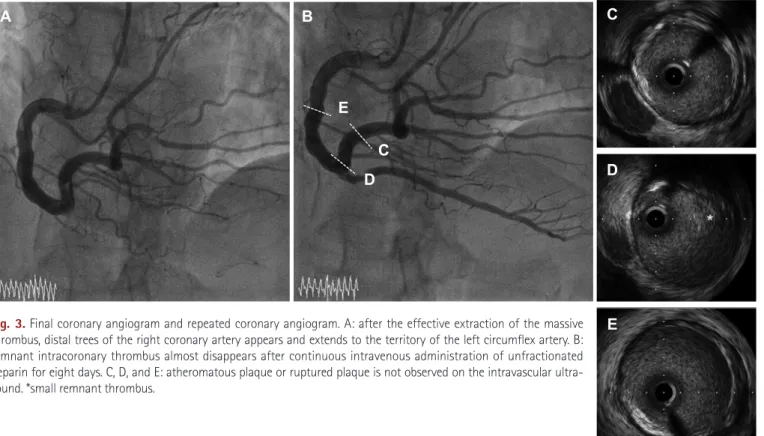
catheter (Heartrail, Terumo, Tokyo, Japan) and a coronary thrombo- suction device. The massive fresh red thrombus was extracted (Fig.

2B) and the final coronary angiography revealed the complete re- covery of coronary flow. The super-dominant RCA, with its pos- terolateral branches supplying the lateral wall of the left ventricle corresponding of the territory of the LCX appeared (Fig. 3A). The patient subsequently received intracoronary abciximab (250 μg/kg bolus, 10 μg/min for 12 hours). Dual antiplatelet therapy, including aspirin and clopidogrel, and intravenous unfractionated heparin were continued for eight days.

A coronary angiography was repeated on day 8. A minimal rem- nant thrombus was observed in the large RCA, but not in the distal branches (Fig. 3B). No significant luminal stenosis was observed, and this was confirmed by intravascular ultrasonography (Atlantis SR Pro, Boston Scientific, Natick, MA, USA) (Fig. 3C, D, and E). The pa- tient’s clinical condition stabilized without any complications and she was discharged with aspirin and clopidogrel five days later.

Two weeks after discharge, the patient complained of chest dis- comfort and dyspnea on exertion. There were no remarkable chang- es in cardiac enzymes, or on her EKG and echocardiography. Howev- er, multiple pulmonary thromboemboli were noted on the chest CT scan (Fig. 4). The patient was treated with warfarin for six months after discontinuation of dual antiplatelets. After the six months chest CT scan was repeated and there was no evidence of pulmonary thromboembolism.

Discussion

The absence of the LCX is an extremely rare congenital anomaly with a frequency of only 0.003% in 126595 patients who under- went coronary angiography.

1)

The condition is commonly com- pensated for with an oversized super-dominant RCA that extends into the LCX territories to minimize the area of hypoperfusion.

Due to the compensation mechanism, this vascular anomaly is Fig. 4. An acute pulmonary thromboembolism develops two weeks after

discharge under dual antiplatelet therapy with no evidence of hypercoagu- lopathies. A chest CT scan shows intra-arterial emboli (arrows) in the right lower basal segmental pulmonary arteries.

A B C

C D

D

E E

Fig. 3. Final coronary angiogram and repeated coronary angiogram. A: after the effective extraction of the massive thrombus, distal trees of the right coronary artery appears and extends to the territory of the left circumflex artery. B:

remnant intracoronary thrombus almost disappears after continuous intravenous administration of unfractionated

heparin for eight days. C, D, and E: atheromatous plaque or ruptured plaque is not observed on the intravascular ultra-

sound. *small remnant thrombus.

(4)

usually considered benign. However, when acute occlusion of the RCA occurs, it is usually equivalent to a two-vessel coronary artery disease involving both the RCA and LCX. This occlusion results in in- ferior, posterior, and lateral wall myocardial infarction.

Giant coronary artery diseases, such as coronary artery ectasia, may increase the risk of ischemic symptoms or myocardial infarc- tions with or without an occlusion of the coronary artery caused by sluggish coronary flow or turbulent flow. Complications from this disease usually occur as thromboembolic phenomena primarily due to thrombosis in the ectasic segment of the coronary artery.

6)

In the present case, the LCX was not seen on the left coronary an- giography and the huge RCA was occluded on the right coronary angiography. Though multidetector-row computed tomography could provide much more information about coronary anomalies and it might be the best modality for confirmation, the patient did not want to underrgo further evaluation.

7)

However, many distal RCA branches were noted on the coronary angiography after revascu- larization, which extended to the lateral wall of the left ventricle without collateral flow from the RCA to the LCX. No anomalous ves- sel arising from aorta was observed on the chest CT scan, which was taken for the diagnosis of pulmonary thromboembolism. These results demonstrate the absence of the LCX.

According to Yip et al.

8)

an infarct-related artery (IRA) with a ref- erence lumen diameter (RLD) lager than 4 mm and high-burden thrombus formation results in a significantly higher incidence of unsuccessful reperfusion than an IRA with a RLD <4 mm in patients with AMI. Slow and turbulent flow in a large diameter coronary ar- tery is associated with thrombus formation and may initiate platelet activity and damage the endothelium, which causes formation of a massive thrombus without significant coronary artery stenosis.

9)

In cases of IRAs with massive thrombus burden, the current re- perfusion techniques are not effective. It is important to extract a thrombus completely to restore the coronary flow and to prevent the no-reflow phenomenon. Onoda et al.

10)

previously extracted a massive intracoronary thrombus using a 6 Fr JR catheter and dem- onstrated that the procedure was safe and effective. They inserted a 6 Fr JR catheter into an 8 Fr Amplatz catheter using the ‘mother and daughter’ technique, and the mother catheter was shortened so the daughter catheter could reach the distal segment of the RCA.

In this case, we extracted most of the thrombus directly using a 6 Fr JR catheter via the right radial approach. Our strategy required less time. The JR catheter was positioned deeply using careful ma- nipulation with a clock-wise rotation and gentle movements with- out causing major injury to the vessel wall. Possible complications during aggressive mechanical thrombectomy procedures include a collapse of the coronary artery due to strong aspiration or forma- tion of a secondary embolism caused by the extracted thrombus

falling into the coronary artery or aorta.

11)

This technique should be considered only in selected cases when an operator is an expert in the transradial procedure and the coronary artery is large enough for the procedure.

The mechanism of massive red thrombus formation in this case was not clear, but the patient’s thrombogenic condition might have been due to her advanced malignancy stage. The patient had stage IV lung cancer and was undergoing her sixth cycle of pemetrexed and cisplatin. The contribution of an intra-coronary glycoprotein IIb/IIIa inhibitor to dissolve the clot remains unclear. According to Fujii et al.

12)

an intracoronary thrombus consisting of red blood cells is a high-burden thrombus, while those consisting of platelets are low-burden thrombi. Glycoprotein IIb/IIIa inhibitors do not have pri- mary fibrinolytic activity. However, inhibitors can help dissolve the remnant intracoronary thrombus by assisting spontaneous fibrino- lysis especially in an active thrombogenic state. Hypercoagulable studies at admission including protein C and S, anti-thrombin III, Factor V Leiden, prothrombin, homocysteine, lupus anticoagulant, and antiphospholipid Ab were all within normal limits or negative in our patient. Consequently, a thrombogenic medical condition, such as malignancy, may cause pulmonary thromboembolism and myocardial infarction of the large coronary artery despite the con- tinuous use of dual antiplatelets.

In conclusion, we have described an effective mechanical aspira- tion technique, which may become an alternative procedure in cas- es of massive thrombi situated in large diameter coronary arteries in order to avoid the slow flow or no-flow phenomenon, and to achieve complete revascularization.

References

1. Yamanaka O, Hobbs RE. Coronary artery anomalies in 126,595 patients undergoing coronary arteriography. Cathet Cardiovasc Diagn 1990;

21:28-40.

2. Gentzler RD 2nd, Gault JH, Liedtke AJ, McCann WD, Mann RH, Hunter AS. Congenital absence of the left circumflex coronary artery in the systolic click syndrome. Circulation 1975;52:490-6.

3. Bestetti RB, Costa RB, Oliveira JS, Rossi MA, Corrêa de Araujo R. Con- genital absence of the circumflex coronary artery associated with di- lated cardiomyopathy. Int J Cardiol 1985;8:331-5.

4. Guo J, Xu M. Congenital absence of the left circumflex artery associat- ed with inferior myocardial infarction. Intern Med 2012;51:71-4.

5. Hong PS, Lee YS, Lee JB. Congenital absence of the left circumflex cor- onary artery in a patient with acute inferior myocardial infarction. Herz 2014;39:957-9.

6. Farto e Abreu P, Mesquita A, Silva JA, Seabra-Gomes R. [Coronary ar- tery ectasia: clinical and angiographic characteristics and prognosis].

Rev Port Cardiol 1993;12:305-10.

7. van Ooijen PM, Dorgelo J, Zijlstra F, Oudkerk M. Detection, visualization

and evaluation of anomalous coronary anatomy on 16-slice multide-

(5)

tector-row CT. Eur Radiol 2004;14:2163-71.

8. Yip HK, Wu CJ, Chang HW, et al. Comparison of impact of primary per- cutaneous transluminal coronary angioplasty and primary stenting on short-term mortality in patients with cardiogenic shock and evaluation of prognostic determinants. Am J Cardiol 2001;87:1184-8.

9. Rath S, Har-Zahav Y, Battler A, et al. Fate of nonobstructive aneurys- matic coronary artery disease: angiographic and clinical follow-up re- port. Am Heart J 1985;109:785-91.

10. Onoda S, Mutoh M, Ishikawa T, et al. Usefulness of a 6 fr right judkins

catheter for mechanically extracting a massive intracoronary thrombus from an ectasic right coronary artery: a report on two different cases of thrombectomy. Jpn Heart J 2004;45:673-8.

11. Hara M, Saikawa T, Tsunematsu Y, Sakata T, Yoshimatsu H. Predicting no-reflow based on angiographic features of lesions in patients with acute myocardial infarction. J Atheroscler Thromb 2005;12:315-21.

12. Fujii T, Ueda M, Ikura Y, et al. Aspirated intracoronary thrombus by Res- cue

TM

PT catheter (histological and immunohistochemical analyses).

Circulation 2002;66(Suppl):I-458.

수치

Fig. 2. Coronary thrombus aspiration with 6 Fr guide catheter. A: the Judkins right guide catheter (arrow) can be deeply positioned into the super-domi- super-domi-nant right coronary artery using a clock-wise rotation
Fig. 3. Final coronary angiogram and repeated coronary angiogram. A: after the effective extraction of the massive  thrombus, distal trees of the right coronary artery appears and extends to the territory of the left circumflex artery

참조

관련 문서

1 John Owen, Justification by Faith Alone, in The Works of John Owen, ed. John Bolt, trans. Scott Clark, &#34;Do This and Live: Christ's Active Obedience as the

Therefore, cTnT is a recommended biomarker for use in the detection of myocardial infarction (MI) and in acute coronary syndromes.[8] Indeed, several authors

(4)the spiral ganglion (5)the auditory nerve fibres.. The Basilar Membrane is a Mechanical Analyzer of Sound Frequency The Basilar Membrane is a Mechanical Analyzer of

The locations of aneurysms were middle cerebral artery in 15 patients, cerebral artery in 15 patients, cerebral artery in 15 patients, cerebral artery in

- the right side : to move deoxygenated blood that is loaded with carbon dioxide from the body to the lungs - the left side : to receive oxygenated blood that has.. had most

void makeTree(Object root, Object left, Object right): Creates a binary tree with root as the root element, left as the left subtree, right as the right

Incident major cardiovascular events (coronary artery disease, ischemic stroke, hemorrhagic stroke and cardiovascular mortality) were set as primary end points.

Background: Incidence of complications related extracorporeal membrane oxygenation (ECMO) support as a bridge to lung transplantation (BTT) and its association with the