• 검색 결과가 없습니다.

Cardiac Hemangioma: A Case ReportSung-Yong Hong, M.D.

N/A
N/A
Protected

Academic year: 2021

Share "Cardiac Hemangioma: A Case ReportSung-Yong Hong, M.D."

Copied!
3
0
0

로드 중.... (전체 텍스트 보기)

전체 글

(1)

Korean J Thorac Cardiovasc Surg 2014;47:149-151 □ Case Report □ http://dx.doi.org/10.5090/kjtcs.2014.47.2.149 ISSN: 2233-601X (Print) ISSN: 2093-6516 (Online)

− 149 −

Departments of

1

Thoracic and Cardiovascular Surgery and

2

Cardiology, Inje University Busan Paik Hospital, Inje University College of Medicine Received: August 29, 2013, Revised: October 8, 2013, Accepted: October 10, 2013

Corresponding author: Il-Yong Han, Department of Thoracic and Cardiovascular Surgery, Inje University Busan Paik Hospital, Inje University College of Medicine, 75 Bokji-ro, Busanjin-gu, Busan 614-735, Korea

(Tel) 82-51-890-6834 (Fax) 82-51-891-1297 (E-mail) [email protected]

C

The Korean Society for Thoracic and Cardiovascular Surgery. 2014. All right reserved.

CC
This is an open access article distributed under the terms of the Creative Commons Attribution Non-Commercial License (http://creative- commons.org/licenses/by-nc/3.0) which permits unrestricted non-commercial use, distribution, and reproduction in any medium, provided the original work is properly cited.

Cardiac Hemangioma: A Case Report

Sung-Yong Hong, M.D.

1

, Kyung-Taek Park, M.D.

1

, Yang-Haeng Lee, M.D.

1

, Kwang-Hyun Cho, M.D.

1

, Jeong-Sook Seo, M.D.

2

, Il-Yong Han, M.D.

1

Hemangioma of the heart, presenting as a primary cardiac tumor is extremely rare; it accounts for approximately 2% of all primary resected heart tumors. In our patient, the tumor was located in the orifice of the right lower pulmonary vein. Few cases of cardiac hemangiomas have been reported to arise from the left atrial (LA) wall. Left atrial hemangiomas, especially those attached to the LA wall, may be erroneously diagnosed as myxomas. Cardiac hemangioma is a rare disease; furthermore, a tumor arising from the LA wall and misconceived as a myxoma is extremely rare. We removed a mass misdiagnosed as a myxoma; it was pathologically confirmed to be a cardiac capillary hemangioma. Therefore, we report a rare case of a cardiac hemangioma misconceived as a myxoma; the tumor was removed successfully.

Key words: 1. Heart neoplasms 2. Hemangioma 3. Myxoma 4. Left atrium

CASE REPORT

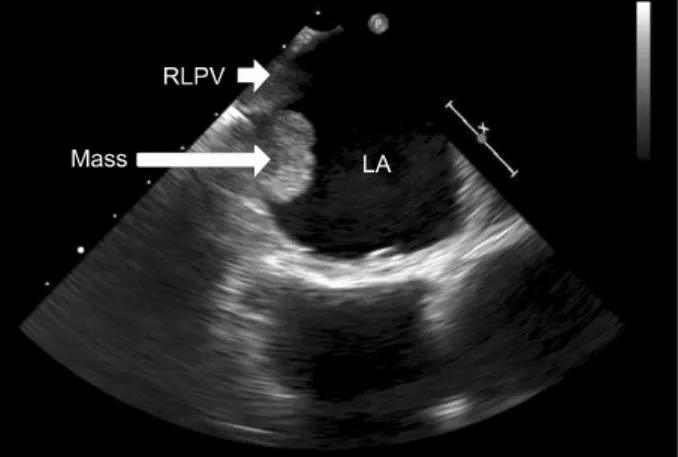
A 74-year-old man presented with mild dyspnea and chest discomfort for 30 months. The symptoms had deteriorated 3 months before his visit to our hospital. Trans-thoracic echo- cardiographic findings showed a left atrial echogenic mass (2×1.5 cm) (Fig. 1).

A provisional diagnosis of a left atrial (LA) myxoma was made, and the patient was admitted for the surgical excision of the tumor. He was hemodynamically stable, and his labo- ratory results were within normal limits. Coronary angiog- raphy revealed a 50% stenosis on the mid-portion of the left anterior descending artery (LAD). We planned the con- comitant operation with mass excision and coronary artery bypass.

Under general anesthesia with supine position, median ster- notomy was performed as usual. Conventional cannulation was performed, and the right atrial wall and the interatrial septum were incised. The cardiac mass was totally removed.

Further, we anastomosed the left internal thoracic artery to the distal portion of the LAD. The resected mass was oval and was made of a white jelly-like material. We resected the mass including the myocardium, and the LA wall was closed by a prolene suture. The patient was transferred to the gen- eral ward the next day.

DISCUSSION

Hemangioma of the heart presenting as a primary cardiac

tumor is extremely rare; it accounts for approximately 2.8%

(2)

Sung-Yong Hong, et al

− 150 −

Fig. 2. Pathologic finding of cardiac hemangioma. (A) Myocardium shows ill-defined aggregates of closely packed, thin-walled capillaries fil- led with blood cells (H&E, ×200). (B) Immunohistochemical staining showed strong immunoreactivity against CD34 on endothelial cells lining of tangled capillaries.

Fig. 1. Preoperative echocardiographic finding. The mass (1.98×

1.54 cm) is located in the orifice of right lower pulmonary vein, and showed irregular shape. LA, left atrium; RLPV, right lower pulmonary vein.

of all primary resected heart tumors [1]. Its histological sub- types are as follows: 1) cavernous hemangioma, 2) capillary hemangioma, and 3) arteriovenous hemangioma or cirsoid aneurysm [1]. The cavernous hemangioma is composed of multiple thin- and/or thick-walled dilated vessels. The capil- lary hemangioma has lobules of endothelial cells forming small, capillary-like vessels. The arteriovenous hemangioma consists of dysplastic thick-walled arterioles, venous-like ves- sels, and capillaries. In our case, the tumor is a capillary he-

mangioma that shows ill-defined aggregates of closely packed, thin-walled capillaries filled with blood cells (Fig. 2).

Cardiac hemangioma can occur at any age. Further, tumors may be located in any heart chamber, the pericardium, the endocardium, or the myocardium [2]. Fifty-six cases were re- viewed by Han et al. [1], and the localization of cardiac he- mangiomas was the right ventricle in 20 cases (35.7%), the left ventricle in 19 cases (33.9%), the right atrium in 13 cas- es (23.2%), the interatrial septum in 6 cases (10.7%), the in- terventricular septum in 6 cases (10.7%), and the left atrium in 4 cases (7.1%). Multiple extensive tumors were noted in 17 cases (30.4%). Very few cases of cardiac hemangiomas have been reported to be arising from the LA wall, mimick- ing the classic presentation of a myxoma. In our patient, the tumor was located in the orifice of the right lower pulmonary vein. However, venous flow obstruction was not observed.

The clinical symptoms depend on the tumor’s location and

size. Some cardiac hemangiomas are asymptomatic and are

discovered during cardiac surgery or upon autopsy. In symp-

tomatic patients, cardiac hemangiomas cause arrhythmia, peri-

cardial effusion, congestive heart failure, right ventricular out-

flow tract obstruction, coronary insufficiency, and sudden

death [3]. Diagnosis can be made by echocardiography, com-

puted tomography (CT), or magnetic resonance imaging

(MRI). CT and MRI help to evaluate the dimensions and the

(3)

Cardiac Hemangioma: A Case Report

− 151 − invasiveness of the tumor. Coronary angiography is some- times useful in revealing how the tumor is fed and its charac- teristic tumor blush [4]. However, we cannot find any feeding vessel or tumor blush in preoperative coronary angiography.

In the opinion of a cardiologist, the tumor had a myx- oma-like shape and exhibited echogenicity. Therefore, myx- oma was strongly suspected in the preoperative evaluation.

Atrial hemangiomas, particularly those attached to the LA wall, may be erroneously diagnosed as myxomas. However, there are no myxoma cells or lepidic cells that can be found usually in cardiac myxomas, and cellular areas with numerous capillaries are usually present [1]. The natural history of car- diac hemangioma is unpredictable. Patients with a resectable tumor usually have a good prognosis, but those with an un- resectable tumor may have a poor prognosis because of ven- tricular tachycardia, sudden death, local progression, or sys- temic dissemination of the malignant tumor [5]. The surgical outcome was generally favorable. A case of recurrence has not been reported thus far. Therefore, we believe that if sur- gical resection is possible, surgery is the best way to treat cardiac hemangioma.

Cardiac hemangioma is a rare disease; furthermore, a tu- mor arising from the LA wall and misconceived as a myx- oma is extremely rare. We removed the mass misdiagnosed

as a myxoma and pathologically confirmed it to be a cardiac capillary hemangioma. In order to share our experience, we report this case, which we successfully treated.

CONFLICT OF INTEREST

No potential conflict of interest relevant to this article was reported.

REFERENCES

1. Han Y, Chen X, Wang X, Yang L, Zeng Y, Yang J.

Cardiac capillary hemangioma: a case report and brief re- view of the literature. J Clin Ultrasound 2014;42:53-6.

2. Abad C, de Varona S, Limeres MA, Morales J, Marrero J.

Resection of a left atrial hemangioma: report of a case and overview of the literature on resected cardiac hemangiomas.

Tex Heart Inst J 2008;35:69-72.

3. Kojima S, Sumiyoshi M, Suwa S, et al. Cardiac hemangio- ma: a report of two cases and review of the literature. Heart Vessels 2003;18:153-6.

4. Pigato JB, Subramanian VA, McCaba JC. Cardiac he- mangioma: a case report and discussion. Tex Heart Inst J 1998;25:83-5.

5. Tomizawa Y, Endo M, Nishida H, Kikuchi C, Koyanagi H.

Reconstruction of the left ventricle in a patient with cardiac

hemangioma at the apex. Ann Thorac Surg 2001;71:2032-4.

수치

Fig. 2. Pathologic finding of cardiac hemangioma. (A) Myocardium shows ill-defined aggregates of closely packed, thin-walled capillaries fil- fil-led with blood cells (H&E, ×200)

참조

관련 문서

Purpose: Calcaneal fracture is a rare fracture, which accounts for about 2% of all fractures, but is one of the most common fractures in the ankle bone.. There is

Patient had laparoscopic surgery on the adnexal tumor and excised tissue was removed through Douglas pouch incision by single surgeon.. Results: The mean age

Purpose: Giant cell tumor of the tendon sheath are the most common tumors after ganglionic cysts in benign soft tissue tumors which could be recurred after surgical

The reduction of power series ( , m→ ∞) to polynomials (m is finite) is a great advantage.. because then we have solutions for all x,

Result: During the study period, 482 patients had elevated cardiac troponin-T levels. The positive predictive value for the.. The diagnostic importance of

- In patients presenting with end-stage organ failure, sequential solid organ (kidney heart liver) transplant followed by ASCT has been successfully. J

3) ACC/AHA/ESC 2006 Guidelines for the Management of Patients with Atrial Fibrillation: a report of the American College of Cardiology/American Heart

1 John Owen, Justification by Faith Alone, in The Works of John Owen, ed. John Bolt, trans. Scott Clark, "Do This and Live: Christ's Active Obedience as the