185
Available online at http://www.kccp.or.kr pISSN: 1226-6051
근거중심 의약품 정책 결정; 극복하기 어려운 과제인가? 한국 전문가의 생생한 의견
이인향*
영남대학교 약학대학
(2013년 4월 14일 접수·2013년 9월 3일 수정·2013년 9월 6일 승인)
Evidence-based Pharmaceutical Policy-making; A Challenging Task?
Vivid Voices from Korean Experts
Iyn-Hyang Lee*
College of Pharmacy, Yeungnam University, Gyeongsan, Gyeongbuk 712-749, Korea (Received April 14, 2013·Revised September 3, 2013·Accepted September 6, 2013)
This study aims to explore the difficulties of evidence-based pharmaceutical policy-making in the Korean con- text where several pharmaceutical policies were introduced within a short period. Semi-structured in-depth inter- views were performed with eight experts in the Korean pharmaceutical arena. The key challenge in Korean situation might be the apparent lack of available evidence caused by the limited resources, the lack of policy consistency and coordination ability in the authorities and distrust across stakeholders. To build an evidence- based tradition, it is essential to resolve the tangible lack. At once, more fundamental changes seem to be required in the intangible policy environments.
□ Key words - Evidence-based policy, Pharmaceutical policy, Qualitative study
INTRODUCTION
Over the past 15 years, the voice proclaiming the link between science and policy has been apparent, as the belief that scientific evidence can improve the vigour of decision making is widespread. In a relatively short time, the concept of ‘evidence-based’ policy-making (EBP) has succeeded in permeating governments as a principle.1-3) Translating the manifesto into practice, however, has proved challenging in policy-making for pharmaceuti- cals.4) Examples may include South Korea. During the 2000s, faced with rising drug expenditure, the Korean government has tried to contain costs by the introduction
of several policy interventions (Table 1). It is, however, sceptical if effective policies have been implemented to tackle the main cause of expenditure inflation in Korea.
Despite evidence suggests that it is necessary to change doctors’ prescribing behaviour,5-8) the Korean govern- ment has focused more on measures influencing patient demand or reimbursement prices so far.
One recent study indicated that treatment controlling patient demand and pricing have achieved a limited impact in containing costs in Korea.9) Furthermore, some unwanted effects were seen after the policy changes, such as a significant restriction in the use of potentially essential drugs.9) Alongside, it has been sug- gested internationally that price control might be pow- erless when confronted with entrepreneur activity marketing for newer, more expensive medications.10-12)
Recently, some measures such as generic prescribing, incentives on the prescribing budget savings have been
Correspondence to : Iyn-Hyang Lee
College of Pharmacy, Yeungnam University 280 Daehak-ro, Gyeongsan, Gyeongbuk 712-749, Korea
Tel: +82-53-810-2829, Fax: +82-53-810-4654 E-mail: [email protected]
piloted to influence prescribing practice. Nevertheless, they are hardly to make progress from the early stages of development (Table 1). The purpose of this study was to explore the difficulties of evidence-based pharmaceutical policy-making in the Korean context by investigating experts’ views on current policies and evidence available to policymakers; by exploring the factors that influence policy decisions; by probing participants’ opinions of the potential policies available to Korean policymakers.
METHODS
This study aimed to probe pragmatic issues relating to the topic area, making a qualitative approach the best choice for it. Semi-structured, in-depth telephone inter- views were carried out with key people from the Korean pharmaceutical policy arena between July and Septem- ber 2009. Interviewees gave informed, written consent before participating. This research was approved by the Department of Health Sciences Research Governance
Committee, University of York.
Potential participants were selected from among the appropriate members of the key groups involving phar- maceutical policy-making in Korea. The selection crite- ria included
• experience of the pharmaceutical policy-making process;
• current or recent involvement in the pharmaceutical policy-making process in South Korea either as a policy-maker or as an advisory committee member;
• experience of academic research into Korean phar- maceutical policies;
• willingness to discuss personal views;
• interests in pharmaceutical policies.
Purposive sampling was employed.13) The ‘information rich’ key people were strategically sampled by asking a number of different informants. To ensure maximum vari- ation and diversity,14) types of potential participant were loosely grouped by the organisations to which they Table 1. Pharmaceutical policies in South Korea.
Pharmaceutical policies Notes Since
Mandatory separation between prescribing and dispensing of drugs establish two drug categories of POM and Pa 2000 Policies influencing patients
Cost-sharing fixed copayments, coinsurance 1977
Consumer education occasionally
Public advertisement of prescription medicines banned Policies influencing providers
Guidelines in prescribing practices advisory, for some therapy
Reimbursement criteria for some therapies 1977
Monitoring prescribing and feedback for some subjects 2001
Drug utilisation review piloted 2009
Benefit drug listing negative list 2001-2006
positive list 2007
Generic substitution Yes 2000
incentives on pharmacists 2001
Generic prescribing piloted 2007
Incentives on saving in pharmacy budget piloted 2008/2009
Policies influencing industry
Direct price control maximum allowable cost 1977
price-cut on original drugs after patent expiry 2007
Price agreement Yes 2007
Patent regulation Yes 1987
Formal request of economic evidence in reimbursement decisions Yes, for some products 2007 a. POM stands for prescription-only-medicines; P stands for pharmacy medicines
have belonged. The groups were made broadly based on their current workplace; authority bodies, nation funded advisory research institutions and academia. To assure practical discussion, particular policies were selected for in-depth discussion; co-payment, prescribing feedback, price control and positive list and affiliated eco- nomic evaluation for existing policies; reference pricing prescribing budget, payment for diagnosis related group and generic prescribing for potential policies. A small pilot was undertaken with selected, interested interviewees.
A total of 49 potential participants were identified through the process, of which 16 were approached.
Nine individuals finally agreed to take part in a one-to- one interview. Recruitment was ended as it became clear that saturation had been reached in terms of the views expressed, with similar opinions and concepts repeatedly recurring in study topics.15) Data saturation is usually achieved around 6~12 participants with this kind of study including a relatively homogeneous popu- lation and exploring fairly narrow objectives.16) Each interview took place over the telephone lasting 40 to 60 minutes. A preliminary questionnaire concerning issues of interest helped to trigger vivid discussion.17) The dis- cussion was audio-recorded and transcribed verbatim.
The data was coded thematically and analysed employing the framework approach.18,19) A qualitative data analysis software, ATLAS.ti version 5 (GmbH Berlin) was used for coding. For reporting, the original language was translated into English by an independent bilingual
translator. There is little evidence that translation would alter the qualitative analysis,20) though some concerns may still arise as to whether translation is accurate and portrays the subtle meanings of the original language.
The references at the end of each indicate the participant reference number, followed by the paragraph numbers where the quotation occurs in the transcript (e.g. p047:4).
RESULTS
Characteristics of participants
Eight interviews were completed (Table 2). One partici- pant was not reached to interview without giving any rea- son. Half of the participants have worked for government bodies at national level and have experienced policy plan- ning and implementation. The rest have worked in either advisory research bodies or academia. All had a pharmacy background and among them, five participants had receiv- ed further training in Health Sciences.
Snapshot of evidence policy-makers currently utilise in pharmaceutical policy-making
The root of trouble testified by participants was that Korean policymakers often faced with limitations to utilise the research evidence in policy cycle, “because, so far, there basically hasn’t been enough evidence available on other previous policy making processes for us to learn from and use as an example whenever we have to make certain future decisions (p047:4)”. Faced
Table 2. Basic characteristics of participants.
Participanta Working forb Lengthc Backgroundd
p006 government body 10< Pharmacy
p014 advisory research body 5~10 Pharmacy, Health Sciences
p017 advisory research body 10< Pharmacy, Health Sciences
p019 advisory research body, academia 10< Pharmacy, Health Sciences
p028 government body 10< Pharmacy
p030 government body 10< Pharmacy
p047 advisory research body, academia 5~10 Pharmacy, Health Sciences
p048 government body, academia 5~10 Pharmacy, Health Sciences
a. Participant numbers (e.g. p006) are arbitrary, and were simply allocated in the order in which names were initially identified during the snowballing process.
b. ‘Working for’ indicates organisations in which participants have been engaged so far.
c. ‘Length’ denotes time period that participants have been engaged on relevant tasks.
d. ‘Background’ reflects their academic discipline.
with the limitations of available evidence, some subop- timal sources of information (e.g. a “policy monograph mainly detailing a foreign system (p014:8)”) remain the important tools for policy decisions. Careful consider- ation seems to be crucial with this type of information in order to learn from “reflecting on information”, not from
“exotic information”.21,22) However, decision-makers at the highest position in Korea “already liked what they saw in that short period of time, so they don’t really seem to care about fully comprehending foreign policies or the systems that they’re interested in as long as they like [the foreign systems] (p014:4)”. Another example was that ‘opinion leaders perspectives’ played a leading role in several big changes to date, including the separation policy and the formal economic evaluation. “So when it comes to a policy-making process, we end up using research materials or data that are either already done by someone else, or already on the market. [Facing with the situation lacking available evidence] I just don’t think we really have any choice but to rely on experts’ opinions. (p006:4)”.
Despite there was available evidence, on the other, quality of it has generally been acknowledged as being poor and single-faceted. The weaknesses of current evi- dence suggested by respondents can be grouped into three categories. First, evidence about the impacts of pharmaceutical policies from abroad seems less useful
“because of the differences between Korean and other countries’ systems (p030:8)”. Second, evidence pro- duced in Korea is also considered impractical, since
“they usually tend to cover just the general aspects of [policy] and leave out all the details (p006:6)”. This was particularly stressed by participants engaged in the planning or implementing of policies, who might wel- come practical prescriptions. Third, it is rare to conduct empirical follow up after introducing a foreign policy,
since “there is little regard to evaluate whether that system would work or not for South Korea (p014:8)”.
“As long as[decision makers] know that the policies have been working well in other countries… they wouldn’t really make a big deal even if we end up copy- ing the foreign policies exactly as they are (p028:20)”.
What causes available evidence in short?
Lack of infrastructure for policy research: Most par- ticipants felt that the dearth of basic infrastructure might cause available evidence to be limited or less valuable. In detail, their statements were omnidirectional, including the lack of fundamental relevant research (e.g. Table 3); the lack of workforce – qualified researchers and training pro- grammes; the lack of experience “like how to evaluate and systematise them [evidence or experience into policy]
(p006:40)”.
Central to the discussion of infrastructure was the demand for properly trained researchers. When com- missioning policy evaluation, participants working as planners or implementers asserted, they often felt that it was necessary to guide researchers with intensive dis- cussions regardless of either the researchers based at governmental institutions or at independent academia, since “most researchers don’t necessarily understand well about the policy direction (p028:14)”. Participants from academia agreed the poor quality of some less qualified researchers who “simply make comparison with foreign policies or evaluate Korean policies tend to be too generalised... (p019:8)”. Often, the ability of eligible researchers suffered from a lack of independence in policy evaluation. Firstly, it seemed to be unavoidably restricted because of the shortage of resources like time, background references, and colleagues for interdiscipli- nary research, or fundamental data that were essential to aid the diversity of research. Secondly, respondents
Table 3. Participants examples concerning the types of relevant information in shortage in the Korean pharmaceutical policy cycle.
• epidemiology relating to chemical substances or epidemiologic researches [on local population] (p030:10);
• head-to-head data on drugs (p030:10);
• evidence on how to allocate the budget [to discuss a prescribing budget] (p019:24);
• costs data in relation to an economic evaluation (p019:8);
• [for prior authorisation] [a standard of judgment] on whether this person really needs this or not (p028:60)
argued that researchers in Korea were inevitably gov- erned by sources of funding or data. Sometimes, the sit- uation was worsen by the inferior standard of quality in request, respondents argued that funders (mostly gov- ernmental bodies) “just want things to be explained descriptively and in certain ways they want them to be explained (p048:6)”, rather than those from a robust scientific analysis.
Lack of coordination among policy researches: To influence policy-making, a body of knowledge, i.e. evi- dence is required in a timely manner, but it does not just appear when needed. With this regard, essential aspect participants indicated was to construct a system- atic research framework with long term planning to improve quality of evidence. Hence, it is important to conduct research consistently and to build routine infor- mation systems regardless of exogenous environments (e.g. political imperatives). One participant in particular spent considerable time describing the definition of coordination in policy cycle. She elucidated it in three ways: to plan a policy from simulation to evaluation prior to introduction; to set out priority among policies and research to avoid wasteful duplication of efforts in close collaboration among relevant governmental bod- ies; and to construct datasets systematically. She argued that the lack of research coordination could cause infe- rior research outcomes compared with inputs in this field. Unfortunately, the following statements answered how it has been difficult to make efforts for policy eval- uation at practice in the Korean context, “it normally takes about three to five years to figure out if policies are properly working or not, but policymakers are usu- ally replaced before that amount of time (p028:24)”; or
“[authorities were] doing another before evaluating a policy introduced ahead (p048:4)”.
What causes policy-makers undermine scientific evi- dence?
Policy-based research milieu: In the last decade, as several participants mentioned, the Korean government has been under pressure from the cost crisis, which
required policymakers to take action, sometimes, to
“introduce all American and European policies, just add to, even if they are not necessarily the best ones for Korea (p030:58)”. Evidence was often used selectively, and sometimes misused to justify policies already intro- duced by “mak[ing] public mainly focused on the
‘good aspects’ of them (014:4)”. The policy based research milieu has been fostered further by three char- acteristics of the current Korean policy cycle; “there are often sudden requests for policy reform (p006:4)”;
“the evaluation for [policies] would be the successor’s responsibilities… (p028:22)”; “there are a number of [government bodies] mainly focusing on their group interest, especially with drug pricing policies (p048:46)”; in short, the lack of time, accountability and transparency.
The weak political will of the government seems to make the situation worse, generating the following con- sequences in practice: First, it often distorts the original proposal, or makes programmes away from original intentions. For instance, according to one participant closely involved in the positive list, “the original plan and affiliated economic evaluation were weakened over time… by downsizing products on the must-do list… as political will was discoloured [by various interests]
(p48:20)”. Not only this, but also “even if a policy is effective for one group [e.g. patients], it can change in the end if the other group or organization gets power and continues to pressure them to change it (p028:28)”.
Second, it avoids establishing policies with which pow- erful stakeholders (e.g. doctors) were in disagreement as discussed in the following section.
Influences from powerful stakeholders: “The main issue is not about the efficiency of medical services in a healthcare system, but about getting the approval of doctors’ (p006:24)”. As seen in other settings,23-25) Korean policy-makers concerned that policies, irrespec- tive of their scientific grounds, would rarely achieve their objectives if doctors disliked and undermined them. Continuing discussion shaped the idea that such difficulties seem a vital underlying cause why many
potential policies have gone no further than the pilot stage. Participants suggested five underlying causes of doctors’ antagonism in drug policies, including financial advantages by prescribing; professional conflicts with pharmacists; the inherent culture commonly observed in auto-regulated professionals; and distrust over generics.
“The biggest problem is that doctors prescribe cer- tain drugs because they have an economic interest in doing so (p048:52)”. Participants pointed out that poli- cies aiming to reduce pharmaceutical expenditure could cause a decline in doctors’ income under the current fee-for-service payment system, which might give med- ical professionals little motivation to behave in accord with cost containment policies. Of equal importance may be the source of economic interest resulting from lobbying by drug companies.
Conflicts between doctors and pharmacists have been another obstacle in pharmaceutical policy-making since the Separation of Prescribing and Dispensing of drugs (SPD) in 2000. Domination of pharmaceuticals may include several issues, though most participants focused on the fact that such power was closely associated with financial advantages (e.g. bribes, material support from the industry). Hence, this is actually the same argument as the preceding issue. In this respect, participants con- sidered that pharmacists also might behave similarly to doctors if they took a dominant position of power in the pharmaceutical market. “In the case of generic pre- scribing, [if] pharmacists would have the right to choose … that doesn’t mean that they’re going to use drugs referred [e.g. cost-effective products], but would just use drugs that might be tied up with a greater dis- count offer (p028:32)”. Moreover, Korean policy-mak- ers likely thought “it’s best to stay neutral rather than firing them by favouring one side over another (p047:14)”, making the introduction of some useful generic policies more challenging.
Thirdly, doctors are likely to adopt an unfriendly atti- tude because they view that any measures undertaken by the government threaten their exclusive rights to prescribe. So far, “[the authorities] can’t really do any- thing when it comes to the cultural aspect, which I think
is the most vital part (p014:39)”. Some participants felt that it might be hard to amend long established pre- scribing practices on such belief merely with a couple of momentary interventions.
Doctors’ deep-seated distrust of the quality of generics was thought the most practical barrier, which has under- mined any strategy fostering generic utilisation so far. Par- ticipants stressed that “[distrust over generics] is what is holding us back from enforcing all these useful policies (047:16)”. A typical example may include generic pre- scribing. The programme was severely opposed by doctors as soon as it was put into place in 2007, although only as a pilot attempt within a single hospital.26) The majority of doctors expressed strong concern about the safety and effectiveness of generic medicines and the role of the phar- macists who would take responsibility for product selec- tion under the new programme.27,28)
Politics ahead of sciences: In-depth discussion over factors influencing policy-making suggested that a variety of factors could override good evidence in consideration of policy in Korea, presumably more frequently than one would imagine. Scientific evidence was often ignored or considered likely to exploit as a ‘backup’ for interventions introduced according to political imperatives.
Examples may include a subject concerning the phar- maceutical industry. Participants expressed the view that the Korean government tended to price generic drugs (mostly locally produced) generously, with the intention of “maintain[ing] the domestic industry (017:64)”, resulting a price bubble in generics, even with the existence of a long lasting price regulation.
Under the current pricing structure1, participants argued, “the manufacturers continue to be in generic business for profit rather than to invest that money toward researching and developing new drugs (p017:64)”, “which can cause illegal financial rebates in the end (p019:24)”.
1 A generic product was listed on the reimbursement list only if it provided a 20~30% price cut over its brand counterpart in South Korea until mid-2012.
What should we do for the better future?
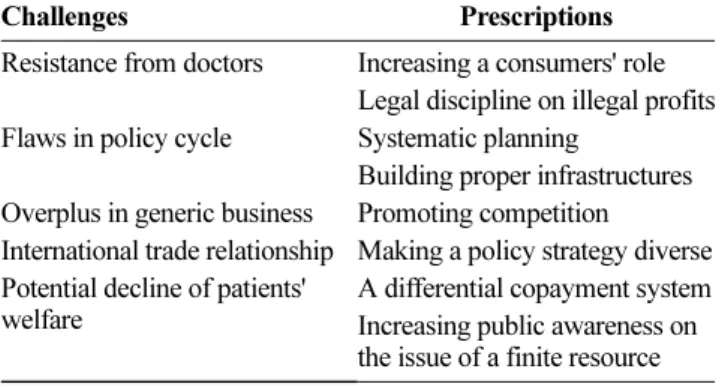
Table 4 presents core prescriptions suggested by par- ticipants along with key challenges they faced. Five challenges stressed repeatedly by participants were pol- icy resistance from doctors; inherent flaws in the pol- icy-making process; excessive profits in generic business; international trade relationship; and potential decline of patients’ welfare. Participants often stressed that no individual measure would be sufficient. They felt that multiple approaches were needed and were keen to suggest a range of methods that would influ- ence stakeholders in different ways, which were formed based on their opinions of the drawbacks in this area.
Amid a variety of prescription, the invariable axiom was “that [policy-makers] carry out this or that which doesn’t harm in consumers (p30:16)”.
Providers: Suggestions from participants on how to soothe the resistance from powerful professionals were separated into two types. One was mandatory standards fostering less costly alternatives as well as reducing pro- fessionals’ power in product choice. Examples included letting patients play a more active role in the product choice, and/or setting a clear, predetermined standard (e.g. mandatory substitution with the lowest priced product at the dispensing stage) by law. The other was to impose strict punitive measures not only to the indus- try, but also to providers, in order to curb improper rela- tionships between them. “Both doctors and pharmacists, who are involved with illegal financial rebates, don’t
really consider this a crime. But if they do get charged by the law for this, then they will start to take things more seriously (p028:46)”. Otherwise, they thought, it might be hard to achieve proposed policy impact, what- ever they were. In addition, the need for a new para- digm in medical education was called for, although that voice was relatively weak.
Authority: Participants felt that government bodies ought to “focus not only on the quantity aspect of estab- lishing, evaluating, and promoting the policy evidence, but also on processing it in a more systematic way (p047:4)”.
A robust system was discussed in the range of topics (including the value of evidence, trust, transparency, public funding and consideration for the vulnerable). Ideas over transparency in policy decisions, channelling more public funding into evaluation and welfare security remained rel- atively general remarks. More practical dialogues con- cerned evidence, as mentioned so far, and trust. Discussion of trust was concentrated upon quality control of generic products. Participants recognised that the current rising trend in drug expenditure had been mainly driven by an upsurge in drug utilisation and a product shift towards more costly drugs. Therefore, they suggested, “we need policies that can encourage using drugs or ingredients that are not as expensive (p006:22)”. In this regard, partic- ipants invariably concerned that many generic policies could not be promoted with full confidence until a good process of quality control was accomplished. They sug- gested that the Korea Food and Drug Administration (KFDA) should strengthen the standard of manufacturing practice and follow up the observance of the standard.
With this as a basis, KFDA must show greater confidence in the quality of generics to acquire social support.
Industry: Participants called for a considerable price cut for generics to build a competitive condition in the generic market by eliminating the possibility of corruption. Previ- ously, some writers argued that abolishing direct price con- trol would be helpful in constructing a more competitive market in the US.29,30) Others suggested that direct price control could provide incentive to companies developing Table 4. Challenges and prescriptions emerged during
interviews.
Challenges Prescriptions
Resistance from doctors Increasing a consumers' role Legal discipline on illegal profits Flaws in policy cycle Systematic planning
Building proper infrastructures Overplus in generic business Promoting competition
International trade relationship Making a policy strategy diverse Potential decline of patients'
welfare
A differential copayment system Increasing public awareness on the issue of a finite resource
‘me-too’ products with little innovation but higher prices, or those encouraging moral hazard through heavy market- ing. 12,31) Korean policymakers, however, rarely thought that the abolition of price control would be helpful to enhance competition in the Korean market. They were deeply concerned that corrupt transactions could make market condition worse under the absence of control.
I can’t really think of a good way to ensure this price competition unless we get rid of all the illegal trading we discussed so far. (p048:58)
Regarding the original industry, it was agreed that few methods would be effective to curb such a strong profit- oriented business in the worst situation, e.g. “[transna- tional manufacturers] may refuse to offer their products to us (p019:36)”. The Korean situation appeared especially difficult, because the Korean economy is mainly depen- dent upon international trade.32) Many domestic drug poli- cies have not only been opposed by private companies, but have also undergone considerable pressure for trade talks with their home governments.33) A recent example is the Free Trade Agreement with the US, which offers a clear objection to the positive list.34)
Patients: Some participants reminded “even though we are covered by insurance, …still there are many cases when you can’t even go if you’re in extremely critical condition (p048:42)” because of insufficient insurance benefits. How- ever, none of them thought co-payment useless. They argued for the importance of controlling patients’ extrava- gant behaviour on one hand while channelling the savings for the vulnerable on the other. A dual approach was sug- gested for controlling patient demand; enlightening patients on the issue of finite resources in healthcare and introducing a differential co-payment system which required higher co- payment for the use of symptom relief drugs.
DISCUSSION: Obstacles to evidence-based policy-making
In order to implement an effective strategy controlling
pharmaceuticals, it is essential to probe nation-specific fac- tors influencing policy and policy-making, as policy out- comes can vary according to “the interactions” among those factors.31) In South Korea, despite substantially differ- ent environments in the pharmaceutical arena from others, there has been little information on how factors interplay with the drug policies or how policymakers determine and evaluate them. In this study, participants discussed how and why pharmaceutical policy research has remained a neglected field in Korea.
Based on discussions, four dominating ideas were specified as obstacles on evidence-based policy-making in South Korea:
• Shortage of resources;
• Absence of systematic arrangement;
• Lack of trust ;
• Strong unscientific influences.
Without doubts, the principal factor placing a hurdle in the way of evidence-based policy-making was the lack of available evidence. The shortage of evidence was stemmed from the limitation of available resources.
Resources in short ranged from a qualified workforce with training, experience or analytic techniques neces- sary to discern optimal strategies, to a network of indi- viduals, organisations and relevant information (e.g.
epidemiological studies on local population).
Since resources for a robust system cannot be estab- lished in short time, it seemed essential to organise the different activities and individuals or organisations involved in the current system to work together, with the long term view. However, in South Korea, the con- ventional milieu has made policy changes that are sud- den and rash, which was a second hurdle. The consistency of a policy has often been ignored. The demand for policy change has been formed in a top- down manner, irrespective of evidence. Under this envi- ronment, it might be hard to implement a systematic plan for constructing an evidence-based tradition. These situations are presumably brought about by a lack of transparency and accountability in the policy cycle.
Reciprocally, the transparent process can hardly be
instituted without a careful systematic planning.
Third, it has been brought up in all discussions that the Korean pharmaceutical arena has suffered from a significant lack of trust. The belief that illegitimate activities have distorted the market order and, conse- quently, there has been little adequate response from pharmaceutical policies so far was universal among participants. Doubts seemed widespread among stake- holders, too. For instance, on the subject of doctors’
resistance, the participants testified on doctors’ distrust over pharmacists, quality control of generic products and policy itself as underlying causes on one hand. On the other, they voiced their own doubts about profes- sionals, expressing the suspicion about the undisclosed interests as a source of policy resistance. While it was inconclusive in the present study how significantly such doubts were supported by scientific evidence, it became clear that distrust was one barrier making pharmaceuti- cal policy objective.
Relating to this issue, considerations about efforts to find a point of agreement between the authorities and the professionals were surprisingly faint. Participants entered into little argument concerning the issue that reliable evidence would generate good persuasive power.35) For instance, most arguments over the percep- tion of the safety and effectiveness of generic medicines were not expanded beyond the bioequivalent test. Many participants showed feelings of helplessness towards the misconception of the bioequivalent test among doc- tors, but they rarely sought other ways of verifying the quality of generic products. A cohort study investigat- ing clinical outcomes from generics over several years, in comparison with those by original products can be an option, which would be more likely to be accepted by doctors who are familiar with such research frames.
Owing to the central trait of policy-making finding a way to balance interests and influences from a variety of perspectives, scientific evidence is often one part of the decision but not all about – and worse, is sometime less robust than other factors in drug policy cycle.
Fourth, however, one thing invariably insisted by par- ticipants was that, in the Korean policy process, scien-
tific evidence was overwhelmed by other considerations
‘more than necessary’. But it seemed, to a considerable degree, strong unscientific influences might be fostered by the fact that available evidence was not sufficient to form a store of knowledge for future programme devel- opments, more effective intervention implementations, and enlightened policy-making.
One notable aspect observed in interviews was that participants tended to speak less positively about the discussed policies in which they were more closely involved. Presumably, because they, ‘insiders’, had greater opportunity to know about the facts and the
‘negative’ aspects of the case, they were more critical.
‘Outsiders’ may have fewer chances to experience them. The insider-outsider situation may be fostered by two conditions. First, the government is more likely to release favourable evidence. Closely linked to this was the subtheme, ‘policy based research milieu’. Second, there was scant research that dealt with aspects from various perspectives (e.g. unwanted effects of policies in a certain subgroup) than “hard facts and figures”1) of the whole population. Given these limitations, although participants generally expressed positive views regard- ing the selected policies in the preliminary question- naire, these might not reflect the reality of the policies.
But it might be shaped by the limited available evi- dence, suggesting a considerable bias in the current per- ceived policy impact. In line with this, the evidence they quoted frequently overlapped, supporting the dis- cussion so far that the source of information may not be sufficiently diverse. Discussions were frequently theo- retical when evidence was lacking. In general, opinions on the recent policies were more likely to reflect partic- ipants’ expectations, rather than the real impact of the interventions. Irrespective of the programme, comments about consequences mostly concerned the shortcomings of the policy programmes themselves. Few participants spoke about the side effects of the policies on other pragmatic variables (e.g. utilisation or costs in relevant healthcare services, or drug accessibility).
Another notable point across interviews was that there was surprisingly little pragmatic discussion regarding set-
ting societal priority, although this could be particularly urgent in South Korea given pervasive anxiety across the society. In some sense, developing a sound healthcare sys- tem starts with setting an agreed priority in the use of lim- ited resources. This can soothe tensions among stakeholders and show an easier way of agreement when interests clash. Presumably, the lacking of strategic thought was caused by the tradition of government-led develop- ment in modern Korea. In the past, society had been used to following what the authorities determined. Nowadays, the power setting societal priority is largely in a vacuum, as the government’s authority has weakened, various decentralised powers are becoming stronger and time is not enough for people to learn how to give-and-take where disagreement appears.
These premises largely overlap with findings in an earlier study that systematically reviewed barriers to the use of evidence by policymakers.36) Dialogue about personal contact between researchers and policymakers was not apparent in this study, unlike other arti- cles.1,4,36-38) This, again, may be due to the absence of evidence in part; any available body of knowledge may be still weak and insufficient to notice whether the poli- cymakers and scientists disagreed.
There are some limitations to the study. Selective par- ticipants with a background in pharmacy were inter- viewed. This certainly limits the generalisability of the study. However, the present sample is regarded as typi- cal of experts involved with pharmacy policy, given the culture for allotting duties in government bodies in Korea – a person with a background in pharmacy is more likely to be involved in pharmaceutical affairs.
Participants from governmental bodies tended to take responsibility closely related to current major pharma- ceutical policies. Those from advisory organisations or academia had published related subjects across a range of media including government-funded research docu- ments, newspapers and academic journals. Thus, all participants could be considered appropriate key per- sons in the Korean pharmaceutical arena.
Summing up, the following actions are recommended for the South Korean pharmaceutical policy arena;
• developing pertinent resources (from persons to data- bases) to encourage researchers to generate good qual- ity of evidence;
• making a great efforts to secure the policy consis- tency;
• making an open discussion over priority in resource allocation;
• paying a greater attention in educational programmes which provide members of society opportunities to consider public goods;
• taking an action to improve trust over the quality of generic products urgently.
CONCLUSION
As policy decisions have been affected by more decentra- lised powers, the awareness of the need to move towards an information-based and outcome-oriented strategy is increas- ing among Korean drug policymakers. Unfortunately, in Korea, the milieu for ‘evidence-based’ policy may not be easy to realise in a short term. The key challenge may be the apparent lack of available evidence. Interests over building up the store of reliable information or setting priorities for policy decisions have been weak across the society. The underlying causes of the current situation are thought largely the result of a long lasting and stubbornly held a top down tradition. In order to diminish the tradition, to build a posi- tive atmosphere for evidence-based policy-making, and to raise social interest in this area live debate should be encour- aged more often. Good research can, of course, stimulate this debate. Thus, the need to produce high quality evidence is on-going, and is expected to continue in South Korea. To the best of my knowledge, this is the first study to investi- gate Korean pharmaceutical policy-making in a qualitative manner. The issues identified here could serve as a platform for future research – both qualitative and quantitative, that could explore any of these themes in greater depth and across different policy-making contexts.
ACKNOWLEDGEMENTS
I thank sincerely all those individuals, who kindly
agreed to spend their valuable time to take part in the interviews. I am grateful to Professor Karen Bloor and Dr.
Joy Adamson at the University of York for their valuable comments on earlier drafts of this work. This research was self-funded. There were no conflicts of interest.
REFERENCES
1. Wilson DC, Smith NA, Blakey NC, et al., Using research- based knowledge to underpin waste and resources policy.
Waste Manage Res 2007; 25: 247-56.
2. van Kammen J, de Savigny D, Sewankambo, et al., Using knowledge brokering to promote evidence-based policy-making: The need for support structures. Bulletin of the World Health Organization 2006; 84: 608-12.
3. Department of Health. Policy research programme:
purpose, objectives and priorities. London: Department of Health, 2008.
4. Soumerai SB, Ross-Degnan D, Fortess, EE, et al., Determinants of change in Medicaid pharmaceutical cost sharing: does evidence affect policy? Milbank Quarterly 2007; 75: 11-34.
5. Cho JG, Lee EK, Kim JY, et al., Evaluation and policy implication of the Separation of prescribing and dispensing drugs. Seoul: Korea Institute for Health and Social Affairs, 2001.
6. Cho JG, Kim JY, Jang SM, et al., Monitoring health care utilisation behaviour after the inception of the separation of prescribing and dispensing drugs. Seoul: Korea Institute for Health and Social Affairs, 2002.
7. Jang SM, Lee EK, Kim Y, et al., Pharmaceutical utilisation before and after the separation of prescribing and dispensing of drugs; focusing on changes in prescribing behaviour.
Seoul: Korea Institute for Health and Social Affairs, 2001.
8. Lee EK, Malone DC. Comparison of peptic-ulcer drug use and expenditures before and after the implementation of a government policy to separate prescribing and dispensing practices in South Korea. Clin Ther 2003; 25: 578-92.
9. Lee IH, Bloor K, Hewitt C, et al., The effects of new pricing and copayment schemes for pharmaceuticals in South Korea. Health Policy 2012; 104: 40-9.
10. Healy, D. The new medical oikumene. In: Petryna A, Lakoff A, Kleinman A, eds., Global pharmaceuticals:
ethics, markets, practices. London: Duke University Press, 2006.
11. Lovell, A. M. Addiction markets: the case of high-dose buprenorphine in France. In: Petryna A, Lakoff A, Kleinman A, eds., Global pharmaceuticals: ethics, markets, practices.
London: Duke University Press, 2006.
12. Jacobzone, S. Pharmaceutical policies in OECD countries:
reconciling social and industrial goals. Paris: Organisation
for Economic Co-operation and Development, 2000.
13. Denscombe, M. Surveys. The good research guide for small-scale social research projects. 3rd ed. Open University Press. Maidenhead. p7-34, 2007.
14. Patton, M. Q. Designing qualitative studies. Qualitative evaluation and research methods. 2nd ed. SAGE Publications Ltd. London. p143-98, 1990.
15. Guest G, Bunce A, Johnson L. How many interviews are enough? An experiment with data saturation and variability.
Field Methods 2006; 18: 59-82.
16. Leech, NL. The role of sampling in qualitative research.
Academic Exchange Quarterly. 2005; 9: 280-84.
17. Adamson J, Gooberman-Hill R, Woolhead G, et al., 'Questerviews': using questionnaires in qualitative interviews as a method of integrating qualitative and quantitative health services research. J Health Serv Res Policy 2004; 9: 139-45.
18. National Centre for Social Research. Framework; the qualitative data analysis tool. London: National Centre for Social Research, 2010.
19. Ritchie J, Spencer L. Qualitative data analysis for applied policy research. In: Bryman A, Burgess RG, eds., Analysing qualitative data. Routledge. London. p173-94, 1994.
20. Marshall C, Rossman GB. Data collection methods.
Designing qualitative research. 4th ed. Sage Publications Ltd. London. p97-150, 2006.
21. Klein R. Learning from others: shall the last be the first?
J Health Politics Policy Law 1997; 22: 1267-78.
22. Rose R. Introduction: why learn lessons from abroad?
Learning from comparative public policy: a practical guide. Routledge. London, 2005.
23. Salter B. Doctors and managers. The new politics of medicine. Palgrave. Basingstoke. p68-92, 2004.
24. Harrison S, Wistow G. Managing health care: balancing interests and influence. In: Davey B, Popay J, eds., Dilemmas in health care. Buckingham: Open University Press, 1993.
25. Ameringer CF. Federal antitrust policy and physician discontent: defining moments in the struggle for congressional relief. J Health Politics Policy Law 2002;
27: 543-74.
26. DailyPharm. [Doctors' representatives, "stop the generic prescribing programme"]. DailyPharm. Seoul, 2007.
27. DailyPharm. [Medical academy doubts the quality of generic products]. DailyPharm. Seoul, 2007.
28. DailyPharm. [Head director of NMC Dr. Kang, "pharmacists would dispense profitable products under a generic prescribing programme]. DailyPharm. Seoul, 2007.
29. Danzon PM, Chao LW. Does regulation drive out competition in pharmaceutical markets? J Law Econ 2000; 43: 311-57.
30. Danzon PM, Furukawa MF. Prices and availability of pharmaceuticals: evidence from nine countries. Health
Aff (Millwood) 2003; Suppl Web Exclusives: W3-521- 36.
31. Guillen AM, Cabiedes L. Reforming pharmaceutical policies in the European Union: a "penguin effect"? Int J Health Serv 2003; 33: 1-28.
32. Lee SY, Kim YM. Globalization and independency of populist nations' welfare policies: focusing on the influences of multinational pharmaceutical companies on the Korean government's policy on the pharmaceutical industry. Korean J Social Welfare 2005; 57: 5-30.
33. Lee SY. The conflict between the protection of patents for pharmaceuticals under the TRIPS Agreement and the sovereign power to address domestic health crisis: a case study of Gleevec in South Korea. Korean J Social Welfare Studies 2004; 23: 139-67.
34. DongA IIbo. [US urged Korean government to give up the PERP]. Dong-A Ilbo. Seoul, 2006.
35. Cookson, R. Evidence-based policy making in health care: what it is and what it isn't. J Health Serv Res Policy 2005; 10: 118-21.
36. Innvaer S, Vist G, Trommald M, et al., A. Health policy- makers' perceptions of their use of evidence: a systematic review. J Health Serv Res Policy 2002; 7: 239-44.
37. Choi BC, Pang T, Lin V, et al., Can scientists and policy makers work together? J Epidemiol Commun H 2005;
59: 632-7.
38. Sharpe M. Weighing the evidence: prospects for evidence-based policy-making. J Environ Monitor 2004;
6: 114N-17N.