ISSN 2234-3806 • eISSN 2234-3814
https://doi.org/10.3343/alm.2019.39.2.205 www.annlabmed.org 205
https://doi.org/10.3343/alm.2019.39.2.205
Estimated Glomerular Filtration Rates Show Minor but Significant Differences Between the Single and
Subgroup Creatinine-Based Chronic Kidney Disease Epidemiology Collaboration Equations
Sholhui Park, M.D. and Tae-Dong Jeong , M.D., Ph.D.
Department of Laboratory Medicine, College of Medicine, Ewha Womans University, Seoul, Korea
The creatinine-based Chronic Kidney Disease Epidemiology Collaboration (CKD-EPI) equation can be calculated according to race, sex, and creatinine concentration (subgroup equation) or in the form expressed by one equation (single equation). Minor differences in the constants used in the CKD-EPI equations (subgroup vs single equations) could result in a significant difference in the estimated glomerular filtration rate (eGFR). We evaluated the impact of this difference in 79,709 Korean patients. The eGFR was calculated as an integer using the single and subgroup CKD-EPI equations. The differences in eGFR and GFR categories between the equations were analyzed. eGFR was higher in the subgroup equation than the single equation by 1 mL/min/1.73 m2 for 12,476 (27.4%) Korean fe- males. The GFR category based on the subgroup equation was reclassified using the sin- gle equation for 352 (0.77%) females. Based on the results, the constant of the single equation was optimized. There was no difference in eGFR values between equations using a multiplier of 1.0213 instead of 1.018 for the “white or other” females constant in the single CKD-EPI equation. Clinicians should carefully apply the CKD-EPI equation because eGFR values may differ by 1 mL/min/1.73 m2 depending on the manner of calculation. To minimize these differences, the constants of the single equation should be revised.
Key Words: Creatinine-based Chronic Kidney Disease Epidemiology Collaboration equa- tion, Constant modification, Glomerular filtration rate
Received: January 9, 2018 Revision received: April 5, 2018 Accepted: September 20, 2018 Corresponding author:
Tae-Dong Jeong, M.D.
https://orcid.org/0000-0002-3873-3117 Department of Laboratory Medicine, College of Medicine, Ewha Womans University, 1071 Anyangcheon-ro, Yangcheon-gu, Seoul 07985, Korea Tel: +82-2-2650-2822
Fax: +82-2-2650-5091 E-mail: [email protected]
© Korean Society for Laboratory Medicine This is an Open Access article distributed under the terms of the Creative Commons Attribution Non-Commercial License (http://creativecom- mons.org/licenses/by-nc/4.0) which permits unrestricted non-commercial use, distribution, and reproduction in any medium, provided the original work is properly cited.
The 2012 Kidney Disease: Improving Global Outcomes (KDIGO) clinical practice guideline for the evaluation and management of chronic kidney disease (CKD) recommends use of the 2009 CKD Epidemiology Collaboration (CKD-EPI) equation to calcu- late the estimated glomerular filtration rate (eGFR) for adults [1].
The creatinine-based CKD-EPI equation is divided into four sub- group equations with regard to sex (female, male) and creatinine concentrations (62 μmol/L [0.7 mg/dL] for females; 80 μmol/L [0.9 mg/dL] for males) in “black” and “white or other” races. A single CKD-EPI equation that incorporates all of the above vari-
ables has been proposed as follows: GFR=141×Min (SCr/k,1)α
×Max (SCr/k,1)1.209×0.993Age [ ×1.018 if female] [ ×1.159 if black], where SCr is serum creatinine (in mg/dL), k is 0.7 for fe- males and 0.9 for males, α is -0.329 for females and -0.411 for males, Min is the minimum of SCr/k or 1, and Max is the maxi- mum of SCr/k or 1 [1, 2].
The subgroup equation employs a constant of 141 for white or other males, 144 for white or other females, 163 for black males, and 166 for black females [1, 2]. To express the sub- group CKD-EPI equation as a single CKD-EPI equation, previous
2017-03-16 https://crossmark-cdn.crossref.org/widget/v2.0/logos/CROSSMARK_Color_square.svg
206 www.annlabmed.org https://doi.org/10.3343/alm.2019.39.2.205 researches multiplied the race and sex variables in the single
equation by a fixed constant, 1.018 for females and 1.159 for black [1, 2]. In white or other females, multiplying 141 by 1.018 is 143.538 and not 144. In other words, the constant of the sin- gle equation for white or other females is 143.538, which is al- most 0.5 less than the corresponding constant, 144, in the sub- group equation. Even such minor differences can affect eGFR values or GFR category. For example, for a 61-year-old Korean female with a serum creatinine concentration of 1.02 mg/dL (90.17 µmol/L), the eGFR (mL/min/1.73 m2) value calculated by the subgroup equation would be 59.510; rounding off to the nearest integer, 60, corresponds to GFR category G2 (60–89 mL/min/1.73 m2). By contrast, the eGFR value calculated by the single equation would be 59.31; rounding off to the nearest integer, 59, corresponds to GFR category G3a (45–59 mL/min/
1.73 m2).
There are various kinds of calculations available to clinicians in clinical laboratories via a laboratory information system (LIS), such as eGFR [2], albumin-creatinine ratio [3], kappa-lambda ratio [4], risk ovarian malignancy algorithm value [5], and some parameters from blood gas analysis [6]. Accurate calculations are necessary for the reported numerical results, and most clini- cal laboratories automatically calculate and report these values using the LIS or instrument interface. Since the single creati- nine-based CKD-EPI equation is easier to apply than the sub- group equation when building a query to automatically calculate eGFR on an LIS or instrument interface, the single equation is used conventionally at many institutions. Some online tools for calculating eGFR also use the single equation [7, 8].
We investigated how differences in eGFR values obtained us- ing the subgroup and single creatinine-based CKD-EPI equations affect the classification of GFR category, in a large Korean co- hort. We also tried to optimize the constant applied to the gen- der variable of the single equation so as to obtain the same GFR category from the subgroup and single creatinine-based CKD- EPI equations for the Korean population.
We retrospectively reviewed the electronic medical records for a total of 246,122 creatinine measurements obtained at Ewha Womans University Mokdong Hospital, Seoul, Korea, from Janu- ary to December 2017. These measurements were obtained using the kinetic Jaffe method (Clinimate CRE Coloring Solution, Sekisui Medical Co. Ltd., Tokyo, Japan) with an isotope dilution mass spectrometry-traceable calibrator (Wako Multi-Chem Cali- brator A, Wako Pure Chemical Industries Ltd., Osaka, Japan) on a Hitachi 7600 automatic analyzer (Hitachi, Tokyo, Japan). After excluding duplicate measurements for the same patient, pa-
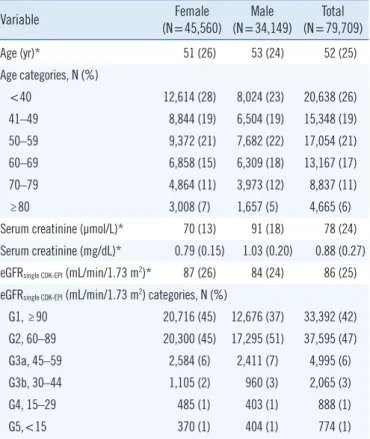
tients aged 17 years and younger than 18 years, and non-Ko- rean patients, 79,709 Koreans (45,560 females and 34,149 males) remained. A flowchart of patient selection is provided in Supplemental Data Fig. S1. The characteristics of the study pa- tients are summarized in Table 1. The Institutional Review Board of Ewha Womans University Mokdong Hospital approved the study (approval number: EUMC 2018-01-048).
Continuous variables were expressed as mean±standard de- viation if normally distributed or as median (interquartile range) if not. The eGFR of each patient was calculated by both the sin- gle and subgroup equations using Microsoft Excel 2016 (Micro- soft Corporation, Santa Rosa, CA, USA). The eGFR was calcu- lated using the creatinine value (mg/dL) to two decimal places, as recommended by the KDIGO guideline [1], and expressed as an integer using a rounding function. Differences in the eGFR values between the two equations (single–subgroup) were ana- lyzed using a paired t-test by using MedCalc (ver. 14.12.0; Med- Calc Software, Ostend, Belgium); the subgroup equation was considered the reference method. GFR categories were deter- mined based on eGFR (mL/min/1.73 m2) values as follows: G1,
Table 1. Clinical characteristics of study patients
Variable Female
(N=45,560) Male
(N=34,149) Total (N=79,709)
Age (yr)* 51 (26) 53 (24) 52 (25)
Age categories, N (%)
<40 12,614 (28) 8,024 (23) 20,638 (26)
41–49 8,844 (19) 6,504 (19) 15,348 (19)
50–59 9,372 (21) 7,682 (22) 17,054 (21)
60–69 6,858 (15) 6,309 (18) 13,167 (17)
70–79 4,864 (11) 3,973 (12) 8,837 (11)
≥80 3,008 (7) 1,657 (5) 4,665 (6)
Serum creatinine (µmol/L)* 70 (13) 91 (18) 78 (24) Serum creatinine (mg/dL)* 0.79 (0.15) 1.03 (0.20) 0.88 (0.27)
eGFRsingle CDK-EPI (mL/min/1.73 m2)* 87 (26) 84 (24) 86 (25)
eGFRsingle CDK-EPI (mL/min/1.73 m2) categories, N (%)
G1, ≥90 20,716 (45) 12,676 (37) 33,392 (42) G2, 60–89 20,300 (45) 17,295 (51) 37,595 (47) G3a, 45–59 2,584 (6) 2,411 (7) 4,995 (6)
G3b, 30–44 1,105 (2) 960 (3) 2,065 (3)
G4, 15–29 485 (1) 403 (1) 888 (1)
G5,<15 370 (1) 404 (1) 774 (1)
*median (interquartile range).
Abbreviations: CKD-EPI, Chronic Kidney Disease Epidemiology Collabora- tion; eGFR, estimated glomerular filtration rate.
https://doi.org/10.3343/alm.2019.39.2.205 www.annlabmed.org 207
≥90; G2, 60–89; G3a, 45–59; G3b, 30–44; G4, 15–29; G5,
<15 [1]. The overall inter-rater agreement between the single and subgroup CKD-EPI equations was analyzed by weighted kappa.
The constant applied to gender variables in the single equa- tion was optimized to yield the same GFR category between the single and subgroup equations. Using the same methods, we also conducted a simulation analysis for the same patients, as- suming the constants used for the black race. In the single equa- tion, the female constant was multiplied by 1.018, and the black constant was multiplied by an additional 1.159 according to the previous research [2].
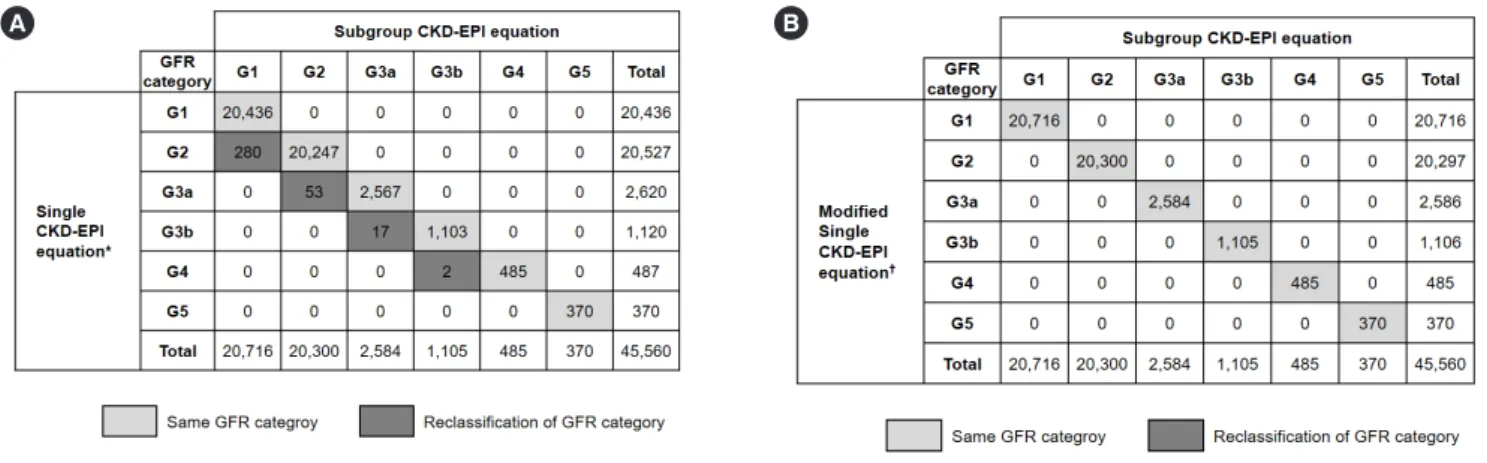
Since the single and subgroup creatinine-based CKD-EPI equa- tions are the same for Korean males, eGFR values did not differ between equations. The eGFR value for 12,476 (27.4%) of the 45,560 female patients was lower by 1 mL/min/1.73 m2 when calculated using the single equation (P <0.0001). The GFR cat- egories of 352 (0.77%) female patients were reclassified with an increase of one category level for every decrease in eGFR by 1 mL/min/1.73 m2 (Fig. 1A). However, applying a constant of 1.0213 (144/141 =1.021276595…) rather than 1.018 elimi- nated the difference in eGFR between the two equations, and all female patients had the same GFR category (Fig. 1B).
In the simulation for black patients, the eGFR from the single equation was 1 mL/min/1.73 m2 higher than that from the sub- group equation for 24,358 (53.5%) female patients (P <0.0001).
Accordingly, GFR category was reclassified for 430 (0.94%) fe-
male patients. Similarly, in 8,296 (24.3%) of the 34,149 male patients, the eGFR from the single equation was 1 mL/min/1.73 m2 higher than that from the subgroup equation (P <0.0001).
Accordingly, GFR category was reclassified for 167 (0.49%) male patients. Dividing the constant used in the subgroup equation for black females (166) and males (163) by 144 and 141 yielded a new constant of 1.15278 and 1.15603, respectively, which mini- mize the difference in eGFR values obtained with the constant of 1.159 in the single equation.
Although the Modification of Diet in Renal Disease (MDRD) equation for calculating the eGFR is multiplied by gender- and race-specific constants, there is only one MDRD equation form;
therefore, the results do not change depending on the MDRD equation used for calculation [9]. By contrast, the creatinine- based CKD-EPI equation has four subgroup equations for two race groups, although it can also be expressed as a single equa- tion [2]. Our results demonstrated that the different constants used for the single and subgroup creatinine-based CKD-EPI equa- tions would result in a 1 mL/min/1.73 m2 difference in the eGFR value depending on which equation is implemented in the LIS.
Although much larger differences would likely reflect non-renal factors, biological variation in serum creatinine concentration, and ethnic coefficients of the CKD-EPI equation besides analyti- cal performance [10-16], even this minor difference can change the GFR category. For example, we found that 272 Korean fe- males with an eGFR of 60 mL/min/1.73 m2 (calculated by the subgroup equation) corresponded to GFR category G2, and 53
Fig. 1. Distribution of GFR category according to the creatinine-based CKD-EPI equation in females. The overall agreement between the subgroup and single equations was 99.2% (weighted kappa, 0.990; 95% confidence interval, 0.989–0.991). (A) When using the single equation with the constant 1.018, the GFR categories of 352 (0.77%, 352/45,560) patients were reclassified. (B) The use of 1.0213 rather than 1.018 eliminated the difference in eGFR. *GFR=141×min (Scr/κ, 1)α×max (Scr/κ, 1)-1.209×(0.993)Age×1.018 [if female]×1.159 [if black]; †GFR=141×min (Scr/κ, 1)α×max (Scr/κ, 1)-1.209×(0.993)Age×1.0213 [if female]×1.159 [if black].
Abbreviations: CKD-EPI, Chronic Kidney Disease Epidemiology Collaboration; eGFR, estimated glomerular filtration rate; G1, ≥90; G2, 60–89; G3a, 45–59;
G3b, 30–44; G4, 15–29; G5,<15 mL/min/1.73 m2; GFR, glomerular filtration rate.
14
Fig. 1. Distribution of GFR category according to the creatinine-based CKD-EPI equation in
Fig. 1. Distribution of GFR category according to the creatinine-based CKD-EPI equation in
A B
208 www.annlabmed.org https://doi.org/10.3343/alm.2019.39.2.205 (19.5%, 53/272) of these patients were reclassified into GFR
category G3a when the single equation was used.
In contrast to the “white or other” equations, the single equa- tion for black females yielded an eGFR value 1 mL/min/1.73 m2 higher than that obtained using the corresponding subgroup equation. This is because in the “white or other” calculation, the constant 141 is multiplied by 1.018, which is slightly smaller than 144 (143.538), whereas the constant for black is 141×1.018 (if female)×1.159 (if black), which is slightly greater than 166 (166.360).
The eGFR calculated by the 2009 creatinine-based CKD-EPI equation is widely used for CKD management such as in prog- nosis, frequency of monitoring (number of times per year), and the need for referral in clinical practice [1, 17]. Therefore, it is appropriate to change the constant applied to the single equa- tion for “white or other” females from 1.018 to 1.0213. Similarly, the constants of the single equation for black patients (female, 1.15278; male, 1.15603) need to be changed appropriately. Al- though changing the constants will inevitably further complicate the single equation, this should not be a problem since most clinical laboratories use an LIS for eGFR calculation.
In conclusion, clinicians should be careful when using the 2009 creatinine-based CKD-EPI equation because the eGFR values may differ by 1 mL/min/1.73 m2 depending on the man- ner of calculation. To minimize these differences, the constants of the single equation can be revised appropriately.
Authors’ Disclosures of Potential Conflicts of Interest
No potential conflicts of interest relevant to this article were re- ported.
REFERENCES
1. Kidney Disease: Improving Global Outcomes (KDIGO) CKD Work Group.
KDIGO 2012 Clinical Practice Guideline for the Evaluation and Manage- ment of Chronic Kidney Disease. Kidney Inter Suppl 2013;3:1-150.
2. Levey AS, Stevens LA, Schmid CH, Zhang YL, Castro AF 3rd, Feldman
HI, et al. A new equation to estimate glomerular filtration rate. Ann In- tern Med 2009;150:604-12.
3. Ko DH, Lee SW, Hyun J, Kim HS, Park MJ, Shin DH. Proposed impreci- sion quality goals for urinary albumin/creatinine ratio. Ann Lab Med 2018;38:420-4.
4. Katzmann JA. Serum free light chain specificity and sensitivity: a reality check. Clin Chem 2006;52:1638-9.
5. Jeong TD, Cho EJ, Ko DH, Lee W, Chun S, Kwon HJ, et al. A new strat- egy for calculating the risk of ovarian malignancy algorithm (ROMA).
Clin Chem Lab Med 2017;55:1209-14.
6. Müller-Plathe O. “Computational” blood oxygen status: requirements and limitations. Scand J Clin Lab Invest Suppl 1990;203:129-33.
7. The National Institute of Diabetes and Digestive and Kidney Diseases.
https://www.niddk.nih.gov/health-information/communication-programs/
nkdep/laboratory-evaluation/glomerular-filtration-rate-calculators/ckd- epi-adults-conventional-units (Updated on Feb 2018).
8. National Kidney Foundation. https://www.kidney.org/professionals/kdo- qi/gfr_calculator (Updated on Feb 2018).
9. Levey AS, Bosch JP, Lewis JB, Greene T, Rogers N, Roth D. A more ac- curate method to estimate glomerular filtration rate from serum creati- nine: a new prediction equation. Modification of Diet in Renal Disease Study Group. Ann Intern Med 1999;130:461-70.
10. Joffe M, Hsu CY, Feldman HI, Weir M, Landis JR, Hamm LL. Chronic Renal Insufficiency Cohort (CRIC) Study Group. Variability of creatinine measurements in clinical laboratories: results from the CRIC study. Am J Nephrol 2010;31:426-34.
11. Murthy K, Stevens LA, Stark PC, Levey AS. Variation in the serum creat- inine assay calibration: a practical application to glomerular filtration rate estimation. Kidney Int 2005;68:1884-7.
12. Gowans EM and Fraser CG. Biological variation of serum and urine cre- atinine and creatinine clearance: ramifications for interpretation of re- sults and patient care. Ann Clin Biochem 1988;25:259-63.
13. Stevens LA, Coresh J, Greene T, Levey AS. Assessing kidney function- -measured and estimated glomerular filtration rate. N Engl J Med 2006;
354:2473-83.
14. Stevens LA, Claybon MA, Schmid CH, Chen J, Horio M, Imai E, et al.
Evaluation of the Chronic Kidney Disease Epidemiology Collaboration equation for estimating the glomerular filtration rate in multiple ethnici- ties. Kidney Int 2011;79:555-62.
15. Jeong TD, Lee W, Yun YM, Chun S, Song J, Min WK. Development and validation of the Korean version of CKD-EPI equation to estimate glo- merular filtration rate. Clin Biochem 2016;49:713-9.
16. Jeong TD, Cho EJ, Lee W, Chun S, Hong KS, Min WK. Accuracy assess- ment of five equations used for estimating the glomerular filtration rate in Korean adults. Ann Lab Med 2017;37:371-80.
17. Inker LA, Astor BC, Fox CH, Isakova T, Lash JP, Peralta CA, et al. KDO- QI US commentary on the 2012 KDIGO clinical practice guideline for the evaluation and management of CKD. Am J Kidney Dis 2014;63:713- 35.
https://doi.org/10.3343/alm.2019.39.2.205 www.annlabmed.org Supplemental Data Fig. S1. Flowchart of patient selection.
Serum creatinine measurement from January to December 2017 (N=246,122)
Patients with serum creatinine measurement (N=90,278)
Duplicated patients (N=155,844)
Patients aged 17 years and younger (N=10,217)
Korean female (N=45,560)
Korean male (N=34,149) Patients aged 18 years and older
(N=80,061)
Patients with Korean ethnicity (N=79,709)