ISSN 2234-3806 • eISSN 2234-3814
64 www.annlabmed.org http://dx.doi.org/10.3343/alm.2016.36.1.64 Ann Lab Med 2016;36:64-66
http://dx.doi.org/10.3343/alm.2016.36.1.64
Letter to the Editor
Diagnostic Hematology
A Rare Case of Pediatric T Lymphoblastic Leukemia With t(11;17)(q23;q21) Involving Mixed-Lineage Leukemia Gene Rearrangement
Heyjin Kim, M.D.1, Jin Kyung Lee, M.D.1,3, Jun Ah Lee, M.D.2, Young Jun Hong, M.D.1,3, Seok-Il Hong, M.D.1,3, Heui Seung Jo, M.D.4, and Yoon Hwan Chang, M.D.1,3
Departments of Laboratory Medicine1 and Pediatrics2, Korea Cancer Center Hospital, Seoul; Radiological & Medico-Oncological Sciences3, University of Science and Technology, Daejeon; Department of Pediatrics4, CHA Bundang Medical Center, CHA University, Seongnam, Korea
Dear Editor,
T lymphoblastic leukemia (T-ALL) comprises 10-15% of pediat- ric ALL cases and is known to be a clinically and genetically heterogeneous disease [1]. Recent studies have presented vari- ous cytogenetic abnormalities in T-ALL. The alterations often present as reciprocal translocations implicated in several tran- scriptional factor genes and lead to arrest during T-cell differen- tiation [1, 2]. Although cytogenetic aberrations are known to be critical in leukemogenesis of many hematologic malignancies, the relationships between these aberrations and the prognosis are not well understood in T-ALL except for t(11;19), a mixed- lineage leukemia gene (MLL)-ENL fusion related to favorable prognosis [3]. Here, we report a very rare case of pediatric T- ALL with t(11;17)(q23;q21) involving MLL rearrangement, which has not been previously reported in Korea.
A 16-month-old boy was admitted to our hospital because of fever, cough, rhinorrhea, and poor oral intake. Physical exami- nation revealed anemic conjunctiva, cervical lymph node en- largement, and splenomegaly. Chest radiography showed no abnormal findings. The complete blood count (CBC) results were as follows: hemoglobin, 8.2 g/dL; leukocytes, 41.3×10⁹/L;
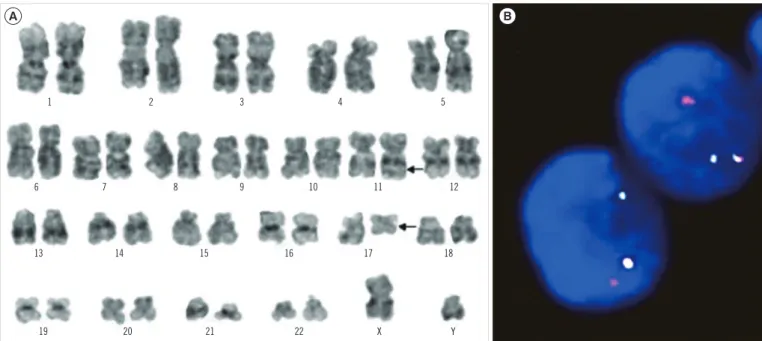
platelets, 177×109/L; and reticulocyte count, 3.4%. The blood smear showed increased blasts (66%). The bone marrow (BM) specimen contained 65% blasts and showed a hypercellular pattern. Small-to-medium sized blasts were observed with con- densed nuclear chromatin and an irregular nuclei margin. Im- munophenotyping using the BM aspirate was brightly positive for CD2 (86%), cCD3 (91%), CD5 (91%), CD7 (92%), and CD34 (76%). Serum lactate dehydrogenase was increased to 638 IU/L. Cytogenetic studies on the BM revealed the karyotype of 46,XY,t(11;17)(q23;q21)[17]/46,XY[3] (Fig. 1A). The patient was diagnosed with T-ALL according to the 2008 WHO classifi- cation [4].
The patient began receiving induction chemotherapy com- prised of prednisolone, vincristine, L-asparaginase, intrathecal cytosine arabinoside, and methotrexate. He seemed to respond to chemotherapy, with decreasing leukocyte counts and spleen size. However, the BM aspirate performed on the 7th day showed increased blasts to 69%. Moreover, interphase FISH analysis using an 11q23 break-apart probe revealed MLL rear- rangement (158 of 200, 79%) (Fig. 1B). He was switched to more intensive induction chemotherapy including doxorubicin
Received: April 29, 2015
Revision received: August 17, 2015 Accepted: October 12, 2015
Corresponding author: Yoon Hwan Chang
Department of Laboratory Medicine, Korea Cancer Center Hospital, Radiological & Medico-Oncological Sciences, University of Science and Technology, 75 Nowon-ro, Nowon-gu, Seoul 01812, Korea
Tel: +82-2-970-1283, Fax: +82-2-973-7143 E-mail: [email protected]
© The Korean Society for Laboratory Medicine.
This is an Open Access article distributed under the terms of the Creative Commons Attribution Non-Commercial License (http://creativecommons.org/licenses/by-nc/3.0) which permits unrestricted non-commercial use, distribution, and reproduction in any medium, provided the original work is properly cited.
Kim H, et al.
T-ALL with t(11;17)(q23;q21)
http://dx.doi.org/10.3343/alm.2016.36.1.64 www.annlabmed.org 65
and cyclophosphamide. The patient achieved complete remis- sion after 28 days of re-induction chemotherapy. Because of his high-risk features, the patient received cord blood stem cell transplantation. At the time of writing, he is alive and has been in a continuous complete remission state for 26 months.
MLL/11q23 rearrangement is intricate in many hematologic malignancies such as ALL, AML, and MDS. The 11q23 translo- cation, which is rarely identified in T-ALL, is a distinct subtype characterized by differentiation arrest at an early stage of thy- mocyte differentiation [5]. Since MLL fusion partners are also known to have an important role in leukemogenesis, recent ef-
forts to unravel MLL fusion partners using long-distance inverse- PCR (LDI-PCR) as compensatory diagnostic method have been implemented by using current molecular diagnostic tools [6, 7].
Not only scarce MLL rearrangement but also few fusion genes are involved in T-ALL, despite that 79 different MLL fusion part- ner genes have been identified in other hematologic malignan- cies [6, 8].
When balanced t(11;17)(q23;q21) involving MLL rearrange- ment was searched on the molecular level, three different fu- sions with MLL at 11q23 were generated by proximally clus- tered genes at the same chromosomal loci: MLLT6/AF17, Fig. 1. Bone marrow karyogram at diagnosis and interphase FISH analysis after induction chemotherapy. (A) G-banded karyogram show- ing t(11;17)(q23;q21). The arrows denote the rearranged chromosomes. (B) FISH analysis using 11q23 break-apart probe revealed MLL rearrangement (158/200, 79%). Separation of a green and a red signal was observed.
B A
1
6
13
19
2
7
14
20
3
8
15
21
4
9
5
10
16
22
11
17
X
12
18
Y
Table 1. Reported cases of T-ALL with t(11;17)(q23;q21) Case No. Age/sex Leukocytes
(×109/L) Hb
(g/dL) Platelets
(×109/L) Blasts in PB
(%) Karyotypes Immunophenotypes OS (mo) Country Reference
1 52 yr/F 0.05 8.4 0.08 68 46,XX,t(11;17)
(q23-25;q21)
CD7(+), OKT10(+), CD1(-), CD3(-), CD4(-), CD8(-), CD10(-), CD19(-), anti-HLA-DR(-), 63D3(-), and TdT(-)*
>14.5 the Netherlands
9
2 49 yr/M ND ND ND ND 46,XY,t(11;17)
(q23;q21) ND 11.6† EU‡ 10
3 16 mo/M 41.3 8.2 177 66 46,XY,t(11;17)
(q23;q21)[17]/
46,XY[3]
CD2 (86%), cCD3 (91%), CD5 (91%), CD7 (92%), and CD34 (76%)
>26.4† Korea Present case
*The results were performed with immunohistochemical stain; †The patients received bone marrow transplantation; ‡The European 11q23 Workshop partici- pants.
Abbreviations: T-ALL, T lymphoblastic leukemia; PB, peripheral blood; OS, overall survival; F, female; CD, cluster of differentiation; TdT, terminal deoxynucle- otidyl transferase; M, male; ND, no data; EU, European Union; mo, months.
Kim H, et al.
T-ALL with t(11;17)(q23;q21)
66 www.annlabmed.org http://dx.doi.org/10.3343/alm.2016.36.1.64 ACACA, and LASP1 at 17q21 [8]. Thus far, MLL with each of
the other three fusion partner genes at 17q21 has been identi- fied mainly in AML and rarely in ALL [8]. Unfortunately, the fu- sion partner gene in this case could not be confirmed by using LDI-PCR because of specimen problems. A literature search re- vealed only two cases regarding t(11;17)(q23;q21) in adults with T-ALL [9, 10] (Table 1).
Prior studies have suggested that immunophenotypic mark- ers are correlated with genetic alterations in pediatric acute leu- kemia [2]. The immunophenotype of leukemic cells in our pa- tient could be classified into the pre-T stage and immature stage according to the European Group for the Immunological Char- acterization of Leukaemias and T-cell receptor classification sys- tem [2]. The immature stage of T-ALL was reported with respect to poor outcome and the lack of a common genetic lesion [1, 2].
In several studies, MLL-rearranged T-ALL overexpressed multi- ple HOX, which are transcription factors that initiate T-cell differ- entiation [5].
Additional cases involving genetic profiling of t(11;17)(q23;
q21) involving MLL rearrangement will help assess whether this rare fusion impacts the disease progression and reveals prog- nostic information.
Authors’ Disclosures of Potential Conflicts of Interest
No potential conflicts of interest relevant to this article were re- ported.
REFERENCES
1. Patrick K and Vora A. Update on biology and treatment of T-cell acute lymphoblastic leukaemia. Curr Opin Pediatr 2015;27:44-9.
2. Meijerink JP. Genetic rearrangements in relation to immunophenotype and outcome in T-cell acute lymphoblastic leukaemia. Best Pract Res Clin Haematol 2010;23:307-18.
3. Pui CH, Schrappe M, Ribeiro RC, Niemeyer CM. Childhood and adoles- cent lymphoid and myeloid leukemia. Hematology Am Soc Hematol Educ Program 2004:118-45.
4. Borowitz MJ and Chan JKC. T lymphoblastic leukaemia/lymphoma. In:
Swerdlow SH, Campo E, Harris NL, Jaffe ES, Pileri SA, Stein H, et al.
eds. WHO classification of tumours of haematopoietic and lymphoid tis- sues. 4th ed. Lyon: IARC, 2008:176-8.
5. Ferrando AA, Armstrong SA, Neuberg DS, Sallan SE, Silverman LB, Korsmeyer SJ, et al. Gene expression signatures in MLL-rearranged T- lineage and B-precursor acute leukemias: dominance of HOX dysregu- lation. Blood 2003;102:262-8.
6. Meyer C, Hofmann J, Burmeister T, Gröger D, Park TS, Emerenciano M, et al. The MLL recombinome of acute leukemias in 2013. Leukemia 2013;27:2165-76.
7. Yang JJ, Marschalek R, Meyer C, Park TS. Diagnostic usefulness of ge- nomic breakpoint analysis of various gene rearrangements in acute leu- kemias: a perspective of long distance- or long distance inverse-PCR- based approaches. Ann Lab Med 2012;32:316-8.
8. Strehl S, König M, Meyer C, Schneider B, Harbott J, Jäger U, et al. Mo- lecular dissection of t(11;17) in acute myeloid leukemia reveals a vari- ety of gene fusions with heterogeneous fusion transcripts and multiple splice variants. Genes Chromosomes Cancer 2006;45:1041-9.
9. Harrison CJ, Cuneo A, Clark R, Johansson B, Lafage-Pochitaloff M, Mugneret F, et al. Ten novel 11q23 chromosomal partner sites. Europe- an 11q23 Workshop participants. Leukemia 1998;12:811-22.
10. Beverstock GC, Hoekman K, Kluin-Nelemans JC, Wienhofer E. Recip- rocal translocation, t(11;17)(q23-25;q21), in a patient with an immature ALL. Cancer Genet Cytogenet 1986;22:83-7.