Citation Impact of Collaboration from Intra- and
Inter-disciplinary Perspectives: A Case Study of Korea
Jae Yun Lee
Department of Library and Information Science Myongji University, Korea
E-mail: [email protected]
EunKyung Chung *
Department of Library and Information Science Ewha Womans University, Korea
E-mail: [email protected]
Open Access
Accepted date: March 10, 2018 Received date: January 15, 2018
*Corresponding Author: EunKyung Chung
Associate Professor
Department of Library and Information Science Ewha Womans University, Korea
E-mail: [email protected]
All JISTaP content is Open Access, meaning it is accessible online to everyone, without fee and authors’ permission. All JISTaP content is published and distributed under the terms of the Creative Commons Attribution License (http:/ creativecommons. org/licenses/by/3.0/). Under this license, authors reserve the copyright for their content; however, they permit anyone to unrestrictedly use, distribute, and reproduce the content in any medium as far as the original authors and source are cited. For any reuse, redistribution, or reproduction of a work, users must clarify the license terms under which the work was produced.
ABSTRACT
Purpose - This research aims to examine collaboration from a disciplinary perspective in Korea. There are needs to ex-plore to what extent researchers collaborate by discipline and across discipline along with the impact of collaboration. Design/methodology/approach - In order to investigate collaboration with respect to entire discipline areas and author-declared discipline information we analyzed a national researcher information database (Korean Research-er Information) with a citation index database (Korean Citation Index) covResearch-ering the entire range of discipline. This study analyzed the data sets for 10 years (2004-2013) including a total of 8 categories and 119 sub-categories of disciplines, 109,551 researchers, 650,263 articles, and 1,170,039 citations in Korea.
Findings - The results demonstrate that there are different intensities of collaboration from heavy to minimal across disciplines. In examining collaboration in terms of author and discipline levels, the results show that col-laboration in author level rises, then inter-disciplinary colcol-laboration increases accordingly, in most of the 119 dis-cipline sub-categories. A number of disdis-ciplines, however, tended to collaborate more intensely within their own rather than with other disciplines. Moreover, the impact of collaboration tended to change over time depending on the types of collaboration. Specifically, inter-disciplinary collaboration was likely to have more immediate im-pact as pioneer research, especially among more than three disciplines, whereas the imim-pact of intra-disciplinary collaboration is higher as time passes.
Originality/value - In this research, a disciplinary investigation on collaboration is conducted for the entire range of disciplines in Korea. Through analyzing distinctive author-declared discipline information from the KRI, this research ex-amines the intensities of collaboration across disciplines, collaboration in author level, and the impact of collaboration. Keywords: Collaboration, Discipline, Intra-disciplinary, Inter-disciplinary, Korea
J Inf Sci Theory Pract 6(1): 65-82, 2018
http://dx.doi.org/10.1633/JISTaP.2018.6.1.5
1. INTRODUCTION
Collaboration is among the unanimously recognized phenomena in the research community. At the institu-tional and nainstitu-tional levels, collaboration has been promot-ed to solve complicatpromot-ed research problems that cannot be solved by single fields or disciplines of research. Funding agencies in many countries have promoted collaborative research in order to solve complex research agendas. Co-pious research has identified the characteristics, structure, and evolution of collaboration through co-authorship using a variety of analysis methods. In characterizing col-laboration trends, positive relationships between collab-oration and productivity have been found (Landry et al., 1996; Lee & Bozeman, 2005; Mairesse & Turner, 2005). As researchers collaborate more with others, there tends to be higher research productivity. Another characterizing effort of collaboration is the relationship between collab-oration and impacts. A wide variety of studies show that more collaboration is likely to have more impact (Lariv-ière, Gingras, Sugimoto, & Tsou, 2015; Leimu & Koriche-va, 2005). More recently, collaboration has been examined from disciplinary perspectives to demonstrate the struc-tures, interactions, and evolution of certain research fields (Cronin, Shaw, & La Barre, 2003; Glänzel, 2002).
Although research on collaboration from a disci-plinary perspective has been widely pursued, these endeavors have been limited in two ways, as Nagurney and Qiang (2010) highlighted. First, primarily due to data availability, research on disciplinary collaboration used authors’ affiliations or journals’ subject categories to determine disciplines. The other limitation in most stud-ies is the scope of the data sets, which contain primarily small numbers of disciplinary areas or certain so-called inter-disciplinary fields. As a result, these studies reach similar conclusions regarding the rising trends of in-ter-disciplinary collaboration and show more impact of collaborative work in certain areas (Franceschet &
Cos-tantini, 2010; Larivière, Gingras, & Archambault, 2006). In this sense, the purpose of this study is to examine collaboration from a disciplinary perspective in Korea. More specifically, disciplinary analyses are twofold: in-tra-disciplinary1) and inter-disciplinary. Intra-disciplinary means collaboration within the same discipline, while inter-disciplinary refers to collaboration among different disciplines. For this purpose, we utilized a unique data-set, the Korean Researcher Information (KRI).2) The KRI contains researcher information such as identification number, affiliation, degree, and research product. More importantly, the KRI maintains researcher-declared dis-cipline areas according to the Korea Research Disdis-cipline Classification Scheme (refer to Appendix) by the Korean Research Foundation (Korean Researcher Information, n.d.). The other data set for this study was the Korea Citation Index (KCI).3) For this study, we analyzed two specific data sets: (1) the data on a total of 650,263 ar-ticles, and 1,170,039 citations for the period 2004-2013 from the KCI and (2) the data on authors’ disciplines for a total of 109,551 researchers according to 8 categories and 119 sub-categories of disciplines from the KRI. In analyzing these two data sets, this study was guided by the following three research questions:
RQ1: To what extent do researchers collaborate by dis-cipline in Korea?
RQ2: To what extent do researchers collaborate across disciplines in Korea?
RQ3: What are the impacts of intra-disciplinary and inter-disciplinary collaboration in Korea?
2. RELATED STUDIES
In viewing collaboration with a disciplinary perspec-tive, we examined mainly two groups of research, char-acteristics of collaboration, and intra- and inter-disci-plinary collaboration.
1) A number of fields including medicine and health science use uni-disciplinary
rather than intra- when referring to collaboration within a single discipline.
2) http://www.kri.go.kr. More explanations are in the data collection section of
the research methods.
3) http://www.kci.go.kr. More explanations are in the data collection section of
2.1. Productivity and Impact of Collabora-tion
To understand the characteristics of collaboration in the research community, two primary clusters of studies can be categorized: collaboration and produc-tivity, and collaboration and impact. The first cluster of studies focuses on the relationship between collab-oration and productivity. Lee and Bozeman (2005) evaluated the extent to which collaboration has impact on scientific productivity. The results showed that the number of authors per article is highly correlated to productivity. Similarly, Adams et al. (2005) studied the effects of the number of collaborators in terms of domestic and foreign institutional collaboration. For the period of 19 years (1981-1999), they calculated the number of collaborations in terms of domestic and foreign institution. The findings indicate that increases in scientific productivity result from larger numerical size of collaborators. In addition, Landry et al. (1996) investigated institutional collaboration in Canada. The results showed that collaboration generally contributes to productivity to a varying range. Bordons et al. (1996) analyzed the influence of collaborations on productivity for three areas within the biomedical discipline: neuro-sciences, gastroenterology, and cardiovascular systems. The results showed that international and domestic collaborations were positively correlated with produc-tivity at the level of individual authors. Defazio, Lock-ett, and Wright (2009) investigated the relationship between collaboration and productivity in the context of EU-funded research networks. Through analyzing a total of 294 researchers in 39 EU research networks, the results showed that the impact of collaboration on productivity is positive and significant. Mairesse and Turner (2005) studied collaboration in the discipline of physics among researchers. The results demonstrated that collaboration is strongly correlated with produc-tivity in terms of correlation coefficient. The study also noted that productivity plays an important role in creating connections among researchers in different locations, which shows similar results in China (Liang & Zhu, 2002). Abramo, Angelo, and Murgia (2017) demonstrate that collaboration at internal and domes-tic levels has a positive effect on research productivity. Research endeavoring at examining the characteristics of collaboration shows that there is a positive relation-ship between collaboration and productivity. However,
a review of these studies indicates that a positive rela-tionship can be found in limited disciplinary areas such as science fields, biomedical areas, and physics.
For the second line of research in investigating the characteristics of collaboration, there have been endeavors to demonstrate the relationship between collaboration and impact. In terms of historical per-spectives, Larivière, Gingras, Sugimoto, and Tsou (2015) examined the relationship between impact and collaboration for the period 1900-2011 with a total of 32,507,682 papers and 514,870,525 citations. The results of this study showed that co-authorship, inter-institu-tional collaboration, and internainter-institu-tional collaboration in-creased in both social sciences and humanities, and in natural and medical science. Moreover, a relationship between collaboration and scientific impact was posi-tively identified in this data set. Van Raan (1998) used indicators based on citation counts to demonstrate that international collaborations have more positive effects on the quality of the output compared with research without collaboration. In the domain of university-in-dustry relationships, a study by Balconi and Laboranti (2006) focused on the discipline of microelectronics. With a combination of bibliometric data and inter-views, the study showed that the type of universi-ty-industry collaboration was strongly correlated with qualitative performance in scientific research. Hayati and Ebrahimy (2009) analyzed Iranian publications on the ISI Web of Science database to demonstrate the relationship between the number and impact of publication. The findings indicated that there is a pos-itive and meaningful correlation among the number of publications and the impact in scholarly scientific publications. In other words, the impact of publications increases as they increase in number. Leimu and Ko-richeva (2005) analyzed 837 research papers published in Oecologia for the period 1998-2000 to determine the impact of collaboration. The findings showed that articles in collaborations with multiple institutions had higher citation rates than did single-authored articles. In these studies, the research impact is commonly mea-sured by the number of citations for papers. Although these studies similarly identified positive correlations between collaboration and impact, different levels of impact are shown according to the different types of collaboration, such as international, inter-institute, and academia-industry.
2.2 Intra-Disciplinary and Inter-Disciplinary Collaboration
From the disciplinary and interdisciplinary perspec-tives on collaboration, there have been two primary groups of endeavors. First, research efforts have been conducted to indicate the differences and features among various individual disciplines in terms of col-laboration. Mostly, studies attempted to compare the differences with respect to collaboration activities and impact. Glänzel (2002) compared the features of collaboration trends and patterns in the biomedical, chemistry, and mathematics disciplines in terms of productivity and impact. The primary findings of that study showed that although collaboration had in-creased substantially, its impact varied widely among disciplines. Considering acknowledgement sections to indicate sub-authorship, Cronin, Shaw, and La Barre (2003) investigated collaboration activities in terms of co-authorship and sub-authorship for the 100 volumes of both Psychological Review and Mind and found dif-ferent collaboration activities. In psychology, collabo-ration had increased and was likely to be considered an acceptable practice, whereas researchers in philosophy tended to work alone rather than collaborate with oth-ers. Abramo, D’Angelo, and Di Costa (2009) analyzed a total of 78 universities’ research data on 36,000 science and technology researchers for the three-year period from 2001 to 2003 in order to indicate the impacts of collaboration in Italy. The study results found that in-terdisciplinary collaboration was correlated with higher impact in the science and technology discipline. More-over, international collaboration with interdisciplinary approaches is highly related to research impact.
The other group of studies has attempted to demon-strate the characteristics and features of interdisciplin-ary collaboration. Franceschet and Costantini (2010) comparatively analyzed the impact and quality as-sessment of cross-disciplinary publications in science, social sciences, and arts and humanities. With 20 disci-plinary areas, 102 research structures, 18,500 research products, and 6,661 peer reviews, the findings of this study indicated that collaboration intensity substan-tially varied across disciplines. In addition, the results highlighted a generally positive association between number of authors on a paper and citation count. The correlation was stronger when collaboration was het-erogeneous, that is, among authors from different
in-stitutions. Larivière, Gingras, and Archambault (2006) analyzed the data of the Science Citation Index, Social Science Citation Index, and the Arts & Humanities Ci-tation Index during the period 1980-2002 to compare the natural sciences and engineering, social sciences, and the humanities in terms of collaboration patterns. The findings largely confirmed that nearly all publica-tions in natural sciences were multi-authored but the collaboration rate in humanities was less than 10%. However, the study did note that collaboration patterns in the social sciences were more similar to those of re-searchers in the natural sciences and engineering than of those in humanities. Van Rijnsoever and Hessels (2011) investigated the characteristics of intra- and inter- disciplinary collaboration. The results showed that gender and work experience are related to in-tra-disciplinary collaboration, while inin-tra-disciplinary collaborations are more likely to occur in fundamental domains, rather than strategic disciplines.
As discussed in these related studies, research on col-laboration has attempted to identify the characteristics of collaboration and has examined its features in either individual or small sets of disciplines, or from inter-dis-ciplinary perspectives. In particular, investigations on inter-disciplinary collaboration have been restricted to certain disciplines and author affiliation information, mostly due to limited data availability. In this current study, we utilized the KRI database for authors’ disci-pline information along with the data on the articles and citations to overcome constraints in investigating collaboration from intra- and inter-disciplinary per-spectives.
3. RESEARCH METHODS
3.1. Data Collection
For this study, two data sets were collected. One was the articles and citations from the Korean Citation Index database for the period of 2004-2013 for arti-cles and citations. The data comprised a total of 2,172 journal titles, 650,263 articles, and 1,170,039 citations as of December 2013. For the articles, the maximum number of citations was 241, and the average number was 1.799. The other data set was researcher discipline information, for which we used the Korean Researcher Information database managed by the National
Re-search Foundation of Korea. The KRI database was launched in 2008 to share information on research products by researchers who are affiliated with univer-sities and research institutes. For evaluation purposes in Korea, individual professors and researchers hired at universities and research institutes must enter the in-formation regarding their disciplines according to the discipline classification scheme shown in the Appen-dix. The database contains 8 discipline categories: hu-manities, social sciences, natural sciences, engineering, medicine and pharmacy, agriculture and fisheries, arts and kinesiology, and multidisciplinary studies; there are a total of 119 sub-categories. Engineering contains 28 sub-categories, whereas medicine and pharmacy has only 6. Humanities also has a large number of sub-cat-egories, 23, the social sciences have 22, and natural science contains 13. Agriculture and fisheries contains 7 sub-categories, and arts and kinesiology has 12. For multidisciplinary studies, there are 8 sub-categories of discipline. This study analyzed a total of 109,551 researchers, 650,263 articles, and 1,170,039 citations among the categories and sub-categories.
3.2. Data Analysis
We analyzed two sets of data to identify the extent of collaboration by discipline, inter-disciplinary collabo-ration, and impacts of collaboration with a disciplinary perspective.
First, in order to demonstrate to what extent re-searchers collaborated by discipline, we calculated a collaboration coefficient (CC) for individual research-ers. Initially, CC was introduced and used to indicate how much researchers, journals, and research teams collaborated using the average number of co-authors on an article (Ajiferuke, Burrel, & Tague, 1988). For the current study, we used author-level CC, which we called the author-level collaboration coefficient (ACC) as shown in (1) to demonstrate individual researchers’ collaboration tendencies.
(1) i: ith article,
ai: the number of author(s) in ith article,
N: the total number of articles published by an author
To compare the collaboration activities by discipline, we calculated the average ACC for each of the 8 cate-gories and then among the 119 sub-catecate-gories. As Ajif-eruke, Burrel, and Tague (1988) observed, ACC tends to approach zero as single-authored articles dominate and to approach 1 as articles co-authored by research-ers from different disciplines dominate.
Second, in order to indicate to what extent research-ers collaborated across disciplines, we calculated the discipline-level CC (DCC) as shown in (2). The for-mula is the same as that for ACC, but M represents the total number of articles published in a discipline rather than authors.
(2) i: ith article,
ai: the number of author(s) in ith article,
M: the total number of articles published in a discipline As with the ACC, the DCC is likely to approach 0 as single-discipline articles predominate and to approach 1 when multi-discipline articles are more common. We should note that with articles by co-authors from dif-ferent disciplines, the articles are listed in each author’s discipline. For instance, an article with three authors from three different sub-categories will be listed as be-longing to each of the three sub-categories. Generally speaking, the DCC tends to be lower than the ACC because the DCC takes into account only articles with different disciplines involved. In addition, to visualize the distribution of disciplinary differences R, a statis-tical computing tool (R Core Team 2014), was used. Microsoft Excel was used for collaboration coefficient scatterplot.
Third, to demonstrate the impacts of both intra- and inter-disciplinary collaboration, we calculated the citation counts by discipline. For comparison, we used field-normalized citation scores (Rehn, Wadskog, Gornitzki, & Larsson, 2014) to identify citation impact by discipline and year of publication. Calculating this citation score required two steps: counting the num-ber of citations of each article and (2) calculating the discipline reference value, which is the average citation count for each discipline and each year. Then, to
an-alyze intra-disciplinary collaboration, we normalized the citation counts of all articles by dividing them by their corresponding discipline reference values. To an-alyze inter-disciplinary collaboration, we normalized the citation counts of all articles by dividing them by the average discipline reference values for all disciplines represented in an article.
4. RESULTS AND DISCUSSION
4.1. Collaboration by Discipline
In order to understand the collaboration propensity by discipline, author-level collaboration coefficients were calculated and averaged by discipline. Figure 1 shows the distribution of authors by ACC value. Over-all, there were distinctive differences among 8 disci-pline categories. Humanities, the social sciences, arts and kinesiology, and multidisciplinary studies showed high rates of ACCs of 0; that is, substantial numbers
of authors in these disciplines do not collaborate with others. Humanities showed an extremely high frequen-cy of authors with no collaboration; social sciences, arts and kinesiology, and multidisciplinary studies showed relatively high frequencies of ACCs of 0.5. By contrast, the natural sciences, engineering, medicine and pharmacy, and agriculture and fisheries tended to collaborate considerably. Among these four categories, the natural sciences and engineering showed a relative-ly high number of authors with no collaboration com-pared with medicine and pharmacy and fisheries.
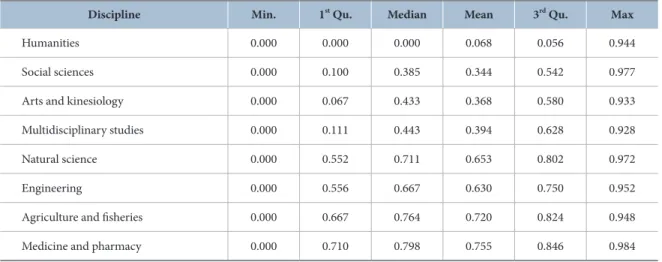
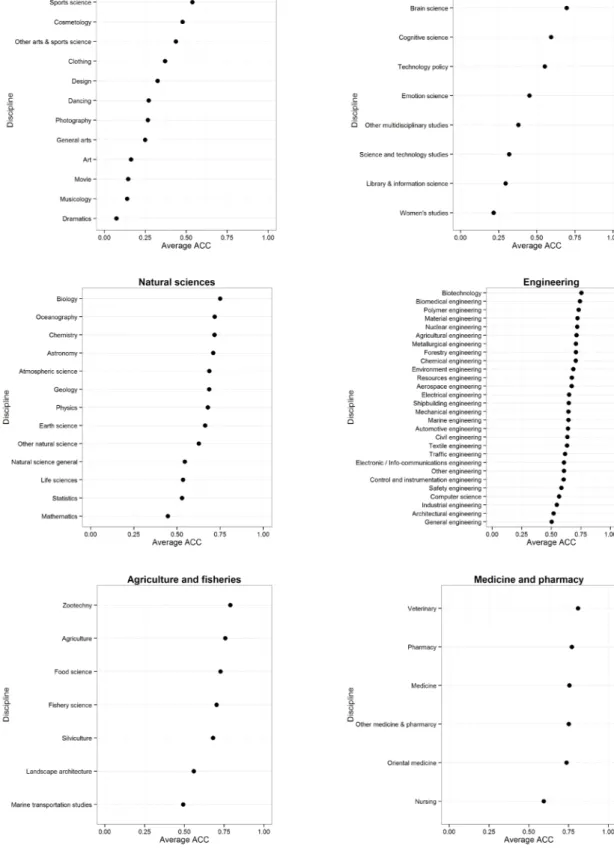
Table 1 shows the ACC scores for each discipline, and Figure 1 shows that two groups of disciplines can be distinguished. The humanities, social sciences, arts and kinesiology, and multidisciplinary studies showed low mean values, less than 0.4. In addition, the humanities showed extremely low means and a median of 0 because most humanities authors do not collaborate with others. In detail, the average ACC was calculated for a total of 119 disciplines as shown in Figure 2. We should note
that two sub-categories, Western classical language and literature and lexicography, are not included in Figure 2 because there were fewer than 10 authors in each of the two disciplines, which could have led to misleading inter-pretations of the full graph. As shown in Figure 2, the av-erage sub-category ACCs showed similar patterns within their larger disciplines. For instance, all 23 humanities sub-categories showed average ACCs of less than 0.25. In contrast, all six sub-categories of medicine and
phar-macy showed high ACCS of over 0.60; the highest was for veterinary. In addition, the average ACCs varied by discipline category. For instance, in the humanities and engineering, the average ACCs followed a narrow range of 0.25, whereas the averages for arts and kinesiology and multidisciplinary studies varied along a wider range.
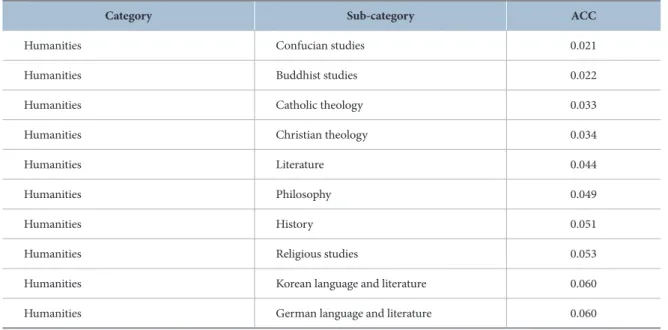
Based on the average ACCs, the 10 highest and lowest sub-categories are shown in Table 2 and Table 3. In the high-ACC group, the average value exceeded 0.73 and
Table 1. ACC Scores for Each Discipline
Discipline Min. 1st Qu. Median Mean 3rd Qu. Max
Humanities 0.000 0.000 0.000 0.068 0.056 0.944 Social sciences 0.000 0.100 0.385 0.344 0.542 0.977 Arts and kinesiology 0.000 0.067 0.433 0.368 0.580 0.933 Multidisciplinary studies 0.000 0.111 0.443 0.394 0.628 0.928 Natural science 0.000 0.552 0.711 0.653 0.802 0.972 Engineering 0.000 0.556 0.667 0.630 0.750 0.952 Agriculture and fisheries 0.000 0.667 0.764 0.720 0.824 0.948 Medicine and pharmacy 0.000 0.710 0.798 0.755 0.846 0.984
Table 2. Ten Highest Average ACCs by Discipline
Category Sub-category ACC
Medicine and pharmacy Veterinary 0.808 Agriculture and fisheries Livestock science 0.789 Medicine and pharmacy Pharmacy 0.770 Agriculture and fisheries Agriculture 0.757 Medicine and pharmacy Medicine 0.755
Engineering Ergonomics 0.755
Medicine and pharmacy Other medicine and pharmacy 0.751
Natural science Biology 0.750
Engineering Biomedical engineering 0.742 Medicine and pharmacy Korean medicine 0.737
Table 3. Ten Lowest Average ACCs by Discipline
Category Sub-category ACC
Humanities Confucian studies 0.021
Humanities Buddhist studies 0.022
Humanities Catholic theology 0.033 Humanities Christian theology 0.034
Humanities Literature 0.044
Humanities Philosophy 0.049
Humanities History 0.051
Humanities Religious studies 0.053 Humanities Korean language and literature 0.060 Humanities German language and literature 0.060
the highest individual ACC was 0.808. The disciplines in this group were mostly in medicine and pharmacy (veterinary, pharmacy, medicine, other medicine and pharmacy, and Korean medicine). In contrast, the sub-categories with the 10 lowest average ACCs were all in the humanities, and all values were extremely low, less than 0.060.
In calculating the ACCs for the 8 main discipline categories and 119 sub-categories, we established that different disciplines showed dissimilar intensities of col-laboration. This result largely confirms the finding that collaboration varies by discipline from previous studies such as Franceschet and Costantini (2010), and
Lariv-ière, Gingras, and Archambault (2006). In particular, collaboration in the humanities is rare, whereas in the sciences and engineering areas, it is common. The find-ings of this current study reveal overall collaboration trends across disciplines in Korea.
4.2. Inter-Disciplinary Collaboration
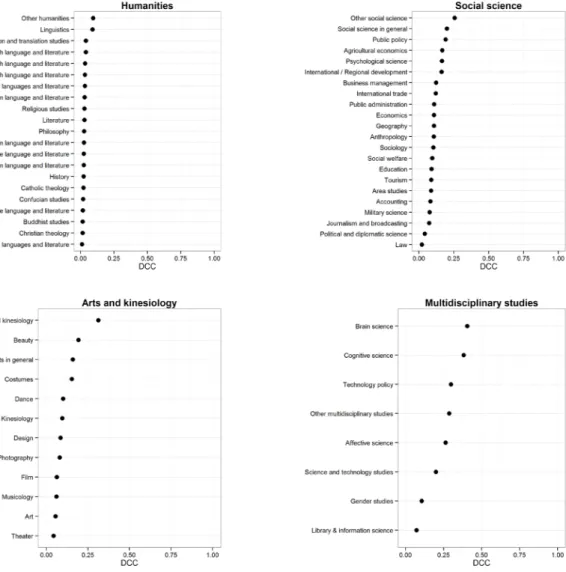
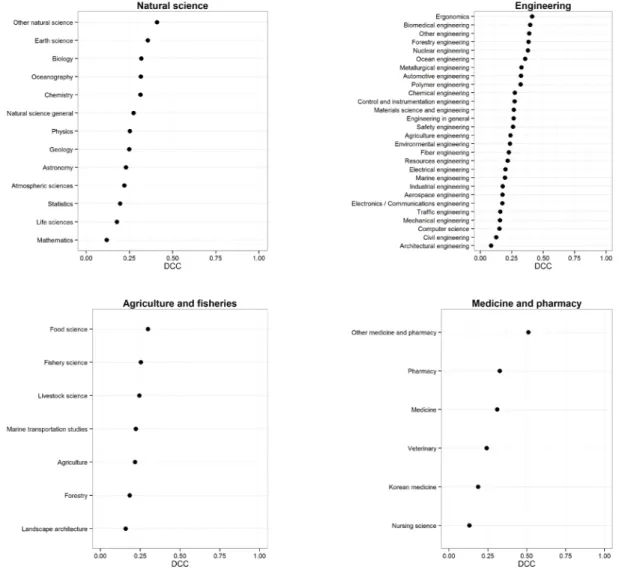
Figure 3 visually displays the extent of collaboration across disciplines based on the DCCs. Although the overall DCCs were lower than the ACCs, their patterns were similar: The humanities showed extremely low DCCs whereas the natural sciences and engineering showed relatively high values.
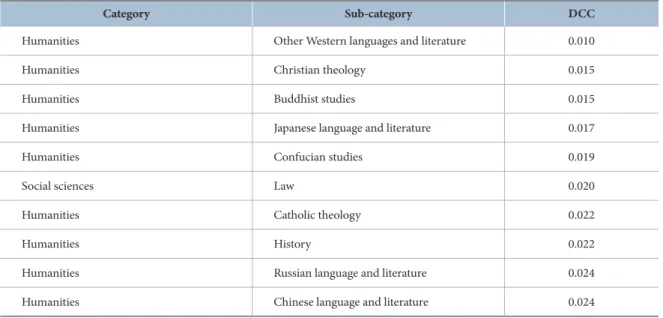
Table 4 and Table 5 show the 10 highest and 10 lowest DCCs by category and sub-category. In contrast to the ACC results, engineering showed high inter-disciplinary collaboration across the sub-categories of ergonomics, biomedical engineering, other engineering, forestry engineering, and nuclear engineering. In addition, mul-tidisciplinary studies (specifically, brain and cognitive science) showed high inter-disciplinary. Similar to the ACC results, the humanities showed the lowest DCCs.
However, we did note that under the social sciences, law showed extremely low inter-disciplinary collaboration.
Just as the ACC reflects the extent of author-level col-laboration, the DCC reflects the extent of collaboration across disciplines. As Figure 4 demonstrates, there were a number of interesting features of inter-disciplinary collaboration depending on the discipline. Overall, the relationship between ACC and DCC showed a positive correlation (Pearson’s correlation coefficient = 0.829); Fig. 3Discipline-level collaboration coefficients (DCC) by discipline sub-category
as the ACC increased, the DCC increased as well. Some disciplines—brain science, ergonomics, biomedical engineering, forestry engineering, and nuclear engi-neering—showed substantial collaboration both among authors and among disciplines. Researchers in these
ar-eas collaborated highly with researchers from different disciplines. In contrast, other disciplines showed high collaboration among authors in the same discipline but not across disciplines. For instance, veterinary, livestock science, agriculture, and Korean medicine showed high
Table 4. Ten Highest DCCs by Discipline
Category Sub-category DCC
Medicine and pharmacy Other medicine and pharmacy 0.510
Engineering Ergonomics 0.411
Natural science Other natural science 0.409 Multidisciplinary studies Brain science 0.406 Engineering Biomedical engineering 0.397 Engineering Other engineering 0.389 Engineering Forestry engineering 0.383 Multidisciplinary studies Cognitive science 0.382 Engineering Nuclear engineering 0.378 Natural science Earth science 0.356
Table 5. Ten Lowest DCCs by Discipline
Category Sub-category DCC
Humanities Other Western languages and literature 0.010 Humanities Christian theology 0.015
Humanities Buddhist studies 0.015
Humanities Japanese language and literature 0.017 Humanities Confucian studies 0.019
Social sciences Law 0.020
Humanities Catholic theology 0.022
Humanities History 0.022
Humanities Russian language and literature 0.024 Humanities Chinese language and literature 0.024
average ACCs but the collaborations were primarily in-tra-disciplinary. Architectural engineering, kinesiology, accounting, civil engineering, tourism, journalism and broadcasting, and nursing science are displayed in the lower right in Figure 4, and they showed a similar pat-tern: Authors collaborated considerably, but within rath-er than across disciplines. In viewing collaboration with an inter-disciplinary perspective, we identified distinct discipline sub-categories with high intra-disciplinary
but relatively low inter-disciplinary collaboration. 4.3. Impact of Collaboration
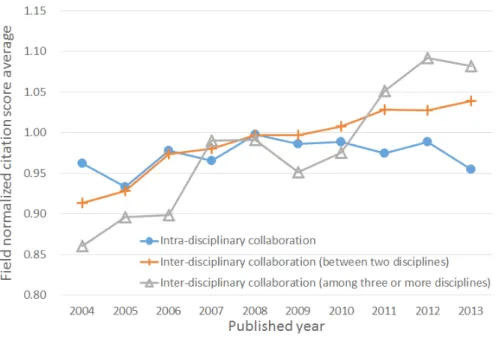
Table 6 shows the impacts of collaboration by type based on citation scores. The average score of intra-dis-ciplinary collaboration was slightly lower than the scores for collaboration between two disciplines and among three or more disciplines. Overall, the impact of inter-disciplinary collaboration is slightly greater than
Fig. 4Average ACCs and DCCs for each discipline sub-category
Table 6. Average Impact Scores in Terms of Intra- And Inter-Disciplinary Collaboration
Type Avg. of impact score
Intra-disciplinary collaboration 0.975 Inter-disciplinary collaboration (between two disciplines) 0.996 Inter-disciplinary collaboration (among three or more disciplines) 0.983
that of intra-disciplinary collaboration.
Figure 5 visually presents the impact of collaboration by the three types listed. Inter-disciplinary collaboration showed more immediate impact, whereas intra-dis-ciplinary showed long-term impact. As we can see in Figure 5, articles that were published in 2004, 2005, and 2006 showed substantially higher inter-disciplinary collaboration among three or more disciplines. By con-trast, in more recently published articles, we found the opposite trend. Both types of inter-disciplinary collabo-ration showed higher impact compared with that within disciplines. This result indicates that inter-disciplinary collaboration tends to result in pioneering research rather than having long-term impacts. Jacobs (2003) discussed the Nobel laureate and psychologist Daniel Kahneman. A number of important articles co-authored by Kahneman and economist Richard Thaler were pub-lished, but they had more immediate impact rather than enduring influence. Kahneman’s most cited articles are primarily within his own discipline, psychology. In fact, his 10 most cited articles have no inter-disciplinary
col-laboration.
The studies that examine the relationship between collaboration and impact primarily demonstrate a pos-itive correlation between the two (Larivière, Gingras, Sugimoto, & Tsou, 2015; Van Raan, 1998; Balconi & Laboranti, 2006). That is, as collaboration increases, the impact of collaborative works increases as well, and these results have come from a wide variety of disci-plines such as the social sciences, humanities, natural sciences, medical science, and microelectronics. How-ever, there have also been mixed findings regarding the positive relationship between collaboration and impact. For instance, Hart (2007) and Medoff (2003) found no evidence that collaboration led to greater impact. As we identify in this study, the impact of collaboration might be affected by time and discipline, and we also demon-strated that article impact varied depending on type of collaboration. In this sense, the findings of this current study may provide a plausible explanation for the pre-vious mixed results. That is, type of collaboration might differently affect the impacts of research over time.
5. CONCLUSION
Despite the fact that collaboration is on the rise as a research topic, our understandings on collaboration have been limited by disciplinary fields or restricted data. As previous studies have indicated, investigations on collaboration have been conducted by utilizing author affiliations or journal subject categories in cer-tain disciplinary areas, not covering the entire set of disciplines. As a way to better understand collaboration both within and across disciplines, we analyzed the KCI and KRI data sets with a total of 8 categories and 119 sub-categories of disciplines, 109,551 researchers, 650,263 articles, and 1,170,039 citations. By calculating collaboration coefficients at the author and discipline levels and also field-normalized citation scores, we in-vestigated the trends and impacts with respect to intra- and inter-disciplinary collaboration.
As collaboration has become significant in a wide variety of research communities, interdisciplinary collaboration has been encouraged in a considerable number of funding agencies among many countries, including Korea. Within the context of interdisciplin-ary collaboration emphasis, the findings of this study imply that inter-disciplinary collaboration needs to be understood cautiously depending on disciplinary research topics or research phases. As previous studies indicated (Franceschet & Costantini, 2010; Larivière, Gingras, & Archambault, 2006), inter-disciplinary collaboration is positive overall. The findings of this study, however, demonstrated that impacts of interdis-ciplinary collaboration are likely to be dynamic. That is, inter-disciplinary collaboration showed relatively high-er impact in an early phase of research, but impacts of intra-collaboration were found to stay strong over later phases of research. It seems that inter-disciplinary col-laborative research is supposed to disseminate new top-ics or methodologies to other disciplines and the im-pact of it is likely to be short-term. On the other hand, intra-disciplinary collaboration tends to accommodate and deepen the adopted topics and methodologies and clearly its impact stays longer than inter-disciplinary collaboration does. This result can imply that research policies to promote collaboration should consider the dynamic characteristics of collaboration impacts on collaboration types.
In this line of research, characteristics and impacts of
collaboration need to be explored further. Future stud-ies on collaboration could be twofold: collaboration in terms of intra- vs. inter- disciplinary approaches, and the impact of collaboration over time. As this current study shows, there are found to be different charac-teristics of collaboration depending on disciplinary areas. On the other hand, the impact of collaboration needs to be understood from disciplinary perspectives. More importantly, the impact of collaboration could be intertwined in a wide variety of disciplinary areas as time goes by. Visualizing collaboration networks might shed light on the distinguishing features of individual disciplines regarding intra- versus inter-disciplinary activities. Moreover, longitudinal observations on col-laboration activities across disciplines might indicate the variations in collaboration impacts over time. In addition, conducting this kind of study in other coun-tries could be desirable with respect to comparing the differences and similarities of collaboration in diverse countries. When repeating similar studies, discipline information for researchers needs to be cautiously col-lected since the way to define the researcher’s discipline is crucial for comparison analysis.
REFERENCES
Abramo, G., D’Angelo, C. A., & Di Costa, F. (2009). Research collaboration and productivity: Is there correlation? Higher Education, 57, 155- 171. Abramo, G., D’Angelo, C. A., & Murgia, G. (2017). The
relationship among research productivity, research collaboration, and their determinants. Journal of Informetrics, 11(4), 1016-1030.
Adams, S. J. D., Black, G. C., Clemmons, J. R., Paula, E., & Stephan, P. E. (2005). Scientific teams and insti-tutional collaborations: Evidence from U.S. univer-sities, 1981-1999. Research Policy, 34(3), 259-285. Ajiferuke, I., Burrel, Q., & Tague, J. (1988).
Collabora-tive coefficient: A single measure of the degree of collaboration in research. Scientometrics, 14, 421-433.
Balconi, M., & Laboranti, A. (2006). University-indus-try interactions in applied research: The case of microelectronics. Research Policy, 35, 1616-1630. Bordons, M., Gomez, I., Fernandez, M. T., Zulueta,
international scientific collaboration in biomedical research. Scientometrics, 37(2), 279-295.
Cronin, B., Shaw, D., & Barre, K. L. (2003). A cast of thousands: Coauthorship and subauthorship col-laboration in the 20th century as manifested in the scholarly journal literature of psychology and philosophy. Journal of the American Society for In-formation Science and Technology, 54(9), 855-871. Defazio, D., Lockett, A., & Wright, M. (2009). Funding
incentives, collaborative dynamics and scientific productivity: Evidence from the EU framework program. Research Policy, 38(2), 293-305.
Rehn, C., Wadskog, D., Gornitzki, C., & Larsson, A. (2014). Bibliometric indicators: Definitions and us-age at Karolinska Institutet. Stockholm: Karolinska Institutet. Retrieved from http://kib.ki.se/sites/ default/files/bildarkiv/Dokument/bibliometric_ indicators_2014.pdf p.8
Franceschet, M. & Costantini, A. (2010). The effect of scholar collaboration on impact and quality of academic papers. Journal of Informetrics, 4(4), 540-553.
Glänzel, W. (2002). Coauthorship patterns and trends in the sciences (1980-1998): A bibliometric study with implications for database indexing and search strategies. Library Trends, 50(3), 461-473.
Hart, R. L. (2007). Collaboration and article quality in the literature of academic librarianship. The Journal of Academic Librarianship, 33(2), 190-195.
Hayati, Z., & Ebrahimy, S. (2009). Correlation between quality and quantity in scientific production: A case study of Iranian organizations from 1997 to 2006. Scientometrics, 80(3), 625-636.
Jacobs, J. A. (2013). Disciplines and interdisciplinarity in research universities. Presentation at the Nation-al Research Council Meetings on Team Science, October 24, 2013 (p. 3). Retrieved from http://sites. nationalacademies.org/cs/groups/dbassesite/docu-ments/webpage/dbasse_085386.pdf
Korean Researcher Information. (n.d.). Retrieved from https://www.kri.go.kr/
Landry, R., Traore, N., & Godin, B. (1996). An econo-metric analysis of the effect of collaboration on academic research productivity. Higher Education, 32(3), 283-301.
Larivière, V., Gingras, Y., & Archambault, É. (2006). Canadian collaboration networks: A comparative
analysis of the natural sciences, social sciences and the humanities. Scientometrics, 68(3), 519-533. Larivière, V., Gingras, Y., Sugimoto, C. R., & Tsou, A.
(2015). Team size matters: Collaboration and sci-entific impact since 1900. Journal of the Association for Information Science and Technology, 66(7), 1323-1332.
Lee, S., & Bozeman, B. (2005). The impact of research collaboration on scientific productivity. Social Studies of Science, 35(5), 673-702.
Leimu, R., & Koricheva, J. (2005). Does scientific col-laboration increase the impact of ecological arti-cles? BioScience, 55(5), 438-443.
Liang, L., & Zhu, L. (2002). Major factors affecting Chi-na’s inter-regional research collaboration: Regional scientific productivity and geographical proximity. Scientometrics, 55(2), 287-316.
Lutz, M. A. (1999). Economics for the common good: Two centuries of economic thought in the humanist tradition (p. 219). London and New York: Rout-ledge.
Mairesse, J., & Turner, L. (2005). Measurement and ex-planation of the intensity of co-publication in sci-entific research: An analysis at the laboratory level. Nber Working Paper Series, w11172.
Medoff, M. (2003). Collaboration and the quality of economics research. Labour Economics, 10(5), 597-608.
Nagurney, A., & Qiang, Q. (2010). A knowledge col-laboration network model across disciplines. Pro-ceedings of the Third International Conference on Social Computing, Behavioral Modeling, and Pre-diction (SBP 2010) (pp. 138-148), Bethesda, MD, USA, March 30-31, 2010.
R Core Team. (2014). R: A language and environment for statistical computing (version 3.1.2). Vienna, Austria: R Foundation for Statistical Computing. Retrieved from. https://www.r-project.org/ Van Raan, A. F. J. (1998). The influence of international
collaboration of the impact of the research results. Scientometrics, 42(3), 423-428.
Van Rijnsoever, F. J., & Hessels, L. K. (2011). Factors associated with disciplinary and interdisciplinary research collaboration. Research policy, 40(3), 463-472.
Appendix
Research Discipline Classification in the Korean Researcher Information Database
Category Sub-category Engineering Engineering in general Mechanical engineering Automotive engineering Aerospace engineering Chemical engineering Polymer engineering ErgonomicsControl and instrumentation engineering Electrical engineering
Material science and engineering Environment engineering
Electronic / Communications engineering Computer science Civil engineering Architectural engineering Industrial engineering Safety engineering Nuclear engineering Marine engineering Ocean engineering Fiber engineering Resources engineering Metallurgical engineering Traffic engineering Biomedical engineering Agriculture engineering Forestry engineering Other engineering Category Sub-category Humanities Lexicography History Philosophy Religious studies Christian theology Catholic theology Confucian studies Buddhist studies Linguistics Literature
Korean language and literature Chinese language and literature Japanese language and literature Other oriental languages and literature English language and literature French language and literature German language and literature Spanish language and literature Russian language and literature Western classical languages and literature Other western languages and literature Interpretation and translation studies Other humanities
Category Sub-category
Social sciences
Social sciences in general Political and diplomatic science Economics Agricultural economics Business management Accounting International trade Sociology Social welfare Area studies Anthropology Education Law Public policy Policy studies Geography International/Regional development Tourism
Journalism and broadcasting Military science
Psychological science Other social sciences
Natural science
Natural science general Mathematics Statistics Physics Astronomy Chemistry Biology Earth science Geology Atmospheric sciences Oceanography Life sciences Other natural science
Category Sub-category Medicine and pharmacy Medicine Veterinary Nursing science Korean medicine Pharmacy
Other medicine and pharmacy
Agriculture and fisheries Agriculture Forestry Landscape architecture Livestock science Fishery science
Marine transportation studies Food science Arts and kinesiology Arts in general Musicology Art Design Costumes Photography Beauty Theater Film Kinesiology Dance
Other arts and kinesiology
Multidisci-plinary studies
Science and technology studies Technology policy
Library and information science Gender studies
Cognitive science Brain science Affective science