INTRODUCTION
In overactive bladder, especially neurogenic detrusor over- activity that arises in patients with spine disorder above sacral micturition center, there are many bladder irritative symp- toms due to low bladder compliance, neurogenic detrusor overactivity and high intravesical pressure (1-3). In those cases, there are many complications including recurrent uri- nary tract infection and vesicoureteral reflex causing upper urinary tract injury, eventually a renal failure. Thus the pur- poses of the management in the overactive bladder is to de- crease the intravesical pressure to appropriate levels and to protect the upper urinary tract. The current and primary treatment modalities include the administration of anti- cholinergics alone or with the intermittent catheterization (4, 5). However, despite such methods are effective, the administration of anticholinergics may often be ceased due to the side effects of anticholinergics such as flushing, drowsi- ness, constipation, erectile dysfunction, dry mouth or in high dose, central nervous system symptoms and cardiovascular symptoms. Also the administration of anticholinergics are not recommended in cases of hyperthyroidism, congestive heart failure, liver disease, kidney disease, myasthenia gravis, and megacolon or closed angled glaucoma. Therefore the
demand for new agents with less adverse effects has been rising accordingly (6).
Aromatherapy is often used to manage the variable symp- toms by abnormal regulation of autonomic nervous system such as anxiety, insomnia or immune system. Aromatherapy may be used by smelling, inhalation, footbath, or massage, only with a few side effects such as hypertension or diarrhea.
Ylang-Ylang essential oil (YYEO) (Cananga odorata) is used worldwide as a perfume. It can also be used as intestinal anti- spasmodics (7, 8). Recent studies indicate the some compo- nents in YY oil have vasodilator properties and relaxing effects on smooth muscle (9-11).
This study was designed to investigate the effects of YYEO, which is currently used in aromatherapy on the relaxation of urinary bladder muscle in vitro and in vivo.
METERIALS AND METHODS Preparation of tissue strips for in vitro study
Male Sprague-Dawley rats weighing 250 to 300 g were used and anesthetized by intraperitoneal sodium pentobarbital (5 mg/kg) and exsanguinated via cervical dislocation. Following
*
Departments of Urology, Anesthesiology*and Phamacology , Dankook University College of Medicine; Department of Chemistry , Dankook University College of Natural Science, Cheonan;
Department of Radiology , Miz-medi Hospital, Seoul, Korea
Hyung Jee Kim, M.D.
Department of Urology, Dankook University College of Medicine, 29 Anseodong, Cheonan, Korea
Tel : +82.41-550-6630, Fax : +82.41-556-0524 E-mail : [email protected]
*The research was conducted by the research fund of Dankook University in 2001.
409
Current and primary treatment modality in overactive bladder includes the admin- istration of anticholinergics. The demand for new agents has been rising since anti- cholinergics have proven to come with many side effects. This study was designed to investigate the effects of ylang-ylang essential oil (YYEO) on the relaxation of urinary bladder muscle in vitro and in vivo. Effects of YYEO were assessed on resting tension, and electrical field stimulation- and various drug-induced contrac- tion in vitro by checking the isometric tension changes of muscle strips and same procedures were repeated in the presence of methylene blue, Nw-Nitro-L-arginine methyl ester hydrochloride (L-NAME), or N-ethylmaleimide, and in vivo. YYEO decreased significantly the contractility of strips. There was no statistically signif- icant difference between the treated group only with YYEO and the pre-treated group with YYEO and methylene blue or L-NAME. When N-ethylmaleimide was employed, there was a statistically significant decrease in the rate of contraction.
In vivo studies showed the same results compared with in vitro study. The results of this study indicate that YYEO has a relaxing effect on the bladder, and such mechanism is thought to be brought about by a pathway mediated by c-AMP.
Key Words : Oils, Volatile; Neurogenic Bladder; Muscle Hypertonia; Cholinergic Antagonists
Received : 10 September 2002 Accepted : 23 January 2003
a suprapubic midline incision, bladder was isolated and lon- gitudinal detrusor muscle strips measuring approximately 1 10 mm were obtained within the Krebs’ solution with room temperature airing 95% O2and 5% CO2after bladder body was dissected. Each strip was mounted in organ-bath contain- ing 20 mL Krebs’ solution with the following composition (mmol/L): NaCl, 118.1; NaHCO3, 25.0; KCl, 4.6; KH2PO4, 1.2; CaCl2, 2.5; MgSO4, 1.2; glucose, 11.0, and equilibrated at 37 with 95% O2and 5% CO2for resulting pH 7.4. After the 90-min equilibration with frequent washout using fresh Krebs’ solution, strips of detrusor muscle were loaded with resting tension of 1 g, and optimal isometric tension was ob- tained as evidenced by two consecutive contraction to bethane- chol (5 10-4M) that differed by less than 10%.
Changes in isometric tension were measured by Grass FT03 transducer (Grass Instruments, Quincy, MA, U.S.A.) and recorded by Grass 79E Polygraph (Grass Instruments).
Experimental procedure for in vitro study
The effects of YYEO on basal tension are reported as the tension at the end of the 10-min incubation in the presence of 0.05 mL YYEO. Electrical field stimulation (EFS) was deliv- ered via platinum electrodes set on either side of the muscle strip in each organ bath. Intramural nerves were stimulated with a Grass 88 field stimulator (Grass Instruments) deliver- ing biphasic square wave pulse of 50 V, 1.0 ms wide at 1 to 16 Hz with a 2-min interval between the stimulation. After the 30-min incubation with fresh Krebs’ solution, 0.05 mL YYEO was added to each organ bath. The tissue was incubat- ed for 10 min and then EFS was repeated.
In separate experiments, the effects of YYEO on bethane- chol, ATP and KCl-stimulated contractions were investi- gated. After the 60-min incubation at 1 g tension, bethane- chol (0.01 mM) was added to each organ bath. Peak response was recorded, and the bath was washed out to be refilled with Krebs’ solution and equilibrated for 30 min. Subse- quently, after the 10-min incubation in 0.05 mL YYEO, the stimulation with bethanechol (0.01 mM) was repeated.
The effects were also recorded. The effects of YYEO on stim- ulation by ATP (2 mM) and KCl (127 mM) were assessed in the same way with other strips.
In order to investigate which drugs were effective in block- ing the YYEO-induced relaxation, other separate experiments were performed. First, after the 60-min equilibration at 1 g tension, the effects of YYEO on electrical field stimulation (EFS)-, bethanechol-, ATP- and KCl-stimulated contractions were investigated with the above method. Baths were then washed out to be refilled with Krebs’ solution and equilibrat- ed for 30 min. Subsequently, after the 10-min incubation in 0.001 mM methylene blue (guanylate cyclase inhibitor), the stimulations with EFS, bethanechol, ATP and KCl were re- peated. The effects were also recorded. The effects of L-NAME (Nw-Nitro-L-arginine methyl ester hydrochloride, nitric
oxide synthase inhibitor, 0.001 mM) and N-ethylmaleimide (c-AMP nonspecific inhibitor, 0.001mM) on relaxation by YY oil were assessed in the same way in other strips to eval- uate which mechanism was related to relaxation by YYEO.
Preparation of animal for in vivo study
Male New Zealand white rabbits weighing about 2.5 kg were used for this investigation. After the sedation with an intramuscular injection of ketamine (10 mg/kg), the rabbits were anesthetized and maintained with enflurane (2.5-3.5%).
The animals breathed spontaneously. The rabbits were then placed supine position, and the body temperature was main- tained at 37 using a heating pad and lamp. The polyethy- lene catheter (Clay Adams PE-50, NJ, U.S.A.) was introduced to bladder through the urethra. The intravesical pressure was measured by pressure transducer (Grass Instruments, Quincy, MA, U.S.A.) and recorded by Grass 79E Polygraph (Grass Instruments). The catheter was connected to a three-way stop- cock, thus permitting the injection of 37 normal saline (10 mL/min). Intravesical pressure and vesical volume were then checked, when spontaneous bladder contraction was occurred.
After half of full volume was introduced to bladder with 37 normal saline, changes of intravesical pressure to YY oil, bethanechol and ATP-induced stimulation were investigated.
The femoral artery on one side was cannulated with polyethy- lene catheter (Clay Adams PE-10) and continuous monitor- ing of arterial pressure and heart rate were measured by pres- sure transducer (Grass Instruments) and recorded by Grass 79E Polygraph (Grass Instruments), when YY oil was admin- istered through the vein of ear. The femoral catheter was con- nected to a three-way stopcock, thus permitting the injection of various drugs. Catheter was filled with heparinized saline (50 IU/2 hr) to prevent clotting. The femoral artery on other side was ligated to obtain the maximum effect of given con- centrated drug.
Experimental procedure for in vivo study
YYEO (0.01, 0.02, 0.05 mL) was injected intravenously, and the change of arterial pressure and heart rate were mea- sured with 1-hr interval. The effects of YYEO on bethanechol- and ATP-stimulated bladder contractions were investigated.
After a minimum of 1 hr of resting, bethanechol (0.01 mM) was injected intra-arterially and peak response of intravesical pressure was recorded. After the 60-min equilibrium, subse- quently YY oil (0.0001-0.01 mL) was injected intra-arteri- ally, and following the 1-min incubation, the stimulation with bethanechol (0.01 mM) was repeated. The effects were record- ed. The effects of YYEO on stimulation by ATP (2 mM) were assessed in the same way with other rabbits.
Contractile responses were expressed as gram tension per 100 mg of tissue in in vitro study and as a percentage of the active muscle tone, compared with control in in vivo study. YYEO
was given as a gift from the company (Aroma Newtech, Cheo- nan, Korea). Bethanechol chloride, ATP, KCl, L-NAME, N- ethylmaleimide and methylene blue were purchased from Si- gma Co. (St Louis, MO, U.S.A.). Data were expressed as the mean (SEM), and differences were assessed using Student’s t-test, with p<0.05 considered to indicate significance.
RESULTS In vitro study
YYEO had no significant effect on the resting tone of smo- oth muscle strips. The response to EFS (1, 2, 4, 8 and 16 Hz) was significantly suppressed by YYEO from 5.3 0.6, 5.8 0.7, 11.2 1.3, 18.7 2.1, and 26.5 2.6 g/100 mg to 3.1 0.5, 3.4 0.7, 7.0 1.3, 12.0 2.5 and 16.0 3.1 g/
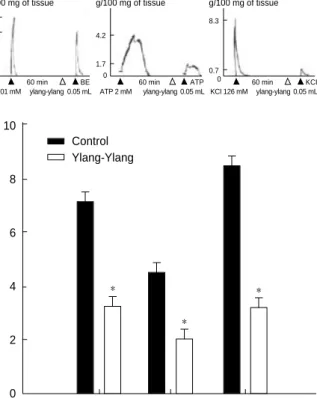
100 mg, respectively (p<0.05, n=19) (Fig. 1). Response to bethanechol, ATP and KCl were significantly suppressed by YYEO from 7.2 0.5, 4.4 0.5, and 8.6 0.8 g/100 mg to 3.5 0.4, 2.1 0.3 and 3.5 0.5 g/100 mg, respectively (p<0.01, n=11, 22, 21, respectively) (Fig. 2). YYEO-induced suppressions of all stimulation-induced contractility were not significantly changed in the presence of methylen blue or L- NAME (data not shown). All stimulation-induced contrac- tility suppressed by YYEO was significantly restored in the presence of N-ethylmaleimide from 1.7 0.3, 1.2 0.3 and 1.1 0.2 g/100 mg (bethanechol, ATP and KCl, respective- ly), and 1.0 0.2, 1.0 0.2, 2.1 0.4, 3.7 0.6 and 5.8 1.0 g/100 mg (EFS) to 4.1 0.8, 2.6 0.5 and 1.8 0.2 g/
100 mg, and 1.8 0.3, 1.8 0.3, 4.1 0.8, 6.1 0.8 and 8.3 0.1 g/100 mg, respectively (p<0.05, n=10, 10, 11, 11,
Contractility (g/100 mg of tissue)
35
30
25
20
15
10
5
0
0 2 4 6 8 10 12 14 16 18 Frequency (Hz)
Control Ylang-Ylang
Fig. 1. Frequency-contractility curves from bladder muscle strips in male Spraque-Dawley rats. Pre-treatment with ylang-ylang oil (0.05 mL) significantly decreases the maximum tension under the control. *p<0.05 indicates significant difference from respec- tive control, n=19 in each group.
* *
*
*
*
Contractility (g/100 mg of tissue)
10
8
6
4
2
0
Bethanechol ATP KCl
Control Ylang-Ylang
Fig. 2. Changes of the contraction induced by bethanchol, ATP, and KCI after pre-treatment with ylang-ylang oil. Bethanechol, ATP, and KCI-induced contractions are decreased by pre-treatment with ylang-ylang oil. *p<0.05 indicates significant difference from respective control (n=11, bethanechol; n=22, ATP; n=21, KCI).
*
*
*
g/100 mg of tissue
BE 0.01 mM ylang-ylang 0.05 mL 60 min 7.6
6.0
0 BE 0 0
g/100 mg of tissue
ATP 2 mM ylang-ylang 0.05 mL 60 min 4.2
1.7
ATP
g/100 mg of tissue
KCI 126 mM ylang-ylang 0.05 mL 60 min 8.3
0.7
KCI
Contractility (g/100 mg of tissue)
10
8
6
4
2
0
Bethanechol ATP KCl
Control Ylang-Ylang
Ylang-Ylang with N-ethylmaleimide
Fig. 3. Changes of the contraction induced by bethanechol, ATP and KCI after pre-treatment with ylang-ylang oil. Bethanechol, ATP and KCI-induced contractions are decreased by pre-treat- ment with ylang-ylang oil and N-ethylmaleimide. *p<0.05 indi- cates significant difference from ylang-ylang induced reduction of contractions (n=8, bethanechol; n=6, ATP; n=6, KCI).
*
*
*
respectively) (Fig. 3, 4).
In vivo study
Intravesical pressure was 16.6 2.5 mmHg, when spon- taneous bladder contraction was occurred.
During the injection of YYEO (0.01, 0.02 and 0.05 mL) intravenously, the heart rate was not significantly changed, but mean arterial pressure was decreased transiently (decrease;
0, 15 and 27.5 mmHg, respectively) (Fig. 5). Intravesical pressures induced by bethanechol and ATP in the presence of YY oil (0.0001-0.01 mL) were significantly suppressed by the amount of the above 0.001 mL YY oil from basal to 110.1 11.4, 55.9 3.8 and 32.7 3.1%, (p<0.01, n=9) and 90.3 7.8, 37.7 5.8 and 36.1 9.3%, respectively (p<0.01, n=7) (Fig. 6).
DISCUSSION
YYEO is internationally used as prime component in high quality perfumes. Forty-nine different components have been identified by gas chromatography-mass spectrometry (GC- MS). Major components to list are linalool, linalyl acetate, eugenol, methyleugenol and methyl benzonate (9-11). In Brazil, methyleugenol is used in folk medicine as a stomachic and intestinal antispasmodic; it suggests YYEO makes smooth muscle of gastrointestinal system relax (7). The main com- ponent of YYEO, linalool, is used as an antibiotics as well as an antispasmodics used to treat epilepsy. Eugenol has also been widely used for many years as a topical, temporary treat- ment for the pain of pulpitis (12-14). Effects of YYEO on skeletal muscle and smooth muscle lead us to study the effect
Contractility (g/100 mg of tissue)
20 18 16 14 12 10 8 6 4 2 0
0 2 4 6 8 10 12 14 16 18 Frequency (Hz)
Control group Ylang-Ylang
Ylang-Ylang with N-ethylmaleimide
Fig. 4. Changes of the contraction induced by electrical field stimulation (EFS) after pretreatment with ylang-ylang oil. Bethane- chol, EFS-induced contractions are decreased by pre-treatment with ylang-ylang oil. Reduction of contractions are not attenuat- ed by pre-treatment with ylang-ylang oil and N-ethylmaleimide.
*p<0.05 indicates significant difference from ylang-ylang induced reduction of contractions, n=11 in each group.
*
Fig. 5.Representative figure showing the effects of intra-arterial ylang-ylang (0.01-0.05 mL) on blood pressure. Administration of ylang- ylang decreased the amplitude of blood pressure transiently.
BP (mmHg) 100 50 5 mm/sec 0
60 min
ylang-ylang 0.01 mL 0.02 mL 0.05 mL
60 min 12 sec
Intravesical pressure (percentage)
120
100
80
60
40
20
0
Bethanechol ATP Group
Control 0.0001 mL 0.001 mL 0.01 mL
Fig. 6. Effects of pre-treated ylang-ylang oil on the response of bethanechol, and ATP. *p<0.01, significant difference from respective control (n=9, bethanechol; n=7, ATP).
*
* *
*
a b c d
BE 0.01 mM
ylang-ylang 0.0001 mL 0.001 mL 0.01 mL 60 min 60 min 60 min 1
0.5
0
a b c d
ATP 2 mM
ylang-ylang 0.0001 mL 0.001 mL 0.01 mL 60 min 60 min 60 min 1
0.5 0
of it on detrusor muscle contractibility.
In this study, in vitro studies using rat bladder were per- formed in order to investigate the basic effect of YY oil. Be- cause of rat’s a little body volume, a relative large amount of YYEO which was diluted in 0.1% ethanol 1 mL and 0.1%
ethanol itself, in vivo studies using the bladder of rats result- ed in large errors on the change of intravesical pressure and were impossible to check the change of blood pressure dur- ing the study. Thus trials by larger animals were needed to obtain error-free results and to observe the adverse effect on the cardiovascular system.
In the results of this study, YYEO inhibited all stimula- tion by EFS and all drugs to contract the bladder. The results were the same in in vitro as well as in in vivo studies. When large amounts, up to 0.5 mL of YY oil was administrated intravenously, only transient and mild decrease of blood pres- sure was found. This suggests that the side effect on the car- diovascular system did not lead to a decrease of intravesical pressure.
Many experiments have been carried out to determine the effect of this oil. Elizabetsky et al. (15) used linalool in white rats to show depression of motor neuron stimulation as well as affecting the central nervous system (CNS) directly. The mechanism of this effect is that the linalool combines with glutamine, CNS excitatory neurotransmitter and inhibits its action. Also in Buchbauer’s study (16), essential oils have a selective effect on tissues, but as it has a nonspecific toxic effect on cell membranes, it has no vital activity. However, in different studies, effects on smooth muscle relaxation were investigated. Hume (17, 18) exerts its effect by [K+]Oon L- type Ca2+channels. Eugenol works as Ca2+-antagonist. Eugenol depressed the constrictor response to norepinephrine (NE), histamine and transmural nerve stimulation. Since NE and histamine act on different and specific receptors, it is proba- ble that dilator effect of eugenol was not mediated by the competition for specific receptor site, but it inhibited one or more stage of the post-receptor excitation-contraction sequence in smooth muscle (19). Recently, it is seen that the eugenoldilol, derived from natural eugenol made a role as a stimulator of non-selective -adrenoreceptor blocker and -adrenorecep- tor blocker or as a 2-adrenoreceptor selective partial ago- nist (17, 20-22). In this experiments, we used crude oil because we had have the purpose that this oil will be used in aro- matherapy treatment applied via the skin through massage or add to bath water or by inhalation. There is some degree of absorption of the individual components into the blood, which was calculated at between 4 and 25% when applied to the skin of a rhesus monkey or man (23). This would be approximately 8 10-6and 1 10-5g/mL of an essential oil in carrier oil applied.
The smooth muscle relaxation was made by c-AMP relat- ed by activation of adenylate cyclase and c-GMP related to activation of guanylate cyclase in nitric oxide pathway (24).
Lis-Balchin and Hart’s study (25) showed that smooth mus-
cle relaxation by lavender essential oils was occurred by the elevated c-AMP levels within the cell. In this study, the action mechanism of YYEO in bladder contractility reduction is thought to increasing c-AMP level because the c-AMP non- specific inhibitor, N-ethylmaleimide only inhibited the re- duction of bladder contractility by YYEO, but inhibitors related to nitric oxide pathway did not.
In summary, YYEO is shown to have a relaxing effect on bladder smooth muscle. The action mechanism of YYEO is thought through the c-AMP pathway; however the exact me- chanism is still unclear. YYEO have several key constituents, one of which would be believed to produce its therapeutic effect. Therefore, to clarify the YYEO in the clinical appli- cation and make the products without the loss of its natural scent, further research is needed to determine the effects of each key components of the YYEO.
REFERENCES
1. Graham SD. Present urological treatment of spinal cord injury patients. J Urol 1981; 126: 1-4.
2. Nanninga JB, Wu Y, Hamilton B. Long term intermittent catheteri- zation in the spinal cord injury patient. J Urol 1982; 128: 760-3.
3. Levin RM. Overview of nerves and pharmacology in the bladder.
Adv Exp Med Biol 1999; 462: 237-40.
4. Moisey CU, Stephenson TP, Brendler CB. The urodynamic and subjective results of treatment of detrusor instability with oxybuty- nine chloride. Br J Urol 1980; 52: 472-5.
5. Thuroff JW, Bunke B, Ebner A, Faber P, De Geeter P, Hannappel J, Heidler H, Madersbacher H, Melchior H, Schaffer W, Schwenzer T, Stockle M. Randomized, double-blind, multicenter trial on treat- ment of frequency, urgency and incontinence related to detrusor hyperactivity: oxybutynin versus propantheline versus placebo. J Urol 1991; 145: 813-7.
6. McEvoy GK. Genitourinary smooth muscle relaxant. In: Kathy L editor, Drug Information, Vol. II. Chapter 86. Bethesda: American society of Health-system pharmacists Inc, 1995: 2504-5.
7. Craveiro AA, Andrade CHS, Matos FJA, Alencar JW, Dantas TNC.
Fixed and volatile constituents of Croton aff. Nepetaefolius. J Nat Prod 1980; 43: 756-7.
8. Magalhaes PJC, Criddle DN, Tavares RA, Melo EM, Mota TL, Leal- Cardoso JH. Intestinal myorelaxant and antispasmodic effects of the essential oil of Croton nepetaefolius and its constituents cineole, methyleugenol and terpineol. Phytother Res 1998; 12: 172-7.
9. Stashenko E, Torres W, Martinez J. A study of compositional varia- tion in the essential oil of ylang-ylang (Cananga odorata) during flower development. J High Resol Chromatogr 1995; 18: 101-4.
10. Stashenko E, Martinez J, Macku C, Shibamoto T. HRGC and GC- MS analysis of essential oil from Colombian ylang-ylang (Cananga odorata). J High Resol Chromatogr 1993; 16: 441-4.
11. Olivero J, Gracia T, Payares P, Vivas R, Diaz D, Daza E, Geerlings P. Molecular structure and gas chromatographic retention behav- ior of the components of Ylang-Ylang oil. J Pharm Sci 1997; 86:
625-30.
12. Maudsley F, Kerr KG. Microbiological safety of essential oils used in complementary therapies and the activity of these compounds against bacterial and fungal pathogens. Support Care Cancer 1999;
7: 100-2.
13. Ostrander FD. Accepted dental therapeutics 1969-1970. A histori- cal review. J Am Dent Assoc 1970; 80: 589-92.
14. Lis-Balchin M, Hart S. Correlation of the chemical profiles of essen- tial oil mixes with their relaxant and stimulant properties in man and smooth muscle preparations in-vitro. Processing of 27th International symposium essential oils. Vienna, Austria 1997: 24-8.
15. Elisabestsky E, Marschner J, Souza DO. Effects of linalool on glu- tamatergic system in the rat cerebral cortex. Neurochem Res 1995;
20: 461-5.
16. Buchbauer G. Molecular interaction: biological effects and modes of action of essential oils. Int J Aroma 1993; 5: 11-4.
17. Hume WR. Effect of eugenol on constrictor responses in blood ves- sels of the rabbit ear. J Dent Res 1983; 62: 1013-5.
18. Hume W, Veaco N, Becker R. Concentration-dependent depression of cellular respiration by eugenol. J Dent Res 1982; 61: 202.
19. Pohto M, Scheinin A. Microscopic observations on living dental pulp. The effect of oil of clove and eugenol on the circulation of the
pulp in the rat's lower incisor. Int Dent J 1960; 5: 405.
20. Lin YT, Wu BN, Horng CF, Huang YC, Hong SJ, Lo YC, Cheng CJ, Chen IJ. Isoeugenol: a selective beta1-adrenergic antagonist with tracheal and vascular smooth muscle relaxant properties. Jpn J Pharmacol 1999; 80: 127-36.
21. Nishijima H, Uchida R, Kameyama K, Kawakami N, Ohkubo T, Kitamura K. Mechanism mediating the vasorelaxing action of eugenol, a pungent oil, on rabbit arterial tissue. Jpn J Pharmacol 1999; 79:
327-34.
22. Chang PC, van Brummelen P, Vermeij P. Acute vasodilator action of pindolol in humans. Hypertension 1985; 7: 146-50.
23. Broaugh RL, Wester RC, Bucks D, Maibach HI, Sarason R. In vivo percutaneous absorption of fragrance ingredients in rhesus monkey and humans. Food Chem Toxicol 1990; 28: 369-73.
24. Steers WD. Physiology and pharmacology of the bladder and urethra.
In: Walsh PC, Retik AB, Vaughan ED, Wein AJ eds, Campbell’s Urol- ogy, 7th edn, Vol. I. Chapter 26. Philadelphia: WB Saunders, 1998:
870-906.
25. Lis-Balchin M, Hart S. Studies on the mode of action of the essen- tial oil of lavender (Lavandula angustifolia P. Miller). Phytother Res 1999; 13: 540-2.