I. Introduction
To reduce noise in a room, sound absorptive materials are a prerequisite and therefore are widely used in the buildings. When developing sound absorptive materials, sound absorption performance should be monitored in every developing step for better results. Also in designing
a new acoustic environment of a room, measurement of sound absorption of the candidate materials could gua- rantee the correct estimation of the reverberation time.
Methods of sound absorption coefficient measurement are internationally standardized in ISO354 (reverberation room method) [1] or ISO10534-2 (transfer function method in the impedance tube). [2] Reverberation room method is
Method of deriving the acoustic impedance and sound absorption coefficient of materials by manipulating
electrical impedance of a loudspeaker
스피커의 전기적 임피던스를 이용한 시료의 음향임피던스와 흡음계수 도출 기법
Sejin Doo 1†
(두세진 1† )
1
Decoton Inc.
(Received March 22, 2021; accepted May 11, 2021)
ABSTRACT: When measuring the sound absorption coefficient of a specimen, a reverberation room which is costly or an impedance tube which has limitations in measuring low frequencies have been engaged. In this paper, a new measurement method of acoustic impedance or sound absorption coefficient has been suggested, which does not need microphones and only uses electrical impedance measurement data and derived Thiele/Small parameters of a speaker. The theory of this method has been described using equivalent circuit of the loudspeaker and acoustic properties of a test specimen are measured to demonstrate the validity of this method. It was confirmed that this method can easily measure the sound absorption coefficient in the low frequency band, which was previously difficult to trust. The advantages, limitations, and applicability of this method are discussed.
Keywords: Sound absorption, Acoustic impedance, Speaker, Equivalent circuit, Measurement
PACS numbers: 43.58.Bh, 43.38.Dv, 43.55.Ev
초 록: 시료의 흡음률 측정을 위해서는 비용이 많이 드는 잔향실 혹은 저주파수에서의 측정에 한계가 있는 임피던스 튜브를 사용한다. 본 논문에서는 마이크로폰을 사용하지 않고 단지 스피커 임피던스와 이로부터 도출된 Thiele/Small 변수만을 사용하여 시료의 음향임피던스와 흡음률을 구하는 기법을 제안하였다. 스피커의 등가회로를 이용하여 이 방법의 이론을 설명하였으며, 시료의 측정을 통하여 본 방법의 유효성을 증명하였다. 본 방법은 기존에 신뢰하기 어려 웠던 저주파 대역에서의 흡음률을 매우 쉽게 측정할 수 있음을 확인하였다. 본 방법의 장점과 제한사항, 그리고 응용 분야에 대해서 검토하였다.
핵심용어: 흡음, 음향 임피던스, 스피커, 등가회로, 측정
†Corresponding author: Sejin Doo ([email protected])
Decoton Inc., 1182 Gwangyeoro, Sanbukmyeon, Yeoju, Gyeonggi Province 12603, Republic of Korea (Tel: 82-1877-8827, Fax: 82-504-765-9525)
Copyrightⓒ2021 The Acoustical Society of Korea. This is an Open Access article distributed under the terms of the Creative Commons
Attribution Non-Commercial License which permits unrestricted non-commercial use, distribution, and reproduction in any medium, provided
the original work is properly cited.
based on the condition of 100 % diffuse field and therefore it gives practically realistic values of sound absorption coefficients. It has a drawback, however, as it sometimes gives more values than 1.0 of sound absorption coefficient due to the edge effect of the specimen installation, which is not theoretically acceptable. Also internal volume of 200 m 3 , precise temperature and humidity control, 5 micro- phones and the relevant measuring systems mean a big investment.
The transfer function method was proposed in the 1980s [3,4] and has been internationally standardized, but the problem was that only the sound absorption coefficient under the condition of normal incidence could be obtained, the hassle of calibration of two or three microphones, and uncertainty in the low frequency ranges.
In addition to these two methods, other attempts were also proposed. Farina proposed the sound intensity method rather than the transfer function method, and emphasized that the method was more advanced. [5]
In particular, new attempts are still limited, as neither the reverberation chamber method nor the transfer function method provides a reliable solution for the measurement of the sound absorption coefficient below 100 Hz. [6]
In this paper, a new method of measuring acoustic properties of the materials, which is especially consistent at the low frequencies is proposed: It does not employ the microphones or the long tube to measure sound pressure at all and instead utilize the equivalent circuit of the loud- speaker to extract acoustic impedance of the specimen, which again converts to sound absorption coefficient with ease.
II. Equivalent circuit of the loudspeaker with acoustic terminals
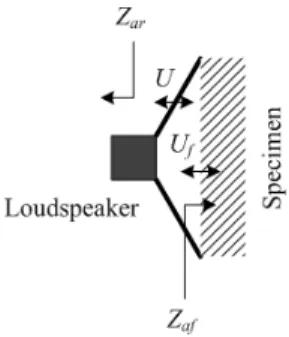
If a specimen is installed near the loudspeaker dia- phragm as shown in Fig. 1, when the volume velocity of the diaphragm is , a volume velocity different from
is applied to the specimen surface due to the elasticity of air formed between the specimen and the diaphragm. If the acoustic impedance at the back of the diaphragm is and the acoustic impedance at the surface of the specimen installed in front of the diaphragm is , the equivalent circuit of the loudspeaker at low frequency ranges where the diaphragm of the loudspeaker vibrates as a piston can be expressed as shown in Fig. 2,
where,
: series DC resistance
: series coil inductance
: parallel inductance associated with coil loss
Fig. 2. Equivalent circuit of the loudspeaker with a specimen near the front of the diaphragm.
Fig. 1. Volume velocity of a loudspeaker diaphragm
and that at the surface of the specimen
.
and
are the acoustic impedances on the specimen
surface and at the rear of the loudspeaker respectively.
: parallel resistance associated with inductance
: mass, compliance, and loss of the moving diaphragm of the loudspeaker respectively
: acoustic impedance at the rear of the loudspeaker
: acoustic impedance of the test specimen
: compliance of the cavity between the loudspeaker diaphragm and the test specimen
: force factor of the loudspeaker
: effective diaphragm area of the loudspeaker
: acoustic, mechanical, and electrical impedance of the loudspeaker seen from the each terminal respectively.
Acoustic impedance which is defined as pressure over volume velocity denotes as
. (1)
For simple manipulation of the equations, motional impedance can be defined as
. (2)
Mechanical impedance of the loudspeaker reduces to
. (3)
Electrical impedance of the loudspeaker incorporating electrical, mechanical and acoustical elements can be written as
. (4)
Also, electrical impedance excluding resistances and inductances of the voice coil equates as
. (5)
Eq. (5) implies that can be indirectly calculated by measuring the electrical impedance of the loudspeaker and extracting the Thiele/Small parameters.
If the specimen is replaced with a rigid surface, the front acoustic impedance becomes infinite and the acoustic impedance is simplified to
. (6)
In the condition that the front cavity of the loudspeaker is small and the frequency is low,
becomes dominant, and the is connected in series with the
of the loudspeaker. This lowers the total compliance, which increases the resonance frequency of the loud- speaker. can therefore be readily calculated by
′
, (7)
where is the loudspeaker resonance frequency in free air and ′
is that when the front cavity is small as in Fig. 1.
Also, volume of the front cavity of the loudspeaker can be calculated by the simple relation of
. (8)
From Eqs. (3) and (6), is expressed as
, (9)
where
. (10)
Eq. (9) is then reduced to
. (11)
Boulandet [7] used an enclosure to measure the acoustic impedance of the loudspeaker, but in this study, it can be easily measured by changing the loudspeaker com- pliance with only the space formed between the front and the hard surface of the loudspeaker. Several manipulations of the above equations yield the acoustic impedance of the specimen as