- 69 -
KISEP Case Report J Rhinol 8(1,2), 2001
Nasal Septal Perforation due to Button Battery
Heung-Man Lee, M.D., Dae Hyung Kim, M.D., Jeong-Min Kim, M.D., Soon Jae Hwang, M.D. and Sang Hag Lee, M.D.
ABSTRACT
A button battery in the nose of children is an unusual foreign body, which can cause liquefaction necrosis with subsequent severe local tissue destruction. All button batteries as foreign bodies in the nasal cavity should be removed immediately to prevent severe local tissue damage, resulting in late sequelae, such as septal perforation or stenosis of the nasal meatus. We present two cases of nasal septal perforation followed by button battery foreign body and discuss the special aspects of this foreign body.
KEY WORDS:Nasal septal perforation·Button battery.
INTRODUCTION
Button batteries are widely used in daily life and can be easily found in electronic games, toys, calculators, watches, cameras, hearing aids, laser pointers and so forth. Button batteries are found as foreign bodies in the nasal cavity, external auditory canal, esophagus and gastrointestinal tract where its battery substances can cause liquefaction necrosis by contact with the human moist tissue in a fast period of time resulting in tissue necrosis followed by perforation.1-3) Button batteries are most easily noticed as a foreign body in the esophagus and gastrointestinal tract by heedless in- gestion of it. Recently, its incidence found in the nasal cavity has increased.
Button batteries ingested through the nasal cavity may incur extensive necrosis of the nasal cavity mu- cosa by electrical and chemical burn and it has also been reported that it may carry complications such as nasal septal perforation, synechia, stenosis and cosm- etic deformity.1-3)
Through this study, we wish to report two cases of
nasal septal perforation caused by button battery for- eign body in the nasal cavity.
CASES
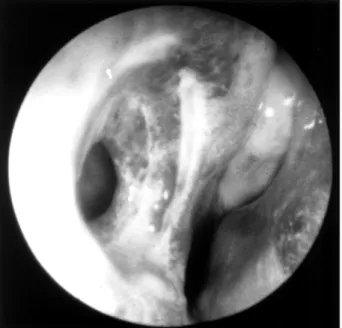
Case 1A 4-year old girl patient visited us with a button battery inserted into the nasal cavity for 8 hours. On physical examination, a metallic object was detected in between the nasal septum of the left nasal cavity and the inferior turbinate (Fig. 1 and 2). The foreign body was removed with forceps through the nasal cavity under local anesthesia. At the time of removal, purulent rhinorrhea and necrosis was observed in the nasal septum and inferior turbinate area where the battery was found. After removal of the button battery, we performed sufficient irrigation with sterile saline and applied antibiotic ointment and prescribed systemic broad spectrum antibiotics. During outpatient follow- up, necrosis of the mucosa of the septum as well as repeated formation of crust was formed and at the 5th week of follow up a 0.5×0.5 cm sized septal perfora- tion developed (Fig. 3).
Case 2
A 6 year old boy patient visited us with right nasal obstruction and rhinorrhea that started 2 days before Department of Otolaryngology-Head and Neck Surgery, Korea
University College of Medicine, Seoul, Korea
Address correspondences and reprint requests to Heung-Man Lee M.D., Department of Otolaryngology-Head and Neck Surgery, Guro Hospital, Korea University College of Medicine, 80 Gurodong, Gurogu, Seoul 152-703, Korea
Tel:82-2- 818-6750, Fax:82-2-868-0475 E-mail:[email protected]
Accepted for publication on June 22, 2001
70 / J Rhinol 8(1,2), 2001
admission. Based on his history, this child had a button battery in the nasal cavity for 48 hours. On physical examination, a metallic object was detected between the nasal septum of the right nasal cavity and the inferior turbinate. The foreign body was removed with forceps through the nasal cavity under local anesthesia (Fig. 4 and 5). At the time of removal, necrosis was noticed in the nasal septum and inferior tubinate where the button battery was found and the nasal septal cartilage was exposed and there was bleeding at the margin of the septal mucosa. After removal of the
button battery, we performed sufficient irrigation with sterile saline and applied antibiotic ointment and prescribed systemic broad spectrum antibiotics. During outpatient follow up we removed the crust and at the 4th week of follow up a 1×1 cm sized septal per- foration developed (Fig. 6).
DISCUSSION
Foreign bodies in the nasal cavity of children are
Fig. 1. Nasal endoscopic finding of a button battery foreign body in the left nasal cavity (case1).
Fig. 2. Button battery removed from the nasal cavity (case1).
Fig. 3. Nasal endoscopic finding showing nasal septal perfor- ation (case1).
Lee et al:Nasal Septal Perforation due to Button Battery / 71
most commonly found in the right side and the most common types of foreign bodies found were plastic toys, and beads, as well as peanuts, seeds, snacks, paper, batteries and so forth. Button batteries found as a foreign body in the nasal cavity is rarely found and it is most commonly discovered in children between the ages 2 to 5 years old.4) Early symptoms were unilateral nasal obstruction, rhinorrhea, pain and as local injury proceeded symptoms such as fever, and mucopurulent rhinorrhea occurred and after 48 hours facial swelling
and blood-tinged rhinorrhea occurred.5)
The anode of a typical button battery is consisted of powered zinc and the cathode is mainly consisted of mercuric oxide and it is separated by the alkaline solution of 45% potassium hydroxide or sodium hyd- roxide. To block the outflow of its inner substances it is sealed with nylon or plastic.1)6)7)
Local tissue injury caused by button batteries may come upon by several mechanisms.8)9) Firstly, alkalis invading the deeper layer of the tissue causes lique- fying necrosis that leads to solubilization of protein
Fig. 4. Nasal endoscopic finding of a button battery foreign body in the right nasal cavity (case2).
Fig. 5. Button battery removed from the nasal cavity (case2).
Fig. 6. Nasal endoscopic finding showing nasal septal perfora- tion (case2).
72 / J Rhinol 8(1,2), 2001
and collagen and saponification of lipids and dehyd- ration of tissue cells. Secondly, electrolysis of the tissue is caused by the low-voltage direct current that exists between the positive and negative poles. Thirdly, the chloride gas or sodium hydroxide that comes from the electrolysis of the surrounding tissues aggravate the tissue injury. Fourthly, pressure necrosis is caused by the battery. The longer the battery remains in the nasal cavity, the local tissue injury is more severe and the development of complications increase. It is still unknown on how much time of stay is necessary for the battery to cause nasal septal perforation. In this case, septal perforation occurred after a short period of 8 and 48 hours and it is thought that the sufficiently charged battery may have acted as a primary factor of septal perforation.
Immediate removal of the battery foreign body in the nasal cavity is necessary for prevention of more severe local tissue injury and it is important to cau- tiously understand the degree injury.8)9) The removal of the battery foreign body in the nasal cavity is carried out under local or general anesthesia and it is impor- tant not to cause any damage to the nasal mucosa.
After removal of the battery foreign body, sufficient irrigation with sterile saline is necessary for removal of alkaline precipitates and in the case of severe burn of the nasal mucosa, a stent may be used to prevent synechiae or stenosis of the nasal cavity. To prevent
the occurrence of complications, continuous follow-up and treatment is necessary until the nasal mucosa ap- pears normal.
Lastly, because the occurrence of complications such as septal perforation increase as the battery remains for a long time in the nasal cavity, sufficient removal of it is necessary along with continuous follow-up and treatment. Education based on the dangers that follow battery foreign bodies in children will be needed.
REFERENCES
1) Rha KS, Choi WJ, Ko PJ, Park CI. A case of nasal septal perfora- tion due to alkaline disc battery as a nasal foreign body. Korean J Otolaryngol 1997;40:300-3.
2) Palmer O, Natarajan B, Johnstone A, Sheikh S. Button battery in the nose-an unusual foreign body. J Laryngol Otol 1994;108:871-2.
3) Brown CR. Intranasal button battery causing septal perforation: A case report. J Laryngol Otol 1994;108:589-90.
4) Tong MC, Ying SY, van Hasselt CA. Nasal foreign bodies in child- ren. Int J Pediatr Otorhinolaryngol 1996;35:207-11.
5) Gomes CC, Sakano E, Lucchezi MC, Porto PR. Button battery as a foreign body in the nasal cavities. Special aspects. Rhinology 1994;
32:98-100.
6) Capo JM, Lucente FE. Alkaline battery foreign bodies of the ear and nose. Arch Otolaryngol 1986;112:562-3.
7) Kim KK, Kim JR, Kim JY. Button battery impaction in nasal cavity.
J Korean Med Sci 1999;14:210-2.
8) Hong D, Chu YF, Tong KM, Hsiao CJ. Button batteries as foreign bodies in the nasal cavities. Int J Pediatr Otorhinolaryngol 1987;
14:15-9.
9) Kavanagh KT, Litovitz T. Miniature battery foreign bodies in audi- tory and nasal cavities. J Am Med Assoc 1986;255:1470-2.