Background and Purpose To determine the risk of Parkinson’s disease (PD) in relation to erectile dysfunction (ED) based on the National Health Insurance Research Database in Taiwan.
Methods We identified 3,153 patients who were newly diagnosed with ED between January 1, 2004 and December 31, 2010. A total of 12,612 randomly selected people without ED served as healthy controls. All of the study subjects were followed-up from the index date to the date of PD diagnosis, withdrawal from the National Health Insurance program, or the end of 2012 whichever occurred first.
Results The incidence density rate of PD was 1.52-fold higher in the ED cohort than the non-ED cohort (3.44 vs. 1.64 per 1,000 person-years), with an adjusted hazard ratio (HR) of 1.52 [95% confidence interval (CI)=1.09–2.12]. The combined effects on patients with ED and diabetes as well as hypertension showed a significant combined association with the PD risk compared with patients without ED, counterpart comorbidities, or medication use. The ad- justed HR of PD for ED was higher for diabetes (2.82, 95% CI=1.42–5.63) and hypertension (2.19, 95% CI = 1.35–3.55).
Conclusions ED leads to an increased risk of PD. ED patients with diabetes or hypertension have an elevated risk of PD.
Key Words comorbidity, diabetes, erectile dysfunction, Parkinson’s disease, risk.
Relationship between Erectile Dysfunction, Comorbidity, and Parkinson’s Disease: Evidence from
a Population-Based Longitudinal Study
INTRODUCTION
Erectile dysfunction (ED) is defined as the inability to achieve or maintain a penile erection sufficient to permit successful sexual intercourse, and it is a complex and heterogeneous disorder.1 The incidence of ED is increasing globally, and it mainly affects men who are old- er than 40 years. It has been reported that approximately 150 million men worldwide suffer from ED.2,3 ED has also been found to be a symptom of serious illnesses such as cardiovas- cular diseases, diabetes, metabolic syndromes, and all-cause mortality.4,5
Erectile function is controlled by the autonomic system, which is frequently compromised in patients with ED. Parkinson’s disease (PD) is another disease commonly affected by the autonomic nervous system,6 and ED is a common nonmotor symptom in PD. In contrast to motor disorders, ED is often unresponsive to levodopa treatment.7 Previous studies have found that ED can be detected several years before a diagnosis of PD.6,8 A retrospective anal- ysis of a large cohort (32,616 men) found ED to be associated with a higher future risk of de- veloping PD, and the authors hypothesized that the autonomic nervous system can be im- paired for years before PD is clinically identified.6 However, the findings of that study might be unreliable due to recall bias.
Yuwan Yanga,b Hsinho Liuc,d Tienhuang Linc,d Yuhung Kuoc,e Tengfu Hsiehc,d,e
a Department of Neurology, China Medical University Hospital, Taichung, Taiwan
b School of Medicine,
China Medical University, Taichung, Taiwan
c Departments of Urology and
e Research, Taichung Tzu Chi Hospital, Buddhist Tzu Chi Medical Foundation, Taichung, Taiwan
d School of Medicine, Tzu Chi University, Hualian, Taiwan
pISSN 1738-6586 / eISSN 2005-5013 / J Clin Neurol 2017;13(3):250-258 / https://doi.org/10.3988/jcn.2017.13.3.250
Received December 29, 2016 Revised April 25, 2017 Accepted April 27, 2017 Correspondence Tengfu Hsieh, MD, PhD Departments of Urology and Research, Taichung Tzu Chi Hospital, Buddhist Tzu Chi Medical Foundation, No.88 Sec.1 Fengxing Rd. Tanzi Dist.
Taichung 42743, Taiwan Tel +886-4-3606-0666 ext 3181 Fax +886-4-3606-5928 E-mail [email protected]
cc This is an Open Access article distributed under the terms of the Creative Commons Attribution Non-Com- mercial License (http://creativecommons.org/licenses/by-nc/4.0) which permits unrestricted non-commercial use, distribution, and reproduction in any medium, provided the original work is properly cited.
JCN
Open Access ORIGINAL ARTICLEYang Y et al.
JCN
To identify the relationship between ED and the subsequent risk of PD, we conducted a nationwide population-based ret- rospective cohort study using a data set from the Taiwan Na- tional Health Insurance (NHI) program. The National Health Insurance Research Database (NHIRD) is a well-validated na- tionwide population-based data set that allows researchers to trace the medical service usage history of all citizens in Tai- wan.9-11 Several studies have used the NHIRD to investigate associations between different diseases;12,13 the present study used NHIRD data to examine the possible association be- tween ED and the risk of PD.
METHODS
Ethics statement
The Institutional Review Board of Taichung Tzu Chi General Hospital in Taiwan approved the study protocol (approval no. REC103-43). Because personal identifiers were not in- cluded in the secondary files, informed consent did not need to be obtained.
Data sources
This study sampled cohort data from the NHIRD. The NHI program has provided comprehensive health-care coverage in Taiwan since 1995. Enrollment in this government-run, universal, single-payer insurance system is mandatory, and currently around 99% of the 23 million residents of Taiwan receive medical care through the NHI program. In addition, more than 97% of the hospitals and clinics in Taiwan are con- tracted to provide health-care services14 that are reimbursed by the NHI Bureau, and all data related to these services are collected and input to the NHIRD by the National Health Research Institutes (NHRI; www.nhri.org.tw) so as to provide a comprehensive record of medical care. The data consist of outpatient care records, inpatient care records, and the regis- tration files of the insured, and the database includes all claims data from the NHI program. The NHI Bureau ran- domly reviews the charts of 1 out of every 100 outpatient cas- es and 1 out of every 20 inpatient cases, as well as performing patient interviews to verify the accuracy of diagnoses.15 The NHRI follows strict confidentiality guidelines for the protec- tion of personal electronic data and maintains the NHI reim- bursement data as anonymized files suitable for research use.
Study population
We conducted a population-based retrospective cohort study that included two groups. We initially identified patients who had been newly diagnosed with organic ED [Interna- tional Classification of Diseases, ninth revision, clinical Modi- fication (ICD-9-CM) code 607.84] or psychogenic ED (ICD-
9-CM code 302.72) from inpatient and outpatient files in at least two consistent diagnoses in outpatient care and who were followed up between January 1, 2004 and December 31, 2010. Similar methods for identifying patients with ED have been used in other studies.16,17 We used the date of ED diagnosis as the index date of the patient.
The control cohort included four non-ED patients per ED patient, who were selected from the same data set with pro- pensity-score matching in order to reduce selection bias by bundling many confounding covariates that may be present in an observational study with this number of variables.
Charlson Comorbidity Index Score
The Charlson Comorbidity Index Score (CCIS) is a widely accepted measure for risk adjustment in administrative- claims data sets.18,19 The CCIS was calculated for each patient by assigning 1 point for each of myocardial infarct, conges- tive heart failure, peripheral vascular disease, dementia, cere- brovascular disease, chronic lung disease, connective-tissue disease, ulcer, chronic liver disease, and diabetes; 2 points for each of hemiplegia, moderate or severe kidney disease, dia- betes with end-organ damage, tumor, leukemia, and lympho- ma; 3 points for moderate or severe liver disease; and 6 points for each of malignant tumor, metastasis, and acquired im- mune deficiency syndrome.
Variables
The independent variables were age, CCIS, comorbidities (e.g., diabetes, hypertension, hyperlipidemia, anxiety, depres- sion, alcoholism, obesity, bipolar disorder, and schizophre- nia), drugs causing parkinsonism (i.e., diazepam, alprazolam, and haloperidol),20 antipsychotic medications (i.e., zolpidem, metoclopramide, and flunarizine),13 other premotor symp- toms [i.e., constipation, rapid-eye-movement-sleep behavior disorder (RBD), and hyposomnia],21 geographic area of resi- dence, and insurance premiums.22
Research outcomes
The main outcome of the study was the occurrence of PD (ICD- 9-CM code 332.0), which was determined by linking records with outpatient and inpatient care data in the NHIRD. This method has been used in other studies to identify PD pa- tients.13,23,24 In Taiwan, secondary PD (including drug-in- duced or vascular) is recorded as ICD-9-CM code 332.1, and multiple-system atrophy with predominant parkinsonism is recorded as ICD-9-CM code 333. As described in detail previously, patients who diagnosed as PD and those receiv- ing antiparkinsonism medication for more than 60 days are defined as the occurrence of PD.13,23,24 All patients were ob- served from the index date to the date of PD diagnosis, with-
Erectile Dysfunction Comorbidity, and PD
JCN
drawal from the NHI program, or the end of 2012 whichev- er occurred first.25,26
Statistical analysis
Pearson’s chi-square test was applied to categorical variables such as age, insurance premiums, drugs causing parkinson- ism, antipsychotic medications, geographic region of resi- dence, and comorbidities. Continuous variables were ana- lyzed using one-way ANOVA. The cumulative risk of PD was estimated using Kaplan-Meier survival curves. A Cox propor- tional-hazards regression model adjusted for patient character- istics was used to analyze the association of ED with subse- quent PD during the 7-year follow-up period. We calculated hazard ratios (HRs) along with 95% confidence intervals (CIs), and used a two-sided p value of <0.05 as a significance cutoff. All of these analyses were conducted using SPSS soft- ware (version 15, SPSS Inc., Chicago, IL, USA).
RESULTS
In total, 15,765 patients were included in our study cohort, of whom 3,153 had ED and 12,612 did not have ED (Supple- mentary Fig. 1 in the online-only Data Supplement). The demographic characteristics and selected morbidities for the two cohorts are presented in Table 1. The mean ages of the ED and non-ED cohorts were 56.7 and 53.4 years, respective- ly. The patients with ED were more likely to reside in north- ern and central Taiwan, have more comorbidities, use more medications, and have higher insurance premiums than those without ED.
Kaplan-Meier analysis demonstrated that the cumulative incidence of PD was significantly higher in the ED cohort than in the non-ED cohort (log-rank test p<0.001) (Fig. 1).
The follow-up periods for the ED and non-ED cohorts were 5.07±1.77 and 6.83±0.70 years (mean±SD), respectively, and the incidence rates of PD were 3.44 and 1.64 per 1,000 person-years. Multivariate Cox proportional-hazards regres- sion analyses revealed that the risk of PD was 1.52-fold high- er in ED patients than in non-ED patients after adjusting for age and comorbidities (95% CI = 1.07–2.10) (Table 2). Since ED is an important variable, we applied the Cox proportion- al-hazards model to stratify by age and CCIS. Compared with the non-ED cohort, the ED cohort still had a higher risk of PD, with an adjusted HR of 1.38 (95% CI=1.02–1.86) (Table 3).
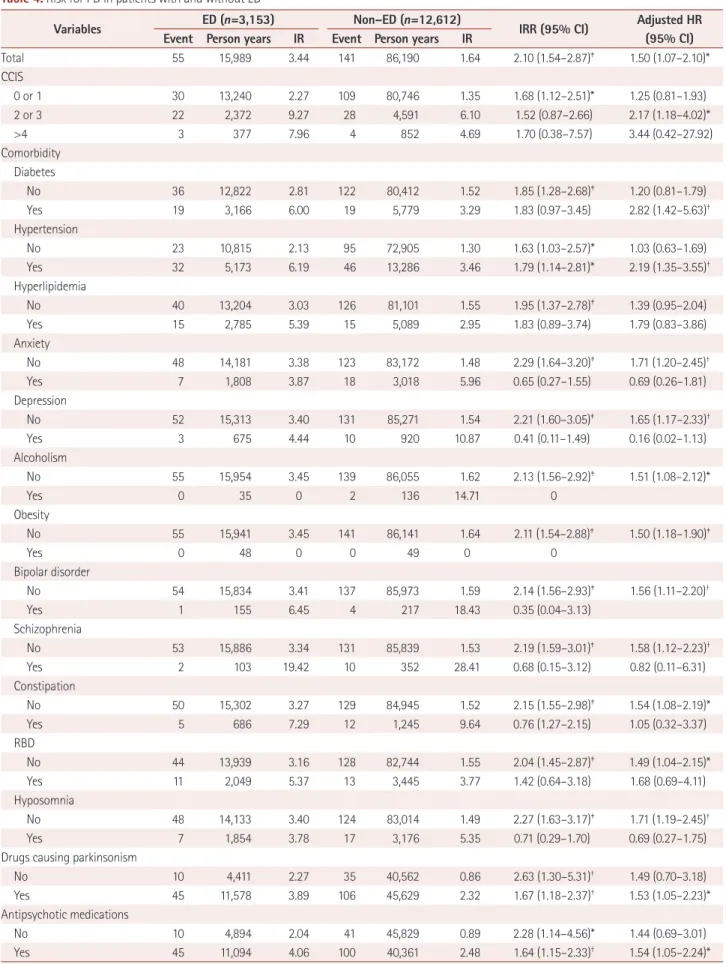
We further explored the association between ED and PD by stratifying age, CCIS, insurance premiums, comorbidity of diabetes, hypertension, hyperlipidemia, anxiety, depres- sion, alcoholism, bipolar disorder, schizophrenia, drugs caus- ing parkinsonism, antipsychotic medications, residence area, and geographic region (Table 4). The adjusted HR of PD for ED was higher for the presence of diabetes (2.82, 95% CI=
1.42–5.63) and hypertension (2.19, 95% CI=1.35–3.55), and the absence of anxiety (1.71, 95% CI=1.20–2.45), depression (1.65, 95% CI=1.17–2.33), bipolar disorder (1.56, 95% CI=
1.11–2.20), schizophrenia (1.58, 95% CI=1.12–2.23), consti- pation (1.54, 95% CI=1.08–2.19), RBD (1.49, 95% CI=1.04–
2.15), and hyposomnia (1.71, 95% CI=1.19–2.45).
Considering that ED is related to neurodegeneration in the premotor stage, we included organic ED in the analysis.
The non-ED group was matched with the propensity score.
The patient’s age, CCIS, diabetes, hypertension, hyperlipid- emia, anxiety, depression, alcoholism, obesity, bipolar disor- der, schizophrenia, constipation, RBD, hyposomnia, drugs causing parkinsonism, antipsychotic medications, insurance premiums, residence area, and geographic region were used for propensity-score matching. The patients with organic ED still had a 1.43-fold higher risk of PD than non-ED patients after the adjustment (95% CI=1.06–1.93). The full results are presented in Supplementary Tables 1 and 2 (in the online-on- ly Data Supplement).
DISCUSSION
This study evaluated independent and combined associations between ED and comorbidities (as well as medications) on PD in a large prospective cohort during a 7-year follow-up period. The findings add to the existing literature by showing a 1.52-fold higher risk of PD in all ED patients after adjusting for age, sex, insurance premiums, residence area, CCIS, co-
0 1 2 3 4 5 6 7 Log-rank test, p-value<0.001
Time (years)
ED 3,153 3,139 3,126 2,575 2,124 1,690 1,309 898 Non-ED 12,61212,59812,58312,47412,34812,18412,924 11,486 No. at risk
0.030 0.025 0.020 0.015 0.010 0.005 0.000
Cumulative incidence
Non-ED ED
Fig. 1. Cumulative incidence of Parkinson’s disease estimated using the Kaplan-Meier method for patients with and without ED. ED: erec- tile dysfunction.
Yang Y et al.
JCN
morbidities, and medications.
We also found that the risk of PD was higher for patients with ED along with diabetes or hypertension than for patients without ED or counterpart comorbidities. ED has been re- ported as a risk factor for the development of PD,6,8 but this association has so far been described as an independent ef- fect. Some previous studies accounted for diabetes and hy- pertension,27,28 but none considered their combined effect with ED on PD. It is unclear whether ED and other comor- bidities play significant combined roles. Our research showed that diabetes and hypertension are jointly associated with ED in producing 2.53- and 2.17-fold higher risks of PD, respec- tively.
ED is a complex and heterogeneous disorder that possibly
has arterial, neurogenic, hormonal, cavernous, iatrogenic, and psychogenic causes. ED could also be associated with not only cardiovascular disease but also neurological disor- ders including migraine, epilepsy, and dementia.1,17,29,30 Fur- thermore, many studies have indicated that ED can be de- tected several years prior to a PD diagnosis.6,8 These findings and the present results can be combined in ongoing efforts to identify individuals at the earliest phase of PD.
ED is diagnosed by self-reporting. It is not easy to reliably classify organic ED and psychogenic ED clinically because all sexual dysfunctions involve the mind as well as the rela- tionship with a sexual partner.31 For these reasons, we per- formed the analysis using both organic and psychogenic ED, and found that ED leads to an increased risk of PD.
Table 1. Demographic characteristics of and comorbidities in patients with and without ED in Taiwan from 2004 to 2010 (n=15,765)
Variable ED (n=3,153) Non–ED (n=12,612)
n (%) n (%) p
Age (years), mean±SD 56.7±9.8 53.4±10.5 <0.006
Follow–up duration (years), mean±SD 5.07±1.77 6.83±0.70 <0.0001
CCIS <0.0001
0 or 1 2,607 (82.7) 11,813 (93.7)
2 or 3 463 (14.7) 675 (5.3)
>3 83 (2.6) 124 (1.0)
Comorbidity
Diabetes 634 (20.1) 837 (6.6) <0.0001
Hypertension 1,051 (33.3) 1,924 (15.3) <0.0001
Hyperlipidemia 578 (18.3) 734 (5.8) <0.0001
Anxiety 351 (11.1) 437 (3.5) <0.0001
Depression 140 (4.4) 136 (1.1) <0.0001
Alcoholism 8 (0.3) 20 (0.2) 0.256
Obesity 11 (0.3) 7 (0.1) <0.0001
Bipolar disorder 34 (1.1) 33 (0.3) <0.0001
Schizophrenia 22 (0.7) 54 (0.4) 0.051
Constipation 140 (4.4) 183 (1.5) <0.001
RBD 408 (12.9) 498 (3.9) <0.001
Hyposomnia 355 (11.3) 464 (3.7) <0.001
Drugs causing parkinsonism 2,256 (71.6) 6,629 (52.6) <0.0001
Antipsychotic medications 2,175 (69.0) 5,857 (46.4) <0.0001
Insurance premium <0.0001
<17,500 NTD/month 884 (28.0) 2,856 (30.6)
17,500–25,000 NTD/month 883 (28.0) 4,334 (34.4)
>25,000 NTD/month 1,386 (44.0) 4,422 (35.0)
Residence area <0.0001
Urban 1,085 (34.4) 3,791 (30.1)
Suburban 1,461 (46.3) 5,774 (45.8)
Rural 607 (19.3) 3,047 (24.2)
Geographic region <0.0001
Northern/central 2,302 (73.0) 8,505 (67.4)
Southern/eastern 851 (27.0) 4,107 (32.6)
CCIS: Charlson Comorbidity Index Score, ED: erectile dysfunction, NTD: New Taiwan Dollar, RBD: rapid eye movement sleep behavior disorder.
Erectile Dysfunction Comorbidity, and PD
JCN
The incidence of ED was lower in our patients than among those included in other studies. This is because ED is a taboo subject in Taiwan, with patients being reluctant to discuss sex.17 Thus, the control group may have included some un- identified ED cases. The risk of PD was still clearly demon- strated despite this possible confounding effect, but the true risk may be even greater when every ED case can be clearly
identified.
A previous study found ED to be associated with PD diag- nosed more than 10 years later.6 However, significant recall bias might have been present in that study. The present na- tionwide population-based cross-sectional study was able to avoid recall bias since it involved a large and representative sample. The NHIRD data set covers more than 99% of the Table 2. Results from the Cox proportional-hazards model measuring HRs and 95% CIs of PD associated with patients with ED
Characteristic Crude Adjusted
HR (95% CI) p HR (95% CI) p
ED 2.34 (1.71–3.21) <0.0001 1.50 (1.07–2.10) 0.019
Comorbidity
Hypertension 3.04 (2.28–4.04) <0.0001 1.11 (0.81–1.52) 0.512
Depression 4.61 (2.63–8.09) <0.0001 1.58 (0.77–3.23) 0.214
Schizophrenia 14.94 (8.33–26.79) <0.0001 19.44 (10.35–36.54) <0.0001
Constipation 5.03 (3.06–8.28) <0.0001 1.42 (0.84–2.39) 0.193
Hyposomnia 2.73 (1.78–4.19) <0.0001 1.50 (0.90–2.51) 0.123
Insurance premiums
<17,500 NTD/month 1.00 Reference 1.00 Reference
17,500–25,000 NTD/month 0.71 (0.51–0.98) 0.038 1.01 (0.71–1.44) 0.938
>25,000 NTD/month 0.50 (0.35–0.71) <0.0001 0.99 (0.68–1.45) 0.960
Geographic region
Northern/central 1.00 reference 1.00 Reference
Southern/eastern 1.10 (0.82–1.47) 0.546 0.99 (0.73–1.36) 0.982
Adjusted HR: adjusted for ED, age, CCIS, insurance premiums, comorbidity of diabetes, hypertension, hyperlipidemia, anxiety, depression, alcoholism, bi- polar disorder, schizophrenia, drugs causing parkinsonism, antipsychotic medications, constipation, RBD, and hyposomnia in Cox proportional-hazards regression.
CCIS: Charlson Comorbidity Index Score, CI: confidence interval, ED: erectile dysfunction, HR: hazard ratio, NTD: New Taiwan Dollar, PD: Parkinson's dis- ease, RBD: rapid-eye-movement-sleep behavior disorder.
Table 3. Results of the stratified Cox proportion-hazards model for PD associated with ED patients and non-ED patients
Characteristics Crude Adjusted
HR (95% CI) p HR (95% CI) p
ED 1.42 1.08–1.88 0.011 1.38 1.02–1.86 0.034
Comorbidity
Hypertension 1.50 1.36–1.66 <0.001 1.46 1.15–1.86 0.002
Depression 1.69 1.33–2.16 <0.001 1.79 1.12–2.87 0.015
Schizophrenia 9.20 7.08–11.96 <0.001 5.91 2.51–13.92 <0.001
Constipation 1.91 1.64–2.23 <0.001 1.62 1.14–2.31 0.007
Hyposomnia 1.38 1.15–1.65 <0.001 1.60 1.12–2.30 0.010
Insurance premiums
<17,500 NTD/month 1.00 1.00
17,500–25,000 NTD/month 0.74 0.66–0.82 <0.001 0.68 0.51–0.91 0.009
>25,000 NTD/month 0.77 0.69–0.87 <0.001 0.75 0.57–0.99 0.044
Geographic region
Northern/central 1.00 1.00
Southern/eastern 1.18 1.08–1.30 <0.001 1.29 1.02–1.65 0.037
Stratified by age and CCIS. Adjusted HR: adjusted for ED, age, CCIS, insurance premiums, comorbidity of diabetes, hypertension, hyperlipidemia, anxi- ety, depression, alcoholism, bipolar disorder, schizophrenia, drugs causing parkinsonism, antipsychotic medications, constipation, RBD, and hyposomnia in Cox proportional-hazards regression.
CCIS: Charlson Comorbidity Index Score, CI: confidence interval, ED: erectile dysfunction, HR: hazard ratio, NTD: New Taiwan Dollar, PD: Parkinson's disease, RBD: rapid-eye-movement-sleep behavior disorder.
Yang Y et al.
JCN
Table 4. Risk for PD in patients with and without ED
Variables ED (n=3,153) Non–ED (n=12,612)
IRR (95% CI) Adjusted HR (95% CI) Event Person years IR Event Person years IR
Total 55 15,989 3.44 141 86,190 1.64 2.10 (1.54–2.87)‡ 1.50 (1.07–2.10)*
CCIS
0 or 1 30 13,240 2.27 109 80,746 1.35 1.68 (1.12–2.51)* 1.25 (0.81–1.93)
2 or 3 22 2,372 9.27 28 4,591 6.10 1.52 (0.87–2.66) 2.17 (1.18–4.02)*
>4 3 377 7.96 4 852 4.69 1.70 (0.38–7.57) 3.44 (0.42–27.92)
Comorbidity Diabetes
No 36 12,822 2.81 122 80,412 1.52 1.85 (1.28–2.68)‡ 1.20 (0.81–1.79)
Yes 19 3,166 6.00 19 5,779 3.29 1.83 (0.97–3.45) 2.82 (1.42–5.63)†
Hypertension
No 23 10,815 2.13 95 72,905 1.30 1.63 (1.03–2.57)* 1.03 (0.63–1.69)
Yes 32 5,173 6.19 46 13,286 3.46 1.79 (1.14–2.81)* 2.19 (1.35–3.55)†
Hyperlipidemia
No 40 13,204 3.03 126 81,101 1.55 1.95 (1.37–2.78)‡ 1.39 (0.95–2.04)
Yes 15 2,785 5.39 15 5,089 2.95 1.83 (0.89–3.74) 1.79 (0.83–3.86)
Anxiety
No 48 14,181 3.38 123 83,172 1.48 2.29 (1.64–3.20)‡ 1.71 (1.20–2.45)†
Yes 7 1,808 3.87 18 3,018 5.96 0.65 (0.27–1.55) 0.69 (0.26–1.81)
Depression
No 52 15,313 3.40 131 85,271 1.54 2.21 (1.60–3.05)‡ 1.65 (1.17–2.33)†
Yes 3 675 4.44 10 920 10.87 0.41 (0.11–1.49) 0.16 (0.02–1.13)
Alcoholism
No 55 15,954 3.45 139 86,055 1.62 2.13 (1.56–2.92)‡ 1.51 (1.08–2.12)*
Yes 0 35 0 2 136 14.71 0
Obesity
No 55 15,941 3.45 141 86,141 1.64 2.11 (1.54–2.88)‡ 1.50 (1.18–1.90)‡
Yes 0 48 0 0 49 0 0
Bipolar disorder
No 54 15,834 3.41 137 85,973 1.59 2.14 (1.56–2.93)‡ 1.56 (1.11–2.20)†
Yes 1 155 6.45 4 217 18.43 0.35 (0.04–3.13)
Schizophrenia
No 53 15,886 3.34 131 85,839 1.53 2.19 (1.59–3.01)‡ 1.58 (1.12–2.23)†
Yes 2 103 19.42 10 352 28.41 0.68 (0.15–3.12) 0.82 (0.11–6.31)
Constipation
No 50 15,302 3.27 129 84,945 1.52 2.15 (1.55–2.98)‡ 1.54 (1.08–2.19)*
Yes 5 686 7.29 12 1,245 9.64 0.76 (1.27–2.15) 1.05 (0.32–3.37)
RBD
No 44 13,939 3.16 128 82,744 1.55 2.04 (1.45–2.87)‡ 1.49 (1.04–2.15)*
Yes 11 2,049 5.37 13 3,445 3.77 1.42 (0.64–3.18) 1.68 (0.69–4.11)
Hyposomnia
No 48 14,133 3.40 124 83,014 1.49 2.27 (1.63–3.17)‡ 1.71 (1.19–2.45)†
Yes 7 1,854 3.78 17 3,176 5.35 0.71 (0.29–1.70) 0.69 (0.27–1.75)
Drugs causing parkinsonism
No 10 4,411 2.27 35 40,562 0.86 2.63 (1.30–5.31)† 1.49 (0.70–3.18)
Yes 45 11,578 3.89 106 45,629 2.32 1.67 (1.18–2.37)† 1.53 (1.05–2.23)*
Antipsychotic medications
No 10 4,894 2.04 41 45,829 0.89 2.28 (1.14–4.56)* 1.44 (0.69–3.01)
Yes 45 11,094 4.06 100 40,361 2.48 1.64 (1.15–2.33)† 1.54 (1.05–2.24)*
Erectile Dysfunction Comorbidity, and PD
JCN
23.74 million residents of Taiwan and the NHIRD has been validated as being highly accurate.11,32 The high coverage rate of the NHI program in our study could also have minimized the number of cohort subjects lost during follow-up. Given the considerable differences in age, medications, and comor- bidities between the present ED and non-ED patients, the risk of PD increased in the Cox proportional-hazards model.
Our results have provided further epidemiological evidence of the relationship between PD and ED.
Many antipsychotic drugs (e.g., flunarizine and zolpidem) and antiemetic drugs (e.g., metoclopramide) can cause PD, and previous studies have investigated the association between ED and the risk of developing PD.6,8,13 However, most of these studies did not include potentially parkinsonism-causing medicines in the adjusted variables. In the current research, the ED patients took these medicines more frequently than non-ED patients (71.6% vs. 52.6% for parkinsonism-related drugs and 69.0% vs. 46.4% for antipsychotic medications, both p<0.0001)–the results may be misleading if the adjust- ed variables do not include these drugs. The present study also found an association between ED and PD in subgroups with and without the use of these medications.
While the present study was not able to identify the real connection between ED and PD, there are at least two possi- ble mechanisms for a relationship between ED and PD. First, ED is one of manifestations of parasympathetic cholinergic failure,33 and the findings of previous studies suggest that many nonmotor symptoms and autonomic dysfunction could be early signs of preclinical stages of PD development.34 Second, testosterone levels are important for erectile function,35 and lower testosterone levels are an important component of ED.
Many authors have reported that testosterone deficiency is often observed in PD patients relative to age-matched con- trols.36,37 Furthermore, beneficial effects of testosterone ad- ministration on both motor and nonmotor symptoms in PD patients have also been reported.37-39
One limitation of the present analysis is that the diagnoses of ED, PD, and comorbid conditions were completely depen- dent on ICD-9-CM codes, and so the presence of coding er- rors should be considered. However, the NHI Bureau ran- domly reviews patient charts and conducts patient interviews to verify the accuracy of diagnoses. Moreover, hospitals with outlier charges or practices may be audited, with subsequent heavy penalties for malpractice or discrepancies. Second, the database does not contain information on daily activity, di- etary habits, tobacco use, education, or body mass index, which may also be risk factors for PD. Laboratory data are also not available in the database. Although we attempted to overcome these problems, they can only be addressed using observable variables, and unobservable variables may still have confounded our results. Further studies linking admin- istrative-claims data and primary hospitalization information such as the severity of ischemic stroke and detailed risk fac- tors are warranted. However, given the magnitude and statis- tical significance of the effects observed in this study, these limitations are unlikely to compromise the results.
In conclusion, the results of this population-based retro- spective cohort study suggest that ED leads to an increased risk of PD. ED patients with diabetes or hypertension had an elevated risk of PD. Further research into the mechanisms underlying the effect of ED on PD is needed, but clinicians should already recognize the potential implications of ED Table 4. Risk for PD in patients with and without ED (continued)
Variables ED (n=3,153) Non–ED (n=12,612)
IRR (95% CI) Adjusted HR (95% CI) Event Person years IR Event Person years IR
Insurance premium
<17,500 NTD/month 26 4,498 5.78 55 25,929 2.12 2.73 (1.71–4.34)‡ 2.00 (1.21–3.29)†
17,500–25,000 NTD/month 11 4,517 2.44 54 29,746 1.82 1.34 (0.70–2.57) 0.96 (0.47–1.98)
>25,000 NTD/month 18 6,974 2.58 32 30,515 1.05 2.46 (1.38–4.38)† 1.44 (0.76–2.73)
Residence area
Urban 19 5,507 3.45 39 25,928 1.50 2.29 (1.33–3.97)† 1.47 (0.80–2.70)
Suburban 28 7,438 3.76 55 39,484 1.39 2.70 (1.71–4.26)‡ 1.99 (1.22–3.27)†
Rural 8 3,044 2.63 47 20,778 2.26 1.16 (0.55–2.46) 0.89 (0.40–2.00)
Geographic region
Northern/central 38 11,735 3.24 92 58,134 1.58 2.05 (1.40–2.99) 1.42 (0.94–2.14)
Southern/eastern 17 4,254 4.00 49 28,056 1.75 2.29 (1.32–3.97) 1.91 (1.05–3.46)*
Adjusted HR: adjusted for ED, age, CCIS, insurance premiums, comorbidity of diabetes, hypertension, hyperlipidemia, anxiety, depression, alcoholism, bipolar disorder, schizophrenia, drugs causing parkinsonism, antipsychotic medications, constipation, RBD and hyposomnia in Cox proportional-haz- ards regression.
*p<0.05, †p<0.01, ‡p<0.001.
CCIS: Charlson Comorbidity Index Score, CI: confidence interval, ED: erectile dysfunction, HR: hazard ratio, IR: incidence rates, per 1,000 person-years, IRR: incidence rate ratio, NTD: New Taiwan Dollar, PD: Parkinson’s disease, RBD: rapid-eye-movement-sleep behavior disorder.
Yang Y et al.
JCN
and stay vigilant for the onset of PD.
Supplementary Materials
The online-only Data Supplement is available with this arti- cle at https://doi.org/10.3988/jcn.2017.13.3.250.
Conflicts of Interest
The authors have no financial conflicts of interest.
Acknowledgements
This study is supported in part by Taiwan Ministry of Health and Welfare Clinical Trial Center (MOHW106-TDU-B-212-113004).
This study was based in part on data from the National Health Insur- ance Research Database provided by the Bureau of National Health In- surance, Department of Health and managed by National Health Re- search Institutes, Taiwan. The interpretation and conclusions contained herein do not represent those of Bureau of National Health Insurance, Department of Health, or National Health Research Institutes.
REFERENCES
1. Shamloul R, Ghanem H. Erectile dysfunction. Lancet 2013;381:153- 165.
2. Ayta IA, McKinlay JB, Krane RJ. The likely worldwide increase in erectile dysfunction between 1995 and 2025 and some possible poli- cy consequences. BJU Int 1999;84:50-56.
3. McKinlay JB. The worldwide prevalence and epidemiology of erec- tile dysfunction. Int J Impot Res 2000;12 Suppl 4:S6-S11.
4. Vlachopoulos CV, Terentes-Printzios DG, Ioakeimidis NK, Aznaouri- dis KA, Stefanadis CI. Prediction of cardiovascular events and all- cause mortality with erectile dysfunction: a systematic review and me- ta-analysis of cohort studies. Circ Cardiovasc Qual Outcomes 2013;6:
99-109.
5. Shabsigh R, Shah M, Sand M. Erectile dysfunction and men’s health:
developing a comorbidity risk calculator. J Sex Med 2008;5:1237-1243.
6. Gao X, Chen H, Schwarzschild MA, Glasser DB, Logroscino G, Rimm EB, et al. Erectile function and risk of Parkinson’s disease. Am J Epide- miol 2007;166:1446-1450.
7. Sakakibara R, Uchiyama T, Yamanishi T, Kishi M. Genitourinary dys- function in Parkinson’s disease. Mov Disord 2010;25:2-12.
8. Schrag A, Horsfall L, Walters K, Noyce A, Petersen I. Prediagnostic pre- sentations of Parkinson’s disease in primary care: a case-control study.
Lancet Neurol 2015;14:57-64.
9. Lin CC, Lai MS, Syu CY, Chang SC, Tseng FY. Accuracy of diabetes diagnosis in health insurance claims data in Taiwan. J Formos Med As- soc 2005;104:157-163.
10. Chen CC, Chen LS, Yen MF, Chen HH, Liou HH. Geographic varia- tion in the age- and gender-specific prevalence and incidence of epilep- sy: analysis of Taiwanese National Health Insurance-based data. Epilep- sia 2012;53:283-290.
11. Cheng CL, Kao YH, Lin SJ, Lee CH, Lai ML. Validation of the Na- tional Health Insurance Research Database with ischemic stroke cas- es in Taiwan. Pharmacoepidemiol Drug Saf 2011;20:236-242.
12. Hsieh TF, Yang YW, Lee SS, Lin TH, Liu HH, Tsai TH, et al. Use of 5-alpha-reductase inhibitors did not increase the risk of cardiovascular diseases in patients with benign prostate hyperplasia: a five-year fol- low-up study. PLoS One 2015;10:e0119694.
13. Yang YW, Hsieh TF, Yu CH, Huang YS, Lee CC, Tsai TH. Zolpidem and the risk of Parkinson’s disease: a nationwide population-based study.
J Psychiatr Res 2014;58:84-88.
14. Chiang TL. Taiwan’s 1995 health care reform. Health Policy 1997;39:
225-239.
15. Tseng CH. Mortality and causes of death in a national sample of dia-
betic patients in Taiwan. Diabetes Care 2004;27:1605-1609.
16. Juan CK, Chen HJ, Shen JL, Kao CH. Lichen simplex chronicus asso- ciated with erectile dysfunction: a population-based retrospective co- hort study. PLoS One 2015;10:e0128869.
17. Yu HH, Chen PC, Yang YH, Wang LC, Lee JH, Lin YT, et al. Statin re- duces mortality and morbidity in systemic lupus erythematosus pa- tients with hyperlipidemia: a nationwide population-based cohort study. Atherosclerosis 2015;243:11-18.
18. Charlson M, Szatrowski TP, Peterson J, Gold J. Validation of a com- bined comorbidity index. J Clin Epidemiol 1994;47:1245-1251.
19. Charlson ME, Pompei P, Ales KL, MacKenzie CR. A new method of classifying prognostic comorbidity in longitudinal studies: develop- ment and validation. J Chronic Dis 1987;40:373-383.
20. Huang CY, Chou FH, Huang YS, Yang CJ, Su YC, Juang SY, et al. The association between zolpidem and infection in patients with sleep dis- turbance. J Psychiatr Res 2014;54:116-120.
21. Wu YH, Liao YC, Chen YH, Chang MH, Lin CH. Risk of premotor symptoms in patients with newly diagnosed PD: a nationwide, popu- lation-based, case-control study in Taiwan. PLoS One 2015;10:e0130282.
22. Liu HH, Tsai TH, Lee SS, Kuo YH, Hsieh T. Maximum urine flow rate of less than 15 mL/sec increasing risk of urine retention and pros- tate surgery among patients with alpha-1 blockers: a 10-year follow up study. PLoS One 2016;11:e0160689.
23. Yang YW, Hsieh TF, Lee CC. Reply to the letter by Andrade. J Psychi- atr Res 2015;60:188-189.
24. Chen YY, Cheng PY, Wu SL, Lai CH. Parkinson’s disease and risk of hip fracture: an 8-year follow-up study in Taiwan. Parkinsonism Relat Disord 2012;18:506-509.
25. Chen JS, Chang CH, Yang WH, Kao YH. Acute urinary retention in- creases the risk of complications after transurethral resection of the prostate: a population-based study. BJU Int 2012;110(11 Pt C):E896- E901.
26. Wahlqvist ML, Lee MS, Hsu CC, Chuang SY, Lee JT, Tsai HN. Met- formin-inclusive sulfonylurea therapy reduces the risk of Parkinson’s disease occurring with Type 2 diabetes in a Taiwanese population co- hort. Parkinsonism Relat Disord 2012;18:753-758.
27. Noyce AJ, Bestwick JP, Silveira-Moriyama L, Hawkes CH, Giovanno- ni G, Lees AJ, et al. Meta-analysis of early nonmotor features and risk factors for Parkinson disease. Ann Neurol 2012;72:893-901.
28. Sun Y, Chang YH, Chen HF, Su YH, Su HF, Li CY. Risk of Parkinson disease onset in patients with diabetes: a 9-year population-based co- hort study with age and sex stratifications. Diabetes Care 2012;35:
1047-1049.
29. Huang CY, Keller JJ, Sheu JJ, Lin HC. Migraine and erectile dysfunc- tion: evidence from a population-based case-control study. Cephalal- gia 2012;32:366-372.
30. Smaldone M, Sukkarieh T, Reda A, Khan A. Epilepsy and erectile dysfunction: a review. Seizure 2004;13:453-459.
31. Jannini EA, McCabe MP, Salonia A, Montorsi F, Sachs BD. Organic vs. psychogenic? The Manichean diagnosis in sexual medicine. J Sex Med 2010;7:1726-1733.
32. Chen YC, Yeh HY, Wu JC, Haschler I, Chen TJ, Wetter T. Taiwan’s Na- tional Health Insurance Research Database: administrative health care database as study object in bibliometrics. Scientometr 2011;86:365- 33. Goldstein DS. Dysautonomia in Parkinson’s disease: neurocardio-380.
logical abnormalities. Lancet Neurol 2003;2:669-676.
34. Braak H, Del Tredici K, Rüb U, de Vos RA, Jansen Steur EN, Braak E.
Staging of brain pathology related to sporadic Parkinson’s disease. Neu- robiol Aging 2003;24:197-211.
35. Mikhail N. Does testosterone have a role in erectile function? Am J Med 2006;119:373-382.
36. Okun MS, McDonald WM, DeLong MR. Refractory nonmotor symp- toms in male patients with Parkinson disease due to testosterone defi- ciency: a common unrecognized comorbidity. Arch Neurol 2002;59:
Erectile Dysfunction Comorbidity, and PD
JCN
807-811.
37. Okun MS, Walter BL, McDonald WM, Tenover JL, Green J, Juncos JL, et al. Beneficial effects of testosterone replacement for the nonmo- tor symptoms of Parkinson disease. Arch Neurol 2002;59:1750-1753.
38. Mitchell E, Thomas D, Burnet R. Testosterone improves motor func-
tion in Parkinson’s disease. J Clin Neurosci 2006;13:133-136.
39. Cunningham RL, Macheda T, Watts LT, Poteet E, Singh M, Roberts JL, et al. Androgens exacerbate motor asymmetry in male rats with unilateral 6-hydroxydopamine lesion. Horm Behav 2011;60:617-624.