• 검색 결과가 없습니다.

‘Outspoken’ Oral Hygienists Promote Oral Health Care Awareness at Public Events for (Pregnant) Women and Young Mothers

N/A
N/A
Protected

Academic year: 2021

Share "‘Outspoken’ Oral Hygienists Promote Oral Health Care Awareness at Public Events for (Pregnant) Women and Young Mothers"

Copied!
10
0
0

로드 중.... (전체 텍스트 보기)

전체 글

(1)

RESEARCH ARTICLE

Received: June 21, 2021, Revised: August 6, 2021, Accepted: August 10, 2021 eISSN 2233-7679

Correspondence to: Annemarie Frederiks, https://orcid.org/0000-0003-4951-1592 Foundation ‘Goed Gebekt’, Julianalaan 3, 2851 XH, Haastrecht, The Netherlands Tel: +31-630506553, E-mail: [email protected]

Copyright © The Korean Society of Dental Hygiene Science.

‘Outspoken’ Oral Hygienists Promote Oral Health Care Awareness at Public Events for (Pregnant) Women and Young Mothers

Yvonne A.B. Buunk-Werkhoven

1

, Jolanda J.C. Gortzak

2,3

, Judith J.E. Sjoerts

2,4

, and Annemarie Frederiks

2,5,†

1

SPOH ARTS – International Optimizing Health Psychology, Amsterdam,

2

Foundation ‘Goed Gebekt’, Spijkernisse,

3

Oral-Vision, Oral Hygiene Clinic, Amsterdam,

4

Self-Employed Oral Hygienist, Capelle aan den Ijssel,

5

Self-Employed Oral Hygienist, Haastrecht, The Netherlands

Background: The aim of these two (pre COVID-19 pandemic) public health studies in Amsterdam were to promote the profession

of the oral hygienist and to increase oral health care awareness among (pregnant) women and young mothers, who were visitors of public consumer’s exhibitions.

Methods: Two cross-sectional studies were carried out. In 2018, during the first study, 1,765 visitors of the Household Fair

completed a questionnaire. In 2020, during Study 2, 304 visitors of the Nine-Month Fair completed a semi-structured online questionnaire. At both fairs a team of ‘outspoken’ oral hygienists, i.e., members of the Foundation ‘Goed Gebekt’, provided the visitors with tailored advices about general health related to adults, mothers’, and their children’ oral health, using natural routine interviewing, that was based on their own professional daily practical experience.

Results: In Study 1, just over half (53.5%) of a total of 1,742 visitors, (85.7% female) was younger than 45 years old. In Study 2,

210 visitors with a mean age of 30.7 years were included. Most women reported their self-perceived oral health as ‘good’

(mean=8.0, standard deviation=1.3; range 3∼10). Qualified (self) employed oral hygienists seem to be known among the visitors, but still only visited upon referral of the dentists. Up to the age of 18 reimbursements by the basic insurance is still unknown to the public.

Conclusion: The Foundation ‘Goed Gebekt’ encourages other oral hygienists to make their own initiatives and experiences public

and to share it. Public awareness is needed for oral health promotion and the development of optimally targeted interventions among (pregnant) women and young mothers by oral hygienists.

Key Words: Child-care, Intervention, Public health, Pregnancy, Prevention

Introduction

At the end of August 2015, the Foundation ‘Goed Gebekt’ (GG) was established to promote the profession of oral hygienists in the Netherlands

1)

. This initiative was taken by 4 self-employed oral hygienists, i.e., working independently, because they observed that their profession was not well-known among the public. In 2014, this observation was confirmed after this quartet of enthusiastic

professionals administered a short questionnaire among

100 random people in a shopping centre. Only 2 respondents

reported to be familiar with an oral hygienist and no

respondent knew that no referral is required for a visit to

an oral hygienist. In the past, since 1978, oral hygienists

were working “under the direction and control” of

dentists, and thus, on referral from dentists. However,

since 2006 a referral from a dentist is no longer required

by law. The founders of GG noticed that still the largest

(2)

group of patients is referred by a dentist. Here, they observed a limitation of the Dutch Dental Hygienists’

Association in profiling their profession in an adequate, continuous, and efficient manner

2,3)

. According to the GG, neither the position of highly work-engaged professionals

4)

on the national oral health care map was strengthened or promoted toward the public. Moreover, the GG observed among the oral hygienists themselves a possible cause of unfamiliarity of the profession. Over many years, changes in Dutch legislation and regulations have been implemented and have affected the work and practice situation of oral health care providers

2,5)

. For instance, a lack of public knowledge of the oral hygienist profession and inadequate cooperation with dentists still results among self-employed oral hygienists in the perception of a dependent position when practicing one’s profession independently

6)

. In addition, the discussion about the deployment of the type of dental care providers by dentists continues. Since the dentists are employing dental assistants, so-called prevention assistants to delegate the duties of oral hygienists to these

‘unqualified’ employees, a result may be that oral hygienists get fewer patients

5-7)

. So, it seems obvious that oral hygienists, who obtained an advanced vocational training, and who are therefore qualified professionals need to be more (world) widely known among the public

8,9)

.

Moreover, to make oral health care in general accessible and transparent, the founders of GG aimed to cluster knowledge about oral health and share it with patients/

clients (in de first place) by means of social media. By financial support of their member oral hygienists an accessible website

1)

was developed, that can be used by all healthcare providers. GG also developed an appealing advertising campaign by means of posters and postcards.

GG focuses its campaigns on the target group of parents, mainly women, (expectant) mothers, who have usually a central role in the family with respect the health of themselves and their family members. Often they also keep an eye on the financial housekeeping and health care, because they intuitively know that optimal oral hygiene is an important part of general health of which everyone may benefit. Besides, GG concluded that the promotion of oral health and the prevention and early detection of oral

diseases bring economic benefits, as treatment costs are lower and there is less loss of productivity due to absenteeism

10)

.

Two public health studies were conducted to promote the profession of the oral hygienist, to increase oral health care awareness, and to stimulate regular visits to a qualified oral health professional. The aim of the Study 1 was to get insight in the overall oral health awareness and the attendances to oral health professionals of the visitors of a public consumer’s exhibition, the Household Fair

11)

, using a short questionnaire, observations and by screening the consumers’ periodontal health condition. The focus of Study 2 conducted at the so-called Nine-Month Fair

12)

was on raising oral health awareness, oral health education and intentional behavioral change among (pregnant) women and young mothers. This study was aimed to motivate this specific target group to take responsibility for their own oral health and oral self-care, including the health care of their babies and toddlers. The latter should preferably be initiated at the age of 6 months, when the first tooth erupts.

Most common oral diseases can be prevented by developing personal skills and performing daily oral self-care (by [pregnant] women and mothers or fathers) and, beginning at a young age, by the toddlers themselves

13,14)

. In the Netherlands and in constituent countries of the Kingdom of the Netherlands, basic oral health care, i.e., with the exception of implants, crown and bridge work and orthodontic treatments, for the youth up to the age of 18 years is for hundred percent reimbursed by the national health insurance

8,14)

. In Study 2, the emphasis was on conveying both facts among the visitors.

Materials and Methods

1. Ethics statement

Two cross-sectional studies, both in the Dutch capital-city, were conducted in line with universal ethical principles.

All visitors participated on a voluntary basis, participants

were informed about what participation entailed, and

especially in Study 1 no pressure was placed on participants

to take part in the periodontal screening by qualified oral

hygienists, i.e., members of the Foundation ‘Goed Gebekt’

1)

.

The periodontal screening was done using a natural

(3)

routine method based on one’s professional daily practice experience, without mutual calibration. This is in accordance with the working method during previous public events

15)

. In both studies, the procedure was consistent with the guidelines of the ethical board Central Committee on Research Involving Human Subjects, which requires filling in a digital or a paper and pencil questionnaire for one occasion does not fall under the scope of Medical Research involving Human Subjects Act

16)

. Furthermore, these studies were conducted in accordance with the Declaration of Helsinki, an extensive formal written informed consent was waived, and only verbal informed consent was obtained. All visitors were rewarded for visiting and participating in the studies with a

‘goody bag’ containing various oral health gadgets.

2. Sample and procedure Study 1

From 17 to 25 February 2018, out of an average of 200.000 to 400.000 visitors, mostly women, a total of 1,765 visitors of a public consumer’s exhibition, the Household Fair in Amsterdam

11)

were invited to participate in the study. Due to the health promotion context in which the visitors were situated, the sample was spontaneously selected, and no sample size calculation was performed.

Also, GG offered the opportunity to determine the visitors’

periodontal condition; by using the Dutch Periodontal Screening Index (DPSI)

17)

. The DPSI scores were determined for each sextant on the basis of the site with the most severe condition. For practical use in Dutch oral health services, a common description of the values is as follows: (1) DPSI-score 0: ‘healthy gum’; (2) DPSI-score 1 and 2: ‘gingivitis’; and (3) DPSI score 3−. 3+ and 4: ‘an advanced stage of periodontal diseases’

18,19)

.

3. Sample and procedure Study 2

From 26 February to 1 March 2020, a month before the Intelligent–Lockdown related to the COVID-19 in The Netherlands

20)

started, visitors of the Nine-Month Fair in Amsterdam were invited to complete a semi-structured online questionnaire. Moreover, the oral hygienists provided the visitors with tailored advices about mothers’ and their children’ oral health, using natural routine interviewing, based on their own professional daily practical experience.

During the personal face-to-face interviews, the oral hygienists noted their impressions and expert opinions through observations and experiences. Additional to the

‘goody bag’ visitors were provided with a list of names and addresses of oral hygienists in the city or area where they live.

4. Questionnaire Study 1 and Study 2

The paper and pencil questionnaire (15 items) for the Household Fair in 2018 was developed by a student. The questions were mainly focussed on visits to (self-employed) oral hygienists or others, referrals by dentists, basic insurance and intentional oral health behavior (e.g., opinions and preferences). For Study 2, a semi-structured online questionnaire (15 items) was a revised version of the questionnaire used in Study 1, and tailored by the first and third author by replacing or tailoring questions on gender, age, and level of education of the visitors. Also some other questions and/or answer options were added or replaced. In order to be able to compare the age and educational level of both samples, the collected data in Study 2 were reorganized. Respondents’ current age is arranged in age categories. The level of education was categorised as ‘low’, ‘middle’, ‘high’, and ‘university’. In these studies, a ‘low’ educational level refers to primary school and vocational training (VMBO and MAVO); a

‘middle’ educational level refers to (HAVO/VWO and MBO); a ‘high’ educational level refers to advanced vocational training/ higher professional/ bachelor, and

‘university’ refers to scientific education/ master/PhD. In addition, the first question in Study 2, “How do you estimate or do you evaluate your own oral health?”, was valued by using a number ranging from “0=very poor to 10=excellent perceived oral health” on a verbal ‘Ladder Scale’ as the Self-Anchoring Striving Scale

21)

. Some questions about visits to oral health professionals and oral health behavior (e.g., opinions and preferences) as used in previous Dutch studies on the determinants of oral hygiene behavior were included

13,15,22,23)

.

5. Statistical analysis

The IBM Statistical Package for Social Sciences 23.0

(IBM Corp., Armonk, NY, USA) was used for data

(4)

Table 1. General Characteristics of the Visitors

Characteristic In 2018, at the

Household Fair

11)

In 2020, at the Nine-Month Fair

12)

.

In 2020, at the Nine-Month Fair

12)

(subgroup) Gender

Men 245 (14.1) 8 (3.8) -

Women 1,494 (85.7) 202 (96.2) 61 (100.0)

Don’t want to report 3 (0.2)

Age (y)

<18 12 (0.7) 2 (1.3) -

19∼25 233 (13.4) 14 (9.4) 10 (16.4)

26∼35 285 (16.4) 103 (69.1) 47 (77.0)

36∼45 402 (23.1) 30 (20.1) 4 (6.6)

46∼55 431 (24.7)

56∼65 211 (12.1)

>66 168 (9.6)

Level of education

Low 23 (10.9) 7 (11.5)

Middle 631 (36.2) 103 (49.0) 24 (39.3)

High 571 (32.8) 63 (30.0) 21 (34.4)

University 510 (29.2) 21 (10.0) 9 (14.8)

Don’t want to report 30 (1.7)

Values are presented as number (%).

-: not available.

analysis. Frequency distributions were created for the nominal variables, and means as well as standard deviations (SDs), were calculated for the quantitative variables. Moreover, by using a helicopter view method, the promotional campaign approaches of GG, were assessed using semi-systematic participatory observation, i.e., the observers (all authors) participated in the situation they were observing.

Results

1. General characteristics of the visitors In Study 1, a response was received from 1,765 visitors, of which 13 participants did not complete the questionnaire.

They were labelled as ‘Missing’ and excluded from the study. In addition, 10 visitors who had not given permission for publication of their data were excluded from the final dataset too.

In Study 2, a response was received from 304 visitors;

of which 38 duplicates (identical numbers) in one day, and 38 visitors who had not given permission for publication of their data, and 3 men, who reported being pregnant with

their first child were excluded. This study applied an age limit of 45 years and younger and therefore, 15 visitors were excluded. A total of 210 visitors with an average age of 30.7 years (SD=4.8; range 17∼42) were included in Study 2. Almost a third (n=61) reported being pregnant with their first child. The mean age of this subgroup was 29.5 years (SD=4.1; range 22∼40). Parents reported to have one child (34.8%, n=73), two children (20.0%, n=42), three children (4.3%, n=9) or up to four children (2.4%, n=5). Children’s mean age was 4.9 years (SD=4.7).

Most women reported their self-perceived oral health as

‘good’ (mean=8.0, SD=1.3; range 3∼10). A percentage of 12.9% valued their oral health with the number 9, and 15.2% with the number 10, which means ‘extremely good’

and ‘excellent’, respectively. Table 1 shows the general characteristics of the visitors at the Household Fair

11)

and at the Nine-Month Fair

12)

.

2. Observations of the experienced oral hygienists Study 1

In Study 1, after a routine medical anamnesis prior to

screening, the periodontal condition of the visitors was

(5)

Table 2. Responses to Common Questions in Study 1 and in Study 2

Question In 2018, at the

Household Fair

11)

In 2020, at the Nine-Month Fair

12)

In 2020, at the Nine-Month Fair

12)

(subgroup) Have you ever visited the oral hygienist?

No 1,186 (68.1) 75 (35.7) 28 (45.9)

Yes 556 (31.9)

Once per year 64 (30.5) 16 (26.2)

Two times per year 59 (28.1) 15 (24.6)

Three times or more per year 12 (5.7) 2 (3.3)

Did you know that you can make an appointment with the oral hygienist without a referral from the dentist?

No 1,345 (77.2) 74 (35.2) 19 (31.1)

Yes 397 (22.8) 136 (64.8) 42 (68.9)

Did you know that a visit to an oral hygienist -up to the age of 18- is reimbursed under the basic insurance?

1,345

No 1,130 (84.0) 63 (30.0) 27 (44.3)

Yes 215 (16.0) 147 (70.0) 34 (55.7)

Now that you know that your child up to the age of 18 can visit the oral hygienist for ‘free’, would you do this?

1,345

Absolutely not - 9 (4.3) 1 (1.6)

No/probably not - 51 (24.3) 14 (23.0)

Maybe 25 (1.9)

Yes/probably yes 784 (55.6) 71 (33.8) 20 (32.8)

Absolutely yes 536 (39.9) 79 (37.6) 26 (42.6)

Values are presented as number (%) or number only.

-: not available.

indicated by oral hygienists using the DPSI

17-19)

. On the basis of a general observation, it appeared that the most visitors were associated with the numerically DPSI score 2, followed by a large group of visitors associated with the numerically DPSI score 3−.

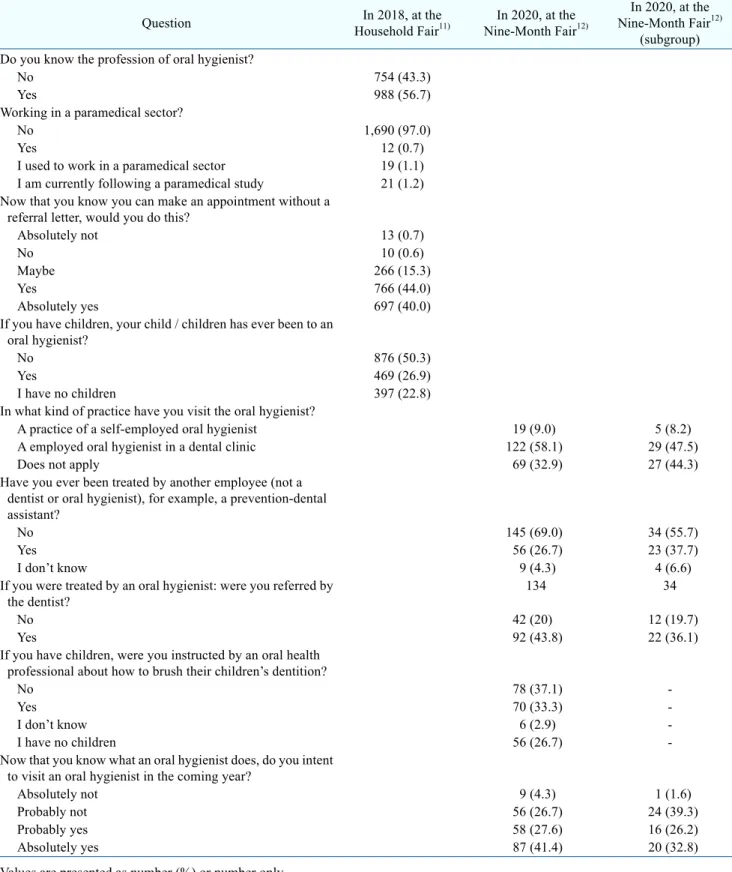
In Table 2 the distribution of the responses to common questions in Study 1 and in Study 2 were shown. Table 3 showed the responses to the other various questions in Study 1 and in Study 2, respectively.

3. Observations of the experienced oral hygienists Study 2

The observations during the semi-structured interviews showed that about three-quarter of the visitors indicated that they only visited an oral hygienist if their dentist deemed it necessary. Other frequently heard and reported comments from the visitors were “Why should I go to the

oral hygienist, I have no problems or complaints” and “I don’t go to an oral hygienist regularly; I only visit the oral hygienist during pregnancy.” Information was often provided that tailored this target group of pregnant women and young mothers, for example, knowledge about hidden sugars or other nutritional advice, and oral care health education for themselves and their babies and toddlers.

Many were surprised that they could visit the oral hygienist without referral by a dentist, and a common response for (probably) not intending to visit an oral hygienist in the coming year, was “An oral hygienist is too expensive, and therefore my dentist will clean my teeth”.

In general, the responses to the survey were “easy to do”,

though some respondents thought the questionnaire was

too long.

(6)

Table 3. Responses to the Other Various Questions in Study 1 and in Study 2, Respectively

Question In 2018, at the

Household Fair

11)

In 2020, at the Nine-Month Fair

12)

In 2020, at the Nine-Month Fair

12)

(subgroup) Do you know the profession of oral hygienist?

No 754 (43.3)

Yes 988 (56.7)

Working in a paramedical sector?

No 1,690 (97.0)

Yes 12 (0.7)

I used to work in a paramedical sector 19 (1.1) I am currently following a paramedical study 21 (1.2) Now that you know you can make an appointment without a

referral letter, would you do this?

Absolutely not 13 (0.7)

No 10 (0.6)

Maybe 266 (15.3)

Yes 766 (44.0)

Absolutely yes 697 (40.0)

If you have children, your child / children has ever been to an oral hygienist?

No 876 (50.3)

Yes 469 (26.9)

I have no children 397 (22.8)

In what kind of practice have you visit the oral hygienist?

A practice of a self-employed oral hygienist 19 (9.0) 5 (8.2)

A employed oral hygienist in a dental clinic 122 (58.1) 29 (47.5)

Does not apply 69 (32.9) 27 (44.3)

Have you ever been treated by another employee (not a dentist or oral hygienist), for example, a prevention-dental assistant?

No 145 (69.0) 34 (55.7)

Yes 56 (26.7) 23 (37.7)

I don’t know 9 (4.3) 4 (6.6)

If you were treated by an oral hygienist: were you referred by the dentist?

134 34

No 42 (20) 12 (19.7)

Yes 92 (43.8) 22 (36.1)

If you have children, were you instructed by an oral health professional about how to brush their children’s dentition?

No 78 (37.1) -

Yes 70 (33.3) -

I don’t know 6 (2.9) -

I have no children 56 (26.7) -

Now that you know what an oral hygienist does, do you intent to visit an oral hygienist in the coming year?

Absolutely not 9 (4.3) 1 (1.6)

Probably not 56 (26.7) 24 (39.3)

Probably yes 58 (27.6) 16 (26.2)

Absolutely yes 87 (41.4) 20 (32.8)

Values are presented as number (%) or number only.

-: not avilable.

(7)

Discussion

The aim of both public health studies was to promote the profession of the oral hygienist, including stimulating regular visits to qualified oral health professionals. Also, the studies aimed to increase oral health care awareness, to evaluate the impact of a professional oral health education, to gain greater insight into opinions and preferences of visitors during two public consumer’s exhibition. Informal and spontaneous visitors were rewarded with a ‘goody bag’ containing various oral health gadgets. Descriptive findings demonstrate that the visitors rated their own oral health with a relatively high score, in comparison with the visitors of the Kidsfabriek, who valued their perceived oral health as ‘ample’, with a mean value of 7.3 (SD=1.2)

23)

. Overestimation of own oral health status could be an explanation as some women may believe that impaired oral health during pregnancy is normal. Findings of women's attitudes, experiences, and behaviors before, during, and after pregnancy have shown that most mothers did not make a dental visit during pregnancy

24,25)

. Current study-outcomes showed that the existence of qualified (self) employed oral hygienists seems to be known among the visitors, but that oral hygienists were only visited upon referral of their dentists, or were only visited in the practice of a dental clinic. Whereas in Study 1, more than three quarters of the visitors did not know they could visit the oral hygienist without a referral from the dentist, in Study 2, two thirds reported to know they could; of which, in Study 2 even a small percentage (4%) more of the women, who were pregnant with their first child, reported to know that they did not need a referral.

In Study 2, more than two thirds reported to know that a visit to an oral hygienist (up to the age of 18) is reimbursed under the basic insurance, which is more improvement over the results of Study 1. However, still one thirds reported not to know, and more or less the same percentage (like during the Kidsfabriek event

23)

) reported that they were never been instructed by an oral health professional about how to brush their children’s dentition.

In Study 1, 95% of the visitors reported that because they now know that their child up to the age of 18 can visit the oral hygienist for ‘free’, they would visit an oral

hygienist. In two years this percentage has fallen to 70%

and a quarter reported probably not. Moreover, a quarter of all visitors (26.7%) and 37.7% of the women being pregnant with their first child have ever been treated by a prevention-dental assistant. This last percentage is about in line with unpublished data from the Kidsfabriek event

23)

, at which more than a third of these visitors (36.6%) reported visiting a prevention-dental assistant, and 7% reported not to know. An explanation for this may lie in the fact that parts of the public do not know the difference between a professionally educated oral hygienist

1,2)

and a prevention-dental assistant

3,5.7)

. Unpublished outcomes about the impact and findings concerning design, content and the intention or willingness for behavioral change as an effect of a Dutch poster-based intervention about the difference between dental hygienists and prevention-dental assistants during the Kidsfabriek event

23)

showed that around 35.2% of the visitors reported to have the intention to inquire by whom they were treated, and that they are willing to give permission if the treatment is not performed by a dentist or oral hygienist.

Both studies are limited because the various data collected were self-reported, for example, about the profession of the oral hygienist and being treated by another employee than a dentist or oral hygienist, e.g., a prevention-dental assistant. Implications for members of GG, especially self-employed oral hygienists, are that they feel threatened in their work. Another implication is the fact, that the public has no real choice; it is a problem for them who are not getting the treatment they deserve when they think they are.

The DPSI

17)

used in Study 1 is replaced by the new simplified screening method PPS (periodic periodontal screening). Recently, the new guideline Periodontal Screening is characterized by an important change in classification of diseases

26)

. In Study 1, simultaneously with the House hold Fair the Nine-Month Fair took place.

This could mean that among the respondents of Study 1 there were also specific visitors, e.g., pregnant women, who combined their visit to both fairs.

As earlier public health studies performed in Korea

27)

,

these both studies showed that participation of GG in

public events may play an important role in the impro-

(8)

vement of awareness of their profession and of oral health awareness, like in previous Dutch studies

8,13,22,23)

. Especially the latter (oral health awareness) is an important first step when it comes to oral health behavioral change, and therefore the different phases of the Transtheoretical Model of Behavior Change

28)

, and/or applying other social psychological theories and models, for instance, the Health Belief Model

29)

, have to be involved when following oral public health campaign studies.

Future research should give increased attention to the different competencies of qualified oral hygienists and prevention-dental assistants. Also more attention is needed for the fact that directly (without referral) visits to self-employed oral hygienists are possible, and that there is a reimbursement by the basic insurance for people up to the age of 18. The information of both studies might be helpful for public health decision makers to make more appropriate decisions about implementing oral health education with pregnant women, and develop interventions tailored to oral health needs and behaviors of (pregnant) women

30)

. Much more Dutch qualified oral health professionals may follow the approach of GG and interact with the public through public events, schools, well-child care clinics, homes and/or by social media

1,31)

. However, the impact of the COVID-19 pandemic situation, with the limitations of crowded public events, including a social distance of 1.5 meters and wearing face masks

32)

may affect (viewing from broader perspectives) the pre- COVID-19 findings of both studies

33)

.

Notes

Conflict of interest

No potential conflict of interest relevant to this article was reported.

Ethical approval

No approval number is needed in this case (behavioral study) needed and available.

Author contributions

Conceptualization: Yvonne A.B. Buunk-Werkhoven, Judith J.E. Sjoerts, and Annemarie Frederiks. Revision

questionnaire: Judith J.E. Sjoerts and Yvonne A.B.

Buunk-Werkhoven. Data acquisition: Yvonne A.B.

Buunk-Werkhoven, Jolanda J.C. Gortzak, Judith J.E.

Sjoerts, and Annemarie Frederiks, Formal analysis Yvonne A.B. Buunk-Werkhoven and Jolanda J.C. Gortzak.

Funding: members of the Foundation ‘Goed Gebekt’.

Supervision: Yvonne A.B. Buunk-Werkhoven. Writing-original draft: Yvonne A.B. Buunk-Werkhoven and Annemarie Frederiks. Writing-review & editing: Annemarie Frederiks, Jolanda J.C. Gortzak, Judith J.E. Sjoerts, Yvonne A.B.

Buunk-Werkhoven. All authors gave their final approval of the version to be published.

ORCID

Yvonne A.B. Buunk-Werkhoven,

https://orcid.org/0000-0001-8524-9574 Jolanda J.C. Gortzak,

https://orcid.org/0000-0001-8274-8669

Judith J.E. Sjoerts, https://orcid.org/0000-0002-5807-0752 Annemarie Frederiks, https://orcid.org/0000-0003-4951-1592

Acknowledgements

We would like to thank Maja Koster and Tiffany Claus for their extraordinary help and support before and during the Household Fair in 2018, including their contribution to the acquisition. Again, many thanks to Maja Koster for her help at the Nine-Month Fair in 2020. For both studies, also many thanks to all the dental hygienists who helped on a voluntary basis at the events. The gadgets for the goody bags were kindly supported by various sponsors in the Netherlands.

References

1. Foundation ‘Goed Gebekt’: [Stichting Goed Gebekt, ter bevordering van het vak mondhygiënist]. Retrieved May 7, 2020, from https://www.goedgebekt.net/. Dutch.

2. Jongbloed-Zoet C, Bol-van den Hil EM, La Rivière-Ilsen J, van der Sanden-Stoelinga MS: Dental hygienists in The Netherlands: the past, present and future. Int J Dent Hyg 10:

148-154, 2012.

https://doi.org/10.1111/j.1601-5037.2012.00573.x

3. Folgerts O, van Splunter-Schneider M, Buunk-Werkhoven

(9)

YAB: Public health and association’s membership:

desires/duties of oral health professionals. Int Dent J 65(S1):

S1-S232, 2015.

4. Buunk-Werkhoven YA, Hollaar VR, Jongbloed-Zoet C:

Work engagement among Dutch dental hygienists. J Public Health Dent 74: 227-233, 2014.

https://doi.org/10.1111/jphd.12050

5. den Boer JCL, van der Sanden WJM, Bruers JJM:

Developments in oral health care in the Netherlands between 1995 and 2018. BMC Oral Health 20: 192, 2020.

https://doi.org/10.1186/s12903-020-01174-8

6. Reinders JJ, Krijnen WP, Onclin P, van der Schans CP, Stegenga B: Attitudes among dentists and dental hygienists towards extended scope and independent practice of dental hygienists. Int Dent J 67: 46-58, 2017.

https://doi.org/10.1111/idj.12254

7. Rederiene G, Aidukaite G, Berlin V, Buunk-Werkhoven YAB, Puriene A: Practice characteristics and views of dental hygienists in Lithuania. Int J Dent Hyg 18: 432-438, 2020.

https://doi.org/10.1111/idh.12458

8. Buunk-Werkhoven YAB, Reyerse E: What is the impact of oral (public) health promotion, and of interventions for oral (self) care awareness raising and behavior change? J Dent Oral Disord Ther 8: 1-4, 2020.

9. Thevissen E, De Bruyn H, Colman R, Koole S: Attitude of dental hygienists, general practitioners and periodontists towards preventive oral care: an exploratory study. Int Dent J 67: 221-228, 2017.

https://doi.org/10.1111/idj.12289

10. Listl S, Galloway J, Mossey PA, Marcenes W: Global economic impact of dental diseases. J Dent Res 94:

1355-1361, 2015.

https://doi.org/10.1177/0022034515602879

11. Foundation ‘Goed Gebekt’: op de Huishoudbeurs [A Household Fair in 2018]. Retrieved April 29, 2021, from https://www.goedgebekt.net/huishoudbeurs.html. Dutch.

12. Foundation ‘Goed Gebekt’: Goed Gebekt gaat naar de Negenmaandenbeurs [the Nine-Month Fair]. Retrieved April 29, 2021, from https://www.goedgebekt.net/9mndbeurs.html.

Dutch.

13. Buunk-Werkhoven YAB, Burrekers SY: Oral health awareness, promotion of home oral self-care, and professional oral health care among young mothers and their babies: a pilot

project. Oral Health Care 2: 1-4, 2017.

https://doi.org/10.15761/OHC.1000134

14. Verlinden DA, Schuller AA, Verrips GHW, Reijneveld SA:

Effectiveness of a short web-based film targeting parental oral health knowledge in a well-child care setting. Eur J Oral Sci 128: 226-232, 2020.

https://doi.org/10.1111/eos.12700

15. Folgerts O, Buunk-Werkhoven YAB, Batenburg R: Periodontal screening during an oral public health promotion campaign: a study among health consumers. Int Dent J 69: 289-294, 2019.

https://doi.org/10.1111/idj.12475

16. Central Committee on Research Involving Human Subjects (CCMO): Questionnaire research. Retrieved December 28, 2020, from http://www.ccmo.nl/en/questionnaire-research.

17. Van der Velden U: The Dutch periodontal screening index validation and its application in The Netherlands. J Clin Periodontol 36: 1018-1024, 2009.

https://doi.org/10.1111/j.1600-051X.2009.01495.x

18. Van Dannis H, Steures R, Sipos P: [Your gum gets a number]. NVvP, Avenhorn, pp.1-6, 2010.

19. Tandvleescijfer. Retrieved April 29, 2021, from https://

www.tandvleescijfer.nl.

20. Coronacrisis in Nederland. Retrieved December, 28 2020, from https://nl.wikipedia.org/wiki/Coronacrisis_in_Nederland.

21. Cantril H: The pattern of human concerns. Rutgers University Press, New Brunswick, 1965.

22. Buunk-Werkhoven YA, Dijkstra A, van der Schans CP:

Determinants of oral hygiene behavior: a study based on the theory of planned behavior. Community Dent Oral Epidemiol 39: 250-259, 2011.

https://doi.org/10.1111/j.1600-0528.2010.00589.x

23. Buunk-Werkhoven YAB, Takrovskaja K, Steverink-Jorna LM: Kidsfabriek: Oral health awareness and promotion of oral self-care during a learning and play event for children and parents in The Netherlands. Annu Clin J Dent Health 7:

22-25, 2018.

24. George A, Dahlen HG, Reath J, et al.: What do antenatal care providers understand and do about oral health care during pregnancy: a cross-sectional survey in New South Wales, Australia. BMC Pregnancy Childbirth 16: 382, 2016.

https://doi.org/10.1186/s12884-016-1163-x

25. Ressler-Maerlender J, Krishna R, Robison V: Oral health

during pregnancy: current research. J Womens Health

(10)

(Larchmt) 14: 880-882, 2005.

https://doi.org/10.1089/jwh.2005.14.880

26. Tonetti MS, Sanz M: Implementation of the new classification of periodontal diseases: decision-making algorithms for clinical practice and education. J Clin Periodontol 46:

398-405, 2019.

https://doi.org/10.1111/jcpe.13104

27. Jung MH, Park MY: A study on the oral healthcare condition of adult in public health and their knowledge about oral health. J Dent Hyg Sci 7: 73-79, 2007.

28. Prochaska JO, DiClemente CC, Norcross JC: In search of how people change. Applications to addictive behaviors. Am Psychol 47: 1102-1114, 1992.

https://doi.org/10.1037//0003-066x.47.9.1102

29. Kim MN, Lim DS, Kim MH, Kim AR, Kim SI, Ahn YS:

Effect of health belief factor on oral health related behavior in pregnant woman. J Dent Hyg Sci 15: 129-137, 2015.

https://doi.org/10.17135/jdhs.2015.15.2.129

30. Figueiredo MGOP, Takita SY, Dourado BMR, et al.:

Periodontal disease: repercussions in pregnant woman and newborn health-a cohort study. PLoS One 14: e0225036, 2019.

https://doi.org/10.1371/journal.pone.0225036

31. dental INFO: Promotional video for awareness of the oral hygienist among the general public. Retrieved May 12, 2021, from https://www.dentalinfo.nl/kennis/communicatie-patient/

romotiefilmpje-voor-bekendheid-mondhygienist-bij-het-grot e-publiek/.

32. Kim JH, Kim MY: Systematic literature review on Coronavirus infectious disease-19 and dental masks. J Dent Hyg Sci 21:

1-7, 2021.

https://doi.org/10.17135/jdhs.2021.21.1.1

33. dental INFO: Current information about Corona virus for oral care. Retrieved December 28, 2020. From https://www.

entalinfo.nl/thema-a-z/medisch-tandheelkundig/coronavirus

-waar-vind-je-actuele-informatie/.

수치

Table  1.  General  Characteristics  of  the  Visitors  Characteristic In 2018, at the Household Fair 11) In 2020, at theNine-Month Fair 12)
Table  2.  Responses  to  Common  Questions  in  Study  1  and  in  Study  2 Question In 2018, at the Household Fair 11) In 2020, at the Nine-Month Fair 12) In 2020, at the Nine-Month Fair 12) (subgroup) Have you ever visited the oral hygienist?
Table  3.  Responses  to  the  Other  Various  Questions  in  Study  1  and  in  Study  2,  Respectively Question In 2018, at the  Household Fair 11) In 2020, at the Nine-Month Fair 12) In 2020, at the Nine-Month Fair 12) (subgroup) Do you know the profess

참조

관련 문서

The Oral health status (such as subjective oral heal th status, toothache) and oral health behaviors (such as tooth brush, or al health examination) were

The experimental group consisted of 458 children from two schools that have oral health centers run by Suncheon Public Health Department, and the control group consisted of

The purpose of this study was to investigate the effects of sound-finding strategies based on phonological awareness on word recognition, oral reading

The first public medical insurance act enacted in 1963 and according to the Amendment in 1976 became the health care insurance compulsorily.. The national

Conclusions : To promote the role of traditional Korean medicine in the public health sector in order to integrate traditional medicine into the public

Abstract: This study aimed to review the oral hygiene status, oral care guidelines, and outcomes of oral care in intensive care unit (ICU) patients from a dental

Note: Figures are estimated using the National Health Insurance database of the National Health Insurance Service; they are standardized for sex and age with reference

□ The least-upper-bound property (sometimes called completeness or supremum property) is a fundamental property of the real number system. The least-upper-bound