Journal of the Korean Chemical Society 2019, Vol. 63, No. 4
Printed in the Republic of Korea https://doi.org/10.5012/jkcs.2019.63.4.233
-233-
Mechanistic Studies of the Solvolyses of Cyclohexanesulfonyl Chloride
Suk Jin Kang and Han Joong Koh*
Department of Science Education, Jeonju National University of Education, Jeonju 55101, Korea.
*E-mail: [email protected]
(Received March 15, 2019; Accepted April 3, 2019)
ABSTRACT. In this study, the solvolysis of cyclohexanesulfonyl chloride (1) was studied by kinetics in ethanol-water, meth- anol-water, acetone-water, and 2,2,2-trifluoroethanol (TFE)-water binary solvent systems. The rate constants were applied to the extended Grunwald-Winstein equation, to obtain the values of m = 0.41 and l = 0.81. These values suggested SN2 mecha- nism in which bond formation is more important than bond breaking in the transition state (TS). Relatively small activation enthalpy values (11.6 to 14.8 kcal·mol-1), the large negative activation entropy values (-29.7 to -38.7 cal·mol-1·K-1) and the sol- vent kinetic isotope effects (SKIE, 2.29, 2.30), the solvolyses of the cyclohexanesulfonyl chloride (1) proceeds via the SN2 mechanism.
Key words: Cyclohexanesulfonyl chloride, Extended Grunwald-Winstein equation, SN2 mechanism, Solvent kinetic isotope effect
INTRODUCTION
The reaction mechanism for the nucleophilic substitution reaction at a halogenated sulfonyl has attracted consider- able attention. It has been reported that the nucleophilic substitution reaction of halogenated sulfonyl having 4- coordination sulfur in a various binary solvents is an SN2 reaction1 or addition-elimination (A-E) reaction.2 We reported that the solvolysis of methanesulfonyl chloride undergo a SN2 reaction mechanism close to the A-E reaction.3 Also, it is generally known that the solvolysis of benzenesulfonyl chlo- ride proceeds through three reaction mechanisms, Scheme 1.4 In this study, the solvolysis of cyclohexanesulfonyl chlo- ride (1), which is not an aromatic ring, was studied kinet- ically in ethanol-water, methanol-water, acetone-water, and TFE-water binary solvent systems, (eq. 1).
(1)
The rate constants were applied to the extended Grun- wald-Winstein equation to discuss the reaction mecha- nism. The reaction mechanism were also discussed through by determining the activation parameters (ΔH≠ and ΔS≠) and solvent kinetic isotope effect (SKIE).
RESULTS AND DISCUSSION
Rate constants for the solvolysis of 1 are summarized in binary solvent systems (Table 1). The rate constant increases in the order of TFE-water < acetone-water < ethanol-water
< methanol-water. The reaction rate also tends to increase as the water content increases (i.e., more nucleophilic sol- vent). The fact that the reaction rate increases with increasing solvent ionization power means that the TS of this reaction is relatively sensitive to water. These results strongly imply that the solvolysis of 1 proceeds by a bimolecular reaction mechanism.4
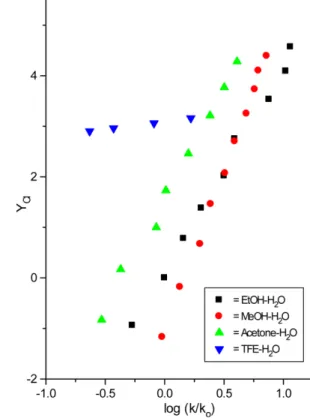
In Fig. 1, we can see that the four solvent systems in the Grunwald-Winstein equation5 (eq. 2) for the solvolysis of 1 are dispersed. In addition, the TFE-water solvent shows a large dispersion phenomenon, which makes it difficult to quantitatively analyze the reaction mechanism for the sol- volysis of the sulfonyl compound in a binary mixed solvent system. Fig. 1 shows that such as the nucleophilicity of the solvent should be considered.6
Scheme 1. Reaction pathways for the solvolysis of benzenesul- fonyl chloride.
Journal of the Korean Chemical Society
234 Suk Jin Kang and Han Joong Koh
log (k/ko) = mYCl + c (2)
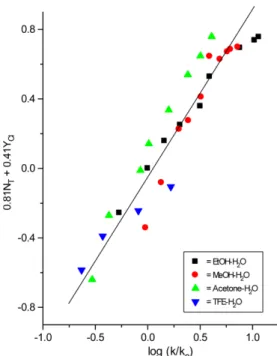
The bimolecular nucleophilic substitution reaction pro- ceeds to a push-pull reaction mechanism in which the sol- vent acts simultaneously with the nucleophile and the electrophile such as Scheme 2.6 Therefore, the bimolecular solvolysis reaction can be applied to the extended Grunwald- Winstein equation7 (eq. 3), which is also dependent on the sensitivity to the nucleophilicity (NT) of the solvent. Fig. 2
log (k/ko) = lNT + mYCl + c (3)
shows an extended Grunwald-Winstein equation plot with the nucleophilicity term of the solvent added to investi- gate the dispersion phenomenon depending on the nuc- leophilicity of the solvent. The dispersion phenomenon is greatly reduced in the extended Grunwald-Winstein equa- tion plot.7
The m value indicating the sensitivity of the ionization power of the solvent was 0.41 and the l value indicating the sensitivity to the nucleophilicity of the solvent was 0.81.
The l and m values for solvolyses of 1 are similar to those for the other solvolyses listed in Table 2, and can be expected an SN2 mechanism in which bond formation is important than bond breaking. According to the results previously reported, l/m values of 1.2 to 3.5 leads to the bimolecular pathway. In this studies, value l/m of 2.0 was obtained (Table 2), and this gives a strong support for a bimolecular reaction mechanism in the solvolysis of 1.7
The activation parameter (ΔH≠ and ΔS≠) values provide Table 1. Rate constants for the solvolyses of 1a in binary solvent
mixtures at 55.0oC, and the NT and the YCl values for the solvents Solvent (%)b NTc YClc k (s-1)
90EtOH 0.16 -0.94 2.45×10⁻⁵
80EtOH 0.00 0.00 4.57×10⁻⁵
70EtOH -0.20 0.78 6.61×10⁻⁵
60EtOH -0.39 1.38 9.33×10⁻⁵
50EtOH -0.58 2.02 1.45×10⁻⁴
40EtOH -0.74 2.75 1.78×10⁻⁴
30EtOH -0.93 3.53 3.47×10⁻⁴
20EtOH -1.16 4.09 4.79×10⁻⁴
H2O -1.38 4.57 5.25×10⁻⁴
100MeOH 0.17 -1.17 4.37×10⁻⁵
90MeOH -0.01 -0.18 6.17×10⁻⁵
80MeOH -0.06 0.67 9.12×10⁻⁵
70MeOH -0.40 1.46 1.12×10⁻⁴
60MeOH -0.54 2.07 1.48×10⁻⁴
50MeOH -0.57 2.70 1.78×10⁻⁴
40MeOH -0.87 3.25 2.24×10⁻⁴
30MeOH -1.06 3.73 2.63×10⁻⁴
20MeOH -1.23 4.10 2.82×10⁻⁴
10MeOH -1.36 4.39 3.31×10⁻⁴
80Acetone -0.37 -0.83 1.35×10⁻⁵
70Acetone -0.42 0.17 1.85×10⁻⁵
60Acetone -0.52 1.00 3.89×10⁻⁵
50Acetone -0.70 1.73 4.68×10⁻⁵
40Acetone -0.83 2.46 7.24×10⁻⁵
30Acetone -0.96 3.21 1.10×10⁻⁴
20Acetone -1.11 3.77 1.45×10⁻⁴
10Acetone -1.23 4.28 1.86×10⁻⁴
80TFEd -2.17 2.90 1.07×10⁻⁵
70TFE -1.98 2.96 1.70×10⁻⁵
60TFE -1.85 3.06 3.72×10⁻⁵
50TFE -1.73 3.16 7.59×10⁻⁵
aUnless otherwise indicated, a 1.0 mol dm-3 solution of the substrate in the indicated solvent, containing 0.1% CH3CN. bOn a volume-volume content at 25.0 oC, and the other component is water. cValues from refs. 5. dSolvent prepared on a weight-weight basis at 25.0 oC, and the other component is water.
Figure 1. Plot of log (k/ko) for solvolyses cyclohexanesulfonyl chloride (1) in 31 solvents at 55.0oC against YCl.
Scheme 2. Push-pull reaction.
Mechanistic Studies of the Solvolyses of Cyclohexanesulfonyl Chloride 235
2019, Vol. 63, No. 4
information on the reaction mechanism of the nucleophilic substitution reaction and the solvolysis reaction. Table 3 summarizes the rate constants and the activation parameter values in 80% ethanol-water, methanol, and 50% TFE-water solvent systems. In the present study, it is shown that the enthalpy change is relatively small and negative entropy change value is large, which means a bimolecular reaction that the disorder state of the transition state is greatly reduced.15
The solvent kinetic isotope effect (SKIE) also provides important information for predicting the reaction mecha- nism. A reaction in which an alcohol or water molecule sol- vent acts as a general base catalyst can be shown in Scheme 3.16 When O-H bond dissociation of the nucleophile alco-
hol or water molecule is performed in the determination step of the TS, the difference of reaction rate is shown when the nucleophile is R-O-H and R-O-D, and thus the SKIE is exhibited.17
The solvent kinetic isotope effects of the solvolysis of 1 are summarized in Table 4. SKIEs provide information for the mechanism of the reaction.
The SKIE values in the solvolysis of 1 were 2.29 and 2.30, respectively. According to the previous studies, it is known that the SKIE value is 1.7 or more for the normal base cat- alytic reaction, whereas the value is as small as 1.2 to 1.5 for the SN2 reaction. The reaction of this study has a relatively large SKIE value, which support to a bimolecular reaction that proceeds with a general base catalytic reaction.18
CONCLUSION
A kinetic study was carried out to investigate the mech- Figure 2. Plot of log (k/ko) for solvolyses of cyclohexanesulfo-
nyl chloride (1) in 31 solvents at 55.0oC against (0.81NT + 0.41YCl).
Table 2. Extended Grunwald-Winstein correlation of the kinet- ics of solvolytic displacement of chloride
Substrate na lb mb l/m Rc
C6H5CH2SO2Cld C13H9CH2OCOCle
C6H5SO2Clf (C6H5)2PSClg (CH3)2NC10H6SO2Clh
4-CH3OC6H4SO2Cli CH2=CHCH2OCOClj
(C6H5)2CHCOClk Cyclo-C6H11SO2Cll
30 30 37 25 31 38 30 34 31
0.61 0.95 1.10 1.00 0.96 1.07 0.93 0.76 0.81
0.34 0.39 0.61 0.64 0.53 0.60 0.41 0.34 0.41
1.8 2.4 1.6 1.8 1.8 2.3 2.2 2.2 2.0
0.954 0.941 0.959 0.983 0.955 0.967 0.964 0.932 0.949
aNumber of solvents. bFrom eq. (3). cMultiple correlation coefficient. dRef.
8. eRef. 9. fRef. 4. gRef. 10. hRef. 11. iRef. 12. jRef. 13. kRef. 14. lThis work.
Table 3. Rate constants and activation parameters for the sol- volyses of 1a at various temperatures
Solvent (%)b T (oC) k (s-1)c ΔH≠ (kcal/mol)d
-ΔS≠ (cal/mol·K)d
80EtOH
35 1.30×10⁻⁵
12.1±0.7 38.7±1.8 45 2.41×10⁻⁵
55 4.57×10⁻⁵
100MeOH
35 1.28×10⁻⁵
11.60.5 40.1±1.7 45 2.43×10⁻⁵
55 4.37×10⁻⁵
50TFEe
35 1.64×10⁻⁵
14.80.2 29.7±0.6 45 3.45×10⁻⁵
55 7.59×10⁻⁵
aA 1.0 mol·dm-3 solution of the substrate in the indicated solvent, also con- taining 0.1% CH3CN. bOn a volume-volume content at 25.0 oC, and the other component is water. cAverages of three or more runs. dThe activation parameters are accompanied by the standard error. eSolvent prepared on a weight-weight basis at 25.0 oC, and the other component is water.
Scheme 3. Solvent kinetic isotope effect.
Table 4. Solvent kinetic isotope effects (SKIEs) for the solvoly- ses of 1 at 55.0oC.
Solvent kH (s) kD (s) SKIE
MeOH 4.37×10⁻⁵ 1.89×10⁻⁵ 2.30
H2O 5.25×10⁻⁴ 2.29×10⁻⁴ 2.29
Journal of the Korean Chemical Society
236 Suk Jin Kang and Han Joong Koh
anism of the solvolysis of 1 and the following conclusions were obtained. The dispersion of Grunwald-Winstein equa- tion5 plot was shown in several solvent systems, and the dis- persion was greatly improved extended Grunwald-Winstein equation plot.7
The rate constants were applied to the extended Grun- wald-Winstein equation, and the results were m = 0.41 and l
= 0.81. These values suggested the SN2 mechanism in which bond formation is more important than bond breaking in the TS. In addition, based on the relatively small activation enthalpy values, the large negative activation entropy values, and the SKIE values, the reaction of this study is expected to proceed through the SN2 mechanism.
EXPERIMENTAL
Ethanol, methanol, acetone and 2,2,2-trifluoroethanol (TFE) solvents were GR grade. Water was used after the third dis- tillation. The substrate, cyclohexanesulfonyl chloride (1), was purchased. The solvolysis of 1 produces hydrogen ions and chloride ions. The reaction rate was measured by the electric conductivity method using the first-order propor- tionality of the conductivity with the change of the amounts of hydrogen ions and chloride ions. The reaction was car- ried out with a substrate concentration of about 10-3 M and a similar first-order reaction, in which the concentration of the nucleophile was much larger than that of the substrate.
The uncertainty in the kobsd values was estimated to be less than ± 3% from replicate runs.
REFERENCES
1. (a) Rogne, O. J. Chem. Soc. B 1968, 1294. (b) Kim, W.
K.; Lee, I. J. Korean Chem. Soc. 1974, 18, 8. (c) Kevill, D. N.; Park, B. C.; Park, K. H.; D’Souza, M. J.; Yaakoubd, L.;
Milynarski, S. L.; Kyong, J. B. Org. Biomol. Chem. 2006, 4, 1580.
2. Ciuffarin, E.; Senatore, L.; Isola, M. J. Chem. Soc., Per- kin Trans. 2 1972, 268.
3. Koo, I. S.; Kwon, E. J.; Choi, H. J.; Yang, K. Y.; Park, J.
K.; Lee, J. P.; Lee, I.; Bentley, T. W. Bull. Korean Chem.
Soc. 2007, 28, 12.
4. Kevill, D. N.; Ryu, J. H.; Neidermeyer, M. A.; Koyoshi, F.; D’Souza, M. J. J. Phys. Org. Chem. 2007, 20, 431.
5. (a) Grunwald, E.; Winstein, S. J. Am. Chem. Soc. 1948, 70, 846. (b) Winstein, S.; Grunwald, E.; Jones, H. W. J. Am.
Chem. Soc. 1951, 73, 2700.
6. Bentley, T. W.; Dau-Schmidt, J. P.; Llewellyn, G.; Mayr, H. J. Org. Chem. 1992, 57, 2387.
7. (a) Kevill, D. N.; D’Souza, M. J. J. Chem. Soc. Perkin Trans. 2 1995, 973. (b) Kevill, D. N.; D’Souza, M. J. J.
Chem. Soc. Perkin Trans. 2 1997, 257. (c) Kevill, D. N.;
Bond, M. W.; D’Souza, M. J. J. Org. Chem. 1997, 62, 7869.
8. Koh, H. J.; Kang, S. J. Bull. Korean Chem. Soc. 2011, 32, 1897.
9. Koh, H. J.; Kang, S. J. Bull. Korean Chem. Soc. 2011, 32, 3799.
10. Kevill, D. N.; Ryu, J. H.; Neidermeyer, M. A.; Koyoshi, F.; D’Souza, M. J. J. Phys. Org. Chem. 2007, 20, 431.
11. Koh, H. J.; Kang, S. J. Bull. Korean Chem. Soc. 2014, 35, 2285.
12. D’Souza, M. J.; Yaakoubd, L.; Mlynarski, S. L.; Kevill, D. N. Int. J. Mol. Sci. 2008, 9, 914.
13. Koh, H. J.; Kang, S. J. Bull. Korean Chem. Soc. 2012, 33, 4117.
14. Koh, H. J.; Kang, S. J. Bull. Korean Chem. Soc. 2015, 36, 2429.
15. Harris, J. M.; Clark, D. C.; Becker, A.; Fagan, J. F. J. Am.
Chem. Soc. 1974, 96, 4478.
16. Bentley, T. W.; Ryu, Z. H. J. Chem. Soc. Perkin. J. Chem.
Soc. Perkin Trans. 2 1994, 761.
17. Bentley, T. W.; Schleyer, P. v. R. J. Am. Chem. Soc. 1976, 98, 7658.
18. Robertson, R. E. Prog. Phys. Org. Chem. 1967, 4, 213.