Printed in the Republic of Korea DOI 10.5012/jkcs.2011.55.4.644
Polyaniline/SiO
2를 이용한 one-pot Mannich 반응: β-amino carbonyl 화합물의 효율적인 합성
Ajeet A. Yelwande, Balasaheb R. Arbad, and Machhindra K. Lande*
Department of Chemistry, Dr. Babasaheb Ambedkar Marathwada University, Aurangabad (M.S.), 431004, India (접수 2010. 12. 12; 수정 2011. 3. 4; 게재확정 2011. 3. 16)
Polyaniline/SiO
2Catalyzed One-pot Mannich Reaction: An Efficient Synthesis of β-amino Carbonyl Compounds
Ajeet A. Yelwande, Balasaheb R. Arbad, and Machhindra K. Lande*
Department of Chemistry, Dr. Babasaheb Ambedkar Marathwada University, Aurangabad (M.S.), 431004, India.
*E-mail: [email protected]
(Received December 12, 2010; Revised March 4, 2011; Accepted March 16, 2011)
요 약. Polyaniline/SiO2촉매를 이용하여, acetophenone, aromatic aldehydes와 aromatic amines을 에탄올 용매 속에서 반응 시켜서 다양한 various β-amino ketones을 one-pot mannich 반응을 수행하였으며, 이 반응을 위해 silica가 충진된 여러 가지 종류의 wt% polyaniline을 화학적인 산화방법에 의해 합성하였다. 합성한 촉매는 thermal analysis(TG-DTA), X-ray diffraction (XRD), scanning electron microscopy(SEM) energy dispersive spectroscopy(EDS), 및 Fourier transform infrared spectroscopy (FT-IR) 방법으로 확인하였으며, 촉매의 용매에 대한 안정도 UV-Visible spectroscopy로 측정하였다. Polyaniline/SiO2촉매를 이용하는 합성 방법은높은 수율로 얻어지며, work up이 쉽고, 독성이 없으며, 쉽게 회수하여 재사용이 가능하다.
주제어: 화학적인 산화반응, Polyaniline/SiO2, Mannich 반응, β-amino carbonyl 화합물
ABSTRACT. Polyaniline/SiO2 catalyzed one-pot mannich reaction of acetophenone, aromatic aldehydes and aromatic amines are carried out in ethanol to afford various β-amino ketones. The various wt% of polyaniline were supported on pure silica synthesized by using chemical oxidative method. The catalyst prepared has been characterized by means of thermal analysis (TG-DTA), X-ray diffraction (XRD), scanning electron microscopy (SEM) energy dispersive spectroscopy (EDS), and Fourier transform infrared spectroscopy (FT-IR). Solvent stability of catalyst was tested using UV-Visible spectroscopy. This protocol has several advantages such as high yield, simple work up procedure, non-toxic, clean, easy recovery and reusability of the catalyst.
Keywords: Chemical oxidative method, Polyaniline/SiO2, Mannich reaction, β-amino carbonyl compounds
INTRODUCTION
Polyaniline is an organic conducting polymeric mate- rial due to their wide range of electrical, electrochemical, and optical properties as well as their good stability.1-4 It is commonly synthesized by oxidizing aniline monomers in bronsted acids using electrochemical or chemical meth- ods.5-7 Polyaniline supported catalyst bears good environ- mental, thermal and chemical stability, electrical and optical properties, facile redox and pH-switching behav- ior.8 Polyanline and polyaniline supported metal oxide has been extensively used as solid acid catalysts for various organic transformations such as oxidation, dehydrogena- tion, condensation, Michael, Suzuki-Miyaura cross-cou- pling and esterification reactions.9-16
Mannich reaction is one of the most important C-C bond forming reactions in organic synthesis for the prep- aration of secondary and tertiary amine derivatives.17,18 The products of Mannich reaction are mainly β-amino carbonyl compounds which are important synthetic inter- mediates for various pharmaceuticals and natural prod- ucts.19,20 Mannich reactions using electrophiles like imines and stable nucleophiles, such as enolates, enol ethers and enamines, have been reported in the literature.21 Recently, the reported Mannich reactions have been catalyzed by conc. HCl,22 NbCl5,23 Yb(OPf)3,24 PS-SO3H,25 dodecyl- benzenesulfonic acid,26 H3PW12O40,27 HClO4-SiO2,28 SiO2- OAlCl2,29 quaternary ammonium salt gemini fluorosurfac- tants,30 ionic liquids,31,32 SnCl2,33 BiCl334 and S. Palaniap- pan et al. reported polyaniline salt35 catalyzed Mannich
reaction with 62-85% yield of the product. However, some of these methods are plugged by one or other kind of drawbacks such as long reaction time, use of volatile organic solvents, low yields, and harsh reaction conditions.
Therefore, it is necessary to develop an improved route for Mannich reaction.
In the continuation of our work, to develop new heter- ogeneous catalysts for the synthesis of heterocyclic and biologically active compounds,36-38 herein, we report a polyaniline/SiO2 catalyzed three-component Mannich reac- tion of acetophenone, aromatic aldehydes, and aromatic amines, which led to β-amino ketones under mild reac- tion conditions.
EXPERIMENTAL SECTION Preparation of pure silica
Silica samples were synthesized by using sol-gel pro- cess. A quantity of 16 mL tetraethyl ortho-silicate (TEOS) was mixed with 60 mL of aqueous ammonia. The result- ing reaction mixture was stirred continuously for 1 h at room temperature to obtain uniform silica sphere. The resulting silica material was further retrieved by centrif- ugation and washed with distilled water and dried at 110oC for overnight. Finally, the resulting material was calcined at 500oC for 5 h under air atmosphere to produce solid porous silica materials.
Preparation of polyaniline/SiO2 catalyst. The series of polyaniline/SiO2 catalytic materials with varying aniline (10, 20, 30 wt%) and SiO2 were prepared by chemical oxi- dative method. In a typical procedure, 10 wt% polya- niline/SiO2 catalysts was synthesized by slowly mixing a solution of 0.3 mL of aniline in 30.8 mL of distilled water with 0.61 mL of concentrated sulphuric acid at 5-10oC.
The resultant mixture was successively slowly treated with 16 mL of aqueous potassium persulphate (used as an oxidant) and 2.68 g of solid porous silica. The mixture was kept at 5oC and stirring continued for 5-6 h resulting in a precipitate that was obtained by filtration, washed with distilled water and acetone. The product, polyaniline /SiO2 salt, was dried in an oven at 70oC for 3 h. Similarly 20 and 30 wt% polyaniline/SiO2 catalysts were prepared.
Catalyst characterization
All chemicals were purchased either from Merck or Fluka and used without further purification. Melting points were taken in an open capillary and are uncorrected. TG- DTA was performed using PYRIS 1 Thermogravimetric analysis. IR spectra were recorded on JASCO-FT-IR/4100,
Japan, in KBr disc. Thin layer chromatography was per- formed on Merck pre-coated silica gel 60-F254 plates. 1H NMR spectra were recorded on an 300 MHz FT-NMR spectrometer in CDCl3 as a solvent and chemical shifts values are recorded δ (ppm) relative to tetramethylsilane (Me4Si) as an internal standard. The X-ray diffraction (XRD) patterns were recorded on Bruker 8D advance X- ray diffractometer using monochromator Cu-Kα radia- tion in which wavelength λ=1.5405 Ao. Scanning electron microscope image with energy dispersive X-ray spectros- copy (SEM-EDS) was obtained on JEOL; JSM-6330 LA operated at 20.0 kV 1.0000 nA.
General Procedure for the Synthesis of β-Amino Carbonyl Compounds
A mixture of acetophenone (5 mmol), aromatic alde- hydes (5 mmol), aromatic amines (5 mmol) and catalytic amount of polyaniline/SiO2 (0.1 g) was refluxed in ethanol (15 ml) for the time mentioned in Table 4. The progress of the reaction was monitored by thin layer chromatography using pet ether: ethyl acetate as a solvent system. After completion of the reaction, the reaction mass was filtered, the filtrate was concentrated under reduced pressure, and the crude product obtained was recrystallized from eth- anol to afford pure products 4(a-i)
Spectroscopic data of compound
(4a): IR (KBr, cm-1): 3393, 3062, 1616, 1505, 1308, 1414;1H NMR (300 MHz, CDCl3,): δH=3.45 (dd, 1H, J=7.8 Hz), 3.54 (dd, 1H, J=5.7 Hz), 4.51 (s, 1H, NH), 5.02 (dd, 1H, J=6 Hz), 6.54-6.68 (2H, m), 7.08-7.15 (2H, m), 7.22-7.34 (4H, m), 7.41-7.53 (3H, m), 7.55-7.58 (2H, m), 7.91-7.94 (2H, m); ES-MS: m/z 302.15 (m+).
RESULTS AND DISCUSSION TG-DTA analysis
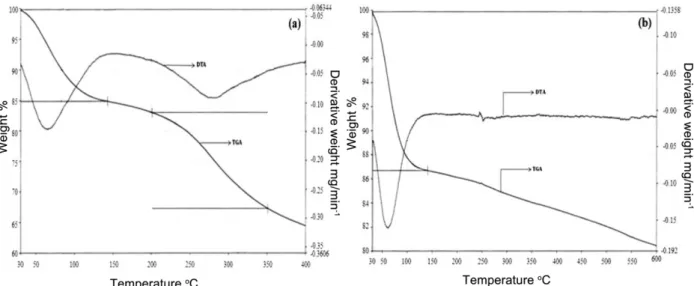
Fig. 1 illustrates the thermal analysis of polyaniline and polyaniline/SiO2. The first weight loss occurs at low tem- perature (140 ºC) for the removal of water molecules from polymer materials. Second weight loss was observed at 200 ºC corresponds to the degradation and decomposition of the polymer back bone. However, complete decompo- sition occurs at 350 ºC for polyaniline chain shown in Fig.
1(a), (b) shows the thermal decomposition of polyaniline supported on SiO2. From this it can be seen that, the ther- mal stability of polyaniline/SiO2 materials has noticeably improved, which may be due to the strong interaction between polyaniline and SiO2. The thermal stability is
characteristic property of the materials, utilized as a cat- alyst in the field of heterogeneous catalysis.
XRD analysis
Fig. 2(a-c) shows the XRD pattern of synthesized mate- rials. Fig. 2(a) shows the broad peak at 2θ (21.98º) cor- responding to the amorphous nature of silica.39 Fig. 2(b) shows the broad peak at 2θ (25.13º) which is charac- teristic of the polyaniline.40 Fig. 2(c) gives broad peak at 2θ (22.18°) for 10 wt% polyaniline/SiO2 the peak was just slightly shifted due to the addition of polyaniline in silica.
SEM-EDS analysis
Fig. 3(a-c) shows the surface morphology of synthe- sized materials. Fig. 3(a) shows good agglomeration of particles of silica with spherical in shape, while a fibrous Fig. 1. TG-DTA pattern of (a) polyaniline (b) 10 wt% polyaniline/SiO2.
Fig. 2. XRD pattern of (a) SiO2 (b) polyaniline (c) 10 wt% poly- aniline/SiO2.
Fig. 3. SEM image of (a) SiO2 (b) polyaniline (c) 10 wt% polyaniline/SiO2.
or globular morphology was observed in Fig. 3(b) which is the characteristic of polyaniline.41 Fig. 3 (c) shows some porosity, it may be due to the insertion of 10 wt%
polyaniline on the surface of SiO2. Finally, from the SEM micrograph, it can be concluded that, the polya- niline addition clearly shows alteration in morphology, which helps to generate the porous materials and the porosity may increases catalytic activity of pure SiO2, as well as polyaniline.
Elemental composition of 10 wt% polyaniline/SiO2 cat- alysts is represented in Fig. 4. The presence of constit- uent elements C, O, Si and S as its atomic weight % are 47.35, 39.41, 12.51 and 0.74 respectively. From this analysis it was shown that, the minimum stoichiometric ratio of desired 10 wt% polyaniline/SiO2 catalysts was maintained.
FT-IR analysis
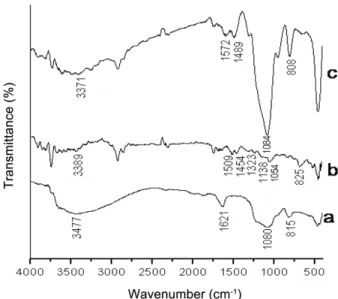
Fig. 5(a-c) shows the FT-IR spectra of the synthesized materials. Fig. 5(a) shows peak at 3477 cm-1 is due to the Si-OH stretching vibration, 1627 cm-1 for the Si-OH bend- ing mode, 1080 cm-1 for Si-O stretching vibration and 815 cm-1 due to the Si-O-Si bending vibration mode. Fig. 5(b- c) shows the FT-IR spectra of the pure polyaniline and 10 wt% polyaniline/SiO2 respectively. The characteristic peaks of the polyaniline at 3389 and 3371 cm-1 is attrib- uted to N-H stretching, 1572 and 1509 cm-1 is due to C=C stretching mode of the quinoid ring, 1489 and 1454 cm-1 due to C=C stretching vibration of benzenoid ring, 1323 and 1309 cm-1. for C-N stretching vibration, 1138 cm-1 for N=Q=N, where Q represents the quinoid ring, peaks at 825 and 808 cm-1 due to aromatic C-H bending mode of 1,4-disubstituted benzene ring, Fig. 5(c) shows peak at 1084 cm-1 due the presence of silica.
Catalytic activity results
The synthesis of β-amino carbonyl compounds via con- densation of acetophenone, aromatic aldehyde and aromatic amines catalyzed polyaniline/SiO2, is shown in (Scheme 1).
The stability of the catalyst was tested in different sol- vents; methanol, acetone, acetonitrile, and ethanol by spectrophotometrically. The results are summarized in Table 1 which shows that the catalyst retains very good stability in ethanol. Hence, in order to get the optimum reaction condition, the reaction of acetophenone, benzal- dehyde, and aniline was considered as a standard model reaction.
To examine the effect of the catalyst composition on the activity, various amounts of polyaniline supported SiO2
have been studied and the results are summarized in Table 2. Pure silica shows no catalytic activity (Table 2, entry 2a) and polyaniline exhibits moderate catalytic activity (Table 2, entry 2b) in terms of reaction time and yield of the products. After optimizing the amount of catalyst it was observed that 10 wt % polyaniline/SiO2 is sufficient to carry out the reaction smoothly in short time with excel- lent yields (Table 2, entry 2c). Increase in wt% (20, 30) of polyaniline/SiO2, reaction rate and yield of the product was found to be reduced (Table 2, entry 2d, e).
Fig. 4. EDS image of 10 wt% polyaniline/SiO2.
Fig. 5. FT-IR spectra of (a) SiO2 (b) polyaniline (c) 10 wt%
polyaniline/SiO2.
Scheme 1.
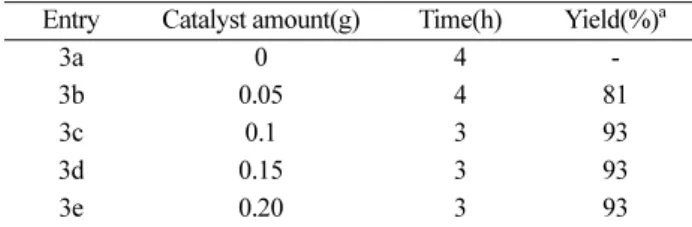
However, in the absence of catalyst, formation of the desired product was not observed (Table 3, entry 3a). For the investigation of the concentration of catalyst, reaction was carried out under varied amounts of catalyst, such as 0.05, 0.1, 0.15 and 0.2 gm for standard model reaction (Table 3, entry 3b-e) and it was observed that 0.1 g of catalyst is suf- ficient to complete the reaction efficiently (Table 3, entry 3c).
The scope and generality of the present method was investigated by performing Mannich reactions with var- ious electronically divergent aromatic aldehydes and aro- matic amines under optimum reaction conditions (Table 4).
Aldehydes bearing different substituents, such as 4-CH3, 4-Cl, and 4-NO2 were compatible with reactions condi- tion. Aromatic amines bearing 4-Cl, 4-CH3, and 3-Cl were also favorable to those conditions.
Then we turned our attention towards the recovery and reusability of the catalyst as it is important from industrial and economical point of view. The catalyst was separated, washed with n-hexane dried at 80oC for 1 h before the next catalytic run. Reusability of the catalyst was inves- tigated for three times and it was found to retain almost consistent activity (Table 4, entry 4a).
CONCLUSION
In summary, an efficient catalytic system has been developed for the synthesis of β-amino ketones using ace- tophenone, aromatic aldehyde and aromatic amines. Present method offers remarkable advantages such as non-toxic, non-corrosive and an inexpensive reaction conditions.
Simple recovery and reusability of the catalyst make the reaction successful under environmental benign condi- tions.
Acknowledgement. We are grateful to the Head, Department of Chemistry, Dr. Babasaheb Ambedkar Mar- athwada University, Aurangabad-431004 (MS), India for providing the laboratory facility.
REFERENCES
1. MacDiarmid, A. G. Synth. Met. 1997, 84, 27.
2. Cao, Y.; Li, S.; Xue, Z.; Guo, D. Synth. Met. 1986, 16, 305.
3. Noufi, R.; Nozik, A. J.; White, J.; Warren, L. F. J. Elec- trochem. Soc. 1982, 129, 2261.
4. Westerweele, W.; Smith, P.; Heeger, A. J. Adv. Mater.
1995, 7, 788.
5. Diaz, A. F.; Logan, J. A. J. Electroanal. Chem. 1980, 111, 111.
6. Watanabe, A.; Mori, K.; Iwabuchi, A.; Iwasaki, Y.; Naka- muraand, Y.; Ito, O. Macromolecules. 1989, 22, 3521.
7. Focke, W. W.; Wnek, G. E.; Wei, Y. J. Phys. Chem. 1987, 91, 5813.
8. Prokes, J.; Stejskal, J. Polym. Degrad. Stab. 2004, 86, 187.
9. Velusamy, S.; Ahmed, M.; Punniyamurthy, T. Org. Lett.
2004, 6, 4821.
10. Devi, C. L.; Olusegun, O. S.; Pavankumar, C. N. S. S.;
Rao,V. J.; Palaniappan S. Catal Lett. 2009, 132, 480.
Table 1. Stability of catalyst in various solvent
Entry Solvent Optical density (O.D.)
1 Methanol 0.309
2 Acetone 0.264
3 Acetonitrile 0.231
4 Ethanol 0.179
Table 2. Effect of various amount of polyaniline
Entry Catalyst Time (h) Yield (%)a
2a SiO2 5 0
2b Polyaniline 4 85
2c 10 wt% polyaniline/SiO2 3 93
2d 20 wt% polyaniline/SiO2 4 90
2e 30 wt% polyaniline/SiO2 4 87
Reaction conditions: acetophenone (5 mmol), benzaldehyde (5 mmol), aniline (5 mmol), catalyst (0.1 g) and ethanol 15 ml. a Iso- lated yields
Table 3. Effect of catalyst amount for the mannich reaction of ace- tophenone, aromatic aldehyde and aromatic amine
Entry Catalyst amount(g) Time(h) Yield(%)a
3a 0 4 -
3b 0.05 4 81
3c 0.1 3 93
3d 0.15 3 93
3e 0.20 3 93
a Isolated yields.
Table 4. 10 wt% polyaniline/ SiO2 catalyzed mannich reaction of acetophenone, aromatic aldehyde and aromatic amines
Entry R R' Time (h) Yield (%)a M.p. (oC)
4a. H H 3 93(93,92,92)c 170-172
4b. H 4-Cl 4 92 172-173
4c. H 4-CH3 3 91 166-168
4d. 4-CH3 H 4 89 128-130
4e. 4-Cl 4-Cl 3 88 118-120
4f. 4-Cl 4-CH3 3 89 115-118
4g. 4-NO2 H 3 90 87-89
4h. 4-NO2 3-Cl 4 87 99-101
4i. 4-NO2 4-Cl 3 90 128-131
Reaction conditions: acetophenone (5 mmol), benzaldehyde (5 mmol), aniline (5 mmol), catalyst 0.1gm, and ethanol 15 ml. a Iso- lated yields. cYield after consecutive cycle
11. Srinivas, C.; Pavankumar, C. N. S. S.; Rao, V. J.; Pala- niappan, S. J. Mol. Catal. A. Chem. 2007, 265, 227.
12. Zhang, A. Q.; Zhang, N.; Hong, S.; Zhang, M. Synth.
Commun. 2009, 39, 3024.
13. Palaniappana, S.; Saravananb, C.; Amarnatha, C. A.; Rao, V. J. Catal. Lett. 2004, 97, 1.
14. Patel, A. L.; Talele, H. R.; Rama, H. S.; Bedekar. A. V.;
Synth. Commun. 2009, 39, 3016.
15. Kantam, M. L.; Roy, M.; Roy, S.; Sreedhar, B.; Sakunthala, M. S.; Choudaryb, B. M. Lal, R.; Tetrahedron. 2007, 63, 8002.
16. Srinivasan, P.; Malladi, S. R.; Green. Chem. 2002, 4, 53.
17. Arend, M.; Westerman, B.; Angew. Chem. Int. Ed. 1998, 37, 1044.
18. Kobayashi, S.; Ishitani, H. Chem. Rev. 1999, 99, 1069.
19. Muller, R.; Goesmann, H.; Waldmann, H. Angew. Chem.
Int. Ed. 1999, 38, 184.
20. Suginome, M.; Uehlin, L.; Murakami, M. J. Am. Chem.
Soc. 2004, 126, 13196.
21. Matsunaga, S.; Kumagai, N.; Harada, S.; Shibasaki, M. J.
Am. Chem. Soc. 2003, 125, 4712.
22. Yi, L.; Lei, H. S.; Zou, J. H.; Xu, X. J. Synthesis 1991, 717.
23. Wang, R.; Li, B. G.; Huang, T. K.; Shi, L.; Lu, X. X. Tet- rahedron. Lett. 2007, 48, 2071.
24. Yi, W. B.; Cai, C. J. Fluor. Chem. 2006, 127, 1515.
25. Iimura, S.; Nobutou, D.; Manabe, K.; Kobayashi, S. Chem.
Commun. 2003, 1644.
26. Manabe, K.; Kobayashi, S. Org. Lett. 1999, 1, 1965.
27. Azizi, N.; Torkiyan, L.; Saidi, M. R. Org. Lett. 2006, 8, 2079.
28. Bigdeli, M. A.; Nemati, F.; Mahdavinia, G. H. Tetrahedron.
Lett. 2007, 48, 6801.
29. Li, Z.; Ma, X. L.; Liu, J.; Feng, X.; Tian, G. Q.; Zhu, A.
G. J. Mol. Catal. A. Chem. 2007, 272, 132.
30. Shen, W.; Wang, L. M.; Tian, H.; J. Fluor. Chem. 2008, 129, 267.
31. Li, J. Z.; Peng, Y. Q.; Song, G. H. Catal. Lett. 2005, 102, 159.
32. Fang, D.; Luo, J.; Zhou, X. L.; Liu, Z. L. Catal. Lett.
2007, 116, 76.
33. Wang, M.; Song, Z-G.; Wan, X.; Zhao, S. Monatsh.
Chem. 2009, 140, 1205.
34. Li, H.; Zeng, H-Y.; Shao, H-W.; Tetrahydron. Lett. 2009, 50, 6858.
35. Palaniappan, S.; John, A.; Amarnath, C .A. Rao, V. J. J.
Mol. Catal. A. Chem. 2004, 218, 47.
36. Katkar, S. S.; Mohite, P. H.; Gadekar, L. S.; Arbad, B. R.;
Lande, M. K. Centr Euro. J. Chem. 2010, 8, 320.
37. Katkar, S. S.; Mohite, P. H.; Gadekar, L. S.; Arbad, B. R.;
Vidhate, K. N.; Lande, M. K. Chin. Chem. Lett. 2010, 21, 421.
38. Rathod, S.; Arbad, B.; Lande, M. Chin. J. Catal. 2010, 31, 631.
39. Li, Y. Q.; Fu, S. Y.; Yang, Y.; Mai, Y. W. Chem. Mater.
2008, 20, 2637.
40. Raghavendra, S. C.; Khasim, S.; Revanasiddappa, M.;
Ambikaprasad, M. V. N. Kulkarrni, A. B. Bull. Mater. Sci.
2003, 26, 733.
41. Ali, M. A.; Saion, E.; Yahya, N.; Kassim, A.; Dahlan, K.
M.; Hashim, S. J. Eng. Sci. Technol. 2007, 2, 111.