ABSTRACT
Background: The aim of this study was to investigate the association between sleep duration and dizziness in a representative Korean population.
Methods: We analyzed data from the Korea National Health and Nutrition Examination Surveys (2010–2012). A total of 12,499 adults who completed otolaryngologic examinations were evaluated.
Results: Both men and women with severely short sleep duration (≤ 5 hours) and severely long sleep duration (≥ 9 hours) tended to have higher dizziness prevalence. However, the adjusted odds ratio (OR) for sleep duration was only significant in women with dizziness after adjusting for confounders. Compared to that in an optimal sleep group (6–8 hr/day), the OR (95% confidence interval) for dizziness prevalence after adjusting for age and health behaviors (body mass index, smoking habit, alcohol consumption, level of exercise, metabolic syndrome, and tinnitus) was 1.473 (1.194–1.818) for the severely short sleep group (≤ 5 hr/day) and 1.472 (1.078–2.009) for the severely long sleep group (≥ 9 hr/day) only in women.
Conclusion: In the Korean population, dizziness was associated with shorter or longer sleep durations only among women. Further epidemiologic and experimental studies are necessary to clarify the impact of dizziness on sleep disorders.
Keywords: Sleep; Dizziness; Epidemiology; Republic of Korea
INTRODUCTION
Sleep is indispensable to human survival. Evidence suggests that sleep imbalance, such as deprivation and/or fluctuations in usual sleep episodes, is significantly associated with diminished quality of life while influencing adverse physical and psychological health outcomes.1 Studies have reported that sleep durations of more or less than 7 or 8 hours in a 24-hour period are associated with cardiovascular disease, diabetes, obesity, depression, automobile accidents, work failures, learning and memory problems, and excess mortality.
Several socioeconomic, cultural, and racial factors influence sleep duration. Short sleep
Original Article
Received: May 7, 2019 Accepted: Jul 22, 2019 Address for Correspondence:
Young-Hoon Joo, MD
Department of Otolaryngology-Head and Neck Surgery, Bucheon St. Mary's Hospital, College of Medicine, The Catholic University of Korea, 327 Sosa-ro, Wonmi-gu,
Bucheon 14647, Republic of Korea.
E-mail: [email protected]
© 2019 The Korean Academy of Medical Sciences.
This is an Open Access article distributed under the terms of the Creative Commons Attribution Non-Commercial License (https://
creativecommons.org/licenses/by-nc/4.0/) which permits unrestricted non-commercial use, distribution, and reproduction in any medium, provided the original work is properly cited.
ORCID iDs Se-Hwan Hwang
https://orcid.org/0000-0002-2838-7820 Jun-Myung Kang
https://orcid.org/0000-0003-1850-1439 Jae-Hyun Seo
https://orcid.org/0000-0002-8443-8581 Kyung-do Han
https://orcid.org/0000-0002-6096-1263 Young-Hoon Joo
https://orcid.org/0000-0002-1158-0974 Disclosure
The authors have no potential conflicts of interest to disclose.
Se-Hwan Hwang ,1 Jun-Myung Kang ,1 Jae-Hyun Seo ,1 Kyung-do Han ,2 and Young-Hoon Joo 1
1 Department of Otolaryngology-Head and Neck Surgery, Bucheon St. Mary's Hospital, College of Medicine, The Catholic University of Korea, Bucheon, Korea
2Department of Biostatistics, College of Medicine, The Catholic University of Korea, Seoul, Korea
The Association between Sleep Duration and Dizziness in Korean Women: The Korea National Health and Nutrition Examination Survey
Otorhinolaryngology
Author Contributions
Conceptualization: Kang JM, Seo JH, Joo YH.
Data curation: Hwang SH, Kang JM, Han KD.
Formal analysis: Han KD. Methodology: Han KD, Joo YH. Software: Han KD. Validation:
Han KD, Joo YH. Visualization: Seo JH. Writing - original draft: Hwang SH, Seo JH. Writing - review & editing: Kang JM, Joo YH.
duration is more common in people who are older, care for young children, are unmarried, work long hours, consume alcohol, or are overweight or obese.2
Dizziness and vertigo are frequent and disabling symptoms in primary care units but remain unexplained in 40%–80% of patients. Dizziness and vertigo may have serious individual and social effects, causing interruption of daily activities in 40% of affected individuals.3 Falls pose an important health risk in the elderly and are known to be associated with morbidity and mortality. Negative physical and mental consequences from falls also can lead to impaired quality of life, loss of independence, or premature admission into a nursing home. Some authors reported that patients with dizziness showed a decrease in deep sleep and an elevated arousal index in comparison with healthy controls.4,5 Although no studies have investigated the relationships between various sleep disturbances and dizziness and falls among a community- population, sleep deprivation can modify the posterior parietal cortex, which is important for processing vestibular information regarding space representation.6 Additionally, gender differences could influence on the sleep and dizziness significantly. Gender difference in sleep become apparent after the onset of puberty. Menstrual cycles, pregnancy, and menopause can alter sleep architecture. For example, women have better sleep quality compared with men, with longer sleep times, shorter sleep-onset latency and higher sleep efficiency.7 Regarding the dizziness, women were more often affected compared with men. It could be suggested that a woman's monthly hormonal variation would be actually the trigger for migraine and dizziness episodes in the premenstrual period, as well as the use of hormones for contraceptive purposes.4 Hence it could be hypothesized that sleep disturbances may be associated with dizziness and gender factor may influence on the sleep and dizziness differently. Understanding and identifying the associations among these factors in a large-scale study would greatly contribute to patient care and relief of social burden for these conditions. The present study was undertaken to report the national prevalence of dizziness and vestibular dysfunction in South Korea, based on survey data obtained from the Korea National Health and Nutrition Examination Survey (KNHANES) 2010–2012 and to investigate the associated factors.
METHODS
Study population
This study was based on data collected during the 2010–2012 KNHANES and the secondary analysis of a large data set. The KNHANES is a nationwide survey designed to assess national health and nutrition levels accurately and has been conducted by the Division of Chronic Disease Surveillance under the Korea Centers for Disease Control and Prevention since 1998. A field survey team that included an otolaryngologist and nurse examiners for health assessments traveled with a mobile examination unit and performed interviews and physical examinations. The survey consists of a health interview, a nutritional survey, and a health examination survey. The survey amasses data via household interviews and by direct standardized physical examinations conducted in specially equipped mobile examination centers. The KNHANES methodology has been described in detail previously and further details are listed in “The 5th KNHANES Sample Design” and reports, made accessible on the KNHANES website (https://knhanes.cdc.go.kr/knhanes/index.do). The KNHANES annual reports, user manuals and instructions, and raw data are available on request.5-7
Every year, 10,000–12,000 individuals in about 4,600 households are selected from a panel to represent the population, using a multistage clustered and stratified random sampling
method that is based on national census data. Survey sample weights were used in all analyses to produce estimates that were representative of the non-institutionalized civilian Korean population. The sample included 12,499 participants > 19-years.
Survey for sleep duration and dizziness
Sleep duration was assessed by self-reported questionnaire. Five categories of sleep duration were defined: less than 5 hours per night, 6 hours per night, 7 hours per night, 8 hours per night, and more than 9 hours per night. Participants were asked whether they had experienced dizziness or imbalance (“Have you been dizzy or unstable within the past year?”). Participants who responded positively to this question were queried concerning the positional dizziness and falls in the past 12 months using the following questions. “Have you had severe vertigo when you rotated your head into a supine position or when you sat up from bed or lay down in the morning?” (no/experienced in the past 12 months/experienced at the time of survey) and “Have you ever fallen unexpectedly in the past 12 months?,” respectively.
Lifestyle habits
Data on medical history and lifestyle habits were collected using self-reported questionnaires about recent and current behavior. Smoking status was classified into never smoker (persons who have never smoked), ex-smoker (persons who smoked in the past but do not smoke currently), and current smoker (persons who smoke currently). Based on the amount of alcohol consumed per day during the 1-month period before the interview, the subjects who drank more than 30 grams per day were designated as heavy drinkers. To assess physical activity levels, a regular exerciser was defined as an individual who incorporated at least 20 minutes of vigorous intensity physical activity at least 3 days a week or at least 30 minutes of light/moderate-intensity physical activity at least 5 days a week.
Anthropometric and laboratory measurements
Weight and height were measured by well-trained medical professionals such as nurses or medical technicians. Standing height was measured when the subject faced directly ahead with shoes off, feet together, arms by the sides, and heels, buttocks, and upper back in contact with the wall. The unit of height was measured in centimeters with one decimal point using SECA 225 (SECA, Hamburg, Germany). Body mass index (BMI) was calculated as weight (kg)/height (m2). Waist circumference (WC) was measured at the level of the midpoint between the iliac crest and the costal margin at the end of a normal expiration to the nearest 0.1 cm.
Metabolic syndrome was defined as 1) a WC more than 90 cm in men and more than 80 cm in women, according to the International Diabetes Federation criteria for Asian countries; 2) a fasting blood sugar more than 100 mg/dL or being on medication use for elevated glucose; 3) fasting triglyceride more than 150 mg/dL or cholesterol lowering medication use; 4) high- density lipoprotein-cholesterol less than 40 mg/dL in men and less than 50 mg/dL in women or cholesterol-lowering medication use; and 5) systolic blood pressure more than 130 mmHg and/or diastolic blood pressure more than 85 mmHg or being on an antihypertensive drug treatment for patients with a history of hypertension. Metabolic syndrome diagnosis requires at least three of the five components to be present.
Statistical analysis
Statistical analyses were performed using SAS ver. 9.3 software (SAS Institute, Cary, NC, USA) to reflect the complex sampling design and sampling weights of KNHANES and to provide nationally representative prevalence estimates. The procedures included unequal
probabilities of selection, oversampling, and nonresponse so that inferences could be made about the Korean adolescent participants. Prevalence and 95% confidence intervals for dizziness were calculated. The Rao–Scott χ2 test (using PROC SURVEYFREQ in SAS) and logistic regression analysis (using PROC SURVEYLOGISTIC in SAS) were used in a univariate analysis to test the associations between gender and risk factors in a complex sampling design. Participant characteristics are described using means and standard errors for continuous variables and numbers and percentages for categorical variables. A final logistic regression model was used to examine the association between sleep duration and dizziness.
We first adjusted for age (model 1), age, BMI, smoking status, alcohol intake, and regular exercise (model 2), and then for age, BMI, smoking status, alcohol intake, regular exercise, metabolic syndrome, stress, and tinnitus (model 3).
Ethics statement
Written informed consent was obtained from all participants prior to the survey, and approval for this study was obtained from the Institutional Review Board (IRB) of the Catholic University of Korea in Bucheon, Korea (IRB No. HC14EISE0097).
RESULTS
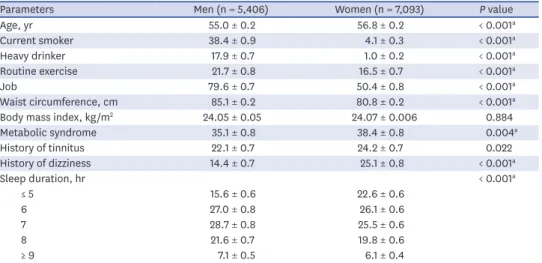
A total of 12,499 respondents were included in our study, comprising 5,406 (43.25%) males and 7,093 (56.75%) women, and 2,690 had experienced dizziness or imbalance in the prior 12 months. The baseline characteristics of the study subjects according to gender are shown in Table 1. Mean age was higher in women than in men (P < 0.001). Study participants with current smoker and heavy drinker had significantly higher in men. Routine exercise, job, and WC were significantly more frequent in men, whereas metabolic syndrome and tinnitus were significantly more frequent in women. The prevalence of dizziness was higher in women than that in men (P < 0.001).
The association between sleep duration category and dizziness or falls is shown in Table 2. Both men and women with severe short sleep duration (≤ 5 hours) and severe long sleep duration (≥ 9 hours) tended to have more dizziness and falls than others.
Table 1. Characteristics of the participants by gender (n = 12,499)
Parameters Men (n = 5,406) Women (n = 7,093) P value
Age, yr 55.0 ± 0.2 56.8 ± 0.2 < 0.001a
Current smoker 38.4 ± 0.9 4.1 ± 0.3 < 0.001a
Heavy drinker 17.9 ± 0.7 1.0 ± 0.2 < 0.001a
Routine exercise 21.7 ± 0.8 16.5 ± 0.7 < 0.001a
Job 79.6 ± 0.7 50.4 ± 0.8 < 0.001a
Waist circumference, cm 85.1 ± 0.2 80.8 ± 0.2 < 0.001a
Body mass index, kg/m2 24.05 ± 0.05 24.07 ± 0.006 0.884
Metabolic syndrome 35.1 ± 0.8 38.4 ± 0.8 0.004a
History of tinnitus 22.1 ± 0.7 24.2 ± 0.7 0.022
History of dizziness 14.4 ± 0.7 25.1 ± 0.8 < 0.001a
Sleep duration, hr < 0.001a
≤ 5 15.6 ± 0.6 22.6 ± 0.6
6 27.0 ± 0.8 26.1 ± 0.6
7 28.7 ± 0.8 25.5 ± 0.6
8 21.6 ± 0.7 19.8 ± 0.6
≥ 9 7.1 ± 0.5 6.1 ± 0.4
Values are mean ± standard error or percentage ± standard error.
aSignificant at P < 0.05.
Table 3 summarized the adjusted odds ratios (ORs) for dizziness in relation to sleep duration.
The adjusted OR for sleep duration is not significant in dizziness for men. Meanwhile, the risk of dizziness was significantly associated with sleep duration in only women. Compared to participants with optimal sleep duration (six to eight hours), those with severe short sleep duration (≤ 5 hours) and severe long sleep duration (≥ 9 hours) adjusted for the confounders showed the high OR with larger than 1.4, which meant that severe short or long sleep duration had an increased dizziness risk after adjusting for the confounders.
DISCUSSION
Although dizziness and falls are closely associated with excessive daytime sleepiness no study has evaluated the relationship between sleep duration and dizziness and falls in the general population.8,9 In the present study, we found that shorter or longer sleep duration were associated with dizziness and falls in Koreans. However, despite the similar tendency of the association between sleep duration and dizziness in both gender, only women had a significant association between shorter or longer sleep duration and dizziness.
Several population-based studies have attempted to estimate the distribution of sleep duration and prevalence of dizziness.1,3 In this study, sleep duration distribution in Koreans aged greater than 19 years was only 7.5% (men, 7.1%; women, 6.1%) for the individuals with severe long sleep duration, 19.1% (men, 15.6%; women, 22.6%) for the individuals with severe short sleep duration, and 73.4% (men, 77.3%; women, 71.4%) for the individuals with moderated sleep duration (6–8 hours), showing the highest percentage. These results are similar with those of Park et al.2 and Shankar et al.10 The overall prevalence of dizziness was 19.5% (men, 14.4%; women, 25.1%), and the prevalence of dizziness was significantly higher in women than that in men.
Table 2. Prevalence of the dizziness according to the sleep duration by gender
History of dizziness History of falls
Men Women Men Women
Yes No P value Yes No P value Yes No P value Yes No P value
Sleep duration, hr 0.018a < 0.001a 0.081 < 0.001a
≤ 5 19.7 ± 1.6 14.9 ± 0.7 29.8 ± 1.4 20.1 ± 0.7 24.9 ± 5.0 19.0 ± 1.7 35.4 ± 3.9 29.0 ± 1.5
6 25.3 ± 1.9 27.3 ± 0.8 23.7 ± 1.2 26.9 ± 0.8 27.5 ± 6.5 25.0 ± 1.9 25.3 ± 3.6 23.4 ± 1.2
7 25.9 ± 2.0 29.1 ± 0.9 20.9 ± 1.2 27.0 ± 0.7 21.8 ± 5.6 26.5 ± 2.1 14.3 ± 2.5 21.8 ± 1.3
8 20.2 ± 1.9 21.9 ± 0.7 18.4 ± 1.1 20.2 ± 0.7 16.6 ± 4.2 20.7 ± 2.0 20.3 ± 3.2 18.2 ± 1.2
≥ 9 8.8 ± 1.2 6.8 ± 0.5 7.2 ± 0.8 5.7 ± 0.4 9.3 ± 3.7 8.8 ± 1.3 4.8 ± 1.4 7.6 ± 0.9
Values are percentage ± standard error.
aSignificant at P < 0.05.
Table 3. Adjusted ORs and 95% CIs for assessing relationship between sleep duration and dizziness using logistic regression model
Sleep duration, hr OR (95% CI)
Men Women
Model la Model 2b Model 3c Model la Model 2b Model 3c
≤ 5 1.218 (0.925–1.603) 1.226 (0.929–1.618) 1.188 (0.888–1.591) 1.566 (1.289–1.903) 1.557 (1.276–1.898) 1.473 (1.194–1.818) 6 1.041 (0.796–1.361) 1.055 (0.806–1.381) 1.044 (0.788–1.383) 1.115 (0.921–1.350) 1.117 (0.922–1.353) 1.103 (0.898–1.354)
7 1 (reference) 1 (reference) 1 (reference) 1 (reference) 1 (reference) 1 (reference)
8 0.943 (0.700–1.271) 0.941 (0.697–1.271) 0.948 (0.693–1.296) 1.179 (0.963–1.445) 1.175 (0.957–1.443) 1.216 (0.974–1.519)
≥ 9 1.215 (0.832–1.774) 1.190 (0.817–1.734) 1.027 (0.678–1.555) 1.420 (1.042–1.936) 1.418 (1.040–1.934) 1.472 (1.078–2.009)
P for trend 0.415 0.396 0.677 0.001d 0.001d 0.003d
OR = odds ratio, CI = confidence interval, BMI = body mass index.
aModel 1: adjusted for age; bModel 2: adjusted for age, BMI, smoking status, alcohol intake, and regular exercise; cModel 3: adjusted for age, BMI, smoking status, alcohol intake, regular exercise, metabolic syndrome, stress, and tinnitus; dSignificant at P < 0.05.
As methods to evaluate dizziness, age distribution, and the survey period of each study varied, substantial differences in dizziness prevalence may exist, and, subsequently, direct comparisons among studies are difficult. However, the prevalence of dizziness from previous studies was 15%–30%, showing that our results are similar with previous results.3 Although dizziness must be objectively diagnosed by a clinician, an appropriate evaluation of vestibular function is practically difficult in a large study. However, it is also important to know the prevalence of self-reported dizziness which can determine whether they are likely to seek medical attention.3,9,11 Several authors have evaluated the prevalence of subjective dizziness and its risk factors in general or community populations with data based on self-reported dizziness questionnaires.3,9,11
Previous studies have indicated that individual characteristics, such as eating patterns, physical activity, socioeconomic status, and smoking habits, are meaningful correlates of shorter or longer sleep duration.12 Several studies have reported that sleep disturbances and excessive sleepiness may be associated with dizziness.9,13,14 However, these studies mainly evaluated the effect of sleep duration on general features except dizziness or assessed the impact of the partial sleep pattern on dizziness in specified aged population. By contrast, methodologically, our study evaluated the association of the classified sleep duration with dizziness among a community population. These features would mean that we could include large population (more than 10,000) and assess the detailed sleep duration effect. Additionally, we measured the dizziness and fall in the same population, respectively, which show the individual effect of sleep duration on vestibular function as well as physical imbalance.
In view of results, we demonstrated that both long and short sleep duration would be harmful to the vestibular function in the general population. Most of the related studies measured the effect of only short or long sleep duration on vestibular function. Considering the relationships between sleep duration and physical and psychological health outcomes, a significant relationship may exist between sleep duration and dizziness. We found a U-shaped association between sleep duration and dizziness using 2010–2012 KNHANES data. In other words, both short (< 6 hours) and long (≥ 9 hours) sleep durations have been associated with increased risks of dizziness in men and women. However, logistic regression analyses revealed that dizziness was more common in short and long women sleepers after adjusting for sociodemographic and health-related variables.
Although the underlying mechanism linking short or long sleep duration and dizziness is not yet known, an abnormal sleep pattern is known to have negative effects on cognitive function. Sleep deprivation seems to disrupt vital biological processes necessary for cognitive function and physical health.15 The short (< 6–7 hours) or long sleep duration (>
7–8 hours) was found to be related to the risk for stroke.16 Vertigo and balance disturbances may involve not only the brainstem and cerebellar structures, but the temporal lobes as well.17-20 Cognitive deficits, such as poor concentration and short-term memory loss, are associated with vestibular abnormalities.21 The mechanisms by which vestibular dysfunction is associated with cognitive dysfunction are unclear, although several potential pathways have been hypothesized. Loss of peripheral vestibular input may lead to atrophy of areas within the cortical vestibular network, which notably includes the dorsal thalamus, the temporo- parietal junction, and the hippocampus. Atrophy of these structures may in turn result in impairments in visuospatial memory and perception.22
Additionally, although our observation that abnormal sleep duration may be associated with a higher risk of dizziness among women is a novel finding, the mechanism underlying this
gender-specific association is unknown. The possibility of a difference in self-reporting of sleep habits between men and women cannot be ruled out, as suggested in a previous analysis that evaluated the relationship between gender and subjective measures of
sleepiness.23 Furthermore, more consideration may be given to social roles and psychosocial differences between men and women when interpreting vestibular health and sleep pattern findings. For example, men may be more reluctant to seek medical counseling and, thus, men seeking treatment may be more adversely affected than women.24,25 Furthermore, a general increased sensitivity of reporting body sensations and/or a different reporting style of somatoform symptoms have been suggested to result into such an woman predominance.26 Further studies are needed to investigate the role of gender as a possible effect modifier on the association between sleep and functional outcomes.25
This study had three major strengths. First, we used a nationally representative, community sample of Korean adults. Secondly, we evaluated the relationships between sleep durations and dizziness by subdividing sleep duration into five categories. Based on this category and analysis, we found that short sleep duration (less than 5 hours per night) or long sleep duration (more than 9 hours per night) were associated with dizziness and falls in the Korean men and women. Additionally, we used three models that each considered possible confounding variables in a series of logistic regression analyses to minimize the confounding effect of possible sleep determinants.2 After adjusting the variables, we could identify that the above mentioned relationship was shown in the only Korean women.
By contrast, this study also had several limitations. First, sleep duration and dizziness were reported only by respondents and were not recorded or observed directly. This may bias our results, as there is only modest correlation between reported and recorded sleep. Additionally, the questionnaire evaluation for dizziness may be dependent on the participants' decision and answers, which could make the inclusion of dizziness more heterogeneous. However, although there were some studies with objective sleep data, those measures are not practical for large, nationally representative samples.27 Furthermore, self-reported sleep duration has been used widely in epidemiological studies examining the relationship between sleep duration and morbidity and mortality.1,12,28 A previous study also evaluated the dizziness based on the same questionnaire data from the KNHANES.3
Although from one standpoint, one might consider the prevalence of dizziness as measured by objective balance function tests to be a more scientific estimation of the prevalence of dizziness, it is likely that patient-centered perceptions of their dizziness are more likely to be the drivers of healthcare seeking behaviors for dizziness. In other words, there is significant importance attached to determining the population-based self-reported prevalence of dizziness. Secondly, our data consider only abnormal duration of sleep. Additional sleep problems, such as snoring, apnea and daytime sleepiness, should be investigated in future studies. Third, the related variables of which the presence or absence may be associated with vestibular dysfunction and could affect the results were not able to be evaluated and the participants with other acute disease status, such as BPPV, were not able to be excluded from this study.
However, KNHANES is a nationwide cross-sectional study to select a representative sample of the Korean population. This survey employed stratified multi-stage design based on age, gender, and residence geographic area. The characteristics such as the nationwide population-based study would overcome the limitation related the acute disease status.29,30
Finally, medications such as diuretics, antiarrhythmics and psychotropics were not evaluated in this study. Polypharmacy is regarded as an important risk factor for falling in the elderly.
Despite these shortcomings, the present study is the first population-based study to assess the relationship between sleep duration and dizziness in the general Korean population. Our results could suggest that clinician need to consider the vestibular function of those with abnormal sleep duration. In future, further longitudinal studies or well controlled studies would be helpful to understand the complex relationship between vestibular dysfunction and abnormal sleep duration.
In conclusion, data from the 2010–2012 KNHANES indicate that abnormal sleep duration, such as short or long duration, is associated with dizziness in women. The results of this general population-based study on the prevalence of abnormal sleep duration and its relationship with dizziness will contribute to their prevention and management in the Korean population.
ACKNOWLEDGMENTS
We thank the 150 residents of the otorhinolaryngology departments of 47 training hospitals in Korea and members of the Division of Chronic Disease Surveillance in Korea Centers for Disease Control & Prevention for participating in this survey and the dedicated work they provided.
REFERENCES
1. Yoon HS, Yang JJ, Song M, Lee HW, Han S, Lee SA, et al. Correlates of self-reported sleep duration in middle-aged and elderly Koreans: from the Health Examinees Study. PLoS One 2015;10(5):e0123510.
PUBMED | CROSSREF
2. Park S, Cho MJ, Chang SM, Bae JN, Jeon HJ, Cho SJ, et al. Relationships of sleep duration with sociodemographic and health-related factors, psychiatric disorders and sleep disturbances in a community sample of Korean adults. J Sleep Res 2010;19(4):567-77.
PUBMED | CROSSREF
3. Koo JW, Chang MY, Woo SY, Kim S, Cho YS. Prevalence of vestibular dysfunction and associated factors in South Korea. BMJ Open 2015;5(10):e008224.
PUBMED | CROSSREF
4. Bittar RS, Oiticica J, Bottino MA, Ganança FF, Dimitrov R. Population epidemiological study on the prevalence of dizziness in the city of São Paulo. Rev Bras Otorrinolaringol (Engl Ed) 2013;79(6):688-98.
PUBMED
5. Park HA. The Korea national health and nutrition examination survey as a primary data source. Korean J Fam Med 2013;34(2):79.
PUBMED | CROSSREF
6. Kim Y, Park S, Kim NS, Lee BK. Inappropriate survey design analysis of the Korean National Health and Nutrition Examination Survey may produce biased results. J Prev Med Public Health 2013;46(2):96-104.
PUBMED | CROSSREF
7. Park SH, Lee KS, Park HY. Dietary carbohydrate intake is associated with cardiovascular disease risk in Korean: analysis of the third Korea National Health and Nutrition Examination Survey (KNHANES III). Int J Cardiol 2010;139(3):234-40.
PUBMED | CROSSREF
8. Hayley AC, Williams LJ, Kennedy GA, Holloway KL, Berk M, Brennan-Olsen SL, et al. Excessive daytime sleepiness and falls among older men and women: cross-sectional examination of a population-based sample. BMC Geriatr 2015;15(1):74.
PUBMED | CROSSREF
9. de Moraes SA, Soares WJ, Rodrigues RA, Fett WC, Ferriolli E, Perracini MR. Dizziness in community- dwelling older adults: a population-based study. Rev Bras Otorrinolaringol (Engl Ed) 2011;77(6):691-9.
PUBMED
10. Shankar A, Charumathi S, Kalidindi S. Sleep duration and self-rated health: the national health interview survey 2008. Sleep 2011;34(9):1173-7.
PUBMED
11. Gassmann KG, Rupprecht R; IZG Study Group. Dizziness in an older community dwelling population: a multifactorial syndrome. J Nutr Health Aging 2009;13(3):278-82.
PUBMED | CROSSREF
12. Kim NH, Shin DH, Kim HT, Jeong SM, Kim SY, Son KY. Associations between metabolic syndrome and inadequate sleep duration and skipping breakfast. Korean J Fam Med 2015;36(6):273-7.
PUBMED | CROSSREF
13. Blakley BW. Antidepressants and dizziness. J Otolaryngol 1999;28(6):313-7.
PUBMED
14. Sowerby LJ, Rotenberg B, Brine M, George CF, Parnes LS. Sleep apnea, daytime somnolence, and idiopathic dizziness--a novel association. Laryngoscope 2010;120(6):1274-8.
PUBMED
15. Tufik S, Andersen ML, Bittencourt LR, Mello MT. Paradoxical sleep deprivation: neurochemical, hormonal and behavioral alterations. Evidence from 30 years of research. An Acad Bras Cienc 2009;81(3):521-38.
PUBMED | CROSSREF
16. Kim LJ, Coelho FM, Tufik S, Andersen ML. Short sleepers or sleep deprivation: finding the real risk factor for ischemic stroke. Sleep Med 2014;15(4):480.
PUBMED | CROSSREF
17. Chorazy M, Drozdowski W, Budlewski T, Rogowski F. Brain perfusion disturbances in patients with vertigo -- a study with SPECT. Neurol Neurochir Pol 2005;39(6):439-44.
PUBMED
18. Kiratli PO, Demir AU, Volkan-Salanci B, Demir B, Sahin A. Cerebral blood flow and cognitive function in obstructive sleep apnea syndrome. Hell J Nucl Med 2010;13(2):138-43.
PUBMED
19. Chang F, Li Z, Xie S, Liu H, Wang W. Vertigo-related cerebral blood flow changes on magnetic resonance imaging. Spine 2014;39(23):E1374-9.
PUBMED | CROSSREF
20. Zhang Y, Chen X, Wang X, Cao L, Dong Z, Zhen J, et al. A clinical epidemiological study in 187 patients with vertigo. Cell Biochem Biophys 2011;59(2):109-12.
PUBMED | CROSSREF
21. Hanes DA, McCollum G. Cognitive-vestibular interactions: a review of patient difficulties and possible mechanisms. J Vestib Res 2006;16(3):75-91.
PUBMED
22. Ventre-Dominey J. Vestibular function in the temporal and parietal cortex: distinct velocity and inertial processing pathways. Front Integr Nuerosci 2014;8:53.
PUBMED | CROSSREF
23. Kuo HK, Yang CC, Yu YH, Tsai KT, Chen CY. Gender-specific association between self-reported sleep duration and falls in high-functioning older adults. J Gerontol A Biol Sci Med Sci 2010;65(2):190-6.
PUBMED | CROSSREF
24. Vogel DL, Wester SR, Larson LM. Avoidance of counseling: psychological factors that inhibit seeking help. J Couns Dev 2007;85(4):410-22.
CROSSREF
25. Lee MS, Shin JS, Lee J, Lee YJ, Kim MR, Park KB, et al. The association between mental health, chronic disease and sleep duration in Koreans: a cross-sectional study. BMC Public Health 2015;15(1):1200.
PUBMED | CROSSREF
26. Filippopulos FM, Albers L, Straube A, Gerstl L, Blum B, Langhagen T, et al. Vertigo and dizziness in adolescents: risk factors and their population attributable risk. PLoS One 2017;12(11):e0187819.
PUBMED | CROSSREF
27. Lauderdale DS, Knutson KL, Yan LL, Rathouz PJ, Hulley SB, Sidney S, et al. Objectively measured sleep characteristics among early-middle-aged adults: the CARDIA study. Am J Epidemiol 2006;164(1):5-16.
PUBMED | CROSSREF
28. Kim JY, Yadav D, Ahn SV, Koh SB, Park JT, Yoon J, et al. A prospective study of total sleep duration and incident metabolic syndrome: the ARIRANG study. Sleep Med 2015;16(12):1511-5.
PUBMED | CROSSREF
29. Joo YH, Hwang SH, Han KD, Seo JH, Kang JM. Relationship between olfactory dysfunction and suicidal ideation: the Korea National Health and Nutrition Examination Survey. Am J Rhinol Allergy 2015;29(4):268-72.
PUBMED | CROSSREF
30. Lee WH, Wee JH, Kim DK, Rhee CS, Lee CH, Ahn S, et al. Prevalence of subjective olfactory dysfunction and its risk factors: Korean national health and nutrition examination survey. PLoS One 2013;8(5):e62725.
PUBMED | CROSSREF