A Study of Core Humanistic Competency for Developing Humanism Education for Medical Students
The authors conducted a survey on essential humanistic competency that medical students should have, and on teaching methods that will effectively develop such attributes. The participants consisted of 154 medical school professors, 589 medical students at Seoul National University College of Medicine, 228 parents, and 161 medical school and university hospital staff. They answered nine questions that the authors created. According to the results, all groups chose “morality and a sense of ethics,” a “sense of accountability,”
“communication skills,” and “empathic ability” were selected as essential qualities.
According to the evaluation on the extent to which students possess each quality, participants believed students had a high “sense of accountability” and “morality,” whereas they thought students had low “empathic ability,” “communicate,” or “collaborate with others”. In terms of effective teaching methods, all sub-groups preferred extracurricular activities including small group activities, debates, and volunteer services. With regard to the speculated effect of humanism education and the awareness of the need for colleges to offer it, all sub-groups had a positive response. However the professors and students expressed a relatively passive stance on introducing humanism education as a credited course. Most participants responded that they preferred a grading method based on their rate of participation, not a relative evaluation. In order to reap more comprehensive and lasting effects of humanism education courses in medical school, it is necessary to conduct faculty training, and continuously strive to develop new teaching methods.
Keywords: Medical Students; Medical Education; Humanism Hee-Yeon Jung,1 Jae-Won Kim,1
Seunghee Lee,2 Seong Ho Yoo,3 Ju-Hong Jeon,4 Tae-woo Kim,5 Joong Shin Park,6 Seung-Yong Jeong,7 Seo Jin Oh,8 Eun Jung Kim,2 and Min-Sup Shin1
1Department of Psychiatry and Behavioral Science, Seoul National University College of Medicine, Seoul, Korea; 2Department of Medical Education, Seoul National University College of Medicine, Seoul, Korea; 3Department of Forensic Medicine, Seoul National University College of Medicine, Seoul, Korea; 4Department of Physiology, Seoul National University College of Medicine, Seoul, Korea; 5Department of Ophthalmology, Seoul National University College of Medicine, Seoul, Korea; 6Department of Obstetrics and Gynecology, Seoul National University College of Medicine, Seoul, Korea; 7Department of Surgery, Seoul National University College of Medicine, Seoul, Korea; 8Department of Clinical Medical Sciences, Seoul National University College of Medicine, Seoul, Korea
Received: 24 October 2015 Accepted: 23 March 2016 Address for Correspondence:
Min-Sup Shin, PhD
Department of Psychiatry and Behavioral Science, Seoul National University College of Medicine, 103 Daehak-ro, Jongno-gu, Seoul 03080, Korea
E-mail: [email protected]
Funding: This work was supported by a research grant from Seoul National University College of Medicine (Foundation for Medical Education and Research) in 2015 (800-20150050).
http://dx.doi.org/10.3346/jkms.2016.31.6.829 • J Korean Med Sci 2016; 31: 829-835
INTRODUCTION
With changes in medical environments that affect doctors’ humanism education, such as the development of medical technology, as well as shifts in demographics and the structure of diseases, medical schools in many countries are striving to improve their curricula (1). The range of qualifications that society demands for “good doctors” has expanded, in the sense that professional doctors (who have medical knowledge and are aware of various techniques) are no longer sufficient. Now, doctors should also be moral and socially accountable. Since the 2000s, there has been an increase in public awareness, with a general consensus that humanism education should be reinforced in curricula throughout the years of medical school in Korea (2).
Nowadays, humanism is considered an essential core quality, part of a doctor’s pro- fessionalism when treating patients (3). What are the important humanistic competen- cies that medical schools should teach? According to a study on doctors’ core attributes, which surveyed students and professors in medical schools, hospital patients, and staff at individual clinics, the top traits of good doctors include (4): accurate treatment and clinical expertise, followed by empathic ability with pain from the patient’s perspective, personal development, moral judgment and actions, a kind attitude, a trusting relation- ship with patients and their family members, and providing service to the local com- munity.
Presently, most of Korea’s 41 medical colleges and schools advocate for the follow- ing criteria (ranked in importance from highest to lowest): medical expertise, profes- Medicine General & Social Medicine
sionalism (ethics, morality, social accountability, and attitude), social contributions (to local society and community), personal management and development (exploring diverse fields, self- reflection), and cooperation (a respect for diversity, trust, com- munication, patient-centered treatment) (5).
Due to the changes in the model doctors wanted by the soci- ety, the scope of fundamental medical education is now expand- ing in order to cover more inclusive humanistic competency.
The increasing number of courses in the medical humanities reflects such changes (2). Values such as understanding of the self and others, professional and social accountability, and the patient-doctor relationship can be reinforced by fostering knowl- edge in the humanities; this can systematically lead to training doctors with the desired qualities, within the larger paradigm of doctor training after graduating from medical school.
As Korea is the country with the highest private medical school ratio in the world (31 of 41, or approximately 75%, of medical schools are private), the privatization of medical education oc- curred before the systematic identification of the public attri- butes of said education. Thus, the education of doctors was fo- cused on cultivating professionals with a high degree of medi- cal knowledge, resulting in a comparatively weak education in the philosophy or values that form the basis of medical technol- ogy (6). Although there has been an increased interest in doc- tors’ ethics and humanism since 2000, medical schools are lim- ited in their systematic implementation of humanistic educa- tion due to the lack of specific regulations for education manu- als for medical school students and medical residents (2). Ever since the World Federation for Medical Education called for all countries to identify specific traits (suitable for each nation) by focusing on values in non-clinical and clinical areas (7), the Ko- rean government has worked to describe such traits and anno- unced the “The global role of Korean doctor” in 2014 (8). Based on the top five core humanistic attributes, doctors should 1) Prioritize the patient’s health and safety; 2) Communicate and cooperate with patients, guardians, medical staff, and society; 3) Strive for a peaceful society and international cooperation; 4) Observe their professional duties; and 5) Continue to self-edu- cate and conduct research.
Thus, there is a relatively clear consensus in society on the value and necessity of comprehensive humanism education in medical school curricula. However, the range of individual cours- es and topics in each medical school remains narrow, limited to medical ethics and accountability. These courses often ap- pear to fail at comprehensively teaching general communica- tion with society, subjective satisfaction and happiness of the doctors’. Moreover, because there are not enough teaching meth- ods or programs that support corresponding curricula, many medical schools are adopting a one-directional lecture style for humanism education (9). Thus, more realistic, specific strate- gies for the goals and teaching methods of humanism educa-
tion need to be established in medical schools.
The authors conducted a survey in a medical school and in- terviewed students, professors, parents, and others associated medicine. The authors asked: 1) What essential humanistic com- petency should medical students have? 2) What is an effective way to teach humanistic competency? 3) Why is humanism ed- ucation necessary, and what are its effects? Based on the results, the authors made several suggestions regarding the direction of future humanism education.
MATERIALS AND METHODS Participants
The participants were either involved in teaching medical stu- dents at Seoul National University College of Medicine in Ko- rea, or believed they were able to judge students’ values and at- titudes. They consisted of 154 medical school professors (includ- ing clinicians who are also adjunct professors), 589 medical students (including pre-medical students), 228 parents, and 161 college and hospital staffs (such as nurses and laboratory technicians). A total of 1,132 people participated (Table 1).
Response variables (survey structure)
All participants answered nine questions that the researchers created. Question 1 asked, “In order of importance, select five humanistic competencies that medical students should have (among the twelve suggested below).” Question 2 asked, “To what degree do you think medical students in this school pos- sess each humanistic competency? (Score each of the twelve qualities on a scale of 0 to 6: 0 = ‘not very much,’ 6 = ‘very well.’”
The authors selected the items in the multiple choice ques- tions after reviewing general virtues (known as humanistic com- petency) and qualities: morality and a sense of ethics (i.e., hon- esty), communication skills, empathic ability (seeing another’s perspective, compassion for the pain of others), a sense of ac- countability, consideration for others, a wide perspective and respect for diversity, a sense of community and cooperative- ness, altruism and service, critical thinking and problem-solv- ing skills (conflict resolution), the ability to control one’s behav- ior and emotions, handle stress, and manners.
Question 3 was a multiple-choice question that asked, “Se- lect at least three effective methods for teaching humanistic com- Table 1. Characteristics of the participants
Variables
Total (n = 1,132) Professors
(n = 154)
Students (n = 589)
Parents (n = 228)
Institute staffs (n = 161)
% of total subjects 13.6 52.0 20.1 14.2
Sex (men/women/unknown) 109/39/6 370/205/14 105/111/12 27/132/2 Age, yr (mean ± SD) 45.9 ± 6.8 21.8 ± 2.7 51.9 ± 4.9 36.7 ± 9.3
petencies.” The following examples were given: lectures, semi- nars and debates, regular one-on-one meetings and counseling with faculty, group activities, extra-curricular activities (sports, choir, music appreciation, art and other creative activities), hu- manities classes and debates, camping excursions and short trips, regular volunteer activities with professors, and education for parents.
Questions 4, 5, 6, and 7 were multiple-choice questions on a scale from 0 to 4 (0 = strongly disagree, 4 = strongly agree) re- garding the effectiveness of humanism education, the need for it, the degree of support for schools providing it, and selecting it as a credited course. Questions 8 and 9 were short-answer ques- tions. Number 8 related to assessment methods (“What method do you think is appropriate for evaluating a student’s performan- ce in the course as an official subject?”) and number 9 covered other opinions on humanism education.
Data collection
Data were collected from March to May 2015 via printed, mailed, or e-mailed questionnaires. The printed questionnaires were a main source of data collection. The survey’s purpose and con- tent were presented on the first page, and all participants were requested to become fully familiar with it, and voluntarily de- cide to participate before answering. School faculty and some institute staff took part in the survey via email, but all the stu- dents submitted printed questionnaires. The parents, who had difficulty submitting the survey in person, mailed the question- naire back to the authors with a stamped, addressed envelope.
All the participants remained anonymous; only information on their age and gender were collected.
Statistical analysis
In the first question, which asked participants to select the top five humanistic competencies (out of twelve choices) based on order of importance, the trait chosen as most important was given 5 points. The fifth choice was given 1 point to calculate the mean score. In the third question, which asked participants
to select at least three methods they think are effective for teach- ing humanism education, each choice was given 1 point, and the average frequency of selecting that choice was calculated.
Excluding the two aforementioned questions, the answers to the rest of the questions were calculated based on Likert scale points, and the mean score was used for analysis. All data were analyzed with the software SPSS Statistics 19.0 (IBM Corp., Ar- monk, NY, USA). The descriptive statistics, such as each sub- group’s mean score, standard deviation, and frequency, were calculated for each question. Analysis of variance (ANOVA) and post-hoc testing were performed to compare the estimations between the groups.
Ethics statement
This study was approved by the institutional review board of Seoul National University Hospital (IRB No. E-1507-012-684).
Since this was a minimal-risk study, the written consent of the individual subjects was waived by the board.
RESULTS
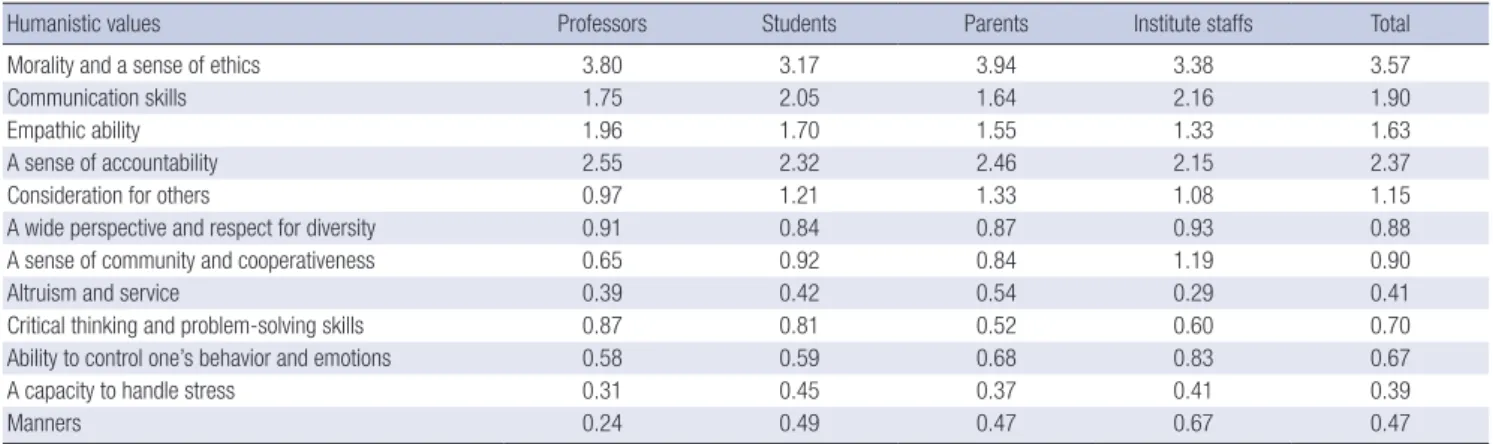
The core values of humanism in medical education In all sub-groups, “morality and a sense of ethics” was chosen as the most important value. The second was a “sense of account- ability,” followed by “communication skills,” “empathic ability,”
“mindfulness and tolerance,” and a “wide perspective and re- spect for diversity.”
Regarding the top three values that each sub-group selected, the professors chose “morality and a sense of ethics,” a “sense of accountability,” and “empathic ability.” The students selected
“morality and a sense of ethics,” a “sense of accountability,” and
“communication skills.” The parents opted for “morality and a sense of ethics,” a “sense of accountability,” and “communication skills.” The employees chose “morality and a sense of ethics,”
“communication skills,” and a “sense of accountability” (Table 2).
The results of assessing to what extent the medical students possessed each humanistic competency showed that most par-
Table 2. Mean of the importance scores on each humanistic value that medical students must have
Humanistic values Professors Students Parents Institute staffs Total
Morality and a sense of ethics 3.80 3.17 3.94 3.38 3.57
Communication skills 1.75 2.05 1.64 2.16 1.90
Empathic ability 1.96 1.70 1.55 1.33 1.63
A sense of accountability 2.55 2.32 2.46 2.15 2.37
Consideration for others 0.97 1.21 1.33 1.08 1.15
A wide perspective and respect for diversity 0.91 0.84 0.87 0.93 0.88
A sense of community and cooperativeness 0.65 0.92 0.84 1.19 0.90
Altruism and service 0.39 0.42 0.54 0.29 0.41
Critical thinking and problem-solving skills 0.87 0.81 0.52 0.60 0.70
Ability to control one’s behavior and emotions 0.58 0.59 0.68 0.83 0.67
A capacity to handle stress 0.31 0.45 0.37 0.41 0.39
Manners 0.24 0.49 0.47 0.67 0.47
ticipants had nearly identical answers (as to whether students possessed the qualities to a high or low degree). Participants thought that students had a high “sense of accountability” and
“morality and a sense of ethics (i.e., honesty).” Participants thou- ght that students had a low degree of “empathic ability,” “mind- fulness and tolerance,” “communication skills,” “altruism and service,” and a “sense of community and cooperation” (Table 3).
There was a small disparity in the distribution of the mean score in each sub-group; the parents and students evaluated the de- gree of each humanistic competency in students more highly than professors and institute staff.
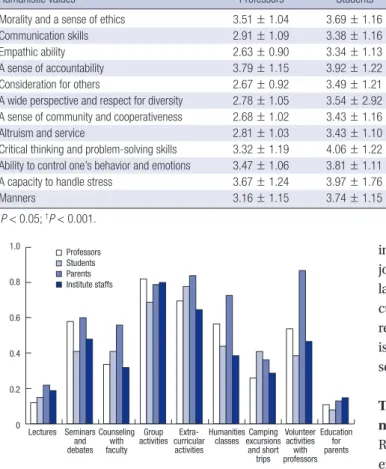
Effective methods for teaching humanism education In all sub-groups, the most frequently chosen option was “ac- tivities beyond the required classes (sports, choir, music appre- ciation, art and other creative activities),” followed by “small group activities, humanities classes and debates,” and “regular volunteer activities with professors.” The least frequently cho- sen options were “parents’ education” and “lectures” (Fig. 1).
Other opinions in the form of short answers addressed issues related to improving curricula: extracurricular activities (discuss-
ing problems with friends, watching movies, experiencing other jobs or majors, debating actual cases, and mentoring programs), launching courses related to humanism, and eliminating a school culture focused on grades. The following were also mentioned:
reinforcing parental discipline, increasing professors’ human- ism education, and increasing the frequency of humanism as- sessments during interviews for entering medical school.
The expected effectiveness of humanism education, the need for it, and methods of implementation
Regarding Questions 4-7, which asked participants about the effectiveness of humanism education, the participants estimat- ed that humanism education would be mildly to moderately effective (in the order of the parents, professors, institute staff, and students). With regard to how necessary it is for medical schools to offer humanism education and how much partici- pants supported colleges offering it, the mean score was the highest among the parents, followed by the institute staff, the professors, and the students.
With regard to the level of support for colleges offering hu- manism education as a credited course, the mean score was the highest among the institute staff, followed by the parents, professors, and students. When comparing the school staff with the parents, the professors and students expressed a rather pas- sive stance toward implementing humanism education in col- leges. Students were more opposed than any other group to se- lecting humanism education as a credited course (Table 4).
Methods for assessing performance in humanism education courses
In terms of gauging students’ performance in humanism edu- cation courses, most participants responded that they preferred a “pass/fail” method based on their rate of participation, and they desire hands-on programs rather than simple lectures. How- ever, many participants opposed the idea of evaluations, be- cause accuracy and fairness are hard to verify. Many students especially opposed introducing humanism education as a reg- Table 3. The scores on each humanistic value that medical students currently carrying out (mean ± SD)
Humanistic values Professors Students Parents Institute staffs F Post-hoc* (Scheffe)
Morality and a sense of ethics 3.51 ± 1.04 3.69 ± 1.16 4.14 ± 1.21 3.44 ± 1.00 15.87† 1,4,2 < 3
Communication skills 2.91 ± 1.09 3.38 ± 1.16 3.67 ± 1.21 2.94 ± 1.06 18.77† 1,4 < 2,3
Empathic ability 2.63 ± 0.90 3.34 ± 1.13 3.42 ± 1.26 2.76 ± 1.16 26.88† 1,4 < 2,3
A sense of accountability 3.79 ± 1.15 3.92 ± 1.22 4.52 ± 1.18 3.41 ± 1.04 28.23† 4 < 1,2 < 3
Consideration for others 2.67 ± 0.92 3.49 ± 1.21 3.60 ± 1.30 2.73 ± 1.04 40.44† 1,4 < 2,3
A wide perspective and respect for diversity 2.78 ± 1.05 3.54 ± 2.92 3.90 ± 1.25 3.09 ± 1.08 8.67† 1,4 < 2,3 A sense of community and cooperativeness 2.68 ± 1.02 3.43 ± 1.16 3.69 ± 1.27 2.92 ± 1.15 29.75† 1,4 < 2,3
Altruism and service 2.81 ± 1.03 3.43 ± 1.10 3.60 ± 1.24 2.93 ± 1.11 22.91† 1,4 < 2,3
Critical thinking and problem-solving skills 3.32 ± 1.19 4.06 ± 1.22 4.16 ± 1.14 3.37 ± 1.12 27.10† 1,4 < 2,3 Ability to control one’s behavior and emotions 3.47 ± 1.06 3.81 ± 1.11 4.23 ± 1.12 3.21 ± 1.12 28.43† 1,4 < 2 < 3 A capacity to handle stress 3.67 ± 1.24 3.97 ± 1.76 4.21 ± 1.22 3.14 ± 1.16 16.67† 4 < 1 < 2,3
Manners 3.16 ± 1.15 3.74 ± 1.15 4.27 ± 1.21 2.94 ± 1.21 48.63† 1,4 < 2 < 3
*P < 0.05; †P < 0.001.
Fig. 1. Mean scores on perceived effectiveness of teaching methods for humanism education in a medical school. Question 3 was a multiple-choice question that asked,
“Select at least three effective methods for teaching humanistic competencies.”
Lectures Seminars debatesand
Counseling with faculty
Group activities Extra-
curricular activities
Humanities classes Camping
excursions and short
trips Volunteer activities with professors
Education parentsfor 1.0
0.8
0.6
0.4
0.2
0
Professors Students Parents Institute staffs
ular course subject, and grading students based on a relative evaluation. Instead, they suggested team activities, small group activities with professors, anonymous peer evaluations, and submitting essays. Most sub-groups suggested submitting term papers or essays, peer assessments, evaluations by the institute (by patients or medical staff), and humanism-related tests.
DISCUSSION
The authors surveyed medical students, professors, university staff, parents, and medical staff that doctors work with (such as nurses, administrative staff, and laboratory technicians) on es- sential humanistic competencies that medical students should have, and on teaching methods that will effectively develop such attributes. Since medical treatment is a doctor-patient interac- tion based on respect, it is crucial for medical students to learn about and experience humanistic values in medical school.
As essential values that directly affect the treatment of pati- ents, previous studies have focused on a sense of ethics, an hon- esty, and a sense of accountability; most medical schools and intern programs share similar values (10). In the workplace, where there is a lot of stress due to heavy workloads, it is neces- sary to interact with diverse people and consider potential risks and accountability to prevent doctors from experiencing burn- out, and helping them maintain a life purpose and sense of sat- isfaction from their jobs. It seems that studying the humanities in medicine leads to “good” and “happy doctors” (2).
According to the results, all groups (professors, students, par- ents, and institute staff) chose “morality and a sense of ethics”
as the most important trait. In addition, a “sense of accountabil- ity,” “communication skills,” and “empathic ability” were select- ed as essential qualities. According to the evaluation on the ex- tent to which students possess each quality, participants believed students had a high “sense of accountability,” whereas partici- pants thought students had low “empathic ability,” “communi- cate,” or “collaborate with others”. There was a difference among the groups in the results. The professor and school staff groups scored meaningfully lower than student and parent groups. This is believed to be due to the fact that professors and school staff, within a real-life school or hospital setting, have a higher evalu- ation standard for the students they view as future doctors.
This shows the need to expand humanism education, through which medical students can learn to empathize, communicate,
mindfulness and tolerance, and a sense of community and co- operation. These values, which medical students can experience and practice by interacting with other people, require specific, observable actions such as showing respect, eliciting emotions and responding to them, and communicating effectively (11).
It is thus necessary to introduce more diverse teaching meth- ods, rather than uniform, passive lectures, so that students can effectively develop each humanistic competency. In terms of effective teaching methods, all sub-groups preferred experience- based teaching methods, rather than classroom lectures. They preferred extracurricular activities (sports, music, art, or other creative activities) and small group activities the most; they also positively assessed humanities classes, debates, and volunteer service with professors.
Although there is no consensus as to the best method for tea- ching professionalism in medical education, previous studies have reported role modeling and mentoring to be effective (12), because they allow students to communicate and interact with patients and peers in many different ways in a safe environment with fewer risks (13). Besides conventional methods such as lectures, simulation or role-playing, which both school staff and students prefer, are expected to increase the educational effect of humanism education when used during debates or small group activities.
With regard to the speculated effect of humanism education and the awareness of the need for colleges to offer it, all sub- groups had a positive response. However, in terms of introduc- ing humanism education as a credited course, most parents and school staff supported the idea, whereas the professors ex- pressed a relatively passive stance; there was stronger opposi- tion from student groups. This passive stance is believed to be due to the fact that the professor group, although agreeing with the need for humanistic education, would feel burdened by the increase in workload, and the student group would feel burden- ed by the lectures and evaluations. Some professors even showed skepticism towards the idea of “educating” one’s character in school. Additionally, it is thought that this judgment may have been affected by the perception that there is still a lack of a cur- riculum and an institutional and human resource infrastruc- ture to provide humanistic education in schools. On the other hand, as future colleagues who may work together, the staff be- lieve that there is a need to increase students’ communication skills through education (the staff group believes that commu- Table 4. The rating scores of the effectiveness and necessity for humanism education in medical school (mean ± SD)
Education parameters Professors Students Parents Institute staffs Total
The effectiveness of humanism education 2.33 ± 0.65 2.01 ± 0.83 2.84 ± 0.65 2.43 ± 0.58 2.28 ± 0.81
The need for humanism education 3.06 ± 0.79 2.48 ± 1.01 3.40 ± 0.64 3.30 ± 0.69 2.86 ± 0.97
The degree of support for schools providing humanism education 3.05 ± 0.83 2.46 ± 1.07 3.48 ± 0.66 3.37 ± 0.70 2.88 ± 1.02 The degree of support for schools selecting humanism education as a
credited course 2.55 ± 1.12 1.81 ± 1.24 3.01 ± 0.99 3.08 ± 0.76 2.38 ± 1.24
nication ability is the second most important attribute after eth- ics). Furthermore, parents desire an increased level of educa- tion and more activities between the students and the profes- sors. Thus, the results reflect the different requirements of each group.
Although all groups were aware of the need for humanism education, it appears that the workload (study load) or the bur- den of assessing performance was an obstacle for them to will- ingly participate in humanism education courses. Hence, it seems best to introduce a core humanism education program into me- dical school curricula in phases, and to adopt a horizontal eval- uation by peers or a “pass/fail” method based on the rate of par- ticipation, as opposed to a subjective assessment by faculty, which can be stressful.
This study has the following limitations. Firstly, the groups that participated were limited to the staff and parents of a spe- cific medical school; thus, the results cannot represent all medi- cal schools in Korea. There are 41 medical colleges and schools in the country. Each school has different goals and educational features based on various criteria such as the founder, location, the quota for the number of students and staff, and whether it has a research hospital. This leads to a disparity in criteria for core humanistic competencies or preferred teaching methods.
Secondly, among the essential humanistic competencies that the authors suggested, some abstract traits (e.g., altruism) can be interpreted differently based on participants’ subjective opin- ions. In future studies, we can mitigate this limitation by giving clearer operational definitions to the presented concepts in multiple-choice questions. Finally, due to the unavailability of standardized survey instruments related to the evaluation of core humanistic competencies in Korea, the authors created and used this survey instrument upon completing theoretical reviews of common humanistic competencies and values, and validity verification for the information provided by 10 medical school professors that provide student guidance. The validity and reliability of the survey instrument could not be verified due to the short duration of the study; therefore, there are limi- tations to the generalization of the survey results, and the ques- tionnaire needs to be revised for further studies.
The conclusion and significance of this study can be summa- rized as follows. Current medical students have a strong degree of morality and sense of ethics, as well as a sense of accountabil- ity. In comparison, they lack some essential humanistic com- petencies, such as empathy and communication skills. There- fore, they should receive complementary humanism education.
Regarding teaching methods for humanism education, it is ex- pected that the field will develop effectively through experience- based activities, which medical school constituents prefer; these include debates, as well as extracurricular and small group ac- tivities.
In terms of essential elements for successfully operating a
humanism education program, previous studies (12,13) men- tioned the training and participation of faculty members in ed- ucational and clinical fields, as well as creating an organization’s culture and environment. In order to reap more comprehensive and lasting effects of humanism education courses in medical school, it is necessary to conduct faculty workshops, launch a committee to monitor a humanism education program, and continuously strive to develop this program.
DISCLOSURE
The authors have no potential conflicts of interest to disclose.
AUTHOR CONTRIBUTION
Design of the study: Shin MS, Jung HY, Kim JW, Lee SH, Yoo SH.
Data collection and analysis: Shin MS, Jung HY, Kim JW, Lee SH, Yoo SH, Jeon JH, Kim TW, Park JS, Jeong SY, Oh SJ, Kim EJ.
Writing manuscript: Shin MS, Jung HY, Kim JW, Lee SH, Oh SJ.
Revision: Shin MS, Jung HY, Kim JW, Lee SH, Oh SJ. Approval of final version of this manuscript: all authors.
ORCID
Hee-Yeon Jung http://orcid.org/0000-0003-0232-7202 Jae-Won Kim http://orcid.org/0000-0001-8821-6225 Seunghee Lee http://orcid.org/0000-0001-8672-5253 Seong Ho Yoo http://orcid.org/0000-0001-5294-0596 Ju-Hong Jeon http://orcid.org/0000-0002-5603-2955 Tae-woo Kim http://orcid.org/0000-0002-5180-0978 Joong Shin Park http://orcid.org/0000-0002-5246-0477 Seung-Yong Jeong http://orcid.org/0000-0003-2726-4850 Seo Jin Oh http://orcid.org/0000-0002-7275-7681 Eun Jung Kim http://orcid.org/0000-0002-8935-2103 Min-Sup Shin http://orcid.org/0000-0001-9840-6997 REFERENCES
1. Yang EB, Meng KH. Five suggestions for future medical education in Ko- rea. Korean J Med Educ 2014; 26: 167-78.
2. You HJ. Two aims of medical humanities education: good doctors and happy doctors. Korean J Med Rev 2015; 17: 51-6.
3. Mueller PS. Incorporating professionalism into medical education: the Mayo Clinic experience. Keio J Med 2009; 58: 133-43.
4. Lee YM, Ahn DS. A preliminary study for exploring the attributes of being a “Good Doctor”. Korean J Med Educ 2007; 19: 313-23.
5. Kim DH, Kim EJ, Hwang J, Shin JS, Lee S. What is the current orientation of undergraduate medical education in Korea? Korean J Med Educ 2015;
27: 87-98.
6. Ahn DS. The future roles of Korean doctors: cultivating well-rounded doc- tors. Korean J Med Rev 2014; 16: 119-25.
7. World Federation for Medical Education (DK). The Global Role of the
Doctior in Health Care: Report of the Meeting of the WFME Task Force.
Copenhagen: World Fedration for Medical Education, 2010.
8. Ministry of Health and Welfare (KR). Global Role of Korean Doctor. Seoul:
Ministry of Health and Welfare, 2014.
9. Hong SH. Application to the dilemma discussion program: ethics and character education for medical students. Korean J Med Rev 2009; 11:
3-14.
10. Lee YH, Lee YM, Kwon HJ. Development of a code of professional con- duct for medical students and residents. Korean J Med Educ 2014; 26:
321-33.
11. Weissmann PF, Branch WT, Gracey CF, Haidet P, Frankel RM. Role mod- eling humanistic behavior: learning bedside manner from the experts.
Acad Med 2006; 81: 661-7.
12. Birden H, Glass N, Wilson I, Harrison M, Usherwood T, Nass D. Teaching professionalism in medical education: a best evidence medical educa- tion (BEME) systematic review. BEME Guide No. 25. Med Teach 2013; 35:
e1252-66.
13. Cohen LG, Sherif YA. Twelve tips on teaching and learning humanism in medical education. Med Teach 2014; 36: 680-4.