Factors That Predict Persistent Smoking of Cancer Survivors
We conducted this cross-sectional study to elucidate factors that predict persistent smoking of the Korean cancer survivors. The subjects were 130 adult (≥19 yr old) cancer survivors who were smokers at the diagnosis of cancer and have participated in the Korean National Health and Nutrition Examination Surveys conducted from 2007 to 2011. We categorized them into the persistent smokers and the quitters, according to change in smoking status between the time of cancer diagnosis and the time of the survey. Factors associated with persistent smoking were evaluated using the multiple logistic regression analysis. During 7.52 yr (standard deviation = 0.34) after the cancer diagnosis, 59.6% of the 130 cancer survivors have continued to smoke. After adjusting for covariates, following factors were independently associated with the risk of persistent smoking: female, low income, high- risk alcohol use, high body mass index (≥ 25 kg/m2), presence of household members who smoke, and longer duration of smoking. Alcohol Use Disorders Identification Test showed a positive association with the risk of persistent smoking (P for trend = 0.012). In conclusion, more efforts for smoking cessation should be in place for the cancer survivors with those risk factors associated with the persistent smoking.
Keywords: Neoplasms; Survivors; Koreans; Risk Factors; Smoking Cessation Hyoeun Kim,1 Mi-Hyun Kim,1
Yong-Soon Park,2 Jin Young Shin,1 and Yun-Mi Song1
1Department of Family Medicine, Samsung Medical Center, Sungkyunkwan University School of Medicine, Seoul; 2Department of Family Medicine, Hallym University Chuncheon Sacred Heart Hospital, Chuncheon, Korea
Received: 30 June 2014 Accepted: 17 February 2015 Address for Correspondence:
Yun-Mi Song, MD
Department of Family Medicine, Samsung Medical Center, Sungkyunkwan University School of Medicine, 81 Irwon-ro, Gangnam-gu, Seoul 135-710, Korea
Tel: +82.2-3410-2442, Fax: +82.2-3410-0388 E-mail: [email protected]
Funding: This work was supported by Basic Science Research Program through the National Research Foundation of Korea (NRF) funded by the Ministry of Science, ICT and future Planning (#2014R1A2A2A01002705).
http://dx.doi.org/10.3346/jkms.2015.30.7.853 • J Korean Med Sci 2015; 30: 853-859
INTRODUCTION
The advances in early detection and treatment of cancer have contributed to extend the lives after cancer diagnosis. The five- year survival rate of cancer patients occurring from 2006 to 2010 was 64.1% for the Korean population (1). The National Cancer Data Base and the Surveillance, Epidemiology, and End Results (SEER) and Medicare Database of the USA show that nearly 13.7 million Americans were living with cancer in 2012 and the size of cancer survivors is predicted to increase to nearly 18 mil- lion by 2022 (2).
The cancer survivors tend to have greater risks for the secon- dary cancers (3, 4) and other chronic health problems such as hypertension, diabetes mellitus, and cardiovascular disease (5), in addition to the potential risk of primary cancer recurrence.
In addition to the genetic factors and cancer treatment related factors, the behavioral factors such as smoking, alcohol, physi- cal activity, and nutritional factors have been found to contrib- ute to the increasing health risks of the cancer survivors (2, 6-8).
Among the health behaviors, cigarette smoking is the most important modifiable risk factor for cancer- and non-cancer- related morbidity and for the mortality of cancer patients (2, 9).
The persistent smoking after cancer diagnosis has been known to deteriorate long term outcome, reduce the efficacy of cancer treatment, increase the risk of secondary cancers, and reduce the quality of life for cancer survivors (4, 6, 8, 10-12). Although
smoking cessation has been known to be beneficial to health even after cancer diagnosis (8, 12), many cancer survivors con- tinue to smoke (13-16).
The previous studies found that the factors associated with persistent smoking after cancer diagnosis were younger age (15, 17, 18), sex (18), lower level of education (15, 19), unmarried status (15, 19), alcohol use (17, 20), type of cancer (15, 17), high nicotine dependency (19, 21), multiple attempts to quit smok- ing (17), and exposure to second-hand smoking (22). However, most of these studies are limited to the survivors of head and neck cancer or lung cancer in the western population (17, 20, 23) and Asian study was scarcely conducted (14). Up until now, only one study on the Korean patients was conducted in a hos- pital setting (14), which may lack representativeness.
In this regard, we conducted this study using the nationwide survey data in order to figure out the patterns of smoking be- havior and the factors that are associated with persistent smok- ing of the cancer survivors.
MATERIALS AND METHOD Study participants
The study participants were Korean men and women over 19 yr of age who participated in the Korean National Health and Nu- trition Examination Surveys (KNHANES) from 2007 to 2011. The KNHANES is a cross-sectional nationwide community health Occupation & Environmental Medicine
survey conducted by the Korea Center for Disease Control, in order to investigate the health and nutritional status of children and adults in Korea. The survey selected representative sample from all ages of Korean population using a stratified, multistage probability sampling design.
Methods of measurement
The KNHANES is composed of three parts: health interview survey, health examination, and nutrition survey. All measure- ments were conducted by well-trained medical personnel. Heal- th survey and measurements were conducted in specially de- signed and equipped mobile centers, whereas nutrition survey was conducted by visiting each household selected for the sur- vey. Laboratory tests were conducted using fresh blood drawn after a minimum of 8 hr of fasting. Using structured question- naire, the following information were collected: information on demographics of the residential area, level of education and in- come, economic activity, marital status, health history (cancer, cardiovascular disease, diabetes mellitus, and depression), sub- jective stress, health habits (smoking, alcohol use, and physical activity), and presence of smoker in the household.
Grouping of subjects by parameters
Among 42,347 participants of the KNHANES from 2007 to 2011, 871 people reported to have been diagnosed with cancer.
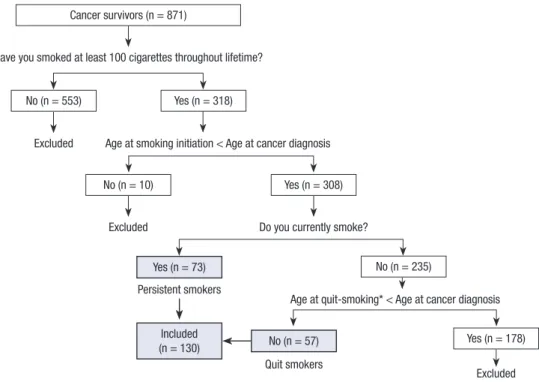
Of the 871 people, 130 people who were smokers at the time of cancer diagnosis were identified for this study using the infor- mation about ‘lifetime smoking’, ‘current smoking’, ‘age at can-
cer diagnosis’, ‘age at smoking initiation’, and ‘duration of smok- ing (for ex-smokers)’ collected for the KNHANES (Fig. 1). Sub- jects with benign tumor, skin cancer, carcinoma in situ, or un- clear or ill-defined (malignant or benign) cancer were not con- sidered as cancer survivors. A smoker was defined as a person who has smoked 100 or more cigarettes throughout the lifetime and continued to smoke until the time at cancer diagnosis. For subjects who were identified as cancer survivor, we further check- ed for the type of cancer and the age at cancer diagnosis. For those with multiple primary cancers, the first diagnosed cancer was included to the analysis. We categorized the following as smoking related cancers: head and neck, lung, esophagus, sto- mach, pancreas, cervix, bladder, kidney, other genitourinary organ, and leukemia (24). Cancers at the thyroid, thymus, duo- denum, liver, gallbladder, biliary duct, colorectum, breast, uter- us, ovary, prostate, osteosarcoma, lymphoma, and multiple my- eloma were categorized non-related to smoking. We calculated years lapsed after the diagnosis of cancer using the current age and the age at the first cancer diagnosis.
We categorized cancer survivors who were smoking at the time of cancer diagnosis into two groups according to change in smoking status between the time of cancer diagnosis and the time of the survey: quit-smokers (those who stopped smoking after the time of cancer diagnosis and maintained quit-smoking status until the time of survey) and persistent smokers (those who continued to smoke until the time of survey).
As the survey was conducted cross-sectionally, the data on the change in smoking status was reconstructed using informa-
Fig. 1. Process for selecting study subjects. *Age at quit-smoking was calculated by adding the duration of smoking to age at smoking initiation.
Cancer survivors (n = 871)
No (n = 553)
No (n = 10)
Yes (n = 73)
No (n = 57) Included
(n = 130)
No (n = 235)
Yes (n = 178) Yes (n = 308)
Yes (n = 318) Have you smoked at least 100 cigarettes throughout lifetime?
Excluded
Excluded
Excluded Persistent smokers
Do you currently smoke?
Age at smoking initiation < Age at cancer diagnosis
Age at quit-smoking* < Age at cancer diagnosis
Quit smokers
tion about age at the time of the survey, age at the time of can- cer diagnosis, age at the time of starting smoking, and age at the time of quit-smoking.
We collected data on ‘high risk alcohol use’, which was defin- ed as consuming seven or more standard drinks for males and five or more standard drinks for females at least once a month.
In addition, we checked alcohol dependency using Alcohol Use Disorders Identification Test (AUDIT) (25, 26).
We categorized the level of physical activity into ‘active’ or
‘inactive’ on the basis of the intensity and expenditure of time.
Walking for more than 30 min at a time over five times a week, moderate activities for more than 30 min at a time over five times a week, or vigorous activities for more than 20 min over three times a week were all considered adequate level of activity. Those completing such amount of exercises were categorized into phy- sically ‘active’ group. Those who do not meet such criteria were included into ‘inactive’ group.
Residential area was categorized into two groups: urban ar- eas or rural areas. The urban areas include Seoul, the surround- ing metropolitan area in Gyeonggi, and other six major metro- politan cities throughout the country. The rural areas include all of the remaining areas. Level of education achieved was cat- egorized into two groups: ≤ 9 yr or > 9 yr of school. We catego- rized economic activities into two groups: economically inac- tive or active. The economically inactive group includes the un- employed, housewives, students, and military. We categorized individual incomes into two groups based on quartiles: the bot- tom 25% or upper 75%. Marital status was categorized into two groups: married or unmarried. If a person has never married, divorced, separated, or widowed, we categorized him or her into the unmarried group. We categorized subjective stress into two levels based on the response to a question, “Are you under stress?”: where the participants choose ratings between the min- imal to mild or the moderate to severe.
Well-trained research assistants carried out the measurements of heights and weights while the participants wore light indoor clothing without shoes. Body mass index was calculated as the weight (in kilograms) divided by squared height (in meters). A person with body mass index over 25 kg/m2 was classified obese according to the World Health Organization guidelines for Asian people (27).
Diabetes mellitus was defined as having high fasting serum glucose level (≥ 7 mM/L), taking glucose lowering agents or in- sulin, or having previous diagnosis of diabetes mellitus. Fasting serum glucose level was measured from fresh blood drawn af- ter a minimum 8 hr of fasting.
Statistical analysis
For the 130 cancer survivors, who were smoking at the time of cancer diagnosis, we further categorized them into two groups according to their smoking status at the time of KNHANES: quit
smoker and persistent smoker. We compared characteristics of the quit smokers and persistent smokers using a chi-square test after the direct age standardization. Then, we evaluated the as- sociation of each measured variables with the risk of persistent smoking by estimating odds ratio and 95% confidence intervals with or without adjusting for age and sex.
To evaluate factors that have independent association with persistent smoking, we did multiple logistic regression analysis by putting age, sex, and those variables that were found to have a at least borderline significant (P < 0.100) association with per- sistent smoking in age and sex adjusted analysis as covariates.
As six subjects had missing values for any of those selected co- variates, 124 subjects were finally included in the multiple lo- gistic regression analysis.
We conducted statistical analyses using PASW statistics 21.0 (SPSS Inc., Chicago, IL, USA) with consideration of sampling weights that were provided by the Korea Centers for Disease Control and Prevention to account for the complex survey de- sign of KNHANES. P value less than 0.05 was considered statis- tically significant for all analyses.
Ethics statement
This study was approved by institutional review board at Sam- sung Medical Center in Korea (IRB file No. 2012-03-090). The data used for this study do not include any identifiable personal information, and informed consent was waived by the board.
RESULTS
During the time lapse of 7.52 yr (standard deviation = 0.34) af- ter cancer diagnosis, 57 (40.4%) of the smoking cancer survivors stopped smoking after the diagnosis of cancer while 73 (59.6%) have continued to smoke. When we looked at the rate of persis- tent smoking of survivors by specific sites of cancer, all of the lung cancer survivors stopped smoking. However, substantial proportions of survivors from other cancers have persisted smo- king (40.5%-100%) without significant difference among them (data not shown).
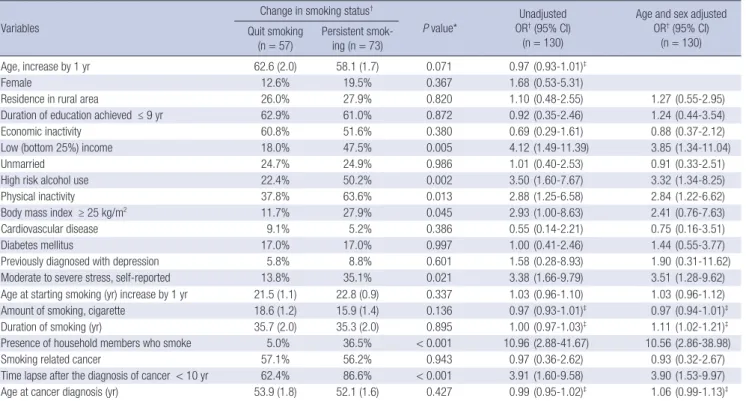
Table 1 shows the associations between the measured vari- ables and the persistent smoking of cancer survivors. Unadjust- ed analysis showed that low income, high risk alcohol use, phys- ical inactivity, moderate to severe stress, short (<10 yr) time lapse after cancer diagnosis, and presence of smoker in the household were significantly associated with persistent smoking. When age and sex were adjusted, the findings from unadjusted analy- sis did not materially change for the most variables. However, a positive association between the duration of smoking and per- sistent smoking became evident with an age and sex adjustment.
Table 2 shows findings from multiple logistic regression anal- ysis with full adjustment for the covariates. In this analysis, fe- male, low income, high risk alcohol use, high body mass index
(≥ 25 kg/m2), presence of smoker in the household, and longer duration of smoking were positively associated with the increas- ed risk of persistent smoking of cancer survivors. Older age was associated with decreased risk of persistent smoking. Physical inactivity, stress, and time lapse after the diagnosis of cancer were not associated with persistent smoking.
Table 3 shows a relation between AUDIT score and the risk of persistent smoking. We found that high risk alcohol use (AUDIT score ≥ 8) was associated with more than 4 times higher risk of persistent smoking, compared to low to moderate risk alcohol
use (AUDIT score < 8). Trend test revealed that the higher the AUDIT score the more the cancer survivors continued to smoke (P for trend = 0.012).
DISCUSSION
In this study, we evaluated factors associated with persistent smoking of cancer survivors using a survey data of a nationally representative population. A previous study of 142 lung cancer survivors reported that 19% of the survivors who were smoking at the time of cancer diagnosis continue to smoke (23). Other studies found that around 50% of the smokers tended to quit smoking soon after cancer diagnosis, but up to 60% (around 30% of survivor who were smoking at the time of cancer diag- nosis) of them restarted smoking later, mostly within 2 months Table 1. Comparisons of characteristics of cancer survivors according to the change in smoking status between the time at survey and the time of cancer diagnosis and evalu- ation† of factors associated with persistent smoking of cancer survivors
Variables
Change in smoking status†
P value*
Unadjusted OR† (95% CI)
(n = 130)
Age and sex adjusted OR† (95% CI)
(n = 130) Quit smoking
(n = 57) Persistent smok- ing (n = 73)
Age, increase by 1 yr 62.6 (2.0) 58.1 (1.7) 0.071 0.97 (0.93-1.01)‡
Female 12.6% 19.5% 0.367 1.68 (0.53-5.31)
Residence in rural area 26.0% 27.9% 0.820 1.10 (0.48-2.55) 1.27 (0.55-2.95)
Duration of education achieved ≤ 9 yr 62.9% 61.0% 0.872 0.92 (0.35-2.46) 1.24 (0.44-3.54)
Economic inactivity 60.8% 51.6% 0.380 0.69 (0.29-1.61) 0.88 (0.37-2.12)
Low (bottom 25%) income 18.0% 47.5% 0.005 4.12 (1.49-11.39) 3.85 (1.34-11.04)
Unmarried 24.7% 24.9% 0.986 1.01 (0.40-2.53) 0.91 (0.33-2.51)
High risk alcohol use 22.4% 50.2% 0.002 3.50 (1.60-7.67) 3.32 (1.34-8.25)
Physical inactivity 37.8% 63.6% 0.013 2.88 (1.25-6.58) 2.84 (1.22-6.62)
Body mass index ≥ 25 kg/m2 11.7% 27.9% 0.045 2.93 (1.00-8.63) 2.41 (0.76-7.63)
Cardiovascular disease 9.1% 5.2% 0.386 0.55 (0.14-2.21) 0.75 (0.16-3.51)
Diabetes mellitus 17.0% 17.0% 0.997 1.00 (0.41-2.46) 1.44 (0.55-3.77)
Previously diagnosed with depression 5.8% 8.8% 0.601 1.58 (0.28-8.93) 1.90 (0.31-11.62)
Moderate to severe stress, self-reported 13.8% 35.1% 0.021 3.38 (1.66-9.79) 3.51 (1.28-9.62)
Age at starting smoking (yr) increase by 1 yr 21.5 (1.1) 22.8 (0.9) 0.337 1.03 (0.96-1.10) 1.03 (0.96-1.12)
Amount of smoking, cigarette 18.6 (1.2) 15.9 (1.4) 0.136 0.97 (0.93-1.01)‡ 0.97 (0.94-1.01)‡
Duration of smoking (yr) 35.7 (2.0) 35.3 (2.0) 0.895 1.00 (0.97-1.03)‡ 1.11 (1.02-1.21)‡
Presence of household members who smoke 5.0% 36.5% < 0.001 10.96 (2.88-41.67) 10.56 (2.86-38.98)
Smoking related cancer 57.1% 56.2% 0.943 0.97 (0.36-2.62) 0.93 (0.32-2.67)
Time lapse after the diagnosis of cancer < 10 yr 62.4% 86.6% < 0.001 3.91 (1.60-9.58) 3.90 (1.53-9.97)
Age at cancer diagnosis (yr) 53.9 (1.8) 52.1 (1.6) 0.427 0.99 (0.95-1.02)‡ 1.06 (0.99-1.13)‡
Data are presented as mean ± standard deviation for continuous variables or percentage for categorical variables. *Comparison was done by t-test for continuous variables and by chi-square test for categorical variables after direct age standardization; †By logistic regression analysis; ‡Estimate for increase by 1 unit. OR, odds ratios; CI, confidence interval.
Table 2. Multivariable adjusted evaluation of factors associated with persistent smok- ing of cancer survivors (n = 124)
Variables OR (95% CI)* P value
Age increase by 1 yr 0.92 (0.85-0.99) 0.025
Female 5.99 (1.38-26.01) 0.018
Low (bottom 25%) income 3.24 (1.22-8.62) 0.019
High risk alcohol use† 3.79 (1.43-10.03) 0.008
Physical inactivity 1.61 (0.63-4.09) 0.313
Body mass index ≥ 25 kg/m2 2.91 (1.01-8.34) 0.048 Moderate to severe stress, self-reported 2.24 (0.67-7.51) 0.189 Duration of smoking, increase by 1 yr 1.12 (1.02-1.22) 0.015 Time lapse after the diagnosis of cancer < 10 yr 1.75 (0.49-6.22) 0.385 Presence of household members who smoke 8.39 (1.95-36.07) 0.005
*Odd ratios and 95% confidence intervals were estimated by multiple logistic regres- sion analysis with an adjustment for all variables in the Table 2; †Consuming seven or more standard drinks for males and five or more standard drinks for females at least once a month. OR, odds ratios; CI, confidence interval.
Table 3. Association between AUDIT score and persistent smoking of cancer survivors AUDIT score Odds ratio (95% confidence interval)*
0-7 1
8-15 4.20 (1.34-13.22)
16-40 5.36 (1.27-22.71)
P for trend† 0.012
*Estimated by logistic regression analysis with an adjustment for age, sex, income, physical activity, body mass index, stress, duration of smoking, presence of house- hold members who smoke, and time lapse after the diagnosis of cancer; †Estimated by linear regression analysis. AUDIT, Alcohol Use Disorders Identification Test.
(18, 28, 29). We found that more than 50% of the cancer survi- vors who were smoking at the time of cancer diagnosis contin- ued to smoke, which is significantly higher compared to the rate of 26.6% of previous Korean studies (14). This unexpectedly high rate of persistent smoking among Korean cancer survivors could be related with the high prevalence of smoking among general Korean population. In addition, relatively low medical attention to smoking cessation for cancer patients in Korea could be a probable reason (30). Another probable reason could be the different distribution of cancer types in this study compared to other studies. The participants in our study survived a wide range of cancer types while the participants of other previous study survived only the smoking related cancers. Finally, differences in the interval between the time of cancer diagnosis and time of survey between the previous study (2.4 yr) and our study (7.4 yr) can be another possible reason.
We found that younger cancer survivors were more likely to smoke persistently than older survivors. This is consistent with the finding that smoking prevalence in general population tends to decrease with increasing age (31). Given that cumulative rate of successful smoking cessation increases over time through the repeated attempt to quit smoking, the older cancer survi- vors may be more successful to quit smoking. In addition, the older cancer survivors tend to have more chronic diseases than the younger survivors, which could further encourage the older survivors to quit smoking (16).
The associations between sex and smoking behavior after the diagnosis of cancer were controversial in the previous studies (13, 15, 17, 20). However, we found that the females have risk about six times higher, even after adjusting for other health hab- its and socioeconomic factors. Several reasons can be taken into consideration. We suppose that this finding is attributable in part to the higher proportion of the cervical cancer survivors included in our study. The cervical cancer survivors occupied 8.2% of our study subjects, which is very high compared to the proportion of cervical cancer among the total cancer patients (4.0% in 2012) registered by the Korea Central Cancer Registry (1). The cervical cancer survivors were found to have the high- est smoking rate and are less likely to quit smoking (15, 16, 32).
Females are less likely to quit smoking among the general pop- ulation (33) and this tendency is also applied to female cancer survivors.
We found that low income was associated with persistent smoking of Korean cancer survivors, which is consistent with the findings of other studies (28, 34). Time and financial con- straints for receiving preventive health services including smok- ing cessation programs may be the hindrance for the low income population. According to the cross-sectional design of our study, we could not negate the lower willpower of persistent smokers compared to successful quitters, and its strong correlation to the low income.
Previous studies showed that smoking and drinking behav- iors were closely related to each other in the cancer survivors (17, 20). Smokers, of general population, with heavy alcohol use tend to have higher nicotine dependency (31), so these were the ones having greater difficulty with smoking cessation among the cancer survivors, which is compatible with the findings for general population (14, 19, 20). This is consistent with our study as well. However, it is still unclear why the smoking and alcohol use are closely associated with each other. As a probable reason, those two were considered to give a psychological benefit to cope with stress. When we examined AUDIT score that is frequently used to identify people with alcohol dependency in our study subjects, we found that the higher the AUDIT score the more the cancer survivors continued to smoke (P for trend = 0.012).
Given that the combined use of cigarette and alcohol after treat- ment of cancer has negative synergic effects on the occurrence of a second neoplasm (19), healthcare professionals should pro- vide cancer survivors who smoke persistently with information about the negative health-related outcomes.
In this study, the presence of smokers in the household was associated with 8- times higher risk of persistent smoking. It is remarkable that about 15% of the family members of cancer sur- vivors were smoking, and the proportions of household mem- bers’ smoking is similar between the cancer survivors and the subjects without cancer. Weaver et al. (28) also found that 24.5%
of the family members of lung cancer patients and 19.7% of the family members of colorectal cancer patients were current smo- kers. Smoking behaviors are found to be affected by intra-famil- ial smoking for the general populations (18). Household mem- bers who smoke tends to hinder the lung cancer patients’ moti- vation toward smoking cessation (21, 35). Kashigar et al. (22) reported that smoking behavior of a spouse has important in- fluence on smoking cessation in head and neck cancer patients.
These findings suggest that cooperative support by family mem- bers of the cancer survivors, such as tailored intra-familial sup- port and smoking restriction at home, is important to lead can- cer survivors to quit smoking.
The strength of our study is that study subjects were selected from the representative samples of Korean population for a na- tionwide community health survey. The crude prevalence of previous cancer diagnosis found in this study (781/42,347 per- sons) is comparable to the cancer prevalence of among Korean population (2,190 per 100,000 persons in 2011) reported by the Korea National Cancer Information Center (1), which supports the representativeness of our study.
Our study has some limitations. First, the small number of cancer survivors included in the study did not provide enough power for subgroup analysis by sex, age group, or cancer types.
However, we could identify factors that have significantly strong association with persistent smoking. Second, we used data col- lected by self-administered questionnaire. This could have re-
sulted in under-reporting of undesirable behaviors such as smo- king or alcohol use, and may have caused underestimation of the risk association. Identifying the cancer survivors by self-re- port may be less accurate compared to the reviewing of medical record or the health care data. Third, KNHANES is a cross-sec- tional study, which does not allow prospective observation. We have overcome this problem by reconstructing the time sequen- cing using related information and could examine longitudinal change in smoking status over 7.52 yr (standard deviation = 0.34) after cancer diagnosis. However, even with this effort, we could not clearly identify those who have repeatedly quit and restart- ed smoking and there could have been some misclassification bias. In addition, some smokers at the time of cancer diagnosis who restarted smoking just prior to cancer diagnosis after a long time of quit-smoking and re-quit smoking before the time of survey participation could have been erroneously classified as quit-smokers at cancer diagnosis and excluded from the pres- ent study, because their age at quit-smoking was calculated by adding the duration of smoking to their age at smoking initiation.
Fourthly, the information about stages of cancer, cancer treat- ment, and recurrence were not available in KNHANES data, and we could not evaluate the effects of these factors on persistent smoking of the cancer survivors. Finally, this study could not provide information about cancer survivors with advanced dis- eases because the target populations of KNHANES were com- munity residents, and the institutionalized patients were not included in the survey.
In conclusion, this study found that many of the cancer sur- vivors continued to smoke even after the cancer diagnosis. Sev- eral factors such as female, low income, high risk alcohol use, obesity, presence of smoker in the households, and longer du- ration of smoking were associated with the increased risk of per- sistent smoking in cancer survivors. These findings suggest that more efforts for smoke cessation should be in place for the can- cer survivors with increased risk of persistent smoking.
DISCLOSURE
All authors have no potential conflicts of interest.
AUTHOR CONTRIBUTION
Conceived and designed the study: Kim H, Song YM, Park YS, Shin JY, Kim MH. Data collection: Kim H, Kim MH. Analyzed the data: Kim H, Park YS. Wrote the first draft of the manuscript:
Kim H, Song YM, Shin JY. Wrote the paper: Kim H, Song YM, Shin JY, Park YS. ICMJE criteria for authorship read and met:
Kim H, Song YM, Park YS, Shin JY, Kim MH. Agree with manu- script results and conclusions: Kim H, Song YM, Park YS, Shin JY, Kim MH.
ORCID
Hyoeun Kim http://orcid.org/0000-0001-7078-7599 Mi-Hyun Kim http://orcid.org/0000-0003-1828-0955 Yong Soon Park http://orcid.org/0000-0002-8926-9836 Jin Young Shin http://orcid.org/0000-0001-9558-1853 Yun-Mi Song http://orcid.org/0000-0001-9232-5563
REFERENCES
1. National Cancer Information Center. Cancer Facts & Figures. 2013. Avail- able at http://www.cancer.go.kr/mbs/cancer/jsp/album/gallery.jsp?spa ge=1&boardId=31817&boardSeq=399626&mcategoryId=&id=cancer_
050207000000 [accessed on 11 January 2014].
2. Siegel R, DeSantis C, Virgo K, Stein K, Mariotto A, Smith T, Cooper D, Gansler T, Lerro C, Fedewa S, et al. Cancer treatment and survivorship statistics, 2012. CA Cancer J Clin 2012; 62: 220-41.
3. Dong C, Hemminki K. Second primary neoplasms in 633,964 cancer patients in Sweden, 1958-1996. Int J Cancer 2001; 93: 155-61.
4. Garces YI, Schroeder DR, Nirelli LM, Croghan GA, Croghan IT, Foote RL, Hurt RD. Second primary tumors following tobacco dependence treatments among head and neck cancer patients. Am J Clin Oncol 2007;
30: 531-9.
5. Shin DW, Nam JH, Kwon YC, Park SY, Bae DS, Park CT, Cho CH, Lee JM, Park SM, Yun YH. Comorbidity in disease-free survivors of cervical cancer compared with the general female population. Oncology 2008;
74: 207-15.
6. Browman GP, Wong G, Hodson I, Sathya J, Russell R, McAlpine L, Sk- ingley P, Levine MN. Influence of cigarette smoking on the efficacy of ra- diation therapy in head and neck cancer. N Engl J Med 1993; 328: 159-63.
7. Chiolero A, Faeh D, Paccaud F, Cornuz J. Consequences of smoking for body weight, body fat distribution, and insulin resistance. Am J Clin Nutr 2008; 87: 801-9.
8. Ligibel J. Lifestyle factors in cancer survivorship. J Clin Oncol 2012; 30:
3697-704.
9. Iribarren C, Tekawa IS, Sidney S, Friedman GD. Effect of cigar smoking on the risk of cardiovascular disease, chronic obstructive pulmonary dis- ease, and cancer in men. N Engl J Med 1999; 340: 1773-80.
10. Peppone LJ, Mustian KM, Morrow GR, Dozier AM, Ossip DJ, Janelsins MC, Sprod LK, McIntosh S. The effect of cigarette smoking on cancer treat- ment-related side effects. Oncologist 2011; 16: 1784-92.
11. Fairley TL, Hawk H, Pierre S. Health behaviors and quality of life of can- cer survivors in Massachusetts, 2006: data use for comprehensive cancer control. Prev Chronic Dis 2010; 7: A09.
12. Garces YI, Yang P, Parkinson J, Zhao X, Wampfler JA, Ebbert JO, Sloan JA. The relationship between cigarette smoking and quality of life after lung cancer diagnosis. Chest 2004; 126: 1733-41.
13. Tseng TS, Lin HY, Moody-Thomas S, Martin M, Chen T. Who tended to continue smoking after cancer diagnosis: the national health and nutri- tion examination survey 1999-2008. BMC Public Health 2012; 12: 784.
14. Yang HK, Shin DW, Park JH, Kim SY, Eom CS, Kam S, Choi JH, Cho BL, Seo HG. The association between perceived social support and contin- ued smoking in cancer survivors. Jpn J Clin Oncol 2013; 43: 45-54.
15. Tseng TS, Lin HY, Martin MY, Chen T, Partridge EE. Disparities in smok- ing and cessation status among cancer survivors and non-cancer indi- viduals: a population-based study from National Health and Nutrition Examination Survey. J Cancer Surviv 2010; 4: 313-21.
16. Underwood JM, Townsend JS, Tai E, White A, Davis SP, Fairley TL. Per- sistent cigarette smoking and other tobacco use after a tobacco-related cancer diagnosis. J Cancer Surviv 2012; 6: 333-44.
17. Chan Y, Irish JC, Wood SJ, Sommer DD, Brown DH, Gullane PJ, O’Sullivan B, Lockwood GA. Smoking cessation in patients diagnosed with head and neck cancer. J Otolaryngol 2004; 33: 75-81.
18. Hopenhayn C, Christian WJ, Christian A, Studts J, Mullet T. Factors as- sociated with smoking abstinence after diagnosis of early stage lung can- cer. Lung Cancer 2013; 80: 55-61.
19. Mayer DK, Carlson J. Smoking patterns in cancer survivors. Nicotine Tob Res 2011; 13: 34-40.
20. Vander Ark W, DiNardo LJ, Oliver DS. Factors affecting smoking cessation in patients with head and neck cancer. Laryngoscope 1997; 107: 888-92.
21. Schnoll RA, Malstrom M, James C, Rothman RL, Miller SM, Ridge JA, Movsas B, Unger M, Langer C, Goldberg M. Correlates of tobacco use among smokers and recent quitters diagnosed with cancer. Patient Educ Couns 2002; 46: 137-45.
22. Kashigar A, Habbous S, Eng L, Irish B, Bissada E, Irish J, Brown D, Gil- bert R, Gullane P, Xu W, et al. Social environment, secondary smoking exposure, and smoking cessation among head and neck cancer patients.
Cancer 2013; 119: 2701-9.
23. Evangelista LS, Sarna L, Brecht ML, Padilla G, Chen J. Health perceptions and risk behaviors of lung cancer survivors. Heart Lung 2003; 32: 131-9.
24. National Cancer Information Center. Cancer Facts & Figures. 2012. Avail- able at http://www.cancer.go.kr/ebook/76/PC/ebook.html [accessed on 11 January 2014].
25. Kim JS, Oh MK, Park BK, Lee MK, Kim GJ. Screening criteria of alcohol-
ism by alcohol use disorders identification test (AUDIT) in Korea. J Ko- rean Acad Fam Med 1999; 20: 1152-9.
26. Saunders JB, Aasland OG, Babor TF, de la Fuente JR, Grant M. Develop- ment of the Alcohol Use Disorders Identification Test (AUDIT): WHO Collaborative Project on Early Detection of Persons with Harmful Alco- hol Consumption--II. Addiction 1993; 88: 791-804.
27. Weisell RC. Body mass index as an indicator of obesity. Asia Pac J Clin Nutr 2002; 11: S681-S4.
28. Weaver KE, Rowland JH, Augustson E, Atienza AA. Smoking concor- dance in lung and colorectal cancer patient-caregiver dyads and quality of life. Cancer Epidemiol Biomarkers Prev 2011; 20: 239-48.
29. Simmons VN, Litvin EB, Jacobsen PB, Patel RD, McCaffrey JC, Oliver JA, Sutton SK, Brandon TH. Predictors of smoking relapse in patients with thoracic cancer or head and neck cancer. Cancer 2013; 119: 1420-7.
30. Shin DW, Cho B, Kim SY, Jung JH, Park JH. Management of cancer sur- vivors in clinical and public health perspectives: current status and fu- ture challenges in Korea. J Korean Med Sci 2013; 28: 651-7.
31. Jha P, Ranson MK, Nguyen SN, Yach D. Estimates of global and regional smoking prevalence in 1995, by age and sex. Am J Public Health 2002;
92: 1002-6.
32. Bellizzi KM, Rowland JH, Jeffery DD, McNeel T. Health behaviors of can- cer survivors: examining opportunities for cancer control intervention. J Clin Oncol 2005; 23: 8884-93.
33. Wetter DW, Kenford SL, Smith SS, Fiore MC, Jorenby DE, Baker TB. Gen- der differences in smoking cessation. J Consult Clin Psychol 1999; 67: 555- 62.
34. Messer K, Mills AL, White MM, Pierce JP. The effect of smoke-free homes on smoking behavior in the U.S. Am J Prev Med 2008; 35: 210-6.
35. Eng L, Su J, Qiu X, Palepu PR, Hon H, Fadhel E, Harland L, La Delfa A, Habbous S, Kashigar A, et al. Second-hand smoke as a predictor of smok- ing cessation among lung cancer survivors. J Clin Oncol 2014; 32: 564-70.