Clinical Outcome of Remnant Thyroid Ablation with Low Dose Radioiodine in Korean Patients with Low to Intermediate-risk Thyroid Cancer
Radioiodine activity required for remnant thyroid ablation is of great concern, to avoid unnecessary exposure to radiation and minimize adverse effects. We investigated clinical outcomes of remnant thyroid ablation with a low radioiodine activity in Korean patients with low to intermediate-risk thyroid cancer. For remnant thyroid ablation, 176 patients received radioiodine of 1.1 GBq, under a standard thyroid hormone withdrawal and a low iodine diet protocol. Serum levels of thyroid stimulating hormone stimulated thyroglobulin (off-Tg) and thyroglobulin-antibody (Tg-Ab), and a post-therapy whole body scan (RxWBS) were evaluated. Completion of remnant ablation was considered when there was no visible uptake on RxWBS and undetectable off-Tg (<1.0 ng/mL). Various factors including age, off-Tg, and histopathology were analyzed to predict ablation success rates. Of 176 patients, 68.8% (n = 121) who achieved successful remnant ablation were classified into Group A, and the remaining 55 were classified into Group B. Group A presented with significantly lower off-Tg at the first radioiodine administration (pre-ablative Tg) than those of Group B (1.2 ± 2.3 ng/mL vs. 6.2 ± 15.2 ng/mL, P = 0.027). Pre-ablative Tg was the only significant factor related with ablation success rates. Diagnostic performances of pre-ablative Tg < 10.0 ng/mL were sensitivity of 99.1%, specificity of 14.0%, positive predictive value of 71.1%, and negative predictive value of 87.5%, respectively. Single administration of low radioiodine activity could be sufficient for remnant thyroid ablation in patients with low to intermediate-risk thyroid cancer. Pre-ablative Tg with cutoff value of 10.0 ng/mL is a promising factor to predict successful remnant ablation.
Keywords: Remnant Thyroid Ablation; Radioiodine; Differentiated Thyroid Carcinoma;
Thyroglobulin Seunggyun Ha,1,2 So Won Oh,2
Yu Kyeong Kim,2 Do Hoon Koo,3 Young Ho Jung,4 Ka Hee Yi,5 and June-Key Chung1,6,7,8
1Department of Nuclear Medicine, Seoul National University College of Medicine; 2Department of Nuclear Medicine, 3Department of Surgery,
4Department of Otolaryngology, and 5Department of Internal Medicine, Seoul National University Boramae Medical Center; 6Department of Biomedical Sciences and 7Laboratory of Molecular Imaging and Therapy, Cancer Research Institute, Seoul National University College of Medicine;
8Tumor Microenvironment Global Core Research Center, Seoul National University College of Medicine, Seoul, Korea
Received: 11 November 2014 Accepted: 9 March 2015 Address for Correspondence:
So Won Oh, MD
Department of Nuclear Medicine, Seoul National University Seoul Metropolitan Boramae Medical Center, 20 Boramae-5-ro, Dongjak-gu, Seoul 156-707, Korea
Tel: +82.2-870-2582, Fax: +82.2-870-2587 E-mail: [email protected]
Funding: This work was supported by the National Research Foundation of Korea (NRF) grant for the Global Core Research Center (GCRC) funded by the Ministry of Science, ICT & Future Planning, Korea (No.2011-0030680).
http://dx.doi.org/10.3346/jkms.2015.30.7.876 • J Korean Med Sci 2015; 30: 876-881
INTRODUCTION
Post-operative remnant thyroid ablation using radioiodine fol- lowed by total or near total thyroidectomy is a mainstay in the management of patients with differentiated thyroid carcinoma (DTC). Remnant ablation eliminating residual thyroid tissues has been credited for improving sensitivity of serum thyroglob- ulin (Tg) monitoring and reducing the likelihood of recurrence (1, 2). These clinical benefits of remnant ablation mainly stem from facilitating complete initial staging to detect previously unrecognized metastases via a post-therapy whole body scan (RxWBS); enabling early detection of recurrence via serum Tg monitoring with/without a diagnostic (DxWBS) or RxWBS; serv- ing as an adjuvant therapy by destroying suspected but unprov- en metastatic disease (3-5).
The appropriate amount of radioactivity for remnant ablation
has been recommended by major guidelines for managing pa- tients with thyroid cancer (3, 4). However, these guidelines pro- vide only broad guidance with a wide range of administered ra- dioactivity (1.1-3.7 GBq) because radioiodine ablation using 1.1 GBq and 3.7 GBq shows similar rates of successful remnant ab- lation and recurrence rates (6). Although higher radioiodine activities are likely to achieve higher ablation rates, more fre- quent side effects such as thyroiditis, sialoadenitis, and naso- lacrimal duct obstruction are unavoidable (7-11). Moreover, re- cent randomized and prospective studies have reported that low radioiodine activity (1.1 GBq) is as effective as high radioio- dine activity (3.7 GBq) to decrease serum Tg levels and destroy remnant thyroid tissue (12, 13). In particular, in patients with low-risk thyroid cancer, the use of minimum radioactivity should be required to achieve beneficial effects of remnant thyroid ab- lation as well as avoid unnecessary exposure to radiation.
Oncology & Hematology
Controversies exist on determining the total amount of ad- ministered radioactivity and number of radioiodine therapy sessions to complete remnant ablation. Successful remnant ab- lation is defined as an absence of visible radioiodine uptake on a subsequent scan or undetectable serum Tg (3). It is not easy to predict the outcome of radioiodine therapy in consideration of differences in the amount of residual thyroid tissues left in situ after surgery, preparation status including thyroid stimulat- ing hormone level (TSH) and low iodine diet, and the effective biological half-life of radioiodine. Fixed radioactivity of 1.1 GBq is preferred in most countries based on feasibility of safety regu- lations about the release of patients after radioiodine adminis- tration and similar results with that of a high activity radioiodine ablation. However, a considerable number of patients need more than two sessions of radioiodine to complete remnant ablation.
It would be of great importance to utilize prognostic factors of radioiodine ablation for the management of thyroid cancer. In this regard, we analyzed clinical outcomes of remnant ablation with 1.1 GBq of radioiodine in patients with low to intermedi- ate-risk DTC, to suggest an optimized remnant thyroid ablation protocol.
MATERIALS AND METHODS Patients
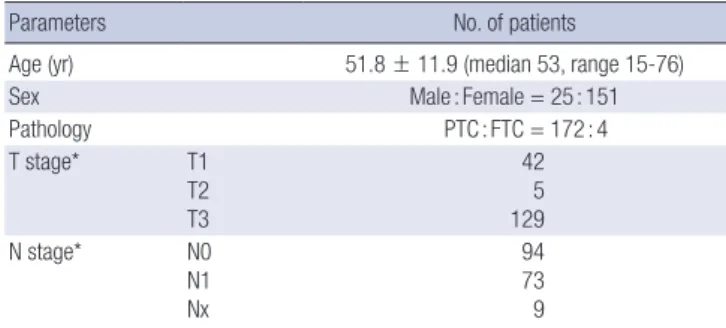
Among 780 patients with DTC who underwent total thyroidec- tomy from June 2006 to June 2012, 225 were treated with 1.1 GBq of radioiodine for remnant thyroid ablation at our institute. Pa- tients with low to intermediate risk were included based on the guidelines (3, 4). Consequently, patients who presented with distant metastases (n = 2), locoregional tissue invasion or mac- roscopic extrathyroidal extension (n = 18), or recurred before completion of remnant ablation (n = 2) were excluded from the study. In addition, patients who were not followed 6-12 months later with TSH stimulated Tg (off-Tg) measurements (n = 16) and follow-up DxWBS (n = 12), were not included. Finally, 176 patients (25 males and 151 females) were retrospectively ana- lyzed for this study. Detailed demographic data are summarized in Table 1.
Preparation for remnant thyroid ablation
All patients were requested to follow a strict thyroid hormone withdrawal regimen in conjunction with a strict low iodine diet.
For thyroid hormone withdrawal, levothyroxine supplementa- tion was discontinued at 4 weeks before radioiodine adminis- tration and switched to triiodothyronine supplementation for 2 weeks. At 2 weeks before radioiodine administration, all forms of thyroid hormone supplementation were completely prohib- ited, and a strict low-iodine diet was started at the same time.
The low-iodine diet was continued until 3 days after radioiodine administration.
Post-therapy WBS
An RxWBS was performed 3 days after radioiodine administra- tion. Using a gamma camera equipped with a high-energy par- allel hole collimator (Infinia Hawkeye 4, GE Healthcare, Parsip- pany, NJ, USA), whole body images were obtained at a 20% sym- metrical window that was centered at 364 keV. RxWBS images were visually interpreted based on a consensus between two nuclear medicine physicians with extensive experience in thy- roid imaging; as definite versus no uptake.
Serum Tg and anti-Tg antibody measurements
Serum levels of TSH, Tg, and Tg-Ab were measured on the day of radioiodine administration in all patients. Serum Tg and Tg- Ab titers were considered valid only when serum TSH level was
> 30 µIU/mL. Serum Tg levels were determined in duplicate using an immunoradiometric assay (Cisbio Bioassays, Codolet, France). Serum Tg-Ab levels were determined in duplicate us- ing a radioimmunoassay (Brahms, Mannheim, Germany). In addition, ratio of urine iodide of creatinine levels (µI/Cr) was measured using an ion-selective electrode method (NeoMet, ISTEK, Seoul, Korea) to evaluate low iodine diet status, which was performed in 66 patients.
Clinical outcome assessment
The completion of remnant thyroid ablation was determined only when no visible radioiodine uptake was observed in the thyroid bed on a WBS and serum off-Tg level became undetect- able (< 1.0 ng/mL). Subsequent radioiodine therapy or follow- up DxRBS and serum off-Tg measurement were repeated with a 6-12 months interval until complete remnant ablation was achieved.
Patients who were confirmed to have complete thyroid abla- tion on the first post-therapy evaluation or the follow-up evalu- ation were classified into Group A. Patients who required radio- iodine therapy more than twice to complete thyroid ablation were classified into Group B. Demographic data and prognostic factors including age, sex, TNM staging, serum levels of TSH, serum Tg and Tg-Ab, and µI/Cr were compared between the two groups (Table 2).
Table 1. Patients’ clinical characteristics
Parameters No. of patients
Age (yr) 51.8 ± 11.9 (median 53, range 15-76)
Sex Male : Female = 25 : 151
Pathology PTC : FTC = 172 : 4
T stage* T1
T2 T3
42 5 129
N stage* N0
N1 Nx
94 73 9
*Staging according to the American Joint Committee on Cancer 7th edition. PTC, pap- illary thyroid carcinoma; FTC, follicular thyroid carcinoma.
Statistical analysis
All statistical analyses were performed using SPSS ver. 18.0, soft- ware (SPSS Inc., Chicago, IL, USA). All the continuous data were expressed as mean ± standard deviation. Comparisons of con- tinuous values were performed with the independent t-test, and independence tests of non-continuous values were carried out by Pearson’s chi-square test. Binary multivariate logistic regres- sion analysis was used to identify independently related factors to the first radioiodine therapy results. Linear-by-linear associa- tion analysis was adopted for subgroup analysis to identify the trend of ablation success rates. P values < 0.05 were considered significant.
Ethics statement
The Ethics Committee of our institute approved this study, and a waiver of informed consent was granted due to the retrospec- tive design of the study. The approved IRB number is 20150105/
26-2015-1/012.
RESULTS
The remnant ablation results of low radioiodine activity were quite excellent in patients with low-risk thyroid cancer. Among 188 patients who were enrolled in this study, outcomes of the first radioiodine administration were assessable in 176 patients.
With the first radioiodine administration, 68.8% (n = 121/176) of the patients achieved successful remnant ablation; they were classified into Group A. In particular, 9 patients already had no remnant thyroid tissue, as proven by no visible uptake on an RxWBS and undetectable off-Tg. On the other hand, 55 patients who had more than two times of radioiodine administration were classified into Group B. However, remnant ablation results were disappointing in Group B, compared to Group A. Only
28.8% (n = 15/52) of Group B patients completed remnant ab- lation, and received a significantly large amount of radioiodine (3.4 ± 0.6 times, 3.7 ± 0.7 GBq) than that of Group A patients.
To identify factors related with the ablation success rate at the first radioiodine administration, various factors were compared;
age, sex, size (long axis), microscopic extrathyroidal extension (mETE), tumor multiplicity, lymphatic invasion, N stage, serum levels of TSH, Tg, Tg-Ab, µI/Cr at the first radioiodine adminis- tration (Table 2). A univariate analysis revealed that age, and Tg level at the first radioiodine administration (pre-ablative Tg) were significantly different between Group A and Group B. Group A patients were significantly older than Group B patients (53.3 ± 11.8 yr vs. 48.6 ± 12.1 yr, P = 0.017) and presented with signifi- cantly lower pre-ablative Tg levels than those of Group B pati ents (1.2 ± 2.3 ng/mL vs. 6.2 ± 15.2 ng/mL, P = 0.027). Binary multi- variate logistic regression analysis was performed for age and pre-ablative Tg. Consequently, it turned out that only pre-abla- tive Tg was an independent factor (odds ratio, 1.138, P = 0.021) related with the first radioiodine ablation results (Table 3).
Pre-ablative Tg was further evaluated as a potential factor for predicting successful remnant ablation at the first radioiodine administration. Patients with lower pre-ablative Tg were more likely to achieve remnant ablation at the first radioiodine admi- nistration (P = 0.004, Fig. 1). The diagnostic performance of pre- ablative Tg was analyzed with two cutoff values of 1.0 ng/mL and 10.0 ng/mL, respectively. Patients presenting with pre-ab- lative Tg < 1.0 ng/mL were more frequent in Group A with a bord- erline significance (P = 0.050). Diagnostic performances of pre- Table 2. Factors affecting ablation success of the first RAI by univariate analysis
Variables Group A Group B P value
No. of patients 121 (68.8%) 55 (31.2%)
Age (yr) 53.3 ± 11.8 48.6 ± 12.1 0.017*
Male sex 14 11 0.138
Tumor size (long axis, cm) 1.1 ± 0.7 1.3 ± 0.7 0.061
Microscopic ETE 90 33 (1†) 0.076
Tumor multiplicity 57 19 (1†) 0.142
Node metastasis 51 22 0.696
Lymphatic invasion 9 4 (1†) 0.994
TFT at the 1st RAI
TSH (μIU/mL) 75.5 ± 56.4 (1†) 77.9 ± 41.7 0.772 Tg (ng/mL) 1.2 ± 2.3 (14†) 6.2 ± 15.2 (5†) 0.027*
Tg < 1.0‡ 69 24 0.050*
Tg ≥ 10.0 1 7 < 0.001*
Tg-Ab > 20.0 IU/mL 52 (9†) 26 (6†) 0.438 Urine iodide (umol/g creatinine) 47.9 ± 58.0 (76†) 42.2 ± 38.8 (34†) 0.685
*Statistically significant; †not checked or not available. RAI, radioactive iodine; ETE, ex- trathyroidal extension; TFT, thyroid function test.
Table 3. Multivariate logistic regression for ablation success of the first RAI
Variables B (SE) OR 95% CI P value
Age (yr) -0.013 (0.016) 0.987 0.957-1.019 0.420
Tg, continuous value 0.130 (0.056) 1.138 1.020-1.271 0.021*
Age (yr) -0.018 (0.015) 0.983 0.954-1.012 0.242
Tg ≥ 10.0 ng/mL 2.702 (1.094) 14.903 1.747-127.167 0.014*
P values were analyzed using binary logistic regression according to the procedure
“Enter”. *Statistically significant. RAI, radioactive iodine; SE, standard error; OR, odds ratio; CI, confidence interval; Tg, thyroglobulin.
Fig. 1. Success rates of remnant ablation according to pre-ablative thyroglobulin (Tg) levels at the first radioiodine therapy. Patients with lower pre-ablative Tg were more likely to achieve remnant ablation than those with higher pre-ablative Tg.
Success rate (%)
Pre-ablative Tg (ng/mL)
P = 0.004
Tg < 1.0 1.0 ≤ Tg < 10.0 Tg ≥ 10.0 100
75 50 25 0
Success
74.2 66.1
12.5
ablative Tg < 1.0 ng/mL were sensitivity of 64.5%, specificity of 52.0%, positive predictive value (PPV) 74.2%, and negative pre- dictive value (NPV) of 40.6%. When the cutoff raised to 10.0 ng/
mL, patients presenting with pre-ablative Tg < 10.0 ng/mL were more likely to be found in Group A, with a stronger statistical significance (P < 0.001). Diagnostic performances of pre-abla- tive Tg < 10.0 ng/mL were sensitivity of 99.1%, specificity of 14.0%, PPV of 71.1%, and NPV of 87.5% (Table 4). In addition, repeated multivariate logistic regression analyses showed that patients presenting with pre-ablative Tg ≥ 10.0 ng/mL had a 14.9 times higher risk of failure at the first radioiodine administration than those not.
DISCUSSION
The total amount and number of radioiodine therapy required for complete remnant ablation are of great concern to many cli- nicians and patients, so as to avoid unnecessary exposure to ra- diation and minimize adverse effects of radioiodine. However, the minimum radioactivity recommended for remnant ablation has quite a broad range from 1.1 to 3.7 GBq. Recently, random- ized trials reported that a low activity of radioiodine (1.1 GBq) is as effective as a high activity of radioiodine (3.7 GBq) to ablate small normal thyroid remnants after total thyroidectomy (12, 13). We found that the first radioiodine administration of 1.1 GBq was enough to achieve remnant ablation in 68.8% of pa- tients with low to intermediate risk thyroid cancer, and pre-ab- lative Tg less than 10.0 ng/mL could be a useful factor predict- ing success remnant ablation of the first radioiodine adminis- tration.
The ablation success rate of the present study was lower than those of the randomized trials, ranging from 90-94% (12,13), main- ly because of the differences in the criteria for complete remnant ablation. Schlumberger et al. assessed thyroid ablation with neck ultrasonography and serum off-Tg level or a DxWBS in patients with detectable Tg-Ab (13). Serum Tg measurement is more sensitive than a DxWBS for detecting recurrence and metasta- sis, and thus a diagnostic radioiodine scan at 6-12 months later is no longer routinely performed in low-risk thyroid cancer pa- tients with no visible uptake outside the thyroid bed (14, 15).
However, complete remnant ablation was given only when there was no visible uptake on RxWBS and undetectable off-Tg at 6 months follow-up in the present study.
Several factors were additionally considered to determine complete remnant ablation in the present study. Most patient population comprised intermediate-risk DTC. There are also false negative Tg and true positive radioiodine scan cases, al- though they are infrequent. It could be helpful to combine ra- dioiodine scan and serum Tg measurement in a complementa- ry way for detecting recurrence and metastasis (16). In this re- gard, the present study adopted more strict criteria for complete remnant ablation and reported lower ablation success rate with 68.8% than the randomized trials.
The current study performed in a high-iodine intake area. Epi- demiology of thyroid cancer including incidence and histology differs by iodine intake amounts. It is well known that excess io- dide suppresses thyroid function via down-regulation of Na/I symporter (NIS) mRNA. In addition, patients have difficulties to accomplish a strict low-iodine diet for radioiodine therapy.
These environmental conditions could lead a decrease in the delivered radioactivity to remnant thyroid tissues. Despite these unfavorable conditions, a single administration of low-activity radioiodine was enough to achieve complete remnant ablation in patients with low to intermediate-risk DTC.
A total of 136 patients completed remnant thyroid ablation with 2.1 times and 2.3 GBq of radioiodine, on average. Among them, 68.8% of patients achieved remnant ablation with the first radioiodine administration. This ablation results are remark- able in terms of both total amount and number of radioiodine administrations when compared with a previous study that was performed in Korean patients with thyroid cancer almost two decades ago. Kim et al. reported that successful remnant abla- tion was confirmed in 51% of patients who were treated with a low radioiodine activity of 1.1 GBq, which was achieved in only 24% of patients at the first radioiodine administration (17). The differences in remnant thyroid ablation results between the two studies might be due to heterogeneous patient populations re- lated to the extent of thyroid surgery. Most patients with thyroid cancer are currently treated with total or near total thyroidecto- my, and have a small amount of normal-remnant thyroid. There- fore, a single administration of low radioiodine activity could be sufficient to ablate remnant thyroid tissues in patients with low- risk thyroid cancer who performed total or near total extent of thyroidectomy.
We found that a considerable number of patients (Group A patients, n = 121) could have completed remnant thyroid abla- tion at the first radioiodine administration. Particularly, a few patients (n = 9) in Group A already had no remnant thyroid tissue, as there was no visible uptake on a scan and undetectable pre- ablative Tg at the first radioiodine administration. Except these 9 patients, remaining patients (n = 112) were in danger of unne- cessary radiation exposure since they received the second radio- iodine administration. Group B patients (n = 55) and vice versa could have put up with risks incurred by incompletion of rem- Table 4. Diagnostic performance of pre-ablative Tg level for successful remnant ab-
lation of the first RAI
Tg levels Sensitivity (%) Specificity (%) PPV (%) NPV (%)
Tg < 1.0 ng/mL 64.5 52.0 74.2 40.6
Tg < 10.0 ng/mL 99.1 14.0 71.1 87.5
Tg, thyroglobulin; RAI, radioactive iodine; PPV, positive predictive value; NPV, negative predictive value.
nant thyroid ablation, if they decided to stop radioiodine thera- py without a follow-up DxWBS and/or subsequent radioiodine administration or serum off-Tg measurement. It is a complicated matter to weigh the importance between the two clinical situa- tions; potential hazards from unnecessary radiation exposure versus recurrence risks from incomplete remnant ablation.
DxWBS can be a useful tool to decide the subsequent radio- iodine therapy, but it is not commonly used in Korea. DxWBS requires a thyroid hormone withdrawal and a strict low iodine diet. It is extremely stressful for patients to keep a low iodine diet for 2 weeks in a region taking dietary iodine almost 20 times more than that of the recommended amount for a low iodine diet. Moreover, there is another concern for “thyroid stunning”.
Thyroid stunning is a phenomenon that a small amount of ra- dioiodine for DxWBS might decrease iodine uptake on the fol- lowed radioiodine therapy (18, 19). Thus, it would be of great importance in the management of thyroid cancer patients, to predict successful remnant ablation and select patients who are in need of the subsequent radioiodine therapy. We revealed that only pre-ablative Tg was an independent factor for predicting successful remnant ablation at the first radioiodine administra- tion. The importance of pre-ablative Tg is well consistent with previous clinical studies (20-23). A meta-analysis including 14 articles and nearly 4,000 patients with thyroid cancer clearly showed that serum Tg levels < 10 ng/mL just before radioiodine remnant ablation has a high NPV of 94.2% and a low PPV of 47.0% (24). Although the number of the patients was smaller than the meta-analysis, we could derive confident and reliable analyses since the study population was homogeneous and treat- ed with one fixed radioiodine activity under a unified protocol.
In the present study, a cutoff value of 10.0 ng/mL resulted in a higher PPV (71.1% vs. 47.0%), but a slightly lower NPV (85.7% vs.
94.2%). A higher PPV is a more important property than a high- er NPV since it would be helpful to avoid unnecessary radioio- dine administration. In this regard, pre-ablative Tg is a pro mising factor to assist remnant thyroid ablation in the management of patients with low-risk thyroid cancer. It is less likely that patients presenting with pre-ablative Tg greater than 10.0 ng/mL achieve complete remnant ablation at the first radioiodine therapy. In such cases, the subsequent radioiodine therapy might be need- ed to follow 6-12 months later based on Tg level and Dx WBS.
Serum Tg level is related to the mass of thyroid tissue left in situ after near-total thyroidectomy. However, there is currently no universally accepted serum Tg cutoff value to decide disease- free status, although serum Tg measured just before remnant thyroid ablation has been suggested in the selection of patients for the remnant thyroid ablation (25, 26). Post-operative serum Tg levels should be cautiously interpreted considering various compounding factors, such as surgical techniques affecting the amount of remnant thyroid tissue, differences in Tg secretion ability, and sensitivity to TSH from remnant thyroid tissues and
tumors. It has also been reported that the effectiveness of radio- iodine remnant ablation varies and depends on the amount of radioactivity as well as remnant thyroid tissue. In the present study, no significant differences were found in remnant abla- tion results by operating surgeons, and all patients were treated with a single low radioiodine activity. Thus, potential influences caused by technical factors and differences in radioactivity could be excluded from the results interpretation.
The clinical usefulness of the off-Tg measurement is deliber- ately considered in the determination of remnant thyroid abla- tion. Currently, an absence of visible radioiodine uptake on a subsequent DxWBS or undetectable serum Tg is regarded as the successful remnant ablation (3). However, there are signifi- cant discordances between the absence of visible uptake on a scan and serum off-Tg levels. It is well known that thyroid rem- nant tissues are present in the vast majority of patients under- going near-total thyroidectomy (26, 27). In the present study, remnant thyroid uptake was definitely visualized in 94.8% (n = 167/176), and pre-ablative Tg levels were already below 10.0 ng/mL in 96.5% (n = 170/176) of the patients. Surprisingly, pre- ablative Tg levels were less than 1.0 ng/mL in 52.8% (n = 93/176) of patients, and most of them (n = 84/93, 90.3%) showed rem- nant thyroid uptake on the RxWBS. However, remnant thyroid uptake was persistently seen in 28% of patients showing pre- ablative Tg less than 1.0 ng/mL on the subsequent RxWBS or DxWBS. Therefore, undetectable Tg level (< 1.0 ng/mL) does not always guarantee the disappearance of the remnant thyroid tissues, and it is too hasty to discard the complementary use of a radioiodine scan in the management of DTC.
Successful remnant ablation was achieved in a considerably high number of patients with a single administration of low ra- dioiodine activity in patients with low to intermediate-risk thy- roid cancer. A pre-ablative Tg is a promising factor to predict the success rate of the first radioiodine administration. To con- firm remnant thyroid ablation, a follow-up DxWBS would be recommended for patients with a pre-ablative Tg less than 10.0 ng/mL, and a subsequent radioiodine administration would be saved for those with a pre-ablative Tg greater than 10.0 ng/mL.
DISCLOSURE
The authors have no conflicts of interest to disclose.
AUTHOR CONTRIBUTION
Study design: Oh SW, Kim YK, Koo DH, Jung YH, Yi KH, Chung JK. Data collection and analysis: Ha S, Oh SW, Kim YK, Koo DH, Jung YH, Yi KH, Chung JK. Writing: Ha S. Revision and submis- sion: Ha S, Oh SW, Kim YK, Koo DH, Jung YH, Yi KH, Chung JK.
Manuscript approval: Ha S, Oh SW, Kim YK, Koo DH, Jung YH, Yi KH, Chung JK.
ORCID
Seunggyun Ha http://orcid.org/0000-0003-2016-1373 So Won Oh http://orcid.org/0000-0001-8967-8923 Yu Kyeong Kim http://orcid.org/0000-0002-3282-822X Do Hoon Koo http://orcid.org/0000-0002-0029-5772 Young Ho Jung http://orcid.org/0000-0002-3399-8167 Ka Hee Yi http://orcid.org/0000-0002-1999-9841 June-Key Chung http://orcid.org/0000-0002-6866-8571 REFERENCES
1. Sawka AM, Brierley JD, Tsang RW, Thabane L, Rotstein L, Gafni A, Straus S, Goldstein DP. An updated systematic review and commentary exam- ining the effectiveness of radioactive iodine remnant ablation in well-dif- ferentiated thyroid cancer. Endocrinol Metab Clin North Am 2008; 37:
457-80, x.
2. Eustatia-Rutten CF, Smit JW, Romijn JA, van der Kleij-Corssmit EP, Pereira AM, Stokkel MP, Kievit J. Diagnostic value of serum thyroglobulin mea- surements in the follow-up of differentiated thyroid carcinoma, a struc- tured meta-analysis. Clin Endocrinol (Oxf) 2004; 61: 61-74.
3. Cooper DS, Doherty GM, Haugen BR, Kloos RT, Lee SL, Mandel SJ, Maz- zaferri EL, McIver B, Pacini F, Schlumberger M, et al. Revised American Thyroid Association management guidelines for patients with thyroid nodules and differentiated thyroid cancer. Thyroid 2009; 19: 1167-214.
4. Pacini F, Schlumberger M, Dralle H, Elisei R, Smit JW, Wiersinga W; Euro- pean Thyroid Cancer Taskforce. European consensus for the manage- ment of patients with differentiated thyroid carcinoma of the follicular epithelium. Eur J Endocrinol 2006; 154: 787-803.
5. Schlumberger MJ. Papillary and follicular thyroid carcinoma. N Engl J Med 1998; 338: 297-306.
6. Mazzaferri EL. Thyroid remnant 131I ablation for papillary and follicu- lar thyroid carcinoma. Thyroid 1997; 7: 265-71.
7. Doi SA, Woodhouse NJ. Ablation of the thyroid remnant and 131I dose in differentiated thyroid cancer. Clin Endocrinol (Oxf) 2000; 52: 765-73.
8. Hackshaw A, Harmer C, Mallick U, Haq M, Franklyn JA. 131I activity for remnant ablation in patients with differentiated thyroid cancer: A systematic review. J Clin Endocrinol Metab 2007; 92: 28-38.
9. Cherk MH, Kalff V, Yap KS, Bailey M, Topliss D, Kelly MJ. Incidence of radiation thyroiditis and thyroid remnant ablation success rates follow- ing 1110 MBq (30 mCi) and 3700 MBq (100 mCi) post-surgical 131I ab- lation therapy for differentiated thyroid carcinoma. Clin Endocrinol (Oxf) 2008; 69: 957-62.
10. Mandel SJ, Mandel L. Radioactive iodine and the salivary glands. Thy- roid 2003; 13: 265-71.
11. Kloos RT, Duvuuri V, Jhiang SM, Cahill KV, Foster JA, Burns JA. Naso- lacrimal drainage system obstruction from radioactive iodine therapy for thyroid carcinoma. J Clin Endocrinol Metab 2002; 87: 5817-20.
12. Mallick U, Harmer C, Yap B, Wadsley J, Clarke S, Moss L, Nicol A, Clark PM, Farnell K, McCready R, et al. Ablation with low-dose radioiodine and thyrotropin alfa in thyroid cancer. N Engl J Med 2012; 366: 1674-85.
13. Schlumberger M, Catargi B, Borget I, Deandreis D, Zerdoud S, Bridji B, Bardet S, Leenhardt L, Bastie D, Schvartz C, et al.; Tumeurs de la Thy- roïde Refractaires Network for the Essai Stimulation Ablation Equiva- lence Trial. Strategies of radioiodine ablation in patients with low-risk
thyroid cancer. N Engl J Med 2012; 366: 1663-73.
14. Schlumberger M, Berg G, Cohen O, Duntas L, Jamar F, Jarzab B, Lim- bert E, Lind P, Pacini F, Reiners C, et al. Follow-up of low-risk patients with differentiated thyroid carcinoma: a European perspective. Eur J Endocrinol 2004; 150: 105-12.
15. Pacini F, Capezzone M, Elisei R, Ceccarelli C, Taddei D, Pinchera A. Di- agnostic 131-iodine whole-body scan may be avoided in thyroid cancer patients who have undetectable stimulated serum Tg levels after initial treatment. J Clin Endocrinol Metab 2002; 87: 1499-501.
16. Park EK, Chung JK, Lim IH, Park do J, Lee DS, Lee MC, Cho BY. Recur- rent/metastatic thyroid carcinomas false negative for serum thyroglobu- lin but positive by posttherapy I-131 whole body scans. Eur J Nucl Med Mol Imaging 2009; 36: 172-9.
17. Cho BY, Koh CS, Lee MC, Chung JK, Lee DS, Kim YK, Jeong JM. Abla- tion of remnant thyroid tissue with I-131 in well differentiated thyroid cancer after surgery. Korean J Nucl Med 1997; 31: 339-45.
18. McDougall IR. The case for obtaining a diagnostic whole-body scan prior to iodine 131 treatment of differentiated thyroid cancer. Thyroid 2009; 19:
811-3.
19. McDougall IR, Iagaru A. Thyroid stunning: fact or fiction? Semin Nucl Med 2011; 41: 105-12.
20. Lee HJ, Rha SY, Jo YS, Kim SM, Ku BJ, Shong M, Kim YK, Ro HK. Predic- tive value of the preablation serum thyroglobulin level after thyroidecto- my is combined with postablation 131I whole body scintigraphy for suc- cessful ablation in patients with differentiated thyroid carcinoma. Am J Clin Oncol 2007; 30: 63-8.
21. Giovanella L, Ceriani L, Ghelfo A, Keller F. Thyroglobulin assay 4 weeks after thyroidectomy predicts outcome in low-risk papillary thyroid carci- noma. Clin Chem Lab Med 2005; 43: 843-7.
22. Polachek A, Hirsch D, Tzvetov G, Grozinsky-Glasberg S, Slutski I, Singer J, Weinstein R, Shimon I, Benbassat CA. Prognostic value of post-thy- roidectomy thyroglobulin levels in patients with differentiated thyroid cancer. J Endocrinol Invest 2011; 34: 855-60.
23. Toubeau M, Touzery C, Arveux P, Chaplain G, Vaillant G, Berriolo A, Riedinger JM, Boichot C, Cochet A, Brunotte F. Predictive value for dis- ease progression of serum thyroglobulin levels measured in the postoper- ative period and after (131)I ablation therapy in patients with differenti- ated thyroid cancer. J Nucl Med 2004; 45: 988-94.
24. Webb RC, Howard RS, Stojadinovic A, Gaitonde DY, Wallace MK, Ahmed J, Burch HB. The utility of serum thyroglobulin measurement at the time of remnant ablation for predicting disease-free status in patients with differentiated thyroid cancer: a meta-analysis involving 3947 patients. J Clin Endocrinol Metab 2012; 97: 2754-63.
25. Vaisman A, Orlov S, Yip J, Hu C, Lim T, Dowar M, Freeman JL, Walfish PG. Application of post-surgical stimulated thyroglobulin for radioio- dine remnant ablation selection in low-risk papillary thyroid carcino- ma. Head Neck 2010; 32: 689-98.
26. Rosario PW, Xavier AC, Calsolari MR. Value of postoperative thyroglob- ulin and ultrasonography for the indication of ablation and 131I activity in patients with thyroid cancer and low risk of recurrence. Thyroid 2011;
21: 49-53.
27. Phan HT, Jager PL, van der Wal JE, Sluiter WJ, Plukker JT, Dierckx RA, Wolffenbuttel BH, Links TP. The follow-up of patients with differentiated thyroid cancer and undetectable thyroglobulin (Tg) and Tg antibodies during ablation. Eur J Endocrinol 2008; 158: 77-83.