• 검색 결과가 없습니다.

Mathematical Model and Design Optimization of Reduction Gear for Electric Agricultural Vehicle

N/A
N/A
Protected

Academic year: 2021

Share "Mathematical Model and Design Optimization of Reduction Gear for Electric Agricultural Vehicle"

Copied!
9
0
0

로드 중.... (전체 텍스트 보기)

전체 글

(1)

Mathematical Model and Design Optimization of Reduction Gear for Electric Agricultural Vehicle

Pandu Sandi Pratama

1

, Jae-Young Byun

2

, Eun-Suk Lee

2

, Dimas Harris Sean Keefe

2

, Ji-Ung Yang

2

, Song-Won Chung

2

, Won-Sik Choi

2

<Abstract>

In electric agricultural machine the gearbox is used to increase torque and lower the output speed of the motor shaft. The gearbox consists of several shafts, helical gears and spur gears works in series. Optimization plays an important role in gear design as reducing the weight or volume of a gear set will increase its service life and improve the bearing capacity. In this paper the basic design parameters for gear like shaft diameter and face width are considered as the input variables. The bending stress and material volume is considered as the objective function. ANSYS was used to investigate the bending stress when the variable was changed. Artificial Neural Network (ANN) was used to obtain the mathematical model of the system based on the bending stress behaviour. The ANN was used since the output system is nonlinear.

The Genetic Algorithm (GA) technique of optimization is used to obtain the optimized values of shaft diameter and face width on the pinion based on the ANN mathematical model and the results are compared as that obtained using the traditional method. The ANN and GA were performed using MATLAB. The simulation results were shown that the proposed algorithm was successfully calculated the value of shaft diameter and face width to obtain the minimal bending stress and material volume of the gearbox.

Keywords : Electric vehicle, Optimization, Gearbox, Genetic algorithm

1 Life and Industry Convergence Research Institute Pusan National University, Korea 2 Department of Bio-industrial Machinery Engineering Pusan National University, Korea Zip Code : 50463

E-mail: [email protected], TEL : 055-350-5100

(2)

1. Introduce

An electric vehicle could be an alternative solution for climate change due to the advancement of battery capacities and desire to reduce carbon dioxide emission [1]. In many application field such as industrial and logistics, electric vehicle has been shown its benefit to assist human and replace the combustion engine [2-4]. In agricultural field, electric vehicle could have important role in agriculture modernization.

A reduction gearbox was one of important part in electric vehicle. In electric agricultural machine the gearbox is used to increase torque and lower the output speed of the motor shaft. The gearbox consists of several shafts, helical gears and spur gears works in series. Optimization plays an important role in gear design as reducing the volume of a gear set will increase its service life and improve the bearing capacity.

In this research, a small electric vehicle with lift and dump capabilities was developed. To achieve high quality and high productivity, a well-designed electric agricultural vehicle is needed. In the design stage, a physical prototype is usually used to produce and evaluate new machine models.

However, this method is slow and expensive.

Computer Aided Design (CAD) for simulation helps designers to do analyses, optimize the design, reduce cost, and reduce the time for making a physical prototype. Moreover, many publications have indicated that virtual

prototyping approaches using well-defined material properties, numerical models, and controllers can accurately analyze, simulate, and investigate real machine behavior. Virtual prototyping technology was proven to reduce the design time and improve the design efficiency. In this research, virtual prototyping technology was used to design a gearbox in electric agricultural vehicle.

The trial and error approach through experimentation to search the optimum design is expensive and time-consuming.

Computationally designing involving optimization techniques can easily lead to some good solutions, which can later be verified experimentally. Optimization using genetic algorithm (GA) is suitable for such condition and already used effectively in the domain of materials design [5, 6]. As suitable mathematical models describing the relation between design and stress occur in gearbox is nonlinear, the mathematic model is developed using artificial neural network (ANN) technique [7].

The purpose of this research is to

minimize the bending stress using Artificial

Neural Network (ANN) and Genetic Algorithm

(GA). To do this, firstly the system design

was introduced. Secondly, the gear failure

was analysed. The simulation method to

calculate stress and deformation on the

gearbox based on finite element method was

described. Brief introduction of ANN to

obtained mathematical model and GA to

calculate the optimal gear design was

(3)

introduced. Then simulation result was done and the result was discussed. Finally, the conclusion was derived and the future plan was proposed.

2. System Design

The developed electric vehicle is shown in Fig 1. This vehicle is basically a cart powered by an electric motor.

a. Proposed electric vehicle

b. Gearbox system.

Fig. 1 Proposed electric vehicle.

The operator controls the vehicle velocity and direction from behind the vehicle through the control panel on the handle. The optimal dimensions of the vehicle were calculated to maximize the capacity and the material strength. The vehicle was designed with a total body weight of 330 kg. The frame is made of high-quality structural steel.

The length of the vehicle is 1760 mm and the width is 830 mm. The cargo size is 1220

mm (L) x 800 mm (W) x 220 mm (H), and the total load capacity is 300 kg. With this amount of load space, bulky crops and vegetables can be loaded easily. Moreover, the cargo can be opened at the back, left, and right sides of the vehicle.

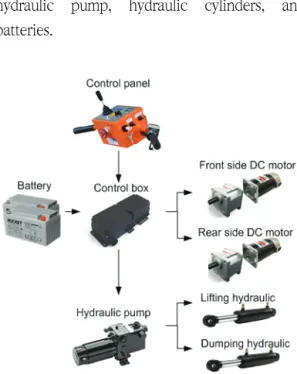
The electrical configuration of the vehicle is shown in Fig. 2. This system consists of a control panel, control box, DC motors, hydraulic pump, hydraulic cylinders, and batteries.

Fig. 2 Electrical configuration of electric agricultural vehicle.

As shown in Fig 2, For lifting and

dumping, 2 hydraulic cylinders with a

diameter of 100 mm were used. The bore

size is 60 mm, the rod size is 30 mm, and

the overall diameter is 70 mm. The cylinders

are configured as a single acting push

configuration. The maximum working pressure

is 210 bar. The system was powered by two

(4)

12 V 100 AH batteries connected in series.

The battery size is 443 mm (L) x 167 mm (W) x 204 mm (H), and the weight is 31 kg.

For safety, the maximum charger current is limited to 7 A.

This vehicle powered by two DA4A-29B4-ML57 24 V 400 W DC motors produced by Daehwa E/M Co. LTD from Korea. The rated angular velocity is 2900 RPM, the rated current is 23 A, the model size is 90 mm, and the shaft specification is powerful tooth cutting. To increase the torque and reduce the motor speed, a reduction gear was used. The D9K030US- S346 reduction gear was made by Daehwa E/M Co. LTD from Korea. The gear ratio is 30:1. The permissible overhang load is 55 kgf, and the permissible thrust load is 15 kgf.

The maximum permissible torque is 300 kgf.cm. The output rotation direction is the same direction as the motor. Each motor was used to power the front wheels and rear wheels.

Fig 3 shows the failure condition of gear caused by contact stress and bending stress.

Gears during service experience a high stresses at the tooth root and contact zones.

Tooth bending causes high stress concentration at the root region and this region is more prone for cracking [8]. In addition gear tooth experiences, a high contact stresses at the profile surfaces that leads to surface damage. In metal spur gears, wear depends on the contact pressure distribution and shear stresses induced. The

contact pressure distribution is a function of contact width and shear stress changes with the presence of sliding component. The purpose of this paper is to improve the gear strength by modifying the gear parameter.

Fig. 3 Failed gear.

3. Method

The structure of reduction gear used in this research as shown in Fig 4 is consists of 5 shaft. Shaft 1 consists of one helical gear.

Shaft 2 consists of one helical gears on high

speed side and one helical gear on lower

speed side. Shaft 3 consists of one helical

gear on the high speed side and one spur

gear on the lower speed side. Shaft 4

consists of one spur gear on the high speed

side and one spur gear on the lower speed

side. Shaft 5 consists of one spur gear on

the output.

(5)

Fig. 4 Front side and rear view of reduction gear.

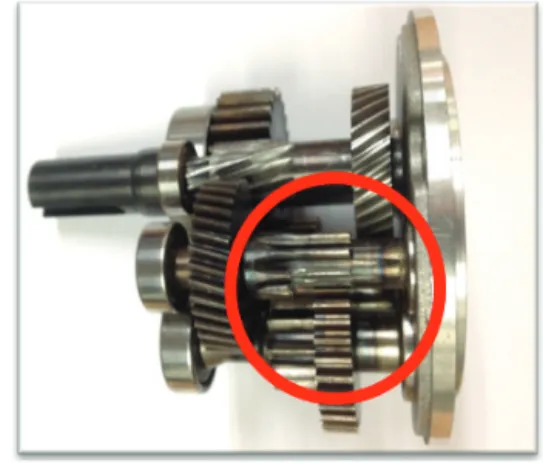
To improve the strength of reduction gear, the shaft 3 as shown in Fig 5 are modified.

The improvement are consists of gear shaft diameter increment and face width modification. The shaft diameter was varied between 15-19mm and face width was varied between 14-18mm. The optimal condition for gear design can be achieved when the stress on the gearbox is minimal with minimal material addition.

Fig. 5 Modification of shaft 3.

In this research the basic design parameters for gear like shaft diameter and face width are considered as the input variables. The bending stress and material volume is considered as the objective function. ANSYS was used to investigate the bending stress when the variable was changed.

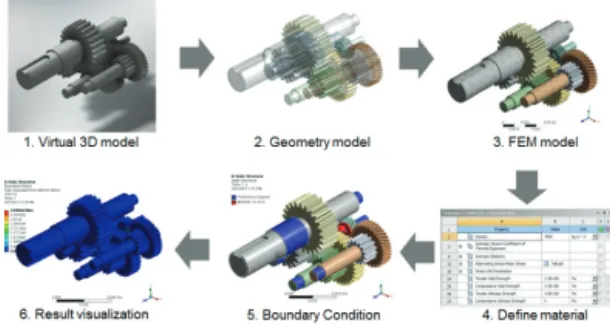
The procedure of static analysis includes

following steps as shown in Fig. 6. Firstly, the 3D model of the gearbox was created. In this research focused on shaft and gear inside the gearbox. Secondly, the model was simplified to obtained geometry model.

Thirdly, the mesh of the model was generated. Fourthly, the materials properties were defined. Fifthly, the boundary condition was defined. Finally, solve the problem, visualized and read the results. The output of this simulation is the von-misses stress occurs in the gearbox. This value was used as the input of mathematical model based on ANN.

Fig. 6 Simulation analysis procedure.

Artificial Neural Network (ANN) is used to obtain the mathematical model of the system based on the bending stress behavior. The ANN was used since the output system is nonlinear. The output of the ANN is mathematical model that describe the relation between shaft diameter, face width and von-misses stress and volume.

The Genetic Algorithm (GA)  is used to

obtain the optimized values of shaft diameter

and face width based on the ANN

mathematical model. Genetic algorithm

(6)

represents the evolution toward better creature. A population of chromosomes is evolved toward better solutions. Each chromosome is defined by its genes. For each chromosome, you should be able to calculate it’s score, also called fitness.

4. Result and Discussion

The gear material used in this research is SCM440/AISI4140 with yield strength 415MPa, Tensile strength 655MPa, and shear modulus 80GPa. Fig 7 shows the simulation result of von-misses stress on the gearbox. It shows that the maximum stress occurred on the gearbox before modification is 158.47MPa, and after modification is 122.17MPa. The safety factor can be improved from 2.618 to 3.396.

Fig. 7 Von-Misses Stress.

Fig 8 shows the maximum stress occurred on the shaft 3. Before modification the stress is 310.53MPa and after modification the stress is 288.42MPa. The safety factor of the gear can be improved from 1.33 to 1.43. The simulation results show that the modification on shaft diameter and face width contributes

to the stress reduction and improvement of safety factor.

Fig. 8 Von-Misses Stress of pinion 4.

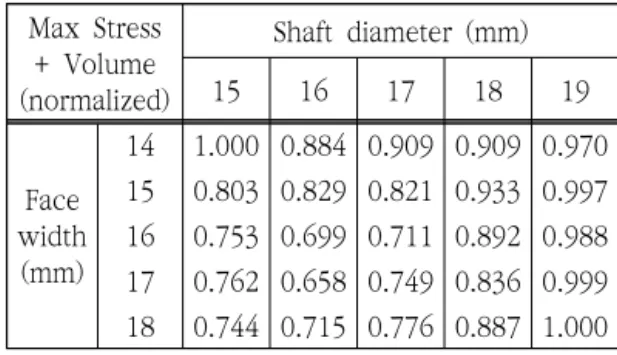
The normalized maximum stress and volume obtained from ANSYS static analysis is shown in Table 1. The von-misses stress obtained from the ANSYS simulation was normalized to 1. The total volume of the gear after shaft diameter and face width modification also was normalized to 1. The average of both normalize value was used as the output of the simulation as shown in Table 1. This step was done to verify that the stress and volume can be weight equally.

In the table 1 the value are varied between 0.5 and 1. Since the shaft is varied between 15-19 and the face width is varied between 14-18, the output result is 25 data represent the stress and volume.

Max Stress + Volume (normalized)

Shaft diameter (mm)

15 16 17 18 19

Face width

(mm)

14 1.000 0.884 0.909 0.909 0.970

15 0.803 0.829 0.821 0.933 0.997

16 0.753 0.699 0.711 0.892 0.988

17 0.762 0.658 0.749 0.836 0.999

18 0.744 0.715 0.776 0.887 1.000

Table 1. Finite element method simulation result

(7)

Based on data on Table 1, mathematical model of bending stress can be obtained using ANN. In this research the number of hidden layer is 10. The result was compared to Response Surface Methodology (RMS) [9].

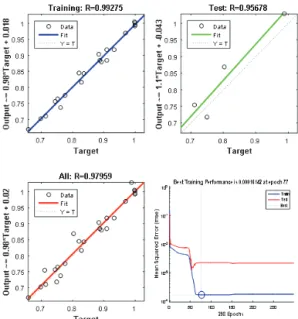
The ANN training regression and performance are shown in Fig. 9.

Fig. 9 Training regression of ANN.

The simulation result shows that the output tracks the targets very well for training, testing, and validation, and the R-value is over 0.97 for the total response.

As all the R parameters are very close to 1, this means that the correlation between the outputs and the targets is very high.

To verivy the effectiveness of ANN mathematical model, it was compared to RSM method. Classical RSM requires the specification of a polynomial function such as linear, first-order interaction or a second- order quadratic to be regressed. Using RSM, a polynomial model is obtained to mathematically express the relationship among the variables—i.e., the initial amount of EM powder (g) and sugar content/brix (%).

The model gives the response as a function of relevant variables. An empirical first-order polynomial mode for two factors using quadratic model can be obtained:

  

 

 

 



 



 



Fig. 10 Surface obtained from RSM. Fig. 11 Surface obtained from Artificial

Neural Network model.

(8)

Based on the data in Table 1, the parameters in above equation can be obtained using the curve fitting module in MATLAB as

  

  

 



  



  



 

The result in Table 1 can be fitted into second order polynomial equation and ANN as follows.

Fig 10 shows that the RSM model resembles concave up curve with smooth surface. On the other hand, the surface obtained from ANN as shown in Fig 11 resembles uneven surface represent non-linear relation between input and output.

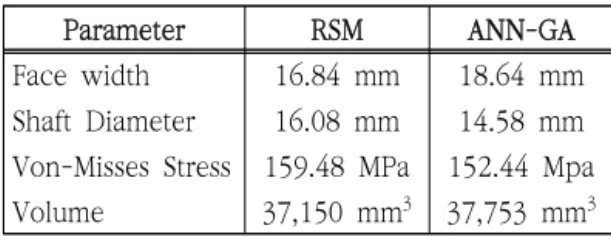
Based on surface on Fig 10 the optimal value of RSM is obtained from calculation of the peak value polynomial equation. On the other hand, Fig 11 obtained was used Genetic algorithm is used to find the optimal value. The results are shown in Table 2.

Parameter RSM ANN-GA

Face width 16.84 mm 18.64 mm Shaft Diameter 16.08 mm 14.58 mm Von-Misses Stress 159.48 MPa 152.44 Mpa Volume 37,150 mm

3

37,753 mm

3

Table 2. Comparison result of RSM and ANN-GA

The optimal condition obtained from RSM is 16.84mm face width and 16.08mm shaft diameter. On the other hand, the optimal condition obtained from the ANN-GA is 18.64mm face width and 14.58mm shaft diameter. It was shown that the von-misses stress obtained from ANN-GA is lower than it

obtained using RSM method. However the volume obtained from GA is slightly higher than that obtained from RSM. However the benefit of volume improvement is highly improvement in von-misses stress reduction.

Therefore the result obtained using ANN-GA is better than that obtained using RSM.

5. Conclusion

In this research the structure analysis was done to the DC motor reduction gear of electric agricultural vehicle. The finite element method was used to calculate the stress occurred in gear box. By modifying shaft 3 the stress occurred in reduction gear can be reduced. Mathematical model using ANN was done to describe the relation between shaft diameter, face width and von-misses stress. Design optimization was done by GA and compared to RSM method.

The Von-Misses stress obtained from ANN-GA method is less than that obtained using RSM method. Therefore ANN-GA is better compared to RSM method

Acknowledgement

This work was supported by Korea

Institute of Planning and Evaluation for

Technology in Food, Agriculture, Forestry and

Fisheries (IPET) through Agriculture, Food and

(9)

Rural Affairs Research Center Support Program, funded by Ministry of Agriculture, Food and Rural Affairs (MAFRA) (716001-7)

References

[1] D. Sperling and D. Gordon, Two Billion Cars:

Driving Toward Sustainability. Oxford University Press, (2009).

[2] W.-S. P. Choi, Pandu Sandi , D. Supeno, J.-H.

Woo, E.-S. Lee, S.-W. Chung, and C.-S. Park,

“Dynamic Vibration Characteristics of Electric Agricultural Vehicle Based on Finite Element Method,” Global Journal of Engineering Science and Researches, vol. 4, no. 1, pp. 27-31, (2017).

[3] P. S. Pratama, A. V. Gulakari, Y. D. Setiawan, D. H. Kim, H. K. Kim, and S. B. Kim,

“Trajectory tracking and fault detection algorithm for automatic guided vehicle based on multiple positioning modules,” International Journal of Control, Automation and Systems, vol. 14, no. 2, pp. 400-410, (2016).

[4] P. S. Pratama, S. K. Jeong, S. S. Park, and S.

B. Kim, “Moving Object Tracking and Avoidance Algorithm for Differential Driving AGV Based on Laser Measurement Technolog,”

International Journal of Science and Engineering, vol. 4, no. 1, pp. 11-15, (2013).

[5] A. Sagai Francis Britto, R. Edwin Raj, and M.

Carolin Mabel, “Prediction and optimization of mechanical strength of diffusion bonds using integrated ANN-GA approach with process variables and metallographic characteristics,”

Journal of Manufacturing Processes, vol. 32, pp.

828-838, (2018).

[6] R. Sirohi, A. Singh, A. Tarafdar, and N. C.

Shahi, “Application of genetic algorithm in modelling and optimization of cellulase production,” Bioresour Technol, vol. 270, pp.

751-754, (2018).

[7] M. Stoffel, F. Bamer, and B. Markert, “Artificial neural networks and intelligent finite elements in non-linear structural mechanics,” Thin-Walled Structures, vol. 131, pp. 102-106, (2018).

[8] N. De Laurentis, A. Kadiric, P. Lugt, and P.

Cann, “The influence of bearing grease composition on friction in rolling/sliding concentrated contacts,” Tribology International, vol. 94, pp. 624-632, (2016).

[9] M. A. Bezerra, R. E. Santelli, E. P. Oliveira, L.

S. Villar, and L. A. Escaleira, “Response surface methodology (RSM) as a tool for optimization in analytical chemistry,” Talanta, vol. 76, no. 5, pp. 965-77, (2008).

(Manuscript received September 27, 2018;

revised December 26, 2018; accepted January 3, 2019)

수치

Fig.  1  Proposed  electric  vehicle.
Fig  3  shows  the  failure  condition  of  gear  caused  by  contact  stress  and  bending  stress
Fig.  5  Modification  of  shaft  3.
Fig.  8  Von-Misses  Stress  of  pinion  4.
+3

참조

관련 문서

웹 표준을 지원하는 플랫폼에서 큰 수정없이 실행 가능함 패키징을 통해 다양한 기기를 위한 앱을 작성할 수 있음 네이티브 앱과

_____ culture appears to be attractive (도시의) to the

1 John Owen, Justification by Faith Alone, in The Works of John Owen, ed. John Bolt, trans. Scott Clark, &#34;Do This and Live: Christ's Active Obedience as the

The design method for the optimization of FRP leaf spring is proposed by applying design method of experiment in order to improve the characteristics of

In particular, the dependences of maximum temperature increase and decay time constant on the laser pulse width, beam diameter, and absorption coefficient

For the structural design methodology to be practically used for the design of spaceborne electronics, it shall provide more reliable results on the mechanical safety

This section describes the overall structure of the diagnostic algorithm for abnormal situations using ANN. 6 illustrates the functional architecture of the diagnostic

[r]