Print ISSN: 2288-4637 / Online ISSN 2288-4645 doi:10.13106/jafeb.2021.vol8.no2.0873
Factors Affecting the Adoption of IFRS: The Case of Listed Companies on Ho Chi Minh Stock Exchange *
Trang Thu TA 1 , Cuong Duc PHAM 2 , Anh Huu NGUYEN 3 , Nga Thanh DOAN 3 , Hang Thuy DINH 4 , Giang Hoang DO 5 , Truong Hong PHAM 6
Received: November 05, 2020 Revised: January 05, 2021 Accepted: January 15, 2021
Abstract
The study investigates the key factors that affect the adoption of the International Financial Reporting Standards (IFRS) by companies listed on Ho Chi Minh Stock Exchange (HOSE) in Vietnam. The factors that are studied in this research include total debt-to-equity ratio, firm size, return-on-equity ratio, audit quality, foreign investment, and financial institution category. The authors have utilized quantitative and qualitative analyses in combination with a logistics regression model and other available analytical tools for conducting the research.
All statistics processed in the paper were based on 379 audited financial statements issued in 2018. The results reveal that factors like firm size, return on equity (ROE), audit quality, foreign investment, and financial institution category positively affect the IFRS adoption of HOSE-listed companies, while total debt-to-equity ratio negatively impacts the adoption. The findings suggest Vietnamese law and policy- makers, when promoting the adoption of IFRS by listed companies, should focus more on five variables with positive influence and they can disregard the total debt-to-equity ratio that is insignificant as a factor affecting the adoption of IFRS. This implication could be applied for other firms in Vietnam and for enterprises in other countries, which are in the same stage of IFRS application.
Keywords: International Financial Reporting Standards, IFRS Adoption, Stock Exchange, Listed Companies, Vietnam JEL Classification Code: M40, M41
1. Introduction
Harmonizing accounting standards around the world has always been posing threats to the flows of international capital and investment, which proves an obstacle to global economic integration. Choi and Levich (1991) suggest that diversity of different countries in accounting system has caused considerable economic loss to financial statement on the international level. Accordingly, many international stock exchanges and accounting institutions have never stopped trying to promote accounting standard harmony as a means of enhancing transparency and comparability of financial information among nations. The effort of International Accounting Standard Board (IASB), the International Organization of Securities Commissions (IOSCO) and other related organizations worldwide has resulted in the development of the International Financial Reporting Standards (IFRS) (Carpenter & Feroz, 2001;
Daske & Gebhardt, 2006; Daske, Hail, Leuz, & Verdi, 2008;
Lenormand & Touchais, 2009; Albu & Albu, 2012; Albu, Albu, Bunea, Calu, & Girbina, 2011; Păşcan, 2015).
*Acknowledgments:
1
This research is funded by the National Economics University (NEU), Vietnam. The authors thank anonymous reviewers for their contributions and the NEU for supporting this research.
1
First Author. Lecturer, School of Accounting and Auditing, The National Economics University, Vietnam.
Email: [email protected]
2
Corresponding Author. Associate Professor, Head of Accounting Principles Department, School of Accounting and Auditing, The National Economics University, Vietnam [Postal Address: 207 Giai Phong, Hai Ba Trung, Hanoi, 113068, Vietnam]
Email: [email protected]
3
Lecturer, School of Accounting and Auditing, The National Economics University, Vietnam.
Email: [email protected]
4
School of Accounting and Auditing, The National Economics University, Vietnam
5
School of Accounting and Auditing, The National Economics University, Vietnam
6
School of Accounting and Auditing, The National Economics University, Vietnam
© Copyright: The Author(s)
This is an Open Access article distributed under the terms of the Creative Commons Attribution
Non-Commercial License (https://creativecommons.org/licenses/by-nc/4.0/) which permits
unrestricted non-commercial use, distribution, and reproduction in any medium, provided the
original work is properly cited.
The international convergence of accounting systems will facilitate the financial communication and satisfy the comparability requirements of financial information. As a matter of fact, this has received advocacy in various regions around the globe. For instance, listed companies in the European Union (EU) have adopted IFRS for their consolidated financial statements since 2005. The trend has continued with the adoption by other institutions including agriculture bodies, commercial banks, financial institutions, insurance companies, investment funds, and stock exchange companies; subsidiary companies that belongs to foreign-listed parent companies outside EU; companies with revenue over €10 billion per annum over two consecutive years and an average number of staff above 100 heads per year. In the foreseeable future, EU has planned to help the small- and medium-sized enterprises (SMEs) adopt the standard (PwC, 2015).
In Asia, since the 1980s, Hong Kong has adopted IFRS as soon as the standard system was issued by IASB. In December 2018, Japan bridged the gap between JGAAP and IFRS by erasing the variances between these two. In South-East Asia, Singapore has taken the lead as, in 2001, the country prepared a long-run roadmap of adoption by establishing Accounting Standards Council (ASC). This organization has been responsible for promoting IFRS adoption in Singapore since 2015. In 2018, it officially assisted Singaporean companies to adopt IFRS. Correspondingly, based on IFRS, a new Singaporean financial statement standard called SG-FRS was developed and applied to enterprises with accounting period from October 1, 2018. IASB has agreed that SG- FRS is entirely compatible with IFRS. Furthermore, another ASEAN country, Malaysia, has gradually adopted IFRS by issuing three different accounting standards for different categories of entities. Though not as prompt as Australia and Hong Kong on the way of adoption, Malaysian accounting standard is regarded in conformity with IFRS.
Since 1995, Vietnam has been recognized as a member of World Trade Organisation (WTO). In 2000, Vietnam stock market opened up and State Securities Commission (SSC) has become an official member of International Organisations of Securities Commissions (IOSCO) since June 2001. The international economic integration and foreign trade along with intensive exposure to foreign investment flows have incentivized the country to design an appropriate accounting standard system. Therefore, from 2002 to 2005, MOF has issued 26 Vietnam accounting standards (VAS) by selectively applying IFRS principles to fit national economic and management capability. However, issued more than 10 years ago without further revisions, VAS has gradually reared its limitations by inappropriately responses to unprecedented economic transactions under a constantly changing market with the presence of complex financial instruments.
Much research has pointed out the benefits of adopting IFRS (Cai & Wong, 2010; DeFond, Hu, Hung, & Li, 2011;
Tran, Ha, Le, & Nguyen, 2019; and Dang, Pham, Nguyen,
& Nguyen, 2020). Accordingly, MOF has announced that the IFRS adoption would positively affect multiple aspects of Vietnamese economy. Due to those advantages, the Government has been proceeding to integrate into this accounting language while helping erase gaps and creating the opportunities for Vietnamese companies to conform with international rules. MOF has published the IFRS adoption roadmap proposal, which is divided into three stages. Accordingly, by 2022, the listed enterprises will have been the first to mandatorily adopt IFRS, which is then followed by those under the control of international financial institutions, FDI companies, and so on. Therefore, through this research, it is highly practical to identify factors and assess their impact on IFRS adoption of the listed firms.
The study focuses on 379 HOSE-listed companies as their total market capitalization accounts for more than 60% of Vietnam’s 2018 GDP (according to 2019 statistics).
2. Literature Review and Hypotheses 2.1. Literature Review
In recent years, companies’ intensive engagement into foreign trade and international market has led to an argument over whether it is vital to issue an international accounting standard system. After numerous discussions and meetings, experts have agreed on the need of a harmonious accounting system for companies all over the world (Murphy, 1999).
This has stimulated the development of International Financial Reporting Standard or IFRS.
According to Jacob and Madu (2009), IFRS represents a set of high-quality, internationally-accepted accounting standards that can enhance the comparability and in-depth analysis of financial statements over the globe. Similarly, Cai and Wong (2010) supposed IFRS would contain widely accepted standards while maintaining the balance and diversity of accounting systems among nations, supporting global business activities and international integration.
Recent research results have recognized considerable changes in the accounting systems of nations adopting international accounting standards (DeFond, Hu, Hung, &
Li, 2010). Relevant studies on factors affecting the IFRS
adoption of different nations have attracted the attention
of many authors in the field. The factors affecting the
development of international accounting system have been
studied since 1960 (Mueller, 1983). Enterprises are mainly
active in the micro-economic environment, which directly
affects their operations. Leuz and Verrechia (2000) examine
the accounting choices of German listed companies on DAX
in 1988. By applying regression analysis, they conclude that
firm size, credit needs and financial activities substantially
affect the decision on adopting IFRS. Barbu (2004) had
conducted data analysis from 1985 to 1999 to assess the trend in international standard compliance of French companies.
A sample size of 100 entities was included to study the affecting factors, which then led to similar results.
In Vietnam, there is still limited research on IFRS adoption. Some research like “The possibilities of adopting IAS/IFRS in Vietnam” (Nguyen, 2011) made comparisons between the development of Vietnamese accounting systems and that of other developing countries. The research revolved around the arguments over the necessity of adopting IFRS in Vietnam. Another study titled “Examining key determinants of International Financial Reporting Standards (IFRS) adoption in Vietnam: An institutional perspective”
by Phan (2014) has pointed out the effects of institutional isomorphism on IFRS adoption in Vietnam. Nguyen (2018), who conducted experimental research in Vietnamese enterprises on converting VAS to IFRS application, has found that accounting capability or management activities positively affect the IFRS adopting decision of discussed companies. Lately, Tran, Ha, Le, & Nguyen (2019) have published their journal “Factors affecting IFRS adoption in listed companies: Evidence from Vietnam,” which indicates how quantitative and qualitative factors like return on equity, foreign-listed, firm size, profitability and audit quality affect IFRS adoption at entity level. However, the authors have not reviewed and assessed the impact of capital origins and types of entity on IFRS adoption. Meanwhile, other foreign researches usually considered factors like capital origins and types of entity as an effective tool to assess the possibility of adopting IFRS.
Firm size (CS)
Affes and Callimaci (2007) applied logistics regression model to conduct research on a sample size of 106 German and Austrian listed companies in order to highlight the benefits of early IFRS adoption. Results showed that the probability of companies’ adopting IFRS early is proportional to their size. Carmona and Trombetta (2008) studied 56 Portugal listed companies and found that smaller companies tended to apply national accounting standards. In contrast, larger companies usually used national accounting standards along with international higher-quality accounting policies even before officially adopting IFRS. The research by Senyigit (2014) in Turkey has proved the influence of firm size on IFRS adoption was significant and positive.
The results have assisted Uyar, Kilic, and Gokcen (2016) in conducting research on compliance with ISA/IFRS and characteristics of Turkey small and medium-sized entities.
This research also indicated some characteristics like total assets or firm size positively affect the IFRS adoption of researched companies.
Total debt-to-equity ratio (DE)
Murphy (1999) and El-Gazzar, Finn, and Jacob (1999) measure how total debt-to-equity ratio of shareholders affects
level of IFRS adoption. The results show that a proportional relationship exists between DE and IFRS adoption decision of researched companies. Meanwhile, Affes and Callimaci (2007), Kolsi and Zehri (2013) point out that companies used this financial ratio as a tool to promote IFRS adoption.
Return on Equity (ROE)
Dumontier and Raffournier (1998) research 28 listed companies applying Switzerland accounting standards and 51 others applying IFRS. They assess the relation between IFRS adoption and business characteristics (internationality, ownership structure, size, capital, audit practitioners’ reputation, and profitability). The results show that there is no relation between IFRS adoption and business outcomes. On the contrary, Carmona and Trombetta (2008), Ha and Kang (2019) conclude that high- profitability companies tended to adopt IFRS to ensure the reliability of their profit results. This research utilizes ROE as an independent variable to reflect operational state of companies. Lopes and Viana (2008) also analyze financial information of 44 Portugal listed companies adopting IFRS and see that net profit and equity positively affect the entities’ accounting policies.
Audit quality (CKT)
Al-Basteki (1995) study characteristics of 26 listed companies in Bahrain publishing their information according to IAS. The assessed characteristics are reputation of independent auditors, firm size, foreign investment, level of dependence on foreign financial resources. The results indicate the decision on adopting IFRS is significantly affected by independent audit firms (Big 4). Joshi and Ramadhan (2002) study, “The adoption of international accounting standards by small and closely held companies:
Evidence from Bahrain,” examine the relationship between accounting policies and IFRS adoption in 36 listed companies in Bahrain. The results show 86% of IFRS- adopting companies are audited by Big 4 firms. Research by Uyar, Kılıc, and Gokcen (2016) on small- and medium-sized companies in Turkey indicates audit quality factor positively affected researched companies’ IFRS adoption.
Foreign investment (FIC)
Irvine and Lucas (2006) conduct various studies on IFRS adoption in countries worldwide. The results show that a vast majority of IFRS-adopting countries witness a considerable increase in foreign direct investment. Judge, Li, and Pinsker (2010) use a sample size of 132 countries to study the influence of foreign trading activities. The authors conclude that foreign direct investment was one of the factors promoting the adoption of IFRS among nations.
De Lima, De Lima, and Gotti (2018) suggest economic
efficiency is one of determining incentives leading to IFRS
adoption. Specifically, larger companies with considerable
financial need normally execute international financial
reporting standards. At the same time, researches conducted
by Owusu, Saat, Suppiah, and Siong (2017) also propose that foreign direct investment significantly affects IFRS promotion in developing countries.
Financial institution category (FYC)
Researches by Albu, Albu, Bunea, Calu, and Girbina (2011) supposed that IFRS adoption ensure the transparency of service provided. According to a research results by KPMG (2018) on 27 listed, foreign-invested and public (yet to be listed) companies and five audit firms, 13 state-owned enterprises, stock exchanges shows that IFRS adopting entities are mainly in financial-institution category (among eight financial institutions, only one bank and one insurance companies do not adopt IFRS, so the adopting accounted for 75%).
2.2. Research Hypotheses
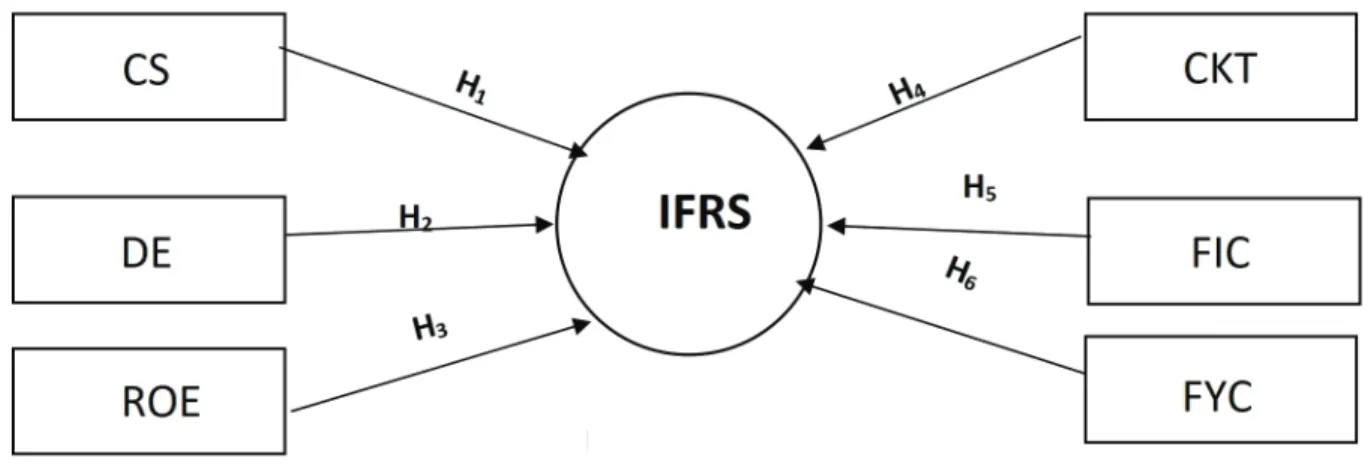
H1: Firm size of HOSE-listed companies positively affects their IFRS adoption.
H2: Total debt-to-equity ratio of HOSE-listed companies in 2018 positively affects their IFRS adoption.
H3: Return on Equity of HOSE-listed companies positively affects their IFRS adoption.
H4: Audit quality of HOSE-listed companies positively affects their IFRS adoption.
H5: Foreign investment of HOSE-listed companies positively affects their IFRS adoption.
H6: Financial institution category among HOSE-listed companies positively affects their IFRS adoption.
Table 1: Variables and Description
Variables Description Expected Tendency
Direction Dependent variable
(IFRS) IFRS adoption: 1, if the firm has adopted IFRS; 0, otherwise.
Independent variables
DE Debt ratio – debt to shareholders’ equity ratio +
CS Company size, measured by logarithm of total assets +
ROE Return on Equity – Net return on equity +
CKT Audit quality. 1: If company is audited by Big 4; 0: if company is not
audited by Big 4 +
FYC Financial-institution category. 1: If company is financial company; 0:
if company is not financial company +
FIC Foreign investment company. 1: If company has foreign investment;
0: If company only has domestic investment +
Figure 1: The proposed study
3. Research Methods 3.1. Research Process
Inheriting the theoretical basis of previous studies on IFRS-adoption process, the authors identify factors significantly influencing the adoption of IFRS and measure them according to appropriate accounting methods, from which choosing suitable independent variables and regression model. Then, the authors collected relevant statistics to build up appropriate econometric model. First, sourced from two websites–finance.vietstock.vn and cafef.com–data in this paper is based on the audited financial statements of HOSE-listed companies in 2018. Second, Microsoft Excel 2016 is used as supporting tool to collect and store data.
Third, collected data is cleansed by removing duplicate and inhomogeneous elements. Fourth, raw statistics are processed using appropriate calculations and formulas of financial ratios to achieve values of variables. Finally, SPSS Statistics 20 software is exploited for regression analysis and descriptive statistics.
Dependent variable IFRS has two values “Yes” or
“No”. The value “Yes” shows that the entities fully, partially or selectively adopted IFRS, while the value
“No” shows that they have no intention or unwillingness to adopt IFRS.
Based on past relevant research papers, the authors found that the total number of entities fully and partially adopting IFRS on HOSE is 14 over 379, which accounts for 3,7% - a relatively modest percentage in comparison with other 365 not adopting it.
3.2. Sampling Method
In this research, the sample is chosen according to the convenient sampling method by selecting non- probability samples. Sample size is often determined based on: (1) minimum size and (2) number of analyzed variables. According to Hair, Black, Babin, Anderson, and Tatham (2010) the sample size is determined based on (1) minimum sample size (min = 50) and (2) number of variables taken into analysis of the model according to the formula:
Where n is the sample size, m is the number of scales, k represents the ratio of the sample to an analytical variable (5/1 or 10/1) and Pj is the number of observed variables of the j-th scale. The research model of this paper has 5 variables, choose the sample rate per an analytical variable of 5/1, applying the above formula of Hair, Black, Babin, Anderson, and Tatham (2006), we have the minimum sample size of 300 listed firms. The sample was collected from 379 HOSE-listed firms in stock exchange. So, the sample is
satisfying. In the light of theoretical proven theoretical basis, the author proposed research model:
Logit IFRS CS DE ROE
CKT FIC FYC u
( ) * * *
* * *
= + + +
+ + + +
b b b b
b b b
0 1 2 3
4 5 6
In that β
0, β
1, β
2, β
3, β
4, β
5, β
6: regression coefficients u: random error
4. Results and Discussion
4.1. Descriptive Statistical Analysis
The table shows sampling structure according to business category of 379 HOSE-listed companies.
Consequently, the number of companies in Industrials is the highest with 27.7%, but the capitalization value is not high; the percentage of financial institution accounts for 7.7% with higher capitalization value than any other categories.
Researched companies in the sample size show an average ROE of 13.1.%, the average DE is 90.3% (due to some companies with high DE). The proportion of companies audited by Big 4 accounts for 42%, those with foreign investment accounts for 45.4%, and financial institution category accounts for 7.7% of the total number of researched companies. By December 31, 2018, the largest HOSE-listed company was a bank with total assets of thousands of billion VND and the smallest company had total assets of more than 100 billion VND.
Tables 2: Descriptive Statistics
Sector Companies Percentage
Utilities 26 6.9%
Technology 4 1.1%
Health Care 13 3.4%
Oil and Gas 11 2.9%
Financials 29 7.7%
Industrials 105 27.7%
Consumer Goods 41 10.8%
Basic Materials 62 16.4%
Essential consumer
Goods 38 10.0%
Telecommunications 2 0.5%
Real Estate 48 12.7%
Total 379 100%
Table 3: Statistic of variables
Variables N Minimum Maximum Mean STD
DE 379 0.08 2763.7 90.3 163
CS 379 11.8 21 14.6 1.6
ROE 379 −168.7 160.8 13.1 18
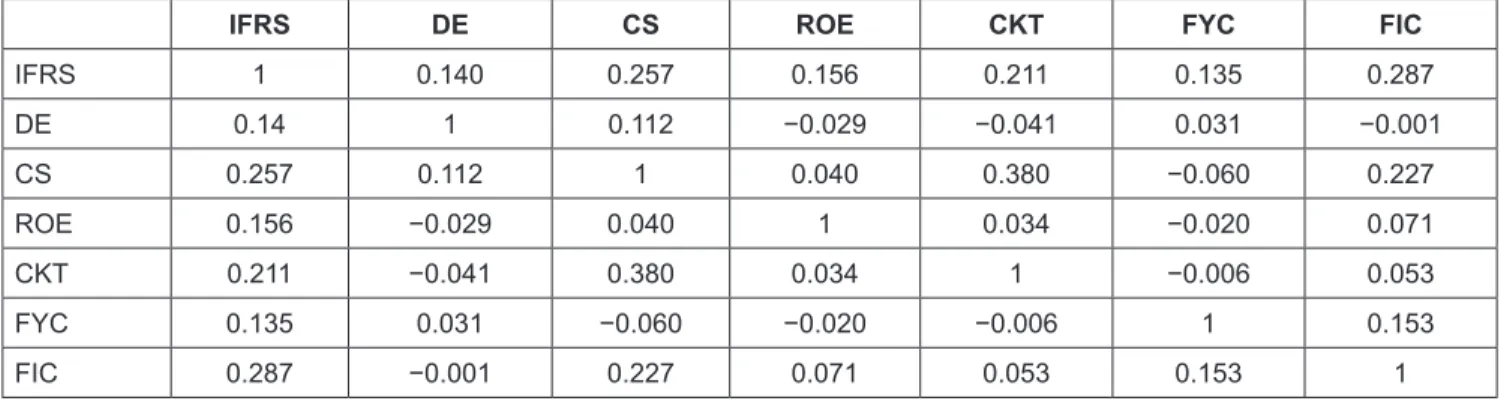
Table 4: The correlation matrix
IFRS DE CS ROE CKT FYC FIC
IFRS 1 0.140 0.257 0.156 0.211 0.135 0.287
DE 0.14 1 0.112 −0.029 −0.041 0.031 −0.001
CS 0.257 0.112 1 0.040 0.380 −0.060 0.227
ROE 0.156 −0.029 0.040 1 0.034 −0.020 0.071
CKT 0.211 −0.041 0.380 0.034 1 −0.006 0.053
FYC 0.135 0.031 −0.060 −0.020 −0.006 1 0.153
FIC 0.287 −0.001 0.227 0.071 0.053 0.153 1
4.2. Univariate Analysis
Table 4 shows a strong correlation among the IFRS variables, which may biasedly estimate the coefficient of variation. To explore this problem, the correlation matrix based on the Pearson test determines the degree of two correlations between the variables. CS, ROE, CKT, FYC and FIC variables have the Sig. value < 0.05. It shows that these variables correlate with IFRS variable. DE variable has Sig.
value > 0.05. It means the removal of DE variable from the model.
Kolmogorov-Smirnov test shows that the distribution of variables does not comply with normal distribution (because Sig. value < 0.05). Therefore, Mann-Whitney test is used to identify the differences between two categories of companies:
adopting IFRS and not adopting IFRS based on the assessment of firm size, return on equity, audited by Big 4 or not, financial institution category and foreign-invested ones.
We have used the Mann-Whitney test for comparing the mean ranks of a variable given in two observation groups.
The Mann-Whitney test was applied for all abnormal variables. Table 6 indicates the result of Mann-Whitney test for ROE, which seems to have no significant difference between two company groups. However, CS, CKT, FYC and FIC variables can be differentiated clearly between two groups. It can be deduced that the listed companies audited by Big 4 have bigger asset scale and foreign investment, which seems more advantageous to adopt IFRS than others.
4.3. Multivariate Analysis
The results of multivariate logistic regression model on IFRS determinants are given in Table 5.
Logistic regression of the model is as follows:
Ln P
i