Print ISSN: 2288-4637 / Online ISSN 2288-4645 doi:10.13106/jafeb.2021.vol8.no1.881
Determinants of the Small and Medium Enterprises Progress: A Case Study of SME Entrepreneurs in Manado, Indonesia
Rudy PRAMONO
1, L. W. SONDAKH
2, Innocentius BERNARTO
3, Juliana JULIANA
4, Agus PURWANTO
5Received: October 01, 2020 Revised: December 06, 2020 Accepted: December 14, 2020
Abstract
The purpose of this study is to descriptively reveal the demographic and business profile and personal-entrepreneurial characteristics in Manado, the capital of North Sulawesi, and secondly to associate these profiles and characters to their business progress. A sample size of 21 respondents was drawn - selected from those who warmly welcomed the interviewers for an open-ended structured questionnaire.
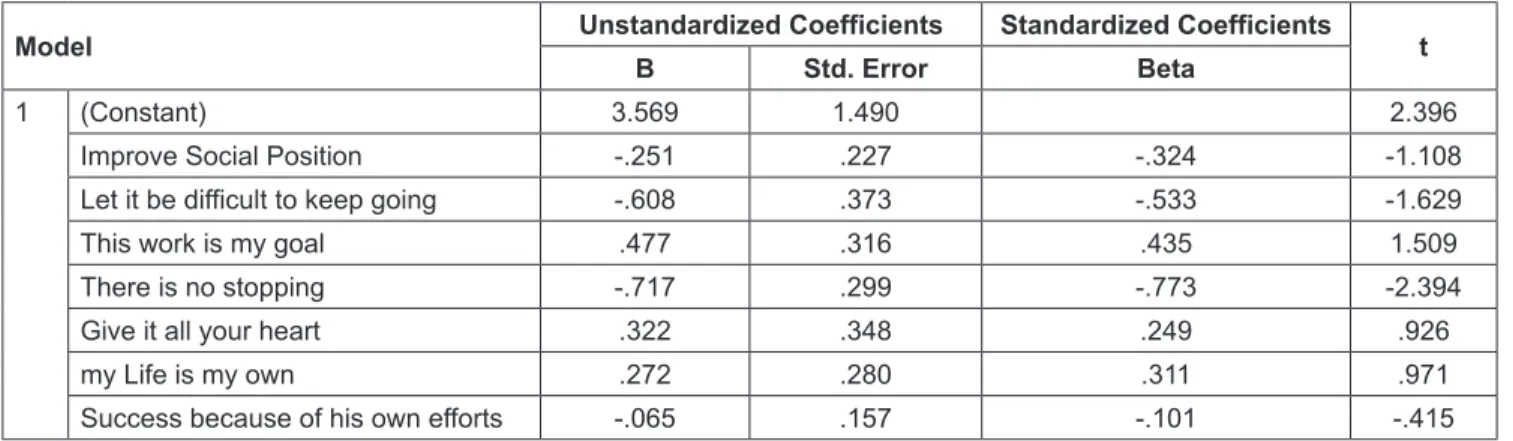
SPSS 24 has been employed to descriptively reveal the sample distribution according to demographic factors and business entities and to determine the dominant factors affecting the progress of the business by testing the hypothesis on the association of variables under study using specified statistical analytical tools, such as regression analysis, especially stepwise regression formula, between specified dependent variables and independent variables and /or between all variables. The stepwise regression analysis has enabled the researcher to determine which variables are the most important reflecting the personal characteristics theorized as “locus of control”: self-efficacy, needs for achievement, personal traits, and barriers to business progress The analysis reveals that the progress of business does have an association and is dependent on the source of capital and education, needs for achievement and locus of control.
Keywords: Small and Medium Enterprises, SMEs Manado, Entrepreneurs JEL Classification Code: D11, D47, E32, L83, Z33
Consequently, limited resources must be managed efficiently, based on economic principles. Namely, humans as “economic man” manage limited resources to get the maximum benefit from these limited resources. From an economic perspective (both macro and micro), economic growth is generated from an “economic policy” on how normative state management manages limited resources (land, labor, capital), economically, efficiently, by using technology and management in various market conditions which are subject to the law of “supply and demand”. Initially, various economic growth policy strategies were referred to as “mainstream economic theory”, both macroeconomics (classical and Keysenian) and microneoclassical, which were based on the assumption of humans as “homo economicus” or “economic men” (Adam Smith). Homo economicus, or economic human, is the figurative human being characterized by the infinite ability to make rational decisions, that is, humans are rational and will attempt to maximize their utility for both monetary and non-monetary gains. The theory states that economic growth is mainly based on the existence of “business activities” in which companies succeed in increasing the “value-added”
of limited resources. The increase in value-added relies on the company’s ability to process production factors (Xi) to
1
First Author and Corresponding Author. Lecturer, School of Hospitality and Tourism, Pelita Harapan University, Indonesia [Postal Address:
MH Thamrin Boulevard 1100, Klp. Dua, Kec. Klp. Dua, Tangerang, Banten 15811, Indonesia] Email: [email protected]
2
Lecturer, Pelita Harapan University, Indonesia.
Email: [email protected]
3
Lecturer, Faculty of Economics and Business Pelita Harapan University, Indonesia. Email: [email protected]
4
Lecturer, School of Hospitality and Tourism, Pelita Harapan University, Indonesia. Email: [email protected]
5
Pelita Harapan University, Indonesia.
Email: [email protected]
© Copyright: The Author(s)
This is an Open Access article distributed under the terms of the Creative Commons Attribution Non-Commercial License (https://creativecommons.org/licenses/by-nc/4.0/) which permits unrestricted non-commercial use, distribution, and reproduction in any medium, provided the original work is properly cited.