I. INTRODUCTION
Stroke, the popular term for a sudden focal neurological deficit of stroke symptoms due to
abnormal cerebral blood flow, has serious effect on physical, psychological, and social function [1-3]. After stroke onset, 25% of the patients die within 1 month, while 75% of the surviving
뇌졸중 영향 척도 3.0의 신뢰도와 타당도
Reliability and Validity of Stroke Impact Scale 3.0
박은영*, 최유임**, 김은주***
전주대학교 중등특수교육과*, 원광대학교 작업치료학과**, 전주대학교 작업치료학과***
Eun-Young Park([email protected])*, Yoo-Im Choi([email protected])**, Eun-Joo Kim([email protected])***
요약
이 연구의 목적은 Stroke Impact Scale 3.0(SIS 3.0)의 신뢰도와 타당도를 조사하는 것이었다. 연구에서 SIS 3.0은 125명의 뇌졸중 환자를 대상으로 측정하였다(평균 = 62.7, 표준 편차 = 9.43). SIS 3.0 하위 영역들 간에 상관 분석을 통해 구성타당도를 확인하였고, MBI(Modified Barthel Index)와 K-MMSE(Mini-Mental State Examination-Korean)간의 상관을 분석하여 수렴타당도를 조사하였다. 각 항목의 특성은 고전적 문항 이론을 바탕으로 내적 합치도와 문항 변별도를 분석하였다. 이 연구를 통해 SIS 3.0의 구성타당도와 수렴타당 도가 확인되었다. 감정 영역에 포함된 i 항목은 문항 변별도가 낮았지만 이 항목을 제외하고는 모두 변별도가 높았다. 하위 영역의 문항내적합치도는 0.858∼0.941로 나타났다. 이 연구는 지역사회에 거주하는 뇌졸중 환 자를 대상으로 임상 현장에서 SIS 3.0 사용을 위한 신뢰도와 타당도를 확인하였다는데 그 의의가 있다.
■ 중심어 :∣신뢰도∣타당도∣뇌졸중 영향 척도∣뇌졸중∣
Abstract
The purpose of this study was to examine the reliability and validity of Stroke Impact Scale 3.0 (SIS 3.0). Here, the SIS 3.0 was completed by 154 stroke patients (mean = 62.7; standard deviation [SD]
= 9.43). Construct validity was verified by analyzing the correlation between SIS 3.0 sub-domains, and convergent validity was investigated by analyzing the correlation between the Modified Barthel Index (MBI) and the Mini-Mental State Examination-Korean (K-MMSE) version. The characteristics of each item were analyzed by internal consistency and item discrimination based on the classical item theory.
Construct and convergent validity were verified through this study. Although the item i included in the emotion domain showed low item discrimination, all but this item showed high discrimination. Internal consistency was also high in all sub-domains.
■ keyword :∣Reliability∣Validity∣Stroke Impact Scale∣Stroke Patients∣
접수일자 : 2019년 05월 20일
수정일자 : 2019년 07월 25일 심사완료일 : 2019년 08월 05일
교신저자 : 김은주, e-mail : [email protected]
patients develop permanent disabilities and multiple health problems[4][5].
Various measurement tools have been developed and used to evaluate stroke patients in rehabilitation[6]. The Fugl-Meyer Assessment of Sensorimotor Recovery After Stroke (FM), Motor Assessment Scale (MAS), and Stroke Rehabilitation Assessment of Movement (STREAM) have been used to investigate motor function status in stroke patients, and Modified Rankin Scale (MRS), Modified Barthel Index (MBI), Functional Independence Measure (FIM), and Functional Reach Test (FRT), which have been tested objectively, have been employed to detect motor function changes[5][7]. Treatment efficacy varies due to the wide degree of symptom severity in stroke. In particular, it is difficult to find an adequate measurement tool for assessing mild and moderate stroke severity [8]. For example, it was overed that MBI and FIM could not discriminate physical impairments in patients with mild stroke, while the other measurement tools can be used to assess physical elements including physical impairment degree and function status and contain factors that assess health-related quality of life (HRQoL)[8][9].
The case reported the measurement results of the HRQoL and found that subjective well-being was increased in the healthcare field[10]. This trend was reflected in the field of rehabilitation.
The use of subjective self-reported rating scales in which the patients reported various aspects of their health conditions has increased in addition to objective therapist rating scales to assess the functional status of stroke patents[10]. The Stroke Impact Scale is an example of a widely used self-reported rating scale[11]. Because tools such as the MBI are not sensitive enough to
evaluate community-residing stroke patients with mild physical impairments, the SIS 2.0 consisting of 64 items and eight domains including strength, hand function, mobility, activities of daily living (ADL), and instrumental ADL (IADL), memory, communication, emotion, and participation to resolve problems related to the measurements not being sensitive enough for detecting mild impairment[11][12]. Recently, the SIS 3.0 consisting of 58 items and eight domains was developed by revising the SIS 2.0[12].
After suggesting the SIS, the psychometric properties of this tool were reported. Compared to other measurement tools, the psychometric properties of SIS enable exact discrimination of the level of disabilities and show high convergent validity and do not present a floor and ceiling effect. SIS was introduced with high accuracy to assess the degree of recovery after stroke[13]. The possibility of the application of SIS in other countries is an advantage. Edward and O’Connell[14] reported the examination of the internal consistency and validity of the SIS short form in 74 stroke patients in Austria. Geyh et al,[15] suggested that 57 items (all but seven of the 64 items in the SIS translated into German) showed appropriate item acceptability through Rasch analysis and SIS had high reliability and validity.
The applicability and usability of SIS have been continuously examined to comprehensively evaluate stroke patients in various countries.
However, there are a few cases in Korea.
Won[16] was assessed to determine the
relationship between the ability to perform ADL
and HRQoL in stroke patients who could walk,
using the SIS translated into Korean. Choi et
al.[29] reported reliability and validity of the
Korean version of SIS 3.0 in hospitalized 70 post
stroke patents. The physical and psychosocial health of stroke patients can be evaluated in a standardized way. However, choosing the most appropriate measure for a specific application depends on many factors such as characteristics of the study sample, practical issues, the original intent of candidate instruments, and their psychometric properties such as reliability and validity. Although the psychometric properties were verified in other countries and Korea, another study needed to be performed because the information on reliability and validity of Korean version of SIS 3.0 in community dwelling stroke patients was still insufficient. Hence, the purpose of this study is to examine the psychometric properties including item discrimination, internal consistency, and construct validity of the Korean language version of SIS 3.0 for investigating its applicability in community dwelling Korean stroke population.
Specific research questions were followed.
First, how was the construct validity of SIS 3.0?
Second, how was the convergent validity of SIS 3.0? Third, how was the reliability of SIS 3.0?
Fourth, how was the item discrimination of SIS 3.0?
II. METHODS 1. Subjects
The subjects of this study were 125 stroke patients who participated in rehabilitation therapy or a rehabilitation program at a welfare center in the community. Subjects had the ability to communicate with other people and obtained K-MMSE scores > 24.
2. Measurement Tools
2.1 SIS
The SIS 3.0 consists of eight domains and 59 items as well as extra question items for checking the degree of recovery. Total number of items was 60. Each item was rated on a five-item Likert scale: not difficult at all, a little difficult, somewhat difficult, very difficult, and cannot do at all. Internal consistency of the SIS 3.0 was 0.94 and test–retest reliability was 0.33–
0.94[11][17]. The SIS 3.0 was consisted of 8 domains such as strength, hand function, mobility, physical and instrumental activities of daily living(ADL and IADL), memory and thinking, communication, emotion, and social participation. Scores for each domain range from 0 to 100. The higher scores means that a better health-related quality of life. The Korean language version of SIS 3.0 was used in this study[27].
2.2 K-MBI
The K-MBI, a measurement tool for evaluating patient ADL function and performance, consists of 10 items. Each item is measured using a five-point Likert scale (1, totally dependent; 5, totally independent). The K-MBI consists of dressing, ambulation, toileting, stair climbing, transfer, bathing, personal hygiene, feeding, bowel control and bladder control[16][18][19].
2.3 K-MMSE
The K-MMSE is an assessment tool for cognitive function and consists of orientation to place and time, naming, reading, visuospatial orientation, writing, and one three-stage command. A total of 30 items are rated on a scale of 0–30. If patients obtain a score > 24, they are considered to have intact cognition[20].
The K-MMSE has reported test–retest reliability
of 0.86 in the elderly[21].
3. Statistical Analysis
To verify the construct validity, the correlation among the SIS 3.0 domains was calculated.
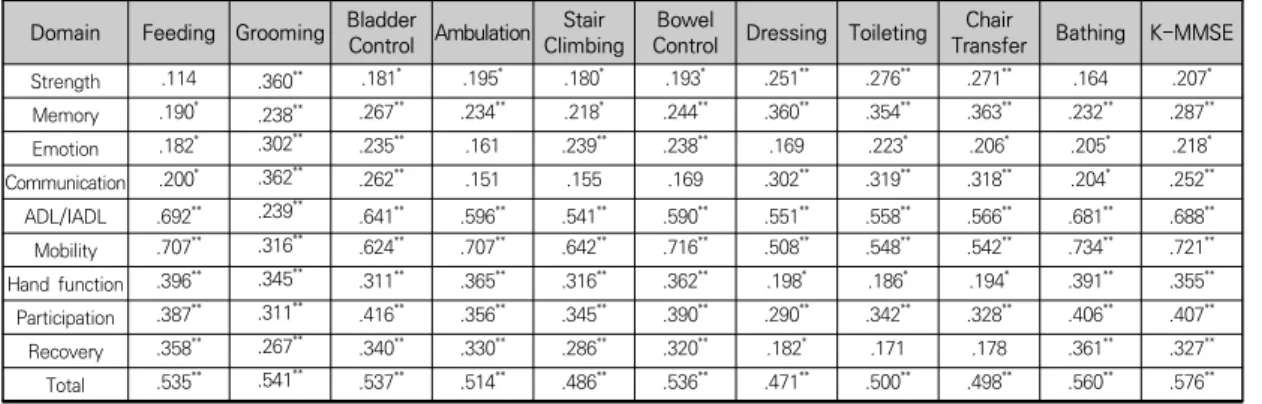
Regarding to convergent validity, the correlation among the SIS 3.0 domains, K-MMSE and K-MBI was verified. Reliability was investigated through internal consistency using Cronbach α. Item discrimination was verified through correlations between item and total score.
The SPSS 20.0 statistical program was used for the analysis.
III. RESULTS
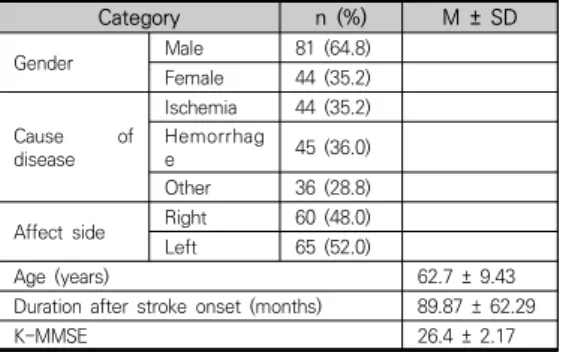
1. General Characteristics of Subjects A total of 125 stroke patients (81 men, 44 women) completed the study. Causes of stroke causes included ischemia (n = 44), hemorrhage (n = 45), and other (n = 36). In terms of affect side, right side was 60 (48.0%), and left side 65 (52.0%). The mean duration after stroke onset was 89.87 months [Table 1], while the mean K-MMSE score was 26.4.
Table 1. General characteristics of subjects
Category n (%) M ± SD
Gender Male 81 (64.8)
Female 44 (35.2) Cause of
disease
Ischemia 44 (35.2) Hemorrhag
e 45 (36.0)
Other 36 (28.8) Affect side Right 60 (48.0) Left 65 (52.0)
Age (years) 62.7 ± 9.43
Duration after stroke onset (months) 89.87 ± 62.29
K-MMSE 26.4 ± 2.17
The SIS 3.0 results are shown in [Table 2].
Communication had the highest score (83.26)
and hand function had the lowest score (34.88) of the possible 100.
Category # of
items M SD Maximal
scores
Strength 4 70.00 23.16 100
Memory 7 77.50 23.81 100
Emotion 9 67.00 23.61 100
Communication 7 83.26 22.25 100
ADL/IADL 10 59.17 26.97 100
Mobility 9 62.52 26.54 100
Hand function 5 34.88 35.34 100
Participation 8 50.91 24.64 100
Recovery 1 44.92 26.46 100
Table 2. Scores of each domain SIS 3.0
2. Construct validity
The domain correlation results of the SIS 3.0 are presented in [Table 3]. The only correlation between recovery and strength was not statistically significant and the others were statistically significant. The correlation between each domain and total score was statistically significant and the coefficient rage was from .476 to .768. The construct validity of SIS 3.0 was confirmed because the correlation coefficient between each domain and total score was above .40[28].
3. Convergence validity
The convergence validity of SIS [Table 4] was
evaluated by examining the correlation between
K-MBI items and K-MMSE scores. The results of
the convergence validity showed that the
following in the strength domain had a
significant correlation: all sub-scales of the
K-MBI and K-MMSE, except for feeding and
bathing on the K-MBI; and the memory,
ADL/IADL, mobility, hand function, and
participation domains had a significant
correlation with all items of the K-MBI.
4. Internal consistency
The internal consistency of all items was α = 0.963 (95% confidence interval, 0.953–0.972). The Cronbach α value of each domain is shown in [Table 5].
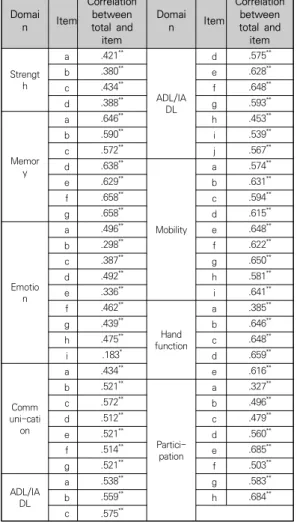
5. Item discrimination
The distribution of item discrimination is depicted in [Table 6]. The range of item discrimination was 0.183~0.685. The item that needs to undergo revision is item i in the emotion domain.
Table 5. Internal consistency of SIS 3.0
Category Cronbach α 95% confidence interval The lowest The highest
Strength .890 .855 .919
Memory .932 .912 .948
Emotion .892 .861 .919
Communication .926 .905 .945
ADL/IADL .930 .911 .947
Mobility .941 .924 .956
Hand function .932 .911 .949
Participation .858 .822 .889
Domain Strength Memory Emotion Communi
cation ADL
/IADL Mobility Hand
function Participati
on Recovery
Memory .852**
Emotion .253** .342**
Communic
ation .405** .560** .251**
ADL/IADL .298** .368** .244** .320**
Mobility .299** .414** .348** .357** .708**
Hand
function .275** .299** .266** .263** .593** .444**
Participation .397** .477** .371** .496** .530** .466** .527**
Recovery .101 .201* .358** .281** .413** .461** .374** .417**
Total .654** .747** .540** .630** .755** .736** .708** .768** .476**
**p<.01, *p<.05
Table 3. Correlation among domains of SIS 3.0
Domain Feeding Grooming Bladder Control Ambulation Stair
Climbing Bowel
Control Dressing Toileting Chair
Transfer Bathing K-MMSE
Strength .114 .360** .181* .195* .180* .193* .251** .276** .271** .164 .207*
Memory .190* .238** .267** .234** .218* .244** .360** .354** .363** .232** .287**
Emotion .182* .302** .235** .161 .239** .238** .169 .223* .206* .205* .218*
Communication .200* .362** .262** .151 .155 .169 .302** .319** .318** .204* .252**
ADL/IADL .692** .239** .641** .596** .541** .590** .551** .558** .566** .681** .688**
Mobility .707** .316** .624** .707** .642** .716** .508** .548** .542** .734** .721**
Hand function .396** .345** .311** .365** .316** .362** .198* .186* .194* .391** .355**
Participation .387** .311** .416** .356** .345** .390** .290** .342** .328** .406** .407**
Recovery .358** .267** .340** .330** .286** .320** .182* .171 .178 .361** .327**
Total .535** .541** .537** .514** .486** .536** .471** .500** .498** .560** .576**
**p<.01, *p<.05
Table 4. Correlation among SIS 3.0, K-MBI, K-MMSE
Domai
n Item
Correlation between total and item
Domai
n Item
Correlation between total and item
Strength
a .421**
ADL/IA DL
d .575**
b .380** e .628**
c .434** f .648**
d .388** g .593**
Memor y
a .646** h .453**
b .590** i .539**
c .572** j .567**
d .638**
Mobility
a .574**
e .629** b .631**
f .658** c .594**
g .658** d .615**
Emotio n
a .496** e .648**
b .298** f .622**
c .387** g .650**
d .492** h .581**
e .336** i .641**
f .462**
Hand function
a .385**
g .439** b .646**
h .475** c .648**
i .183* d .659**
uni-catiComm on
a .434** e .616**
b .521**
Partici- pation
a .327**
c .572** b .496**
d .512** c .479**
e .521** d .560**
f .514** e .685**
g .521** f .503**
ADL/IA DL
a .538** g .583**
b .559** h .684**
c .575**
*p<.05, **p<.01
Table 6. Item discrimination of SIS 3.0
IV. DISCUSSION
Although the outcome measurement after stroke onset is important from both the clinical and research aspects, there is no concordant opinion about the best measurement among stroke outcomes to date[24]. Measurement tools used in previous reports lacked adequate sensitivity for detecting changes in patients with mild stroke[11]. The SIS was developed to assess mild and moderate stroke severity[11]. It has
been translated into different languages for use in Austria, Germany, and Brazil, and its psychometric properties have been verified;
however, this information has not been reported in Korea to date. The purpose of this study was to investigate the reliability and validity of the SIS 3.0.
The statistical method for examining construct validity is correlation using an experimental design and factor analysis[23]. This study used correlation to verify SIS 3.0 construction. The calculation of correlation is a method that draws out the correlation between subtotal values from each domain and total score to examine the construct[23]. The correlation between sub-domain and total score shows that the recovery domain has a low correlation coefficient with strength and correlation with other domains was significant but low (<.50).
Strength, ADL/IADL, locomotion, and hand function included in the motor domain showed lower correlations than those reported by Edwards and O’Connell[14]. The correlation of strength was .298 with ADL/IADL, .180 with locomotion, and .231 with hand function, lower than the value of .60 reported by Edwards and O’Connell[14]. ADL/IADL has a .541 correlation with locomotion and a .593 correlation with hand function. The correlation with hand function was less than that .71 reported by Edwards and O’Connell[14]. The correlation between each domain and total score was >.40, which verified the construct validity of the SIS 3.0.
A major factors that affect the quality of life
have been reported with ADL[30] and
cognition[31]. In this study, the K-MBI and
K-MMSE, which used the most common
measurement tool for evaluating the ADL and
cognition in stroke patients, were used to verify the reliability and validity of the Korean language version of SIS 3.0. The convergent validity was verified by examining the correlation between the K-MBI and K-MMSE.
The reliability of SIS was examined via internal consistency evaluation. The internal consistency of all items overall was α = .963, and each domain showed a range of .953–.972. The internal consistency was reported as .80–.90 by Edwards and O’Connell[14] and .83–.90 by Duncan et al.[11]. The internal consistency in this study was higher than previously reported results. According to the judgment criterion for internal consistency, a value >.70 means acceptable reliability, that >.80 means good reliability, and that >.90 indicates maximal reliability[25]. If the internal consistency is very high, the measurement tool is thought to include too many items[26]. Memory, communication, ADL/IADL, locomotion, and hand function showed internal consistencies >.90; hence, the fact that the number of items in this domain was too high should be considered.
Item discrimination indicates the extent to which item success corresponds to test success, and the item discrimination index is estimated through correlations between item and total score. Although there are no absolute standards for judging item discrimination, a correlation
>.40 was judged as high, that in the range of .30 –.40 was deemed to have discrimination ability, and that <.30 means low discrimination by Ebel[22] measurement reliability criteria. If an item is <.20, its removal should be considered[23]. The item discrimination of the SIS 3.0 was determined by the correlation between an item and total score based on the classical item theory. The result of distribution
of item discrimination of SIS ranged from .0183 –.685. The lowest value in item-total correlation was for item i, “Smile and laugh at least once a day?” at .183 and it should be revised. The item i was included in the emotion domain, and its reliability was low in other studies. Duncan et al.[11] reported a test–retest reliability of 0.57 and Carod-Artal et al.[17] reported internal consistency of 0.49. The internal consistency of the emotion domain was .863 in this study (acceptable); however, low item discrimination and the need for item revision occurred in the emotion domain. This result suggested that further studies on the emotion domain are needed.
The development of medical technology is raising the ratio of rehabilitation treatment in community dwelling strok patients, and it is also increasingly interesting about the quality of life of the stroke[32]. As a result, the effect of intervention on quality of life in stroke patients who lived in community have been increasingly important. This study has confirmed the reliability and validity of SIS 3.0, a tool that evaluates the qualtiy of life in community dwelling stroke patients.
V. CONCLUSION
The purpose of this study was to provide basic
data for the use of the Korean language version
of SIS 3.0 in clinics and research. The internal
consistency, item discrimination, construct
validity, and convergent validity were determined
in community dwelling Korean stroke
population. The general reliability and validity of
SIS 3.0 were verified in community dwelling
stroke patients. However, items in the emotion
and recovery domains require revision.
참 고 문 헌
[1] P. Clarke, V. Marshall, S. E. Black, and A.
Colantonio, "Well-being after stroke in Canadian seniors: Findings from the Canadian Study of Health and Aging," Stroke, Vol.33, No.4, pp.1016-1021, 2002.
[2] D. T. Farzan, "Reintegration for stroke survivors.
Home and Community considerations," The Nursing Clinics of North America, Vol.26, No.4, pp.1037-1048, 1991.
[3] P. Kim, S. Warren, H. Madill, and M. Hadley,
"Quality of life of stroke survivors," Quality Life Research, Vol.8, No.4, pp.293-301, 1999.
[4] J. W. Oak(ed.),
Effect of stroke on the patient's family burden, Hallym University, Seoul, 2003.
[5] E. Finch, C. Gowland, and N. E. Mayo(editors),
Physical Rehabilitation Outcome Measures,Lippincott Williams & Wilkins, Philadelphia, 1995.
[6] V. Schepers, M. Ketelaar, Van de Port I, J.
Visser-Meily, and E. Lindeman, "Comparing contents of functional outcome measures in stroke rehabilitation using the International Classification of Functioning, Disability and Health," Disability & Rehabilitation, Vol.29, No.3, pp.221-230, 2007.
[7] S. M. Lai, S. Perera, P. W. Duncan, and R. Bode,
"Physical and social functioning after stroke:
comparison of the Stroke Impact Scale and Short Form-36," Stroke, Vol.34, No.2, pp.488-493, 2003.
[8] P. W. Duncan, G. P. Samsa, M. Weinberger, L. B.
Goldstein, A. Bonito, D. M. Witter, C. Enarson, and D. Matchar, "Health status of individuals with mild stroke," Stroke, Vol.28, No.4, pp.740-745, 1997.
[9] U. G. Schulz, "Predicting functional outcome in acute stroke-prognostic models and clinical
judgement," J. Neurology Neurosurgery and Psychiatry, Vol.75, No.3, pp.351-352, 2004.
[10] F. J. Artal, “Specific scales for rating quality of life after stroke," Revista de Neurologia, Vol.39, No.11, pp.1052-1062, 2004.
[11] P. W. Duncan, D. Wallace, S. M. Lai, D.
Johnson, S. Embretson, and L. J. Laster, "The stroke impact scale version 2.0: Evaluation of reliability, validity, and sensitivity to change,"
Stroke, Vol.30, No.10, pp.2131-2140, 1999.
[12] P. W. Duncan, R. K. Bode, S. Min Lai, and S.
Perera, "Rasch analysis of a new stroke-specific outcome scale: The Stroke Impact Scale,"
Archives Physical Medicine & Rehabilitation, Vol.84, No.7, pp.950-963, 2003.
[13] S. M. Lai, S. Studenski, P. W. Duncan, and S Perera, "Persisting consequences of stroke measured by the Stroke Impact Scale," Stroke, Vol.33, No.7, pp.1840-1844, 2002.
[14] B. Edwards and B. O'Connell, "Internal consistency and validity of the Stroke Impact Scale 2.0 (SIS 2.0) and SIS-16 in an Australian sample," Quality Life Research, Vol.12, No.8, pp.1127-1135, 2003.
[15] S. Geyh, A. Cieza, and G. Stucki, "Evaluation of the German translation of the Stroke Impact Scale using Rasch analysis," Clinical Neuropsychology, Vol.23, No.6, pp.978-995, 2009.
[16] J. I. Won, "The relationship between activities of daily living and Health-Related Quality of Life in ambulatory stroke patients," Physical Therapy Korea, Vol.15, No.1, pp.12-19, 2008.
[17] F. J. Carod-Artal, L. F. Coral, D. S. Trizotto, and C. M. Moreira, "The Stroke Impact Scale 3.0 evaluation of acceptability, reliability, and validity of the Brazilian version," Stroke, Vol.39, No.9, pp.2477-2484, 2008.
[18] C. A. Trombly and M. V. Radomski(editors),
Occupational therapy for physical dysfunction,Lippincott Wiliams & Wilkins, Baltimore, 2002.
[19] A. Kucukdeveci, G. Yavuzer, A. Tennant, N.
Suldur, B. Sonel, and T. Arasil, "Adaptation of
the modified Barthel Index for use in physical medicine and rehabilitation in Turkey,"
Scandinavian J. Rehabilitation Medicine, Vol.32, No.2, pp.87-92, 2000.
[20] M. F. Folstein, S. E. Folstein, and P. R. McHugh,
"Mini-mental state: A practical method for grading the cognitive state of patients for the clinician," J. Psychiatric Research, Vol.12, No.3, pp.189-198, 1975.
[21] C. Han, S. A. Jo, I. Jo, E. Kim, M. H. Park, and Y. Kang, "An adaptation of the Korean mini-mental state examination (K-MMSE) in elderly Koreans: demographic influence and population-based norms (the AGE study),"
Archives Gerontology Geriatrics, Vol.47, No.3, pp.302-310, 2008.
[22] R. L. Ebel(ed.),
Measuring Educational Achivement, Prentice-Hall, NJ, 1965.
[23] T. J. Sung(ed.),
The Theory and Practice of item development and analysis,Hakjisa, Seoul, 2004.
[24] L. Roberts and C. Counsell, "Assessment of clinical outcomes in acute stroke trials," Stroke, Vol.29, No.5, pp.986-991, 1998.
[25] J. S. Nunnally and I. H. Bernstein(editors),
Psychometric theory (3rd ed.),McGraw-Hill, USA, 1994.
[26] D. L. Streiner, "Starting at the beginning: an introduction to coefficient alpha and internal consistency," J. Personality Assessment, Vol.80, No.1, pp.99-103, 2003.
[27] H. J. Lee and J. M. Song, "The Korean language version of Stroke Impact Scale 3.0:
Corss-cultural adaptation and translation," J.
Korean Society of Physical Medicine, Vol.10, No.3, pp.265-273, 2015.
[28] S. H. Kim, S. Y. Yoo, and Y. Y. Kim, "Validity and reliability of the Korean version scale of the Clinical Learning Environment, Supervision and Nurse Teacher Evaluation Scale(CLES+T),"
J. Korean Academy of Nursing, Vol.48, No.1, pp.70-84, 2018.
[29] S. U. Choi, H. S. Lee, J. H. Shin, S. H. Ho, M.
J. Koo, K. H. Park, J. A. Yoon, D. M. Kim, J. E.
Oh, S. H. Yu, and D. A. Kim, "Stroke Impact Scale 3.0: Reliability and validity evaluation of the Korean version," Annual Rehabilitation Medicine, Vol.41, No.3, pp.387-393, 2017.
[30] M. L. van Mierlo, C. M. van Heugten, M. W. M.
Post, T. R. S. Hajos, L. J. Kappelle, and J. M. A.
Visser-Meily, "Quality of life during the first two years post stroke: The restore stroke cohort study," Cerebrovascular Disorder, Vol.41, No.1-2, pp.19-26, 2016.
[31] L. M. Kuo, W. C. Tsai, M. J. Chiu, L. Y. Tang, H. J. Lee, and Y. L. Shyu, "Cognitive dysfunction predicts worse health-related quality of life for older stroke survivors: A nationwide population-based survey in Taiwan," Aging &
Mental Health, Vol.23, No.3, pp.305-310, 2019.
[32] H. J. Jun, K. J. Kim, and O. K. Moon, "The relationship between stroke patients' socio-economic conditions and their quality of life: The 2010 Korean community health survey," J. Physical Therapy Science, Vol.27, pp.781-784, 2015.
저 자 소 개
박 은 영(Eun-Young Park) 정회원
▪ 1999년 2월 : 연세대학교 대학원 재 활학과(이학석사)
▪ 2007년 2월 : 공주대학교 대학원 특 수교육학과(교육학박사)
▪ 2008년 3월 ∼ 현재 : 전주대학교 중등특수교육과 교수
<관심분야> : 직업재활, 특수교육
최 유 임(Yoo-Im Choi) 정회원
▪ 2005년 2월 : 연세대학교 대학원 재 활학과(이학석사)
▪ 2013년 8월 : 연세대학교 대학원 작 업치료학과(이학박사)
▪ 2008년 3월 ∼ 2014년 2월 : 호원 대학교 작업치료학과 부교수
▪ 2014년 3월 ∼ 현재 : 원광대학교 작업치료학과 부교수
<관심분야> : 삶의 질, 참여
김 은 주(Eun-Joo Kim) 정회원