한식의 세계화 관련 학술적 연구 동향 분석
민 계 홍
전주대학교 문화관광대학 외식산업학과 부교수
Analysis of Academic Research Trends Pertaining to Globalization of Korean Food
Kye-Hong Min
Department of Foodservice Management, College of Culture and Tourism, Jeonju University
Abstract
The purpose of this study was to analyze research trends in scholarly journals that were related to the globalization of Korean food and to provide information on the future of these trends such as various creative subject selection and research methods. 70 papers pertaining to Korean food research, such as academic journals expected to be registered, and national-scale academic papers, were selected. This research was conducted from April 6 to April 22. 2009. The results of this study were as the follows: First, most of the papers, 20(28.6%), were published in the journal of Korean journal of food culture. In addition, most articles had a single author, 24(34.3%). In regard to the profession of the auther, university professor was the most frequent profession, 127 persons(68.3%). In terms of the research subjects, preference was the most dominant preference(19.2%). Investigatory research was the most frequent research method, 58 papers(82.9%). Furthermore, foreigners and natives were the most dominant research objects, 21 papers(30.0%). As for the analysis methods, frequency analysis, one-way ANOVA, T-test, reliability analysis, and factor analysis were used the most in that order. Future studies should includ papers for master's degrees and doctorial degrees.
Key words: Korean food, globalization, academic research, trends, Korean restaurants
†
Corresponding author: Min, Kye-Hong, Department of Foodservice Management, College of Culture and Tourism, Jeonju University Tel: 063-220-2896
Fax: 063-220-2736
E-mail: [email protected]
I. 서 론
우리나라에서 최근에 널리 회자(膾炙)되고 있는 중요 한 화두는 한식의 세계화이다. 국내외에 한류 확산과 웰 빙에 대한 관심 증가 등으로 한식의 세계화는 그 요구가 증대되고 있고, 새로운 기회를 맞고 있는 지금 정부차원 의 체계적인 지원책이 그 어느 때보다 요구되고 있는 실 정이다(Lee YJ 2008).
정부는 한식의 세계화를 위해 2009년 4월 6일 관련 부 서인 농림수산식품부가 한식 세계화 추진 전략(안)을 발표 했는데, 올해를 한식 세계화의 원년으로 삼고 오는 2017 년까지 해외 한식당을 4만개로 늘리는 등 한식을 세계 5 대 음식으로 육성시킨다는 비전을 발표했다(Yuk JH와 Youn EO 2008). 그리고, 향후에 이르기까지 세부적이고 체계
적인 내용으로 지원을 확대하여 효율적으로 추진하고, 관 리하기 위한 관련기관을 신설하는 등 다면화로 빠르게 업무를 진행하고 있다. 정부가 한식 세계화에 대한 관심 을 갖는 이유는 음식은 가장 감성적이며 파급효과가 큰 대표적인 민간외교 아이템으로 최근 고부가가치 산업으 로 떠오름에 따라(Lee YJ와 Lee SB 2008), 전통문화의 세계화를 통하여 고용 및 부가가치를 창출하고 국가이 미지를 고양시키기 위해서 이다(Min KH 2007).
이러한 시대적․사회적 관심 때문에 관련 학계에서는 한식을 세계화시키기 위한 접근방법의 일환으로 학술적 인 측면에서 여러 연구자에 의해 다양한 방법으로 연구 가 이루어지고 있다. 특히 사회․자연과학 분야의 학술적 연구를 기반으로 하여 한식 세계화와 관련된 연구 동향 을 파악하고 향후 연구 방향을 제시해 줄 필요성이 제기 되고 있다. 어느 학문이던지 연구의 흐름과 동향을 알아 봄으로써 이론적 발전이나 그 추세를 알 수가 있고, 보 다 전반적인 연구의 흐름 속에서 시기별로 연구 주제나 연구 방법 등의 여러 특징들을 파악할 수 있다. 따라서 보다 체계적이고 유효한 연구를 위해 학술적으로 연구
동향을 파악하는 것은 성공적인 연구를 위해 꼭 필요한 작업이며, 균형 있는 연구 활동이 전개되기 위해서는 이 러한 유형의 연구가 필요하다고 할 수 있다(Lee SH와 Na TK 2006).
학술적 연구 동향 분석에 관한 선행연구로는 인문학, 사회과학, 자연과학 등 각 학문 분야별로 연구가 진행이 되었다. 연구동향 중에서 연구방법에 대한 내용인 연도 별 게재논문 편수와 연구대상, 연구주제, 연구방법 등을 정리해 보면 다음과 같다. 서비스와 물류분야의 연구 동 향(Park KT 등 2008)에서는 서비스 분야의 경우 2004년 부터 2007년까지 755편의 논문이 게재되었는데, 연도별 로 2004년 109편, 2005년 110편, 2006년 113편, 2007년 135편으로 논문 게재의 증가폭이 높았다. 물류 분야의 경 우 2006년부터 논문 편수가 증가하였는데, 분석 통계기법 은 정량적인 분석보다는 사례분석과 같은 정성적인 연구 들이 증가하고 있다는 것으로 나타났다. 김치관련 연구 동향(Lee MK 등 2007)에서는 1990년부터 2006년까지 국 내 논문은 268건, 해외논문은 130건으로 1998년에 138%
증가세로 국내 논문이 가장 많이 발표 되었으며, 연구자 가 외국인의 경우에는 한국인과 공동저자 외에는 단독 연구자가 없었으며, 소속은 대학이 52% 연구기관이 9%
로 대부분 대학이 주도하였다. 식문화 연구 동향 분석(Kim HS 2004)에서는 1990년부터 2003년까지 게재된 논문은 총 268편으로 논문의 주제는 외식(100편), 향토음식(54편), 전통음식의 이용과 조리(49편), 외국의 식문화와 재외 거 주 한인의 식문화(22편)의 순으로 연구가 이루어졌다. 외 식 메뉴 관련 연구의 동향 분석(Lee SH와 Na TK 2006) 에서는 호텔과 외식업체를 대상으로 1993년부터 2002년 까지 소비자 선택과 만족도와 메뉴분석에 관한 주제로 조사연구방법으로 연구를 하여 79편이 게재가 되었다. 게 재된 학술지는 한국조리학회지와 외식경영연구가 많았으 며, 2002년 15편과 2000년 14편으로 가장 많은 연구가 이루어졌다. 외식․조리 관련 연구의 동향 분석(Na TK 등 2004)에서는 1995년부터 2001년까지 외식과 조리 관 련 학회에 269편의 논문이 게재가 되었는데, 주제는 메 뉴와 음식서비스, 연구방법은 조사연구, 연도별로는 2000 년에 80편으로 가장 많은 연구가 이루어졌다.
지금까지 각 학문 분야별로 국내 학술지 게재 논문이 나 학위논문을 중심으로 연구 동향 분석에 관한 연구는 간헐적으로 이루어졌다. 그러나 학술적으로 한식 세계화 를 위해서 어떤 연구 방법을 통해서 전체적으로 연구가 진행되었는지에 대한 연구 동향을 분석한 논문은 전무한 실정이다.
따라서 본 연구의 목적은 선행연구를 바탕으로 지금 까지 한식 세계화를 위해 한식과 관련된 학술적 연구는 어느 부분까지 이루어졌는지 논문을 분류하여 내용을 토 대로 연구 동향을 분석하는데 있다. 또한 향후 한식의 세
계화를 위해서 학술적으로 연구를 하려는 연구자들에게 유효한 기초 자료로 제공하여 독창성 있는 주제 선정과 다양한 연구가 되도록 하는데 있다.
II. 연구 방법
1. 조사대상 및 기간
최근의 연구동향을 살펴보기 위해 조사대상 학술지 선 정은 2000년부터 2009년 상반기까지 학술진흥재단 등재 학술지와 등재후보 학술지에 발표된 한식의 세계화를 위 한 한식 관련 연구들 중에서 73편을 분석 대상으로 선정 하였다. 선정기준은 학술지 중에서 한식을 세계화 할 수 있는 내용으로 학술지에 게재된 논문을 기준으로 하였다.
한식과 관련된 연구 분야는 연구의 특성 상 국내 학술지 에서만 활발하게 연구가 진행이 되었기 때문에 국내 등 재 학술지와 등재후보 학술지인 한국식품조리과학회지, 외 식경영연구, 한국조리학회지, 한국식생활문화학회지, 동아 시아식생활학회지, 한국영양학회지, 대한가정학회지, 호텔 경영학연구, 식품유통연구, 한국의류학회지, 한국복식학회 지, 관광연구, 관광경영학연구, 한국색채학회지, 국제지역 연구 등 총 15개 학술지에 게재된 논문만을 한정하여 선 정하여 조사를 하였다. 선정자료 수집은 해당 인터넷에 서 검색어인 한식, 한식당, 한국음식, 한식의 세계화, 한국 음식의 세계화 등을 검색어로 사용하여 수집하였다. 조 사기간은 2009년 6월 6일부터 6월 22일까지 17일 동안 조사를 실시하였는데, 조사자는 본 연구자를 포함하여 관 련 분야 전공의 전임교원 2명과 석사과정 2명 등 총 5 명이다.
2. 자료 수집 및 조사내용
본 연구의 논문 수집은 한국교육학술정보(http://www.
riss4u.net)와 한국학술정보(http://www.search.koreanstudies.
net), 국회도서관(http://www.nanet.go.kr) 등의 인터넷 매 체를 이용하여 논문들을 검색하였다. 자료 수집은 해당 인터넷에서 검색어인 한식, 한식당, 한국음식, 한식의 세 계화, 한국음식의 세계화 등을 검색어로 사용하여 수집 하였다. 그리고 본 연구의 연구자가 소속된 기관에서는 논문보기 협약이 되어 있기 때문에 자료를 검색하는 과 정에서 원문보기가 제한되어 있지 않아 자료 수집을 하 는데 큰 어려움은 없었다.
조사내용은 기초적인 논문의 내용과 일반적 사항으로 학술지별 해당 논문의 제목과 권(호), 쪽수, 발표년도로 분류한 연도별 게재 논문의 수, 저자의 수, 직업에 대한 내용, 연구의 동향으로 연구 주제와 연구방법, 연구대상, 자료의 분석방법 등으로 나누어서 전체적인 내용을 분 류하였다.
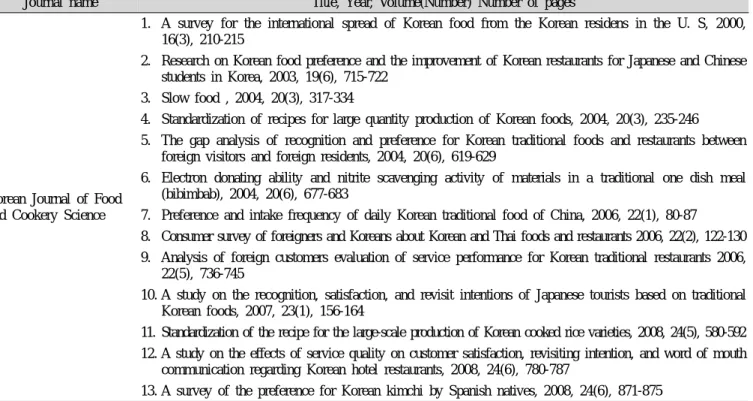
Table 1. Subject of journal
Journal name Title, Year, Volume(Number) Number of pages
Korean Journal of Food and Cookery Science
1. A survey for the international spread of Korean food from the Korean residens in the U. S, 2000, 16(3), 210-215
2. Research on Korean food preference and the improvement of Korean restaurants for Japanese and Chinese students in Korea, 2003, 19(6), 715-722
3. Slow food , 2004, 20(3), 317-334
4. Standardization of recipes for large quantity production of Korean foods, 2004, 20(3), 235-246
5. The gap analysis of recognition and preference for Korean traditional foods and restaurants between foreign visitors and foreign residents, 2004, 20(6), 619-629
6. Electron donating ability and nitrite scavenging activity of materials in a traditional one dish meal (bibimbab), 2004, 20(6), 677-683
7. Preference and intake frequency of daily Korean traditional food of China, 2006, 22(1), 80-87 8. Consumer survey of foreigners and Koreans about Korean and Thai foods and restaurants 2006, 22(2), 122-130 9. Analysis of foreign customers evaluation of service performance for Korean traditional restaurants 2006,
22(5), 736-745
10. A study on the recognition, satisfaction, and revisit intentions of Japanese tourists based on traditional Korean foods, 2007, 23(1), 156-164
11. Standardization of the recipe for the large-scale production of Korean cooked rice varieties, 2008, 24(5), 580-592 12. A study on the effects of service quality on customer satisfaction, revisiting intention, and word of mouth
communication regarding Korean hotel restaurants, 2008, 24(6), 780-787
13. A survey of the preference for Korean kimchi by Spanish natives, 2008, 24(6), 871-875
3. 자료의 평가
본 연구자는 선정된 논문이 한식 세계화와 관련하여 유사성과 접근성이 있는가를 면밀하게 검토를 한 후에 자료를 평가 하였다. 수집된 자료의 평가는 평정 지침서 를 기준으로 사용하였다. 평정 지침서(Jo SH 2003)는 학 회지 게재논문을 평가하기 위해 작성하였는데 내용분류 와 연구대상자 관련 정보, 연구방법의 분류, 자료 분석방 법, 측정도구의 평가 항목이 있다. 본 연구의 평정 지침 서에 대한 구체적인 내용으로는 첫째, 논문의 내용을 분 류하였는데, 각 논문 별로 등재 학술지 또는 등재 후보 학술지에 게제가 되었는지 구분한 후에 논문의 제목과 권, 호, 쪽 수에 대하여 평가를 하였다. 둘째, 일반적 사 항을 평가하였는데, 연도별 게재 논문 편수, 논문 1편 당 저자의 수와 직업에 대한 내용을 평가하였다. 셋째, 연구 주제와 연구방법, 연구 대상자, 통계분석방법을 평가 하 였다.
평가는 평정자들이 하였는데 신뢰성 있는 분석이 되기 위해 평정자들은 본 연구자를 포함해서 동일 분야 전공 의 전임교원 2명과 석사과정 2명 등 총 5명이 참여를 하였다. 평정절차는 Kwon JH(2008) 연구자가 사용한 방 법을 본 연구의 취지와 목적에 맞게 수정․보완하여 사 용하였다. 첫 번째로 평정자들에게 평정 지침서를 배부 하고 각 평정항목 및 항목별 분류를 설명하였다. 두 번 째로 5개 논문을 무작위로 선정하여 모의 평정 및 평가 를 실시하였다. 세 번째로 전체 논문을 반으로 나누어서
평가 한 후에 2명의 평정자에 의해 작성된 결과를 함께 토론하는데, 의견의 불일치가 발생하면 토론을 하여 의 견을 일치시킨다.
4. 분석방법
한식의 세계화 관련 연구 동향을 알아보기 위한 본 연 구의 분석방법은 내용분석법을 실시하였다. 내용분석은 조직적이고 객관적인 정량분석 방법 중의 하나로 자료수 집을 하는 분석방법으로 설문지와 인터뷰를 통하지 않고 측정하는 방법이다(Oh IK 2000). 특히 학술지 논문의 성격이나 내용을 분석하는 기법으로도 유용하게 사용되 어온 기법 중위 하나이다(Lee SH와 Na TK 2006). 수집 된 자료는 각 변인별로 정리하여 SPSS 12.0 통계 프로 그램을 이용하여 학회지별 논문의 분류, 연도별 게재 논 문, 저자의 수, 직업, 연구 주제, 연구방법, 연구대상, 분 석방법 데이터를 코딩한 후에 빈도수와 백분율로 산출 하여 분석을 실시하였다.
III. 결과 및 고찰
1. 논문의 분류 및 내용
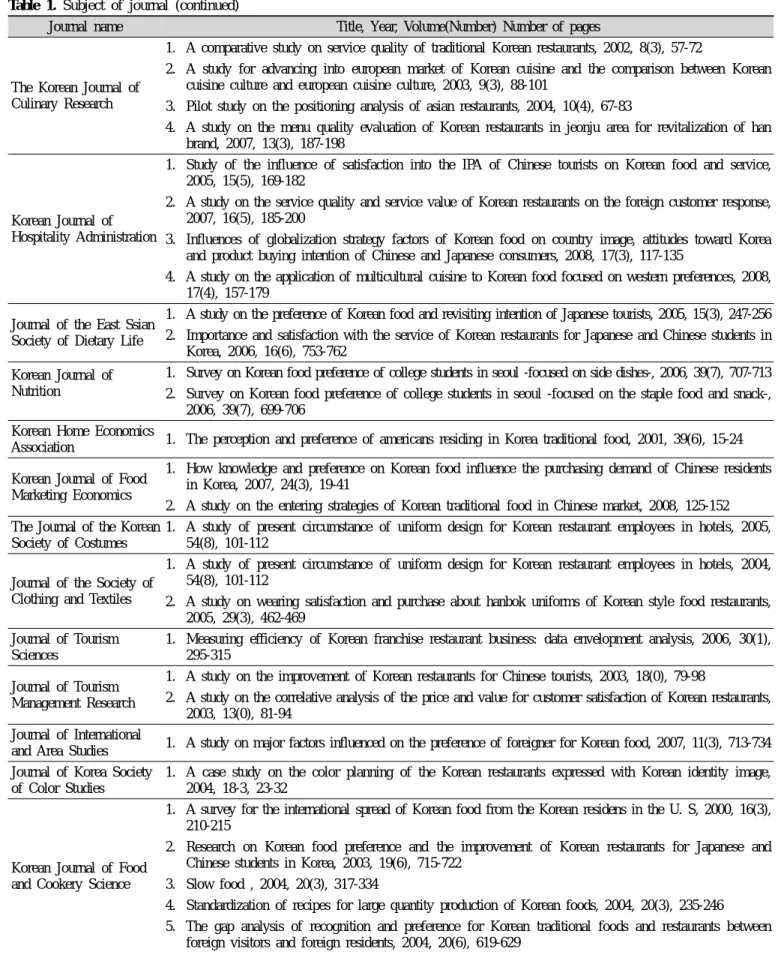
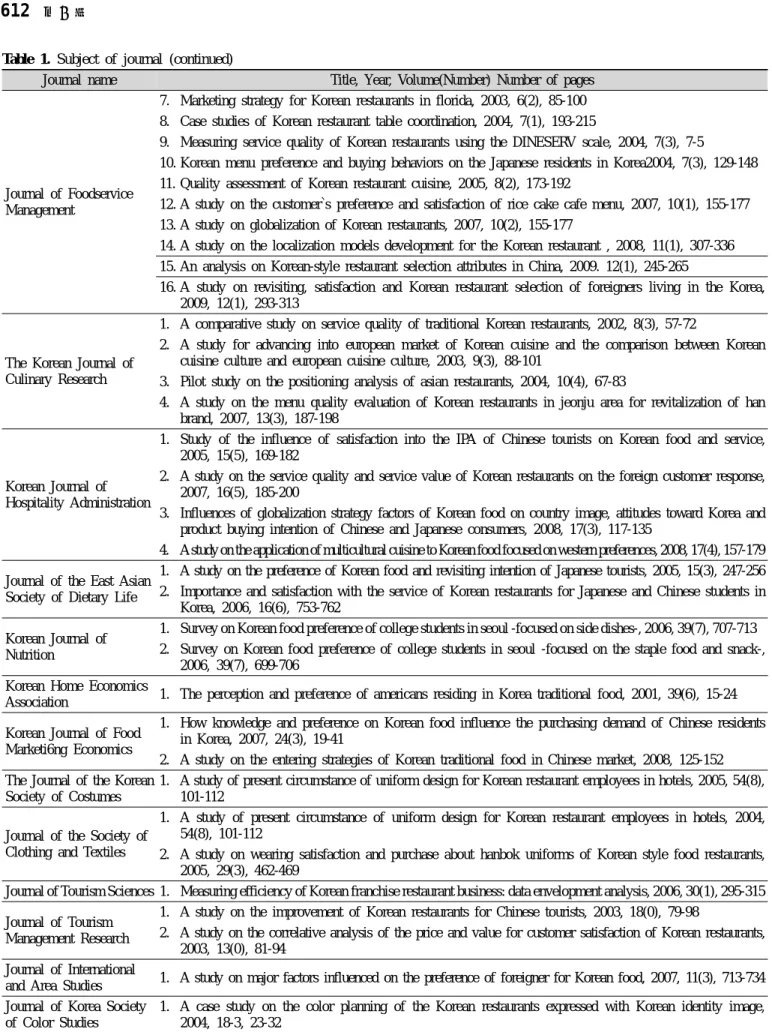
15개 등재․등재후보 학술지에 게재된 논문은 총 70 편으로 구성되었는데 학회지별로 분류하여 논문의 제목 과 권, 호, 쪽 수에 대한 내용으로 구분하였다. 각 학회 지에 대한 논문 내용은 Table 1과 같다.
Table 1. Subject of journal (continued)
Journal name Title, Year, Volume(Number) Number of pages
Korean Journal of Food Culture
1. Recognition and preference to Korean traditional food of foreign visitors in Korea, 2000, 15(3), 215-223 2. The differences between Korean and Japanese ways of seasonings, 2004, 19(2) 223-238
3. Korean traditional food perception and cultural aspect of Korean mongolian housewives, 2005, 20(1), 35-43 4. A study on the satisfaction for the menu quality of Korean traditional food of Japanese tourists, 2005,
20(2), 283-291
5. A study on recognition and preference of Korean foods for foreigners in different nationality, 2005, 20(3), 367-373
6. Universalizing Korean food, 2005, 20(5), 499-507
7. A study of evaluation for service quality of Korean restaurant customers , 2005, 20(5), 538-547 8. Perceptional trend and preference for Korean traditional holiday food of China-Korean in yanbian area
2006, 21(1), 1-7
9. Recognition and preference to Korean traditional food of Chinese at seoul residence 2006, 21(1)17-30 10. University students attitudes and interests for ethnic food, 2006, 21(5), 463-472
11. The preference of americans residing in the US for Korean traditional cookies, 2006, 21(4), 351-356 12. Content analysis of the new york times on Korean food from 1980 to 2005, 2007, 22(2), 289-298 13. A study on difference between the importance and performance of the role of food coordinator for the
globalization of Korean food, 2007, 22(5), 544-555
14. A survey of the preference of the turk for Korean kimchi, 2007, 22(6), 690-695 15. The globalization of Korean cuisine through the brand chefs, 2007, 22(6), 682-689 16. Sensory evaluation of Korean traditional foods for americans, 2007, 22(6), 801-807
17. Expectation and satisfaction of foreign customers visiting Korean restaurants located in USA, 2008, 23(2), 152-162
18. A survey of the perception of Korean kimchi by the Chinese in shandong province, 2008, 23(6), 693-704 19. Sensory evaluation of dining staffs at UCLA for Korean foods, 2008, 23(6), 705-712
20. Globalization of Korean cuisine through the Korean food items promotion, 2008, 23(6), 729-736 21. Chinese customers perception of Korean foods and satisfaction and revisit intentions to Korean cuisine
restaurants, 2009, 24(2), 126-136
Journal of Foodservice Management
1. A study on the Korean restaurant's strategy through the survey of ethnic cuisine within the US market, 2001, 4(1), 125-147
2. A study on the importance and performance evaluation of the visual element of the dining space at Korean restaurant, 2001, 4(1), 265-288
3. A study on the management technique for Korean, 2001, 4(1), 313-330
4. A study on the analysis of satisfaction in service qualities of Korean restaurants,2001, 4(2), 53-71 5. Customer satisfaction analysis for Korean franchise restaurants, 2002, 5(1), 199-211
6. The study of service quality perception determinants on Korean restaurants, 2002, 5(3), 127-142 7. Marketing strategy for Korean restaurants in florida, 2003, 6(2), 85-100
8. Case studies of Korean restaurant table coordination, 2004, 7(1), 193-215
9. Measuring service quality of Korean restaurants using the DINESERV scale, 2004, 7(3), 7-5
10. Korean menu preference and buying behaviors on the Japanese residents in Korea2004, 7(3), 129-148 11. Quality assessment of Korean restaurant cuisine, 2005, 8(2), 173-192
12. A study on the customer`s preference and satisfaction of rice cake cafe menu, 2007, 10(1), 155-177 13. A study on globalization of Korean restaurants, 2007, 10(2), 155-177
14. A study on the localization models development for the Korean restaurant , 2008, 11(1), 307-336 15. An analysis on Korean-style restaurant selection attributes in China, 2009. 12(1), 245-265
16. A study on revisiting, satisfaction and Korean restaurant selection of foreigners living in the Korea,
2009, 12(1), 293-313
Table 1. Subject of journal (continued)
Journal name Title, Year, Volume(Number) Number of pages
The Korean Journal of Culinary Research
1. A comparative study on service quality of traditional Korean restaurants, 2002, 8(3), 57-72
2. A study for advancing into european market of Korean cuisine and the comparison between Korean cuisine culture and european cuisine culture, 2003, 9(3), 88-101
3. Pilot study on the positioning analysis of asian restaurants, 2004, 10(4), 67-83
4. A study on the menu quality evaluation of Korean restaurants in jeonju area for revitalization of han brand, 2007, 13(3), 187-198
Korean Journal of Hospitality Administration
1. Study of the influence of satisfaction into the IPA of Chinese tourists on Korean food and service, 2005, 15(5), 169-182
2. A study on the service quality and service value of Korean restaurants on the foreign customer response, 2007, 16(5), 185-200
3. Influences of globalization strategy factors of Korean food on country image, attitudes toward Korea and product buying intention of Chinese and Japanese consumers, 2008, 17(3), 117-135
4. A study on the application of multicultural cuisine to Korean food focused on western preferences, 2008, 17(4), 157-179
Journal of the East Ssian Society of Dietary Life
1. A study on the preference of Korean food and revisiting intention of Japanese tourists, 2005, 15(3), 247-256 2. Importance and satisfaction with the service of Korean restaurants for Japanese and Chinese students in
Korea, 2006, 16(6), 753-762 Korean Journal of
Nutrition
1. Survey on Korean food preference of college students in seoul -focused on side dishes-, 2006, 39(7), 707-713 2. Survey on Korean food preference of college students in seoul -focused on the staple food and snack-,
2006, 39(7), 699-706 Korean Home Economics
Association 1. The perception and preference of americans residing in Korea traditional food, 2001, 39(6), 15-24 Korean Journal of Food
Marketing Economics
1. How knowledge and preference on Korean food influence the purchasing demand of Chinese residents in Korea, 2007, 24(3), 19-41
2. A study on the entering strategies of Korean traditional food in Chinese market, 2008, 125-152 The Journal of the Korean
Society of Costumes
1. A study of present circumstance of uniform design for Korean restaurant employees in hotels, 2005, 54(8), 101-112
Journal of the Society of Clothing and Textiles
1. A study of present circumstance of uniform design for Korean restaurant employees in hotels, 2004, 54(8), 101-112
2. A study on wearing satisfaction and purchase about hanbok uniforms of Korean style food restaurants, 2005, 29(3), 462-469
Journal of Tourism Sciences
1. Measuring efficiency of Korean franchise restaurant business: data envelopment analysis, 2006, 30(1), 295-315
Journal of Tourism Management Research
1. A study on the improvement of Korean restaurants for Chinese tourists, 2003, 18(0), 79-98
2. A study on the correlative analysis of the price and value for customer satisfaction of Korean restaurants, 2003, 13(0), 81-94
Journal of International
and Area Studies 1. A study on major factors influenced on the preference of foreigner for Korean food, 2007, 11(3), 713-734 Journal of Korea Society
of Color Studies
1. A case study on the color planning of the Korean restaurants expressed with Korean identity image, 2004, 18-3, 23-32
Korean Journal of Food and Cookery Science
1. A survey for the international spread of Korean food from the Korean residens in the U. S, 2000, 16(3), 210-215
2. Research on Korean food preference and the improvement of Korean restaurants for Japanese and Chinese students in Korea, 2003, 19(6), 715-722
3. Slow food , 2004, 20(3), 317-334
4. Standardization of recipes for large quantity production of Korean foods, 2004, 20(3), 235-246
5. The gap analysis of recognition and preference for Korean traditional foods and restaurants between
foreign visitors and foreign residents, 2004, 20(6), 619-629
Table 1. Subject of journal (continued)
Journal name Title, Year, Volume(Number) Number of pages
Korean Journal of Food and Cookery Science
6. Electron donating ability and nitrite scavenging activity of materials in a traditional one dish meal(bibimbab), 2004, 20(6), 677-683
7. Preference and intake frequency of daily Korean traditional food of China, 2006, 22(1), 80-87 8. Consumer survey of foreigners and Koreans about Korean and Thai foods and restaurants 2006, 22(2), 122-130 9. Analysis of foreign customers evaluation of service performance for Korean traditional restaurants 2006,
22(5), 736-745
10. A study on the recognition, satisfaction, and revisit intentions of Japanese tourists based on traditional Korean foods, 2007, 23(1), 156-164
11. Standardization of the recipe for the large-scale production of Korean cooked rice varieties, 2008, 24(5), 580-592 12. A study on the effects of service quality on customer satisfaction, revisiting intention, and word of
mouth communication regarding Korean hotel restaurants, 2008, 24(6), 780-787
13. A survey of the preference for Korean kimchi by Spanish natives, 2008, 24(6), 871-875
Korean Journal of Food Culture
1. Recognition and preference to Korean traditional food of foreign visitors in Korea, 2000, 15(3), 215-223 2. The differences between Korean and Japanese ways of seasonings, 2004, 19(2) 223-238
3. Korean traditional food perception and cultural aspect of Korean mongolian housewives, 2005, 20(1), 35-43 4. A study on the satisfaction for the menu quality of Korean traditional food of Japanese tourists, 2005,
20(2), 283-291
5. A study on recognition and preference of Korean foods for foreigners in different nationality, 2005, 20(3), 367-373
6. Universalizing Korean food, 2005, 20(5), 499-507
7. A study of evaluation for service quality of Korean restaurant customers , 2005, 20(5), 538-547 8. Perceptional trend and preference for Korean traditional holiday food of China-Korean in yanbian area
2006, 21(1), 1-7
9. Recognition and preference to Korean traditional food of Chinese at seoul residence 2006, 21(1)17-30 10. University students attitudes and interests for ethnic food, 2006, 21(5), 463-472
11. The preference of americans residing in the US for Korean traditional cookies, 2006, 21(4), 351-356 12. Content analysis of the new york times on Korean food from 1980 to 2005, 2007, 22(2), 289-298 13. A study on difference between the importance and performance of the role of food coordinator for the
globalization of Korean food, 2007, 22(5), 544-555
14. A survey of the preference of the turk for Korean kimchi, 2007, 22(6), 690-695 15. The globalization of Korean cuisine through the brand chefs, 2007, 22(6), 682-689 16. Sensory evaluation of Korean traditional foods for americans, 2007, 22(6), 801-807
17. Expectation and satisfaction of foreign customers visiting Korean restaurants located in USA, 2008, 23(2), 152-162
18. A survey of the perception of Korean kimchi by the Chinese in shandong province, 2008, 23(6), 693-704 19. Sensory evaluation of dining staffs at UCLA for Korean foods, 2008, 23(6), 705-712
20. Globalization of Korean cuisine through the Korean food items promotion, 2008, 23(6), 729-736 21. Chinese customers perception of Korean foods and satisfaction and revisit intentions to Korean cuisine
restaurants, 2009, 24(2), 126-136
Journal of Foodservice Management
1. A study on the Korean restaurant's strategy through the survey of ethnic cuisine within the US market, 2001, 4(1), 125-147
2. A study on the importance and performance evaluation of the visual element of the dining space at Korean restaurant, 2001, 4(1), 265-288
3. A study on the management technique for Korean, 2001, 4(1), 313-330
4. A study on the analysis of satisfaction in service qualities of Korean restaurants,2001, 4(2), 53-71 5. Customer satisfaction analysis for Korean franchise restaurants, 2002, 5(1), 199-211
6. The study of service quality perception determinants on Korean restaurants, 2002, 5(3), 127-142
Table 1. Subject of journal (continued)
Journal name Title, Year, Volume(Number) Number of pages
Journal of Foodservice Management
7. Marketing strategy for Korean restaurants in florida, 2003, 6(2), 85-100 8. Case studies of Korean restaurant table coordination, 2004, 7(1), 193-215
9. Measuring service quality of Korean restaurants using the DINESERV scale, 2004, 7(3), 7-5
10. Korean menu preference and buying behaviors on the Japanese residents in Korea2004, 7(3), 129-148 11. Quality assessment of Korean restaurant cuisine, 2005, 8(2), 173-192
12. A study on the customer`s preference and satisfaction of rice cake cafe menu, 2007, 10(1), 155-177 13. A study on globalization of Korean restaurants, 2007, 10(2), 155-177
14. A study on the localization models development for the Korean restaurant , 2008, 11(1), 307-336 15. An analysis on Korean-style restaurant selection attributes in China, 2009. 12(1), 245-265
16. A study on revisiting, satisfaction and Korean restaurant selection of foreigners living in the Korea, 2009, 12(1), 293-313
The Korean Journal of Culinary Research
1. A comparative study on service quality of traditional Korean restaurants, 2002, 8(3), 57-72
2. A study for advancing into european market of Korean cuisine and the comparison between Korean cuisine culture and european cuisine culture, 2003, 9(3), 88-101
3. Pilot study on the positioning analysis of asian restaurants, 2004, 10(4), 67-83
4. A study on the menu quality evaluation of Korean restaurants in jeonju area for revitalization of han brand, 2007, 13(3), 187-198
Korean Journal of Hospitality Administration
1. Study of the influence of satisfaction into the IPA of Chinese tourists on Korean food and service, 2005, 15(5), 169-182
2. A study on the service quality and service value of Korean restaurants on the foreign customer response, 2007, 16(5), 185-200
3. Influences of globalization strategy factors of Korean food on country image, attitudes toward Korea and product buying intention of Chinese and Japanese consumers, 2008, 17(3), 117-135
4. A study on the application of multicultural cuisine to Korean food focused on western preferences, 2008, 17(4), 157-179 Journal of the East Asian
Society of Dietary Life
1. A study on the preference of Korean food and revisiting intention of Japanese tourists, 2005, 15(3), 247-256 2. Importance and satisfaction with the service of Korean restaurants for Japanese and Chinese students in
Korea, 2006, 16(6), 753-762 Korean Journal of
Nutrition
1. Survey on Korean food preference of college students in seoul -focused on side dishes-, 2006, 39(7), 707-713 2. Survey on Korean food preference of college students in seoul -focused on the staple food and snack-,
2006, 39(7), 699-706 Korean Home Economics
Association 1. The perception and preference of americans residing in Korea traditional food, 2001, 39(6), 15-24 Korean Journal of Food
Marketi6ng Economics
1. How knowledge and preference on Korean food influence the purchasing demand of Chinese residents in Korea, 2007, 24(3), 19-41
2. A study on the entering strategies of Korean traditional food in Chinese market, 2008, 125-152 The Journal of the Korean
Society of Costumes
1. A study of present circumstance of uniform design for Korean restaurant employees in hotels, 2005, 54(8), 101-112
Journal of the Society of Clothing and Textiles
1. A study of present circumstance of uniform design for Korean restaurant employees in hotels, 2004, 54(8), 101-112
2. A study on wearing satisfaction and purchase about hanbok uniforms of Korean style food restaurants, 2005, 29(3), 462-469
Journal of Tourism Sciences 1. Measuring efficiency of Korean franchise restaurant business: data envelopment analysis, 2006, 30(1), 295-315 Journal of Tourism
Management Research
1. A study on the improvement of Korean restaurants for Chinese tourists, 2003, 18(0), 79-98
2. A study on the correlative analysis of the price and value for customer satisfaction of Korean restaurants, 2003, 13(0), 81-94
Journal of International
and Area Studies 1. A study on major factors influenced on the preference of foreigner for Korean food, 2007, 11(3), 713-734 Journal of Korea Society
of Color Studies
1. A case study on the color planning of the Korean restaurants expressed with Korean identity image,
2004, 18-3, 23-32
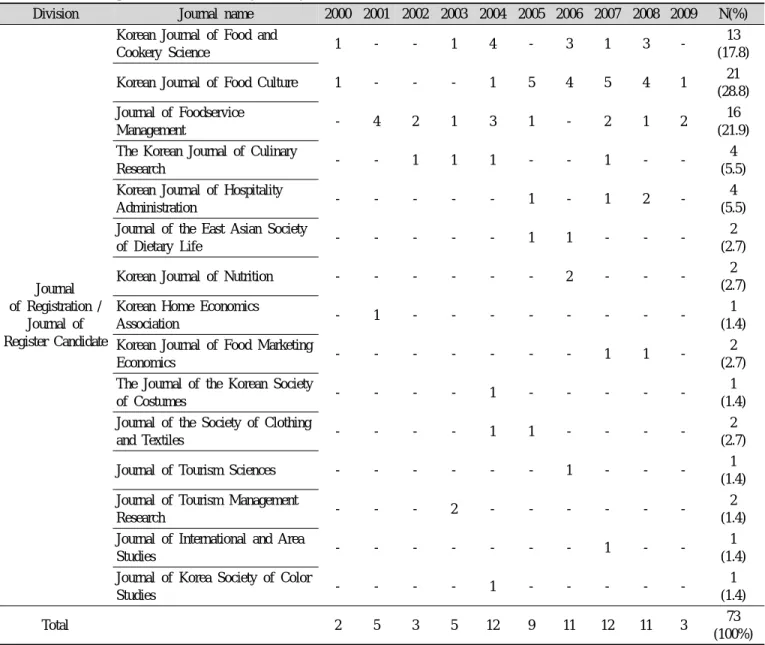
Table 2. Results of publication article analysis on year
Division Journal name 2000 2001 2002 2003 2004 2005 2006 2007 2008 2009 N(%)
Journal of Registration /
Journal of Register Candidate
Korean Journal of Food and
Cookery Science 1 - - 1 4 - 3 1 3 - 13
(17.8)
Korean Journal of Food Culture 1 - - - 1 5 4 5 4 1 21
(28.8) Journal of Foodservice
Management - 4 2 1 3 1 - 2 1 2 16
(21.9) The Korean Journal of Culinary
Research - - 1 1 1 - - 1 - - 4
(5.5) Korean Journal of Hospitality
Administration - - - - - 1 - 1 2 - 4
(5.5) Journal of the East Asian Society
of Dietary Life - - - - - 1 1 - - - 2
(2.7)
Korean Journal of Nutrition - - - - - - 2 - - - 2
(2.7) Korean Home Economics
Association - 1 - - - - - - - - 1
(1.4) Korean Journal of Food Marketing
Economics - - - - - - - 1 1 - 2
(2.7) The Journal of the Korean Society
of Costumes - - - - 1 - - - - - 1
(1.4) Journal of the Society of Clothing
and Textiles - - - - 1 1 - - - - 2
(2.7)
Journal of Tourism Sciences - - - - - - 1 - - - 1
(1.4) Journal of Tourism Management
Research - - - 2 - - - - - - 2
(1.4) Journal of International and Area
Studies - - - - - - - 1 - - 1
(1.4) Journal of Korea Society of Color
Studies - - - - 1 - - - - - 1
(1.4)
Total 2 5 3 5 12 9 11 12 11 3 73
(100%)
한국식품조리과학회지의 논문 주제는 재미한인들의 한국음식 세계화, 일본과 중국 유학생의 한국음식 기호도 및 한식당 개선방안, 슬로우드 푸드의 조리과학적 접근, 한국음식의 대량생산 표준레시피 개발, 주한외국인의 한 국음식 인식, 비빔밥 전통음식, 중국 연변 조선족의 한국 음식 선호도, 한국음식과 태국음식의 외국인 의식, 한식 당의 외국인 평가, 일본관광객의 한국음식 인식, 한식의 표준레시피, 호텔 한식당의 서비스품질, 김치 세계화를 위한 기호도이다. 한국식생활문화학회지의 논문 주제는 외국인의 한국음식 인지도와 기호도, 한식과 일식의 조미 료 사용법, 조선족 여성의 한식 인식, 방한 일본 관광객 의 한식 만족도, 국내 체류 외국인들의 한식 인지도 및 선호도, 한국음식의 국제화 방안, 한식당 서비스품질 평 가, 조선족의 한식 인식도, 한식 선호도, 중국인들의 한식
인지도와 기호도, 대학생들의 관심도, 한과에 대한 미국 인들의 선호도, 미국의 한국음식 내용분석, 김치의 세계 화를 위한 기호도, 브랜드 쉐프를 통한 한국음식의 세계 화 방안, 한식에 대한 미국인들의 선호도, 외국인들의 한 식 인식도, 한국음식의 세계화 방안, 한식의 기호도이다.
외식경영연구의 논문 주제는 한식당 현지화 전략, 한식당 의 식공간, 한식당 관리기법, 한식의 만족도 및 기호도, 한식 상차림, 한식당 서비스품질, 한식의 이미지 인식, 한 식 메뉴 평가, 한식의 메뉴 선호도, 한식의 세계화 방안이 다. 한국조리학회지의 논문 주제는 한식당 서비스품질, 한 식의 유렵진출방안, 미국소재 한식당의 포지셔닝, 한식당 의 메뉴평가이다. 호텔경영학연구의 논문 주제는 한식 세 계화 전략, 한식당의 고객지향성, 중국 관광객의 한식 만 족도, 한식당의 만족도이다. 동아시아식생활학회지는 한
Table 3. Results of authors number analysis on year
Publication year Number of author
Number of total author 1person 2person 3person 4person 5person 6person
2000 - 2 - 1 - - 8(5.0)
2001 3 - 2 - - 1 15(9.3)
2002 1 2 - - - - 5(3.1)
2003 2 2 1 - - - 9(5.6)
2004 3 3 1 3 - - 24(14.9)
2005 6 3 - 1 - - 16(9.9)
2006 2 5 3 1 - - 25(15.5)
2007 5 - 4 2 - - 25(15.5)
2008 1 5 1 2 1 - 27(16.8)
2009 - 2 1 - - - 7(4.3)
Number of total paper 24(32.9) 24(32.9) 13(17.8) 10(13.7) 1(1.4) 1(1.4) 161(100%)
73(100%)
Table 4. Results of job analysis of authors
Job of authors Single author
(one person)
United author
(more than 2 authors) N(%)
University professor 19 111 130(67.4)
Research in laboratory - 28 28(14.5)
Part-time university lecturer - 4 4(2.1)
Masters course 3 7 10(5.2)
Doctorial course 2 17 19(9.8)
Others(CEO, company employee) 1 1 2(1.0)
N(%) 25(13.0) 168(87.0) 193(100%)
Total N : 193, % : 100.0
식 선호도 및 인식도, 한식당 만족도이다. 한국영양학회지는 한식의 선호도이며, 대한가정학회지는 한식의 인식 과 기호도이며, 식품유통연구는 중국인의 한국 음식 선호 도이다. 한국의류학회지와 한국복식학회지는 한식당 유니 폼의 만족도와 디자인을 주제로 하였다. 관광연구와 관 광경영학연구에서는 한식당의 만족도와 개선 방안, 국제 지역연구에서는 한식선호도, 한국색채학회지에서는 한식 당의 색채에 대한 주제로 연구를 하였다. 각 학회지 별로 논문 주제를 종합해 보면 한식의 선호도와 만족도에 관 한 주제로 다양한 연구를 수행하였다.
2. 일반적 사항
일반적 사항에서는 연도별 게재 논문, 저자의 수와 직 업에 대한 내용으로 분류하여 분석하였다. 첫째로 연도 별 게재 논문에 관한 결과는 Table 2와 같다. 연도별 게 재 논문은 2000년부터 2009년 상반기까지 한식 관련 국 내 학술지에 게재된 논문을 연도별로 게재 편수를 분석 하였다. 국내 등재․등재 후보 학술지에 게재된 논문의 수는 총 73편이며 2000년에 2편을 시작으로 하여 2004년
부터 게재된 논문 편수가 12편으로 증가하여 2009년 상 반기 까지 꾸준한 연구가 진행되었다. 게재된 논문은 학 술지 별로 한국식생활문화학회지가 21편(28.8%)으로 가 장 많았으며, 그 다음으로 외식경영연구가 16편(21.9%), 한국식품조리학회지가 13편(17.8%) 순으로 나타났다.
둘째, 연도별 국내 학회지에 게재된 논문 1편 당 저자 의 수를 분석하였는데 그 결과는 Table 3과 같다. 저자의 수는 단독 저자와 2인 공동 저자가 24편(32.9%)으로 가 장 많이 나타났다. 이러한 결과는 대부분 한식 관련 논문 을 연구할 때의 저자의 수는 단독이나 2인 공동 저자로 논문을 투고한다는 것을 알 수가 있다.
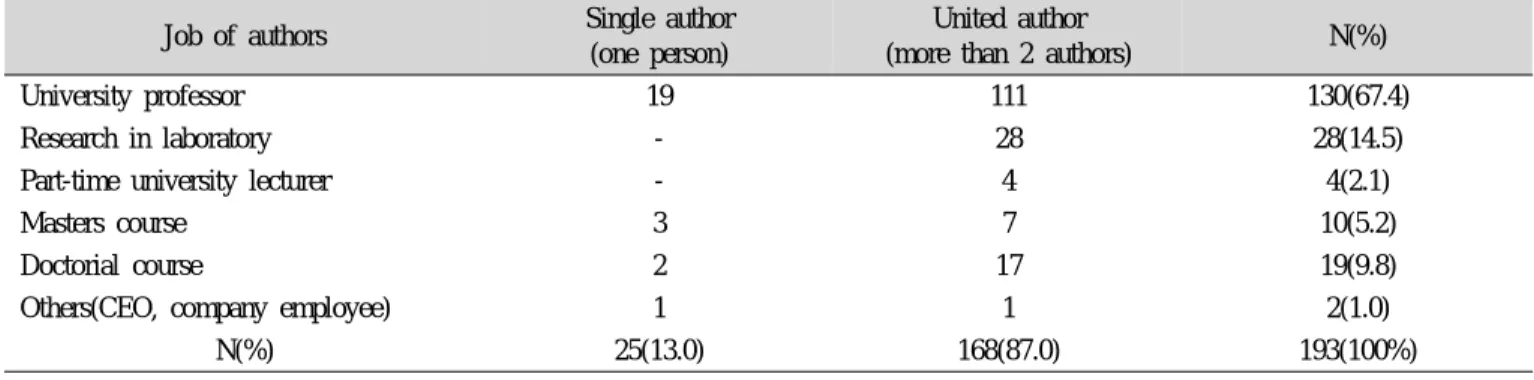
셋째, 논문에 대한 저자들의 직업을 알아보기 위해 주 저자와 공동 저자로 구분하여 분석 한 결과는 Table 4와 같다. 총 73편의 논문 중에서 총 저자의 수는 186명이였 는데, 단독 저자는 25명(13.4%)이고 2인 이상 공동 저자 는 163명(86.6%)으로 한식관련 연구가 이루어졌다. 구체 적으로 저자의 직업은 대학교수가 127명(68.3%)으로 가 장 많았으며 그 다음으로는 연구소 연구원이 28명(15.1%), 박사과정이 18명(9.7%)의 순으로 나타났다. 이러한 결과
Table 5. Results of research subject content
Research subject content 2000 2001 2002 2003 2004 2005 2006 2007 2008 2009 N(%)
Globalization of Korean food 1 - 1 1 - 1 - 3 2 - 9(12.3)
Preference of Korean food - - - 2 - 3 5 3 1 - 14(19.2)
Recognition(residing) of Korean food 2 1 - - 2 2 3 - 3 - 13(17.8)
Satisfaction of Korean food - - 1 - - - 2 2 - - 5(6.8)
Korean restaurant localization - 2 - 1 - - - - - - 3(4.1)
Satisfaction of Korean restaurant - 1 - - - - 1 2 1 3 8(11.0)
Korean food menu in connection - - - - 4 2 - 1 1 - 8(11.0)
Service of Korean restaurant - 2 1 1 2 1 1 - 1 - 9(12.3)
Other - - - - 2 1 - 1 - - 4(5.5)
N(%) 3(4.1) 6(8.2) 3(4.1) 5(6.8) 10(13.7) 10(13.7) 12(16.4) 12(16.4) 9(12.3) 3(4.1) 73(100.0) Total N : 73, % : 100.0
Table 6. Results of research method
Data collection Research method 2000 2001 2002 2003 2004 2005 2006 2007 2008 2009 N(%) Quantitative
research
Experimental research - - - - 1 - - - 1 - 2(2.7)
Investigatory research 3 3 2 4 6 9 13 11 7 3 61(83.6)
Qualitative research
Literature research - 3 - 1 - 1 - - - - 5(6.8)
Case study - - - - 2 - - 1 1 - 4(5.5)
Basis theory - - 1 - - - - - - - 1(1.4)
Total 73(100.0)
는 학술지에 게재된 논문의 저자는 대학에서 재직 중인 교수들이 대부분 연구를 하고 있음을 알 수가 있었다.
그러나 향후에는 교수뿐만 아니라 다른 직업에 해당되 는 사람들도 한식의 세계화에 대하여 관심을 가져야 할 필요성이 있어야 한다.
3. 연구의 동향 분석 1) 연구 주제의 내용
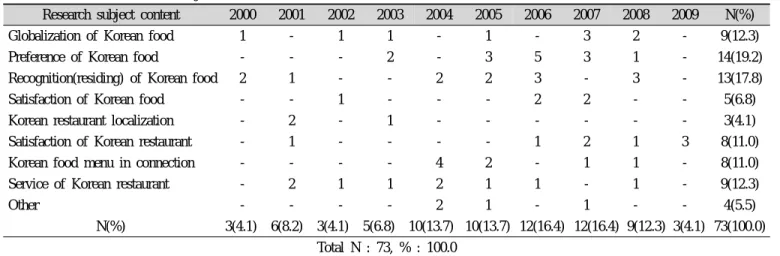
연구 주제의 동향을 분석해 보면 어느 주제를 선정하 여 연구가 이루어졌는지 알 수가 있는데, 그 결과는 Table 5와 같다. 연구 주제는 한식에 대한 선호도(기호도) 연구가 14편(19.2%)으로 가장 많았는데, 가장 선호하는 한식은 비빔밥, 불고기, 갈비구이, 삼계탕, 잡채, 김치 등 이다. 그 다음으로 한식에 대한 인지도(인식도) 연구가 13편(17.8%)으로 나타났다. 연구 결과 한식은 기호식품이 고 제철식품이 많으며 곡류와 채소 위주이며 건강에 유 의하다는 인식 수준은 낮았다. 또 양념이 짜고 매우며 발 효식품이 발달하였다는 인식을 하고 있다. 그리고 한식 당에 대한 서비스 관련 연구와 한식의 세계화를 위한 방 안 연구의 순으로 다양한 내용으로 연구가 이루어지고 있는 추세이다. 향후 연구에서는 주제 선정에 있어서 한 식과 한식당의 만족도에 관한 연구와 한식의 현지화를 위한 연구가 활발하게 진행이 되어야 하겠다.
2) 연구방법의 내용
한식 관련 국내 학술지 게재 논문들이 연구방법에 따 라 내용을 분석한 결과는 Table 6과 같다. 연구 방법의 범주는 자료수집에 따라 양적연구와 질적연구로 구분하 였는데, 이를 다시 연구방법에 따라 양적연구와 질적연 구로 구분하였다. 양적연구는 실험연구와 조사연구로 구 분하였다. 질적연구는 문헌연구와 사례연구, 근거이론으 로 구분하였다.
총 73편의 논문 중에서 대부분의 연구가 조사연구로 61 편(83.6%)이 이루어졌는데, 이러한 결과는 한식의 세계화 와 관련 된 분야는 사회과학 분야에 속하므로 연구자들 이 인문학이나 자연과학에서 사용하는 연구방법을 사용 안 하고 있는 것으로 판단된다. 연도별로는 2005년에서 2007년까지 33편으로 조사연구를 가장 많이 실시한 것으 로 나타났다.
3) 연구대상의 선정
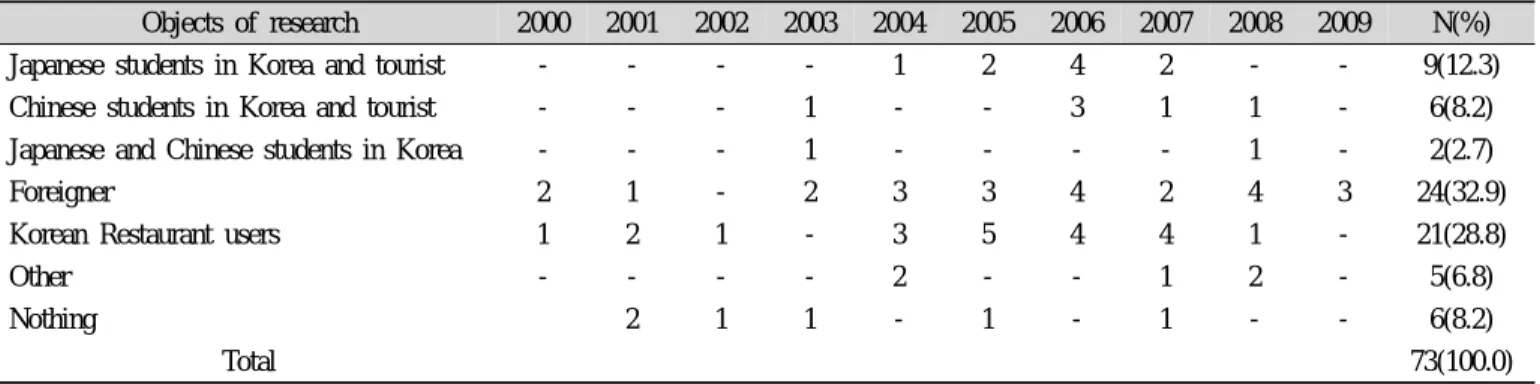
한식 관련 연구를 대상자 별로 구분 해 본 내용의 결 과는 Table 7과 같다. 연구 대상자는 주로 외국인이 21 편(30.0%), 내국인이 20편(28.6%)으로 가장 많았는데, 외 국인 중에는 미국인이 많았다. 또한 유학생 및 관광객을 대상으로 연구가 활발하게 이루어졌는데, 유학생 및 관광 객 중에는 일본과 중국 유학생 및 관광객이 주류를 이루
Table 7. Results of analysis on research object selection
Objects of research 2000 2001 2002 2003 2004 2005 2006 2007 2008 2009 N(%)
Japanese students in Korea and tourist - - - - 1 2 4 2 - - 9(12.3)
Chinese students in Korea and tourist - - - 1 - - 3 1 1 - 6(8.2)
Japanese and Chinese students in Korea - - - 1 - - - - 1 - 2(2.7)
Foreigner 2 1 - 2 3 3 4 2 4 3 24(32.9)
Korean Restaurant users 1 2 1 - 3 5 4 4 1 - 21(28.8)
Other - - - - 2 - - 1 2 - 5(6.8)
Nothing 2 1 1 - 1 - 1 - - 6(8.2)
Total 73(100.0)
Table 8. Results of analysis methods on material
Analysis Method 2000 2001 2002 2003 2004 2005 2006 2007 2008 2009 Total(N)
Frequency analysis 2 5 2 5 7 9 13 10 8 3 64
Reliability analysis - 1 2 1 2 3 4 5 3 1 22
T-test - - 1 1 4 4 8 4 2 2 26
Factor analysis - 1 2 1 1 2 1 4 6 - 18
One way ANOVA - 1 - 4 5 7 3 5 1 - 26
x2 test - 1 - 2 2 4 2 1 - - 12
Regression analysis - 1 2 - 2 1 3 3 4 1 17
Crosstabulation analysis - - - - - - - - 1 - 1
Correlation relationship analysis - - - - - - 1 2 2 - 5
Covariate analysis - - - - - - - 1 - - 1
Path analysis - - - - - - - 2 1 - 3
Cluster analysis - - - - - 1 1 - - - 2
Chi square 2 - - 1 1 - 3 - - - 7
IPA analysis - - - - - - 2 2 - 2 6
Other - - - - 1 - - 1 - - 2
Nothing - 1 1 1 2 1 - 2 1 - 9
- Materials were checked repeatedly when statistic methods, more than one, were applied.
고 있었다. 특히 연구 대상자를 일본과 중국 유학생 및 관광객, 일본과 중국유학생으로 구분을 한 이유는 게재 된 논문의 저자가 대상자를 선정하였기 때문이다. 이러한 결과는 음식문화의 접근 방법에 있어서 아시아 대표 주 변국인 일본과 중국, 그리고 한식 업체가 가장 많이 진출 한 미국을 주요 조사 대상국으로 선정하였기 때문인 것 으로 판단이 된다. 향후 연구에서는 다양한 접근 방법에 서 다국적인 표본 집단을 대상자로 선정해야 할 것이다.
4) 자료의 분석방법
통계적 기법은 과학이란 용어를 붙여둔 모든 학문분 야에서 널리 사용되고 있는 추세인데(Lee SH와 Na TK 2006), 조사 연구를 통하여 알고자하는 것이 무엇인가에 따라 자료의 종류와 자료수집방법 및 분석기법이 달라지 게된다(Ko JW와 Ryu C 2008). 본 연구에서 사용한 통계
분석방법의 결과는 Table 8과 같다.
통계분석 방법에서는 주로 빈도분석, 신뢰도분석, T-test, 요인분석, 일원배치 분산분석을 위주로 통계분석을 하였 다. 그중에서 빈도분석이 64편, 일원배치 분산분석 26편, T-test 26편, 신뢰도분석 22편, 요인분석 18편의 순으로 분석방법을 사용하였으며, 교차분석과 공변량분석 방법은 1편으로 분석방법의 빈도 빈도가 가장 낮게 나타났다. 특 히 신뢰도와 타당도 분석을 통한 크론바흐의 알파계수 를 이용해서 신뢰도를 분석하였고, 타당도 분석을 검증하 기 위해서 아이겐 값을 구하고 요인분석을 실시하였다.
그러나 통계 분석을 이용하지 않은 논문은 9편이었다.
이러한 결과는 조사 자료의 분석은 사회과학 분야이고, 학술 논문이므로 객관적이고 신뢰할 수 있는 분석방법을 사용하는 것으로 판단이 된다.
IV. 결론 및 제언
본 연구는 정부 차원에서 한식 세계화를 위한 정책 추진과 최근 국내에서 활발하게 진행되고 있는 한식 관 련 학술적 연구 동향을 분석하여 향후 연구에 대한 기초 적인 정보를 연구자들에게 제시하는데 의의가 있다. 조사 방법은 인터넷 매체를 이용하여 관련 논문 73편의 자료 를 수집하여 분석을 하였는데, 수집된 자료는 논문의 내 용 분류, 각 논문 별로 학술지 게제 구분, 일반적 사항, 연도별 게재 논문 편수, 논문 1편 당 저자의 수와 직업, 연구 주제와 연구방법, 연구 대상자, 통계분석방법을 분 석 하였다. 이에 대한 결과는 다음과 같이 요약을 하였다.
첫째, 학술진흥재단의 국내 등재 학술지와 등재 후보 학술지에 게재된 한식 관련 논문 편수를 연도별로 분석 하였는데, 2000년부터 2008년까지 총 70편의 논문이 게 재가 되었다. 연구는 2000년에 2편을 시작으로 2004년과 2007년에 12편씩 가장 많은 연구가 진행되었고, 게재된 학술지는 한국식생활문화학회지에 20편(28.6%)으로 가장 많이 게재가 되었다. 연도별 게재된 논문의 편 수당 저 자의 수는 단독 저자가 24편(34.3%)으로 가장 많았으며, 2인 공동 저자가 22편(31.4%)으로 대부분 단독이나 2인 공동저자가 연구를 수행하였음을 알 수가 있다. 주저자와 공동저자의 수는 186명인데, 저자들의 직업은 대학 교수 가 127명(68.3%)으로 가장 많았으며 연구소 연구원이 28명(15.1%)의 순으로 나타났다.
둘째, 연구동향에서는 연구 주제와 연구방법, 분석 방 법을 분석하였다. 연구 주제의 동향은 한식에 대한 기호 도 및 선호도가 14편(20.0%)으로 가장 많았으며, 한식에 대한 인지도 및 인식이 13편(18.6%)으로 대부분의 연구 주제가 한식에 대한 선호도 및 인지도에 초점을 맞추어 연구가 진행되었다. 연구 방법에서는 양적연구(실험연구, 조사연구)와 질적연구(문헌연구, 사례연구, 근거이론)로 구 분하였는데, 대부분의 연구가 조사연구로 58편(82.9%)이 이루어졌다. 연구의 대상자는 외국인과 내국인이 각각 21 편(30.0%), 20편(28.6%)으로 가장 많았으며, 외국인 중에 는 미국인이 많았다. 분석방법에서는 빈도분석, 신뢰도 분석, T-test, 요인분석, 일원배치 분산분석을 위주로 분석 을 하였는데, 빈도분석이 61편, 일원배치 분산분석 26편, T-test 25편, 신뢰도분석 22편, 요인분석 18편의 순으로 가장 많이 사용하였다.
이러한 연구 결과와 선행연구 결과와 비교를 하면 서 비스와 물류의 연구동향(Park KT 등 2008)에서는 연도별 로 2006년과 2007년에 가장 많은 연구가 이루어 졌다.
그러나 본 연구와 선행연구의 결과가 일치하는 부분이 많지 않은 이유는 본 연구와 선행연구는 학문의 연구 분 야가 다르기 때문으로 판단이 된다.
본 연구의 한계점으로는 한식 세계화와 관련된 학술 적 연구 동향 분석에 관한 선행연구가 전무하여, 타 학 문 분야의 선행연구를 참고하여 연구가 이루어졌기 때 문에 연구 대상 선정과 측정도구를 분석 하는데 어려움 이 있었다. 그리고 학술지 논문 중에서 학술진흥재단에 등재가 되지 않은 전국규모 학술지를 제외한 학술진흥 재단 등재 학술지와 등재후보 학술지에 발표된 논문만 을 분석 대상으로 설정하였기 때문에 국내의 연구 동향 을 포괄한다고 하기에는 한계가 있을 것으로 생각된다.
향후 연구에서는 다양한 측면에서 접근할 수 있는 분석 방법을 활용하고, 학술지 논문만 포함하지 말고 석사․박 사 학위논문을 포함해서 종합적으로 연구가 이루어진다 면 한식을 세계화 하는데 학술적으로 연구 동향을 파악 할 수 있을 것이다.
제언으로는 이러한 연구 동향에 대한 결과를 근거로 하여 향후 연구에서는 한식 세계화와 관련된 다양한 주 제 선정과 연구방법을 통하여 지속적인 연구가 이루어져 야 한다. 또한 연구가 연구로만 그치지 말고 자료를 제 공하는 공급자 입장의 연구자와 수요자 입장의 한식관 련 해당 기관과 실무업체에서도 유용하게 자료를 활용 을 하여야 하겠다.