Kor. J. Hort. Sci. Technol. 29(4):306-310, 2011
과실 제거가 ‘부유’ 단감 유목의 질소화합물 분배와 축적 및 재이용에 미치는 영향
박수정* 경상대학교 원예학과
Effect of Defruiting on Nitrogen Partitioning, Accumulation, and Remobilization of Young Trees in ‘Fuyu’ Persimmon
Soo Jeong Park
*Department of Horticulture, College of Agriculture and Life Sciences, Gyeongsang National University, Jinju 660-701, Korea
Abstract. This study examined the changes in the distribution of nitrogenous compounds in various parts of 3- and 4-year-old persimmon (Diospyros kaki cv. Fuyu) with fruits (fruited) and without fruits (defruited).
The effect of the changes was then related to the storage and their reutilization for new growth in the following year. From June 15 to November 1, the partitioning of amino acids among perennial parts of fruited trees was inconsistent, whereas that of defruited trees was characterized by a significant increase. Compared with the fruited trees, amino acids accumulated in the perennial parts of defruited trees were 1.66 g and 3.48 g more in 3- and 4-year-old trees, respectively. Of the total proteins increased during this period, the proportions distributed to the perennial parts of the tree were less than 50% for fruited trees, but they were more than 90% for defruited trees. Roots were the strongest sink for proteins; percent proteins in the roots amounted to 94 in defruited 3-year-old trees and 76 in 4-year-old trees. Compared with the proteins accumulated in perennial parts of fruited trees, those of defruited trees were 1.64 g more in 3-year-old and 2.58 g more in 4-year-old trees. During this period, the nitrogenous compounds decreased by 0.50-0.56 g in the leaves of fruited trees, while they increased by 0.66-0.78 g in their fruits. During the new growth from April 10 to June 10 of the following year, amino acids decreased both in the fruited and defruited trees. Proteins, especially in the root, decreased in the trees that had been previously defruited. More amino acids and proteins were found in the newly grown parts of the defruited trees. Compared with the fruited trees, the defruited trees accumulated nitrogenous compounds more in roots than in the other parts of the perennial parts. The reserve nitrogenous compounds contributed to the new shoot growth and fruit set in the following year.
Additional key words: amino acids, Diospyros kaki, fruiting, protein
*Corresponding author: [email protected]
※ Received 2 June 2011; Accepted 8 August 2011.
서 언
영양생장과 과실생장의 균형뿐만 아니라 과도한 영양생 장으로 인한 과실생산의 문제점에 관한 연구가 감나무에 있 어서도 다수 이루어져 왔다(Choi et al., 2003; George et al., 1995; Kim and Kang, 2006; Park et al., 1999, 2000, 2003, 2008). 그러나 감나무의 발육에 대한 대부분의 연구는 신초 나 과실과 같은 특정 부위에 한정되었을 뿐 수체 모든 부위 에 대한 조사 결과를 종합적으로 고려한 경우는 드물다. 감
나무의 저장양분 정도를 결정하는 요인으로 가장 중요한 것 은 착과량이라 할 수 있다(Choi et al., 2002, 2010a; Collins and George, 1997). 과수의 수체에 축적되는 저장양분은 다 음해 생장과 과실생산에 큰 영향을 끼치기 때문에 저장양분 을 증가시킬 수 있는 방안을 강구하는 연구는 매우 중요하 다(Cheng and Fuchigami, 2002; Taylor and May, 1967;
Titus and Kang, 1982). 저장양분 축적 정도를 나타내는데
표지가 될 수 있는 부위별 물질분배는 과학적인 수체 관리
를 위해 반드시 이해되어야 한다. 수용부위 활성이 높은 과
실이 많으면 많을수록 다른 부위로 분배되는 물질의 양이
그만큼 줄어들고, 이는 저장양분 부족으로 나타나 다음해
수체 생장과 과실생산에 나쁜 영향을 미칠 수밖에 없다
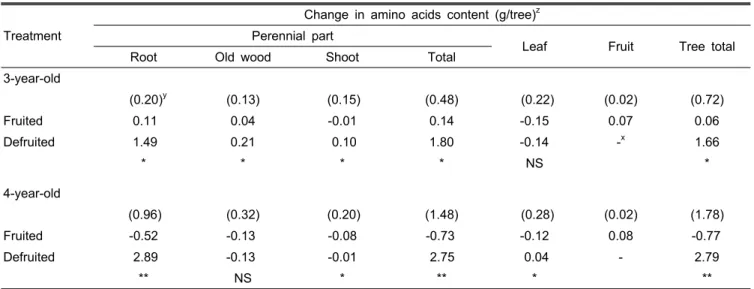
Table 1. Effect of defruiting on amino acids changes in different parts of a tree between June 15 and November 1.
Treatment
Change in amino acids content (g/tree)z Perennial part
Leaf Fruit Tree total
Root Old wood Shoot Total
3-year-old
(0.20)y (0.13) (0.15) (0.48) (0.22) (0.02) (0.72)
Fruited 0.11 0.04 -0.01 0.14 -0.15 0.07 0.06
Defruited 1.49 0.21 0.10 1.80 -0.14 -x 1.66
* * * * NS *
4-year-old
(0.96) (0.32) (0.20) (1.48) (0.28) (0.02) (1.78)
Fruited -0.52 -0.13 -0.08 -0.73 -0.12 0.08 -0.77
Defruited 2.89 -0.13 -0.01 2.75 0.04 - 2.79
** NS * ** * **
zThe difference in amino acids between November 1 at harvest and June 15 at the time of defruiting.
yAmino acids measured on June 15.
xNon-applicable.
NS,*,**Nonsignificant or significant at P < 0.05 or 0.01 by t-test, respectively.
(Choi et al., 2002, 2010a). 감나무는 해거리현상이 심한 과 수이기 때문에 착과 정도가 부위별 물질분배와 저장양분 축 적에 미치는 영향이 뚜렷할 것으로 생각되지만 이 관계를 구체적으로 밝힌 연구 결과는 많지 않다. 특히 영양의 저장 기관으로서 가장 중요한 역할을 하는 부위로 알려져 있는 뿌리의 물질축적이 배제된 상태에서 얻어진 연구 결과는 그 자체가 한계를 지닐 수밖에 없다.
따라서 본 연구는 정상적인 수준으로 착과시킨 감나무와 과실을 완전히 제거한 감나무의 유목에 있어서 뿌리를 포함 한 수체 부위별 질소화합물 분배와 축적의 변화를 밝히고, 다음해 축적된 질소화합물의 재이용과 새로운 생장부위의 분포를 조사하였다.
재료 및 방법
본 연구는 공대에 접목한 단감 ‘부유’(Diospyros kaki)를 사용하였다. 노지에서 1년간 재배한 나무를 30L 화분에 옮 겨 심어 경상대학교 부속농장의 비가림 하우스에서 재배하 였다. 2006년에는 3년생, 2007년에는 4년생 21주를 각각 이 용하였다. 전년도 처리가 새로운 생장부위의 질소화합물에 미치는 영향을 조사하기 위해 시험수들은 2007년과 2008년 6월 10일까지 각각 굴취하여 조사에 이용하였다. 시험기간 동안에는 전정을 실시하지 않았으나, 나무의 시비, 관수 그 리고 병해충 관리는 표준관리에 준하였다(Choi et al., 2010b;
Kim et al., 2009). 2006년과 2007년 6월 15일에 엽과비가 20:1이 되도록 착과를 조절한 나무(fruited, 이하 착과수)와
모든 과실을 제거한 나무(defruited, 이하 제과수)의 두 처리 구를 두었다 . 시험구는 처리당 3반복, 반복당 1주로 하여 완 전임의법으로 배치하였다. 과실 제거를 시작하는 6월 15일에 3주를 굴취하여 나무의 생장을 조사하였고, 이들 나무는 두 처리구의 당년 질소화합물 변화를 측정하는 기준으로 사용하 였다. 수확기인 11월 1일, 이듬해 발아기인 4월 10일과 신초 생장이 끝난 6월 10일에 두 처리구로부터 각각 3주를 굴취하 여 나무의 생장을 조사하였다. 굴취한 나무를 잎, 신초, 과실, 2년생 이상의 가지(old wood, 주간 포함), 뿌리로 나누어 각 부위별 질소화합물의 변화를 조사하였다 .
건조한 시료는 Wiley mill(Thomas, USA)을 이용하여 20 mesh를 통과하도록 분쇄하여 분석시료로 사용하였다. Yoon (1996)이 보고한 방법으로 아미노산과 단백질을 측정하였 다. 표준 아미노산으로 L-leucine을 그리고 표준 단백질로는 bovine albumin을 사용하였다.
당년과 이듬해 수체 각 부위별 질소화합물의 변화는 5%
와 1% 수준에서 t-test로 통계분석을 하였다.
결과 및 고찰
과실 제거가 당년 질소화합물의 분배에 미치는 영향
6월 15일부터 11월 1일까지 주당 총 아미노산은 착과수의
3년생에서 증가하였으나 4년생에서 감소하여 수령에 따른 변
화의 일관성이 없었다. 이 기간 동안 과실을 제거한 제과수의
3년생은 주당 1.66g, 4년생은 주당 2.79g의 총 아미노산이 증
가하였다(Table 1). 제과수의 4년생에서는 증가한 아미노산
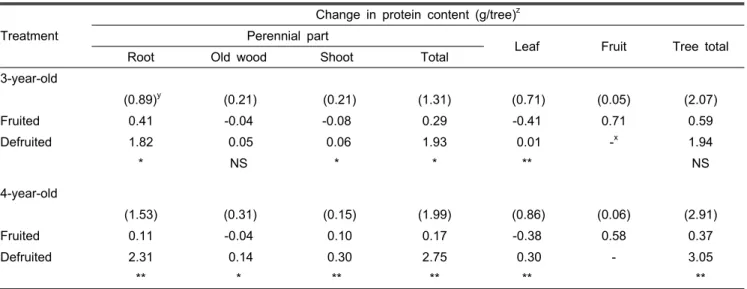
Table 2. Effect of defruiting on protein changes in different parts of a tree between June 15 and November 1.
Treatment
Change in protein content (g/tree)z Perennial part
Leaf Fruit Tree total
Root Old wood Shoot Total
3-year-old
(0.89)y (0.21) (0.21) (1.31) (0.71) (0.05) (2.07)
Fruited 0.41 -0.04 -0.08 0.29 -0.41 0.71 0.59
Defruited 1.82 0.05 0.06 1.93 0.01 -x 1.94
* NS * * ** NS
4-year-old
(1.53) (0.31) (0.15) (1.99) (0.86) (0.06) (2.91)
Fruited 0.11 -0.04 0.10 0.17 -0.38 0.58 0.37
Defruited 2.31 0.14 0.30 2.75 0.30 - 3.05
** * ** ** ** **
zThe difference in protein between November 1 at harvest and June 15 at the time of defruiting.
yProtein measured on June 15.
xNon-applicable.
NS,*,**Nonsignificant or significant at P < 0.05 or 0.01 by t-test, respectively.
의 98.5%가 영구기관에 분배되었다. 특히 영구기관의 뿌리에 서 아미노산이 크게 증가하였다. 착과수와 제과수의 영구기 관에 축적된 주당 아미노산 함량의 차이는 3년생은 1.66g, 4년생은 3.48g이었다. 당년 착과수의 잎에서 0.12-0.15g의 아미노산이 감소하나, 과실은 0.07-0.08g이 증가하였다.
6월 15일부터 11월 1일까지 단백질 증가량과 분포 비율은 착과수와 제과수 사이에 현저한 차이가 있었다(Table 2). 당 년에 증가한 단백질은 착과수 보다는 제과수에서 3년생은 3 배, 4년생은 8배 이상 많았다. 착과수는 당년에 증가한 주당 총 단백질이 3년생은 0.59g, 4년생은 0.37g이었다. 당년 착 과수의 영구기관에서는 2년생 이상의 가지와 신초에서 단백 질 축적이 감소하였으나 뿌리에서 3년생은 0.41g, 4년생은 0.11g의 단백질이 증가하였다. 그러나 제과수에서는 증가한 주당 총 단백질이 3년생은 1.94g, 4년생은 3.05g이었고, 이 들 영구기관으로 90% 이상이 분배되었다. 특히 뿌리로 분배 된 비율이 3년생은 94%, 4년생은 76%에 달하여 뿌리로의 단백질 축적이 현저한 것을 알 수 있었다. 착과수와 제과수 의 영구기관에 축적된 주당 단백질 함량의 차이는 3년생은 1.64g, 4년생은 2.58g이었다. 착과수의 잎에서 단백질이 3년 생은 0.41g, 4년생은 0.38g 감소하였으나, 제과수에서는 다 소 증가하였다. 착과수에서 과실의 당년 단백질 증가량은 3 년생은 0.71g, 4년생은 0.58g이었다. 가을 노화기간 동안 잎 에서 공급되는 질소화합물은 과실과 수체로 동시에 공급되 어야 하는 경쟁관계에 있으므로, 과실이라는 강력한 수용부 위가 있는 착과수는 수체 영구기관에 축적된 질소화합물의 양이 그만큼 줄어드는 것으로 생각한다(Choi et al., 2010a).
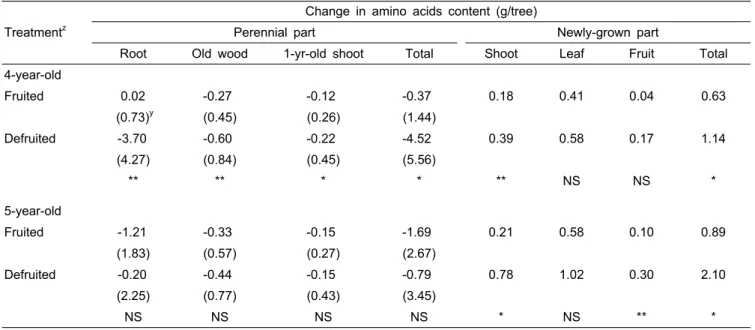
과실 제거가 다음해 질소화합물의 분배에 미치는 영향 이듬해 4월 10일부터 6월 10일까지 수체 각 부위별 아미 노산 함량의 변화를 조사하였다(Table 3). 신초생장기 동안 아미노산은 전년도 착과수와 제과수의 영구기관 모두에서 감소하였다. 새로운 생장부위의 주당 총 아미노산은 전년도 착과수와 제과수의 3년생에서는 각각 0.63g과 1.14g, 4년생 에서는 0.89g과 2.10g으로, 착과수보다 전년도 제과수의 3 년생은 1.8배, 4년생은 2.3배 많았다. 새로운 부위의 총 아미 노산은 잎이 전년도 착과수의 3년생과 4년생 모두 65%를 차지하였고, 제과수도 49-51%로 차지하는 비율이 가장 높 았다. 착과수와 제과수에서 신초는 24-29%와 34-37%, 과실 은 6-11%와 14-15%를 각각 차지하였다. 새로운 부위의 생 장기간 동안 영구기관의 아미노산이 감소하였는데, 이는 아 미노산이 새로운 생장기관으로 재이동되었기 때문으로 생 각한다(Park, 2002).
이 기간동안 단백질은 전년도 제과수의 뿌리에서 감소하
였고, 착과수에서는 변화의 일관성이 없었다(Table 4). 6월
10일 제과수의 뿌리 단백질은 4월 10일에 비하여 3년생은
13%, 4년생은 18% 감소하였다. 새로운 생장 부위의 단백질
은 전년도 제과수에서 높은 것으로 나타났다. 새로운 생장
부위의 주당 총 단백질은 전년도 착과수와 제과수의 3년생
에서 각각 1.42g과 1.76g, 4년생에서는 1.62g과 2.32g이었
다. 이중 잎이 65-81%로 차지하는 비중이 가장 컸고, 신초
와 과실의 순이었다. 제과수의 뿌리에 저장된 단백질은 다
음해의 새로운 생장에 사용되는데(Kang et al., 1982; Park,
2002; Taylor and May, 1967), 이는 뿌리의 단백질 감소와
Table 3. Effect of defruiting the previous year on amino acids changes in different parts of a tree between April 10 and June 10 of the following year.
Treatmentz
Change in amino acids content (g/tree)
Perennial part Newly-grown part
Root Old wood 1-yr-old shoot Total Shoot Leaf Fruit Total 4-year-old
Fruited 0.02 -0.27 -0.12 -0.37 0.18 0.41 0.04 0.63
(0.73)y (0.45) (0.26) (1.44)
Defruited -3.70 -0.60 -0.22 -4.52 0.39 0.58 0.17 1.14
(4.27) (0.84) (0.45) (5.56)
** ** * * ** NS NS *
5-year-old
Fruited -1.21 -0.33 -0.15 -1.69 0.21 0.58 0.10 0.89
(1.83) (0.57) (0.27) (2.67)
Defruited -0.20 -0.44 -0.15 -0.79 0.78 1.02 0.30 2.10
(2.25) (0.77) (0.43) (3.45)
NS NS NS NS * NS ** *
zTrees were either normally-fruited or defruited in the previous year.
yAmino acids measured on April 10.
NS,*,**Nonsignificant or significant at P < 0.05 or 0.01 by t-test, respectively.
Table 4. Effect of defruiting the previous year on protein changes in different parts of a tree between April 10 and June 10 of the following year.
Treatmentz
Change in protein content (g/tree)
Perennial part Newly-grown part
Root Old wood 1-yr-old shoot Total Shoot Leaf Fruit Total 4-year-old
Fruited 0.92 0.05 0.00 0.97 0.21 1.15 0.06 1.42
(1.00)y (0.18) (0.19) (1.37)
Defruited -0.51 0.04 -0.04 -0.51 0.27 1.31 0.18 1.76
(3.98) (0.27) (0.35) (4.60)
* NS NS * * NS * *
5-year-old
Fruited -0.46 0.05 -0.03 -0.44 0.22 1.26 0.14 1.62
(1.77) (0.30) (0.21) (2.28)
Defruited -0.99 0.12 0.03 -0.84 0.46 1.51 0.35 2.32
(5.64) (0.30) (0.32) (6.26)
* NS * NS * NS * *
zTrees were either normally-fruited or defruited in the previous year.
yProtein measured on April 10.
NS,*,**Nonsignificant or significant at P < 0.05 or 0.01 by t-test, respectively.
새로운 생장부위의 높은 단백질로 반영되었다. 초기생장은 영양기관이나 과실 모두 세포분열과 단백질합성에서 시작 되므로 저장양분 중에서 질소화합물의 중요성은 널리 인식 되어 왔다(Titus and Kang, 1982).
본 연구에서는 착과 유무라는 극단적인 경우만을 전제로 질소화합물의 분배와 함께 양적인 차이가 어느 정도인지를
조사하였다. 화분에 재식된 유목을 공시한 실험이므로 근권
이 제한되지 않는 포장에서나 성목의 경우에도 이러한 결과
가 재현될 수 있을지는 과제로 남아 있다. 그러나 착과에 의
해 분배비율이 가장 큰 영향을 받는 것으로 나타난 뿌리까
지 포함하여 나무 전체의 변화를 추적한 것은 매우 의미있
는 일로 생각한다. 제과수는 착과수보다 뿌리를 주축으로
하는 영구기관에 더 많은 질소화합물을 축적함으로써 다음 해의 생장과 결실에 기여할 수 있는 여지를 마련하는 것으 로 여겨진다. 본 연구에서 얻어진 결과들은 착과 정도가 다 양한 조건에서 질소화합물의 분배 과정을 밝히고자 하는 연 구의 기초자료로 이용될 수 있을 것이다.
초 록
본 연구는 3-4년생인 ‘부유’ 감나무를 이용하여 정상적인 착과수와 결실 후 어린 과실을 따버린 제과수의 수체 부위별 질소화합물 분배 비율의 변화를 조사함으로써 저장양분의 축적 그리고 다음해 새로운 생장에 이들 저장양분의 재이용 관계를 구명하였다. 6월 15일부터 11월 1일까지 아미노산은 착과수의 영구기관에서 변화의 일관성이 없는 반면 제과수 에서는 아미노산이 현저히 증가하였다. 착과수와 비교하면, 제과수의 영구기관에 축적된 주당 아미노산 함량이 3년생은 1.66g, 4년생은 3.48g 많았다. 이 기간 동안 착과수에서는 증 가한 총 단백질의 50% 이하가 영구기관으로 분배되었으나 제 과수에서는 그 비율이 90% 이상이었고, 특히 뿌리로 분배된 비율이 3년생은 94%, 4년생은 76%에 달하여 뿌리의 단백질 축적이 현저한 것을 알 수 있었다. 착과수의 영구기관에 축적 된 주당 단백질 함량과 비교하면 제과수의 3년생은 1.64g, 4 년생은 2.58g이 많았다. 이 기간 동안 질소화합물이 착과수 의 잎에서 0.50-0.56g이 감소하였고, 과실에서 0.66-0.78g 이 증가하였다. 이듬해 신초생장기 동안 아미노산은 전년도 착과수와 제과수의 영구기관에서 모두 감소하였다. 단백질 은 전년도 제과수의 뿌리에서 특히 감소하였다. 새로운 생 장 부위의 아미노산과 단백질은 전년도 제과수에서 높은 것 으로 나타났다. 제과수는 착과수보다 뿌리를 주축으로 하는 영구기관에 더 많은 질소화합물을 축적함으로써 다음해의 생장과 결실에 기여할 수 있을 것으로 생각한다.
추가 주요어 : 아미노산, Diospyros kaki, 착과, 단백질
인용문헌
Cheng, L. and L.H. Fuchigami. 2002. Growth of young apple trees in relation to reserve nitrogen and carbohydrates. Tree Physiol. 22:1297-1303.
Choi, S.T., D.S. Park, S.M. Kang, and Y.C. Cho. 2010a. Effect of fruit-load on the growth, absorption, and partitioning of inorganic nutrients in young ‘Fuyu’ persimmon trees. Sci.
Hort. 126:408-412.
Choi, S.T., S.M. Kang, D.S. Park, W.D. Song, and G.H. Ahn. 2003.
Effect of different severities of summer pruning on fruit charac-
teristics and tree growth in young ‘Fuyu’ and ‘Nishimurawase’
persimmon. J. Kor. Soc. Hort. Sci. 44:569-578.
Choi, S.T., S.M. Kang, D.S. Park, W.D. Song, and K.K. Seo. 2002.
Thinning effect on fruit characteristics and reserve accumulation of persimmon trees defoliated in early autumn. J. Kor. Soc.
Hort. Sci. 43:660-665.
Choi, S.T., W.D. Song, D.S. Park, and S.M. Kang. 2010b. Effect of different girdling dates on tree growth, fruit characteristics and reserve accumulation in a late-maturing persimmon. Sci.
Hort. 126:152-155.
Collins, R.J. and A.P. George. 1997. Managing crop load on non- astringent persimmon (Diospyros kaki L.) grown in the sub- tropics. Acta Hort. 436:251-260.
George, A.P., R.J. Nissen, R.J. Collins, and T.S. Rasmussen. 1995.
Effects of fruit thinning, pollination and paclobutrazol on fruit set and size of persimmon (Diospyros kaki L.) in subtropical Australia. J. Hort. Sci. 70:477-484.
Kang, S.M., K.C. Ko, and J.S. Titus. 1982. Mobilization and metabolism of protein and soluble nitrogen during spring growth of apple trees. J. Amer. Soc. Hort. Sci. 107:209-213.
Kim, J.C. and S.M. Kang. 2006. Fruit-load effect on seasonal changes of nonstructural carbohydrates in shoots of mature persimmon trees during senescence. Hort. Environ. Biotechnol.
47:329-335.
Kim, Y.K., C.S. Lim, S.M. Kang, and J.L. Cho. 2009. Root storage of nitrogen applied in autumn and its remobilization to new growth in spring of persimmon trees (Diospyros kaki cv. Fuyu).
Sci. Hort. 119:193-196.
Park, D.S., S.M. Kang, G.M. Shon, C.W. Ro, and W.K. Shin.
1999. Growth and carbohydrate accumulation of shoots and fruit characteristics of ‘Fuyu’ persimmon as affected by the size of bearing mother branches. J. Kor. Soc. Hort. Sci.
40:455-458.
Park, D.S., S.M. Kang, S.T. Choi, C.A. Lim, and W.D. Song.
2003. Effect of secondary-shoot prunings on fruit growth and following year’s fruit set of ‘Fuyu’ persimmon. J. Kor. Soc.
Hort. Sci. 44:678-682.
Park, D.S., S.T. Choi, K.K. Seo, K.H. Ahn, S.C. Kim, W.D. Song, and S.M. Kang. 2000. Shoot growth and fruit characteristics of ‘Fuyu’ persimmon as affected by the size of bearing mother branches and the time of fruit-load adjustment. J. Kor. Soc.
Hort. Sci. 41:401-405.
Park, D.S., S.T. Choi, S.C. Kim, and S.M. Kang. 2008. Yield, fruit quality, and branch extension of ‘Fuyu’ persimmon as affected by the length of bearing mother branches. Kor. J.
Hort. Sci. Technol. 26:101-105.
Park, S.J. 2002. Effect of different degrees of defoliation on fruit quality, reserve accumulation and early growth of young Fuyu persimmon. Kor. J. Hort. Sci. Technol. 20:110-113.
Taylor, B.K. and L.H. May. 1967. The nitrogen nutrition of the peach tree. II. Storage and mobilization of nitrogen in young trees. Austral. J. Biol. Sci. 20:389-411.
Titus, J.S. and S.M. Kang. 1982. Nitrgen metabolism, translocation, and recycling in apple trees. Hort. Rev. 4:204-246.
Yoon, M.S. 1996. Seasonal changes of nitrogenous compounds and carbohydrates in one-year-old seedlings of persimmon (Diospyros kaki). J. Kor. Soc. Hort. Sci. 37:257-262.