Convergent Factors Related to TOEIC Learning Flow of Some College Students in Health Care
Soomi Hong, Sang-Yun Bae
*Professor, Dept. of Health Administration, Vision University of Jeonju
보건계열 일부 대학생의 토익 학습몰입과 관련된 융복합적 요인
홍수미, 배상윤*
전주비전대학교 보건행정학과 교수
Abstract This study investigates convergent factors to TOEIC learning flow among some health college students in TOEIC class. The questionnaire was performed on 255 health college students in TOEIC class from college located in J area from May 1st, 2018 to May. 25th, 2018 by using an unregistered self-administered questionnaire. The hierarchical multiple regression analysis shows the following results. The TOEIC learning flow of respondents turned out to be significantly higher in following groups: a group in which self efficacy is higher, a group in which academic control is higher, a group in which school resilience is higher. The results show explanatory power of 43.4%. As the results of the study, it is necessary to make an effort to increase self efficacy, academic control and school resilience to improve the TOEIC learning flow among health college students. These results can be used in development and operation of TOEIC learning program to higher TOEIC learning flow in health college students.
Further studies need the analysis of structural equation model effecting TOEIC learning flow of health college students.
Key Words : Convergent factor, Health college students, TOEIC learning flow, Self efficacy, Academic control, School resilience
요 약 본 연구는 보건계열 일부 대학생의 토익 학습몰입과 관련된 융복합적 요인들을 조사하였다. 설문조사는 2018년 5월 1일부터 2018년 5월 25일까지 J지역에 소재한 대학의 보건계열 토익학습반에서 임의로 선정된 대학생 255명에 대하여 무기명 자기기입식 설문지를 사용하였다. 위계적 다중회귀분석 결과, 자기효능감이 높을수록, 학업통제감이 높을수록, 학교 적응유연성이 높을수록 토익 학습몰입이 높았으며 이들의 설명력은 43.4%이었다. 연구결과를 볼 때, 보건계열 대학생의 토익 학습몰입을 높이기 위해서는 자기효능감, 학업통제감 및 학교적응유연성을 높이는 노력이 필요하다. 이러한 결과는 보건계열 대학생의 토익 학습몰입을 높이는 토익학습 프로그램 개발 및 운영에 활용될 수 있다. 추후연구에서는 보건계열 대학생의 토익 학습몰입에 영향을 미치는 구조방정식 모형의 분석이 필요하다.
주제어 : 융복합적 요인, 보건계열 대학생, 토익 학습몰입, 자기효능감, 학업통제감, 학교적응유연성
*Corresponding Author : Sang-Yun Bae([email protected]) Received August 30, 2018
Accepted November 20, 2018
Revised October 12, 2018 Published November 28, 2018
1. Introduction
The medical service environment in Korea went through continuous quantitative and qualitative growth accepting external demands arising from low population and aging of the population, structural change of the industry, low economic growth, imbalance of urban and rural medical resources, diversification and expansion of social security and lack of public medical service[1,2]. In addition, the high qualitative improvement of medical service is being aimed responding to the internal demand such as the continuous development of medical technology, the spread of precision medical equipment, the dualization of manpower structure and the specialized job in hospital, the development and growth of license, qualification and certification system, the promotion of health and the focus on prevention and the increase in necessity of efficient operation of medical delivery system[1,3]. An increase in demand for various medical services and demand for high quality job of the medical staff and the management personnel of a hospital is increasing the need for hospital management innovation[2,4].
In addition to the development of medical systems in accordance with the internal and external changes of medical services and the necessity of hospital management innovation, the stability of the national health care system, the development of medical services and hospital administration support, the high quality of private medical services, high job level of manpower, etc. improve the medical competitiveness of Korea and speed up the quantitative expansion of internationalized medical services[5,6]. As a result, there is a growing need of hospitals for staff to perform internationalized medical services in medical, medical support and administrative fields, etc.[5,7].
In this situation, public health college students have both fear and expectation of international hospital work[6]. Public health college students can not avoid the need to strengthen their ability to speak foreign languages as well as curriculum and subjects of major field[7]. In contrast to other industries, hospitals have
labor-intensive characteristics, in which most of jobs are carried out directly by personnel and foreign language proficiency of hospital staff is recognized as an important axis of international medical services[6,7].
The performance of hospital duties for foreign patients and families who are totally dependent on a translator can increase the risk of medical malpractice which can be caused by a lack of understanding of medical knowledge and the hospital system [5]. As the social demands for strengthening the foreign language capacity of public health college students according to the expansion and growth of global medical services are increasing day by day, there is a growing interest in the regular and special curriculums and subjects of the related departments of colleges accepting the same[5-7].
In order to strengthen the global medical service practice and foreign language skills of public health college students, the TOEIC graduation certification system and the credit approval system are being implemented in the regular education course and TOEIC academy, camp, special class, etc. are operated separately in the special education course[5]. TOEIC is a non-native English assessment test developed in the United States in 1979 and introduced to Korea in 1982.
TOEIC score is variously used in employment, evaluation of job performance, entrance examination, degree granting, etc. around government, public institutions, private companies, universities and graduates schools[5].
Public health college students can improve their ability to speak English through TOEIC learning and develop their ability to communicate in English so that they can perform global medical service jobs in hospital after graduation[7]. It is necessary to provide the learning flow and learning support to maximize the efficient TOEIC learning curriculum effect for enhancing the English communication ability corresponding to the job of internationalized medical service. The flow is to indicate the state of maximum participation and commitment in one’s activity to
perform the best function. The learning flow is recognized to show the “harmony of challenge and ability” in which both the levels of challenge of study subject and one’s learning ability are high, the
“integration of behavior and consciousness” which is a natural connection between the learning activity and one’s recognition, the “accurate goal” which is the accurate determination of one’s learning activity, the
“specified feedback” which is the accurate evaluation and use of feedback of the activity process, the “focus on subjects” which is high concentration on the activity, the “sense of control” which is the confidence from spontaneous control of activity performing process, the “loss of self-consciousness” which is the sense of integration of the activity and oneself, the
“distortion of time sense” which is the indifference to time flow by the flow in activity performance, the
“autotelic experience” focusing on the compensation from the activity performing process[8]. The learning flow is considered to be increase by making a student deeply participate in one’s learning activity at one’s will and experience the state of controlling by oneself and by growing the resilience into the environment to which one belongs to such as study, grade, school rules, overall school life, etc. In other word, the learning flow is considered to be improved by learning support increasing the self-efficacy, improving the academic control and increasing the school resilience.
The existing researches reported the English communication skill[9,10], English learning strategy [11], TOEIC accomplishment[12-14] and learning flow[15] showing the relevance to the self-efficacy which is the belief of acting properly to the situation.
It was pointed that the academic control which is the ability of controlling study by oneself and proceeding voluntarily increases the school resilience[16] and shows the positive relevance to the learning flow[5,6].
In addition, it is supposed that the school resilience indicating the flexibility of adaptation to overall school life affects the learning flow[5,6]. Likewise, the researches on some factors related to the learning flow
were reported but it is hard to find the analysis of the relevant importance and influence of these factors affecting TOEIC learning flow of public health college students. Therefore, the present research studies on not only the general characteristics of public health college students, but also TOEIC learning flow depending on the self-efficacy, academic control and school resilience and analyzes the complex relevance between theses factors and TOEIC learning flow and effect to provide base data of the education and learning support which can be used in the development and operation of TOEIC learning program increasing TOEIC learning flow of public health college students.
2. Research Method
2.1 Subject of Survey
The sample size proper to the analysis was calculated by using G*Power 3.1 program[17]. When analyzing the power of t-test, ANOVA and multiple regression analysis with a significance level of .05, a power of .95 and an effect size of .15, an F critical value was 1.57 and a minimum sample size of 238. Therefore, the number of subject of the survey was 300 considering poor response. The survey was performed on 300 college students in TOEIC class of the public health college randomly extracted from college randomly selected in district J, 272 questionnaires were collected (90.1%) and the data of 255 students excluding 17 poor responses were finally analyzed. The survey was performed from May 1 to 25, 2018 and in order to secure the accuracy and research ethics, a researcher visited the site, explained the purpose and contents of the survey, the way to complete the questionnaire, the data protection method and right to refuse, etc. and handed out an unregistered self-administered questionnaire only when the subject agrees with participating in the survey, made the subject complete the questionnaire and collected it immediately.
2.2 Survey Tool
The survey consisted of 21 items of the general characteristics, 18 items of the self-efficacy, 7 items of the academic control, 22 items of the school resilience and 29 items of TOEIC learning flow.
For the general characteristics, the sex, age (years), religion (yes, no), home economics (tough, good), conversation with parent (often, rarely), parenting attitude (permissive, strict), family atmosphere (good, bad), family life satisfaction (satisfying, dissatisfying), major (nursing department and four others), school record (high, mid, low), relation with professors (good, bad), peer relation (good, bad), school violence experience (yes, no), school life satisfaction (good, bad), drinking status, smoking status, regular exercise, regular meal (yes, no), average daily sleep time (less than 7 hours, 7 hours or more), hobby and leisure activities (sufficient, insufficient), subjective health status (good, bad), etc.
For the self-efficacy, 18 items which was reorganized by Yang Sook Mi[19] from Tipton and Worthington’s measurement tool[18] and of which the validity was verified were used. The score ranged from 18 to 126, with a higher score indicating higher self-efficacy. The Cronbach’s α value, which indicates the internal reliability of this survey was .887. For the academic control, 7 items which were modified and supplemented by Lee Young Bok et al.[21] from the measurement tool of Karasek et al.[20] were used. The score ranged from 7 to 35, with a higher score indicating a higher degree of academic control. The Cronbach’s α value, which indicates the internal reliability of this survey was .872.
For the school resilience, 22 items which were modified and supplemented by Park Hyun Sun[23] from the measurement tool of Masten et al.[22] were used.
The subscales of this scale consisted of 7 items of interest in school life, 5 items of attitude toward school and grade and 10 items of compliance with school rules.
The score ranged from 22 to 88, with a higher score indicating a high degree of school resilience. The
Cronbach’s α value, which indicates the internal reliability of this survey was .815.
For the learning flow, 29 items which were validated by Kim Ah Young et al.[24] from the measurement tool of Csikszentmihalyi were used. the score ranged from 29 to 145, with a higher score indicating a higher degree of learning flow. The Cronbach’s α value, which indicates the internal reliability of this survey was .951.
2.3 Data Processing
For the statistical analysis, SPSS (ver 23.0) was used. Comparisons of TOEIC learning flow depending on the general characteristics, self-efficacy, academic control and school resilience were tested by t-test and ANOVA. At this time, considering the distribution of the value of control variable, the age was changed to the category type by dividing based on 20 years old.
The self-efficacy, academic control and school resilience without an official cut-off point were divided into 「lower group」 and 「higher group」 based on the median to compare TOEIC learning flow in a t-test.
In order to figure out the influence of each independent variable affecting TOEIC learning flow, a hierarchical multiple regression analysis was performed by using the variables showing significant differences in the univariate analysis as independent variables and TOEIC learning flow as a dependent variable. At this time, categorical variables that were significant for TOEIC learning flow were converted into dummy variables and used and the variables which have been converted into the dummy variables were school grade, school life satisfaction, regular exercise, hobby and leisure activity and subjective health status. The significance level of all statistics was p<.05.
3. Result of Survey
3.1 TOEIC Learning Flow by General Characteristics
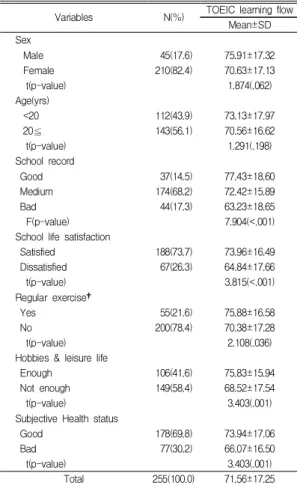
In Table 1, TOEIC learning flow score of 255
subjects was 71.56±17.25. TOEIC learning flow depending on the general characteristics was significantly higher in the groups with good school grades, high school life satisfaction, regular exercise, sufficient hobbies and leisure activities and good subjective health status. For the other general characteristics, the sex, age, religion, home economics, conversation with parent, parenting attitude, family atmosphere, family life satisfaction, major, relation with professor, peer relation, school violence experience, drinking, smoking, meal and sleep did not show a significant difference in TOEIC learning flow.
Variables N(%) TOEIC learning flow
Mean±SD Sex
Male 45(17.6) 75.91±17.32
Female 210(82.4) 70.63±17.13
t(p-value) 1.874(.062)
Age(yrs)
<20 112(43.9) 73.13±17.97
20≦ 143(56.1) 70.56±16.62
t(p-value) 1.291(.198)
School record
Good 37(14.5) 77.43±18.60
Medium 174(68.2) 72.42±15.89
Bad 44(17.3) 63.23±18.65
F(p-value) 7.904(<.001)
School life satisfaction
Satisfied 188(73.7) 73.96±16.49
Dissatisfied 67(26.3) 64.84±17.66
t(p-value) 3.815(<.001)
Regular exercise†
Yes 55(21.6) 75.88±16.58
No 200(78.4) 70.38±17.28
t(p-value) 2.108(.036)
Hobbies & leisure life
Enough 106(41.6) 75.83±15.94
Not enough 149(58.4) 68.52±17.54
t(p-value) 3.403(.001)
Subjective Health status
Good 178(69.8) 73.94±17.06
Bad 77(30.2) 66.07±16.50
t(p-value) 3.403(.001)
Total 255(100.0) 71.56±17.25
†: At least three times a week, more than 30 minutes at a time.
Table 1. TOEIC learning flow according to general characteristics
3.2 TOEIC Learning Flow by Self-Efficacy, Academic Control and School Resilience
In Table 2, TOEIC learning flow depending on the self-efficacy, academic control and school resilience was compared. TOEIC learning flow was significantly higher in the groups with higher self-efficacy, academic control and school resilience.
Variables(Total score) N(%) TOEIC learning flow Mean±SD Self efficacy
Low group§ 124(48.6) 64.37±16.56
High group 131(51.4) 78.37±15.03
t(p-value) -7.075(<.001)
Academic control
Low group 124(48.6) 64.37±16.56
High group 131(51.4) 78.37±15.03
t(p-value) -7.075(<.001)
Total School resilience
Low group 127(49.8) 66.04±16.30
High group 128(50.2) 77.04±16.45
t(p-value) -5.364(<.001)
Interest in school life
Low group 140(54.9) 65.04±16.83
High group 115(45.1) 79.50±14.19
t(p-value) -7.447(<.001)
Attitudes to study and grades
Low group 137(53.7) 65.45±15.86
High group 118(46.3) 78.66±16.09
t(p-value) -6.591(<.001)
Compliance with school regulations
Low group 138(54.1) 69.36±16.55
High group 117(45.9) 74.16±17.75
t(p-value) -2.235(.026)
Total 255(100.0) 71.56±17.25
§ : Low and high group classified by the median score of each variable.
Table 2. TOEIC learning flow according to self efficacy, academic control and School resilience
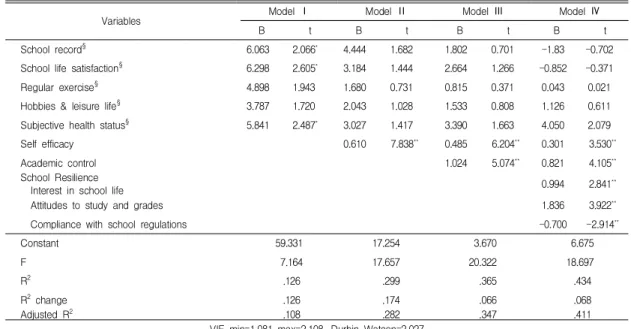
3.3 Factors Affecting TOEIC Learning Flow In Table 3, a hierarchical multiple regression analysis of four models were performed to figure out the explanatory power of the independent variables affecting TOEIC learning flow. As the result of inputting the general characteristics into the regression model, model I showed that the higher the school record, the better the school life satisfaction, the better the subjective health status, the higher the TOEIC learning flow and the explanatory power was 12.6. As the result of inputting the self-efficacy to the variable input to model I, model II showed that the higher the
self-efficacy, the higher TOEIC learning flow and the explanatory power was 29.9%. As the result of inputting the academic control to the variable input to model II, model III showed that the higher the self-efficacy and academic control, the higher TOEIC learning flow and the TOEIC learning flow could be explained with the input variables by 36.5%. As the result of inputting the school resilience to the variable input to model III, model IV showed that the higher the self-efficacy, academic control and school resilience, the higher TOEIC learning flow and the TOEIC learning flow could be explained with the variables inputted to model IV by 43.4%. In the above model, the explanatory power was increased by 17.4% by adding the self-efficacy, 6.8% by adding the school resilience and 6.6% by adding the academic control, so that the TOEIC learning flow is more influenced by the self-efficacy, school resilience and academic control in order. As the result of reviewing the regression model, DW (Durbin-Watson) index was 2.027, indicating that there was no autocorrelation and VIF (Variance Inflation Factor) is from at least 1.081 to at most 2.108, indicating that there was no multicollinearity.
4. Discussion
The TOEIC learning flow score of public health college students ranged 29 to 145 and the average score was 71.56±17.25 which was lower than the TOEIC learning flow score of 72.55±19.23 in the existing research dealing with the similar sample[6]. It is urgent to provide effective education and learning support for enhancing English proficiency of public health college students in order to meet the demands of the international medical service in these days.
In general characteristics, the sex, age, religion, home economics, conversation with parent, parenting attitude, family atmosphere, family life satisfaction, major, relation with professor, peer relation, school violence experience, drinking, smoking, meal and sleep did not show a significant difference in TOEIC learning flow but the school grades, school life satisfaction, regular exercise, hobbies and leisure activities and subjective health status showed a significant difference in TOEIC learning flow. The school grades, school life satisfaction, hobbies and leisure activities and subjective health status factors having significant
Variables Model Ⅰ Model Ⅱ Model Ⅲ Model Ⅳ
B t B t B t B t
School record§ 6.063 2.066* 4.444 1.682 1.802 0.701 -1.83 -0.702
School life satisfaction§ 6.298 2.605* 3.184 1.444 2.664 1.266 -0.852 -0.371
Regular exercise§ 4.898 1.943 1.680 0.731 0.815 0.371 0.043 0.021
Hobbies & leisure life§ 3.787 1.720 2.043 1.028 1.533 0.808 1.126 0.611
Subjective health status§ 5.841 2.487* 3.027 1.417 3.390 1.663 4.050 2.079
Self efficacy 0.610 7.838** 0.485 6.204** 0.301 3.530**
Academic control 1.024 5.074** 0.821 4.105**
School Resilience
Interest in school life 0.994 2.841**
Attitudes to study and grades 1.836 3.922**
Compliance with school regulations -0.700 -2.914**
Constant 59.331 17.254 3.670 6.675
F 7.164 17.657 20.322 18.697
R2 .126 .299 .365 .434
R2change .126 .174 .066 .068
Adjusted R2 .108 .282 .347 .411
VIF min=1.081 max=2.108, Durbin Watson=2.027
§ : Dummy Variable, * : p<.05, ** : p<.01.
Table 3. Hierarchial multiple regression of selected variables on TOEIC learning flow
relation with TOEIC academic burnout[5] also showed significant relation with TOEIC learning flow but the sex, conversation with parent, parenting attitude, relation with professor, peer relation, regular exercise, sleep, etc. did not show significant relevance. TOEIC learning flow had less factors of general characteristics having significant relevance and thus it was determined that there are relatively less control variables explaining the learning flow. In order to improve the English communication skill of public health college students by the deep TOEIC learning flow, it seemed to be necessary to manage the major grade well, increase the school life satisfaction, encourage to do regular exercise, guide to take time for hobbies and leisure activities and make an effort to develop and mediate learning support programs for consulting and managing health care, etc.
The result that the higher self-efficacy, the higher TOEIC learning flow was similar to the result of the existing research that the higher the self-efficacy, the higher the interest of middle school students in English[15], TOEIC accomplishment, English accomplishment[9,11] and English communication skill[10] of university students[12-14] and thus it was determined that the belief that activities proper to the circumstance can be done increases the TOEIC learning flow by improving the ability to do positive behaviors. For the correlation between te academic control and self-regulated learning of university students[16], the significant relevance between TOEIC learning flow and academic control of public health college students was also found. It was determined that the TOEIC learning flow can be increased by increasing the confidence in learning, spontaneity and self-regulating. As the result, it is necessary to develop and operate an education program increasing self-directing and self-regulating ability of TOEIC learning and increasing the TOEIC learning flow through regular study and effective management of curriculums. The relation between the school resilience and learning flow of public health college students[6]
was similar in this research and thus it was determined that the TOEIC accomplishment can be increased through the learning flow for best learning by actively participating and being immersed in TOEIC education programs. It was considered that the effort to develop and mediate the learning support is needed for one’s will, deep participation and experience of self-regulated state of public health college students to improve the school resilience to the environment to which one belongs such as learning, grades, school rules and overall school life to increase the TOEIC learning flow.
As the result of performing the hierarchical multiple regression analysis on four models to figure out the explanatory power of independent variables affecting the TOEIC learning flow of public health college students, in the general characteristics of model I, the better the school grade, the higher the school life satisfaction, the better the subjective health status, the higher the TOEIC learning flow, in the self-efficacy of model II, the higher the self-efficacy, the higher the TOEIC learning flow, in the academic control of model III, the higher the academic control, the higher TOEIC learning flow, in the school resilience of model IV, the higher the school resilience, the higher the TOEIC learning flow and the explanatory power of all the variables was 43.4%.
In particular, the explanatory power was increased in the above model by 17.4% by adding the self-efficacy, 6.8% by adding the school resilience and 6.6% by adding the academic control, so that the relation between the self-efficacy and TOEIC learning flow was somewhat higher. It is suggested that the TOEIC learning flow of public health college students has higher relation with the self-efficacy, school resilience and academic control in order. The report on individual factors in the existing research showing that the higher the self-efficacy[12-14], the academic control[16], and the school resilience[6], the higher the English accomplishment and TOEIC learning flow was similar to the present research. This result suggests that the self-efficacy, academic control and school
resilience need to be managed first to increase the TOEIC learning flow of public health college students, the subject of this research. It was found that the self-efficacy, academic control and school resilience affecting the TOEIC learning flow of public health college students could be the mediation factor of TOEIC learning flow. This result suggests that it is necessary to develop and distribute the learning support program considering one’s ability to handle situation positive, enhancing self-directing and self-regulation ability and supporting one’s will, deep participation and experience of self-regulated state.
Since this research is a cross-section study on small-size sample targeting some public health college students, it is limited to stretch and apply the result to the entire public health college students. For follow-up studies, it is necessary to suggest a structural model to figure out the additional factors affecting TOEIC learning flow of public health college students and correlation and relative importance of factors and an analysis using a structural equation. In addition, an additional study is necessary on the relation between the TOEIC learning flow of public health college students and factors like use of multi media[25], self-determining academic motivation[26], virtual reality-based situation concentrating English learning system[27] and self leadership[28] of which the relation with learning flow of university students is being reported in recent studies. In addition, the results of this study need to be sought for ways to expand and apply to not only health school students but also to other majors. This research is meaningful by figuring out the relation between the self-efficacy, school resilience and academic control and the TOEIC learning flow by integrating individual factors related to the TOEIC learning flow of public health college students.
5. Conclusion
In this research, the relation between the self-efficacy, academic control and school resilience
and the TOEIC learning flow of public health college students was reviewed. We analyzed the survey on 255 college students in TOEIC classes of public health colleges extracted from randomly selected in district J from May 1 to 25, 2018.
The TOEIC learning flow of public health college students was significantly high in the groups with high school grades, high school life satisfaction, regular exercise, sufficient hobbies and leisure activities, good subjective health status, high self-efficacy, high academic control and high school resilience. In the hierarchical multiple regression analysis, public health college students showed that the higher the self-efficacy, the higher the academic control and the higher the school resilience, the higher the TOEIC learning flow and the explanatory power of all the variables was 43.4%. Therefore, it is necessary to prepare a plan for making effort to support and mediate the learning resources for the complex factors of the self-efficacy, academic control and school resilience affecting TOEIC learning flow and use it in the development and operation of education programs increasing TOEIC learning flow of public health college students.
REFERENCES
[1] S. H. Kim & S. Y. Bae. (2018). Analysis of convergent factors related to occupational stress among general hospital administrative staff. Journal of Digital Convergence, 16(4), 259-265.
DOI : 10.14400/JDC.2018.16.4.259
[2] S. Y. Bae & S. H. Kim. (2018). Analysis of convergent influence of organizational justice, self esteem and self efficacy on occupational stress among some regional general hospital administrative staff. Journal of Digital Convergence, 16(5), 309-315.
DOI : 10.14400/JDC.2018.16.5.309
[3] S. Y. Bae & S. H. Kim. (2018). Analysis of convergent influence of organizational commitment questionnaire, type A behavior pattern and depression on job burnout among hospital administrative staff. Journal of Digital Convergence, 16(3), 345-351.
DOI : 10.14400/JDC.2018.16.3.345
[4] S. H. Kim & S. Y. Bae. (2018). A study on the convergent factors related to depression among some administrative staff in general hospital. Journal of Digital Convergence, 16(6), 251-258.
DOI : 10.14400/JDC.2018.16.6.251
[5] S. M. Hong, S. H. Kim & S. Y. Bae. (2017). A study on convergence factors related with academic burnout of students in health majors in studying for TOEIC.
Journal of Digital Convergence, 15(6), 315-327.
DOI : 10.14400/JDC.2017.15.6.315
[6] S. M. Hong, S. H. Kim & S. Y. Bae. (2017). An analysis on structure equation model of convergent influence on academic burnout of health major students in studying for TOEIC. Journal of Digital Convergence, 15(7), 329-342.
DOI : 10.14400/JDC.2017.15.7.329
[7] S. M. Hong & S. Y. Bae. (2018). Convergent influence of job seeking stress, self efficacy and academic burnout on TOEIC test anxiety at TOEIC study among health college students. Journal of Digital Convergence, 16(7), 289-298.
DOI : 10.14400/JDC.2018.16.7.289
[8] M. Csikszentmihalyi, Creativity: Flow and the psychology of discovery and invention(1st ed.), NY:
Harper Collins Publishers, 1996.
DOI : 10.1177/001698629704100309
[9] S. I. Han & S. Y. Lee. (2012). Influence of undergraduate students' English proficiency and active class participation on academic self-efficacy, class satisfaction, and academic achievement. The Journal of Yeolin Education, 20(2), 103-125.
UCI : G704-001282.2012.20.2.004
[10] Y. S. Lee. (2017). Analysis on the effects of English mediated instruction at universities: Focusing on students' academic self-efficacy and self-concept of English communication. Journal of Research in Curriculum & Instruction, 21(2), 84-99.
DOI : 10.24231/rici.2017.21.2.84
[11] H. Y. Eun. (2018). A study of learning strategies and self-efficacy of university learners in Korea in English reading course. LAK Journal, 26(1), 199-218.
DOI : 10.24303/lakdoi.2018.26.1.199
[12] H. J. Oh. (2012). The relationship between self-efficacy and TOEIC achievement. English Language Teaching, 24(3), 299-319.
DOI : 10.17936/pkelt.2012.24.3.014
[13] C. K. Park. (2017). Analysis on the difference of
motivation and self-efficacy depending on academic achievement in TOEIC. Journal of The English Language and Literature, 59(3), 319-339.
DOI : 10.18853/jjell.2017.59.3.016
[14] M. Y. Shin. (2013). Aspects of motivation and self-efficacy depending on academic performances in TOEIC. Journal of The English Language and Literature, 55(4), 303-330.
DOI : 10.18853/jjell.2013.55.4.014
[15] K. S. Park & I. S. Oh. (2016). The effect of self-determination motivation and self-efficacy on student engagement: Focusing on the mediating effect of English subjects interest. Journal of Research in Curriculum & Instruction, 20(4), 295-305.
DOI : 10.24231/rici.2016.20.4.295
[16] J. W. You. (2012). The relationship among academic procrastination, self-regulated learning, fear, academic self-efficacy and perceived academic control in e-learning. The Journal of Educational Information and Media, 18(3), 249-271.
UCI : G704-000750.2012.18.3.006
[17] F. Faul, E. Erdfelder, A. Lang & A. Buchner. (2007).
G*Power 3: A flexible statistical power analysis program for the social, behavioral, and biomedical sciences. Behavior Research Methods, 39(2), 175-191.
DOI : 10.3758/BF03193146
[18] R. M. Tipton & E. L. Worthington. (1984). The measurement of generalized self-efficacy: A study of construct validity. J Pers Assess, 48(5), 545-548.
DOI : 10.1207/s15327752jpa4805_14
[19] S. M. Yang. (2000). The development and effectiveness of group program on empowerment for the parents with mentally retarded adults, Doctoral Dissertation. Seoul National University, Seoul.
UCI : G901:A-0004899932
[20] R. Karasek, C. Brisson, N. Kawakami, I. Houtman, P.
Bongers & B. Amick. (1998). The job content questionnaire(JCQ): An instrument for internationally comparative assessments of psychosocial job characteristics.
Journal of Occupational Health Psychology, 3(4), 322-355.
DOI : 10.1037/1076-8998.3.4.322
[21] Y. B. Lee, S. M. Lee & J. Y. Lee. (2009). Development of korean academic burnout scale. The Korea Educational Review, 15(3), 59-78.
UCI : G901:A-0003064058
[22] A. S. Masten & J. D. Coastworth. (1998). The development of competence in favorable and unfavorable
environment: Lessons from research on successful children. American Psychologist, 53, 205-221.
DOI : 10.1037/0003-066X.53.2.205
[23] H. S. Park. (1998). The school resilience of Korean adolescents in poverty, Doctoral dissertation, Seoul National University, Seoul.
UCI : G901:A-0004796457
[24] A. Y. Kim, H. Y. Tack & C. H. Lee. (2010). The development and validation of a learning flow scale for adults. KJEP, 24(1), 33-39.
UCI : G901:A-0002788237
[25] Y. S. Hwang & Y. M. Seo. (2017). A study on the effect of pro-environmental consumers on environmental education utilizing value-attitude-behavior model.
Journal of the Korea Convergence Society, 8(7), 273-282.
DOI : 10.15207/JKCS.2017.8.7.273
[26] J. H. Kim & M. K. Park. (2018). Effects of self-determination motivation to learning flow on in self-regulated learning : Mediating effect of metacognition. Journal of the Korea Convergence Society, 9(2), 349-357.
DOI : 10.15207/JKCS.2018.9.2.349
[27] J. W. Kim, S. J. Park, G. Y. Min & K. M. Lee. (2017).
Virtual reality based situation immersive English dialogue learning system. Journal of Convergence for Information Technology, 7(6), 245-251.
DOI : 10.22156/CS4SMB.2017.7.6.245
[28] H. K. Lee, L. A. Kim, J. E. Kim, Y. R. Lee, J. M. Lee, H. S. Han & H. K. Hwang. (2017). Converged factors affecting learning flow in nursing college students.
Journal of Convergence for Information Technology, 7(5), 15-23.
DOI : 10.22156/CS4SMB.2017.7.5.015
홍 수 미(Hong, Soo Mi) [정회원]
․2003년 5월 : Purdue University (Dept. of Health Science)
․2018년 2월 : 전주대학교 대학원 (영문학박사)
․2012년 3월 ~ 현재 : 전주비전대 학교 보건행정학과 교수
․관심분야 : 영어교육, TOEIC학습
․E-Mail : [email protected]
배 상 윤(Bae, Sang Yun) [정회원]
․2007년 2월 : 충남대학교 보건대 학원(보건학석사)
․2014년 2월 : 충남대학교 대학원 (보건학박사)
․1996년 9월 ~ 현재 : 전주비전대 학교 보건행정학과 교수
․관심분야 : 보건학, 보건교육
․E-Mail : [email protected]