• 검색 결과가 없습니다.

The Effects of Cognitive Stimulation Circulative Program on the Depression and Social Cognitive Ability of Stroke Patients

N/A
N/A
Protected

Academic year: 2021

Share "The Effects of Cognitive Stimulation Circulative Program on the Depression and Social Cognitive Ability of Stroke Patients"

Copied!
8
0
0

로드 중.... (전체 텍스트 보기)

전체 글

(1)

The Effects of Cognitive Stimulation Circulative Program on the Depression and Social Cognitive Ability of Stroke Patients

Ji-Hye Do 1 , Eun-Joo Kim 2*

1

Doctoral student, Dept. of Occupational Therapy, Yonsei University Graduate school

2

Professor, Dept. of Occupational Therapy, Jeonju University

뇌졸중 환자의 우울 및 사회인지 능력에 대한 인지자극순환프로그램의 효과

도지혜 1 , 김은주 2*

1
연세대학교 작업치료학과 대학원 박사과정,

2

전주대학교 작업치료학과 교수

Abstract Poststroke depression can have a secondary effect on social cognition, and this can lead to behavioral problems. The purpose of this study was to verify the effects of a Cognitive Stimulation Circulative Program(CSCP) based on occupational therapy. The participants of this study were 12 stroke patients. The CSCP was organized in such a way to promote the cognitive process. This program were carried out as a circuit program(16 sessions). As a result of this study, the depression scale of the subjects had statistically significant benefit(p<.05). Also, the evaluation results verified partial improvement in quality of life, and the relationship change scale which was used to evaluate role of physical and social cognitive function ability had statistically significant benefit(p<.05). The above results of this study verified that the CSCP was an efficient intervention program that reduces the depression of stroke patients and improve their social cognitive function ability, thus enhancing the quality of life.

Key Words : CSCP, Depression, Quality of life, Social cognitive function, Stroke, Occupational therapy

요 약 이 연구의 목적은 뇌졸중 후 발생가능한 정서적, 사회인지 문제의 중재를 위해 작업 치료에 기초한 인지자극순 환프로그램(CSCP ; Cognitive Stimulation Circulative Program)의 효과를 확인하는 것이다. 이 연구에는 12명의 뇌졸중 환자가 참여하였고 CSCP는 인지과정을 촉진시키는 방법으로 조직화되었으며 총 16회기의 순환 프로그램으로 실시되었다. 프로그램의 효과를 알아보기 위하여 우울증 척도와 관계 변화 척도, 삶의 질 평가 도구를 사용하였다. 연구 결과 피험자의 우울증 척도와 역할의 물리적 및 사회적 인지 기능 능력을 평가하기 위해 사용된 관계 변화 척도는 통계 적으로 유의미한 변화가 있었다(p<.05). 또한, 삶의 질 영역 중에서 신체적 역할, 사회적 기능의 항목에서 의미있는 향상이 있었다. CSCP가 뇌졸중 환자의 우울을 감소시키고 사회인지 기능을 향상시켜 삶의 질을 향상시키는 효율적인 중재 프로그램으로 사용 가능함을 입증하였다.

주제어 : CSCP, 우울증, 삶의 질, 사회적 인지 기능, 뇌졸중, 작업치료

*Corresponding Author : Eun-Joo Kim([email protected])

Received May 3, 2019 Revised May 30, 2019

Accepted June 20, 2019 Published June 28, 2019

(2)

1. Introduction

Poststroke depression which occurs after stroke is a factor that can have negative effect on the recovery of neurological function and chronic functional disability[1]. Poststroke depression can develop even if there is no special mental illness and the incidence rate is higher than 50%[2]. Depression symptoms such as loss of value, lack of enthusiasm, and weakening of will to participate in occupation can negatively affect quality of life. In particular, damage of body image caused by the problem of cognitive impairment due to stroke, difficulties in the habituation and performance of activities of daily living can directly influence depression[3].

Therefore, depression can lead to cognitive and behavioral problems in learning and processing environmental information, as well as affective symptoms[4].

Cognitive function is a critical function of the cerebral cortex which encompasses the entire process of memorizing and thinking and various neurological problems can be a sufficient cause of cognitive decline[5]. Specifically, depression can have a secondary effect on social cognition which is an important aspect of the human cognitive function, and this can lead to behavioral problems that negatively react to the intentions of other people or ethical concepts.

Consequently, depression can negatively influence ego and be another cause of personality disorder and social maladaptation[5].

According to Kim(2009)[6], people who have low cognitive level have lower social cognitive abilities compared to those who do not, and cognitive abilities influence social cognition.

Social cognition is a very important mental process in interpersonal relationship and refers to the ability of understanding and predicting proper behaviors in social contexts which lead to adaptive behaviors. Examples of social cognition include social contexts, interpersonal relationship,

moral awareness, and communication skills[6].

The problem of social cognitive ability is a factor that can have negative effect on rehabilitation after disability and negatively influences the process of returning to society after functional recovery[7].

In general, 50-75% of patients show mild to moderate cognitive impairment after stroke[7].

Previous studies reported that poststroke depression was closely correlated with cognitive function and the cognitive function of stroke patients with depression was significantly lower than stroke patients with no depression. In particular, cognitive function, depression, and quality of life are closely correlated[8-10]. Thus, limited cognitive function seriously inhibits the performance ability of stroke patients in activities of daily living and a critical disability that hinders return to society[7]. Therefore, treatment to improve cognitive function is crucial. In spite of such importance, however, rehabilitation in the past focused on the recovery of physical functions and depression disorder was regarded as a natural outcome of stroke[11].

The current rehabilitation treatment systems are still focused on physical treatment process[7].

The poststroke depression symptoms must not be ignored as simple psychological symptoms, but need to be recognized as a factor that can have serious effect on the whole rehabilitation process and warrants sufficient consideration[10].

Therefore, physical, psychological, and social aspects must not be considered individually, but viewed as total concepts and an appropriate inclusive approach must be taken.

Occupational therapy, which is one of the

aforementioned inclusive approaches, is a

therapeutic intervention method that enables

patients to get the pleasure and satisfaction of

life through participation in a meaningful

occupation[12]. A group occupational therapy

program can promote the emotional growth,

socialization, and cognitive development through

(3)

psychodynamic consideration[13]. Furthermore, an occupation that is provided through activity analysis by an expert can not only improve physical and cognitive functions, but also have positive effects on social aspects through the process of requiring task performance and problem solving capacity that is appropriate for the subject[13]. In particular, the tasks applied after activity analysis can not only draw interest from the subjects, but also promote participation and motivation, thus leading to participation in a practical occupation. As a result, the subjects can perceive their realistic abilities and get satisfaction through achievement, which have positive effects on depression and quality of life.

The acceleration of cognitive decline after stroke has been already proven by many studies.

Programs to maintain and enhance cognitive function around subjects who have no cognitive problems have been attempted recently, but the effects of such programs do not have sufficient evidences. The purpose of this study was to verify the effects of a cognitive stimulation circulative program based on occupational therapy which is an inclusive approach on the affective or social cognition problems that may develop after stroke.

2. Methods

2.1 Participants

The participants of this study were 12 stroke patients who were being treated in H health center in Jeonju who satisfied the selection criteria for this study and wanted to participate after sufficient understanding of this study. They received an explanation about the purpose and methods of the study and provided informed consent prior to participation in accordance with the ethical principles of the Declaration of Helsinki. They aged 50-60 years, within 5-8 years

duration after stroke. The selection criteria for the participants were no other neurological symptoms, 24 or higher score of the Korean version of mini-mental state examination(K-MMSE), no history of diagnosis with depression or administration of depression medicines, and possibility of passive and active exercises.

2.2 Instruments

2.2.1 Geriatric Depression Scale (GDS-K) The GDS(Geriatric Depression Scale) is a representative questionnaire for evaluating the degree of depression of elderly people developed by Yesavage(1983)[14]. For this program, the translated questionnaire by Kee and Lee(1995) was used[15]. The test retest reliability of GDS-K was as high as r = .90. It is known that the validity is high between the normal elderly group and the depressed elderly group[15]. The questionnaire consists of 30 questions in total, including 20 questions that require positive answer when depressed and 10 questions that require negative answer when depressed. The answer is given as Yes or No of the thirty questions. This tool has the advantage of checking overall depression symptoms because it contains affective, cognitive, physical, and social aspects. A resulting score of 14∼18 is interpreted as doubt for depression or mild depression symptoms, a score of 19∼21 as intermediate depression symptoms, and 22 or higher score as severe depression symptoms.

2.2.2 Relationship Change Scale (RCS) To examine the change of social cognition ability, the questionnaire for the relationship change scale RCS (Relationship Change Scale), which had been developed by Schlein and Guerney(1971) was used[16]. We used the RCS, translated by Moon(1980) and modified by Yang(2002)[17, 18]. This self-reporting questionnaire consists of seven subdomains:

satisfaction, communication, trust, friendliness, sensitivity,

(4)

openness, and understanding. A high score can be interpreted as good interpersonal relationship ability.

2.2.3. Health-related Quality of Life (SF-8;

Short Form)

SF-8(Short Form) was used as the assessment scale for health-related quality of life to assess the subjective quality of life in physical, mental, social, and economical areas. It consists of 8 important subdomains of quality of life: general health, physical function, role physical, bodily pain, vitality, social function, mental health, and role emotional. A high score is interpreted as positive reaction to the quality of life[19].

2.3 Cognitive Stimulation Circulative Program(CSCP) This program consisted of 16 sessions in total.

The program was organized in such a way to promote the cognitive process in each session in line with the characteristics of the subject through an activity analysis process together by two occupational therapists and two physical therapists. The first, second, third and fourth weeks of the program were reality orientation program, cognitive exercise program, task oriented program for cognitive stimulation, and reminiscence activity, respectively, and they were carried out as a circuit program. The details of the program are described below.

2.3.1 Reality Orientation Program

The reality orientation program is a training method that generally uses the time, place, location, the names of related persons, individual information related to orientation, and information about past and recent events, which are related to orientation. The purpose of the reality orientation program is to maintain or enhance orientation, and to promote functional communication.

Therefore, the therapy program was organized using activities based on them. The applied program consisted of introducing the daily

schedule, introducing a partner, expression my look, and community exploration. A total of four sessions were conducted in the period of 16 weeks[20].

2.3.2 Cognitive Exercise Program

The cognitive exercise activities in this program consisted of cognitive exercises that maintain the coordination of hands, arms, and legs which can affect attention and cognitive function using 30cm rubber balls and elastic bands. A total of four sessions were conducted in the period of 16 weeks. The difficulty level of some motions was adjusted in line with the characteristics of the subjects[21].

2.3.3 Task Orientation Program

The task oriented cognitive stimulation training promoted the functional motions of subjects through tasks which were customized to each subject by providing an appropriate difficulty level and feedback in a structured environment. A total of four sessions were conducted in the period of 16 weeks with wall painting, cooking fruit syrup and cookies, pop art, and board game tasks[21].

2.3.4 Reminiscence Program

Reminiscence program promotes cognitive processing through recreation of past memories, and self-confidence and psychological stability can be expected through positive reminiscence.

Various media that can stimulate various senses are used to help subjects recall past memories, but in this program the reminiscence process was derived using audiovisual materials. The reminiscence program in this study consisted of

‘past incidences on newspapers,’ ‘my childhood,’

‘foods and plays in my memory,’ and ‘happy trips.’

A total of four sessions were conducted in the

period of 16 weeks. After watching audiovisual

materials, the subjects were given personal

questions to recollect past memories[22].

(5)

2.4 Procedure

In this study, subjects were selected in accordance with the process revealed in the subject selection criteria and the cognitive stimulation circulative program was conducted for the experimental group once a week, 60 minutes per session for a total of 16 weeks by two occupational therapists, two physical therapists, and 16 pre-trained occupational therapy students.

A preliminary assessment was conducted for all subjects before starting the cognitive stimulation circulative program and post-assessment was conducted after completing the 16 week program.

2.5 Data Analysis

All the collected data was statistically analyzed using SPSS 22.0. A normality test for each item of subject data showed that the data did not meet the condition of normal distribution. Thus, the nonparametric test method was used. A frequency analysis for the general characteristics of subjects was conducted using technical statistics. Furthermore, the Wilcoxon signed ranks test was used to compare the degree of depression, relationship scale, and quality of life before and after the intervention of the cognitive stimulation circulative program. The statistical significance level of this study (ɑ value) was set at 0.05.

3. Results

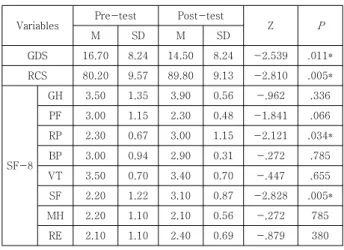
As a result of this study, the depression scale of the subjects changed from 16.70±8.24 before the program to 14.50 ±8.24 after the program, and the difference was statistically significant (p<.05). The relationship change scale which was used to evaluate social cognitive function ability changed from 80.20±9.57 before the program to 89.80±9.13 after the program, and the difference

was statistically significant (p<.05). As a result of the evaluation of the health-related quality of life, the general health score of the subjects changed from 3.50±1.35 before the program to 3.90±0.56 after the program, the physical function score changed from 3.00±1.15 to 2.30±0.48, the role physical score from 2.30±0.67 to 3.00±1.15, the bodily pain score from 3.00±0.94 to 2.90±0.31, the vitality score from 3.50±0.70 to 3.40±0.70, the social functioning score from 2.20±1.10 to 2.10±0.56, and role emotional score from 2.10±1.10 to 2.40±0.69. The evaluation results verified partial improvement in quality of life, and the differences in role physical and social functioning were statistically significant (p<.05) (see Table 1).

Variables Pre-test Post-test

Z P

M SD M SD

GDS 16.70 8.24 14.50 8.24 -2.539 .011*

RCS 80.20 9.57 89.80 9.13 -2.810 .005*

SF-8

GH 3.50 1.35 3.90 0.56 -.962 .336

PF 3.00 1.15 2.30 0.48 -1.841 .066

RP 2.30 0.67 3.00 1.15 -2.121 .034*

BP 3.00 0.94 2.90 0.31 -.272 .785

VT 3.50 0.70 3.40 0.70 -.447 .655

SF 2.20 1.22 3.10 0.87 -2.828 .005*

MH 2.20 1.10 2.10 0.56 -.272 785

RE 2.10 1.10 2.40 0.69 -.879 380

*GDS: geriatric depression scale

*RCS: relationship change scales

*GH: general health, PF: physical function, RP: role physical, BP: bodily pain, VT: vitality, SF: social functioning, MH: mental health, RE: role emotional

Table 1. Comparison of depression, social cognition and QOL in participations (N=12)

4. Discussion

Depression management for stroke patients is

critical because poststroke depression has a high

incidence rate and can have a negative effect on

the patients’ quality of life. Depression can show

multi-faceted problem symptoms that need to be

approached from cognitive aspect as well as

(6)

from affective aspect. Depression is sometimes explained as a factor that can have secondary effects on social cognition[6].

This study was conducted to present a more-developed intervention method for stroke patients in communities by preventing depression that may develop after stroke and improving the quality of life while maintaining and enhancing the cognitive function of stroke patients through the cognitive stimulation circulative program.

The results of this study showed that the depression of the subjects statistically significantly decreased and the relationship change scale for social cognitive ability also showed statistically significant changes after applying the program. Furthermore, the evaluation results for the health-related quality of life of the subjects showed statistically significant differences in role physical and social cognitive functioning after applying the program.

These results of this study are similar to the results of other studies related to cognitive therapy for stroke patients. First, Jang, and Jeon (2012) conducted a cognitive rehabilitation program for acute stroke patients and the cognitive, depression, and performance of activities of daily living of the subjects significantly improved[23]. Furthermore, Lee (2012) applied a computer based cognitive rehabilitation program to stroke patients and found that the interpersonal relationship ability of the subjects improved[24]. Kim, Yi, Park, Kang, and Lee (2010) conducted a study on the effects of a cognitive promoting program consisting of cognitive learning and play programs on the cognitive function, depression and quality of life of elderly people. They obtained statistically significant results in cognitive function, depression and quality of life scores after applying the cognitive promoting program to 1,251 normal elderly people aged 60 or older who had not been diagnosed with dementia[25].

This study followed the trend of attempting interventions for ordinary elderly people living in communities owing to rising interest in the prevention of dementia in normal elderly people while maintaining and enhancing their cognitive function. This context of research is in line with the context of this study on stroke patients who have higher cognitive risk than normal elderly people even though their cognitive problems were not discovered.

The cognitive stimulation circulative program used in this study adopted a circuit formation which can reduce the boredom of repetitive tasks unlike the repeated cognitive rehabilitation programs used in previous studies. As a result, the subjects participating in the cognitive rehabilitation program participated well in the program without losing interest until the end of the experiment, thereby improving the effects of intervention. Furthermore, the reality orientation, cognitive exercise, task-oriented, reminiscence programs used for intervention in this study had been already used independently and their effects had been verified in previous studies. In this study, they were transformed similarly and applied in circulation, and their effects were verified. Therefore, the significance of this study lies in the provision of a new paradigm for cognitive rehabilitation methods.

Regarding the clinical significance of this study, whereas previous studies conducted cognitive rehabilitation studies on stroke patients who had obviously damaged cognitive function among stroke patients, the cognitive rehabilitation program used in this study for stroke patients who had a high risk of depression even though their cognitive function was intact was found to be effective in preventing depression. Therefore, this program has clinical significance as a preventive therapy for stroke patients who are exposed to the risk of depression.

Kim(2009) wrote about the importance of

social cognitive function ability in stroke patients

(7)

and argued that occupational therapy must have interest in the rehabilitation of social cognitive function ability because disorders of social cognitive abilities such as the solution of interpersonal relationship problems, ethical judgement, communication, and contextual understanding have negative effects on the functional recovery and quality of life of stroke patients[6]. The social cognitive function that he mentioned has a positive correlation with cognitive function.

Therefore, the enhancement of cognitive function through cognitive rehabilitation was believed to bring about the improvement of social cognitive ability. In fact, the results of this study showed that cognitive rehabilitation contributed to the improvement of the social cognitive function of stroke patients.

Shin(2014) reported that the quality of life in stroke patients showed a significant negative correlation with depression and a significant positive correlation with interpersonal relationship[26]. In other words, depression in stroke patients was associated with lower quality of life and a better interpersonal relationship was associated with a higher quality of life. The results of these studies have something in common with the improved quality of life score in subjects with lower depression and better interpersonal relationship after applying the cognitive stimulation circulative program to stroke patients.

The above results of this study verified that the cognitive stimulation circulative program was an efficient intervention program that reduces the depression of stroke patients and improve their social cognitive function ability, thus enhancing the quality of life. One limitation of this study was that the cognitive function, which can influence depression or social cognition was not set as a dependent variable, and it could not be ascertained whether the improvement cognitive function had influenced a change in results.

Another limitation of this study is that only the interpersonal relationship, which is one

characteristic of social condition, was evaluated rather than the overall social cognitive ability. If the overall social cognition could be evaluated together with cognitive function, it would support more systematically the claim that the cognitive stimulation circulative program has positive effects on the cognitive function and social cognitive capacity of stroke patients. Also needed is a study on the comparison of effects between the cognitive stimulation circulative program and the general cognitive rehabilitation program with a control group that can be used to compare effects with the experimental group in the study design.

REFERENCES

[1] L. Caeiro, J. M. Ferro, C. O. Santos & M. L. Figueira.

(2006). Depression in acute stroke. Journal Psychiatry Neuroscience, 31(6), 377-383.

[2] I. I. Kneebone & E. Dunmore. (2000). Psychological management of post stroke depression. British Journal of Clinical Psychology, 39(1), 53-65.

[3] M. L. Hackett, C. Yapa., V. Parag. & C. S. Anderson.

(2005). Frequency of depression after stroke. A systematic review of observational studies. Stroke, 36(6), 1330-1340.

[4] N. H. Fultz, M. B. Ofstedal, A. R. Herzog & R. B.

Wallacc. (2003). Additive and interactive effects of comorbid physical and mental conditions of functional health. Journal of Aging and Health, 15(3), 465-481.

[5] H. Brodaty, A. Withall, A. Altendorf & P. S. Sachdev.

(2007). Rates of depression at 3 and 15 months poststroke and their relationship with cognitive decline: The sydney stroke study. The American Journal of Geriatric Psychiatry, 15(6), 477-486.

[6] Y. G. Kim. (2009). The study on the necessity of occupational therapy for social cognition disability.

Journal of Korean Society of Occupational Therapy, 17(4), 25-35.

[7] Y. N. Cho. (2010). The Effects of Computerized Cognitive Rehabilitation on Cognitive Function in Elderly Post-stroke Patient. Daegu University, Daegu.

[8] R. I. Hwang, J. Y. Lim & Y. W. Lee. (2009). A

comparison of the factors influencing the life

satisfaction of the elderly according to their cognitive

impairment level. Journal of Korean Academy of

Nurse, 39(5), 622-631.

(8)

[9] S. C. Kim & H. K. Kim. (2014). Cognitive Deficits in Depressed Patients : Evidence from a Paired-task Analysis. The Korean Journal of Rehabilitation Psychology, 21(2), 151-169.

[10] S. D. Yoo, M. H. Jeon & S. B. Pyeon. (2009).

Relationship between the severity of poststroke depression (PSD) and cognitive function in the patients with stroke. Annals of Rehabilitation Medicine, 33(5), 527-532.

[11] H. Dam, M. Harhoff, P. K. Andersen & L. V. Kessing.

(2007). Increased risk of treatment with antidepressants in stroke compared with other chronic illness. International Clinical Psychopharmacology, 22(1), 13-19.

[12] Y. Funaki, F. Kaneko & H. Okamura. (2005). Study on factors associated with changes in quality of life of demented elderly persons in group homes. Scandinavian Journal of Occupational Therapy, 12(1), 4-9.

[13] M. Y. Jung. et al. (2011). Group Dynamics in Occupational therapy, 3e, Seoul : Koonja.

[14] J. A. Yesavage. et al. (1983). Development and validation of a geriatric depression screening scale: A preliminary report. Journal of Psychiatric Reserach, 17(1), 37-39.

[15] B. S. Kee & C. W. Lee. (1995). A Preliminary Study for the Standardization of Geriatric Depression Scale in Korea. Journal of the Korean Neuropsychiatric Association, 34(6), 1875-85.

[16] A. Schlein & B. G. Guerney. (1971). Relationship enhancement. CA: Jossey-Bass, SanFrancisco.

[17] S. M. Moon. (1980). A study on the Effect of Human Relationship Training Group Counseling. Gyeogsang National University paper, 19. 195-204.

[18] M. H. Yang. (2002). Effect of Psychodrama on Personal Relationship of College Students. A master’s thesis.

Cheju National University, Jeju.

[19] J. E. Ware, M. Kosinski, J. E. Dewey & B. Gandek.

(2001). How to score and interpret single-item health statues measure: A manual for users of the SF-8 health survey. RI: Quality Metric Incorporate, Lincoln.

[20] J. W. Kim. (2013). Improving cognitive abilities for people with alzheimer’s disease: Application and effect of reality orientation therapy(ROT). Phonetics and speech sciences, 5(1), 27-38.

[21] S. Y. Sim, J. Y. Baek, H. S. Jung & T. H. Cha. (2015).

Effects of Physical Activities and Cognitive Activities on EEG and Occupational Performance in Mild Dementia. Institute of Special Education &

Rehabilitation Science, 54(4), 453-469.

[22] Y. Y. You & Y. A. Yang. (2009). The effects of exercise with cognitive activity on balance performing ability in the elderly with dementia. The Journal of Korean Society of Occupational Therapy, 17(3), 15-26.

[23] Y. J. Jang & S. S. Jung. (2012). Effect of cognitive

rehabilitation program on cognitive function, depression, and activities of daily living among patients with strokes. The Journal of Korean Academic Society of Adult Nursing, 24(3), 305-316.

[24] J. M. Lee. (2012). The correlation between relationship ability and activities of daily living(ADL) performance ability of patients with traumatic brain injury(TBI).

Therapeutic Science for Neurorehabilitation, 1(1), 71-79.

[25] H. S. Kim, Y. J. Yi, K. H. Park, U. K. Kang & B. M. Lee.

(2010). Effects of cognition promoting program on cognitive function, depression and quality of life in elderly. Journal of the Korea Contents Association, 10(8), 227-239.

[26] K. E. Shin. (2014). Effect of virtual reality game on old patient's depression, Relationship and Life Satisfaction. Dongshin University, Naju.

도 지 혜(Do, Ji Hye) [정회원]

․ 2010년 2월 : 연세대학교 재활학과(보 건학사)

․ 2015년 8월 : 연세대학교대학원 작업 치료학과(작업치료학석사)

․ 2016년 3월 ~ 현재 : 연세대학교대학 원 작업치료학과 박사과정

․ 관심분야 : 작업치료

․ E-Mail : [email protected]

김 은 주(Kim, Eun Joo) [정회원]

․ 1997년 2월 : 연세대학교 재활학과(보 건학사)

․ 2014년 2월 : 연세대학교대학원 작업 치료학과(작업치료학박사)

․ 2007년 3월 ~ 현재 : 전주대학교 작업 치료학과 교수

․ 관심분야 : 작업치료, 보조공학

․ E-Mail : [email protected]

수치

Table 1. Comparison of depression, social cognition and  QOL  in  participations      (N=12)

참조

관련 문서

Purpose: This study aimed to investigate the effects of a short-term group multimodal intervention program that mixes physical activity, cognitive motion, and social interaction,

The purpose of the research study is to confirm in effectiveness of somatosensory stimulation and to propose ideal training strategy for functional recovery of stroke patients.

A Study on the Effects of Stroke Patients' Activities of Daily Living, Depression and Social Support for Them on Their Life Quality.. thesis,

The aim of this study was investigated the effect of cognitive training using tablet pc applications on cognitive function, daily living, and satisfaction in subacute

PURPOSE: The present study was conducted to investigate the effects of functional electrical stimulation gait training with rhythmic auditory stimulation on balance and gait ability

In conclusion, regular exercise program may positive effects on mental status cognitive status, depression, uneasiness, and living satisfaction of the

Purpose : The purpose of this study is to investigate the effects of transcranial direct current stimulation and virtual reality program application on

Purpose : The purpose of this study was to determine the effects of a cognitive-exercise program using step on the cognitive function, gait, and depression of elderly