A Study of Usability Analysis on 'Low-Budget' Mobile Game Development
Duck-ki Ahn 1 , Suk-rae Kim 2*
1
School of Games, Hongik University, Professor,
2Division of Multimedia, Inje University, Professor
저비용 모바일 게임 개발사례 분석을 통한 사용성 연구
안덕기 1 , 김석래 2*
1
홍익대학교 게임학부 교수,
2인제대학교 멀티미디어학부 교수
Abstract This study is an analytical case study focusing on ‘low-budget’ mobile game development centered on both short-term development and small-scale collaboration. This study set up the assumption of four months as development period limited by three developers along with step by step productional documentation. In the previous study, we set up the responsibilities of the development personnels to analyze the effective process of the practical production. Furthermore, the study analyzed the usability verification of both advantages and disadvantages for conducting the quantitative survey with developer's feedbacks. The study is to provide the essential guideline for ‘low-budget’ development group with effective pipeline.
Key Words : Low-Budget, Mobile Game Development, Short-Term Development, Small-Scale Development, Usability Survey
요 약 본 연구는, 기존의 저비용 모바일 게임개발 사례를 근간으로, 3명의 개발인원, 4개월의 개발기간이라는 연구의 지향점을 두고 진행된 분석연구로, 소규모, 단기간 조건하에서 게임제작에 필수적인 업무 간 협업과정을 단계별로 기 록, 효율적 게임개발의 필수요소들을 검증하였다. 선행연구로 개발인원의 업무적 책임역량을 이론적으로 고찰한 후, 본문에서 단기간 제작사례를 바탕으로 제작자의 입장에서 효과적인 제작 과정을 분석, 과정상의 핵심요소를 제시하고, 사용성 검증을 위하여 개발자들의 피드백을 추가적으로 첨부함으로서, 소규모 인원에 의한 단기간 게임개발의 장, 단점 및 보완사항이 연구결과로 제시되었다는 점에서, 본 연구가 소규모 개발사에게 좋은 가이드라인이 될 것으로 판단된다.
주제어 : 저비용, 모바일 게임개발, 단기간 개발, 소규모 인원, 사용성 검증
*This work was supported by 2019 Hongik University Research Fund.
*Corresponding Author : Suk-Rae Kim([email protected])
Received April 1, 2019 Revised April 23, 2019
Accepted June 20, 2019 Published June 28, 2019
1. Introduction
1.1 Research background
Both computer games and video games have been very popular in children and adolescents' life, and it is played as a prominent role in the culture of young people[1]. The mobile game has
evolved into a new entertaining platform throughout the all generation[2], furthermore it became a vast profitable industry with revenue of 4.5 billion dollars researched by 2017 KOCCA[3].
Mobile game engines are also have been actively
promoted through the expansion of the market
growth within the inexpensive accessibility[4],
and mobile game system became easier to be developed by the small number of group with effective pipeline during the short-term development cycle. This study focused on the methodology of a mobile game development by utilizing the both short-term production and small-numbers of developers, which can be affected by ‘low-budget’ game development. Then the study extended the developers’ feedback for the both advantage and disadvantage from the usability survey.
In the early days of the mobile game development periods, developers focused on long-term development for tremendous sales return such as "Angry Bird" from Rovio or "Crash of Clan" from Supercell. In the most recent mobile game development, however, small group of game developers have been attempted to create the ‘low-budget’ mobile game with both small-scale and short-term production system for the successful returns. It becomes the background of this study that developers oriented to the 'low-budget' system as implementable mobile game application within the short-term and small-number of people.
This study has its purpose to extend the usability analysis of essential requirement of 'low-budget' mobile game development[5] by proposing the efficient production guideline for the small group of mobile game developers by evaluating the case study of "Fruity Fish" mobile game project.
1.2 Scope and method of research
In order to provide an effective guideline for 'low-budget' development system to the small group of mobile game developers, the study researched on the related studies of a successful developing case in mobile game production as the precedent research. Next, the research proceeded experimental case study through the five productional periods divided by the
pre-production, early-production, mid-production, final-production, and build-production. Then the study evaluated the validation steps of the satisfaction scale by conducting the survey from the practical production participants to verify the usability of the 'low-budget' development system.
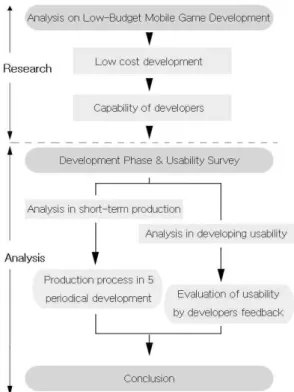
The following Fig. 1. is a summary of the scope of the research through the overall analysis study.
Fig. 1. Research procedure of the Study
2. Mobile Game Development
2.1 Low cost development
The early mobile game system was adapted through the phone device in 1994 with MT-2000's 'Tetris' using mobile phone named Hagenuk in German[6]. The major evolution of mobile game platform was 1st generation of iPhone series which was published by Apple Inc.
in 2007. Furthermore, the mobile game
application was radically improved along with
launching of Apple's online App. store in 2008[7].
Despite of the most successful growth of early handheld game platform such as Nintendo's DS or Sony's PSP in the previous game platform generation, recent mobile game platform does not include those handheld game platforms since either phone or mobile tablet devices along with both consistent upgrade of operation system and technical solution, which are indicated as mobile game development platforms[8].
Hipster Whale Pty Ltd was founded by three game developers as a small mobile game company in 2014; Ben Weatherall, Andy Sum, and Matt Hall. Those three developers created popular mobile game named "Crossy Road"
during three months of development period with 'low-budget' investment, and published game for the initial sales number of 50 million copies with three months revenue of more than 10 million dollars 4 million daily users[9]. The following Fig. 2. is a image sample of the mobile game 'Crossy Road' by Hipster Whale Pty Ltd.
Fig. 2. The mobile game 'Crossy Road'
2.2 Capability of developers
The study classified the short-term mobile game development with limited numbers of developers to verify the capability indication of efficient production pipeline by planing, tuning, testing, and modifying[10] using Android game platform[11] with Unity Engine[12]. Therefore, this study used the three designation responsibility to the following three positions listed by graphic artist(GR), engineer(EN). and producer(PR).
In the role position of graphic artist, the person needs to create visual graphic data with computer generated images to balance the context by not only distinguishing the shape and
color values for the unique game style in both characters and environment, but also maintaining the graphic data‘s loading speed from the animation sequences. In addition, graphic artist needs to visualize the initial concept with overall level design during this pre-production period, so that future production work-flow can be planned straightforward to the build production stage. Therefore, it is necessary for the artist to be exposed in game development pipeline at least two years from practical graphic industry.
In the role position of Engineer, the person needs to utilize the programming code to the Unity3D game engine where the production work-flow can be optimized by mobile game engineering system. Engineer also needs to build the sufficient game data sharing sever that can be used for both graphic artist, engineer, and producer when they assemble multiple data assets to game engine system directly from the sharing server. In addition, engineer needs to envision a interacting relationships between character, prop, and environment collision system while initiating a points of collision object to inactive object throughout the game-play. Engineer needs to control the functional indication by integrating the graphic data to the game engine. Therefore it is necessary for the engineer to be experienced in the game development pipeline at least two years from practical programming industry.
In the role position of producer, the person needs to visualize entire game's level of difficulty and user interface(UI) design by emerging both graphic concept and programming knowledge as a leader of the team. Producer also needs to concede the balance of game quality by adjusting the team member's availability within designated deadline of production cycle as a manager.
Therefore, it is necessary for the producer to be exposed in the game development at least three years of practical game directing industry.
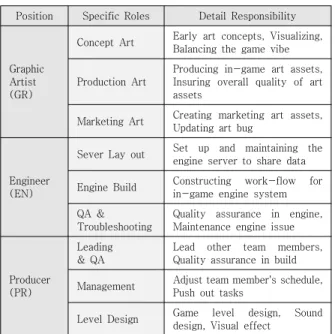
The following Table 1. is a brief summary
analysis of three different positions with required
roles which are described by specific responsibilities for this 'low-budget' game development.
Position Specific Roles Detail Responsibility
Graphic Artist (GR)
Concept Art Early art concepts, Visualizing, Balancing the game vibe
Production Art
Producing in-game art assets, Insuring overall quality of art assets
Marketing Art Creating marketing art assets, Updating art bug
Engineer (EN)
Sever Lay out Set up and maintaining the engine server to share data
Engine Build Constructing work-flow for in-game engine system QA &
Troubleshooting
Quality assurance in engine, Maintenance engine issue
Producer (PR)
Leading
& QA
Lead other team members, Quality assurance in build
Management Adjust team member's schedule, Push out tasks
Level Design Game level design, Sound design, Visual effect
Table 1. Responsibility in developer's position
Based on the position of three specific role responsibilities described above, this study extended experimental case study of 'Fruity Fish' mobile game to associate with three positional developer who had game industry experience previously.
3. Development Phase and Survey
The study focuses on the five manufacturing steps of 'low-budget' mobile game production based on the four months of mobile game project by emphasizing the productivity while analysing the most effective work-flow through the mobile game development pipeline. In addition, the study also provides feedback from the complementary value of satisfaction survey by each developers at the end of the game completion.
3.1 Analysis in Short-term Production In order to embody the methodology, the study classified the process of mobile game development into five interdependent procedure.
Nevertheless, the criterion of the five productional process is oriented to the core tasks and protocol completion within the four months of developing production divided by three different positions with their role responsibilities.
First, in the case of 'Pre-production' stage, it progresses of initial game plan projection for future development in both story concept, game play, and design contents by centering on the developing schedule. During this process, pipeline research should be organized by producer in the perspective of graphic artist and engineer's scheduling perspective, so that overall pipeline of development can be maintained as original concept toward the later stages.
Furthermore, producer and graphic designer should designed both story concept and game play precisely to designate the users' age.
Engineer needs to research the system engine and affordable data server for the game content by communicating with other developers.
Second, in the case of 'Early-production' stage, it progresses of early development of game production for both graphic art and programing data sources as a dependable developing schedule. During the process, both graphic artist and engineer should visualize the initial game resources as a in-game art and program data along with implementation objects such as characters, environments, difficulty level, and collision system by applying them to the engine.
Third, in the case of 'Mid-production' stage, it
produces of huge expansion of multiple levels
from early-production stage by the integration of
game server and Unity3D game engine. During
this process, most of the game graphic assets
should be produced by the graphic artist while
engineer optimizes the engine to modify art
assets into game system. Producer needs to revise the flexible periodical schedule for the other two other members while expanding additional design changes to improve from the early production's game play in the engine.
Forth, in the case of 'Final-production' stage, it progresses of concrete diversity of overall quality of game design by subjoining user interface(UI) design along with sound, logo, and visual effects.
During this progress, most of the in-game art assets should be polished by graphic artist, and engineer needs to comply the stability of game engine before he lock down the 'Final-production' stage. Producer needs to communicate with other developers to tune up the sound effect and visual effects so that effects can be applied to engine without further technical issues.
Finally, in the case of 'Build-production' stage, it progresses of completion level of final game by polishing the latest build until the game's release to online application store. During this progress, daily build should be provided by engineer while graphic artist verifies the daily build in order to maintain the game's quality and stability.
Producer needs to prioritize the level of build issues before he confirmed the completion of final build, otherwise he needed to resend fixing request items from the issue lists to engineer.
Producer can send additional art request item to the graphic artist to upgrade the final quality from the daily game build.
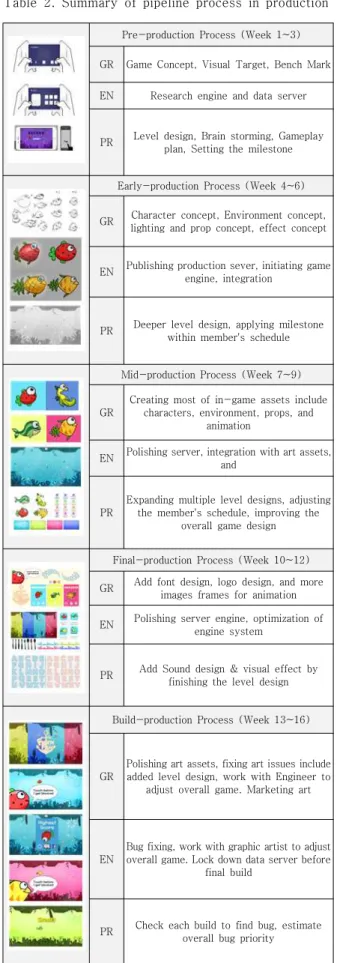
The following Table 2. is a brief summary of the productional process of 'Fruity Fish' project.
In this way, case study of 'low-budget' mobile game development was achieved from the preparation to final production through the 4 months of work-flow timeline by utilizing the number of three developers. The study also established the periodical task orders to analysis the variable interaction along with different positions for the effective schedule. For example, engineer needed to provide securing data engine server so graphic designer could submit the vast
Pre-production Process (Week 1~3)
GR Game Concept, Visual Target, Bench Mark
EN Research engine and data server
PR Level design, Brain storming, Gameplay plan, Setting the milestone
Early-production Process (Week 4~6)
GR Character concept, Environment concept, lighting and prop concept, effect concept
EN Publishing production sever, initiating game engine, integration
PR Deeper level design, applying milestone within member's schedule
Mid-production Process (Week 7~9)
GR
Creating most of in-game assets include characters, environment, props, and
animation
EN Polishing server, integration with art assets, and
PR
Expanding multiple level designs, adjusting the member's schedule, improving the
overall game design
Final-production Process (Week 10~12)
GR Add font design, logo design, and more images frames for animation
EN Polishing server engine, optimization of engine system
PR Add Sound design & visual effect by finishing the level design
Build-production Process (Week 13~16)
GR
Polishing art assets, fixing art issues include added level design, work with Engineer to
adjust overall game. Marketing art
EN
Bug fixing, work with graphic artist to adjust overall game. Lock down data server before
final build
PR Check each build to find bug, estimate overall bug priority
Table 2. Summary of pipeline process in production
art assets to integrate with game engine when it is required to add multiple operation checks during the mid-production process.
However, this case study still need to find the potential usability from the developer's perspective in 'low-budget' game development.
In the following 3.2, the study researched the survey of satisfaction by each developers after the game completion to find effective solution of improvement based on three elements of satisfaction in scope, time, and cost.
3.2 Analysis in Developing Usability
Based on the process of the 'low-budget' mobile game production, this study conducted the satisfaction survey focused on the three constraint perspectives from limited environment such as scope, time, and cost. In the survey, developers marked numbers on six questionaries per each perspective to provide referrer satisfaction elements of quality by Fig. 3. project management triangle. Project management triangle, and the study evaluated the average value of between effective and ineffective lists to analysis developing perspective by revising the effective solutions based on the project management triangle study[13].
Fig. 3. Project management triangle in quality
The study of project management triangle shows relational information of construction between scope, time, and cost to define the satisfaction quality of work environment based on the survey analysis for simple game contents' development[14]. Therefore this study continued to evaluate the level of work quality from small group of developers by measuring the satisfaction scale from usability survey scaled
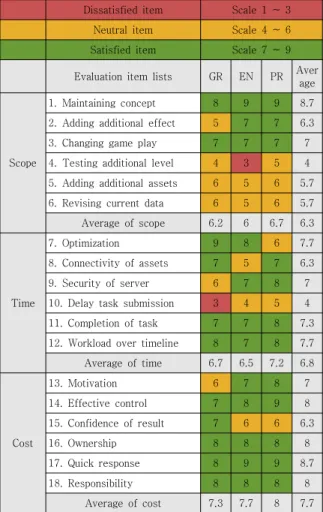
from 1 to 9 as shown in the following Table 3.
Survey of satisfaction survey.
Dissatisfied item Scale 1 ~ 3 Neutral item Scale 4 ~ 6 Satisfied item Scale 7 ~ 9
Evaluation item lists GR EN PR Aver age
Scope
1. Maintaining concept 8 9 9 8.7
2. Adding additional effect 5 7 7 6.3
3. Changing game play 7 7 7 7
4. Testing additional level 4 3 5 4 5. Adding additional assets 6 5 6 5.7
6. Revising current data 6 5 6 5.7
Average of scope 6.2 6 6.7 6.3
Time
7. Optimization 9 8 6 7.7
8. Connectivity of assets 7 5 7 6.3
9. Security of server 6 7 8 7
10. Delay task submission 3 4 5 4
11. Completion of task 7 7 8 7.3
12. Workload over timeline 8 7 8 7.7 Average of time 6.7 6.5 7.2 6.8
Cost
13. Motivation 6 7 8 7
14. Effective control 7 8 9 8
15. Confidence of result 7 6 6 6.3
16. Ownership 8 8 8 8
17. Quick response 8 9 9 8.7
18. Responsibility 8 8 8 8
Average of cost 7.3 7.7 8 7.7
Table 3. Survey of developers' satisfaction survey
In the case of 'Scope' perspective, producer(PR) marked highest average satisfaction scale at 6.7 compared to the engineer(EN) marked the lowest at 6 within the overall scale of 6.3 'Neutral' in the scope. However, three average value groups of 'Adding additional levels' (4), 'Adding assets' (5.7), and 'Revising data' (5.7) received the lowest points where the value can be mostly improved by adjusting the development scoping schedule in the very early stage rather than update during the middle of production since it can be overload at any later production time.
In the case of 'Time' perspective, producer
marked highest average satisfaction scale at 7.2
while engineer marked the lowest at 6.5 within
the overall scale of 6.8 'Neutral' during the satisfaction survey. 'Delay task submission' received the lowest average point of 4, where the value can be improved by either increasing the number of developers temporary or extending pipeline schedule. However, increasing both factors should be minimal attempt otherwise the concept of 'low-budget' development system can be troubled into high-cost issue.
In the case of 'Cost' perspective, producer marked highest average satisfaction scale at 8 again, while graphic artist(GR) marked the lowest at 7.3 within the overall scale of 7.7 'Satisfied' in the survey. 'Confidence of result' received the lowest average point of 6.3 where the value can be improved by facilitating the information sharing system of both work progress and project goal through the group communication.
Meanwhile, overall 'Cost' perspective received the most satisfied scale scope than the other two perspectives since most developers understood the limitation of 'low-budget' development prior to the initial production.
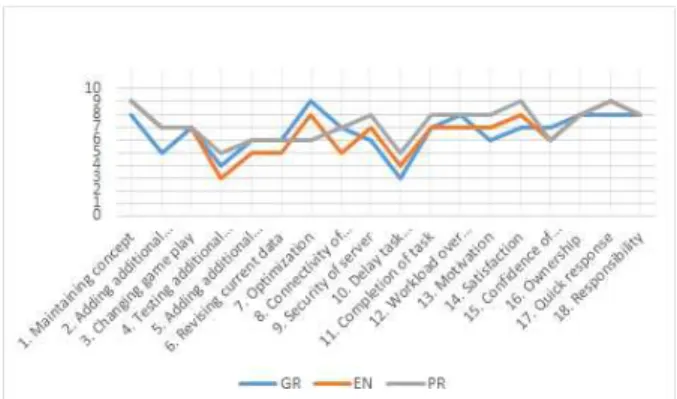
Accordingly, the analysis result from the above usability survey clearly shows the possibility of both potential advantages and disadvantages of the 'low-budget' mobile game development. One of the most noticeable merit from 'low-budget' development is lowering the development cost by 'Maintaining concept' of the game design in the production stage, and make the process easier to follow the work-flow while graphic artist and engineer are assigned the acceptable modification with 'Quick responses'. In addition, the positive result of 'Effective control' of cost perspective is analyzed as the solution of interacting the both 'Responsibility' and 'Motivation' as the development owners during the production cycle despite the limited resources. However, some disadvantages are mainly shown as both 'Delay of shared task' and 'Testing additional level' between the developers, because minimum number of developers are only available to digest limited
workload during the production. The complicated workload with exceeding each production schedule is analyzed as a problematic factor that reduces the satisfaction from the developers especially in the current 'low-budget' production periods.
The following Fig. 4. Summary graph of usability evaluation is the graphical summary to assist visual understanding of survey from the usability analysis derived by developers.
Fig. 4. Summary graph of usability evaluation
The usability survey of this case study finds that insufficient resources can cause critical developmental difficulties during the 'low-budget' game development, so the study also proceeds the list of four alternative solutions to minimize those difficulties.
First, each developers can maximize a sufficient conceptualization in the pre-production period with deliverable task plan. Therefore, periodical game assets can be finalized within the least number of conversion during the production by securing the original game design.
Second, producer is required to build the priority developing list to ensure the efficient work process based on each developers' capability prior to the pre-production period. Therefore, game assets can be produced from high to low in priority developing list by conducting the high priority order.
Third, each developers should be allowed to
adjust the feasible schedule of delivery deadline by utilizing the flexible management during the mid-production stages. Therefore, developers can avoid the confliction time management issue of related dependent task's delay during the heavy asset developing stage.
Forth, the group of developers needs to participate the proactive work related communication between developers to share the game data source information in the end of stages. Therefore, developers can discuss to conduct related developing issues during the early following production stages by maintaining the work-flow stability within the group developing schedule during most of developing processes.
4. Conclusion
In the modern mobile game industry, computer tools easily provides faster developing technology for small group of game developers, but there are only a few of studies show the approachable work-flow of the 'low-budget' mobile game development. This study focused on the 'low-budget' mobile game development based on the case study from 'Fruity Fish', which was successfully created by three developers in four months period with five productional process.
The study also analysis the developer's usability survey after the completion of project to provide alternative solutions from development issues.
This study's evaluation has its importance of the research not only verifying the case study of 'low-budget' development, but also analysing the list of four alternations based on developers' usability survey. In addition, the result of the survey analysis can be used on the 'low-budget' for the small number of developing producers or outsourcing game groups[15] as a guideline, which can be extended to consecutive analysis on the ‘mid-budget’ mobile game development
with various time schedule and numbers of developer in the future study.
REFERENCES
[1] S. M. Dorman. (1997). Video and Computer Games:
Effect on Children and Implications for Health Education. Journal of School Health. 67(4), 133-138.
DOI: 10.1111/j.1746-1561.1997.tb03432.x
[2] B. Wu, A. I. Wang & Z. Deng. (2012). A Guideline for Game Development-Based Learning: A Literature Review. International Journal of Computer Games Technology. 2012(103710), 20.
DOI: 10.1155/2012/103710
[3] Industry Promotion Policy Division. (2017). Korea Creative Content Agency. Game Industry White Paper. p59 [4] K. M. Jeong. (2010). Future Direction of Mobile Game
Market according to the Advance of Mobile Device Capability. Journal of Digital Contents Society, 11(4), 495-501.
[5] H. G. Kim. (2012). An Analysis of Market Trend and Profitability Model for Mobile Social Game : A Case Study of Japanese Mobile Social Game. Journal of Korea Entertainment Industry Association, 6(4), 82-92.
DOI: 10.21184/jkeia.2012. 12.6.4.82
[6] K. M. Cho. (2013). Donga Magazine. Game History:
What is the world first mobile game.
http://game.donga.com/68455/
[7] J. H. Hong. (2014). The Growth History of Mobile Game Industry in Korea. The Journal of Korean Academy Of Business Historians, 70(2), 29-49.
[8] E. S. O. (2007). A Study on Digital Game Trends in USA - Focused on Mobile Games. The Journal of Korean Society of Design Culture., 13(3), 222-231.
UCI: I410-ECN-0102-2008-650 -002621345 [9] R. Lefebvre. (2015). Cult of Mac. How Crossy Road
developers made $10 million in 90 days.
https://www.cultofmac.com/314240/crossy-road-deve lopers-made-10-million-90-days/
[10] S. H. Ryu, D. H. Han, B. P. Kyung & D. L. Lee. (2008).
3D Game Production Pipeline and Application Instance Proposal. The Journal of the Korea Contents Association, 8(7), 128-134.
DOI: 10.5392/JKCA.2008 .8.7.128
[11] J. S. Cho. (2014). The Beginner's Guide to Android Game Development. USA: Glasnevin Publishing. ISBN:
978-1908689269.
[12] J. Manning & P. B. Addison. (2017). Mobile Game Development with Unity: Build Once, Deploy Anywhere.
Australia : O'Reilly Media. ISBN: 978-1491944745
[13] R. Atkinson. (1999). Project Management: Cost, Time,
and Quality, Two best guesses and a phenomenon, its time to accept other success criteria. The International Journal of Project Management, 17(6), 337-342.
DOI:10.1016/s0263- 7863(98)00069-6
[14] S. H. Ryu. (2002). A Study on Mobile Game Industry Trend and User Analysis. Journal of Korea Multimedia Society, 6(1), 15-33.
[15] D. K. Ahn & S. R. Kim. (2015). The Graphic Designer's Competency in Convergence of Outsourcing Game Development. Journal of Digital Convergence, 13(6), 257-265.
DOI: 10.1440 0/JDC.2015.13.6.257
안 덕 기(Ahn, Duck Ki) [정회원]
․ 2003년 3월 : Savannah College of Art and Design(SCAD), Computer Art (BFA)
․ 2004년 3월 : Savannah College of Art and Design(SCAD), Computer Art (MA)
․ 2013년 3월 ~ 현재 : 홍익대학교 게임 학부 게임그래픽디자인전공 교수
․ 2016년 3월 ~ 현재: 동국대학교 영상대학원 박사과정
․ 관심분야 : Game Graphic Design, 3D Computer Animation, Character Design, VR Graphic 등.
․ E-Mail : [email protected]
김 석 래(Kim, Suk Rae) [정회원]