정량적 위험성평가 프로그램(Hy-KoRAM)을 이용한 제조식 수소충전소 피해범위 및 영향 분석
김혜림⋅강승규
†
한국가스안전공사 가스안전연구원
Analysis of Damage Range and Impact of On-Site Hydrogen Fueling Station Using Quantitative Risk Assessment Program (Hy-KoRAM)
HYELIM KIM, SEUNGKYU KANG
†Hydrogen Research Division, Korea Gas Safety Corporation, 1390 Wonjung-ro, Maengdong-myeon, Eumseong 27738, Korea
†
Corresponding author :
[email protected]Received
31 August, 2020Accepted
30 October, 2020Abstract >> As the hydrogen industry grows, expansion of infrastructure for hydro- gen supply is required, but the safety of hydrogen facilities is concerned due to the recent accidents at the Gangneung hydrogen tank and the Norwegian hydro- gen fueling station. In this study, the damage range and impact analysis on the on-site hydrogen fueling station was conducted using Hy-KoRAM. This is a do- mestically developed program that adds functions based on HyRAM. Through this risk assessment, it was evaluated whether the on-site hydrogen fueling sta- tion meets international standards and suggested ways to improve safety.
Key words : Hydrogen(수소), On-site hydrogen fueling station(제조식 수소충전소), Damage range(피해범위), Hazard distance(위험거리), Risk assessment(위험성 평가)
1. 서 론
최근 정부의 수소경제 활성화 로드맵 발표 (’19.1) 와 함께 적극적인 정책 추진의 결과로 수소산업의 발전이 급속하게 이루어지고 있다 . 수소에너지는 차 세대 청정연료로서 수송·발전·건물·산업 등의 원료 로 활용되고 있으며, 관련 인프라 확충과 기술개발로 인해 급격한 성장세를 보이고 있다 . 특히, 1998년 국 가 G7 사업 및 차세대 자동차 개발 사업을 기점으로
수소차 개발을 시작하여 교통 인프라 보급이 확대되 고 있으며 2040년까지 수소차 290만 대, 수소충전소 1,200개소를 목표로 하고 있다. 이러한 수소차 보급 및 시장 활성화를 위해 수소충전소의 확대가 필요하 나 이전까지 국내에서는 충전 인프라에 대한 신뢰성 있는 위험성평가 프로그램이 부재하였기 때문에 안 전성 확인에 어려움이 있었다 .
본 연구에서는 이를 위해 수소충전소 전용 위험성 평가 프로그램인 Hy-KoRAM을 활용하여 제조식 수
DOI: https://doi.org/10.7316/KHNES.2020.31.5.459
pISSN 1738-7264 • eISSN 2288-7407
소충전소에 대한 정량적 위험성평가를 수행하였다 . 수소충전소는 수소의 공급 방식에 따라 저장식과 제조식으로 나누어진다. 제조식 수소충전소는 수소 의 원료가 되는 가스를 개질기와 같은 추출장치로 수소를 직접 생산하여 수소차에 공급하는 방식으로 서 충전소 건설비용이 높아 국내에서는 주로 저장식 수소충전소 방식을 이용하고 있다 . 하지만 수소충전 차량의 수요가 점점 증가함에 따라 수소 공급 요구 량이 증대되면서 여러 지역에서 제조식 수소충전소 설치사업을 확대 실시하고 있다. 따라서 본 연구를 통해 제조식 수소충전소에 대한 피해 범위 및 영향 을 분석하여 안전성을 제고하고자 한다.
2. 위험성평가 프로그램(Hy-KoRAM)
본 연구는 제조식 수소충전시스템의 피해범위와 영향을 분석하기 위하여 정량적 위험성평가 프로그 램인 Hy-KoRAM을 활용하였다. Hy-KoRAM은 가스 누출에 따른 피해 범위 예측 및 사고 빈도를 고려하 는 프로그램으로서 department of energy (DOE)에서 개발한 HyRAM 1,2) 에 정성적·정량적 모듈을 보완하 여 만든 위험성평가 프로그램이다. 현재, 국내에서는 Phast/Safeti, EFFECTS/RISKCURVES 등 주로 석유 화학플랜트의 위험성을 평가하는 해외 범용 프로그 램을 사용하고 있다. 하지만 해외 범용 프로그램은 국내환경 부합에 제한적이며 사용되는 고장률 데이 터베이스에 따라 평가 결과의 편차가 크다 .
따라서 본 연구에서는 최근 국내에서 국제공동연 구를 통해 개발한 수소환경에 부합하는 위험성평가 프로그램인 Hy-KoRAM을 활용하여 제조식 수소충 전소의 피해범위와 영향을 분석하고자 한다 .
Hy-KoRAM은 수소충전소 사고 발생 시 피해반경 을 기반으로 개인적 위험도 산출 및 주변 주민과 환 경을 고려한 사회적 위험도(frequency-number curve) 산출이 가능하다. 또한, 수소 누출 및 제트화염 실증 시험을 기반으로 한 피해 영향 모델이 프로그램에 적용되었으며 , 고장률데이터의 통계처리 방법을 이 용해 수소설비에 적합하도록 failure frequency가 보
정된다 . Hy-KoRAM의 누출 제트 및 제트화염 모델 식은 HyRAM과의 산출방식과 동일하고 개인적위험 도와 사회적위험도 산출 기능이 추가 되었으며 각각 의 모델식은 아래와 같다 1,3) .
Jet release model equations
exp
(1)
exp
(2)
exp
(3)
: velocity, : density, cl : centerline, amb : ambient B : characteristic half-width
: ratio of density spreading relative to velocity r : perpendicular to the stream-wise direction Y : mass fraction of hydrogen
Jet flame model equation
(4)
∆ (5)
log (6)
(7)
: total emitted radiative power
: normalized radiative heat flux
: radiant fraction
: mass flow rate of fuel
∆ : heat of combustion (118.83 MJ/kg)
: flame residence time
: mass fraction of hydrogen in a stoichiometric mixture
, and : flame density, width and visible
length
Table 1. Specifications of on-site type hydrogen fueling station
Classification
Storage (processing) capability
Design pressure (MPa)
Qua ntity Note
(Fuel) Reformer 100
Nm3/h 0.99 1 NG
reforming
Processing facility
1st compression
160
Nm3/h 22 1
2nd compression
460
Nm3/h 99 1
Charging facility 3,338
Nm3/h 90 1
Compressed gas facility
1,300 27.6 2 1,189 50 2 553 103.4 2 Buffer tank 6,185 0.96 1 NG compressor 106.3
Nm3/h 0.99 1 NG
compression
Chiller - - 1
Gas throughput Hydrogen 11,040 Nm3/day
Fig. 1. Location of hydrogen fueling station
, and : density, diameter and velocity of jet at exit
Individual risk
(8)
(9)
: Total individual risk from death at geographic location “x,y”
: Individual risk from death at geographic lo- cation “x,y” of accident case “i”
n : Total number of accident result cases con- sidered in the analysis
: Frequency of accident case “i” in frequency analysis
: Probability of accident case “i” causing death at location “x,y”
사회적 위험도를 산출하는 F-N 곡선을 계산하기 위 한 과정은 개인적 위험도 산출 방식과 동일하며 , 따 라서 각 사고 결과 사례의 영향을 받는 사람의 수를 예측하기 위해서는 해당 정보를 인구 자료와 결합하 여야 한다.
Societal risk
(10)
: Number of deaths caused in accident case “i”
: Number of people at location “x,y”
3. 위험성평가 모델
3.1 제조식 수소충전소 개요
3.1.1 수소충전소 사양/위치
제조식 수소충전소의 정량적 위험성평가를 위해 수도권 근처에 위치한 제조식 수소충전소를 평가 모
델로 선정하였다 . 해당 충전소는 용기 또는 차량에
고정된 탱크에 고압가스를 충전할 수 있는 설비로
고압가스를 충전하는 것으로서 고압가스 제조 (충전)
허가 대상에 포함된다. Table 1과 Fig. 1에 충전소의
위치 및 저장능력 , 설계압력 등 시설사양을 표시하였
으며, 수소충전소에서 사용되는 가스는 수소가스로
써 처리량은 11,040 Nm 3 /day이다.
Table 2. Safety evaluation criteria through damage impact
evaluationEvaluation
item Application standard4) Corresponding facilities Distance from
fire handling facility
LEL 1/4 or less -
Site boundary distance
⦁Flame length :
less than the distance to the site boundary
⦁Radiant heat :
4 kW/m2 from the site boundary
⦁Compressor
⦁Storage vessel
⦁Dispenser
⦁Reformer
Dispenser and road separation
distance
⦁Flame length :
less than the distance to the road boundary
⦁Radiant heat :
4 kW/m2 from the Road boundary
⦁Dispenser
Distance between facilities
⦁Flame length :
less than the distance to the facility boundary
⦁Radiant heat :
4 kW/m2 from the facility boundary
⦁Compressor
⦁Storage vessel
⦁Dispenser
⦁Reformer
Table 3. Distribution of population for risk assessment
Site Category Population
H2 station Operators 2
KOGAS valve station Industry 1 LPG fueling station site Industry 28
Gasoline station site Industry 18
Table 4. Facilities test conditions and dangerous distance cal-
culation resultsFacilities
Leak size (mm)
Leak frequency
(/year)
Dangerous distance
Reformer (buffer tank)
2.5 mm2
(0.96 MP) 5.0E-03 ⦁Flame length : 0.8
⦁Radiant heat : 0.9 1st
Compressor
5 mm2
(20 MP) 1.21E-03 ⦁Flame length : 4.7
⦁Radiant heat : 5.8 2nd
Compressor
5 mm2
(90 MP) 2.09E-04 ⦁Flame length : 8.2
⦁Radiant heat : 10.6 Storage vessel
(LOW)
2.5 mm2
(27.6 MP) 3.79E-05 ⦁Flame length : 3.8
⦁Radiant heat : 4.2 Storage vessel
(MID)
2.5 mm2
(50 MP) 2.09E-04 ⦁Flame length : 4.8
⦁Radiant heat : 6.0 Storage vessel
(HIGH)
2.5 mm2
(93 MP) 2.09E-04 ⦁Flame length : 6.0
⦁Radiant heat : 7.8
Dispenser 2.5 mm2
(90 MP) 8.32E-05 ⦁Flame length : 6.0
⦁Radiant heat : 7.5
4. 위험성평가 조건
4.1 정량적 위험성평가 조건
4.1.1 안전성평가 기준
피해영향평가를 통한 안전성평가 기준을 Table 2에 표시하였다 . 4) 수소가스 누출 시 4 kW/m 2 의 복사열이 방산될 경우 20초 내에 보호되지 않으면 통증과 함 께 피부가 부풀어 오르고, 37.5 kW/m 2 의 복사열이 방산되면 장치 및 설비가 손상되는 정도의 영향을 미친다. 5) 따라서 수소충전소 설치 시 Table 2에 명시 한 기준들을 토대로 공정 설계 및 시설 기준을 이행 하여 안전거리를 확보하여야 한다 .
4.1.2 해석 조건
위험성평가 조건을 선정하기 위하여 누출원의 크 기와 누출빈도에 대해 다음과 같이 기존의 문헌들을
참고하였다 . 누출원의 크기는 IEC 60079-10-1 6) (KS C IEC 60079-10-1 7) , KGS GC101 8) )에서 권장하는 2차 누출등급의 누출원 크기로 선정하였으며, 누출빈도 는 SAND2009-0874 (2009) 9) 를 참조하였다.
특히 누출빈도의 경우 누출크기에 따라 보수적인 값을 반영하여 위험성평가를 수행하였으며 개질기 · 압축기(1차, 2차)·저장용기(LOW, MID, HIGH), 디스 펜서에 대한 피해영향 결과를 도출하였다 .
개인적/사회적 위험도 평가를 위한 인구분포는 주
변지역 조사를 통해 다음과 같은 데이터를 사용하였
다(Table 3).
(a) ETA (1st compressor)
(b) Radiant heat (1st compressor)
(c) Flame (1st compressor) Fig. 3. ETA and HCA analysis result (1st compressor) (a) ETA (reformer)
(b) Radiant heat (reformer)
(c) Flame (reformer) Fig. 2. ETA and HCA analysis result (reformer)
5. 위험성평가 결과
5.1 ETA/HCA (flame, radiant heat) 해석 결과
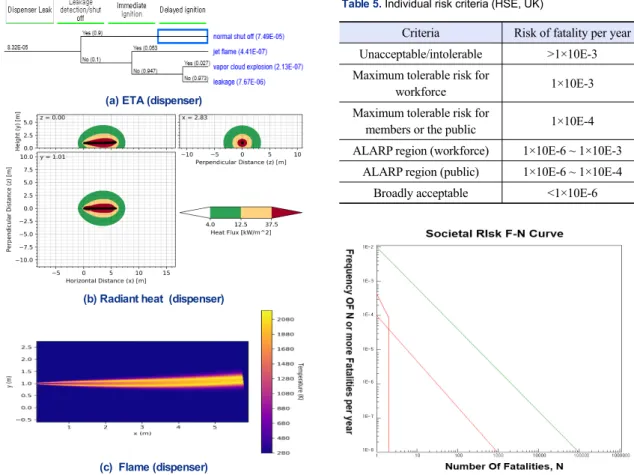
각 시설들의 위험성평가 조건에 따른 결과는 다음 과 같다. Figs. 2-8에서 나타낸 ETA/ HCA 해석을 통 해 화염길이와 복사열의 영향 범위를 확인할 수 있으 며, ETA의 점화확률은 SAND 2012- 10150(2012) 10) 을 참조하여 분석하였다 (Table 4).
ETA 분석 결과로부터 수소충전소의 가스 누출로 인해 발생 가능한 사고는 제트화재와 증기운 폭발임 을 알 수 있고 , 모든 시나리오에서 제트화재의 발생 가능성이 증기운 폭발보다 높게 나타나고 있다. 따라 서 수소충전소의 안전거리 설정에 있어서 제트화재 에 의한 피해범위가 주요 고려사항이라 할 수 있다 .
제트화재 해석 결과 누출크기와 압력이 클수록 화 염길이와 복사열이 미치는 영향이 크며, 특히 2차 압 축기에서의 피해영향이 가장 큰 것으로 나타났다 . 본
충전소 내에는 화기설비가 없어 화기와의 거리는 검 토 대상에서 제외 되었으며 , 사업소 경계와의 거리는 2차 압축기의 제트화재에 따른 복사열이 미치는 거 리인 10.6 m 이상 확보가 필요하다. 본 시설은 사업 소 경계와 15 m 이상의 이격거리를 확보하고 있고, 추가로 설비 주변에 방호벽을 설치하여 안전성을 강 화하였다 .
디스펜서로부터 발생한 제트화염의 피해범위는
7.5 m이고 본 시설은 디스펜서로부터 도로까지 23 m
이격거리를 확보하고 있어 안전성을 확보하고 있다 .
설비간의 이격거리 검토에서는 현재 압축기와 압축
가스설비가 방호벽 내의 공동 공간에 배치되어 있기
때문에 하나의 설비에서 사고 발생 시 다른 설비에
영향을 미칠 수 있다 . 주변의 방호벽으로 인해 외부
로의 영향은 차단이 가능하나 설비간 사고의 도미노
효과를 차단하기 위해서는 설비 사이의 격벽 설치를
통한 추가적인 안전조치가 필요할 것으로 보인다 .
(a) ETA (storage vessel_LOW)
(b) Radiant heat (storage vessel_LOW)
(c) Flame (storage vessel_LOW) Fig. 5. ETA and HCA analysis result (storage vessel_LOW)
(a) ETA (storage vessel_HIGH)
(b) Radiant heat (storage vessel_HIGH)
(c) Flame (storage vessel_HIGH) Fig. 7. ETA and HCA analysis result (storage vessel_HIGH) (a) ETA (2nd compressor)
(b) Radiant heat (2nd compressor)
(c) Flame (2nd compressor) Fig. 4. ETA and HCA analysis result (2nd compressor)
(a) ETA(Storage vessel_MID)
(b) Radiant heat (storage vessel_MID)
(c) Flame (storage vessel_MID)
Fig. 6. ETA and HCA analysis result (storage vessel_MID)
(a) ETA (dispenser)
(b) Radiant heat (dispenser)
(c) Flame (dispenser)
Fig. 8. ETA and HCA analysis result (dispenser) Fig. 9. Societal risk analysis results
Fig. 10. Individual risk contours
Table 5. Individual risk criteria (HSE, UK)
Criteria Risk of fatality per year Unacceptable/intolerable >1×10E-3 Maximum tolerable risk for
workforce 1×10E-3
Maximum tolerable risk for
members or the public 1×10E-4 ALARP region (workforce) 1×10E-6 ~ 1×10E-3
ALARP region (public) 1×10E-6 ~ 1×10E-4 Broadly acceptable <1×10E-6
5.2 QRA 해석 결과
QRA 해석 결과를 분석하기 위해 위험도 허용 기 준을 명시한 UK HSE 11) 자료를 참조하였다(Table 5).
본 연구 대상인 제조식 수소충전소의 개인적 위험 도(위험시설 주변에서 개인이 사상[死傷]할 수 있는 확률 ) 분석 결과, 작업자에 대한 허용 불가 영역 (>1×10E-3) 및 작업장 밖에서의 일반 대중에 대한 허용 불가 영역(>1×10E-4)은 나타나지 않았으며, 충 전소 주변의 인구현황 분포를 적용한 사회적 위험도 평가 결과 ALARP 영역(as low as reasonably practi- cable, 합리적으로 허용 가능한 범위) 및 완전 허용 가 능 구역 내에 분포하는 것으로 확인되었다 (Figs. 9, 10).
6. 결 론
본 연구는 제조식 수소충전소에 대해 국내에서 개 발한 위험성 평가프로그램인 Hy-KoRAM을 이용하 여 정량적 위험성평가를 수행하였다 . 각 시설의 위험 요인을 분석하기 위하여 국제표준(IEC 60079-10-1) 에서 제시하고 있는 2차 누출 조건을 적용하였으며, 수소충전소 사고에 따른 피해 범위 및 영향을 확인 하였다 . 연구결과를 요약하면 다음과 같다.
1) 피해영향분석에서 2차 압축기의 피해영향이 가장 큰 것으로 나타났으며 압축기와 압축가스 설비 가 방호벽 내의 공동 공간에 배치되어 있는 상태이 기 때문에 한 설비에서 사고 발생 시 다른 설비로 사 고가 전이 될 수 있어 격벽 등의 방호조치로 안전성 을 강화하는 것이 권장된다.
2) 본 연구의 대상인 제조식 수소충전소의 개인적 위험도 분석 결과 작업자에 대한 허용 불가 영역 (>1×10 -3 ) 및 작업장 밖에서의 일반 대중에 대한 허 용 불가 영역(>1×10 -4 )은 나타나지 않았으며, 충전소 주변의 인구현황 분포를 적용한 사회적 위험도 평가 결과 ALARP 영역 및 완전 허용 가능 구역 내에 분 포하는 것으로 확인되었다 .
후 기
본 연구는 산업통상자원부(MOTIE)와 한국에너지 기술평가원 (KETEP)의 지원을 받아 수행한 “수소충 전소 위험성평가(risk assessment)를 위한 소프트웨 어 개발” 연구과제입니다(20178520040490).
References
1. K. M. Groth, E. S. Hecht, and J. T. Reynolds, “Methodology for assessing the safety of hydrogen systems: HyRAM 1.0 technical reference manual”, Sandia Report, SAND2015- 10216, 2015.
2. B. W. Kang and T. H. Lee, “An investigation of hazard distance in a series of hydrogen jet fire with the hyram tools”, Trans. Korean Hydrogen New Energy Soc, Vol. 28, No. 2, 2017, pp. 166-173, doi: https://doi.org/10.7316/KHNES.
2017.28.2.166.
3. S. K. Kang, “A study of jet dispersion and jet-fire character- istics for safety distance of the hydrogen refueling station”, Journal of the Korean Institute of Gas, Vol. 23, No. 6, 2019, pp. 74-80, doi: https://doi.org/10.7842/kigas.2019.23.6.74.
4. “Review of 70MPa hydrogen station technical standards“, KHK, Japan, 2012.
5. Kosha Guide P-102-2013, “Technical guide on accident damage prediction techniques”, Korea Occupational Safety and Health Agency, 2013. Retrieved from https://www.kosha.or.kr.
6. IEC 60079-10-1, “Classification of areas-Explosive gas at- mospheres”, International Electrotechnical Commission, 2015. Retrieved from https://www.iec.ch.
7. KS C IEC 60079-10-1, “Classification of areas-explosive gas atmospheres”, Korean Standards Service Network, 2017.
8. KGS GC 101, “Classification code for explosive hazardous area on gas facility”, Korea Gas Safety Corporation, 2018.
Retrieved from https://cyber.kgs.or.kr/codesrc/kgscode_
pdf/2018/GC101_180712.pdf.
9. SAND2009-0874, “Analyses to support development of risk-informed separation distances for hydrogen codes and standards”, 2009. Retrieved from https://energy.sandia.gov/
wp-content/uploads/2018/05/SAND2009-0874-Analyses -to-Support-Development-of-Risk-Informed-Separation -Distances-for-Hydrogen-Codes-and-Standards.pdf.
10. SAND2012-10150, “Early-stage quantitative risk assess- ment to support development of codes and standard re- quirements for indoor fueling of hydrogen vehicles”, 2012.
11. HID CI5A, “Guidance on ALARP decisions in COMAH, United Kingdom health and safety executive(UK HSE)”, 2019.