주행모드별 경유 중형화물자동차의 온실가스 배출 특성 연구
홍희경⋅정택호⋅정성운⋅김선문⋅서석준⋅김인구⋅이상은⋅이승환⋅김정화⋅홍유덕⋅문선희†
국립환경과학원 교통환경연구소
A Study on the Emission Characteristics of Greenhouse Gas from Diesel Medium Duty Trucks According to Driving Modes
HEEKYOUNG HONG, TAEKHO CHUNG, SUNGWOON JUNG, SUNMOON KIM, SEOKJUN SEO, INGU KIM, SANGEUN LEE, SEOUNGHWAN LEE, JOUNGHWA KIM, YOUDEOG HONG, SUNHEE MUN
†Transportation pollution Research Center, National Institute of Environmental Research, 42 Hwangyoung-ro, Seo-gu, Incheon 22689, Korea
†Corresponding author : [email protected] Received 2 October, 2018 Revised 19 February, 2019 Accepted 28 February, 2019
Abstract >> This study was investigate the characteristics of GHGs (CO
2, CH
4, and N
2O) emissions of diesel medium duty trucks according to their various driving modes. GHGs emissions decreased as vehicle speed increased, and emissions in- creased after 64.7 km/h. The 4.5 ton trucks show higher values of CO
2, CH
4, N
2O, 35%, 25%, and 57%, respectively, comparing of the 2.5 ton trucks. Also, CO
2emis- sions under WHVC mode were 20% lower than those under the NEDC mode. In the case of cold start condition, CO
2emissions were 12-13% higher than those for hot start condition. In the future, the result of present study will provide basic data to set up GHGs emission standards for medium and heavy duty vehicles.
Key words :
Greenhouse gas(온실가스), Diesel medium duty trucks(경유 중형화물자 동차), Driving mode(주행모드), CO2(이산화탄소)1. 서 론
우리나라는 2030년 온실가스 배출량을 배출전망치 (business as usual, BAU) 대비 37% 감축목표를 발표 하였다(2015)1). 수송부문의 목표감축률은 24.6%로 전체 배출원 중 가장 높게 설정되었다. 환경부 소속 온실가스종합정보센터에서 발표한 우리나라의 2015년 온실가스 총 배출량은 690.2 백만 톤으로 에너지부문 이 차지하는 비율은 87.1%이며, 이 중 수송부문이 차
지하는 비율은 16%이다2).
자동차에서 배출되는 온실가스는 CO2, CH4, N2O 등이 있으며 이 중 CO2가 90% 이상 차지한다. 연료 의 연소에 의하여 배출되는 CO2는 연료소비율과 밀 접한 관계가 있고, CH4는 연료조성비와 관계가 있으 며 자동차 엔진의 불완전연소에 의하여 생성되고 촉매 장치에서 미처리된 메탄이 대기에 배출된다3). N2O는 공 기와 연료 중의 질소성분이 연소하여 발생하는Fuel NO 또는 Prompt NO의 중간 생성물질로서 고온연소
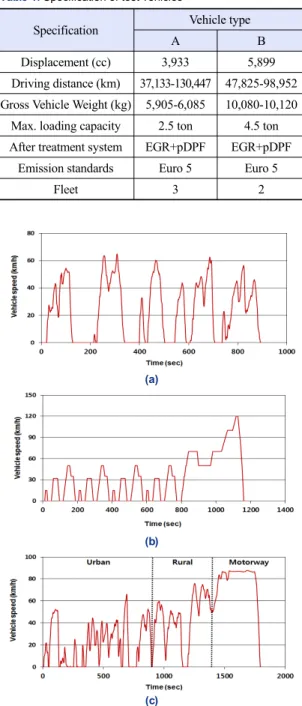
Table 1. Specification of test vehicles
Specification Vehicle type
A B
Displacement (cc) 3,933 5,899
Driving distance (km) 37,133-130,447 47,825-98,952 Gross Vehicle Weight (kg) 5,905-6,085 10,080-10,120
Max. loading capacity 2.5 ton 4.5 ton After treatment system EGR+pDPF EGR+pDPF
Emission standards Euro 5 Euro 5
Fleet 3 2
(a)
(b)
(c)
Fig. 1. Driving test modes: (a) NIER 7, (b) NEDC, (c) WHVC
시에는 N2O에서 NO로 전환된다고 알려져 있다4). Kim 등5)의 연구 결과에 따르면 경유 소형화물 자동차 의 온실가스 배출량은 차속모드인 NIER 모드로 시험 한 결과 차속이 증가할수록 감소 경향을 나타내었으 며, 각국의 온실가스 배출량 측정모드를 적용한 결과 유럽에서 적용하고 있는 NEDC 모드에서 가장 높은 경향을 보였다. 또한 Jeon 등6), Lyu 등7), Quiros 등8)에 의해서도 자동차에서 배출되는 온실가스에 대한 다 양한 연구들이 이루어지고 있다.
우리나라는 환경부 고시 제2017-225호 「자동차 평균에너지소비효율기준 온실가스 배출허용기준 및 기준의 적용 관리 등에 관한 고시」에 따라 승용자동차 및 승합자동차로서 승차인원이 15인승 이하이고 총 중 량이 3.5톤 미만인 자동차에 한하여 배출규제를 적용 하고 있으나, 소형자동차에 비하여 배기량과 중량이 크 고 1일 주행거리가 길어 차량대수가 적음에도 불구 하고 전체 자동차 온실가스의 약 30%를 차지하는 대 형자동차의 경우 규제가 이루어지고 있지 않다9).
이에 본 연구에서는 Euro 5 경유 중형화물자동차 를 대상으로 주행모드별 온실가스 배출 특성을 연구 하였으며 향후 중·대형자동차 온실가스 기준설정을 위한 기초자료로 활용하고자 한다.
2. 연구 방법
2.1 시험차량
본 연구에서는 국토교통부의 국내 자동차등록대수 자료를 이용하여 차종별 점유율을 고려하여 자동차 관리법에 따라 최대적재량 1톤 초과 5톤 미만인 Euro 5 기준의 2.5톤 3대, 4.5톤 2대의 차량을 선정, 화물적 재 중량 50%를 반영하여 각 2회씩 시험하였다. 시험 차량의 제원은 Table 1에 나타내었다.
2.2 시험모드
경유 중형화물자동차의 배출 특성을 분석하기 위 하여 적용한 시험모드는 국립환경과학원에서 국내 운행 조건을 반영하여 개발한 차속모드인 National
Institute of Environ-mental Research (NIER) 모드로 본 연구에 사용된 평균 차속은 4.7, 10.4, 23.5, 45.0, 64.7, 80.5, 94.8 km/h의 7개 모드이다. 또한 경유자 동차의 규제시험모드인 New European Driving Cycle (NEDC) 모드와 중·대형 트럭의 국제 표준화 모드인
Table 2. Specification of each driving modes Test mode
Driving distance
(km)
Average speed (km/h)
Maximum speed (km/h)
Driving time (sec)
NIER 1 1.19 4.7 29.4 908
NIER 3 2.70 10.4 48.4 937
NIER 7 5.82 23.5 64.8 891
NIER 10 11.94 45.0 79.8 955
NIER 12 16.08 64.7 85.4 866
NIER 13 18.35 80.5 93.6 782
NIER 14 22.17 94.8 109.5 801
NEDC 10.92 33.4 120.0 1,180
WHVC 20.06 40.2 87.8 1,800
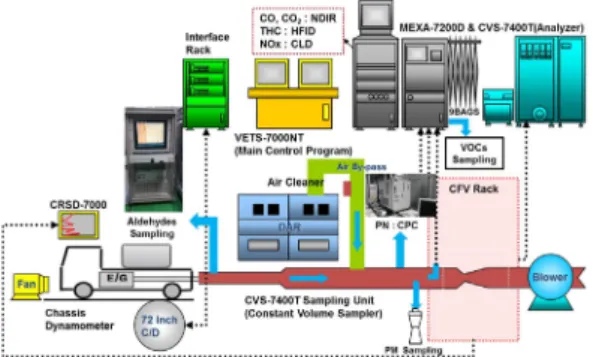
Fig. 2. Schematic diagram for vehicle exhaust emission test system
Fig. 3. Overview of chassis dynamometer
Worldwide Harmonized Vehicle Chassis dynamometer test (WHVC) 모드를 적용하여 분석하였다. NEDC 모드는 시내 주행모드와 고속도로 주행모드가 연속 으로 구성된 모드이며, WHVC 모드는 실도로 운행 특성을 반영하여 도시(urban), 교외(rural), 고속도로 (motorway)를 구성하여 만든 모드이다. 시험모드의 자세한 제원은 Fig. 1과 Table 2에 나타내었다.
2.3 시험장치
차대동력계는 가속, 감속, 정속, 정지 등의 실제 도로 주행을 모사하여 주행할 수 있도록 자동차에 부하를 주는 장치이며 차대동력계 배출가스 측정장치는 Fig. 2 와 같이 차대동력계, 보조운전장치, 희석터널, 입자 상물질측정장치, 정용량시료채취장치, 배기가스분석 기로 구성되어있다. 보조운전장치는 운전자가 자동차 로 도로에서 주행하는 상태로 운전할 수 있도록 화면 에 운행상태를 표시해주는 장치이며, 희석터널은 고 온에 의한 입자상물질의 변화를 배제시키고 대기 조 건으로 제어하기 위하여 시료채취 온도가 52℃ 이내 로 유지되도록 외부공기와 배기가스를 희석시키는 역 할을 한다. Fig. 3에 시험모습을 나타내었다.
2.4 시험 방법
시험차량이 차대동력계의 롤러 위에서 각 시험모 드를 주행할 때 배기관으로부터 배출되는 가스를 정 용량시료채취장치(constant volume sampler, CVS)에 서 일정량의 공기로 희석한 후 대형 시료채취백에 채취된 배출가스를 분석기로 분석하였다. CO2는 비 분산적외선분석법(nondipersive infraed, NDIR), CH4는 열식불꽃이온화검출기법(heated flame ionization de- tector, HFID)을 이용하였으며 배출량은 주행거리당 중량단위(g/km)로 환산하여 산정하였다.
N2O는 차량시험을 하는 동안 대형 시료채취백에 포집된 배출가스를 5 L 테들러백(tedlar bag)에 시료 채취하였으며 자동차 배출오염물질 외 희석공기도 동 시에 포집하였다. 시료는 pulsed discharge helium ion- ization detector (PDHID)가 부착된 gas chromatography를 이용하여 분석하였으며 Tables 3-5에 분석장비의 제
Table 3. Specifications of chassis dynamometer
Items Specification
Model AVL Chassis dynamometer 48” compact
Maximum force 10,096 N
Maximum calibration force 8,000 N
Maximum speed 200 km/h
Total inertia range 454-5,443 kg
Roller diameter 1,219.2 mm
Table 4. Specifications of exhaust gas analyzer
Pollutant Measuring method Measuring conc. range
CO2 NDIR 1, 2, 3, 6%
CH4 HFID 10, 20, 50, 500 ppm
Table 5. Analysis conditions of GC
Activity Analysis conditions
GC
Model Varian GC 450
Detector PDHID
Column CP-PoraPLOT Q
(50 m × 0.32 mm × 10 μm)
Column temp. 50℃
Injector temp. 100℃
Detector temp. 250℃
Sample flow 100 mL/min
(a)
(b)
(c)
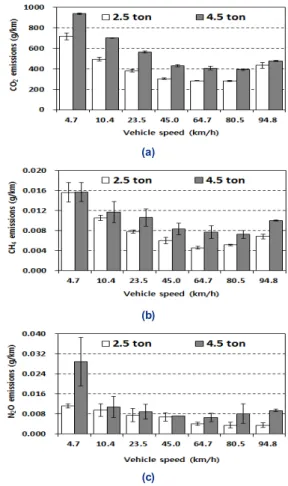
Fig. 4. Emission characteristics of GHGs according to vehicle speeds. (a) CO2, (b) CH4, (c) N2O
원과 분석 조건을 나타내었다.
3. 결과 및 고찰
3.1 차속별 온실가스 배출 특성
Fig. 4는 차속별 온실가스 배출 특성을 나타낸 그 림이다. 평균 차속이 증가할수록 CO2, CH4, N2O 배 출량은 감소하였고 일정차속(64.7 km/h) 이후에는 배출이 다소 증가하였다. 공회전 및 감속이 많은 저속 구간에서는 연료의 미연소로 인하여 주행거리 당 연료 소비량이 증가하여 CO2가 많이 배출되었고, 차속이 증 가하면서 연료의 완전연소 가능성이 커져 CO2 배출량 이 감소한 것으로 판단된다. CH4는 저속주행시 낮은
공연비로 인하여 산소부족으로 연소효율이 낮아지고 불완전연소가 생성되면서 배출량이 많아지고6) 고속에 서는 연소실 온도가 상승하면서 촉매가 활성화되어 CH4 배출량이 감소한 것으로 판단된다. N2O는 당량비 와 실린더온도에 의하여 크게 영향을 받으며10) NOx 의 불완전환원에 의하여 생성된다. 고속에서 증가하는 N2O는 엔진의 고온에 따른 thermal NOx에 의한 것으 로 사료된다. NOx는 대부분이 thermal NOx에 기인하 는데 이것은 주로 연소온도 및 연소영역에서 산소의 농도가 높을 때, 고온영역에서 연소가스의 체류시간이 길 때 많이 발생한다고 알려져 있다11). 차량중량이 증가 하면 도로 마찰력 등에 의하여 엔진에 가해지는 부하 량이 증가함에 따라 연료소비량이 많아진다. 이에 따 라 2.5톤 대비 4.5톤 차량에서 CO2 35%, CH4 25%,
(a)
(b)
(c)
2.5 ton vehicle 4.5 ton vehicle
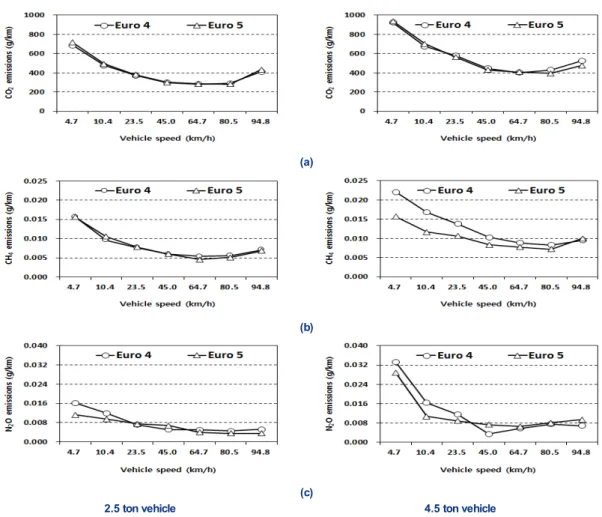
Fig. 5. Comparison of GHGs emissions according to emission standards. (a) CO2, (b) CH4, (c) N2O
N2O 57% 배출량이 증가하는 것을 확인하였다.
Fig. 5는 기존 Euro 4 경유 중형화물자동차의 측정 자료12)를 일부 활용하여 자동차 규제물질 배출허용 기준 강화에 따른 온실가스 배출 특성을 나타낸 그림 이다. Euro 4 대비 Euro 5 차량은 물질별 차이를 보이며 배출량이 감소하였으나 감소폭이 크지 않고 CH4과 N2O는 배출수준이 낮아 배출허용기준 강화가 온실가 스 배출 저감에 미치는 영향은 크지 않다고 보여진다.
3.2 주행모드 및 시동 조건에 따른 CO2 배출 특성
Fig. 6에 경유자동차 규제모드와 국제표준화 주행 모드의 CO2 결과를 나타내었다. 모드 전반적으로 차량 중량이 증가함에 따라 CO2 배출량은 약 47-48% 증가
함을 확인하였으며, 이는 차량중량에 따른 연료소비율의 증가에 따른 것으로 판단된다. 2.5톤 및 4.5톤 차량은 NEDC 모드 대비 WHVC 모드에서 약 20% 낮게 배출 되었다. 이는 NEDC 모드와 WHVC 모드의 평균 속도 가 각각 33.4 km/h, 40.2 km/h로 약 1.2배 차이로 인한 결 과로 판단되며, WHVC 모드의 높은 평균 속도는 내연 기관 효율의 증가를 나타내기 때문에13) 이러한 영향이 CO2 배출에도 영향을 미친 것으로 보여진다.
시동 조건에 따른 CO2 변화 수준을 확인하기 위하 여 시험차량을 일정한 온도/시간(25±5℃, over 12-36 hours) 동안 충분히 안정화 후 도심지역의 평균 차속 을 고려하여 NIER 7 모드를 적용하여 시험하였으며 Fig. 7에 열간 및 냉간시동 조건에서의 CO2 결과를 나타내었다. 그 결과, 냉간시동시 약 12-13% 배출량
(a)
(b)
Fig. 8. CO2 emissions and fuel efficiency according to vehicle speeds. (a) 2.5 ton vehicle, (b) 4.5 ton vehicle
Fig. 6. Characteristics of CO2 emissions under NEDC and WHVC modes
Fig. 7. Characteristics of CO2 emissions for cold and hot start conditions
이 증가하였다. 자동차는 냉간시동시 연소실의 낮은 분위 기온도 및 배출가스저감장치의 촉매활성화온도(light-off temperature) 미도달 등의 이유로 인하여 연소효율 저 하와 배출가스의 과다배출현상이 발생한다. 이러한 현 상을 개선하기 위하여 자동차 제작사에서는 냉간시동 초기에 비교적 기존 연료분사량 수준보다 높게 설정 하여 연소와 배출가스 개선에 유리한 온도 조건을 확보 하고 있으며, 이와 같은 이유로 인하여CO2 배출량이 증가한 것으로 판단된다.
3.3 CO2와 연비
Fig. 8에 CO2 배출량과 연비를 비교하여 나타내었다.
자동차에서 배출되는 CO2는 차량의 연비와 반비례 하는 등 연료소비와 밀접한 상관관계를 가지며 연비가 좋을수록 CO2 배출량은 감소하는 경향을 나타냈다. 2.5 톤 차량의 CO2는 716 g/km (4.7 km/h)에서 282 g/km (80.5 km/h)로 61% 감소하는 반면 연비는 2.5배 향상 되었으며, 4.5톤 차량의 CO2는 939 g/km (4.7 km/h)
에서 395 g/km (80.5 km/h)로 58% 감소하는 반면 연비는 2.4배 향상되었다. 두 차량 모두 94.8 km/h에 서는 다시 CO2 배출이 증가하고 연비는 낮아졌다.
전체 속도 구간 중 64.7-80.5 km/h 구간이 CO2 배출 과 연비의 효율이 가장 높은 주행속도 구간으로 판 단된다.
4. 결 론
본 연구에서는 경유 중형화물자동차를 대상으로 다양한 주행모드를 사용하여 각 모드에 대한 온실가스 배출 특성을 분석하였으며, 다음과 같은 결론을 얻었다.
1) 차속별 온실가스 배출 특성 결과 평균 차속이 증 가할수록 CO2, CH4, N2O 배출량은 감소하였고 일정 차속(64.7 km/h) 이후에는 배출량이 다소 증가하였다.
2) 주행모드에 따른 CO2 배출 특성 결과 NEDC 모 드 대비 WHVC 모드에서 약 20% 낮게 배출되었다.
3) 열간 및 냉간시동 조건에 따른 CO2 배출 특성 결과 냉간시동시 약 12-13% 배출량 증가를 확인하
였다.
4) CO2와 연비를 비교한 결과 차속이 4.7 km/h에 서 80.5 km/h로 증가하는 동안 두 차량은 CO2의 감 소와 연비의 증가가 뚜렷하게 나타났으며, 94.8 km/h 에서는 다시 CO2 배출이 증가하고 연비는 낮아졌다.
후 기
본 논문은 환경부의 재원으로 국립환경과학원의 지원을 받아 수행하였다(2013 자동차 온실가스 및 대기오염물질 통합관리 시스템구축 Ⅵ).
References
1. Ministry of Environment, “Korea's greenhouse gas reduction target is set at 37% in preparation for BAU(851 million tons) in 2030”, Ministry of Environment, Korea, 2015. Retrieved from http://www.me.go.kr/home/web/board/read.do?pag erOffset=0&maxPageItems=10&maxIndexPages=10&sea rchKey=title&searchValue=2030%EB%85%84&menuId
=286&orgCd=&boardId=534080&boardMasterId=1&bo ardCategoryId=39&decorator=.
2. Greenhouse Gas Inventory and Research Center, “National Greenhouse Gas Inventory Report of Korea”, Greenhouse Gas Inventory and Research Center, Korea, 2017. Retrieved from http://www.gir.go.kr/home/board/read.do?pagerOffs et=0&maxPageItems=10&maxIndexPages=10&searchKey
=&searchValue=&menuId=36&boardId=41&boardMaste rId=2&boardCategoryId=.
3. D. M. Lee, “A Study on the Characteristics of Air Pollutand and Greenhouse Gas Emissions from Diesel and CNG Urban BUSes in Korea”, Inha University Graduate School of Engineering, Korea, 2010. Retrieved from http://dcollection.
inha.ac.kr/public_resource/pdf/000000004809_2019022113 1206.pdf.
4. J. A. Miller and C. T. Bowman, “Mechanism and modeling of nitrogen chemistry in combustion”, Process in Energy and Combustion Science, Vol. 15, No. 4, 1989, pp. 287-338, doi: https://doi.org/10.1016/0360-1285(89)90017-8.
5. J. Y. Kim, C. Seo, J. Son, J. Park, T. Moon, S. Lee, and J. Kim,
“A Study of Greenhouse Gas Emission rates from LDTs according to emission Certification Modes and Real-World
Vehicle Driving Cycles in Korea”, Climate Change Research, Vol. 3, No. 4, 2012, pp. 235-243. Retrieved from http://kscc.
re.kr/journal/journal_download.php?art_id=115.
6. M. S. Jeon, J. H. Ryu, Y. S. Lyu, J. C. Kim, C. S. Lim, D. W.
Kim, S. W. Jeong, and S. Y. Cho, “A Study on Characteristics of Methane Emission from Gasoline Passenger Cars”, Journal of Korean Society for Atmospheric Environment, Vol. 21, No. 6, 2005, pp. 649-655. Retrieved from http://www.koreascience.or.kr/article/JAKO20051172256 9708.page.
7. Y. S. Lyu, J. H. Ryu, S. W. Jung, M. S. Jeon, D. W. Kim, M. D.
Eom, and J. C. Kim, “A Study on the Characteristics of Carbon Dioxide Emissions from Gasoline Passenger Cars”, Transactions of KSAE, Vol. 15, No. 2, 2007, pp. 58-64.
Retrieved from http://www.koreascience.or.kr/article/
JAKO200714364029768.page.
8. D. C. Quiros, J. Smith, A. Thiruvengadam, T. Huai, and S.
Hu, “Greenhouse gas emissions from heavy-duty natural gas, hybrid, and conventional diesel on-road trucks during freight transport”, Atmospheric Environment, Vol. 168, 2017, pp. 36-45, doi: https://doi.org/10.1016/j.atmosenv.
2017.08.066.
9. NIER, “The study on the development of measure ment method about greenhouse gas of heavy duty vehicle”, NIER, Korea, 2011. Retrieved from http://ecolibrary.me.go.kr/nier/
search/DetailView.ax?sid=15&cid=5511361.
10. J. Ko, J. Son, C. L. Myung, and S. Park, “Comparative study on low ambient temperature regulated/unregulated emis- sions characteristics of idling light-duty diesel vehicles at cold start and hot restart”, Fuel, Vol. 233, 2018, pp. 620-631, doi: https://doi.org/10.1016/j.fuel.2018.05.144.
11. B. H. Lee, D. I. Seol, Y. J. Chang, and C. H. Jeon, “A numer- ical study on internal combustion characteristics of diesel engine”, Korean Society of Automotive Engineers, Korea, 2007, pp. 118-124. Retrieved from http://www.dbpia.co.kr/
Journal/ArticleDetail/NODE00982364.
12. NIER, “Establishment of GHGs & Air Pollutants Integrated Management System for ransportation Sector(Ⅵ)”, NIER, Korea, 2013. Retrieved from http://ecolibrary.me.go.kr/nier/
search/DetailView.ax?sid=15&cid=5577543.
13. S. J. Kwon, J. P. Cha, D. M. Seo, W. Kang, Y. H. Seo, and S. W.
Park, “Experimental measurement of energy consumption efficiency of Medium-Heavy duty vehicle and Impact of fuel consumption by each of driving modes”, Korean Society of Automotive Engineers, Korea, 2013, pp. 828-831. Retrieved from http://www.dbpia.co.kr/Article/NODE02174828.