논문 2011-48CI-6-15
시드 정제 기술을 이용한 웹 스팸 필터링의 품질 향상
( Improving the Quality of Web Spam Filtering by Using Seed Refinement )
무하마드 아티프 쿠레시*, 윤 태 섭*, 이 정 훈**, 황 규 영****
( Muhammad Atif Qureshi, Tae-Seob Yun, Jeong-Hoon Lee, and Kyu-Young Whang )
요 약
웹 스팸은 중요하지 않은 웹 페이지들의 중요도를 승격시키기 때문에 웹 검색 결과의 품질에 중대한 영향을 준다. 따라서 웹 검색 엔진은 웹 스팸을 제거할 필요가 있다. 웹 스팸 필터링은 스팸 페이지들, 즉 웹 스팸에 기여하는 웹 페이지들을 식별 하는 것이며, 잘 알려진 웹 스팸 필터링 알고리즘으로는 Trust Rank, Anti-Trust Rank, Spam Mass, 그리고 Link Farm Spam이 있다. 이러한 알고리즘들의 결과 품질은 입력 시드(input seed)에 따라 달라진다. 따라서 입력 시드를 정제(refinement) 함으로써, 웹 스팸 필터링의 품질을 향상 시킬 수 있다. 본 논문에서는 잘 알려진 네 가지 알고리즘에 대한 시드를 정제하는 기술을 제안한다. 다음으로, 이러한 기술을 원(original) 알고리즘에 각각 적용하는 방법으로 알고리즘을 수정한다. 이를 수정된 웹 스팸 필터링 알고리즘이라고 부른다. 본 논문에서는 또한, 웹 스팸 필터링을 좀 더 향상시키기 위한 전략을 제안한다. 이 전략에서는 수정된 알고리즘들을 수행 순서상의 적절한 위치에 배치함으로써 알고리즘들의 상호간 지원을 통해 전체적으로 성 능을 향상시키는 가능성을 고려한다. 마지막으로, 실험에서는 시드 정제의 효과를 보인다. 이를 위해, 먼저, 수정된 알고리즘의 웹 스팸 필터링 품질이 원 알고리즘의 품질보다 더 우수함을 보인다. 다음으로, 웹 스팸 필터링 알고리즘들이 수행되는 순서의 조합 중 가장 성능이 우수한 조합이 가장 뛰어난 잘 알려진 알고리즘과 비교하여 정확도(precision)를 유지하면서 파라미터의 전형적인 값 범위 내에서 재현율(recall)은 최대 1.38배까지 높게 향상됨을 보인다.
Abstract
Web spam has a significant influence on the ranking quality of web search results because it promotes unimportant web pages. Therefore, web search engines need to filter web spam. web spam filtering is a concept that identifies spam pages ⎯ web pages contributing to web spam. TrustRank, Anti-TrustRank, Spam Mass, and Link Farm Spam are well-known web spam filtering algorithms in the research literature. The output of these algorithms depends upon the input seed. Thus, refinement in the input seed may lead to improvement in the quality of web spam filtering. In this paper, we propose seed refinement techniques for the four well-known spam filtering algorithms. Then, we modify algorithms, which we call modified spam filtering algorithms, by applying these techniques to the original ones. In addition, we propose a strategy to achieve better quality for web spam filtering. In this strategy, we consider the possibility that the modified algorithms may support one another if placed in appropriate succession. In the experiments we show the effect of seed refinement. For this goal, we first show that our modified algorithms outperform the respective original algorithms in terms of the quality of web spam filtering. Then, we show that the best succession significantly outperforms the best known original and the best modified algorithms by up to 1.38 times within typical value ranges of parameters in terms ofrecall while preservingprecision.
Keywords : 웹 스팸 필터링, 입력 시드 정제, 링크 스팸, 성능
* 학생회원, ** 학생회원-교신저자, *** 평생회원, 한국과 학기술원 전산학과
(Dept. of Computer Science, Korea Advanced Institute of Science and Technology)
※ 이 논문은 2011년도 정부(교육과학기술부)의 재원으 로 한국연구재단의 지원을 받아 수행된 연구임(No.
2011-0020498).
접수일자: 2011년7월20일, 수정완료일: 2011년11월1일
Ⅰ. Introduction
World Wide Web(WWW) is a huge information resource, and it doubles in less than two years[1]. Thus, it would be difficult to find information from WWW without search assistance. A web search engine is a search system for retrieving relevant web
pages for the user's queries from the WWW[2]. Google[3], Yahoo[4], MS Bing[5], and Naver[6] are popular examples of web search engines.
A web search engine usually returns a huge amount of relevant web pages for the user's query[7,
8]. However, the user wants to browse the most important ones[7]. Thus, the web search engine arranges the relevant web pages in the order of their importance[1]. For this the web search engine utilizes a ranking method[1].
Link-based ranking methods are prevalent in popular web search engines[2, 9~10] such as Google, Yahoo, and MS Bing[10]. These methods exploit the link structure of web for ranking the search results[1]. However, the methods suffer from link spam[11], which is the type of web spam that takes advantage of the link structure of web in order to boost importance of one or more unimportant web pages[11,
12]. In order to filter out link spam, many link spam filtering algorithms have been proposed[13~16]. However, the algorithms do not perform well if the seed given to the algorithms is not good because they are dependent upon the seed. Thus, if the seed is well refined, the quality of the spam filtering algorithms will get improved. So far, much research has been done on the link spam filtering algorithms.
However, research on seed refinement techniques has been less than adequate.
In this paper, we propose input seed refinement techniques for four well-known web spam filtering algorithms i.e., TrustRank[14], Anti-TrustRank[15], Spam Mass[13], and Link Farm Spam[16]. The contributions of the paper are as follows. First, we propose the modified algorithms for four web spam filtering algorithms by making use of additional input seed sets. Specifically, the four web spam filtering algorithms use at most one type of seed set(either for spam or non-spam). However, we modify these algorithms to use both types of input seed sets(i.e., seed sets for spam and non-spam) to detect more web spam. Next, we propose a strategy that arranges the execution sequence of our modified algorithms in order to achieve better quality of web spam filtering.
Finally, we conduct extensive experiments to show the effect of seed refinement. We first show the quality improvement of our algorithms compared to the corresponding original ones. Then, we evaluate the best succession among our algorithms.
The rest of this paper is organized as follows. In Section Ⅱ, we introduce the web graph model, PageRank, and link spam. In Section Ⅲ, we introduce the four well-known web spam filtering algorithms.
In Section Ⅳ, we explain our modifications in the four well-known algorithms and investigate successions among them. In Section Ⅴ, we show the results of our evaluation. In Section Ⅵ, we conclude the paper.
Ⅱ. Preliminary
In this section, we introduce a graph model for web: web graph model. Then, we explain the PageRank algorithm, which is a popular link-based ranking algorithm[17]. Finally, we explain link spam.
2.1. Web Graph Model
Web can be modeled as a directed graph
consisting of a set of web nodes (vertices) and a set of directed links(edges)[14]. Directed links are classified into inlinks and outlinks. Inlinks are those incoming to a web node, and outlinks are those outgoing from a web node[14]. Fig.1 shows an example of a web graph. In this figure A, B, and C represent web nodes while the arrows represent the links. and are the outlinks of the web nodes A and B, respectively. and
are the inlinks of the web nodes B and C, respectively.
The web graph can be classified into two classes:
V = {A, B, C}
E = {AB, BC}
AB is a n outlink of the web node A BC is a n outlink of the web node B AB is a n inlink of the web node B BC is a n inlink of the web node C
A B C
그림 1. 웹 그래프의 예
Fig. 1. An example of a web graph.
page-level and domain-level web graphs[13, 15~16]. In a page-level web graph, a web node represents page information(e.g., cnn.com/index.html), and a directed link represents a link(i.e., URL) contained in a web page. In a domain-level web graph, a domain(e.g., cnn.com) of web pages is represented by a web node, as a link represents all the inlinks or outlinks to or from this domain from or to another domain[18]. In addition, algorithms on a domain-level web graph are more scalable compared to a page-level web graph, and the well-known web spam filtering algorithms[13~
14, 16] use domain-level web graphs.
2.2. PageRank
PageRank[2, 17] is a well-known link-based ranking algorithm that exploits the link information to assign global importance score to the entire web[14, 17, 19]. The basic idea of PageRank is that a web page is important if it is inlinked by many other pages. The PageRank score of a web page is computed as in Eq.(1)[17]:
·
∈
· (1)
In Eq.(1), PR[p] denotes the PageRank score of the web page p; d is the damping factor, which is the probability of following an outlink; Noutlink(q) is the number of outlinks of the web page q; v[p] is the probability that a user randomly jumps from p to any arbitrary web page. The probability is uniform and is defined as reciprocal to the total number of web pages[17]. The PageRank algorithm can be applied to rank domains by using a domain-level web graph in place of a page-level web graph[13].
2.3. Link Spam
Web spam is a deliberate action performed in order to boost a web page's ranking without improving its real merit[11, 15, 20]. Link spam is an action that changes the link structure of web in order to boost a web page's ranking[11]. Fig.2 shows an example of link spam.
In this figure, there are eleven domains from D1 to
D1 D4
D3 D2
D5
D9
D7 D6 D10
D8
D11
Doma in Link
그림 2. 링크 스팸의 예
Fig. 2. An example of link spam.
D11. The domains D3 to D8 contain pages that outlink to pages of the domain D1. This link structure is created in order to provide undue advantage to the pages of the domain D1, i.e., to make those pages look important because they are inlinked by many pages of different domains. The domains D1 and D3 to D8 are involved in web spam.
However, the domains D2, D9, D10, and D11 are not participating in web spam. The domains that are involved in web spam are known as spam domains while the rest are known as non-spam domains.
Ⅲ. Related Work
In this section, we review four well-known web spam filtering algorithms. In Section 3.1 we present a brief overview of classification(i.e., seed generators and spam detectors) of the four well-known algorithms. In Section 3.2 we describe TrustRank that promotes non-spam domains and Anti-TrustRank that demotes spam domains as seed generators. In Section 3.3 we describe Spam Mass and Link Farm Spam, which are spam detectors.
3.1. Overview
Web spam filtering is an action to identify web spam. To achieve this goal, existing work makes use of the link structure of web, manually declared spam or non-spam domains(simply, the input seed set), and additional information for declaring spam or non-spam domains. Research on web spam filtering is classified into two approaches: one of evaluating badness(or goodness) of domains by using only the input seed set and the other of identifying spam
domains by exploiting additional properties of web spam. It is well known that, though the former can identify web spam, the quality of the results is insufficient[13, 15]. The latter detects more spam domains than the former because it adopts techniques uncovering boosting activity explained in Section 2.3.
However, the former may help generate the refined input seed set, which can be used as the input of the latter. We expect that the refined input may help improve the quality of web spam filtering. Based on this expectation, we classify web spam filtering algorithms into two types of algorithms: seed generation algorithms(simply, seed generators) and spam detection algorithms(simply, spam detectors).
3.2. Seed Generation Algorithms
3.2.1. Trust Rank
TrustRank[14] exploits the outlink information of trusted domains, which are defined as well-known non-spam domains such as .gov and .edu. TrustRank begins by taking as the input a seed set of non-spam domains. Then, it propagates trust scores of the non-spam domains to the outlinks of the domains while attenuating by the damping factor as defined in Section 2.2. Finally, a threshold value is chosen, and all domains whose trust scores fall above this value are declared as new non-spam domains.
3.2.2. Anti-Trust Rank
Anti-TrustRank[15] exploits the inlink information of the spam domains that are provided as the input seed. Anti-TrustRank propagates anti-trust scores of the spam domains to their inlinks(i.e., in the reverse direction) while attenuating by the damping factor.
Finally, a threshold value is chosen, and all domains whose anti-trust scores fall above this value are declared as new spam domains.
3.3. Spam Detection Algorithms
3.3.1. Spam Mass
Spam Mass[13] exploits both the scores coming
from spam and non-spam domains[11]. The spam score is estimated by subtracting the non-spam score from the overall score. TrustRank is used to calculate the non-spam score, and the overall score is calculated by PageRank. The basic assumption of this algorithm is that a spam domain usually gets a high score from suspicious domains, which are not trusted by TrustRank. Under the assumption, this algorithm declares a domain that receives excessively higher PageRank score compared to the trust score as a spam domain.
3.3.2. Link Farm Spam
Link Farm Spam[16] exploits bidirectional links and outlinks of domains. That is, if a domain has many bidirectional links or many outlinks to spam domains, the domain is declared as a spam domain. Link Farm Spam begins by finding bidirectional links among domains and marks a domain as a spam if the number of bidirectional links of the domain is equal to or greater than a given threshold. Then, the algorithm attempts to find more spam domains by observing outlinks and marks a domain as a spam if the number of its outlinks to spam domains is equal to or greater than another threshold. We denote the threshold dealing with bidirectional links by limitBL and that dealing with outlinks by limitOL.
Ⅳ. Input Seed Refinement for Web Spam Filtering Algorithms
In this section, we propose modifications of four web spam filtering algorithms. We also propose a strategy for determining the succession(i.e., the execution sequence) of our modified algorithms in order to get better quality of web spam filtering.
4.1. Overview
The objective of seed refinement for web spam filtering is to improve the quality of web spam filtering. Specifically, the objective is to maximize the correct detections over the total detections(simply, precision[21]), to maximize the fraction of the correct
detections over entire spam or non-spam population(simply, recall[21]), or both.
In Section Ⅲ, we have observed that the existing spam filtering algorithms depend on the input seed set. However, they utilize only one type of the input seed set belonging to either spam or non-spam seed domain. Thus, if both types are provided as input seed sets to the algorithms, it may improve the quality of web spam filtering. Furthermore, an output from one algorithm can become the input to the other algorithm. Thus, the effective succession between these algorithms may lead to further improvement.
4.2. Seed Generation Algorithms
4.2.1. Modified TrustRank
TrustRank takes as the input seed set a set of trusted domains. This algorithm may promote spam domains since trusted(i.e., non-spam) domains can outlink to spam domains. For example, a trusted university domain may outlink to a student's domain which may in turn outlink to a honey pot*. In Fig.3, the domain 1 represents the university's domain, the domain 3 represents the student's domain, and the domains 5 and 6 are the part of a honey pot.
In Fig.3, we observe that the spam domains 5 and 6 receive high trust scores because the domain 3 is deceived by the domain 5. In order to overcome this potential shortcoming caused by outlinking from a non-spam domain to a spam domain, we add another seed set of known spam domains, which serves as an
1
2
3
1/2 t(1)=1
t(2)=1
t(3)=5/6 1/2
1/3 1/3
1/3
5/12
5/12
a seed non-spam domain
t(i): the trust score of the domain i The domains 5 and 6 are
involved in web spam.
a domain being considered t(5)=5/12 +
…
5 6
4
t(4)=1/3
t(6)=5/12 +
… 5/12
5/12
그림 3. 스팸 도메인에 높은 신뢰 점수를 부여하는 TrustRank의 예
Fig. 3. An example of TrustRank giving high trust scores to spam domains.
* Honey pot is a set of pages which provide some useful information(e.g., Unix documentation pages) but have hidden outlinks to spam pages[20].
Input:
a seed set of non-spam domains N a seed set of spam domains S the threshold cutoff the difference threshold ε web graph G= (V, E) Output:
a set of non-spam domains ON
trust score vector of all domains Tordered
Algorithm:
1. FOR EACH d ∈ V 2. IF d ∈ N THEN 3.
4. ELSE 5. T0[d] = 0 6. i = 0 7. DO
8. FOR EACH d ∈ V 9. FOR EACH (d, q) ∈ E 10. IF q ∉ S THEN 11.
12. FOR EACH d ∈ V 13.
14. Δ = | Ti+1 - Ti | 15. i = i + 1 16. UNTIL Δ < ε
17. Tordered = Sort Ti+1 by trust scores in the descending order 18. ON = the set of domains with highest trust scores within cutoff 19. Remove domains whose trust score = 0 from ON
20. RETURN ON, Tordered
1 size(N) T0[d] =
Ti[d]
damp × +
= Ti+1[q] Ti+1[q]
Noutlink(d)
).
1
( damp Ti[d]
Ti+1[d] T= i+1[d] + -
그림 4. 수정된 TrustRank 알고리즘 Fig. 4. Modified TrustRank algorithm.
exception list, so that the links to the spam domains do not contribute to the trust scores of the domains.
Fig.4 shows the algorithm of Modified TrustRank.
Inputs to the algorithm are a set of non-spam domains N, a set of spam domains S, the threshold value cutoff, the difference threshold ε, and web graph G. Hereafter, we use these inputs for other algorithms as well unless we explicitly specify different inputs. The output is a set of non-spam domains ON and the trust score vector of all domains Torderd. The threshold cutoff is used for determining the non-spam domains at the end of the algorithm[14,
15]. This threshold is defined relative to the size of the non-spam input seed set so that top cutoff percent of domains with the high trust scores are declared as non-spam domains. For example, if cutoff
= 100%, the number of domains declared as non-spam domains is equal to that of the non-spam seed set under the ideal assumption that every domain declared as non-spam has a non-zero trust score because the score is affected by trust scores propagated from the non-spam seed set. We define this case as the base case for TrustRank and
Modified TrustRank. In fact, the size of domains declared as non-spam domains is less than or equal to that of the non-spam seed set because we remove the domains whose trust score = 0 from the domains declared as non-spam. Compared with original TrustRank algorithm, the modified algorithm additionally gets the set of spam domains S as an input seed set and uses it for preventing scores of non-spam domains from propagating to spam domains(lines 10-11). The algorithm first initializes the trust scores of all domains by assigning a uniform value 1/size(N) to every non-spam domain N and zero to the rest of domains(lines 1-5). Then, it iteratively calculates trust scores until the difference between the two consecutive trust score vectors is less than ε(lines 7-16). Specifically, the algorithm uniformly distributes trust scores of domains to their outlinks pointing to all domains except spam domains while taking the damping factor into account(lines 8-11). Here, Noutlink(d) represents the number of outlinks of the domain d(line 11). Then, the algorithm assigns the random jump value to all domains according to their trust scores(lines 12-13). All the domains are arranged in the descending order of their trust scores(line 17), and then, the algorithm picks domains with the highest trust scores that are determined by cutoff defined earlier and adds the domains to ON(line 18). Then, the domains with a zero trust score are removed from ON(line 19).
Finally, the algorithm returns ON and Tordered(line 20).
4.2.2. Modified Anti-TrustRank
Anti-TrustRank takes as the input seed set a set of spam domains. The algorithm may demote non-spam domains that point to spam domains such as honey pots as mentioned in Section 4.2.1.
Fig.5 shows the algorithm of Modified Anti-TrustRank. The output is a set of spam domains OS and the anti-trust score vector of all domains ATordered. The threshold cutoff is used for determining the spam domains at the end of the algorithm[15]. This threshold is defined relative to the size of the spam input seed set so that top cutoff
Input:
a seed set of non-spam domains N a seed set of spam domains S the threshold cutoff the difference threshold Δ web graph G= (V, E) Output:
a set of spam domains OS
anti-trust score vector of all domains ATordered
Algorithm:
1. FOR EACH d ∈ V 2. IF d ∈ S THEN 3.
4. ELSE 5. AT0[d] = 0 6. i = 0 7. DO
8. FOR EACH d ∈ V 9. FOR EACH (q ,d) ∈ E 10. IF q ∉ N THEN
11.
12. FOR EACH d ∈ V 13.
14. Δ = | ATi+1 - ATi | 15. i = i + 1 16. UNTIL Δ < ε
17. ATordered = Sort ATi+1 by anti-trust scores in the descending order 18. OS = the set of domains with the highest anti-trust score within cutoff 19. Remove domains whose anti-trust score = 0 from OS
20. RETURN OS, ATordered
] [ ) 1 ( ] [ ]
[ 1
1d AT d damp ATd
ATi+ = i+ + - × i
) (
] ] [
[ ]
[ 1
1
d N
d damp AT q AT q AT
inlink i i
i+ = + + ×
1 size(S) AT0[d]=
그림 5. 수정된 Anti-TrustRank 알고리즘 Fig. 5. Modified Anti-TrustRank algorithm.
percent of domains with the high anti-trust scores are declared as spam domains. For example, if cutoff
= 100%, the number of domains declared as spam domains is equal to that of the spam seed set under the assumption similar to what we made in Section 4.2.1 except that this assumption is based on the spam seed set and anti-trust score. We define this case as the base case for Anti-TrustRank and Modified Anti-TrustRank. Compared with original Anti-TrustRank algorithm, the modified algorithm additionally gets the set of non-spam domains N as an input seed set and uses it for preventing anti-trust scores of spam domains from propagating to non-spam domains(lines 10-11). The proposed algorithm first initializes the anti-trust scores of all domains by assigning a uniform value 1/size(S) to every spam domain S and zero to the rest of domains(lines 1-5). Then, it iteratively calculates anti-trust scores until the difference between the two consecutive anti-trust score vectors is less than ε (lines 7-16). Specifically, the algorithm uniformly distributes anti-trust scores of domains to their inlinks pointing to all domains except non-spam domains while taking the damping factor into
account(lines 8-11). Here, Ninlink(d) represents the number of inlinks of the domain d(line 11). Then, the algorithm assigns the random jump value to all domains according to their anti-trust scores(lines 12-13). All the domains are arranged in the descending order of their anti-trust scores(line 17), and then, the algorithm picks domains with the highest anti-trust scores that are determined by cutoff and adds the domains to OS(line 18). Then, domains with a zero anti-trust score are removed from OS(line 19). Finally, the algorithm returns OS
and ATordered(line 20).
4.3. Spam Detection Algorithms
4.3.1. Modified Spam Mass
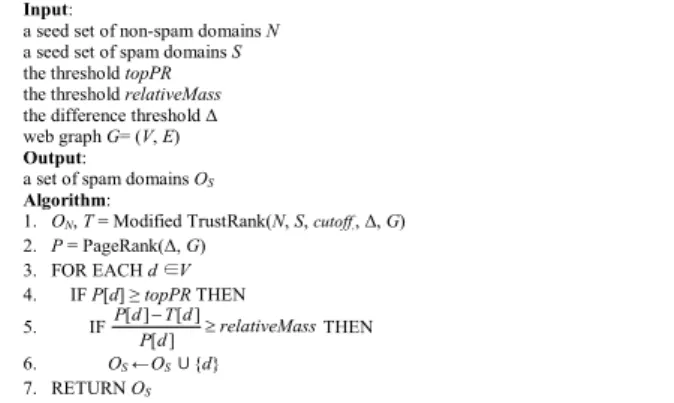
Spam Mass uses TrustRank for determining spam domains so it suffers from the same problem as explained in Section 4.2.1. Thus, we substitute Modified TrustRank in place of TrustRank for performing Modified Spam Mass. Fig.6 shows the algorithm of Modified Spam Mass. Inputs to the algorithm are a set of non-spam domains N, set of spam domains S, the threshold value topPR, the threshold value relativeMass, the difference threshold ε, and web graph G. The output is a set of spam domains OS. The threshold topPR represents the minimum PageRank score of a domain so that the domain is considered as a candidate for web spam[13]. The threshold relativeMass is defined as the ratio of the spam score to the overall score as explained in Section 3.3.1. It is used for deciding a domain as a spam domain so that, if the domain receives excessively higher spam score compared to non-spam score, the domain is a candidate for web spam[13]. While original Spam Mass algorithm calls original TrustRank for computing trust scores for all domains, the modified algorithm first initializes two vectors of trust scores and PageRank scores by using Modified TrustRank and PageRank, respectively(lines 1-2). Then, a domain is declared as a spam if it meets two thresholds constraints, topPR and relativeMass(lines 3-6). First, a domain should
Input:
a seed set of non-spam domains N a seed set of spam domains S the threshold topPR the threshold relativeMass the difference threshold Δ web graph G= (V, E) Output:
a set of spam domains OS
Algorithm:
1. ON, T = Modified TrustRank(N, S, cutoff,, Δ, G) 2. P = PageRank(Δ, G)
3. FOR EACH d ∈ V 4. IF P[d] ≥ topPR THEN
5. IF THEN 6. OS← OS ⋃ {d}
7. RETURN OS
ss relativeMa d
P d T d
P - ³
] [
] [ ] [
그림 6. 수정된 Spam Mass 알고리즘 Fig. 6. Modified Spam Mass algorithm.
have at least topPR PageRank score to be considered as a spam(line 4). Second, the domain also should have a fractional value higher than or equal to relativeMass(line 5). Here, the fractional value of a domain is defined as the ratio of the difference between its PageRank score and its trust score to the PageRank score. If a domain satisfies the two constraints, the domain is added to OS(line 6). Finally, algorithm returns OS(line 7).
4.3.2. Modified Link Farm Spam
Link Farm Spam does not take any input seed.
However, we argue that the input seed set of spam and non-spam domains would improve the quality of its spam filtering. That is, a seed set of non-spam
Input:
a seed set of non-spam domains N a seed set of spam domains S the threshold limitBL the threshold limitOL web graph G= (V, E) Output:
a set of spam domains OS
Algorithm:
1. OS ← S 2. FOR EACH d ∈ V 3. IF d ∉ N THEN
4. I = inDomain(d) – N – {d}
5. O = outDomain(d) – N – {d}
6. IF size( I ∩ O) ≥ limitBL THEN 7. OS ← OS ⋃ {d}
8. DO 9. Oold ← OS
10. FOR EACH d ∈ V 11. IF d ∉ N THEN 12. O = outDomain(d) ∩ OS
13. IF size(O) ≥ limitOL THEN 14. OS ← OS ⋃ {d}
15. UNTIL size(OS) > size(Oold) 16. RETURN OS
그림 7. 수정된 Link Farm Spam 알고리즘 Fig. 7. Modified Link Farm Spam algorithm.
domains allows us to minimize wrong spam detections such as well-known trusted domains(i.e., .gov, .edu, etc.), and a seed set of spam domains would help in identifying more spam domains.
Fig.7 presents the algorithm of Modified Link Farm Spam. Inputs to the algorithm are a set of non-spam domains N, a set of spam domains S, the threshold value limitBL(defined in Section 3.3.2), the threshold value limitOL(defined in Section 3.3.2), and web graph G. The output is a set of spam domains OS. Compared with original Link Farm Spam algorithm, the modified algorithm additionally gets the two sets of non-spam domains N and spam domains S as input seed sets and uses them (lines 1-11). The algorithm first initializes OS with S(line 1). Then, the algorithm considers domains as spam domains if they have many bidirectional links with the domains that are not included in non-spam domains given as the seed(lines 2-7). Here, non-spam domains are not considered as spam domains although they have many bidirectional links(line 3). inDomain(d) represents the set of domains pointing to the domain d(line 4), and outDomain(d) represents the set of domains pointed by the domaind(line 5). The domain d is considered as a spam domain(line 7) if the constraint for limitBL is satisfied(line 6). After finding spam domains OS due to bidirectional links, the algorithm additionally declares the domains that have many outgoing links to OS as spam domains(lines 9-14). This process(lines 9-14) continues until no more spam domain can be found(line 15). Finally, the algorithm returns OS(line 16).
4.4. Successions of Web Spam Filtering Algorithms
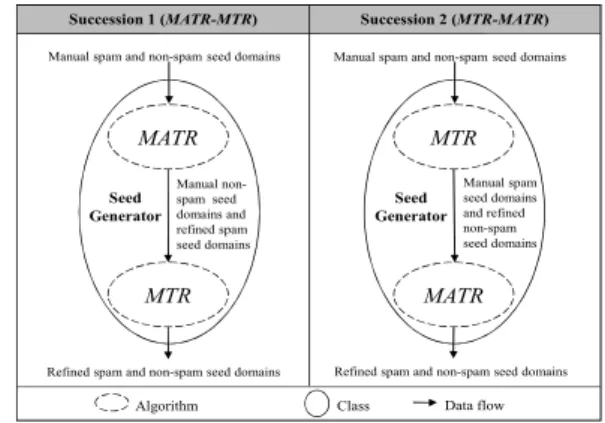
In this section, we present successions among Modified TrustRank(MTR), Modified Anti-TrustRank (MATR), Modified Spam Mass(MSM), and Modified Link Farm Spam(MLFS). We first introduce the global view of successions among web spam filtering algorithms; then, we present the possible successions.
4.4.1. Global View of Successions
Seed generators are not pure spam detection algorithms; instead, they promote and demote spam and non-spam domains as discussed in Section 3.
Therefore, we believe that MTR and MATR can help generate refined input seed sets. Since spam detectors require input seed sets with better quality for their operations, seed generators could provide good input seed sets if they come in succession. In the seed generators, our concern is how to precisely determine the seed sets of spam and non-spam domains whereas, in the spam detectors, our concern is how to correctly detect spam domains.
Our strategy is to execute the succession of seed generators(MTR and MATR) and that of spam detectors(MSM and MLFS) in turn. The input to the former succession of seed generators is lists of spam and non-spam domains, which are manually labeled.
We call these domains the manual spam and non-spam seed domains. The output of the former succession is the input of the latter succession for spam detectors. We call the output the refined spam and non-spam domains. Finally, the output from the latter succession is a list of spam domains detected.
We call these spam domains the detected spam domains. In Sections 4.2.2 and 4.2.3, we explain the successions inside each class.
4.4.2. Possible Successions inside the Seed Generator
The possible successions between MTR and
Succession 1 (MATR-MTR) Succession 2 (MTR-MATR)
MATR
MTR
Manual spam and non-spam seed domains
Manual non- spam seed domains and refined spam seed domains
Manual spam and non-spam seed domains
MTR
MATR
Refined spam and non-spam seed domains Refined spam and non-spam seed domains Manual spam seed domains and refined non-spam seed domains Seed
Generator
Seed Generator
Algorithm Class Data flow
그림 8. 시드 생성기내에서의 가능한 연속
Fig. 8. Possible successions inside the seed generator.
Succession 1 (MLFS-MSM) Succession 2 (MSM-MLFS)
MLFS
MSM
Refined spa m/non-spa m seed doma ins
Spa m doma ins a nd refined non- spa m seed doma ins
Refined spa m/non-spa m seed doma ins
MSM
MLFS
Detected spa m doma ins Detected spa m doma ins Spa m doma ins a nd refined non- spa m seed doma ins Spam
Detector
Spam Detector
Algorithm Class Data flow
그림 9. 스팸 탐지기내에서의 가능한 연속
Fig. 9. Possible successions inside the spam detector.
MATR for the seed generator are shown in Fig.8. In Succession 1, we run MATR followed by MTR (MATR-MTR); in Succession 2, we run MTR followed by MATR(MTR-MATR). Under both successions, the manual spam seed domains are refined by MATR while the manual non-spam seed domains are refined by MTR.
4.4.3. Possible Successions inside the Spam Detector
The possible successions between MSM and MLFS for the spam detector are shown in Fig.9. In Succession 1, we run MLFS followed by MSM(MLFS-MSM); in Succession 2, we run MSM followed by MLFS(MSM-MLFS). Under both successions, we use the refined spam and non-spam seed domains as the input seed set. Here, we perform two more tests using single algorithms, i.e., MLFS and MSM, using the refined spam and non-spam seed domains as the input seed set, to investigate the effect of the succession of spam detectors. Table 1 shows the two types of tests for the spam detector.
Successions Single Algorithms
MLFS-MSM MSM-MLFS MLFS MSM
표 1. 스팸 탐지기를 위한 테스트
Table 1. Tests for the spam detector.
Ⅴ. Performance Evaluation
In this section, we evaluate the effectiveness of our
modifications over the original four web spam filtering algorithms. We also evaluate the effectiveness of the successions of the modifications and find the best one from those successions.
5.1. Experimental Data and Environment We use two sets of experiments. In the first set, we show the effect of refining seed for four web spam filtering algorithms[13, 14, 15, 16] by comparing the original algorithms with our modified algorithms. In the second set, we show the effect of arranging the execution sequence among our modified algorithms.
To achieve this goal, we get all the possible successions of the modified algorithms on the basis of the classification explained in Section 4.4. Then, we find the best succession. Finally, we show the
Symbol Description
Original algorithms
TR TrustRank ATR Anti-TrustRank
SM Spam Mass
LFS Link Farm Spam
Modified algorithms
MTR Modified TrustRank MATR Modified Anti-TrustRank
MSM Modified Spam Mass MLFS Modified Link Farm Spam Successions of
the modified algorithms
MATR-MTR Modified Anti-TrustRank followed by Modified TrustRank MTR-MATR Modified TrustRank followed by Modified Anti-TrustRank MLFS-MSM Modified Link Farm Spam followed by Modified Spam Mass MSM-MLFS Modified Spam Mass followed by Modified Link Farm Spam
표 2. 실험에서 비교한 알고리즘
Table 2. Algorithms compared in the experiments.
Sets of the
Experiments Experiments Parameters
Comparisons for showing the
effect of refining seed set
Exp. 1 Comparison between TR and MTR
cutoffTr 0% - 160%
ratioTop 10%, 50%, 100%
damp 0.85
Exp. 2
Comparison between ATR and MATR
cutoffATr 0% - 1600%
ratioTop 10%, 50%, 100%
damp 0.85
Exp. 3 Comparison between SM and MSM
relativeMass 0.7 – 1.0 topPR 10%, 50%, 100%
damp 0.85
Exp. 4 Comparison between LFS and MLFS
limitBL 2 - 7 limitOL 2 – 7
Comparisons for showing the
effect of ordering executions
Exp. 5
Finding the best succession for the
seed generator
cutoffTr 50% - 160%
cutoffATr 50% - 350%
damp 0.85
Exp. 6
Finding the best succession for the
spam detector
cutoffTr 110%
cutoffATr 182%
relativeMass 0.7 – 0.99
topPR 100%
limitBL 2
limitOL 2
damp 0.85
Exp. 7
Comparison among the best succession, the best known algorithm, and best modified algorithm
cutoffTr 110%
cutoffATr 182%
relativeMass 0.7 – 0.99
topPR 100%
limitBL 2
limitOL 2
damp 0.85
표 3. 실험 요약
Table 3. Summary of the experiments.
quality improvement in web spam filtering of the best succession over the best modified and the best known original algorithms. Table 2 summarizes the algorithms that we compare in the experiments, and Table 3 summarizes the experiments.
In all the experiments, we use the public data set of UK-2006 domains[22]. The data set consists of 7,473 domains labeled as either spam or non-spam while the rest of 3,929 domains are unlabeled. The labeled data set is classified into two disjoint sets in order to perform evaluation[22]: Seed Set is the input seed set for the algorithms shown in Table 2, and Test Set is the universal set of domains that are used for computing the quality(i.e., precision and recall) of the outputs obtained from the algorithms.
In addition, in order to enhance the quality of web spam filtering, we label more spam and non-spam domains by using the well-known labeling rule[11, 13~
15, 22], and then, add them to Seed Set. That is, we
label domains that contain spam terms in their domain name(e.g., mp3, mortgage, and sex) as spam domains. We also label trusted administrative and educational domains(e.g., .ac.uk, .gov.uk, and .police.uk) as non-spam domains.
Table 4 summarizes the characteristics of the data set in terms of domains and web pages. This data set has been prevalently used for web spam filtering[9, 11, 22~25]. Table 5 shows Seed Set and Test Set for the data set. Here, “Before Additional Labeling” represents the original seed set shown in[22]. “After Additional Labeling” represents the input
Domains Web pages
Labeled Spam 1,924
Total 77.9 Million Non-spam 5,549
Unlabeled Unknown 3,929
Total 11,402
표 4. 도메인과 웹 페이지 데이터 집합의 특성[22]
Table 4. Characteristics of the data set in terms of domains and web pages[22].
Seed Set
Test Set [7]
Before Additional Labeling [7]
After Additional Labeling [3, 12, 13, 17]
Labeled Spam Domains 674 737 1,250
Labeled Non-Spam Domains 4,948 7,306 601
표 5. 시드 및 테스트 데이터 집합의 분류
Table 5. Classification of the data set as Seed Set and Test Set.
seed set augmented by using the rules explained above. Hereafter, labeled spam domains of “After Additional Labeling” in Seed Set are called Spam Seed Set, and labeled non-spam domains of “After Additional Labelling” in Seed Set are called Non-Spam Seed Set. We conduct all the experiments using a Linux 2.6 system with a Pentium Core2Duo 3.0 GHz processor and 3.0 GBytes of main memory.
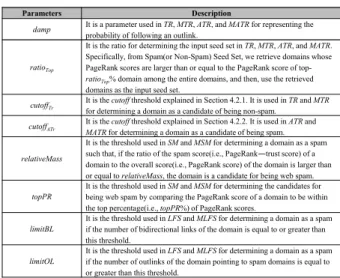
5.2. Experimental Measures and Parameters In order to evaluate the quality of the algorithms shown in Table 2, we use two well-known measures:
precision and recall[21]. In all the algorithms other than TR and MTR, precision means how accurately an algorithm detects spam domains from Test Set(i.e., the ratio of the number of spam domains collected from Test Set to that of domains collected from Test Set), and recall means how large a portion of spam domains the algorithm detects from Test Set(i.e., the ratio of the number of spam domains collected from Test Set to that of spam domains in Test Set). In TR and MTR, because the two algorithms detect non-spam(i.e. trusted) domains, precision and recall are defined in the same way as explained above except that they are defined in terms of the non-spam domains. Table 6 summarizes input parameters for the experiments.
Parameters Description
damp It is a parameter used in TR, MTR, ATR, and MATR for representing the probability of following an outlink.
ratioTop
It is the ratio for determining the input seed set in TR, MTR, ATR, and MATR.
Specifically, from Spam(or Non-Spam) Seed Set, we retrieve domains whose PageRank scores are larger than or equal to the PageRank score of top- ratioTop% domain among the entire domains, and then, use the retrieved domains as the input seed set.
cutoffTr It is the cutoff threshold explained in Section 4.2.1. It is used in TR and MTR for determining a domain as a candidate of being non-spam.
cutoffATr It is the cutoff threshold explained in Section 4.2.2. It is used in ATR and MATR for determining a domain as a candidate of being spam.
relativeMass
It is the threshold used in SM and MSM for determining a domain as a spam such that, if the ratio of the spam score(i.e., PageRank―trust score) of a domain to the overall score(i.e., PageRank score) of the domain is larger than or equal to relativeMass, the domain is a candidate for being web spam.
topPR
It is the threshold used in SM and MSM for determining the candidates for being web spam by comparing the PageRank score of a domain to be within the top percentage(i.e., topPR%) of PageRank scores.
limitBL
It is the threshold used in LFS and MLFS for determining a domain as a spam if the number of bidirectional links of the domain is equal to or greater than this threshold.
limitOL
It is the threshold used in LFS and MLFS for determining a domain as a spam if the number of outlinks of the domain pointing to spam domains is equal to or greater than this threshold.
표 6. 실험 파라미터
Table 6. Parameters used in the experiments.
5.3. Experimental Results
In Section 5.3.1, we show the results of the comparisons between the original web spam filtering algorithms and our modified algorithms. In Section 5.3.2, we show the results of the comparisons between the possible successions of our algorithms.
5.3.1. Comparisons between original and modified algorithms
Exp. 1: comparison between TR and MTR Figs.10 and 11 show the results as ratioTop is varied: 10%, 50%, and 100%. Here, we choose the value range of cutoffTr so that TR and MTR declare all domains in Test Set as candidates of being non-spam domains at the high end of the value range (i.e., we choose the value range of cutoffTr by considering the base case for TR and MTR as mentioned in Section 2). We use Spam Seed Set and Non-Spam Seed Set. Then, as explained in Table 6, we obtain the input seed sets for the trusted domains from Non-Spam Seed Set as ratioTop is varied.
Hereafter, we use the two seed sets, Spam Seed Set and Non-Spam Seed Set, as the input seed sets unless otherwise specified. We set the damping factor to 0.85, which is considered as the standard[14, 26]. Hereafter, the damping factor is fixed for every experiment that needs it.
Figs.10 and 11 show that MTR performs slightly better than TR. In both Figs.10 and 11, precision and recall of MTR is overall higher than those of TR in the range where cutoffTr≤110%. From the starting
(a) ratiotop= 10%. (b) ratiotop= 50%.
(c) ratiotop= 100%.
0 50 100 150
Precision
cutoffTr(%)
MTR TR
0 50 100 150
Precision
cutoffTr(%)
MTR TR
0 50 100 150
Precision
cutoffTr(%)
MTR TR
그림 10. ratioTop의 변화에 따른 정확도 Fig. 10. Precision as ratioTopis varied.
(a) ratiotop= 10%. (b) ratiotop= 50%.
(c) ratiotop= 100%.
0 50 100 150
Recall
cutoffTr(%)
MTR TR
0 50 100 150
Recall
cutoffTr(%)
MTR TR
0 50 100 150
Recall
cutoffTr(%)
MTR TR
그림 11. ratioTop의 변화에 따른 재현율 Fig. 11. Recall as ratioTop is varied.
point where cutoffTr > 110%, precision start decreasing sharply to the lowest as shown in Fig.10(c). The lowest point of precision is the point where almost every domain is marked as non-spam due to the high value of cutoffTr. Thus, from this point, increase in the value cutoffTr would bear no change in recall while only decreasing precision. Therefore, all the points where precision is the lowest are insignificant for comparison.
From Figs.10 and 11 we observe ratioTop=100%
provides higher recall and comparable precision compared to other ratioTop values. Thus, hereafter, we fix the value of ratioTop as 100%. When ratioTop=100% as shown in Fig.10(c), we observe that the effective cutoffTr value is 110% since from that point onwards precision sharply decreases. When cutoffTr=110% in Figs.10(c) and 11(c), the precisionof MTR is better than that of TR while the recall of MTR is the same as that of TR: the precision of MTR is 0.83, the precision of TR is 0.79, and their recalls are 0.27. Thus, we conclude that MTR is better than TR.
Exp. 2: comparison between ATR and MATR Figs.12 and 13 show the results comparing the ATR with the MATR. Here, we choose the value range of cutoffATr so that ATR and MATR declare all domains in Test Set as candidates of being spam domains at the high end of the value range (i.e., we choose the value range of cutoffATr by considering the base case for ATR and MATR as mentioned in