Abstract― In this study the optimum dyeing conditions and blocking effect of UV deodorization efficiency of Ligustrum japonicum Thunb were investigated. Colorants were water-extracted from Ligustrum japonicum Thunb fruit and freeze-drided to obtain colorants powder. The effects of dye concentration, dyeing temperature, dyeing time, and the number of dipping count were studied. Fastness to dry cleaning, rubbing, perspiration, and light were measured according to KS K 0644, KS K 0650, KS K 0715 and KS K 0700, respectively. In order to examine the dyeability according to dyeing conditions, reflectance of fabrics were measured by using UV/VIS spectrophotometer.
The bath ratio was 1:20. Dyeing concentration was 100, 200, 300, 400 and 500% on the weight of fiber. Dyeing time was 20, 40, 60, and 80 minutes. Dyeing temperature was 20, 40, 60, 80, and 100℃. The infrared high pressure dying machine was used.
As dyeing concentration increased, dye adsorption increased up to 400% and it slowed down. Dye uptake was increased with raising themperature up to 80℃ and it slowed down. Dye adsorption occurred rapidly at first 20 minutes and then it slowed down and reached almost maximum dye uptake at 60 min. Dye uptake increased by repeated dyeing.
Therefore, it is considered that optimum dyeing condition is 400%(o.w.f.), 80℃, 60 min. And repeated dyeing improves dye uptake. Color fastness to dry cleaning and rubbing was good, but light fastness and perspiration fastness was not good. Blocking effect of ultraviolet radiation and deodorization efficiency was good.
Keywords: Ligustrum Japonicum Thunb, optimum dyeing condition, colorfastness, natural dyeing, silk fabric, blocking effect of UV, deodorization efficiency
광나무 열매 추출물을 이용한 견직물의 염색성
이혜선†․고성미
제주대학교 의류학과
Dyeability of Silk Fabrics Using Extracts of Ligustrum Japonicum Thunb Fruit
Hye-Sun Lee† and Sung-Mi Ko
Dept. of Clothing and Textile, Jeju National University
(Received: February 19, 2010/Revised: March 17, 2010/Accepted: March 25, 2010)
1. 서 론
광나무 열매는 제주도에서 쉽게 구할 수 있으 며 색상이 아름답다. 그런데 지금까지 이를 이 용한 연구는 별로 없다. 제주도에 널리 자생하 는 광나무(학명:Ligstrum japonicum Thunb)는 일 본, 대만, 우리나라 남부지방의 산야지에서 자라 는 상록관목으로 높이는 3~5m이다. 가지는 회 색이며, 줄기는 단단하고 잎은 각 마디마다 두 개씩 붙어 있는데 두껍고 넓은 타원형으로서 가 장자리가 밋밋하고 잎자루는 길이 5~12cm이다.
꽃받침은 가장자리가 물결모양으로서 통부는 열 편보다 약간 길거나 같고 뒤로 젖혀져서 수술은 2개이며 열매는 난상원형으로 10월~11월에 자 흑색으로 익은 후 겨울 내내 달려 있다1).
†Corresponding author. Tel.: +82-19-690-1992; Fax.: +82-64-725-2591; e-mail: [email protected] 본 연구의 목적은 광나무 열매를 이용한 염색 의 최적조건을 제공하는데 있다. 염액농도, 염색 온도, 염색시간, 염색횟수 및 수소이온농도지수 를 변인으로 하여 IR염색기로 염색한 후 표면반 사율과 색차를 측정하였다. 일광견뢰도, 드라이 클리닝견뢰도, 땀견뢰도, 건・습마찰견뢰도 등을 분석하여 염색성을 검토해 보았다. 그리고 자외 선 차단성과 소취성을 검토하였다2).
2. 실험재료 및 방법 2.1 시료
본 실험에서 사용된 시료는 시판 견직물로, 정련후 수세‧건조하여 사용하였다. 시료의 특성 은 Table 1과 같다.
Fiber Weave Fabric count (ends×118)
Thickness (mm)
Weight (g/㎡) Silk 100% Plain 150×118 0.18 50 Table 1. Characteristics of fabric
2.2 염료
본 실험에서 사용된 염료는 제주대학교 정원수 로 심어진 광나무 열매를 채취하여 사용하였다.
2.3 염액 추출 및 분말화
증류수 1ℓ에 염재 50g을 넣고 100℃에서 2시 간 가열하여 추출한 염액을 -40℃에서 냉동건조 하여 분말화하였다. 염액의 pH는 4.82이었다.
2.4 염색
IR염색기(Model : DL-6000, Daelim Starlet Co.Ltd) 를 이용하여 1:20의 액비로 염액농도(100%, 200%, 300%, 400%, 500%), 염색온도(20℃, 40℃, 60℃, 80℃, 100℃), 염색시간(20분, 40분, 60분, 80분), 반복 횟수(1회, 2회, 3회), pH(3, 5, 7, 10) 를 변인으로 해서 염색하였다3-5).
2.5 표면색 측정
각각의 염색조건에 따른 염색성을 알아보기 위해 염색포의 표면반사율을 측정하였다. 측정 장치로는 분광광도계(UV/VIS Spectrophotometre, HP 8453)를 사용하여 표면반사율을 측정하고 색 차계(CR-200, Minolta, Japan)로 Hunter L*a*b*값 을 측정하고 Munsell값을 구하였다6).
2.6 염색견뢰도
일광견뢰도는 KS K 0700에 준하여 Fade-O- meter(Model: HS-213, Korea)를 사용하였으며, 드라이클리닝견뢰도는 KS K 0644에 준하여 Launder-O-meter(Yasuda Seiki Seisakusho, Japan) 와 테트라클로로에틸렌을 사용하여 시험하였으 며, 땀견뢰도는 KS K 0715에 따라 Perspiration Tester (Model: DL-2012, DaeLim Korea)를 사 용하였다7). 마찰견뢰도는 KS K 0650에 준하 여 Crockmeter (Yasuda Seiki Seisakusho, Japan) 를 이용하여 건조 시와 습윤 시의 마찰 견뢰 도를 측정하여 변‧퇴색용 Gray scale (JIS L 0804)로 등급을 판정하였다8).
2.7 자외선 차단성 측정
자외선 가시광선 근적외선 분광광도계(UV/VIS/
NIR Spectrophotometre, Perkin-Elmer Landa) 를 사용하여 AATCC 183-2004에 준하여 측정하 였다9).
2.8 소취성 측정
일본 섬유평가기술협의회(JTETC) 시험법에 준 하여 측정하고 감소율을 산출하였다. 5L의 테트 라백에 10×10 cm의 제시 시료를 넣고, 초기농 도로 조정한 가스 3L를 주입한 후, 2시간 후 가 스농도를 검지관(3La:ガステック製)으로 측정하 였다.
3. 결과 및 고찰
3.1 염액농도에 따른 염색성
Fig. 1은 염액농도를 각각100%, 200%, 300%, 400%, 500%로 하여 액비 1:20, 80℃에서 60분간 염색하여 표면반사율을 측정한 결과이다. 이에 의하면 염액 농도가 증가할수록 염색성이 향상 되었으나 점차 증가 속도가 둔화되고 있다. Table 2는 색차계로 ⊿E값을 측정한 결과로 100%에서 14.60, 200%에서 22.07, 300%에서 25.75, 400%에 서 27.59, 500%에서 29.52로 나타났다. 색상은 8.7R에서 5.4R로 변하였고, 명도는 7.9에서 6.5로 낮아졌고, 채도는 1.2에서 2.3로 높아졌다. 광나 무 열매의 색상분포에서 a값은 5.14~9.83이며 b 값은 4.40~5.59으로 나타났다. 견직물에서의 색 상은 Red이고 염액 농도가 진할수록 염착량이 증가되었으나 점차 증가폭이 줄어들고 있다. 따 라서 최적의 염색 농도는 400%로 볼 수 있다10).
3.2 염색온도에 따른 염색성
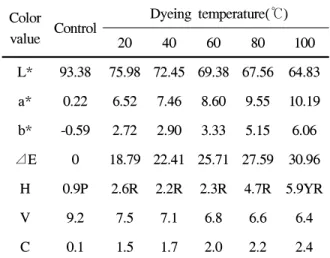
Fig. 2는 염액온도를 각각 20℃, 40℃, 60℃, 80℃, 100℃로 하여 액비 1:20, 염액농도400%에 서 60분간 염색하고 표면반사율을 측정한 결과 이다. 이에 의하면 염색온도가 증가할수록 염색 성이 향상되었으나 증가 속도가 둔화되고 있다.
Table 3은 색차계로 ⊿E값을 측정한 결과로 20℃에 18.79, 40℃에 9, 41, 60℃에 95.71, 80℃
에 97.59, 100℃에 30.96으로 나타났다. 광나무 열매의 전체적인 색상분포에서 a값은 6.52~10.19 이며 b값은 2.72~6.06으로 나타났으며, 색상은
Dye concentration(o.w.f.)
Wavelength (nm)
200 300 400 500 600 700 800
Reflectance (%)
0 20 40 60 80 100
100%
200%
300%
400%
Fig. 1. UV/VIS spectra of silk fabrics dyed with extracts of Ligustrum japonicum Thunb fruit at various dyeing concentration(80℃, 60min).
Color
value Control Dye concentration(o.w.f.) 100% 200% 300% 400% 500%
L* 93.38 80.56 73.35 69.92 67.56 66.15 a* 0.22 5.14 7.70 8.28 9.55 9.83 b* -0.59 4.40 4.92 6.33 5.15 5.59
⊿E 0 14.60 22.07 25.75 27.59 29.52
H 0.9P 8.7R 6.1R 7.9R 4.7R 5.4R
V 9.2 7.9 7.2 6.9 6.6 6.5
C 0.1 1.2 1.8 2.0 2.2 2.3
Table 2. Effect of dyeing concentration on L*, a*, b* and Munsell values of silk fabrics dyed with Ligustrum japonicum Thunb fruit extracts(80℃, 60min)
Dyeing temperature
Wavelength (nm)
200 300 400 500 600 700 800
Reflectance (%)
0 20 40 60 80 100
20 40 60 80
Fig. 2. UV/VIS spectra of silk fabrics dyed with extracts of Ligustrum japonicum Thunb fruit at various dyeing temperature(400%, 60min).
Color
value Control Dyeing temperature(℃)
20 40 60 80 100
L* 93.38 75.98 72.45 69.38 67.56 64.83 a* 0.22 6.52 7.46 8.60 9.55 10.19 b* -0.59 2.72 2.90 3.33 5.15 6.06
⊿E 0 18.79 22.41 25.71 27.59 30.96 H 0.9P 2.6R 2.2R 2.3R 4.7R 5.9YR
V 9.2 7.5 7.1 6.8 6.6 6.4
C 0.1 1.5 1.7 2.0 2.2 2.4
Table 3. Effect of dyeing temperature on L*, a*, b* and Munsell values of silk fabrics dyed with Ligustrum japonicum Thunb fruit extracts(400%, 60min)
2.6R에서 5.9YR로 변하였고, 명도는 7.5에서 6 4 로 낮아졌으며 채도는 1.5에서 2.4로 높게 나타 났다.
염색온도가 올라 갈수록 염착량은 계속 증가 되다가 80℃ 이후부터 증가폭이 줄어들었으며 100℃에서는 견직물의 고유한 광택도 현저히 줄 어들고 색상이 갈변되었다. 따라서 최적 염색 온도는 80℃로 볼 수 있다11).
3.3 염색시간에 따른 염색성
Fig. 3는 염색시간을 각각 20분, 40분, 60분, 80분으로 하여 액비 1:20, 염색농도400%, 염색 온도 80℃에서 염색하고 표면반사율을 측정한 결과이다. 이에 의하면 염색시간이 증가할수록 염색성이 향상되었으나 60분이상에서 증가 속 도가 둔화되고 있다.
Table 4는 색차계로 ⊿E값을 측정한 결과로 20분에서 24.14, 40분에서 25.04, 60분에서 27.59, 80분에서 28.45로 나타났다. 견직물의 a값은 8.45~9.84이며 b값은 5.15~5.68로 나타났고, 색상은 4.7R로 변함이 없고 명도는 6.9에서 6.5로 낮아졌으며 채도는 2.0에서 2.3으로 높 아졌다.
광나무 열매 1차 추출한 염액을 각각 20분, 40분, 60분, 80분 동안 염색하여 색차를 측정한 결과이다. 염색 시간이 길어짐에 따라 염착량 이 증가하였고, 60분 이후부터는 증가폭이 둔 화되었다. 따라서 염색시간은 60분이 적정한 것으로 생각되었다12).
Dyeing time(min)
Wavelength (nm)
200 300 400 500 600 700 800
Reflectance (%)
0 20 40 60 80 100
20min 40min 60min 80min
Fig. 3. UV/VIS spectra of silk fabrics dyed with extracts of Ligustrum japonicum Thunb fruit at various dyeing time(400%, 80℃).
Color
value Control Dyeing time(min)
20 40 60 80
L* 93.38 70.81 70.08 67.56 64.76
a* 0.22 8.45 8.96 9.55 9.84
b* -0.59 5.15 5.43 5.15 5.68
⊿E 0 24.14 25.04 27.59 28.45
H 0.9P 4.7R 4.7R 4.7R 4.7R
V 9.2 6.9 6.8 6.6 6.5
C 0.1 2.0 2.1 2.2 2.3
Table 4. Effect of dyeing time on L*, a*, b* and Munsell values of silk fabrics dyed with Ligustrum japonicum Thunb fruit extracts(400%, 80℃)
3.4 염색횟수에 따른 염색성
Fig. 4는 염색횟수를 각각 1회, 2회, 3회로 하 여 액비 1:20, 염색농도 400%로 하여 80℃에서 60분간 염색하고 표면반사율을 측정한 결과이 다. 이에 의하면 염색횟수가 증가할수록 염색성 이 향상되고 있다. Table 5는 색차계로 ⊿E값을 측정한 결과로 1회 염색에서 27.59, 2회 염색에 서 31.44, 3회 염색에서 37.55로 나타났고 1회 염색 시 a*값은 9.55, b*값은 5.15, 2회 염색 시 a*값은 10.25, b*값은 6.42, 3회 염색 시 a*값은 10.48, b*값은 6.53로 나타났다. 광나무 열매의 견직물에 대한 색상은 전체적으로 Red 계열의 색상을 나타내었고, 염색이 반복 될수록 redness 와 yellowness가 모두 증가 하였다. 염색횟수가 반복 될수록 염착량이 증가되므로 농색을 얻기 위해서는 반복염색이 효과적이다13).
Dipping count
200 300 400 500 600 700 800
Reflectance (%)
0 20 40 60 80 100
1 2 3
Wavelength (nm)
Fig. 4. UV/VIS spectra of silk fabrics dyed with extracts of Ligustrum japonicum Thunb fruit at dipping count(400%, 80℃, 60min).
Color
value Control Dyeing repetition
1 2 3
L* 93.38 67.56 64.11 59.79
a* 0.22 9.55 10.25 10.48
b* -0.59 5.15 6.42 6.53
⊿E 0 27.59 31.44 37.55
H 0.9P 4.7R 5.0R 5.0R
V 9.2 6.6 6.2 5.7
C 0.1 2.2 2.5 2.5
Table 5. Effect of dipping count on L*, a*, b* and Munsell values of silk fabrics dyed with Ligustrum japonicum Thunb fruit extracts(400%, 80℃, 60min)
3.5 염액 pH에 따른 염색성
광나무 열매에서 추출한 염액을 각각 pH3, 5, 7, 10으로 조절하여 액비 1:20, 염액농도 400%, 염색온도 80℃, 염색시간60분으로 하여 염색성 을 측정한 결과는 Table 6과 같다. ⊿E값은 pH3 에서 37.12, pH5에서 27.59, pH7에서 12.34, pH10 에서 10.02로 나타났다. 그런데 pH 7이상부터는 갈변현상이 나타나며 염색성이 급격히 저하된 다. 광나무 열매 추출물은 산성상태에서 단백질 섬유에 염착이 잘되는 것으로 보아 산성 염료 로 추측된다.
3.6 염색 견뢰도
광나무 열매 추출물로 염액농도 400%,염색온 도 80℃,염색시간 60분, 액비 1:20으로 하여 염 색한 후 염색견뢰도를 측정한 결과는 Table 7과
Color
value Control pH value of dyeing solution
3 5 7 10
L* 93.38 58.97 67.56 85.66 88.10
a* 0.22 12.60 9.55 2.37 0.80
b* -0.59 5.82 5.15 8.80 7.91
⊿E 0 37.12 27.59 12.34 10.02
H 0.9P 4.0R 4.7R 7.9YR 0.1YR
V 9.2 5.8 6.6 8.4 8.7
C 0.1 2.9 2.2 1.4 1.2
Table 6. Effect of pH on L*, a*, b* and Munsell values of silk fabrics dyed with Ligustrum japonicum Thunb fruit extracts(400%, 80℃, 60min)
Light Fastness 1
Dry Cleaning
Fastness colour change 5
Perspiration Fastness
acidic colour change 4
staining 4-5
alkaline colour change 2-3
staining 4
Abrasion Fastness
dry 5
wet 5
Table 7. Color fastness of silk fabrics dyed with Ligustrum japonicum Thunb Fruit extracts
같다. 염색물의 일광견뢰도는 1급으로 일광에 대한 견뢰도가 좋지 못한 것으로 나타났다. 드 라이클리닝견뢰도와 건․습 마찰 견뢰도에서 5급 으로 매우 우수하게 나타났다. 땀 견뢰도는 산 성 땀에서 변․퇴색의 정도는 4급, 오염의 정도는 4~5급으로 나타나 양호한 결과를 보였다. 알칼 리 땀에서 변․퇴색의 정도는 2~3급, 오염포의 정도는 4급으로 나타나 좋지 못한 것으로 나타 났다. 따라서 앞으로 일광견뢰도와 알칼리에 대 한 견뢰도 증진 방안과 관련된 후속 연구가 필 요하다14).
3.7 자외선 차단성
광나무 열매 추출물로 염액농도 400%, 염색 온도 80℃,염색시간 60분, 액비 1:20으로 하여 염색한 염색포의 자외선차단성은 Table 8과 같 다. 이에 따르면 염색포의 자외선A의 차단율은
Sample UDF T(UV-A)% T(UV-B)% UV-A% UV-B%
Natural silk fabric
4 37.7 15.8 62.3 84.2
Dyed silk fabric
14 11.2 4.6 88.8 95.4
Table 8. Transmittance or blocking of ultraviolet radiation
Silk Fabric
Concentration of ammonia gas(ppm)
Initial concentration
After 2 Hours
Blank 100.0 98.0
Dyed silk fabric 100.0 10.4 Reduction of ammonia(%) - 89.6 Natural silk fabric 100.0 32.7 Reduction of ammonia(%) - 67.3 Table 9. Deodorization efficiency of the silk fabrics dyed with Ligustrum japonicum Thunb fruit
88.8%, 자외선B의 차단율은 95.4%이다. 자외선 차단지수가 14로 자외선차단성이 좋은 것으로 나타났다.
3.8 소취성 측정
광나무 열매로 염색한 견직물의 소취성은 Table 9에 나타낸 바와 같이 염색된 시료의 암모니아 가스 감소율이 89.6%이므로 소취성이 좋다고 할 수 있다.
4. 결 론
본 연구는 제주도에서 쉽게 구할 수 있으나 염재로서 사용되고 있지 않던 광나무 열매를 이용하여 염색성을 검토해 본 결과 다음과 같 은 결론을 얻었다. 광나무 열매에서 추출한 염료는 산성 상태에서 단백질 섬유에 염착이 잘되는 것으로 보아 산성염료로 추측되며 색 상은 Red계열이다. 염색의 최적조건은 농도 400%, 온도 80℃, 염색시간 60분이며 반복염 색으로 농색을 얻을 수 있다. 염색포의 드라 이클리닝견뢰도와 마찰견뢰도는 우수하나 일 광견뢰도는 좋지 않다. 광나무 열매로 염색한
직물은 자외선 차단성과 소취성을 가지고 있 다. 따라서 광나무 열매는 기능성 천연염료로 사용할 수 있다.
감사의 글
본 연구는 2008년 제주대학교 NURI사업의
‘아열대생물산업 및 친환경농업생명산업인력 양성사업단’의 지원에 의하여 연구되었음.
참고문헌
1. J. H. Lee, S. Y. Chang, and C. S. Yook, Studies on the Morphology and Chemical Components of Ligustrum Obtysifolium and Other Ligustrum spp, Bull. K.H. Pharma. Sci., 27, 21-30(1999).
2. Y. H Lee, E. K Hwang, and H. D. Kim, Dyeing and Fastness of Silk and Cotton Fabrics Dyed with Cherry Extract, Textile Coloration and Finishing(J. Korean Soc. Dyers & Finishers), 12(6), 389-395(2000).
3. S. K. Bai, Natural Dyeing of Silk Fabric Dyed With Rubus Coreanus Miquel Extract, J.
Korean Soc. Cloth. Ind, 8(4), 476-480(2006).
4. S. K. Dho and I. A. Kang, Dyeing of Silk Fabric with Aqueous Extract of Cassia tora L.
Seed-focusing on the mordanting and dyeing mechanisms-, Textile Coloration and Finishing (J. Korean Soc. Dyers & Finishers), 17(2), 74-82(2005).
5. T. Y. Kim and J. D. Jang, Dyeing Properties and Antibacterial Activity of Wool Blend Fabrics dyed with Rhus Verniciflua Extract, J.
Korean Soc. Cloth, Ind, 10(1), 106-112(2008).
6. Y. H. Park, A Study on the Dyeability and Antibiosis of Fabrics Dyed with Solanum Nigrum Extract, J. Korean Soc. Costume, 57(4), 61-69(2007).
7. J. M. Ryu, Y. S. Jeon, I. H. Kim, and S. W.
Nam, Dyeing Properties of Silk Fabric Dyed with Black Soybean Extracts, Textile Coloration
and Finishing(J. Korean Soc. Dyers & Finishers), 17(5), 242-247(2005).
8. S. Y. Kim, S. K. Yum, and K. N. Lee, Studies on the Dyeing Properties of Black Soybean Anthocyanin, J. Kor, Soc. Cloth. Ind., 9(1), 104-105(2007).
9. S. H. Lee, Y. S. Jo, and S. H. Choi, Dyeing of Wool Fabric by the Pigment Extracte from Opuntia Ficus- indica, Textile Coloration and Finishing(J. Korean Soc. Dyers & Finishers), 18(2), 72-78(2006).
10. Y. O. Jeong and S.S Kim, Dyeing Fabrics with Grape Juice which is Discarded in the Process of Grape juice, J. Korean Soc. Cloth.
Ind, 4(1), 79-85(2002).
11. Y. S. Lee, J. D. Jang, The Dyeing Properties of Silk Fabrics of Glycyn-hizae Radix Extract, Textile Coloration and Finishing(J. Korean Soc. Dyers & Finishers), 16(1), 34-39(2004).
12. A. S. Kim, A Study on the Dyeing Properties of Silk Fabrics Dyed with Impatiens Balsa- mina Extract(Ⅱ), Textile Coloration and Finishing(J. Korean Soc. Dyers & Finishers), 16(3), 131-137(2004).
13. K. H. Bae, Y. U. Jeong, and S. H. Lee, The Study of the Dyeability of Laurel Tree Extracts, Textile Coloration and Finishing(J. Korean Soc. Dyers & Finishers), 16(6), 301-309 (2004).
14. S. K. Bai, The Study of the Dyeability of Forsythia Koreana Nakai, Textile Coloration and Finishing(J. Korean Soc. Dyers &
Finishers), 15(5), 310-315(2003).