한국지반공학회논문집 제28권 6호 2012년 6월 pp. 63 ~ 70
1. Introduction
The infiltration of rainfall increases the water content in the unsaturated slope, and reduces the resulting shear strength, and thus causes instability to slope. Several studies including (Brand 1992; Rahardjo H. 2002; Pradel
and Radd 1993; Wang and Sassa 2003) show that the infiltration capacity and the subsequent change in matric suction are affected by several external and intrinsic factors. The external factor includes climatic conditions such as the rainfall duration and rainfall intensity while the intrinsic factors include the coefficient of permeability,
저강도 강우시 절토사면의 흡인력 분포와 안정성에 대한 투수계수의 효과
Effect of Hydraulic Conductivity on Suction Profile and Stability of Cut-Slope during Low Intensity Rainfall
마무드 칼리드1 Khalid Mahmood
김 진 만2 Kim, Jin Man
Abstract
The authors discuss the effect of hydraulic conductivity on the suction profile and stability of a typical cut-slope subjected to low intensity rainfall. The initial suction value above the ground table in the unsaturated zone is assumed to be 15 kPa. The uncoupled approach of finite element and limit equilibrium method is used to evaluate the stability of the cut-slope at different elapsed times of rainfall. The finite element seepage analysis shows that the soil in the unsaturated zone always remains unsaturated during the course of low intensity rainfall. Furthermore, the slope stability remains practically unchanged so long as the wetting front remains in the unsaturated zone but it decreases noticeably when the wetting front reaches and elevates the ground water table level.
요 지
저강도 강우상태에서 투수계수가 일반적인 절토사면의 흡인력 분포와 안정성에 어떤 영향을 주는지를 평가하였다.
지하수면 위의 불포화 지층의 초기 흡인력을 15 kPa로 가정하였다. 강우 지속시간 증가에 따른 절토사면의 안정성을
평가하기 위해 유한요소법과 한계평형법을 사용하였다. 유한요소 침투해석 결과, 저강도 강우상태에서는 불포화 지층
이 계속해서 불포화 상태로 유지되는 현상을 보였다. 또한, 침윤선(wetting front)이 불포화 지층에 남아있는 경우에는 사면의 안정성에 사실상 변화가 없었으나, 침윤선(wetting front)이 지하수면에 도달하는 경우에는 지하수면이 높아짐 에 따라 사면안정성이 크게 저하되었다.
Keywords : Hydraulic conductivity, Low intensity rainfall, Saturated-unsaturated cut-slope, Slope stability
1 비회원, Post Doctoral Candidate, Dept. of Civil Engineering, Pusan National University, Busan, Korea
2 정회원, Member, Associate Professor, Dept. of Civil Engineering, Pusan National University, Busan, Korea, Tel: +82-51-510-2349, Fax: +82-51-513-9596, [email protected], 교신저자
* 본 논문에 대한 토의를 원하는 회원은 2012년 12월 31일까지 그 내용을 학회로 보내주시기 바랍니다. 저자의 검토 내용과 함께 논문집에 게재하여 드립니다.
(a) Geometry (b) FE discretization Fig. 1. Cut-slope
water retention characteristics, and strength properties.
Among the intrinsic factors the hydraulic conductivity is the most important factor that can directly affect the rainfall infiltration. The previous study by Lee (Lee et al., 2005) showed that the redistribution of matrix suction is a key factor in the design of a specific slope. However, it does not consider the effect of the hydraulic con- ductivity. Mahmood (Mahmood et al., 2012) showed that the stability of a simple single-sloped embankment slope during a rainfall can be evaluated better on the basis of unsaturated soil mechanics.
The purpose of the present study is to evaluate the effect of the hydraulic conductivity and especially vertical conductivity on the pore-water pressure profile and ultimately on the stability of the three-sloped cut slope during a low intensity rainfall. The low intensity rainfall is applied in order to insure complete infiltration in the unsaturated cut-slope. The applied low rainfall intensity is further discussed in the text of the paper.
2. Example Problem
2.1 Geometry and finite element discretization of cut- slope
The geometry and finite element discretization of three- sloped cut slope is shown in Fig. 1. A constant suction value of 15 kPa and hydrostatic pore-water pressure is assumed above and below the horizontal water table, respectively. For simplicity the rainfall is only applied at
the top of slope. Section A'A' is used to evaluate the volumetric water content and pore-water pressure at diffe- rently selected times of rainfall.
2.2 Saturated-unsaturated seepage analysis and hydraulic conductivity
The saturated-unsaturated seepage analysis in this study is conducted using the finite element program (Seep/W).
In the finite element seepage model the flow of water in the two-dimension for transient case can be defined as:
(1)
where kx, ky are the coefficient of permeability in the x and y directions, respectively; H is the hydraulic head;
q, the applied boundary flux; ρ, the density of water; and m, the specific water capacity. The specific water capacity is defined as:
(2)
where θw is the volumetric water content; ua , the pore air pressure; uw , the pore-water pressure; and (ua-uw), the matric suction.
For the saturated zone, as the volumetric water content is constant, Eq. 2 becomes zero. In case of the unsatura- ted zone, the hydraulic conductivity coefficient and the volumetric water content are the functions of the matric
Table 1. SWCC properties for weathered soil
Material Weathered soil
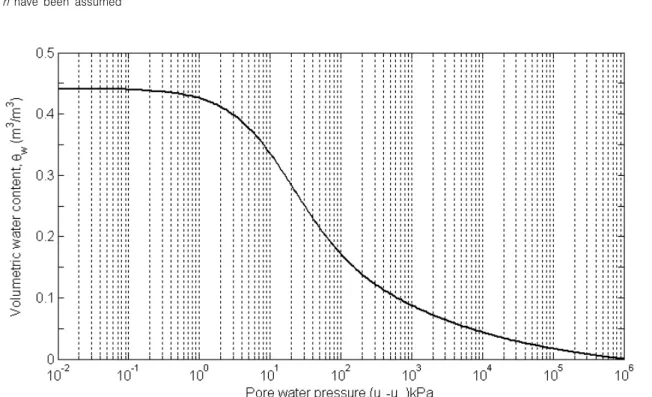
Saturated volumetric water-content 0.441
Air entry value, a (kPa) 10
*Fredlund and Xing, (1994) parameter, m 1
*Fredlund and Xing, (1994) parameter, n 1
*m and n have been assumed
Fig. 2. SWCC for weathered soil
suction. The curve that defines the relationship between volumetric water content and matric suction is called soil water characteristic curve (SWCC). In the present case this SWCC is established using the method proposed by Fredlund and Xing (1994). The parameters used for this method are given in Table 1. The SWCC for the weathered soil is shown in Fig. 2. There is no need to establish SWCC for weathered rock as it remains saturated in this study.
According to Boumans (1976), the value of Kr for average (or radial) flow can be computed from the geometric, or logarithmic, mean of Kh (horizontal direction) and Kv
(vertical direction) as follows:
(3)
log log log (4)
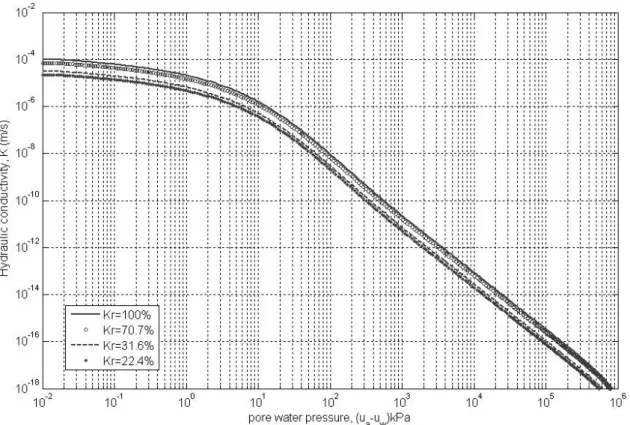
In this paper the average hydraulic conductivity is evalu- ated based on Eq. 3. For a known SWCC it is possible to estimate the hydraulic conductivity curve based on the Fredlund and Xing (1994) method, if the saturated hydraulic conductivity value is known. The weathered soil saturated hydraulic conductivity in the present case is assumed to be 1×10⁻⁴ m/s. It is assumed that for the case of Kv=Kx
the hydraulic conductivity is 100% and the hydraulic con- ductivity reduces to 70.7%, 31.6% and 22.4% respectively for Kv=0.5Kx, Kv=0.1Kx and Kv=0.05Kx. The 100% (70.7%) is taken as high and that of 31.3% (22.4%) is taken as low. The hydraulic conductivity curves are shown in Fig. 3.
In this study a rainfall with intensity 3.5×10⁻⁶ m/s that lasts for a period of 84 h is assumed. According to Mein and Larson (1973) if the rainfall intensity is less than the saturated hydraulic conductivity then there will be com- plete infiltration. The rainfall intensity in this case is lower
Fig. 3. Hydraulic conductivity curves
Table 2. Strength properties for weathered soil and weathered rock
Material Weathered soil Weathered rock
Unit weight, (kN/m3) 18.8 19.8
Cohesion, (kN/m2) 34.9 41.8
Friction angle, (o) 27.8 27.8
φb, (o) 31.5 31.5
than the lowest saturated hydraulic conductivity and thus complete infiltration is assumed.
2.3 Failure criterion and material properties
The stability analysis in this study is conducted based on the modified Mohr-Coulomb failure criteria that is defined as
′ tan′ tan (5)
where (σn-ua) is the net normal stress; (σa-uw) is the matric suction and; φb, the angle expressing the rate of increase in shear strength relative to matric suction.
The weathered soil and weathered rock properties are those used in the paper of Lee et al. (2005) and are given in Table 2.
The slope stability results in this study have been evalu- ated probabilistically i.e., in term of reliability indexes.
In geotechnical engineering it has been well established that, the soil medium is usually heterogeneous and its engineering properties such as the strength parameters c and φ vary. In this study the weathered soil deposit is considered as statistically homogeneous which means that, the strength parameters has one mean and one coefficient of variation within the soil deposit. The detailed description of statistical homogeneity can be found in the work of Kim (2001). In this study the two strength parameters c and φ are considered as random variables having the coefficient of variation (COV) of 0.2 and 0.1 respectively.
These COV values have been selected from the paper of Mahmood et al., (2012). The unit weight in this study is considered as a deterministic value.
Fig. 4. (a) Volumetric water content profile; (b) Pore-water pressure profile
3. Results and Discussion
3.1 Initial condition
In this study the initial state is set up by providing a constant suction value of 15 kPa above the ground water table in the unsaturated zone. Furthermore, below the ground water table the pore-water pressure linearly in- creases with depth based on the hydrostatic stress law.
3.2 Transient seepage analysis
The rainfall infiltration increases the volumetric water
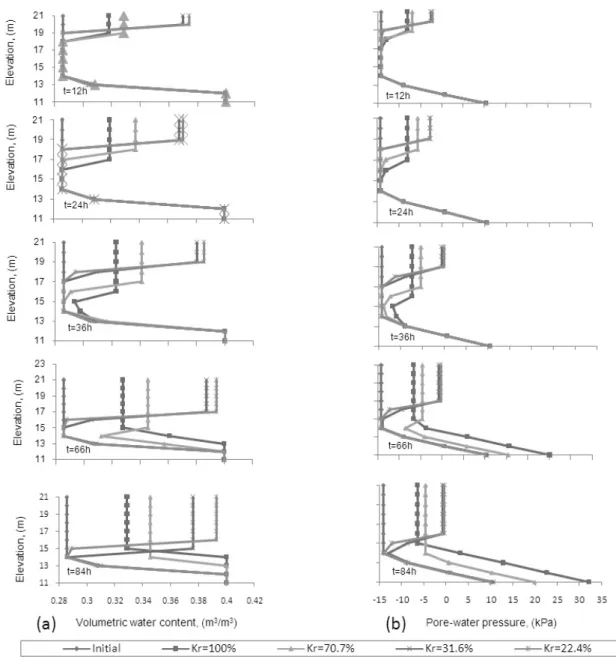
content in the unsaturated zone. This change in the volu- metric water content thus affects the suction profile in the unsaturated zone. Fig. 4a shows the volumetric water content while Fig. 4b shows the pore-water pressure pro- file for different hydraulic conductivities. These profiles have been evaluated at section A'A' of Fig. 1a at different time of rainfall.
According to Fig. 4a, at the same depth the volumetric water content is higher for the low conductivity than the high hydraulic conductivity. Thus at the same depth the matric suction is lower for the low hydraulic conductivity than for the high conductivity. Furthermore, during the same time of rainfall the wetting front for the low hydraulic
Fig. 5. Reliability index of cut-slope in term of rainfall duration
conductivity (31.6%, 22.4%) is shallower than that of the high hydraulic conductivity. From Fig. 4 it can be noticed that at the end of rainfall, the depths of wetting fronts for the low hydraulic conductivity 31.6% and 22.4% are 6 m and 5 m respectively from the top of the slope.
In case of the high hydraulic conductivities (100%, 70.7%), it can be seen from Fig. 4 that the wetting front reaches the water table at the end of 66 hours of rainfall.
At the end of rainfall, it seems that the water table has elevated up to a certain depth and has produced full saturation above the water table. This saturation thus creates a positive pore-water pressure that changes the pressure considerably after 84 hours of rainfall.
According to Green and Ampt (1911), the soil above the wetting front is fully saturated, while it remains at the initial water content below the wetting front. In their model, the flow of water in the saturated zone is con- trolled by gravity and the matric suction effect. However, It can be seen from Fig. 4 that the soil above the wetting front is still partially saturated. In other words, the water phase in the unsaturated zone is not continuous, thus the gravity term does not contribute to the infiltration capacity.
The only term is then matric suction that contributes to the infiltration capacity. In the unsaturated zone, the in- filtration capacity in the vertical direction can be defined according to the relationship proposed by Gavin and Xue (2008).
(6)
where iy is the infiltration capacity in vertical y direction and; Sy is the matric head suction values at y depth.
The second term in Equation 6 on the right hand side is defined as the hydraulic gradient due to suction. Equation 6 shows that the infiltration capacity is controlled by the unsaturated hydraulic conductivity and the suction gradient.
Figure 4 shows that the wetting front depth increases initially for all hydraulic conductivities but for 22.4% and 31.6% it reaches a depth of 5 m and 6 m respectively at the end of rainfall. In case of hydraulic conductivities 100% and 70.7%, it progressively moves below to the water table. Figure 4b shows that in case of high hyd-
raulic conductivities the unsaturated soil shows little sa- turation as the rainfall continues. Also, the unsaturated hydraulic conductivity Kv that controls the flow of water to the ground water table is higher for higher hydraulic conductivities.
3.3 Slope stability analysis
The stability modeling procedure in Slope/W can be defined in terms of three different components: (1) definition of the geometry; (2) definition of the soil strength pro- perties; and (3) definition of pore-water pressure in soil slope. Seep/W and Slope/W are integrated codes denoting that the geometry and pore-water pressure at any selected time of rainfall defined in Seep/W can be used in Slope/W.
In this study the slope stability is evaluated using an uncoupled approach of the finite-element seepage-analysis (Seep/W) and the limit-equilibrium analysis (Slope/W).
The safety factor of the cut-slope at different times of rainfall is evaluated using the Morgenstern-Price method with the same grid and radius for the critical slip surface.
The slope reliability index is calculated as:
(7)
where β is the reliability index; μF the mean safety factor; and σF the standard deviation of the safety factor.
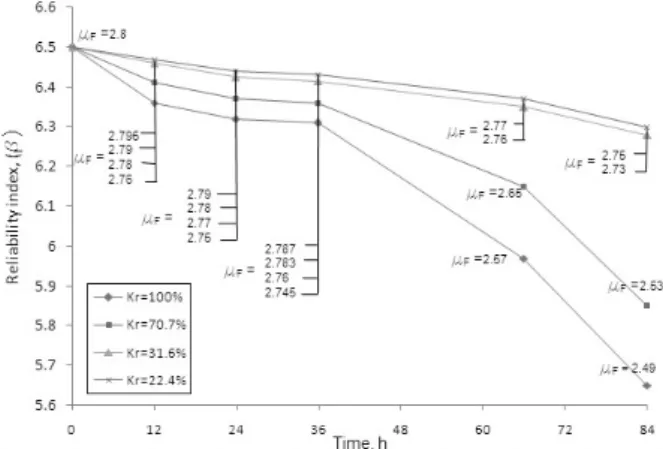
The reliability index along with the mean factor of safety (μF) at different times of rainfall for the different hydraulic conductivities is shown in Fig. 5.
The reliability index of the unsaturated embankment is 6.5 before the start of the rainfall. It can be inferred from this figure that the reduction in the reliability index is small for low hydraulic conductivities (31.6% and 22.4%) up to 84 hours of rainfall. For high hydraulic conduc- tivities (100% and 70.7%) the reduction is small up to 36 hours of rainfall but becomes noticeable after that.
As discussed in Section 4.2, for this low-intensity rain- fall, there is always suction in the unsaturated zone when the wetting front moves through the unsaturated slope.
For high hydraulic conductivities, the wetting front depth increases somewhat, but at the same time, the suction profile above the wetting front for low conductivities is somewhat more saturated. The decreased suction strength thus compensates for greater wetting front depth and gives almost the same reliability index for all hydraulic con- ductivities up to 36 h. At 84 h of rainfall, the wetting front passes through a depth of 6 m and 5 m for low hydraulic conductivities (31.6% and 22.4%) and thus, the reduction in reliability index is smaller. At 84 h the wetting front that has already reached the ground water table for high hydraulic conductivities (100% and 70.7%) causes significant change in the pore-water pressure profile. This causes a relatively larger reduction in the reliability index for high hydraulic conductivities.
4. Conclusion
The conclusions drawn from this study are summarized as follows.
A uniform rainfall whose intensity is lower than the saturated hydraulic conductivity affects the volumetric water content and the suction profile. During this low intensity rainfall, as the wetting front moves, the soil in the un- saturated zone does not saturate fully and remains partially saturated.
The infiltration capacity in the case when the soil is unsaturated is exclusively controlled by the suction gradient and unsaturated hydraulic conductivity. This study shows that these two factors are higher for high hydraulic con- ductivities than for low conductivities and the wetting front is deeper for high conductivities. Therefore in case
of high conductivities, the rainwater reaches the ground water table in a relatively short time and causes significant effects on the pore-water pressure profile.
The reduction in the reliability index after the rainfall is insignificant when the hydraulic conductivity is low.
This is because the wetting front does not reach the water table, and the soil in the unsaturated zone remains un- saturated, thus making the slope stable. For high hydraulic conductivities, the reduction in the reliability index is insignificant up to 36 hours rainfall but becomes notable around 66 hours and 84 hours. This is because during the first 36 hours, the wetting front remains in the un- saturated zone, and therefore, the soil in this zone remains unsaturated and provides stability to the slope. After 36 hours the wetting front reaches the water table, and around 66 and 84 hours the water table is elevated, because of which the stability of the slope is reduced.
Acknowledgement
This research was supported by Basic Science Research Program through the National Research Foundation of Korea (NRF) funded by the Ministry of Education, Science and Technology (No. 2011-0014592).
References
1. Boumans, J. H. (1976). “Drainage calculations in stratified soils using the anisotropic soil model to simulate hydraulic conductivity conditions.” In: J. Wesseling (ed.), Proceedings of the international drainage workshop. ILRI Publication 25, Wageningen, pp. 108-123.
2. Brand, E. W. (1992). “Slope stability in tropical areas.” Proceed- ings of the 6th International Symposium on Landslides, Christchurch, New Zealand, V. 1, pp. 2031-2051.
3. Fredlund, D. G., Rahardjo, H. (1993). “Soil mechanics for un- saturated soils.” Wiley, New York
4. Fredlund, D. G., Xing, A. (1994). “Equations for the soil-water characteristic curve.” Canadian Geotechnical Journal, Vol. 31(3), pp. 521-532.
5. Freez, R. A., Cherry, J. A. (1979). “Groundwater.” Prentice-Hall, Inc, New Jersey, pp 604
6. Gavin, K., Xue, J. (2008). “A simple method to analyze infil- tration into unsaturated soil slopes.” Computers and Geotechnics, Vol. 35(2), pp. 223-230.
7. Green, W. H., Ampt, C. A. (1911). “Studies on soil physics: flow of air and water through soils.” J. Agric. Sci., Vol. 4, pp. 1-24.
8. Kim, J. M. (2001). “Probabilistic approach to evaluation of earth-
quake induced permanent deformation of slopes.” PhD thesis, Uni- versity of California Berkeley USA.
9. Lee, S. R., Kim, Y. K., Choi. J. Y. (2005). “Application of un- saturated soil parameters to slope design against rainfall infiltration- induced instability.” Proceedings of International Conference on Pro- blematic Soils, Eastern Mediterranean University, Famagusta, N.
Cyprus, pp. 175-182.
10. Mahmood, K., Ryu Jeong Ho, Jin, Man Kim, “Effect of anisotropic conductivity on suction and reliability index of unsaturated slope exposed to uniform antecedent rainfall.” Journal of Landslide, Accepted on March 8th 2012.
11. Mein, R. G., Larson, C. L. (1973). “Modeling infiltration during a steady rain.” Water Resour. Res, Vol. 9(2), pp. 384-394.
12. Pradel, D., and Radd, G. (1993). “Effect on permeability on surficial stability of homogeneous slopes.” J. Geotech. Eng., ASCE, Vol.
119(2), pp. 315-332.
13. Rahardjo, H., (2000). “Rainfall-induced slope failures.” Research Report. No. NSTB 17/6/16, Nanyang Technological University., Singapore
14. Wang, D., and Sassa, K. (2003). “Pore-pressure generation and movement of rainfall induced landslide: Effect of grain size and fine-particle content.” Engineering Geology, Vol. 69. pp. 109-125.
(접수일자 2012. 3. 17, 심사완료일 2012. 6. 12)