R E S E A R C H Open Access
Chemoresponse after non-curative gastrectomy for M1 gastric cancer
Hyun Beak Shin, Seung Hyoung Lee, Young Gil Son, Seung Wan Ryu and Soo Sang Sohn *
Abstract
Background: M1 gastric cancer has a poor oncologic outcome with a median survival of less than 1 year despite aggressive chemotherapy. Recent trials include chemotherapy combined non-curative gastrectomy. This study evaluated the chemoresponse after non-curative gastrectomy in M1 gastric cancer and the survival benefit.
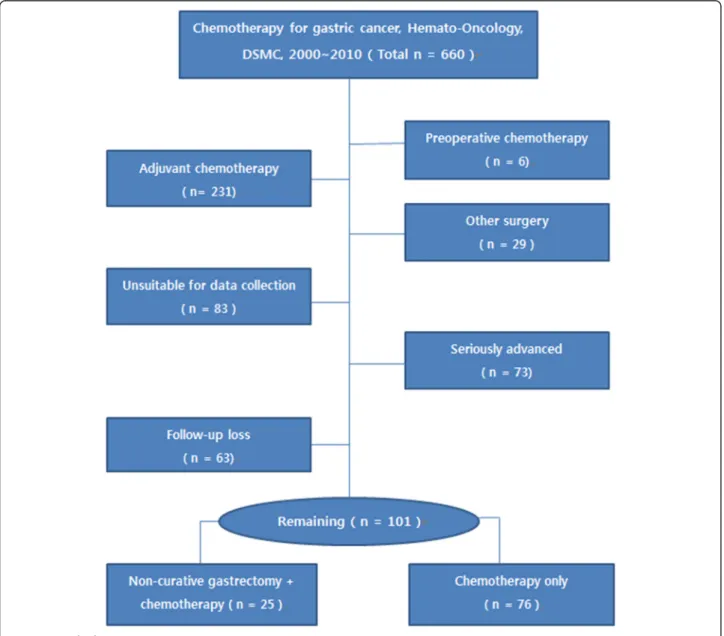
Methods: Between January 2000 and December 2010, 660 patients received chemotherapy for gastric cancer at the Department of Hemato-Oncology, Dongsan Medical Center, Keimyung University School of Medicine, Daegu, Korea. Data was collected retrospectively from the medical records. Patients who received preoperative or adjuvant chemotherapy, who underwent other surgeries like gastrojejunal bypass or exploratory laparotomy, who died within 3 months due to seriously advanced gastric cancer, who were lost to follow-up, or whose medical records were unsuitable for data collection were excluded. The remaining 101 patients had received chemotherapy only (CTx group, n = 76) or chemotherapy after non-curative gastrectomy (NCG + CTx group, n = 25). Clinicopathologic characteristics, chemoresponse, and overall survival were compared between the two groups.
Results: There were no significant differences between the two groups in clinicopathologic characteristics including age, sex, body mass index (BMI), comorbidity, histologic differentiation, tumor location, clinical T stage, and initial site of distant metastasis. Chemoresponse was checked on two separate occasions from the initiation of chemotherapy: first chemotherapy regimen and until the third regimen change. The NCG + CTx group showed more favorable chemoresponse than the CTx group in both checks (60% and 72% vs. 18.4% and 23.7%). The NCG + CTx group showed longer overall survival than the CTx group (26 vs. 11 months).
Conclusions: Non-curative gastrectomy in M1 gastric cancer could improve chemoresponse and extend overall survival.
Keywords: Chemoresponse, Non-curative gastrectomy, M1 gastric cancer, Chemotherapy, Survival
Background
M1 gastric cancer is characterized by distant metastasis at sites other than regional lymph node (LN) [1]. Distant me- tastasis comprises peritoneal metastasis including ovarian metastasis; hematogenous metastasis that spreads to the liver, lung, and bone; and metastasis to distant LNs includ- ing paraaortic, neck, and mediastinal LNs.
Chemotherapy has been recommended as a main treatment modality for M1 gastric cancer in the third Japanese gastric cancer treatment guidelines as well as in the 2013 National Comprehensive Cancer Network (NCCN) gastric cancer guidelines [2,3]. However, the
median survival of M1 gastric cancer is under 1 year despite aggressive chemotherapy. Although a few clinical trials showed the effectiveness of adjuvant chemotherapy after curative resection in advanced gastric cancer [4-7], the generally poor oncologic outcomes in M1 gastric cancer might be caused by the lack of an outstanding chemotherapeutic agent and definite treatment guide- lines specifying surgery [8].
Several study groups have tried to improve the onco- logic outcomes with the various new concepts including liver resection for hepatic metastasis from gastric cancer, aggressive surgery with peritonectomy for localized peri- toneal metastasis, intraperitoneal chemotherapy, surgery
* Correspondence: [email protected]
Department of Surgery, Keimyung University School of Medicine, 194, Dongsan-dong, Choong-gu, Daegu 700-712, Korea
© 2015 Shin et al.; licensee BioMed Central. This is an Open Access article distributed under the terms of the Creative
Commons Attribution License (http://creativecommons.org/licenses/by/4.0), which permits unrestricted use, distribution, and
reproduction in any medium, provided the original work is properly credited. The Creative Commons Public Domain
Dedication waiver (http://creativecommons.org/publicdomain/zero/1.0/) applies to the data made available in this article,
unless otherwise stated.
with curative intent in patients who have presented fa- vorable response after chemotherapy, and chemotherapy after non-curative gastrectomy. Some survival benefits were reported [9-24]. But these studies focused on pa- tient survival, although chemoresponse could be the most important mechanism to prolong the survival time after chemotherapy.
With this in mind, we concentrated our attention on the chemoresponse after non-curative gastrectomy in M1 gastric cancer. We hypothesized that non-curative gastrectomy will improve the chemoresponse by redu- cing tumor burden, similar to other cancers, with non- curative gastrectomy inhibiting the chemoresponse by destroying the lymphatic channels or blood vessels that are the anatomic routes to tumor. Accordingly, the goal
was to identify if non-curative gastrectomy could im- prove the chemoresponse. The influence of chemore- sponse on patient survival was assessed.
Methods
Between January 2000 and December 2010, 660 patients received chemotherapy for gastric cancer at the Depart- ment of Hemato-Oncology, Dongsan Medical Center, Keimyung University School of Medicine, Daegu, Korea.
We collected the data from this group through a retro- spective review of medical records. Patients who re- ceived preoperative or adjuvant chemotherapy, who underwent other surgeries like gastrojejunal bypass or exploratory laparotomy, who died within 3 months due to seriously advanced gastric cancer, and who were lost
Figure 1 Study design.
to follow-up, whose medical records were unsuitable for data collection were excluded (Figure 1). The remaining 101 patients had received chemotherapy only (CTx group, n = 76) or chemotherapy after non-curative gas- trectomy (NCG + CTx group, n = 25). Non-curative gas- trectomies were comprised of total gastrectomy (n = 15) and subtotal gastrectomy (n = 10).
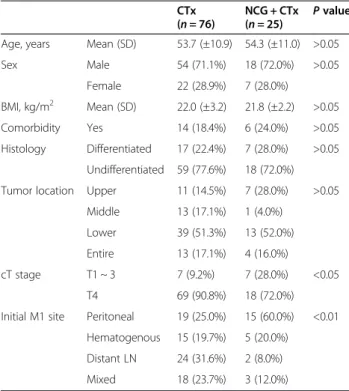
There were no significant differences between the two groups in clinicopathologic characteristics including age, sex, body mass index (BMI), comorbidity, histologic dif- ferentiation, tumor location, clinical T stage, and initial site of distant metastasis (Table 1). Chemoresponse and overall survival were compared. In the absence of pre- viously defined criteria for chemoresponse, new criteria were assigned (Figure 2). Patients presenting once with
complete response (CR) or partial response (PR) or stable disease (SD) on the Response Evaluation Criteria in Solid Tumors (RECIST) according to clinical progress and follow-up computed tomography (CT), positron emission tomography (PET), bone scan, or magnetic resonance im- aging (MRI) from initiation of chemotherapy to the time of evaluation were reclassified as ‘favorable chemore- sponse.’ Otherwise, patients who continued to present progressive disease (PD) until evaluation were reclassified as ‘unfavorable chemoresponse’. The clinical course of pa- tients who received palliative chemotherapy for M1 gastric cancer is typically determined following the third change of regimen. Thus, chemoresponse was checked on two separate occasions from the initiation of chemotherapy.
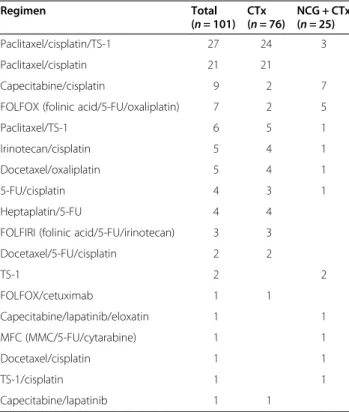
One was chemoresponse for the first chemotherapy regi- men. The other was chemoresponse until the third regi- men change. Overall survival between the two groups was compared. Various regimens were applied for the first chemotherapy as shown in Table 2.
This study was approved by the Institutional Review Board of Keimyung University School of Medicine, Dongsan Medical Center, Daegu, Korea (IRB file no.
2014-01-018).
Statistical analyses
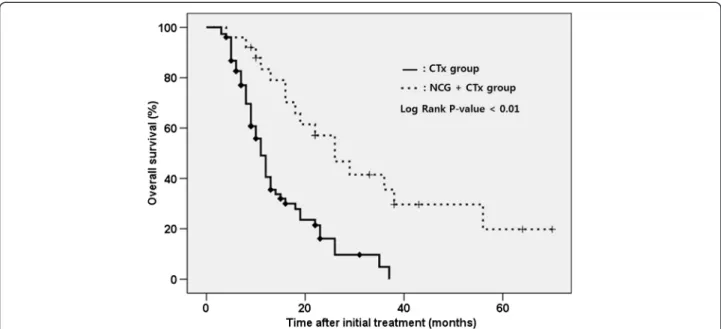
SPSS version 20.0 (SPSS, Chicago, IL, USA) was used for statistical analyses. To compare the clinicopathologic characteristics and the chemoresponse between the two groups, chi-square test was used for categorical vari- ables, and Student’s t-test and Fisher’s exact test were used for continuous variables. Overall survival was ana- lyzed with the Kaplan-Meier curve analysis, and statistical significance was evaluated with log-rank test. P < 0.05 was considered significant.
Results
There were no significant differences in age, sex, BMI, comorbidity, histologic differentiation, and tumor loca- tion between the two groups (Table 1). Despite efforts to make the two groups homogenous, clinical T4 gastric Table 1 Clinicopathologic characteristics
CTx
( n = 76) NCG + CTx
( n = 25) P value Age, years Mean (SD) 53.7 (±10.9) 54.3 (±11.0) >0.05
Sex Male 54 (71.1%) 18 (72.0%) >0.05
Female 22 (28.9%) 7 (28.0%)
BMI, kg/m
2Mean (SD) 22.0 (±3.2) 21.8 (±2.2) >0.05 Comorbidity Yes 14 (18.4%) 6 (24.0%) >0.05 Histology Differentiated 17 (22.4%) 7 (28.0%) >0.05
Undifferentiated 59 (77.6%) 18 (72.0%) Tumor location Upper 11 (14.5%) 7 (28.0%) >0.05
Middle 13 (17.1%) 1 (4.0%)
Lower 39 (51.3%) 13 (52.0%)
Entire 13 (17.1%) 4 (16.0%)
cT stage T1 ~ 3 7 (9.2%) 7 (28.0%) <0.05
T4 69 (90.8%) 18 (72.0%)
Initial M1 site Peritoneal 19 (25.0%) 15 (60.0%) <0.01 Hematogenous 15 (19.7%) 5 (20.0%)
Distant LN 24 (31.6%) 2 (8.0%) Mixed 18 (23.7%) 3 (12.0%) Abbreviation: cT stage clinical T stage, SD standard deviation.
Figure 2 Reclassification of chemoresponse according to the Response Evaluation Criteria in Solid Tumor (RECIST).
cancer was somewhat more prevalent in the CTx group.
However, considering that serosal exposure of gastric cancer could not be identified directly in this group be- cause there was no operative view and it was difficult to distinguish T4 from T3 in gastric cancer by CT and PET, this slight difference was disregarded.
The NCG + CTx group displayed a higher proportion of peritoneal metastasis than the CTx group (60.0% vs.
25.0%). Distant LN metastasis was more common in the CTx group (31.6% vs. 8.0%). If we regarded the existence of mixed-type metastasis as being indicative of the ag- gressiveness of M1 gastric cancer, there was no signifi- cant difference in the aggressiveness of cancer between the two groups, because the mixed type metastasis be- tween the two groups displayed no significant difference (23.7% vs. 12%, P = 0.266).
Based on this result, we compared the chemore- sponse and overall survival. The NCG + CTx group showed more favorable chemoresponse than the CTx group at both checks (60% and 72% vs. 18.4% and 23.7%; Table 3). The NCG + CTx group had a longer overall survival than the CTx group (26 vs. 11 months;
Table 4, Figure 3).
Discussion
Presently, patients who received chemotherapy after non- curative gastrectomy for M1 gastric cancer displayed a
more favorable chemoresponse and longer overall sur- vival. This result is consistent with the view that non- curative gastrectomy in M1 gastric cancer improves the chemoresponse by reducing the tumor burden [25,26], with minimal inhibited chemoresponse due to destruction of the anatomic route to the tumor during surgery, which lead to prolonged overall survival.
Several previous studies reported that various non- curative surgeries that reduce the tumor burden could produce a survival benefit in M1 gastric cancer [24,27-29].
However, the studies addressed survival after non-curative surgery and not chemoresponse. The significance of the present study was the focus on the relationship between non-curative gastrectomy and chemoresponse.
Generally, it is anticipated that a more favorable che- moresponse after chemotherapy could lead to longer survival. However, how the chemoresponse could influ- ence patient survival in M1 gastric cancer is unclear [30]. This unreliable probability between chemoresponse and survival in M1 gastric cancer might be caused by the lack of an outstanding chemotherapeutic agent. With the development of such an agent, studies demonstrating the oncologic benefit of non-curative gastrectomy would be an important cornerstone for the treatment guideline for M1 gastric cancer.
This study has some limitations. The study was retro- spective and the CTx group had no operative view, which could create selection bias and heterogeneity be- tween the two groups. Second, non-curative gastrectomy in itself reduces the tumor burden, which could have overestimated a favorable response. Third, the CTx group displayed marginally more prevalent clinical T4 gastric cancer, which could be connected to poorer survival. This lack of homogeneity should be consid- ered in overall survival comparative analysis between the two groups. Finally, a quality-of-life evaluation was not Table 3 Chemoresponse according to the change of regimens for chemotherapy
Change Response CTx
( n = 76) NCG + CTx ( n = 25) P value For the first regimen Favorable 14 (18.4%) 15 (60.0%) <0.01
Unfavorable 62 (81.6%) 10 (40.0%) Until the third regimen Favorable 18 (23.7%) 18 (72.0%) <0.01
Unfavorable 58 (76.3%) 7 (28.0%)
Table 4 Overall survival
Group Median
(months)
1-YSR (%) 2-YSR (%) 3-YSR (%) P value
CTx 11 40.6 16.1 4.8 <0.01
NCG + CTx 26 83.4 57.1 35.6
Abbreviation: YSR year survival rate.
Table 2 Regimens used for the first chemotherapy
Regimen Total
( n = 101) CTx
( n = 76) NCG + CTx ( n = 25)
Paclitaxel/cisplatin/TS-1 27 24 3
Paclitaxel/cisplatin 21 21
Capecitabine/cisplatin 9 2 7
FOLFOX (folinic acid/5-FU/oxaliplatin) 7 2 5
Paclitaxel/TS-1 6 5 1
Irinotecan/cisplatin 5 4 1
Docetaxel/oxaliplatin 5 4 1
5-FU/cisplatin 4 3 1
Heptaplatin/5-FU 4 4
FOLFIRI (folinic acid/5-FU/irinotecan) 3 3
Docetaxel/5-FU/cisplatin 2 2
TS-1 2 2
FOLFOX/cetuximab 1 1
Capecitabine/lapatinib/eloxatin 1 1
MFC (MMC/5-FU/cytarabine) 1 1
Docetaxel/cisplatin 1 1
TS-1/cisplatin 1 1
Capecitabine/lapatinib 1 1
Abbreviations: 5-FU 5-fluorouracil, MMC mitomycin-C, TS-1 tegafur-gimeracil-oteracil
potassium.
performed. Thus, it is impossible to definitely recom- mend non-curative gastrectomy, although it is feasible technically.
Conclusions
Despite the aforementioned limitations due to the hetero- geneity between the two groups, non-curative gastrectomy in M1 gastric cancer could improve chemoresponse and extend survival.
Abbreviations
BMI: Body mass index; CR: Complete response; CT: Computed tomography;
CTx: Chemotherapy; cT stage: Clinical T stage; 5-FU: 5-Fluorouracil; LN: Lymph node;
MMC: Mitomycin-C; MRI: Magnetic resonance imaging; NCG + CTx: Chemotherapy after non-curative gastrectomy; NCCN: National comprehensive cancer network;
PD: Progressive disease; PET: Positron emission tomography; PR: Partial response; RECIST: Response evaluation criteria in solid tumors; SD: Stable disease; SD: Standard deviation; TS-1: Tegafur-gimeracil-oteracil potassium;
YSR: Year survival rate.
Competing interests
The authors declare that they have no competing interests.
Authors ’ contributions
HBS helped in the design, analysis, interpretation of data, and drafting of the manuscript. YGS helped in the design, acquisition of data, and critical revision. SHL helped in the design and acquisition of data. SWR and SSS provided critical revision. All authors read and approved the final manuscript.
Acknowledgements
This article was supported by scholarships from Keimyung University.
Received: 6 June 2014 Accepted: 8 January 2015
References
1. Japanese Gastric Cancer Association. Japanese classification of gastric carcinoma: 3rd English edition. Gastric Cancer. 2011;14(2):101 –12.
2. Association JGC. Japanese gastric cancer treatment guidelines 2010 (ver. 3).
Gastric Cancer. 2011;14(2):113 –23.
3. Ajani JA, Bentrem DJ, Besh S, D ’Amico TA, Das P, Denlinger C, et al. Gastric cancer, version 2.2013: featured updates to the NCCN guidelines. J Natl Compr Canc Netw. 2013;11(5):531 –46.
4. Bang YJ, Kim YW, Yang HK, Chung HC, Park YK, Lee KH, et al. Adjuvant capecitabine and oxaliplatin for gastric cancer after D2 gastrectomy (CLASSIC): a phase 3 open-label, randomised controlled trial. Lancet.
2012;379(9813):315 –21.
5. Sasako M, Sakuramoto S, Katai H, Kinoshita T, Furukawa H, Yamaguchi T, et al. Five-year outcomes of a randomized phase III trial comparing adjuvant chemotherapy with S-1 versus surgery alone in stage II or III gastric cancer.
J Clin Oncol. 2011;29(33):4387 –93.
6. Bang YJ, Van Cutsem E, Feyereislova A, Chung HC, Shen L, Sawaki A, et al.
Trastuzumab in combination with chemotherapy versus chemotherapy alone for treatment of HER2-positive advanced gastric or gastro- oesophageal junction cancer (ToGA): a phase 3, open-label, randomised controlled trial. Lancet. 2010;376(9742):687 –97.
7. Sakuramoto S, Sasako M, Yamaguchi T, Kinoshita T, Fujii M, Nashimoto A, et al. Adjuvant chemotherapy for gastric cancer with S-1, an oral fluoropyrimidine. N Engl J Med. 2007;357(18):1810 –20.
8. Foukakis T, Lundell L, Gubanski M, Lind PA. Advances in the treatment of patients with gastric adenocarcinoma. Acta Oncol. 2007;46(3):277 –85.
9. Bozzetti F, Bonfanti G, Audisio RA, Doci R, Dossena G, Gennari L, et al.
Prognosis of patients after palliative surgical procedures for carcinoma of the stomach. Surg Gynecol Obstet. 1987;164(2):151 –4.
10. Cheon SH, Rha SY, Jeung HC, Im CK, Kim SH, Kim HR, et al. Survival benefit of combined curative resection of the stomach (D2 resection) and liver in gastric cancer patients with liver metastases. Ann Oncol. 2008;19(6):1146 –53.
11. Hioki M, Gotohda N, Konishi M, Nakagohri T, Takahashi S, Kinoshita T.
Predictive factors improving survival after gastrectomy in gastric cancer patients with peritoneal carcinomatosis. World J Surg. 2010;34(3):555 –62.
12. Kahlke V, Bestmann B, Schmid A, Doniec JM, Kuchler T, Kremer B. Palliation of metastatic gastric cancer: impact of preoperative symptoms and the type of operation on survival and quality of life. World J Surg. 2004;28(4):369 –75.
13. Kikuchi S, Arai Y, Morise M, Kobayashi N, Tsukamoto H, Shimao H, et al.
Gastric cancer with metastases to the distant peritoneum: a 20-year surgical experience. Hepatogastroenterology. 1998;45(22):1183 –8.
14. Kim KW, Chow O, Parikh K, Blank S, Jibara G, Kadri H, et al. Peritoneal carcinomatosis in patients with gastric cancer, and the role for surgical resection, cytoreductive surgery, and hyperthermic intraperitoneal chemotherapy. Am J Surg. 2014;207(1):78 –83.
15. Kunisaki C, Shimada H, Akiyama H, Nomura M, Matsuda G, Ono H. Survival benefit of palliative gastrectomy in advanced incurable gastric cancer.
Anticancer Res. 2003;23(2C):1853 –8.
Figure 3 Comparison of overall survival between the NCG + CTx group and the CTx group.
16. Li C, Yan M, Zhu ZG. Nonpalliative surgical resection for gastric cancer patients with distant metastasis. J Invest Surg. 2012;25(2):100 –6.
17. Miner TJ, Jaques DP, Karpeh MS, Brennan MF. Defining palliative surgery in patients receiving noncurative resections for gastric cancer. J Am Coll Surg.
2004;198(6):1013 –21.
18. Saidi RF, ReMine SG, Dudrick PS, Hanna NN. Is there a role for palliative gastrectomy in patients with stage IV gastric cancer? World J Surg. 2006;30 (1):21 –7.
19. Sakamoto Y, Ohyama S, Yamamoto J, Yamada K, Seki M, Ohta K, et al.
Surgical resection of liver metastases of gastric cancer: an analysis of a 17-year experience with 22 patients. Surgery. 2003;133(5):507 –11.
20. Sougioultzis S, Syrios J, Xynos ID, Bovaretos N, Kosmas C, Sarantonis J, et al.
Palliative gastrectomy and other factors affecting overall survival in stage IV gastric adenocarcinoma patients receiving chemotherapy: a retrospective analysis. Eur J Surg Oncol. 2011;37(4):312 –8.
21. Yan TD, Yonemura Y, Morris DL. Surgical strategies for gastric cancer with synchronous peritoneal carcinomatosis (Br J Surg 2006; 93: 1530 –1535). Br J Surg. 2007;94(5):642. author reply 642 –643.
22. Glockzin G, Schlitt HJ, Piso P. Peritoneal carcinomatosis: patients selection, perioperative complications and quality of life related to cytoreductive surgery and hyperthermic intraperitoneal chemotherapy. World J Surg Oncol. 2009;7:5.
23. Ojima H, Ootake S, Yokobori T, Mochida Y, Hosouchi Y, Nishida Y, et al.
Treatment of multiple liver metastasis from gastric carcinoma. World J Surg Oncol. 2007;5:70.
24. Novotny AR, Reim D, Friess HM, Schuhmacher C. Secondary gastrectomy for stage IV gastroesophageal adenocarcinoma after induction-chemotherapy.
Langenbecks Arch Surg. 2014;399(6):773 –81.
25. Bonenkamp JJ, Sasako M, Hermans J, van de Velde CJ. Tumor load and surgical palliation in gastric cancer. Hepatogastroenterology. 2001;48 (41):1219 –21.
26. Pollock RE, Roth JA. Cancer-induced immunosuppression: implications for therapy? Semin Surg Oncol. 1989;5(6):414 –9.
27. Zhang JZ, Lu HS, Huang CM, Wu XY, Wang C, Guan GX, et al. Outcome of palliative total gastrectomy for stage IV proximal gastric cancer. Am J Surg.
2011;202(1):91 –6.
28. Hartgrink HH, Putter H, Klein Kranenbarg E, Bonenkamp JJ, van de Velde CJ.
Value of palliative resection in gastric cancer. Br J Surg. 2002;89(11):1438 –43.
29. Koga S, Kawaguchi H, Kishimoto H, Tanaka K, Miyano Y, Kimura O, et al.
Therapeutic significance of noncurative gastrectomy for gastric cancer with liver metastasis. Am J Surg. 1980;140(3):356 –9.
30. An JY, Kim HI, Cheong JH, Hyung WJ, Kim CB, Noh SH. Pathologic and oncologic outcomes in locally advanced gastric cancer with neoadjuvant chemotherapy or chemoradiotherapy. Yonsei Med J. 2013;54(4):888 –94.
Submit your next manuscript to BioMed Central and take full advantage of:
• Convenient online submission
• Thorough peer review
• No space constraints or color figure charges
• Immediate publication on acceptance
• Inclusion in PubMed, CAS, Scopus and Google Scholar
• Research which is freely available for redistribution
Submit your manuscript at www.biomedcentral.com/submit