Vol. 19, No. 6 pp. 391-404, 2018
치매노인의 낙상예방을 위한 중재 프로그램에 대한 국내 ·외 논문 분석
차현수1, 황성우2*
1
세한대학교 간호학과,
2두원공과대학교 간호학과
Analyses of Studies on the Intervention programs for the Prevention of Falls in Elderly with Dementia
Hyun-Su Cha
1, Sung-Woo Hwang
2*1
Department of Nursing, Sehan University
2
Department of Nursing, Doowon Technical University
요 약 이 연구의 목적은 치매노인의 낙상을 예방하기 위한 중재연구의 현황을 파악하고 낙상예방을 위한 중재 프로그램의 내용과 효과를 알아보는 것이다. 문헌 검색은 치매, 알쯔하이머, 알츠하이머, 낙상, 낙상예방을 검색어로 하여 한국교육학술 정보원(http://www.riss4u.net), 국회도서관, 한국학술정보(http://kiss. kstudy.com)와 pubMed, CINAHL을 통해 2000년 1월부터 2016년 12월까지 발표된 연구 논문을 검색하였다. 전자 자료를 검색한 후 연구자가 원본을 확인하여 선별한 13편의 논문을 최종 분석 하였다. 연구에 적용된 중재분야는 운동 치료(8편, 61.5%), 물리 치료와 작업 치료(2편, 15.4%), 보완대체요법(2편, 15.4%), 음악 치료(1편, 7.7%)이었다. Scottish Intercollegiate Guideline Network의 체크 리스트로 논문의 질적 평가를 실시하 였다. 논문의 질적 평가 결과 10점 만점에 9점인 연구가 2편, 8점인 연구가 5편, 7점인 연구가 6편이었다. 낙상예방 중재내용
을 분석한 결과 중재시간은 1회당 평균 55분을 시행하였고 중재 총 시행 횟수는 평균 37회이었다. 분석한 연구 결과에 의하
면 운동 치료(타이치 포함), 음악 치료, 물리 치료와 작업 치료, 율동 동작 치료 등이 치매노인의 낙상예방에 효과가 있는 것으로 나타났다. 향후 이 결과를 활용하여 임상 현장에서 간호사에 의한 낙상예방 중재 프로그램 개발에 근거 자료로 활용 하기를 기대한다.
Abstract The purpose of this study was to determine the status of interventional studies to prevent falling in elderly with dementia and to determine the contents and effectiveness of intervention programs to prevent falling. Existing reports published between January 1, 2000 and December 31, 2016 were searched electronically using the RISS, National Library, KISS, PubMed, and CINAHL database with the keywords dementia, Alzheimer's or Alzheimer's disease, falling, and prevention of falling. After checking the original sources of the articles, 13 articles were included in the review. Therapeutic interventions used in the articles included exercise therapy (8, 61.5%), physiotherapy and occupational therapy (2, 15.4%), complementary therapies (2, 15.4%), and music therapy (1, 7.7%). As a result of the qualitative evaluation of the papers using a checklist of the Scottish Intercollegiate Guideline Network, two studies scored 9 out of 10 points, five studies scored 8 out of 10, and six studies scored 7 out of 10. Intervention sessions were conducted for 55 minutes, on average, for a total of 37 sessions. This study found that exercise, music therapy, physical and occupational therapy, and rhythmic motion therapy were effective in preventing falling in the elderly with dementia. In the future, these findings are expected to be used as a basis for the development of a preventive intervention program for nurses in a clinical setting.
Keywords : Dementia, Elderly, Literature Review, Prevention of Falls, Effects of Intervention program
본 논문은 2018년도 세한대학교 교내 연구비 지원에 의하여 수행되었음.
*
Corresponding Author : Sung-Woo Hwang(Doowon Technical Univ.) Tel: +82-31-8056-7313 email: [email protected]
Received March 27, 2018 Revised (1st April 27, 2018, 2nd May 8, 2018)
Accepted June 1, 2018 Published June 30, 2018
1. 서론
1.1 연구의 필요성
요즘 우리나라의 전체 노인 인구는 빠르게 증가하고 있으며 치매노인 인구는 더 빠르게 증가하고 있다. 2009 년에서2012년 사이에 전체 노인 인구는 5,016천명에서 5,889천명으로 17.4%가 증가하였으며 치매노인 인구는 421천명에서 534천명으로 26.8%가 증가하였다[1].
2030년이 되면 치매노인인구수는 113만 명 이상이 될 것으로 예상하고 있다[2].
치매노인은 일반노인에 비해 낙상이8배 더 많이 발 생된다[3]. 치매노인은 일반노인에 비해 보행능력, 판단 력 및 시공간 개념이 저하되며, 위험에 대처하는 능력이 부족하여 낙상 발생률이 더 높을 뿐만 아니라 낙상 발생 후 회복이 더 저조한 것으로 보고되고 있다[4]. 따라서 향후 낙상이 발생되는 치매노인의 수는 점점 많아질 것 으로 예상된다.
낙상이란 본인의 의지와 상관없이 자세가 변화하여 신체가 낮은 곳으로 넘어지는 것을 뜻한다. 노인은 노화 로 인해 신경계 기능이 퇴화되어 균형감이 떨어지고, 근 력이 약화되어 보행능력이 감소됨에 따라 걸려서 넘어지 거나 미끄러지는 낙상이 쉽게 발생한다[5].
낙상을 발생시키는 요인은 내적 요인과 외적 요인으 로 나눌 수 있다. 내적 요인으로는 연령의 증가[6], 노화 로 인한 신체적 및 심리적 변화, 만성적 질환 이환, 약물 복용[7] 등이 있고 외적 요인으로는 낙상 시 활동, 낙상 발생 장소, 낙상이 일어나는 시기, 치료 상황과 관련된 낙상, 낙상이 일어나는 환경 등이 있다. 낙상 시 활동은 휠체어를 사용하기 위해 자세를 바꿀 때, 욕실이나 화장 실에서 침상으로 이동하는 경우에 발생하였다[6]. 낙상 발생 장소는 침실이 가장 많았고[8] 낙상이 주로 일어나 는 시기는 밤이나 저녁이었다[9]. 낙상이 주로 일어나는 치료 상황은 정맥 주사 치료와 관련 있었다[10]. 낙상이 주로 일어나는 환경은 미끄러운 바닥, 실내의 어두운 조 명 등이었다[11].
낙상과 관련하여 진행된 선행 연구는 크게3가지 주 제로 분류할 수 있다. 낙상 실태에 관한 연구, 낙상의 유 발 요인에 관한 연구, 노인 낙상예방 프로그램의 효과에 관한 연구 등으로 나눠진다.
첫째, 낙상 실태에 관한 연구를 살펴보면 다음과 같 다. 집안에서 보다는 집밖에서 더 낙상이 많이 발생하였
고, 남성보다 여성에서 낙상 발생률이 더 높았고 연령이 증가할수록 낙상 발생률이 높았다[12].
둘째, 낙상의 유발 요인에 관한 연구 결과에 따르면, 내적 요인으로 시력이 낮은 노인은 시력이 정상인 노인 에 비해 낙상 발생률이 더 높았고[13], 근육이 약한 노인 은 근육이 건강한 노인에 비해 낙상 발생률이1.8배 더 높았다[14]. 낙상에 대한 두려움이 큰 노인은 낙상에 대 한 두려움이 적은 노인에 비해 낙상 발생률이 더 높았고 [15], 우울증을 앓고 있는 노인은 건강한 노인에 비해 낙 상 발생률이 더 높았다[16]. 체질량지수(BMI)가 낮은 노 인은 체질량지수가 높은 노인에 비해 낙상 발생률이 더 높았다[17].
낙상 유발의 외적 요인은 환경 변수와 행위관련 변수 로 나눠진다. 환경 변수로는 단독 주택이 아파트보다 낙 상 발생률이 높았고, 낙상이 많이 발생한 장소로는 욕실, 현관, 침실, 부엌, 거실, 계단의 순인 것으로 보고되었다 [18]. 행위관련 변수로는 발에 맞지 않는 신발을 신는 노 인은 발에 맞는 신발을 신는 노인에 비해 낙상 발생률이 높았고[19], 한 달에 1ℓ이상의 술을 마시는 노인은 그 렇지 않은 노인에 비해 낙상 발생률이 3배 높았고[20], 여러 가지 약을 동시에 복용하는 노인은 약을 복용하지 않는 노인에 비해 낙상 발생률이 높았다[21].
셋째. 노인 낙상예방 프로그램의 효과에 관한 연구 결 과에 따르면, 캐나다의 Home Support Exercise Program(HSEP) 프로그램의 경우, 일정 간격으로 프로 그램 제공자가 가정을 직접 방문하여 프로그램을 제공하 였기 때문에 낙상 발생률을 감소시켰음을 보고하였다 [22]. 동일한 HSEP 프로그램을 적용한 한국의 경우에도 신체 균형감과 보행정도, 하지근력, 낙상 효능감이 증진 되어 낙상예방에 효과가 있었다[23].
노인 낙상예방 프로그램은 주로 노인들의 균형 및 보 행 능력에 향상을 가져다주었으며[24] 노인 낙상예방을 위한 운동 프로그램에 관하여 국내논문을 분석한 Jeoung의 연구[25]에 의하면 노인 낙상예방 운동 프로그 램은 탄력밴드를 이용한 저항성 운동과 하지근력향상을 위한 운동을 수행하여 효과를 검증한 논문들이 대부분이 었는데1회당 60분 이상, 주당 3회, 12주 동안 운동 프로 그램을 수행하는 것이 낙상예방 운동으로 효과가 있었다.
최근 국내·외 낙상 연구 동향을 살펴보면 낙상 유발요 인을 규명하는 연구가 대부분이고[13-21] 낙상예방 프로 그램의 효과성을 검증하는 연구는 소수에 불과하다
[22-25]. 소수의 낙상예방 프로그램의 효과성에 관한 연 구들도 문헌고찰 연구와 낙상을 예방하는 운동중재의 효 과성 유무 정도만을 검증하는 수준에 머물러 있다. 따라 서 이미 여러 연구자들이 지적했듯이 향후에는 낙상예방 프로그램이 낙상 발생률을 얼마나 감소시켰는지를 검증 하는 연구가 시행되어야 할 것이다.
낙상을 경험하는 치매노인의 수가 증가함에 따라 노 인 낙상 치료비도 증가하고 있다. 2015년 우리나라 노인 총 의료비는19조원인데 이중 노인 낙상과 관련된 치료 비가 약8.7%로[26] 이미 많은 치료비가 노인 낙상 치료 에 지불되고 있으나 노인 낙상 치료비의 지불은 계속 증 가되어 향후 사회적인 부담으로 작용하리라 예상된다.
낙상으로 인한 치매노인 치료비 증가를 감소시키기 위해서는 치매노인에게 적합한 낙상예방 프로그램을 개 발해야 하는데, 낙상예방 프로그램 개발을 위해서 치매 노인을 대상으로 낙상예방 중재방법과 중재방법에 따른 중재효과를 파악하는 체계적 문헌고찰을 통해 효과가 검 증된 낙상예방 프로그램을 파악할 필요가 있다. 그러나 아직까지 치매노인만을 대상으로 낙상예방 중재효과에 관한 체계적 문헌고찰이 거의 이루어지지 않고 있는 실 정이다. 이에 본 연구자들은 치매노인을 대상으로 실시 된 낙상예방 중재연구의 효과를 파악하여 이를 바탕으로 치매노인의 낙상예방 중재 프로그램 개발의 근거자료를 제공하고자 한다.
1.2 연구의 목적
본 연구는2000년 1월부터 2016년 12월까지 국내외 에서 실시된 치매노인 낙상예방 중재 프로그램의 현황을 파악하고 그 효과를 알아보기 위한 것으로 구체적 목적 은 다음과 같다.
1) 치매노인 낙상예방 중재연구의 연구관련 특성을 파악한다.
2) 치매노인 낙상예방 중재연구에서 사용한 중재 프 로그램의 특성을 분석한다.
3) 치매노인 낙상예방 중재 프로그램의 결과 변수와 효과를 파악한다.
2. 연구 방법 2.1 연구 설계
본 연구는 치매노인에게 적용한 낙상예방 중재프로그 램의 효과를 파악하기 위해 문헌을 검색하고 체계적으로 분석한 문헌고찰 연구이다.
2.2 자료수집방법
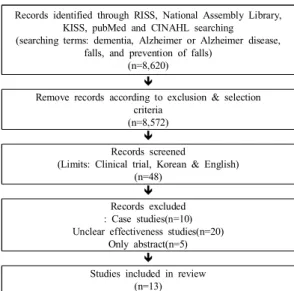
본 연구는 최근17년간 치매노인을 대상으로 낙상예 방 중재를 시행한 국내·외 연구 논문을 분석대상으로 하 였다. 문헌검색은 2000년 1월부터 2016년 12월까지 발 표된 연구 중에서 한국학술정보(kiss.kstudy .com), 한국 교육학술정보원(www.riss4u.net), 국회도서관, pubMed, CINAHL 등의 전자 자료 검색도구를 이용하여 학술지 게재 논문과 학위논문을 검색하였다. 중재유형과 관련된 검색어는 낙상예방이고, 대상자 유형과 관련된 검색어는 치매(dementia), 알쯔하이머, 알츠하이머(Alzheimer or Alzheimer disease), 낙상(falls)이었다. 선별단계에서 8,620편의 제목과 초록을 검토하여 주제와 상관없는 8,572편을 제외하였다. 선정단계에서는 제외기준과 선 정기준에 따라 검토하였다. 제외기준은 1)질적 연구, 리 뷰 연구2)중복 게재 연구였고 선정기준은 1)치매노인을 대상으로 한 연구2)언어가 영어 또는 한국어로 된 연구 3)실험연구 4)낙상을 예방하기 위한 중재의 효과를 검증 한 연구였다. 48편의 원문을 검토한 결과 증례 연구(10 편), 낙상을 예방하기 위한 중재의 효과 기술이 불명확한 연구(20편), 원문이 제공되지 않고 초록만 제시된 연구(5 편)를 제외하였다. 이런 과정을 거쳐 총 13편의 연구를 최종 분석 대상으로 선정하였다[Fig. 1].
Records identified through RISS, National Assembly Library, KISS, pubMed and CINAHL searching (searching terms: dementia, Alzheimer or Alzheimer disease,
falls, and prevention of falls) (n=8,620)
ê
Remove records according to exclusion & selection criteria
(n=8,572) ê Records screened
(Limits: Clinical trial, Korean & English) (n=48)
ê Records excluded : Case studies(n=10) Unclear effectiveness studies(n=20)
Only abstract(n=5) ê
Studies included in review (n=13)
Fig. 1. Flow Diagram for Study Selection
2.3 문헌 평가
선정된 논문들은 Scottish Intercollegiate Guideline Network(2013)[27]에서 제안한 체크리스트와 Jung[28]
의 질적 평가기준 등을 사용하여 평가하였다. 평가 틀에 포함된 항목은 연구 설계, 무작위 할당, 이중 맹검, 대상 자수 선정의 근거, 대상자 선정기준, 중도 탈락률(20%이 하), 중재시행 장소(2곳 이상), 통계기법의 적절성, 도구 의 신뢰도, 결과의 임상적 유용성 등 10가지이다. 해당 논문에 각 항목이 해당되면‘1’점을, 아니면 ‘0’점을 부 여한 후 이들 총합을 최종 점수 란에 표기하였다.
2.4 자료 분석 방법
선정된 논문들을 일관성 있게 분석하려고 원문분석 기록지를 작성하였다. 원문분석 기록지에 포함된 내용은 연구 제목, 저자, 출판 연도, 연구 설계 방법, 연구 대상 자수, 연구 영역, 연구물의 출판유형(미 출판된 석사학위 논문 또는 박사학위논문, 출판된 학술지 논문), 중재빈도 (주당 횟수), 중재 회당 중재시간(분), 총 회 차수, 중재 제공자의 영역, 종속변수(신체적, 사회·심리적), 자료통 계 분석방법, 연구 결과 등이다. 수집된 자료의 일반적 특성(연구 영역, 연구 설계 방법, 연구물의 출판유형)은 실수와 백분율로 구하였고, 연구의 중재 및 결과는 원문 분석 기록지를 이용하였다.
3. 연구 결과
3.1 논문의 일반적 특성
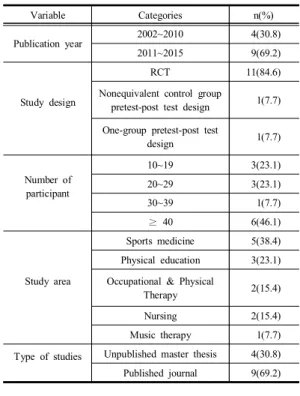
2000년부터 2016년까지 17년 동안 실시된 국내·외 치매노인 낙상예방을 위한 중재연구 중 체계적 문헌고찰 에 최종 선정된 논문들의 일반적 특성을 분석하였다 [Table 1]. 논문이 게재된 시기는 2002∼2010년이 4편 (30.8%)이었고 2011∼2015년이 9편(69.2%)이었다. 실 험설계는 무작위 대조군 사전사후 설계가 11편[30-39, 41], 비동등성 대조군 사전사후 설계가 1편[40], 단일군 사전사후 설계가1편[29]이었다. 연구 대상자는 40명 이 상이 6편[29-32, 34, 35]으로 가장 많았고 10∼19명 [37-39]과 20∼29명[33, 36, 40]이 각각 3편이었고 30∼
39명이 1편[41]이었다. 연구자의 전공 분야는 스포츠 의 학 분야가5편[31-35]으로 가장 많았고 체육교육학 분야 는3편[36, 39, 41], 작업 치료학와 물리 치료학 분야는
2편[30, 38], 간호학 분야 2편[29, 40], 음악 치료 분야 1편[37]이었다. 미 출간된 석사학위 논문이 4편[37-39, 41]이었고 출판된 학술지 논문이 9편[29-36, 40]이었다.
Table 1. General Characteristics of Studies (N=13)
Variable Categories n(%)
Publication year 2002~2010 4(30.8)
2011~2015 9(69.2)
Study design
RCT 11(84.6)
Nonequivalent control group
pretest-post test design 1(7.7) One-group pretest-post test
design 1(7.7)
Number of participant
10~19 3(23.1)
20~29 3(23.1)
30~39 1(7.7)
≥ 40 6(46.1)
Study area
Sports medicine 5(38.4) Physical education 3(23.1) Occupational & Physical
Therapy 2(15.4)
Nursing 2(15.4)
Music therapy 1(7.7)
Type of studies Unpublished master thesis 4(30.8) Published journal 9(69.2)
3.2 논문의 질적 평가
선정된13편의 논문들에 대한 질적 평가를 Table 2와 같이 실시하였다. 13편 모두 연구 설계가 잘 명시되어 있었다. 대상자 선정을 무작위 할당한 연구 논문은 9편 [30-35, 37, 39, 40]이었고 이중 맹검은 2편[31, 32]이었 고 단일 맹검은7편[30, 33-35, 37, 40, 41]이었다. 대상 자 선정기준은13편 모두 명시되어 있었다. 대상자수 선 정을 표본크기 계산에 의해 산정한 논문은2편[31, 32]
이었다. 대상자 중도 탈락률이 20%미만인 연구 논문은 8편[29, 33-36, 38]이었다. 13편 모두 측정도구의 신뢰도 검사를 하였고 적절한 통계적 분석방법이 사용되었다.
한 편의 논문[30]을 제외한 12편의 연구 논문에서 중재 가 임상적으로 관련성이 있었다. 이상의 논문의 질적 평 가를 종합하면10점 만점에 9점인 연구가 2편[31, 34], 8점인 연구가 5편[32, 33, 35, 37, 40], 7점인 연구가 6편 [29, 30, 36, 38, 39, 41]이었다.
Table 2. Results of the Scientific Quality Assessment of the Studies (N=13)
Author (year of publication)
Research design
Participants Intervention Measure
-ment Analysis Result
Score Random
allocation Blinding Inclusion criteria
Sample size:
clearly formulated
Drop out:
less than 20%
Intervention site: more than
2
Reliability
Appropriate statistical techniques
clinical relevant
Yao et al.
(2012) Y N N Y N Y
(13.6) Y Y Y Y 7
Wesson et al.
(2013) Y Y Y Y N N
(42.0) N Y Y N 7
Pitka“la” et al.
(2013) Y Y Y Y Y N
(23.3) Y Y Y Y 9
Zieschang et. al.
(2013) Y Y Y Y Y N
(25.0) N Y Y Y 8
Toulotte et al.
(2003) Y Y Y Y N Y
(0.0) N Y Y Y 8
Rosendahl et al.
(2008) Y Y Y Y N Y
(17.3) N Y Y Y 9
Rolland et al.
(2007) Y Y Y Y N Y
(17.9) N Y Y Y 8
Jung et al.
(2014) Y N N Y N Y
(0.0) Y Y Y Y 7
Choi
(2012) Y Y Y Y N N
(29.0) Y Y Y Y 8
Park
(2010) Y N N Y N Y
(10.0) Y Y Y Y 7
Yeom
(2015) Y Y N Y N N
(33.3) Y Y Y Y 7
Lim
(2002) Y Y Y Y N Y
(5.0) N Y Y Y 8
Kim
(2015) Y N Y Y N Y
(18.2) N Y Y Y 7
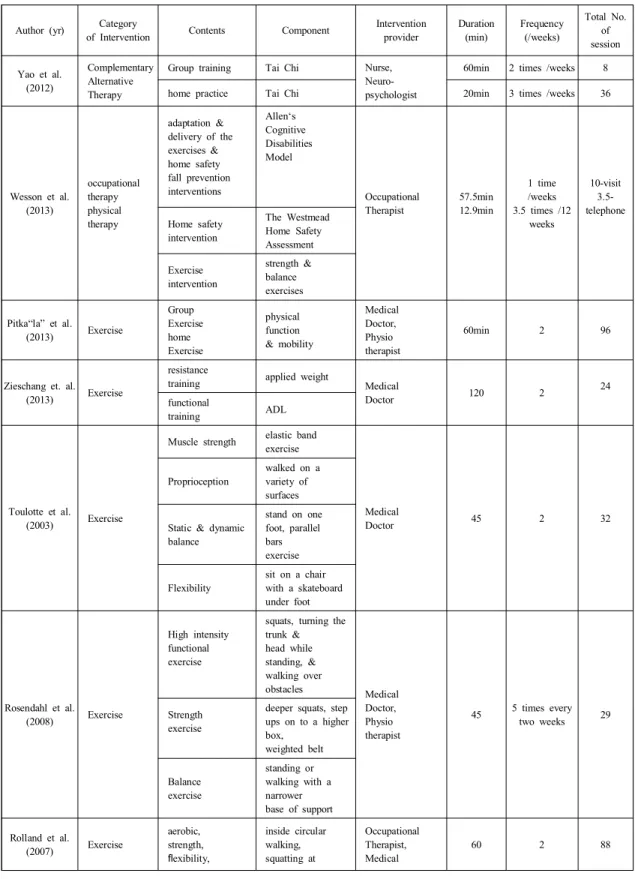
Table 3. Analysis of Content on Intervention for Prevention Falls in Elderly with Dementia (N=13)
Author (yr) Category
of Intervention Contents Component Intervention
provider
Duration (min)
Frequency (/weeks)
Total No.
of session
Yao et al.
(2012)
Complementary Alternative Therapy
Group training Tai Chi Nurse,
Neuro- psychologist
60min 2 times /weeks 8
home practice Tai Chi 20min 3 times /weeks 36
Wesson et al.
(2013)
occupational therapy physical therapy
adaptation &
delivery of the exercises &
home safety fall prevention interventions
Allen‘s Cognitive Disabilities Model
Occupational Therapist
57.5min 12.9min
1 time /weeks 3.5 times /12
weeks
10-visit 3.5- telephone Home safety
intervention
The Westmead Home Safety Assessment Exercise
intervention
strength &
balance exercises
Pitka“la” et al.
(2013) Exercise
Group Exercise home Exercise
physical function
& mobility
Medical Doctor, Physio therapist
60min 2 96
Zieschang et. al.
(2013) Exercise
resistance
training applied weight
Medical
Doctor 120 2 24
functional
training ADL
Toulotte et al.
(2003) Exercise
Muscle strength elastic band exercise
Medical
Doctor 45 2 32
Proprioception
walked on a variety of surfaces
Static & dynamic balance
stand on one foot, parallel bars exercise
Flexibility
sit on a chair with a skateboard under foot
Rosendahl et al.
(2008) Exercise
High intensity functional exercise
squats, turning the trunk &
head while standing, &
walking over
obstacles Medical
Doctor, Physio therapist
45 5 times every
two weeks 29
Strength exercise
deeper squats, step ups on to a higher box,
weighted belt
Balance exercise
standing or walking with a narrower base of support
Rolland et al.
(2007) Exercise
aerobic, strength, flexibility,
inside circular walking, squatting at
Occupational Therapist, Medical
60 2 88
balance training
different levels or repeated stand ups from a chair, lateral elevation of the legs in a standing position, rising on the toes, simple flexibility exercises, small step trial exercises, one- or two-leg balance exercises
Doctor
Jung et al.
(2014) Exercise
Senior robics Exercise
movements with music
Exercise
therapist 60 3 times /weeks 24
Thera-Band Exercise
arms movements, legs movements,
Choi
(2012) music therapy
Musical Attention Control Training :MACT
Stop and start playing with the other therapist by following the same pattern of rhythm at the
same time Music
Therapist 30 3 times /weeks 9
double problem program used.
RAS(Rhythmic Auditory Stimulation)
auditory stimuli, walking, bean counting
Park (2010)
Physical Therapy
physical activity program
otago exercise
program Physio
Therapist 60 3 times /weeks 24
Occupational Therapy
group recognition activity
ring throw balloon, volleyball
Yeom (2015)
complex exercise
aerobic exercise
open eyes, stand with left leg
Exercise
therapist 60 3 times /weeks 30
legs resistance exercise
open eyes, stand with right leg
small muscle exercise
Berg balance scale Functional reach
2.44m up and go
Lim (2002)
Complementary Alternative Therapy
stretching rhythmic gymnastics game
Nurse 60 3 48
Kim
(2015) Exercise
ADL
The Barthel ADL Index
Exercise therapist, Caregiver
45 2 24
Fall related Fitness
chair stand
244cm up and go
one leg
standing test
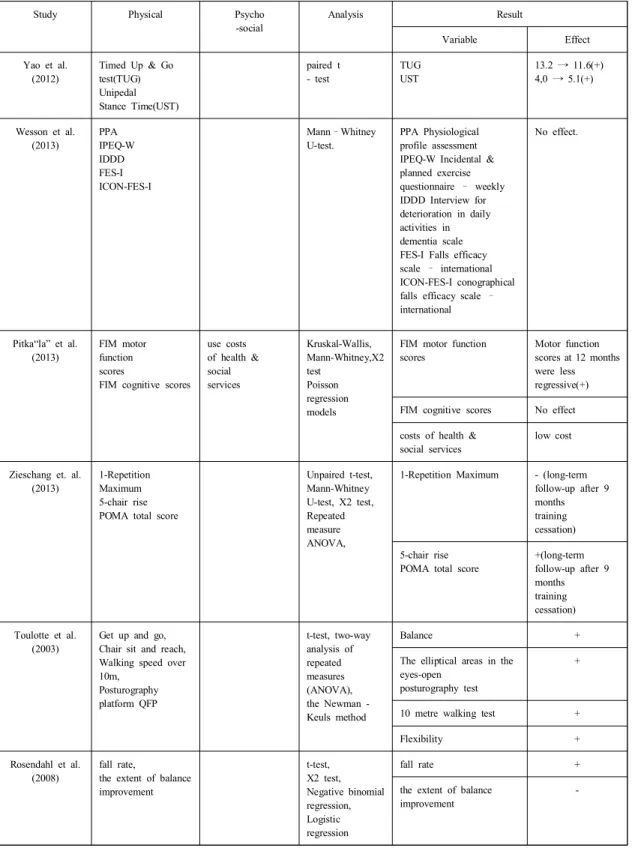
Table 4. Outcome Variables and Results of the Studies (N=13)
Study Physical Psycho
-social
Analysis Result
Variable Effect
Yao et al.
(2012)
Timed Up & Go test(TUG) Unipedal Stance Time(UST)
paired t - test
TUG UST
13.2 → 11.6(+) 4,0 → 5.1(+)
Wesson et al.
(2013)
PPA IPEQ-W IDDD FES-I ICON-FES-I
Mann–Whitney U-test.
PPA Physiological profile assessment IPEQ-W Incidental &
planned exercise questionnaire – weekly IDDD Interview for deterioration in daily activities in dementia scale FES-I Falls efficacy scale – international ICON-FES-I conographical falls efficacy scale – international
No effect.
Pitka“la” et al.
(2013)
FIM motor function scores
FIM cognitive scores
use costs of health &
social services
Kruskal-Wallis, Mann-Whitney,X2 test
Poisson regression models
FIM motor function scores
Motor function scores at 12 months were less regressive(+) FIM cognitive scores No effect costs of health &
social services
low cost
Zieschang et. al.
(2013)
1-Repetition Maximum 5-chair rise POMA total score
Unpaired t-test, Mann-Whitney U-test, X2 test, Repeated measure ANOVA,
1-Repetition Maximum - (long-term follow-up after 9 months training cessation) 5-chair rise
POMA total score
+(long-term follow-up after 9 months training cessation) Toulotte et al.
(2003)
Get up and go, Chair sit and reach, Walking speed over 10m,
Posturography platform QFP
t-test, two-way analysis of repeated measures (ANOVA), the Newman - Keuls method
Balance +
The elliptical areas in the eyes-open
posturography test
+
10 metre walking test +
Flexibility +
Rosendahl et al.
(2008)
fall rate,
the extent of balance improvement
t-test, X2 test, Negative binomial regression, Logistic regression
fall rate +
the extent of balance improvement
-
Rolland et al.
(2007)
Katz ADL score, physical performance, nutritional status, behavioral disturbance
depression t-test, X2 test, Kruskal-Wallis, Fisher exact tests, Multiple logistic regression analyses, Spearman correlation
Katz ADL score 6
months -
12 months
+ physical performance
- walk speed - get up and go - one leg balance
+ - -
+ - -
nutritional status - -
behavioral disturbance - -
depression - -
Jung et al.
(2014)
arms muscular length MMSE – DS Depression Stress fall efficacy
two-way ANOVA with repeated measure
arms muscular length Depression Stress fall efficacy
+ + + legs muscular length +
legs muscular length whole body endurance explosive muscular length
flexibility
- - - - whole body
endurance explosive muscular strength flexibility Choi
(2012)
brief body perform examination(SPPB)
number memorizing examination (Digitspan Digitspan),
Wilcoxon test number memorizing examination (Digitspan), korean old man sign join
examination(K-TMT-e)
+ -
standing and going examination(TUG) cadence stride length
korean old man sign
join examination (K-TMT-e)
brief body perform examina-tion(SPPB) standing and going examination(TUG) cadence stride length
+ + - - Park
(2010)
still balance weakness time walking ability space walking ability
quality of life depression
paired t - test independent t - test
still balance weakness time walking ability space walking ability
+ + - -
quality of life depression
+ - Yeom
(2015)
balance ability pagbode bean shifting activity of daily living (ADL)
cognition function (MMSE-K)
repeated mea-sured two way ANOVA Mann Whitney test
Wilcoxon signed rank test
open eyes, left leg standing
+
open eyes, right leg standing
+
Berg balance scale +
Functional reach -
2.44m up and go -
pagbode, bean shifting ADL MMSE-K
+
+
-
-
3.3 중재의 형태
연구에서 사용된 중재 프로그램을 분석하면 운동치료 (8편, 61.5%), 물리 치료와 작업 치료(2편, 15.4%), 보완 대체요법(2편, 15.4%), 음악 치료(1편, 7.7%) 등을 적용 하여 중재하였다. 중재자는 의사가 가장 많았으며(5 편)[31-35] 그 다음으로 운동치료사(3편)[36, 39, 41]와 물리치료사가 많았고(3편)[31, 34, 38] 작업치료사(2 편)[30, 35]와 간호사(2편)[29, 40], 음악치료사(1편)[37]
와 임상심리학자(1편)[29] 순이었다. 중재시간은 1회당 평균 55분을 시행하였고, 중재간격은 1주일에 2∼3회 (평균 2.3회)를 시행하였다. 중재 총 시행 횟수는 평균 37회로 최소 8회에서 최대 96회의 범위였다[Table 3].
3.4 연구 결과 및 사용된 결과 변수
결과 변수는 신체적 변수와 사회·심리적 변수로 나누 어 분석하였다. 신체적 변수로는 Timed Up and Go test (TUG), Unipedal Stance Time (UST), Physiological profile assessment (PPA), Incidental and planned exercise questionnaire – weekly (IPEQ-W), Interview for deterioration in daily activities in dementia scale (IDDD), Falls efficacy scale - international (FES-I), Iconographical falls efficacy scale – international (ICON-FES), Functional Independence Measure(FIM) motor function scores, FIM cognitive scores, 1-Repetition Maximum, 5-chair rise, Performance Oriented Motor Assessment(POMA) total score, Get up and go, Chair sit and reach, Walking speed over 10m, Posturography platform QFP, fall rate, the extent of balance improvement, Katz ADL score, 신체적 수행능 력, 영양 상태, 행동장애, 상지근력, 하지근력, 전신지구 력, 순발력, 유연성, 간단 신체수행검사, 분속 수, 활 보 장, 눈뜨고 왼발 외발서기, 눈뜨고 오른발 외발서기,
Berg 균형척도, Functional reach, 2.44m up and go, 패 그보드, 콩 옮기기, 정적 균형, 허약감, 시간적 보행능력, 공간적 보행능력, 체전굴 검사(똑바로 선 상태에서 상체 만 구부려 손가락을 바닥에 대는 검사), 균형 측정도구, 하지근력, 민첩성, 평형성 등이 결과 변수로 사용되었다.
사회·심리적 변수로는 건강 및 사회 서비스 비용, 스트레 스, 낙상 효능감, 숫자 외우기 검사, 노인형 기호잇기, Mini Mental State Examination-Korean (MMSE-K), 삶 의 질, 우울 등이 결과 변수로 사용되었다.
연구 결과는 신체 변수 중 TUG, UST, FIM, motor function scores, 5-chair rise, POMA total score, 균형감, The elliptical areas in the eyes-open posturography test, 10m 걷기 검사, 유연성, 낙상 발생률, 걷는 속도, 상지 근력, 낙상 효능감, 숫자 외우기 검사(Digitspan Digitspan), brief body perform examination(SPPB), 눈 뜨고 왼발 외발서기, 오른발 눈뜨고 외발서기, 2.44m up and go, 패그보드, 콩 옮기기, Sit & Reach test, 의자검 사, ADL, 하지근력, 민첩성, 평형성 척도에서 효과가 있 는 것으로 나타났다. 사회·심리적 변수 중 허약감, 삶의 질, 우울 척도에서 효과가 있는 것으로 나타났다[Table 4].
4. 논의
본 연구는 치매 진단을 받은 노인을 대상으로 실시된 낙상예방 중재 프로그램의 세부 내용과 효과를 파악하기 위한 것으로, 국내·외에서 2000년부터 2016년까지 실시 된 연구의 체계적 분석 결과를 바탕으로 치매노인에게 간호중재로서 효과적인 낙상예방 중재를 시행함으로써 낙상 발생을 줄이고 환자 안전에 기여할 수 있는 방향에 대해 다음과 같이 논의하고자 한다.
치매진단을 받은 노인을 대상으로 한 낙상예방 중재 연구 중 실험 연구만을 선별하여 분석하였는데 분석 대
Lim (2002)
physical Functioning
depression Mann Whitney
U test Wilcoxon signed rank test
balance scale Sit &Reach test chair test
+ + +
depression -
Kim (2015)
ADL 2-way repeated
measure ANOVA
ADL +
fall-related fitness (lower body length, agility, balance)
lower body length agility
balance
+
+
+
상 논문13편 중 12편이 운동 치료, 물리 치료 및 작업 치료, 율동적 동작운동, 타이치 등의 운동과 관련된 중재 요법을 사용하였고[29-36, 38-41] 1편[37]만이 음악치료 요법을 중재방법으로 선택하였다. 분석 대상 논문의 연 구 설계를 살펴본 결과, 13편 중 무작위 할당이 이루어 진 연구는 총11편[30-39, 41]이었다. 비동등성 대조군 사전사후 설계로 진행된 논문은1편[40]이 있었으며 단 일군 사전사후 설계 논문이 1편[29]이었다.
간호사가 중재자로 참여한 연구는2편에 불과하였는 데[29, 40] 대부분의 중재 프로그램이 운동과 관련된 중 재방법을 사용하였기에 운동치료사, 물리치료사, 작업치 료사, 스포츠 의학 분야의 전문의들이 주로 중재를 제공 하고 있었다. 낙상예방 효과가 검증된 중재 프로그램이 수동 및 능동적 근력강화 운동, 균형 잡기 등의 신체적 기능강화 측면에 집중되어 있어서 상대적으로 간호사들 의 중재 개입도가 낮은 것으로 판단된다. 이러한 간호사 의 저조한 참여결과는 치매노인을 대상으로 한 많은 연 구에 간호사들이 연구 조력은 하고 있으나 독자적인 낙 상예방 간호중재연구가 미흡함을 보여주는 것으로 향후 적극적인 낙상예방 간호중재 개발 및 그 효과성 연구가 시행될 필요가 있음을 시사하는 것이다. 특히, 전 세계적 으로 가속화되는 고령화로 치매노인의 유병률이 급속히 증가하는 것으로 보고되었는데[42] 노인이 거주하는 요 양시설 및 재가노인센터 등 병원 이외의 환경은 간호사 가 보다 다양한 역할을 수행할 수 있는 기관이므로 이 기관 소속 간호사들이 치매노인의 낙상예방을 위한 신체 적 기능 강화와 관련된 간호중재를 개발하고 반복적으로 시행하여 다양한 낙상예방 중재를 활용한 치매 예방 분 야에서의 간호사 역할 확대를 도모할 필요가 있다고 사 료된다. 특별한 운동 도구가 필요 없는 근력 및 근 긴장 도 강화 훈련과 균형 감각 강화 훈련, Thera-band를 활 용한 상하지 운동, 노인에게 친숙한 음악을 활용한 율동 동작 강화 운동 등은 치매노인들이 많이 입소해 있는 시 설 및 재가노인센터에서 충분히 활용할 만한 운동 중재 프로그램이므로 시설 근무 간호사들을 대상으로 이러한 운동 중재 프로그램을 교육하고 보급하여 치매노인의 낙 상 감소 효과를 지속적으로 검증하려는 노력이 필요하다.
분석 논문들 중2편[31, 32]만이 이중 맹검법을 실시 하여 연구의 타당도를 유지하고 연구 결과 편의를 방지 하고자 하였고, 나머지 논문은 그러하지 못하였다. 향후 연구의 타당도와 연구 결과의 신뢰도를 높이기 위해 연
구 설계 시 이중 맹검법을 적극적으로 실시하여 연구 논 문의 질적 관리에 연구자와 학계가 보다 노력할 필요가 있다.
연구 결과의 일반화를 위해서는 연구 설계 시 적절한 표본수가 필요하다. 분석된 논문 13편 중 모든 연구에서 대상자 선정기준은 분명히 언급한 반면, 연구의 목적과 변수의 수, 자료 분석 방법, 효과크기 등을 고려한 표본 수를 산정하여 시행된 연구 논문은2편[31, 32]에 불과 하였다. 대상자의 수가 20명 미만인 연구도 3편[37-39]
이 있었는데 이 연구들은 결과를 일반화시키는데 주의가 필요하다. 대상자의 중도 탈락율이 20% 미만일 때 연구 결과 타당도에 지대한 영향을 미치지 않는 것으로 보고 되었기 때문에[27] 중도 탈락률 20% 미만을 기준으로 분석한 결과, 총 8편[29, 33-36, 38]이 이에 해당하였다.
연구 대상자수의 산출 근거 뿐 아니라 적절한 통계분 석 기법의 적용은 보건의료분야 연구의 이론적 근거와 결과의 일반화를 제시하는데 매우 중요한 요소이다. 20 명 미만의 대상자가 참여한 연구[37-39]에서 2편은[37, 39] 비모수 검정 통계방법을 사용하였고 1편[38]은 Shapiro Wilk검정을 통해 모든 변수가 정규 분포함을 확 인하여 모수통계를 사용하였기에 통계적 오류는 발생하 지 않았을 것으로 사료된다.
전혀 중재 효과가 없는 것으로 나타난 연구의 경우, 연구 대상자수가 적고 중재 시 실험군의 자료수집이 불 충분한 것으로 확인되었기 때문에 중재 그 자체의 효과 없음보다 부적절한 연구 대상자수와 부적절한 자료수집 에 기인한 것은 아닌지 추가적인 연구가 필요하다고 사 료된다.
집단으로 타이치 훈련을 주당2회씩 총 8회 시행하고 집에서 스스로 타이치 운동을 주당3회씩 총 36회 진행 한 중재연구[29]에서는 중재군이 ‘의자에서 일어난 후 걷기 테스트’와 ‘외다리로 서있기 테스트’에서 대조군에 비해 동작시간이 감소하는 개선 효과가 있었는데 이러한 결과는 일반노인을 대상으로 타이치 운동이 낙상률 감소 에 긍정적 효과가 있었다는 선행 연구의 결과[43]와 유 사한 것으로 나타나 일반노인 뿐 아니라 치매노인에게도 타이치 운동 효과가 있음을 지지하는 것으로 확인되었다.
치매노인을 대상으로 한 운동 중재가 단기적인 효과 뿐 아니라9개월에서 12개월 이후까지 장기적인 신체적 측면의 개선효과로 이어져 낙상예방 효과가 있음이 입증 된 연구들[31, 34, 38]에 따르면 그룹 운동훈련과 집에서
개인 운동을 주당2회씩 적어도 6개월 이상 지속하였을 때, 운동을 그만둔 후 6개월에서 12개월 이후의 신체적 기능의 퇴화가 대조군보다 적고[31] 의자 들기 능력[34]
과 의자에서 일어서서 걷기, 걸음 속도에서 대조군에 비 해 향상된 결과를 유지하고 있는 것으로 보고되었다. 이 러한 장기적 개선 효과로 인해 치매노인의 낙상관련 건 강관리에 드는 사회적 비용이 대조군에 비해 그룹 운동 훈련을 받은 중재군이35.2%가 덜 소요되었고 집에서 개인 운동을 시행한 중재군도 23.9%가 적게 소요되어 비용효과가 큰 중재로 확인되었다[31].
치매노인에게 낙상예방을 위한 음악적 중재를 제공한 연구[37]에서는 신체적 기능의 개선 효과 외에도 숫자를 기억하는 인지적 테스트에서 중재군이 대조군보다 긍정 적 효과가 있는 것으로 나타나 음악적 중재를 통한 다양 한 측면의 개선효과를 확인할 수 있었다. 낙상이란 단순 히 신체적인 근력과 운동기능의 저하 뿐 아니라 인지기 능이 저하된 경우에도 빈번하게 발생하고 있는 것으로 선행연구에서 확인되었으므로[44, 45] 신체적 측면의 개 선효과와 더불어 인지기능 개선 등 사회·심리적 측면의 개선을 동반할 수 있는 중재방법의 개발이 중요하다.
본 연구는 치매노인의 낙상예방 중재 프로그램의 효 과를 검증한 실험 논문을 체계적으로 검토함으로 써 낙 상예방을 위한 중재 중 개선 효과가 있는 중재를 분석하 고 신체적 측면 또는 사회·심리적 측면의 개선을 확인하 기 위해 시행되었으나 많은 연구에서 운동 중재요법의 신체적 기능 개선에만 초점을 맞추어 시행되었으며 인지 기능, 삶의 질, 우울 등의 사회·심리적 측면에 대한 개선 과 관련된 연구는 미흡하였으며 또한 운동요법 이외의 다양한 중재방법의 적용이 이루어지지 못하고 있음이 나 타났으므로 간호사들이 간호영역에서 시행 가능한 다양 한 낙상예방 중재방법의 개발을 통해 정서적 측면에서도 개선이 이루어져 낙상예방이 포괄적이며 장기적으로 지 속될 수 있도록 할 필요가 있다. 그러나 본 연구는 2000 년부터2016년까지의 국내·외 실험 연구만을 분석 대상 으로 하고 있기 때문에 치매환자 전체로 확대 해석하는 데는 제한이 있으며 주의가 필요하다.
5. 결론 및 제언
본 연구는 치매진단을 받은 노인을 대상으로 국내·외
에서2000년부터 2016년까지 실시된 낙상예방 중재 프 로그램을 적용한 실험 연구를 체계적으로 고찰함으로써 중재 프로그램의 효과성을 파악하기 위해 시도되었다.
분석에 포함된 중재에는 운동 중재가 대부분이었으며 음 악 중재를 사용한 논문이1편에 불과하였다. 연구에서 사용된 중재를 통해 신체적 기능(근력강화정도, 균형감 각 향상도, ADL 점수의 향상도, 걷는 속도, 유연성 등) 에서 일부 혹은 전반적 개선이 있는 것으로 확인되었으 며 이러한 중재효과는12개월 이후까지 장기적으로 영 향을 미치는 것으로 분석되었다. 그러나 신체적 측면의 개선 효과 외에 사회·심리적 측면의 개선 효과를 보고한 연구결과가 미미하고 경제적 효과성을 분석한 연구가 드 문 것으로 확인되어 향후 간호 연구자들은 이러한 효과 성에도 관심을 가지고 연구를 진행하여 낙상예방을 위한 포괄적이고 다양한 측면에 효과를 보일 수 있는 중재 프 로그램을 개발할 필요가 있다.
이상과 같이 낙상예방 중재연구의 효과성을 체계적으 로 분석한 결과를 토대로 다음과 같은 제언을 하고자 한 다. 우선 치매노인을 대상으로 하여 간호 연구자에 의한 낙상예방 중재 프로그램을 적극적으로 적용한 실험논문 이 임상현장에서 보다 많이 시행되어야 하며 신체기능 개선 효과와 더불어 사회·심리적 측면의 개선효과를 보 일 수 있는 다양한 중재 프로그램의 개발이 요구되어진다.
References
[1] Ministry of Health and Welfare, The second (2013-2015) National dementia manage comprehensive plan.
Retrieved August 2, 2012, from
http://blog.naver.com/PostView.nhn?blogId=rlaqudgjs883
&logNo=90148849829
[2] Number of elderly with dementia by year, http://info.khidi.or.kr/board/view?pageNum=1&rowCnt=1 0&menuId=MENU00286&maxIndex=99999999999999&
minIndex=99999999999999&schType=0&schText=&cate goryId=&continent=&country=&upDown=0&boardStyle
=&no1=0&linkId=125414. 2018.3.13
[3] L. M. Allan, C. G. Ballard, E. N. Rowan, R. A. Kenny, Incidence and prediction of falls in dementia: a prospective study in older people, PLoS One, vol. 4, no.
5, pp. e5521, 2009.
DOI: https://doi.org/10.1371/journal.pone.0005521 [4] J. Swanenburg, E. D. de Bruin, D. Uebelhart, T. Mulder,
Falls prediction in elderly people: a 1-year prospective study, Gait and Posture, vol. 31, no. 3, pp. 317-321, 2010.
DOI: https://doi.org/10.1016/j.gaitpost.2009.11.013
[5] L. Rubenstein, K. Josephson, Falls and their prevention in elderly people: What does the evidence show?, The Medical Clinics of North America, vol. 90, no. 5, pp.
807-824, 2006.
DOI: https://doi.org/10.1016/j.mcna.2006.05.013 [6] Korea geriatric disease society, geriatric medicine (2nd),
Seoul, medicine publisher, 2005.
[7] N. M. Kosse, M. H. de Groot, N. Vuillerme, T.
Hortobagyi, C. J. Lamoth. Factors related to the high fall rate in long-term care residents with dementia, International Psychogeriatrics, vol. 27, no. 5, pp.
803-814. 2015.
DOI: https://doi.org/10.1017/S104161021400249X [8] S. Sadigh, A. Reimers, R. Andersson, L. Laflamme,
Falls and fall-related injuries among the elderly: a survey of residential-care facilities in a Swedish municipality, Journal of Community Health, vol. 29, no.
2, pp. 129-140, 2004.
DOI: https://doi.org/10.1023/B:JOHE.0000016717.22032.03 [9] P. P. Barry, Iatrogenic disorders in the elderly;
preventive techniques, Geriatrics, vol. 41, no. 9, pp.
42-47. 1986.
[10] E. J. Choi, Y. S. Lee, E. J. Yang, J. H. Kim, Y. H. Kim, H. A. Park, Characteristics and Risk Factors for Falls in Tertiary Hospital Inpatients, Journal of Korean Academy of Nursing, vol. 47, no. 3, pp. 420-430, 2017.
DOI: https://doi.org/10.4040/jkan.2017.47.3.420 [11] H. Park. The perception of interior design factor related
to risk of falls among elderly, Korean Institute of Interior Design Journal, 25, pp. 130-134, 2000.
[12] J. Hu, Q. Xia, Y. Jiang, P. Zhou, Y. Li, Risk factors of indoor fall injuries in community-dwelling older women:
a prospective cohort study, Archives of Gerontology and Geriatrics, vol. 60, no. 2, pp. 259-264. 2015.
DOI: https://doi.org/10.1016/j.archger.2014.12.006 [13] M. J. Kang, H. Rim, S. S. Kim, The Epidemiologic
Survey Committee in the Korean Ophthalmological Society, Visual Acuity and Falls in South Korea: Korean National Health and Nutrition Examination Survey 2008-2012, Journal of Korean Ophthalmological Society, vol. 57, no. 9, pp. 1451-1459, 2016.
DOI: https://doi.org/10.3341/jkos.2016.57.9.1451 [14] J. D. Moreland, J. A. Richardson, C. H. Goldsmith, C.
M. Clase, Muscle weakness and falls in older adults, Journal of the American Geriatrics Society, vol. 52, no.
7, pp. 1121-1129, 2004.
DOI: https://doi.org/10.1111/j.1532-5415.2004.52310.x [15] M. Kim, Factors Associated with Falls in the Elderly :
Based on 2014 the Korean Elderly Survey. Journal of Contents Association, vol. 17, no. 6, pp. 479-489, 2017.
[16] R. Korpelainen, J. Korpelainen, J. Heikkinen, K.
Vaananen, S. Keinanen-Kiukaanniemi. Lifelong risk factors for osteoporosis and fractures in elderly women with low body mass index, Bone, vol. 39, no. 2, pp.
385-391, 2006.
DOI: https://doi.org/10.1016/j.bone.2006.01.143 [17] V. D. Voort, P. P. Geusens, G. J. Dinant. Risk factors
for osteoporosis related to their outcome. Osteoporosis International, vol. 12, no. 8, pp. 630-638, 2001.
DOI: https://doi.org/10.1007/s001980170062
[18] Y. H. Park, J. S. Moon, Home environmental hazards of falling accident in the elderly, Journal of korean society for health education and promotion, vol. 22, no. 4, pp.
203-213, 2005.
[19] Y. Lajoie, S. P. Gallagher. Predicting falls within the elderly community, Archives of Gerontology &
Geriatrics, vol. 38, no. 1, pp. 11-26. 2004.
DOI: https://doi.org/10.1016/S0167-4943(03)00082-7 [20] K. L. Mukamal, M. A. Mittleman, W. T. Longstreth, A.
B. Newman, L. P. Fried, D. S. Siscovick. Self-reported alcohol consumption and falls in older adults, Journal of the American Geriatrics Society, vol. 52, no. 7, pp.
1174-1179, 2004.
DOI: https://doi.org/10.1111/j.1532-5415.2004.52318.x [21] S. M. Friedman, B. Munoz, S. K. West, G. S. Rubin, L.
P. Fried. Falls and fear of falling, Journal of the American Geriatrics Society, vol. 50, no. 8, pp.
1329-1335, 2002.
DOI: https://doi.org/10.1046/j.1532-5415.2002.50352.x [22] C. Tudor-Locke, A. M. Myers, C. S. Jacob, J. Jones,
D-A. Lazowski, N. A. Ecclestone. Development and formative evaluation of the centre for activity and ageing's home support exercise program for frail older adults, Journal of Ageing & Physical Activity, vol. 8, no.
1, pp. 59-75, 2000.
DOI: https://doi.org/10.1123/japa.8.1.59
[23] I. Y. Yoo. Effects of Fall Prevention Program applying HSEP on Physical Balance and Gait, Leg Strength, Fear of Falling and Falls Efficacy of Community-dwelling Elderly, Journal of the Korean Gerontological Society, vol. 29, no. 1, pp. 259-273, 2009.
[24] M. C. Kim, C. S. Ahn, Y. S. Kim. The effect of exercise program for falls prevention on balance and quality of life in the elderly women, Journal of the Korean Society of Physical Medicine, vol. 5, no. 2, pp. 245-254, 2010.
[25] B. J. Jeoung. A review of exercise program for fall prevention in the elderly, The journal of korean society of aerobic exercise, vol. 12, no. 1, pp. 1-9, 2008.
[26] National Health Insurance Corporation. Symposium associated with health care expenditure for the elderly.
Retrieved August 31, 2015, from
http://m.healthmedia.co.kr/news/articleView.html?idxno=
52291
[27] Scottish Intercollegiate Guidelines Network (SIGN)(2013, April26). Methodology checklist 2:
Randomized controlled trials. Retrieved May 09, 2013, from www.sign.ac.uk/ methodology/checklists.html [28] S. H. Jeong. "Systematic review of the literatures on
music intervention for neurological patients in korea", Journal of Korean Biological Nursing Science, vol. 15, no. 2, pp. 65-73, 2013.
DOI: http://dx.doi.org/10.7586/jkbns.2013.15.2.65 [29] L. Yao, B. J. Giordani, D. L. Algase, M. You, N. B.
Alexander. Fall Risk-Relevant Functional Mobility Outcomes in Dementia Following Dyadic Tai Chi Exercise, Western Journal of Nursing Research, vol. 35, no. 3, pp. 281 – 296. 2012.
DOI: http://dx.doi.org/10.1177/01939459124433191-Dy [30] J. Wesson, L. Clemson, H. Brodaty, S. Lord, M. Taylor,
L. Gitlin, J. Close. A feasibility study and pilot
randomized trial of a tailored prevention program to reduce falls in older people with mild dementia. Wesson et al. BMC Geriatrics, vol. 13, no. 1, pp. 89-101, 2013.
DOI: http://doi.org/10.1186/1471-2318-13-892-fe [31] K. H. Pitka¨la¨, M. M. Po¨ysti, M. L. Laakkonen, R. S.
Tilvis, N. Savikko, H. Kautiainen, T. E. Strandberg.
Effects of the Finnish Alzheimer Disease Exercise Trial (FINALEX), JAMA Internal Medicine, vol. 173, no. 10, pp. 894-901, 2013.
DOI: https://doi.org/10.1001/jamainternmed.2013.359 [32] T. Zieschang, M. Schwenk, P. Oster, K. Hauer.
Sustainability of Motor Training Effects in Older People with Dementia, Journal of Alzheimer’s Disease, vol. 34, no. 1, pp. 191 – 202, 2013.
DOI: http://dx.doi.org/10.3233/JAD-1208146-mo [33] C. Toulotte, C. Fabre, B. Dangremont, G. Lensel, A.
Thevenon. Effects of physical training on the physical capacity of frail, demented patients with a history of falling: a randomized controlled trial, Age and Ageing, vol. 32, no. 1, pp. 67 – 73, 2003.
DOI: https://doi.org/10.1093/ageing/32.1.67
[34] E. Rosendahl, Y. Gustafson, E. Nordin, L.
Lundin-olsson, L. Nyberg. A randomizes controlled trial of fall prevention by a high-intensity functional exercise program for older people living in residential care facilities, Aging clinical and experimental research, vol.
20, no. 1, pp. 67-75, 2008.
DOI: https://doi.org/10.1007/BF03324750
[35] Y. Rolland, F. Pillard, A. Klapouszczak, E. Reynish, D.
Thomas, S. Andrieu, D. Rivie`re, B. Vellas. Exercise Program for Nursing Home Residents with Alzheimer’s Disease: A 1-Year Randomized, Controlled Trial, The American Geriatrics Society, vol. 55, no. 2, pp. 158 – 165, 2007
DOI: http://dx.doi.org/10.1111/j.1532-5415.2007.01035.x10-ex [36] S. W. Jung, G. H. Ra, S. G. Woo. Effectiveness
verification of improve dementia in 8 weeks complex exercise. Athletic event, 2, vol. 014, no. 5, pp. 67-74, 2014.
[37] J. H. Choi. The effect of the dual task program based on neurologic music therapy techniques on preventing fall so folder adults with early-stage dementia. Myongji University master thesis, 2012.
[38] J. S. Park. The Effect of Physical Activity Program on Cognitive Function, Physical Function, Quality of Life and Depression in the Elderly with Dementia. Sahmyook University master thesis, 2010.
[39] Y. S. Yeom. An effect of 8weeks of exercise therapy on cognitive function and daily life performance ability of the aged with severe dementia. Kyung Hee University master thesis, 2015.
[40] Y. M. Lim. Effects of Movement/Exercise on Physical and emotional Functioning in Elders with Cognitive Impairments, Journal of the Korea Gerontological Society, vol. 21, no. 3, pp. 197- 211. 2002.
[41] Y. J. Kim. Effects of a resistant balance exercise on ADL and fall related fitness of older adults with dementia, Korea National Sport University master thesis, 2015.
[42] M. Prince, R. Bryce, E. Albanese, A. Wimo, W. Ribeiro,
CP. Ferri. The global prevalence of dementia: A systematic review and meta analysis, Alzheimer’s &
Dementia, vol. 9, no. 1, pp. 63-75. 2013.
DOI: http://dx.doi.org/10.1016/j.jalz.2012.11.007 [43] F. Li, P. Harmer, K. John Fisher, E. McAuley, N.
Chaumeton, E. Eckstrom, N. L. Wilson. Tai Chi and Fall Reductions in Older Adults: A Randomized Controlled Trial, The Journals of Gerontology: Series A, vol. 60, no. 2, pp. 187 – 194. 2005.
DOI: https://doi.org/10.1093/gerona/60.2.187
[44] R. Tideiksaar. Falling in Old Age: its Prevention and Treatment. New York: Springer Publishing Company, 1989.
[45] J. Kim, H. Suh. Risk Factors for Falls in the Elderly by Life-cycle, Korean Journal of Health Education and Promotion, vol. 27, no. 1, pp. 21-34, 2010.
차 현 수(Hyun-Su Cha) [정회원]
•2002년 2월 : 가톨릭대학교 산업보
건대학원 (보건학석사)
•2015년 8월 : 이화여자대학교 간호
학과 (간호학박사)
•2015년 9월 ~ 2017년 2월 : 서남 대학교 간호학과 조교수
•2017년 3월 ~ 현재 : 세한대학교 간호학과 조교수
<관심분야>
보완대체요법, 노인간호
황 성 우(Sung-Woo Hwang) [정회원]