• 검색 결과가 없습니다.

Spatial Pattern of Larix gmelini in a Spruce-fir Valley Forest of Xiaoxing'an Mountains, China

N/A
N/A
Protected

Academic year: 2021

Share "Spatial Pattern of Larix gmelini in a Spruce-fir Valley Forest of Xiaoxing'an Mountains, China"

Copied!
6
0
0

로드 중.... (전체 텍스트 보기)

전체 글

(1)

720

F OREST S OCIETY

Spatial Pattern of Larix gmelini in a Spruce-fir Valley Forest of Xiaoxing`an Mountains, China

Guangze Jin

1

, Liang Liu

1

, Zhili Liu

1

and Ji Hong Kim

2

*

1

School of Forestry, Northeast Forestry University, Harbin, 150040, China

2

College of Forest & Environmental Sciences, Kangwon National University, Chuncheon 200-701, Korea

Abstract : On the basis of vegetation data in the 9.12 ha (380 m × 240 m) permanent sample plot of the spruce-fir valley forest in Liangshui National Reserve of Xiaoxing`an Mountains, the study was conducted to evaluate spatial distribution pattern and spatial association by using point pattern analysis for living and dead trees of Larix gmelini by DBH size class. The number of L . gmelini were counted as 59 living stems/

ha (6.42 m

2

/ha of basal area) and 34 dead stems/ha (2.86 m

2

/ha of basal area). The distributional curve of diameter class exhibited bimodal shape. The analysis of spatial distribution patterns of all living larch stems noted the clumped distribution on the whole. The size of larch aggregates of dead stems was decreased as diameter class was increased. The distribution of dead stems became gradually randomized with decreased clumped size as the scale increased. Living stems and dead stems of the larch had positive spatial association at most of scales, illustrating that the occurrence of mortality of the larch tree was closely related to the distribution pattern of living larch trees.

Key words : dead stem distribution, large permanent sample plot, O-ring statistics, point pattern analysis, spatial association

Introduction

The spatial distribution pattern of a population is the consequence of integrative processes associated with the eco-physiological characteristics of the population, intra- specific and inter-specific relationship, and environmen- tal conditions (Greig-Smith, 1983). Dale (1999) empha- sized importance of spatial distribution of individuals in a species, playing major role in plant ecological theory.

Condit et al. (2000) have been assembling a long-term, large-scale, and global research effort on spatial patterns and dynamics of forest ecosystems.

Larix gmelini has been naturally distributed in far east- ern Siberia of Russia, and Daxingan mountains, Xiaox- ingan mountains, and Zhangguangcai mountains beyond 42°30' north latitude in China (Zhou, 1986). The L . gmelini forests have extended in the area of around 3,300,000 ha and the growing stock of the forests has been estimated more than 300,000,000 m

3

(Li, 1993), occupied 8% of total forest carbon storage and 30% of timber production in China (Zhou et al ., 2000).

Numbers of scientific studies for L . gmelini have been

carried out on account of ecological importance in China (Xu, 1998). Of these several researches have been reported on the spatial distribution pattern of L. gmelini individ- uals mainly growing throughout Daxingan Mountains.

Xu et al. (1994) analyzed different age structure of the species by using the analytical method of spatial distri- bution pattern proposed by Greig-Smith (1983). Han (1994) investigated regeneration pattern on the size of 2 m × 2 m and Ban et al. (1997) reviewed the affect of spatial distribution on the mortality and reproduction patterns.

A few of dimensional analyses were examined for spa- tial distribution pattern of L. gmelini , such researches as Ma et al. (1999) on correlation dimension, Ma and Zu (2000a) on information dimension, and Ma and Zu (2000b) on box-counting dimension. Shu et al. (2008) implemented quantitative study of spatial distribution pattern by the analysis of correlation between mean and variance, index of dispersion, and index of clumping for L. gmelini trees greater than 5 cm of DBH in two 50 m × 50 m sample plots each of the primitive forest, successive cutting for- est, and clearcutting forest. Nevertheless, since most of previous studies concerning the spatial distribution pat- tern have been subjected to restriction on the size of sample plot and survey method, they were hardly capa- ble of explaining the larger and broader scale of spatial

*Corresponding author

E-mail: [email protected]

(2)

distribution pattern for the species.

On the basis of vegetation data in permanent sample plot of 380 m × 240 m in Liangshui National Reserve of Xiaoxing`an Mountains, this study was carried out to evaluate spatial distribution pattern and spatial associa- tion by using point pattern analysis for living and dead trees of L . gmelini by DBH size class in the spruce-fir valley forest type. This study could provide the funda- mental information for the occurrence, mortality, and regeneration capacity of the L. gmelini in the Northeast China.

Materials and Methods

1. Study area

The study was conducted in the spruce-fir valley forest, located in Liangshui National Reserve of Xiaoxing`an Moun- tains (Figure 1). The reserve is characterized by rolling mountainous terrain with 707.4 m of highest peak above sea level and 300 m of lowest peak above sea level, and average slope gradient is 10-15

o

. Mean annual temper- ature is -0.3

o

C with mean annual highest temperature of 7.5

o

C and lowest temperature of -6.6

o

C. Mean annual precipitation is 676 mm with 78% of relative humidity and 805 mm of evaporation rate (Jin et al. , 2009).

The trees of L. gmelini growing in the spruce-fir val- ley forest of Liangshui National Reserve are distributed along the southern boundary of Xiaoxing`an Mountains, of which the distribution range would be located in the sensitive areas to the climate change. This susceptible forest ecosystems have been confronted with the change of growing conditions, especially due to the thawing of permafrost by global warming. In 2006 the permanent sample plot of 380 m × 240 m was established to mon- itor the effects of climate change on the structure and

function of the spruce-fir valley forest.

The vegetation types of Liangshui National Reserve are classified into the mixed Pinus koraiensis -broadle- aved forest type above 300 m sea level, and types of spruce-fir forest, Alnus hirsuta forest, and Salix revarine forest below 300 m sea level in valleys. The spruce-fir valley forest type is distributed on permafrost in patches characterized by cold and moist site condition. Domi- nated by Picea koraiensis and Abies nephrolepis , the type is commonly composed of Larix gmelini , Betula platyphylla , Betula costata , Acer ukurunduense , Acer mono , Prunus padus , Acer tegmentosum , and Alnus sibirica (Jin et al ., 2009).

2. Data collection and analysis

The vegetation data were collected from the 380 m × 240 m rectangular permanent experimental plot established in the spruce-fir valley forest in 2006. The plot was divided into nine hundred twelve 10 m × 10 m square sub-plots of which four corners were marked with driv- ing stakes. For every woody plant greater than 2 cm of DBH in each sub-plot, we attached the aluminum num- ber tag, placed coordinates on the grid map, measured DBH and height, and recorded existing type of dead stems.

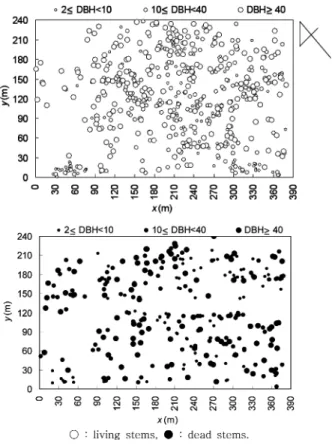
All L . gmelini individuals of DBH 2 cm in 9.12 ha plot of the spruce-fir valley forest were subjected to dividing into three DBH size classes, trees of 2 cm DBH < 10 cm, 10 cm DBH < 40 cm, and DBH 40 cm (Figure 2). The spatial distribution pattern and spatial association were analyzed by the univariate O -ring sta- tistic and bivariate O -ring statistic, respectively, for all living and dead stems of each DBH size class. We used Programita software devised by Wiegand and Moloney (2004). The analysis was implemented 99 times of Monte

Figure 1. Location of the study area.

(3)

Carlo simulation and obtain 99% of confidence interval for spatial scale of 1~120 m (Wiegand and Moloney, 2004).

In the univariate O -ring statistics, if the value of O (r) is greater than the upper limit of confidence interval, the target species is supposed to be distributed as clumped pattern, if within the confidence interval as random pat- tern, and if less than lower limit of confidential interval as regular pattern. In the bivariate O -ring statistics, if the value of O (r) is greater than the upper limit of confi- dence interval, the target pair has positive association at the corresponding scale, if within the confidence interval as no significant association, and if less than lower limit of confidence interval as negative association.

Results

1. Population structure of Larix gmelini

The number of L . gmelini individuals in the spruce-fir

valley forest were counted as 63 stems per hectare for seedlings (H 0.3 m & DBH < 2 cm), 59 living stems (DBH 2 cm) per hectare, and 34 dead stems (DBH 2 cm) per hectare (Table 1). The average basal area per hectare of the living stem was estimated to 6.42 m

2

with mean DBH of 31.2 cm. The mean basal area and mean DBH of dead stems were 2.86 m

2

and 26.9 cm, respec- tively. The result showed smaller diameter for dead stems than living ones, possibly indicating that natural thinning of the species had been taking place in the dense spruce- fir valley forest, supporting improved growing space for survived larches.

Overall diameter distribution of L. gmelini presented bimodal shape in both living and dead stems, relatively large number of dead stems on diameter < 10 cm and 30~50 cm (Figure 3). The pattern of diameter distribu- tion of living stems showed little difference between small and large diameter classes. However, it could be recognized that low density and high mortality of small diameter class (< 10 cm) stems would notify the short- age of regeneration replenishment, indicating that the larch would decline in population size.

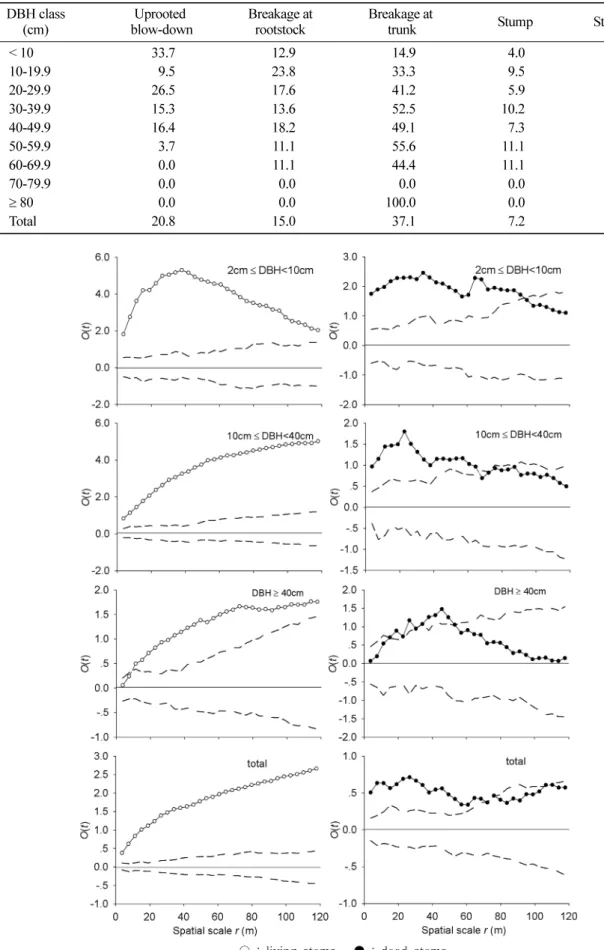
The existing types of dead stems in the order of large proportion were breakage at trunk, uprooted blow-down, standing die, breakage at rootstock, and stump, showing varied proportion in the size of diameter class (Table 2).

The proportional values of types of standing die and uprooted blow-down were relatively high in DBH < 10 cm, probably due to dying of overtopped younger larch Figure 2. Position maps of living and dead stems of Larix

gmelini in the 9.12 ha sample plot.

Table 1. Stand structure of Larix gmelini in the spruce-fir valley forest.

Density

(stems/ha) Basal area

(m

2

/ha) DBH (cm)

Mean ± SD Max.

Seedlings (H ≥ 0.3 m & DBH < 2 cm) 63.0

Living stems (DBH ≥ 2 cm) 59.1 6.42 31.2 ± 20.29 110

Dead stems (DBH ≥ 2 cm) 33.7 2.86 26.9 ± 18.87 86

Figure 3. DBH class distribution of Larix gmelini in the

spruce-fir valley forest.

(4)

Table 2. Relative density of existing types of Larix gmelini dead stems by DBH classes in the 9.12 ha sample plot of the spruce-fir valley forest.

DBH class

(cm) Uprooted

blow-down Breakage at

rootstock Breakage at

trunk Stump Standing die

< 10 33.7 12.9 14.9 4.0 34.7

10-19.9 9.5 23.8 33.3 9.5 23.8

20-29.9 26.5 17.6 41.2 5.9 8.8

30-39.9 15.3 13.6 52.5 10.2 8.5

40-49.9 16.4 18.2 49.1 7.3 9.1

50-59.9 3.7 11.1 55.6 11.1 18.5

60-69.9 0.0 11.1 44.4 11.1 33.3

70-79.9 0.0 0.0 0.0 0.0 0.0

≥ 80 0.0 0.0 100.0 0.0 0.0

Total 20.8 15.0 37.1 7.2 19.9

Figure 4. Spatial distribution patterns of Larix gmelini in the 9.12 ha sample plot of the spruce-fir valley forest.

(5)

trees by the competition of limited light coming through the stand and due to being uprooted down on the forest floor by stroke of falling snags. The type of breakage at trunk was highest proportion in the other diameter classes 10 cm (Table 2), mainly because hard wind break trunks of the liv- ing and dead larch stems at the canopy.

2. Spatial patterns of Larix gmelini

The analysis of spatial distribution patterns of all liv- ing larch stems of DBH 2 cm noted the clumped dis- tribution on the whole at all scales less than 120 m. Even though the random distribution pattern was detected at less than 10 m scale for both living and dead larch stems of DBH 40 cm, stems of the other DBH size classes showed the clumped distribution pattern at all scales less than 120 m (Figure 4). The intensity of clumped distri- bution pattern was highest at the scale of 38 m for living larch stems of 2 cm DBH < 10 cm, presenting an bimodal shape curve. On the other hand, as scale was increased, the intensity was gradually increased for living larch stems of 10 cm. All dead stems of DBH 2 cm gen- erally showed clumped distribution pattern at less than 90 m scale, and random distribution pattern at more than 90 m scale. The dead stem sizes of 2 cm DBH < 10 cm, 10 cm DBH < 40 cm, and DBH 40 cm commonly exhibited clumped distribution pattern at the scales < 95 m, < 68 m, and < 53 m, respectively, but random distri- bution at the other scales, indicating that, as diameter classes were increased, the scale of clumped distribution pattern was decreased (Figure 4).

3. Spatial association of living and dead stems of Larix gmelini

All living and dead larch stems of DBH 2 cm had positive spatial association on the whole at all scales less than 120 m. The analytical result of each DBH size class showed that the stems of 2 cm DBH < 10 cm had pos- itive spatial association with each other at all scales less than 120 m. The stems of 10 cm DBH < 40 cm at

< 7.6 m and > 91 m and of DBH 40 cm at < 7.6 m and

> 110 m had the positive association, but the association was not significant at the other scales for 10 cm DBH

< 40 cm and DBH 40 cm (Figure 5).

Discussion

The results of stand structure of Larix gmelini in the spruce-fir valley forest of Liangshui National Reserve of Xiaoxing`an Mountains were similar to the stand more than 160 years old in main distributional range of the species in terms of average diameter, but recorded one sixth basal area, compared with study done by Li (1993).

The distributional curve of diameter class exhibited bimodal shape. Relatively high ratio of mortality and low ratio of regeneration replenishment of the larch (Figure 3) inti- mated that the larch was probably replaced by other tree species in the studied forest.

The clumped distribution pattern might be known as common phenomenon in regenerated stands (van Laar and Akca, 1997). In our 380 m × 240 m sample plot, liv- ing stems of the larch 2 cm DBH < 10 cm and 10 cm

Figure 5. Spatial association of living and dead stems of three DBH size classes for Larix gmelini in the 9.12 ha sample plot

of the spruce-fir valley forest.

(6)

≤ DBH < 40 cm presented clumped distribution pattern at all scales within 120 m which was largest scale of analytical process. The distinctive feature of clumped distribution pattern was also observed in forests of Dax- ingan Mountains (Xu, 1998). This may react upon an important ecological strategy for maintaining the L . gme- lini population to take advantage of forming favorable micro-environment for survival and growth of seedlings and saplings (Han, 1994). Large diameter living larch trees (DBH 40 cm) displayed clumped distribution at more than 10 m scale but random distribution at less than 10 m scale. Random distribution at smaller scale was seemed to be the result of competition from the growth of larch trees, of which expanded crown obtained better growing space so as to be advantageous to grasp larger amount of sunlight (Ishizuka, 1984). The size of clumped mass of dead stems was decreased as diameter class was increased (Figure 4). The fact illustrated grad- ually becoming random distribution by occurring dead stems and decreasing clumping size.

All living and dead larch stems of DBH 2 cm had positive spatial association on the whole at all scales less than 120 m which was largest scale of analytical pro- cess. In every DBH size class, living and dead stems had positive spatial association at middle portion of scales.

Living stems and dead stems of the larch had positive spatial association in most of scales, illustrating that the occurrence of mortality of the larch tree was closely related to the distribution pattern of living larch trees.

The trees of L. gmelini growing in the spruce-fir val- ley forest of Liangshui National Reserve are distributed along the southern boundary of Xiaoxing`an Mountains, of which the distribution range would be located in the sensitive areas to the climate change. Accordingly, the investigation of spatial distribution pattern and continu- ous monitoring of L . gmelini in this region could provide important information to predict the influence and side effect of climate change on the dynamics of larch pop- ulation in the spruce-fir valley forest.

Acknowledgements

The research was supported by the Forestry Science and Technology Supporting Program of China (No.2006BAD03A0702), and Forestry Commonweal Sci- ence and Technology Project of China (No.200704005, No.200804001).

Literature Cited

1. Ban, Y., Xu, H.C. and Li, Z.D. 1997. Mortality patterns of Larix gmelini and effect of fallen dead wood on regeneration of old Larix gmelini forest. Chinese Jour-

nal of Applied Ecology, 8(5): 449-454.

2. Condit, R., Ashton, P.S. and Baker, P. 2000. Spatial pat- terns in the distribution of tropical tree species. Science 288: 1414-1418.

3. Dale, M.R.T. 1999. Spatial Patterns Analysis in Plant Ecol- ogy. Cambridge University Press, Cambridge.

4. Greig-Smith, P. 1983. Quantitative Plant Ecology. Black- well Scientific Publications. 3rd Edition. London, UK.

pp. 21-36.

5. Han, M.Z. 1994. A study on the patterns of natural regen- eration and ecological strategy of dahurian larch popula- tion. Journal of Inner Mongolia Forestry College 16(1):

1-10.

6. Ishizuka, M. 1984. Spatial pattern of trees and their crowns in natural mixed forests. Japanese Journal of Ecology 34: 421-430.

7. Jin, G.Z., Liu, Z.L. and Cai, H.Y. 2009. Coarse Woody Debris (CWD) in a Spruce-fir Valley Forest in Xiaox- ingan Mountains, China. Journal of Natural Resources 24(7): 1256-1266.

8. Li, J.W. 1993. Coniferous Forest. 113-149, In The For- est of Heilongjiang. Editorial Board of the Forest of Heilongjiang. Northeast Forestry University Press and China Forest Publishing House.

9. Ma, K.M., Zu, Y.G. and Ni, H.W. 1999. Fractal prop- erties of the spatial pattern of Larix gmelini population:

correlation dimension. Acta Ecologica Sinica 1999(3):

353-358.

10. Ma, K.M. and Zu, Y.G. 2000a. Fractal properties of the spatial pattern of Larix gmelini population-information dimension. Acta Ecologica Sinica 20(2): 187-192.

11. Ma, K.M. and Zu, Y.G. 2000b. Fractal properties of the spatial pattern of Larix gmelini population: box-counting dimension. Bulletin of Botanical Research 20(1): 104-111.

12. Shu, M., Tie, N., Xi, Q.H. and Liu, W.J. 2008. Study on the spatial distribution pattern of Larix gmelini forest.

Forest Resources Management 3: 86-89.

13. van Laar, A. and Akca, A. 1997. Forest Mensuration.

Cuvillier Verlag, Goettingen, Germany, 418pp.

14. Wiegand, T. and Moloney, K.A. 2004. Rings, circles and null-models for point pattern analysis in ecology.

Oikos 104: 209-229.

15. Xu, H.C., Fan, Z.F. and Wang, S. 1994. A study in spa- tial patternsernsernserin virgin Larix gmelini forest. Acta Ecologica Sinica, 14(2): 155-160.

16. Xu, H.C. 1998. Da Hinggan Ling Mountains Forest in China. Science Press: Beijing. 231.

17. Zhou, Y.B., Yu, Z.L. and Zhao, S.D. 2000. Carbon stor- age and budget of major chinese forest types. Acta Phytoecologica Sinica, 24(5): 518-522.

18. Zhou, Y.L. 1986. Ligneous Flora of Heilongjiang.

Heilongjiang Science Press. Harbin. 585pp.

(Received July 16, 2010; Accepted September 26, 2010)

수치

Figure 1. Location of the study area.
Table 1. Stand structure of  Larix gmelini  in the spruce-fir valley forest.
Table 2. Relative density of existing types of  Larix gmelini  dead stems by DBH classes in the 9.12 ha sample plot of the spruce-fir valley forest.
Figure 5. Spatial association of living and dead stems of three DBH size classes for  Larix gmelini  in the 9.12 ha sample plot of the spruce-fir valley forest.

참조

관련 문서

On his part, CEO of Express Roads Authority, Saud Al-Naqqi said that the heavy rains of the previous day led to clogging parts of the express

Kuwait will celebrate on Sunday the fourth anniversary of the UN honoring and proclamation of His Highness the Amir, Sheikh Sabah Al-Ahmad Al-Jaber Al-Sabah as

• 이명의 치료에 대한 매커니즘과 디지털 음향 기술에 대한 상업적으로의 급속한 발전으로 인해 치료 옵션은 증가했 지만, 선택 가이드 라인은 거의 없음.. •

The proposal of the cell theory as the birth of contemporary cell biology Microscopic studies of plant tissues by Schleiden and of animal tissues by Microscopic studies of

However, it is expected that in the case of biotech start-ups facing the Valley- of-Death, the shareholders’ equity value has a function of a growth option in real

2재화 2요소 헥셔-올린 모형에서는 어느 한 경제에서 어느 한 요소의 양이 증가하면, 그 요소를 집약적으로 사용하는 산업의 생산량은 증가하고 다른

웹 표준을 지원하는 플랫폼에서 큰 수정없이 실행 가능함 패키징을 통해 다양한 기기를 위한 앱을 작성할 수 있음 네이티브 앱과

Equipped with the nonresponse survey data of the latest (2012) KGSS, an annually conducted national sample survey that keeps maintaining a notable reputation of ‘quality