• 검색 결과가 없습니다.

Data-driven Co-Design Process for New Product Development: A Case Study on Smart Heating Jacket

N/A
N/A
Protected

Academic year: 2021

Share "Data-driven Co-Design Process for New Product Development: A Case Study on Smart Heating Jacket"

Copied!
9
0
0

로드 중.... (전체 텍스트 보기)

전체 글

(1)

Data-driven Co-Design Process for New Product Development:

A Case Study on Smart Heating Jacket

Sooyeon Leem

1

, Sang Won Lee

2*

1

Doctoral Student, Department of Interdisciplinary Program in Studies of Arts, Sungkyunkwan University

2

Professor, School of Mechanical Engineering, Sungkyunkwan University

신제품 개발을 위한 데이터 기반 공동 디자인 프로세스:

스마트 난방복 사례 연구

임수연

1

, 이상원

2*

1

성균관대학교 예술학협동과정 박사과정,

2

성균관대학교 기계공학부 교수

Abstract This research suggests a design process that effectively complements the human-centered design through an objective data-driven approach. The subjective human-centered design process can often lack objectivity and can be supplemented by the data-driven approaches to effectively discover hidden user needs. This research combines the data mining analysis with co-design process and verifies its applicability through the case study on the smart heating jacket. In the data mining process, the clustering can group the users which is the basis for selecting the target groups and the decision tree analysis primarily identifies the important user perception attributes and values. The broad point of view based on the data analysis is modified through the co-design process which is the deeper human-centered design process by using the developed workbook. In the co-design process, the journey maps, needs and pain points, ideas, values for the target user groups are identified and finalized. They can become the basis for starting new product development.

Key Words : Human-centered design, Data mining analysis, Co-design, New product development, Smart heating jacket design

요 약 본 연구는 객관적인 데이터 기반 방법을 통해 인간 중심 디자인 과정을 효과적으로 보완하는 디자인 프로세스를 제시한다. 즉, 주관적 방법에 의한 인간 중심 디자인 프로세스에서 결여되는 객관성이 데이터 기반 접근에 의해 보완되 어 숨겨진 사용자의 니즈를 효과적으로 발견하는 프로세스로 발전될 수 있다. 이에 본 연구에서는 설문조사 데이터 마이닝 분석 과정과 공동 디자인 프로세스가 접목된 인간 중심 디자인 프로세스를 제시하며, 스마트 난방복 사례연구를 통해 이를 검증한다. 설문조사 데이터 마이닝 분석 과정에서는 클러스터링과 의사결정 나무의 두 가지 분석 방법이 사용된다. 클러스터링은 타겟 그룹을 선정하는 기준이 되는 페르소나의 초안을 제시하며, 의사결정 나무는 제품 구매에 중요한 사용자 인식 속성 파악과 사용자 가치 체계를 일차적으로 제안한다. 이후 데이터 분석을 통해 얻어진 광범위한 관점에 대하여 타겟 그룹을 대표하는 사용자가 직접 참여하는 공동 디자인 프로세스가 수행되며 맞춤형 워크북을 이용 하여 신제품에 대한 사용자의 여정맵, 니즈, 아이디어, 가치 체계 등을 체계적으로 도출한다. 본 논문에서 수행한 스마 트 난방복 사례 연구는 제안된 방법론의 적용성을 보여주고 있다.

주제어 : 인간 중심 디자인, 데이터 마이닝 분석, 공동 디자인, 신제품 개발, 스마트 난방복 디자인

*This study is supported by the Korea Institute of Industrial Technology [kitech JA-20-0001]; the Gyeongi-Do Technology Development Program [kitech IZ-20-0004].

*Corresponding Author : Sang Won Lee([email protected]) Received September 21, 2020

Accepted January 20, 2021 Revised January 7, 2021

Published January 28, 2021

(2)

1. Introduction

Today, a human-centered design process has been recognized as an effective product development method because it promotes richness of user experiences of the product.

From this perspective, co-design is one of the effective human-centered design tools to effectively get user preferences and wants.

Co-design has been evolved in the realm of participatory design where a new direction of design was emerged through the decision-making with citizen [1, 2]. In the co-design process, potential users specifically who are not trained in design participate in the early design stage and the users’ latent needs can be found by building the collective creativity of designers and stakeholders [3]. The co-design process regards stakeholders as the ‘experts’ of the design project, not just the passive interviewees.

However, objective analysis and reflection of the co-design process are hard to be attained because there remained crticial questions such as

‘Who determines what the outcome means?’,

‘How do you know if the event(s) was/were successful?’, and so on [4]. It has been inevitable for the co-design project to be assessed by someone’s subjectivity.

To complement this, the research in this paper suggests how a data-driven approach can be effectively combined with the co-design process.

The data-driven analysis can allow a comprehensive understanding of users’ needs based on objective and quantitative methods.

There have been attempts to integrate the data processing techniques with product design processes. Jiao et al. suggested the Kansei mining system that was comprised of the data mining process, conjoint analysis, and regression equation for the affective design [5]. In addition, the design framework that offered the critical attributes and persona based on the decision rules or factor analysis has been discussed by

McGinn & Kotamraju and Lin et al. [6, 7]. In particular, Lin et al. used the decision tree analysis for interpreting the UX design decision [7].

Recently, many smart products have been introduced to various markets. Since they have a lot of interactions with humans, it is necessary to find out users’ needs and to accurately predict their preferences. In addition, the human-centered data exploration is expected to have more attention along with a smart wearable product development as they enable to collect enormous data about users in various ways [8-11]. Thus, a comprehensive data-driven human-centered design process is required.

In this context, this paper discusses the data-driven co-design framework by combining the data-mining step and co-design step. In the data-mining analysis, clustering and decision tree methods are applied to identify target user groups and critical user perception attributes, respectively. In particular, the critical user perception attributes are linked with value elements, since it is believed that an effectiveness of the co-design process can be significantly improved [12]. For the value elements, the E3 value concept is adopted [13]. The E3 values are composed of 'economic', 'ecological', and 'experience' values, and each one has many value elements. Among the value elements in the E3 values, those in the 'experience' value are of much interest since many products have a lot of interactions with users to create meaningful human experience.

In the co-design process, the customized workbook is developed for guiding the participants to create the journey maps, to explore needs, and to generate solution ideas. It has been known that the journey map can facilitate unexperienced participants to conceive of ambiguous design process as it can easily visualize users' activity patterns [14].

The proposed data-driven co-design

(3)

framework is validated by the case study on the smart heating jacket. In the case study, the online survey is carried out in advance, and the results are used as input data. The subsequent step-by-step processes are given, and the final insightful results are drawn for effective development of the new smart heating jacket.

2. Data-driven Co-design Framework

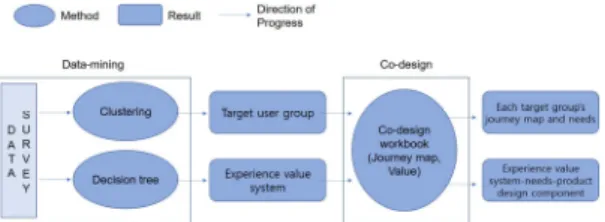
The outline of the data-driven co-design framework is schematically shown in the Fig. 1.

As can be seen in Fig. 1, there are two steps in the framework: data-mining and co-design.

Fig. 1. Schematic view of the data-driven co-design framework

First, before the data-mining step, the user surveys are carried out, and the results are processed as data sets for the data-mining. Two data mining techniques such as a clustering and a decision tree are used. The clustering method is applied to extract target user groups and to identify their critical characteristics [15]. In the decision tree method, users' preferences are drafted based on their experiences. According to Lin et al., the decision tree method can offer critical attributes on users' decision [7]. In addition, the results can be shown in a hierarchical tree structure, and therefore, it is easy to figure out relations among the attributes.

These results from the data mining analysis are confirmed and further analyzed in the next step of co-design process through a participation of actual users. When recruiting the participants, the target user groups from the clustering

analysis can be actively considered. The co-design process is carried out with the developed workbook comprised of journey map and value exploration. Through this process, each target group’s journey map and needs can be obtained. In addition, the analysis can draw a systematization of user needs, ideas, and values.

To demonstrate the applicability of the framework, the case study on a smart heating jacket is conducted.

3. Case Study: Smart Heating jacket 3.1 Data mining step with online survey

3.1.1 Clustering and target user groups First, the online survey of 100 respondents was conducted, and the results became the basis for data mining analysis. The clustering algorithm was used to classify the respondents and group them. Fig. 2 shows the positions of respondents according to two axes. In Fig. 2, the X-axis is the frequency of experiences of cold weather in winter in last two years, and the Y-axis is the frequency of using heat-generating devices such as a hot-pack, a hand warmer, and so on.

As can be seen in Fig. 2, the respondents could

be grouped into 4 groups. The respondents in

the blue group are not sensitive to cold weather

compared to other groups. Those in the red

group are quite sensitive to cold weather but do

not generally carry any devices or additional

accessories that keep them warm. For the green

and black groups, they are very sensitive to cold

wether and accordingly always carry the devices

and accessories to protect them from cold

weather. Therefore, 4 user groups were identified

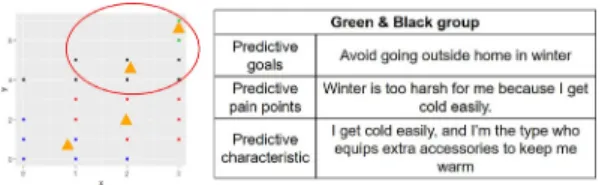
from the clustering analysis. For example, Fig. 3

shows the predicted goals, pain points and

characteristics of the green and black user

groups.

(4)

Fig. 2. Clustering results of the survey respondents

Fig. 3. Predicted features of users of the green and black groups

From the clustering analysis, red, black and green groups were selected for the target user groups of the case study for a smart heating jacket, since those groups' users are very sensitive to cold weather and eager to carry heating devices. Thus, participants who could be categorized into these groups were recruited for the next co-design step.

3.1.2 Decision tree and values

The online survey was composed of the questions on user perception attributes and purchase intention of a smart heating jacket.

Among 12 questions on user perception attributes, there are 4 product feature questions and 8 product experience questions.

The 4 questions on product features were about evaluation on heat parts' numbers and locations, a heating control method, a heating jacket form and a mobile app usage with a heating jacket, respectively. On the other hand, 8 questions on user experiences on a heating jacket were as follows; 'willing to recommend the product to others’, ‘to like the design of the

product’, ‘to manage the product (battery charging and laundry) easily ’, ‘to arouse purchase interest’, ‘to have an attractive design’,

‘to use the product easily', 'to have usefulness', and 'to make me stand out'.

For the decision tree analysis, 12 questions of user perception attributes were used for input independent variables and 1 purchase intention question was used for a dependent variable. Fig.

4 shows the results of the decision tree analysis.

From the results given in Fig. 4, 92 respondents answered that they would recommend the smart heating jacket to others, and 50 out of 92 respondents who like the design of the product would buy it. On the other hand, among remaining 42 respondents, 19 of them would buy the jacket in the case of easiness of product management with battery charging or laundry.

Therefore, it was preliminarily concluded that the ‘willing to recommend the product to others’

had the greatest impact on the users’ decision to buy a smart heating jacket. In addition, the ‘to like the design of the product’ also had a significant influence on the decision making, while the ‘to manage the product (battery charging or laundry) easily' were occasionally prioritized. The overall accuracy of the decision tree analysis was 0.7931, which was sufficiently high, and its results could be used for the user experience analysis.

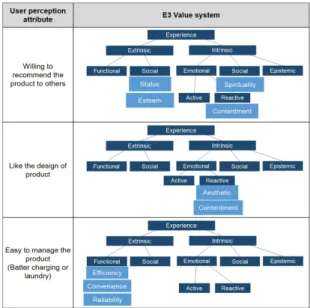
The results from the decision tree analysis were mapped to the user experience values of the E3 - economic, ecological and experience - value framework [13]. Fig. 5 shows the value elements of the experience value for each critical user perception attribute.

As can be seen in Fig. 5, the ‘willing to recommend the product to others’ could be linked with the value elements of ‘status’,

‘esteem’, ‘spirituality’ and ‘contentment’. The 'to

like the design of the product' could be

associated with the emotional value elements

such as 'aesthetic' and 'contentment'. In addition,

(5)

the ‘to manage the product easily’ could be related with the functional value elements. These value elements can be confirmed and further revised through the in-depth interviews in the co-design step.

Fig. 4. Decision tree analysis results from the online survey

Fig. 5. The experience value elements for the critical user perception attributes derived from the decision tree analysis

3.2 Co-design step with in-depth interviews For the co-design process, 8 participants who are categorized into the red and black groups were recruited. Among selected 8 participants, 6

participants were from the red group while 2 participants were from the black group. To facilitate the in-depth interviews , the customized workbook was developed and its sample snapshot photo is given in Fig. 6.

Fig. 6. Snapshot photo of the workbook for the co-design process

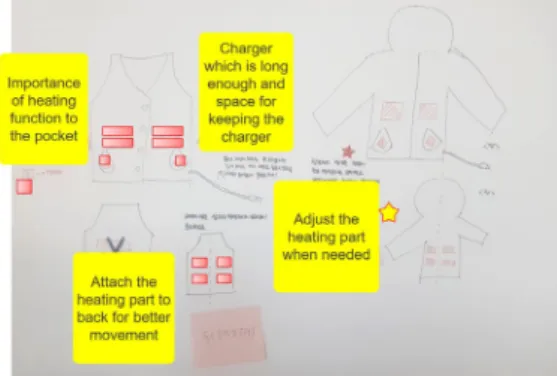
The workbook is comprised of 4 parts. The first part is to generate journey maps when the participants using an ordinary winter jacket. In this journey map, several related activities are identified, and they are graphically listed in order. In the second part, the participants are asked to create new journey maps by imagining possible activities when using the smart heating jacket. In the third part, possible user needs for the smart heating jacket are explored and grouped based on the previous activities, and pain points of the activity nodes are also rated. Then, in the fourth part, new ideas for the smart heating jacket are generated by the participants.

In the case study, each participant conducted the co-design process under the guidance of the researchers and it took about 90 minutes for one participant to finish the process. The sample results of the co-design process are given in Fig. 7 and Fig. 8.

Fig. 7. The sample individual journey map with the needs on

usage of the smart heating jacket in the second

and third parts of the co-design process

(6)

Fig. 8. The sample idea sketches for the smart heating jacket in the fourth part of the co-design process

In Fig. 7, the journey map on usage of the smart heating jacket which was created by one participant is given. In the journey map, the pain points and users’ needs were mapped at each activity node. The journey map for an ordinary winter jacket was created first, and the new usage scenario of the smart heating jacket was conceived by modifying the activities and adding new possible activities.

After making two journey maps, the participants generated possible solutions ideas by considering the needs. Fig. 8 shows the sample idea sketches for the smart heating jacket, and several new functions and features are created and added.

Furthermore, the post interviews were carried out to understand how they considered the 3 user perception attributes which were identified from the decision tree analysis.

3.3 Results and findings

After finishing the co-design process, the results were analyzed to formulate the representative journey map and needs for each target user group. The targe user group 1 represents people who feel uncomfortable or even bothered to carry additional heating products although they feel cold. The group 2 represents people who prepare heating products well to protect them from cold weather. It was

modeled that people in the group 1 want an convenient manipulation of heating control system of the smart heating jacket without bothering them. Those in the group 2 want a proper location and enough number of heating elements of the jacket to perfectly protect them from cold weather.

Fig. 9 shows the journey maps for the targer user groups 1 and 2, respectively. The journey maps, given in Fig. 9, included the activities in a sequential order, and the numbers given at each activity node represented the importance levels before, during and after using the smart heating jacket.

Fig. 9. The representative journey maps for the target user groups 1 and 2 with activities and importance levels

From the journey maps in Fig. 9, users in the group 1 considered the activities of 'to wear the jacket' and 'to laundry the jacket without breaking it' more importantly. Meanwhile, users in the group 2 weighed more importance on the activities of 'to purchase right heating jacket' and 'to laundry the heating jacket'.

Fig. 10 shows the needs that were explored by the participants. The needs were categorized into 7 classes such as 'experience of cold weather', 'problems of ordinary winter heating equipment', 'control of excessive warmth', 'price', 'safety', 'convenience' and 'quality of the smart heating jacket'.

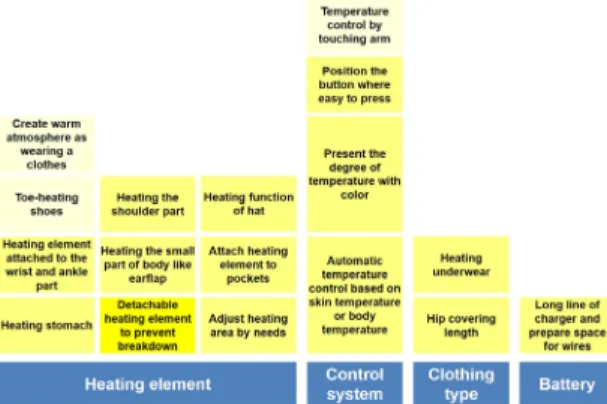
In the meantime, Fig. 11 shows the generated

solution ideas for the smart heating jacket, and

they were also categorized into 4 functional

(7)

elements such as 'heating element', 'control system', 'clothing type', and 'battery'.

Fig. 10. The collected needs and their categorization

Fig. 11. The generated solution ideas for the smart heating jacket

The drafted value elements that are given in Fig. 5 was updated through additional interviews and further analysis. The final value elements for the smart heating jacket is given in Fig. 12. As can be seen in Fig. 12, the value elements under the experience functional class are dominant ones to be considered in the early design of the smart heating jacket. At the same time, the experience reactive emotional and the economic cost reduction elements should also be considered.

Fig. 12. The final value elements for the smart heating jacket that are derived from the data-driven co-design framework

Conclusively, the attribute of ‘willing to recommend the product to others’ was significantly affected by the excellence of heating function, low cost, convenience of interface and managing, and aesthetics of the jacket. The ‘to like the design of product’ was influenced by the appearance, clothing type, and convenience of interface. Lastly, the ‘to manage the product (battery charging or laundry) easily’

was associated with the efficiency, convenience, and reliability of the jacket. This conclusion has been confirmed by the retrospective interviews of the participants.

4. Conclusion

In this paper, the data-driven co-design framework for a new product development was proposed, and the case study on the smart heating jacket was conducted to show its applicability to a new product development. The proposed design framework is composed of two main steps - data mining analysis and co-design process. In the data mining analysis, the clustering and decision tree methods were utilized to identify the targe user groups and to draft the values associated with the needs and preferences of users from the survey.

In the co-design process, the possible users

representing the target groups were recruited,

and they participated in the in-depth interviews

using the customized workbook. The participants

(8)

generated the journey maps for a new product by considering usage of a similar existing product.

In the journey maps, the detailed user needs, pain points and importance levels could be described. Then, the possible solution ideas were generated. Meanwhile, the critical values could be determined after analyzing the results from the participants with the post-interviews.

In the case study, the smart heating jacket was considered. The case study was carried out by 8 participants, and the journey maps, needs, and solution ideas were collected. After the analysis, the target user groups for the smart heating jacket were identified, and their representative journey maps were extracted. The categorized needs were obtained, and the associate solution ideas were also generated and classified. Finally, the critical value elements were defined based on the E3 value framework for the actual development of the new smart heating jacket, and these resutls were confirmed by the participants via the retrospective interviews.

Thus, the proposed design framework could be validated.

In conclusion, the proposed data-driven co-design framework can be applied to a new product development process systematically and effectively with the combined strategy of data-based approach and human-centered design philosophy.

REFERENCES

[1] N. Cross. (1972). In the Preface to Design Participation. Proceedings of the design research society’s conference

[2] S. Bodker. (1996). Creating conditions for participation:

Conflicts and resources in systems development.

Human–computer interaction, 11(3), 215-236.

DOI: 10.1207/s15327051hci1103_2

[3] E. B. N. Sanders & P. J. Stappers. (2008). Co-creation and the new landscapes of design. Co-design, 4(1), 5-18.

DOI: 10.1080/15710880701875068

[4] E. B. N. Sanders & B. Westerlund. (2011).

Experiencing, exploring and experimenting in and with co-design spaces. Nordes, (4) .

[5] J. R. Jiao, Y. Zhang & M. Helander. (2006). A Kansei mining system for affective design. Expert Systems with Applications, 30(4), 658-673.

DOI: 10.1016/j.eswa.2005.07.020

[6] J. J. McGinn & N. Kotamraju. (2008, April).

Data-driven persona development. In Proceedings of the SIGCHI Conference on Human Factors in Computing Systems.

[7] K. Y. Lin, C. F. Chien, & R. Kerh. (2016). UNISON framework of data-driven innovation for extracting user experience of product design of wearable devices. Computers & Industrial Engineering, 99, 487-502.

DOI: 10.1016/j.cie.2016.05.023

[8] I. Li, A. K. Dey & J. Forlizzi. (2011, September).

Understanding my data, myself: supporting self-reflection with ubicomp technologies. In Proceedings of the 13th international conference on Ubiquitous computing

[9] Q. Han, S. Liang & H. Zhang. (2015). Mobile cloud sensing, big data, and 5G networks make an intelligent and smart world. IEEE Network, 29(2), 40-45.

DOI: 10.1109/MNET.2015.7064901

[10] G. hetty, M. White & F. Akther. (2015). Smart phone based data mining for human activity recognition.

Procedia Computer Science, 46, 1181-1187 DOI: 10.1016/j.procs.2015.01.031

[11] H. J. Lee & H. S. Oh. (2015). A Study on Wearable Device Products -Focused on the Smart Watch and Smart Band. A Treatise on The Plastic Media, 18(2), 239-244.

[12] D. Yoo, A. Huldtgren, J. P. Woelfer, D. G. Hendry & B.

Friedman. (2013, April). A value sensitive action-reflection model: evolving a co-design space with stakeholder and designer prompts. In Proceedings of the SIGCHI conference on human factors in computing systems

[13] C. K. Cho, Y. S. Kim & W. J. Lee. (2010, October).

Economical, ecological and experience values for product-service systems. In Proc. Design & Emotion Conference.

[14] S. D. Reay, G. Collier, R. Douglas, N. Hayes, I.

Nakarada-Kordic, A. Nair & J. Kennedy-Good. (2017).

Prototyping collaborative relationships between design and healthcare experts: mapping the patient journey. Design for Health, 1(1), 65-79.

DOI: 10.1080/24735132.2017.1294845

[15] B. Agard & A. Kusiak*. (2004). Data-mining-based methodology for the design of product families.

International Journal of Production Research, 42(15), 2955-2969.

DOI: 10.1080/00207540410001691929

(9)

임 수 연(Sooyeon Leem) [정회원]

․ 2014년 8월 : 성균관대학교 기계공학 부 (공학사)

․ 2016년 8월 : 성균관대학교 예술학협 동과정 (예술학석사)

․ 2016년 9월 ~ 현재 : 성균관대학교 예술학협동과정 (박사과정중)

․ 관심분야 : 인간중심디자인, 공동디자 인

․ E-Mail : [email protected]

이 상 원(Sang Won Lee) [정회원]

․ 1995년 2월 : 서울대학교 기계설계학 과(공학사)

․ 1997년 2월 : 서울대학교 기계설계학 과(공학석사)

․ 2004년 8월 : (미) Univ. of

Michigan, Mechanical

Engineering (공학박사)

․ 2006년 3월 ~ 현재 : 성균관대학교 기계공학부 교수

․ 관심분야 : 융합디자인교육, 인간중심디자인, 데이터기반디 자인

․ E-Mail : [email protected]

수치

Fig.  1.  Schematic  view  of  the  data-driven  co-design  framework
Fig.  3.  Predicted  features  of  users  of  the  green  and  black  groups
Fig.  6.  Snapshot  photo  of  the  workbook  for  the  co-design  process
Fig. 8. The sample idea sketches for the smart heating  jacket  in  the  fourth  part  of  the  co-design  process
+2

참조

관련 문서

한편 이 연구의 궁극적인 목적인 서비스 가격의 적절성을 평가하기 위해 질병 의 중증도를 통제한 상태에서 소득수준에 따른 외래이용을 분석하기 위하여

Five days later, on 15 January 1975, the Portuguese government signed an agreement with the MPLA, FNLA and UNITA providing for Angola to receive its independence on 11

Usefulness of co-treatment with immunomodulators in patients with inflammatory bowel disease treated with scheduled infliximab maintenance therapy.. Oussalah A, Chevaux JB, Fay

Inclusion and Inclusiveness: Shared Vision of Youth for Local, National, and Global Village Inclusion at large stands for embracing populations with disabilities and

각 브랜드의 강점과 약점이 서로 상충되는 경우, 각 브랜드에 있어서 어떤 속 성의 약점을 다른 속성의 강점에 의해 보완하여 전반적인 평가를 내리는 것.

It is impossible to change the voltage across a capacitor by a finite amount in zero time, for this requires an infinite current through the capacitor.. (A capacitor resists

The index is calculated with the latest 5-year auction data of 400 selected Classic, Modern, and Contemporary Chinese painting artists from major auction houses..

The key issue is whether HTS can be defined as the 6th generation of violent extremism. That is, whether it will first safely settle as a locally embedded group